



Perovskite Photovoltaics Market Trends, Companies, Contract Wins / Project Pipeline, Installed Capacity, Power Generation, Government Investment, Technology Adoption, Competitive Positioning, and Growth Forecast
Perovskite Photovoltaics Market (By Product Type: Rigid Perovskite Solar Cells, Flexible Perovskite Solar Cells, Semi-transparent Perovskite Solar Cells; By Device Architecture: Planar Structure Mesoporous Structure Tandem Structure By Fabrication Technique: Solution Processing, Vapor Deposition, Inkjet Printing, Roll-to-Roll Printing; By Material Composition: Lead-based Perovskites, Lead-free Perovskites; By Application: Utility-scale Solar Power, Building Integrated Photovoltaics, Consumer Electronics, Automotive, Aerospace & Defense, Indoor Energy Harvesting; By End User: Energy and Utilities, Residential, Commercial, Industrial, Consumer Electronics Manufacturers, Automotive Manufacturers, Government and Research Institutions; By Distribution Channel: Direct Sales, EPC Contractors, Distributors and Wholesalers, Online Sales) - Global Industry Analysis, Size, Trends, Leading Companies, Regional Outlook, and Forecast 2026 to 2035
Source: https://www.precedenceresearch.com/perovskite-photovoltaics-market
 Get a Sample
 Table Of Content


Perovskite Photovoltaics Market Size and Forecast 2026 to 2035
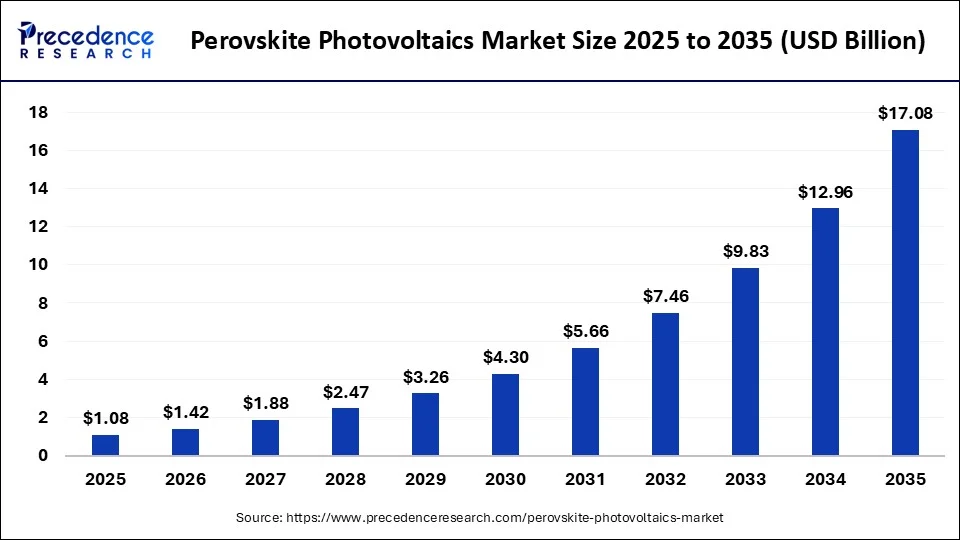
The global perovskite photovoltaics market size accounted for USD 1.08 billion in 2025 and is predicted to increase from USD 1.42 billion in 2026 to approximately USD 17.08 billion by 2035, expanding at a CAGR of 31.80% from 2026 to 2035. The market is driven by the technology's capability to be utilized in silicon-perovskite tandem configurations to bypass the physical efficiency restrictions of traditional solar cells.
Key Takeaways
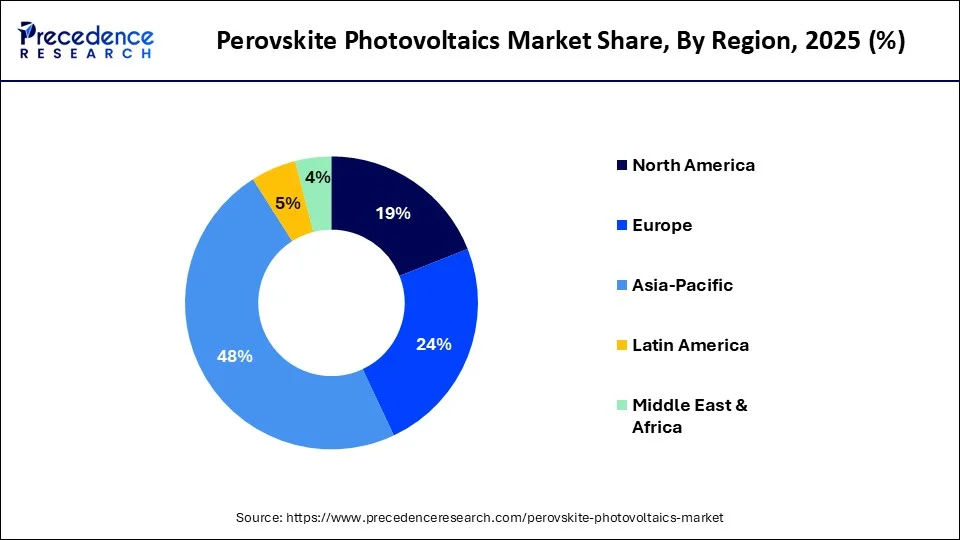
- Asia-Pacific dominated the perovskite photovoltaics market with a share of 48% in 2025 and is expected to grow at the fastest CAGR of 35.1% in the coming years.
- North America held a 19% share of the market in 2025 and is expected to grow at a significant CAGR of 30.4% during the projection period.
- By product type, the rigid perovskite solar cells segment held a dominant position in the market with a 54% share in 2025.
- By product type, the flexible perovskite solar cells segment held a 28% share of the market in 2025 and is expected to grow at the fastest CAGR of 36.7% during the projection period.
- By fabrication technique, the solution processing segment held a dominant position in the market with a 48% share in 2025.
- By fabrication technique, the roll-to-roll printing segment held an 18% share of the market in 2025 and is expected to grow at the fastest CAGR of 38.5% during the projection period.
- By material composition, the lead-based perovskites segment dominated the perovskite photovoltaics market with an 82% share in 2025.
- By material composition, the lead-free perovskites segment held an 18% share of the market in 2025 and is expected to grow at the fastest CAGR of 39.8% during the projection period.
- By application, the utility-scale solar power segment led the market with a 29% share in 2025.
- By application, the consumer electronics segment held a 16% share of the market in 2025 and is expected to grow at the fastest CAGR of 38.6% during the projection period.
- By end user, the energy and utilities segment held the largest market share of 37% in 2025.
- By end user, the consumer electronics manufacturers segment held a 10% share of the market in 2025 and is expected to grow at the fastest CAGR of 39.2% during the projection period.
Market Overview
Perovskite photovoltaics is the industry sector that focuses on the development, manufacturing, and commercialization of next-generation solar cells that use "perovskite" crystal structures as their active, light-harvesting layer. It represents the shift toward highly efficient, flexible, and lower-cost solar energy options compared to traditional silicon. Perovskites can be made semi-transparent and flexible, enabling them to be integrated into curved surfaces, portable electronics, and building facades. The market is mainly driven by the material's extraordinary power conversion efficiency, lower manufacturing costs, and unparalleled design flexibility.
Perovskite Photovoltaics Market Trends
- The most significant commercial shift is the pairing of perovskite with conventional crystalline silicon. Perovskite-silicon tandem cells overcome the Shockley-Queisser limit, achieving record-breaking efficiencies that significantly drive power output for utility-scale farms.
- Innovations in low-temperature, solution-based manufacturing, like roll-to-roll and sheet-to-sheet printing, are radically lowering production costs. Firms are scaling up pilot lines to produce commercial-grade and large-area perovskite modules.
- Beyond rigid solar farms, lightweight and transparent perovskite modules are revolutionizing building-integrated photovoltaics and mobile electronics. Moreover, they are increasingly incorporated into curved building facades, windows, and even vehicle roofs.
Market Report Coverage and Key Metrics
| Report Coverage | Details |
| Market Size in 2025 | USD 1.08 Billion |
| Market Size in 2026 | USD 1.42 Billion |
| Market Size by 2035 | USD 17.08 Billion |
| Market Growth Rate from 2026 to 2035 | CAGR of 31.80% |
| Dominating Region | Asia Paicfic |
| Fastest Growing Region | North America |
| Base Year | 2025 |
| Forecast Period | 2026 to 2035 |
| Segments Covered | Product Type, Device Architecture, Fabrication Technique, Material Composition, Application, End User, Distribution Channel, and Region |
| Regions Covered | North America, Europe, Asia-Pacific, Latin America, and Middle East & Africa |
Market Dynamics
Drivers
Global Demand for Solar Technologies
Global demand for solar technologies drives the market because perovskites provide an economic and scalable way to boost solar efficiency. As the world rapidly transitions to clean energy, perovskites meet the massive need for cheaper, higher-performing, and more versatile solar solutions. Perovskites are produced using low-temperature, solution-based roll-to-roll processes rather than the high-energy processes required for traditional silicon. This drastically decreases the capital required to manufacture panels.
Restraint
Material Toxicity & Regulations
Material toxicity is a primary restraint in the perovskite photovoltaics market as the highest-performing solar cells depend heavily on water-soluble lead. This raises severe environmental, health, and regulatory concerns, creating significant barriers to mass adoption, commercial scale-up, and even regulatory compliance.
Opportunity
IoT and Portable Electronics
Internet of Things (IoT) and portable electronics represent a massive opportunity for the market because they provide a reliable, sustainable alternative to disposable batteries. Unlike rigid, traditional silicon panels, perovskites can be programmed to harvest artificial indoor light with high efficiency. Perovskite materials feature tunable band gaps that can be specifically adjusted to absorb the wavelength spectra of artificial indoor lighting, like LEDs and fluorescent lamps. This enables them to generate sufficient power even in dim office or home environments.
Segmental Analysis
Product Type Insights
Why Did the Rigid Perovskite Solar Cells Segment Lead the Perovskite Photovoltaics Market?
The rigid perovskite solar cells segment led the market with a 54% share in 2025, driven by commercial pilot production expansion, strong compatibility with existing module manufacturing, and higher durability, which supports early deployments. Rigid perovskites are the main choice for pairing with traditional crystalline silicon layers to create perovskite-silicon tandem cells. This breakthrough combination, then, pushes energy conversion efficiency, which existing silicon-only panels struggle to achieve.
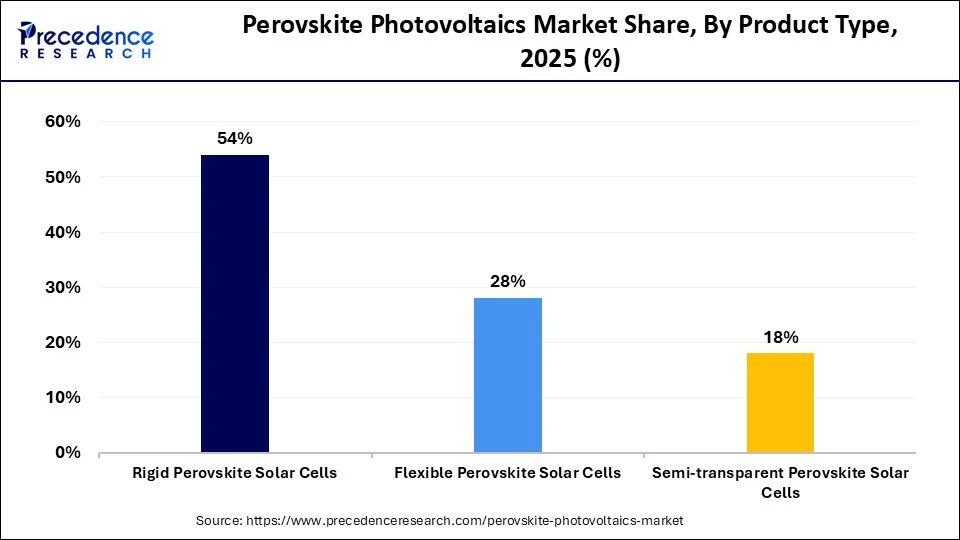
The flexible perovskite solar cells segment held a 28% share of the market in 2025 and is expected to grow at the fastest CAGR of 36.7% during the projection period. This is mainly due to the growing wearable and portable electronics industry, and roll-to-roll manufacturing lowers production costs. Flexible cells can conform to curved surfaces and irregular geometries. This enables them to be deployed in building-integrated photovoltaics (BIPV), wearable electronics, and transportation, like electric vehicles and drones. Because they are thin and lightweight, f-PSCs deliver a significantly higher power-to-weight ratio as compared to conventional glass-based solar modules, making them highly desirable for aerospace and portable power needs.
The semi-transparent perovskite solar cells segment held an 18% share of the market in 2025 and is expected to grow at a CAGR of 33.8% during the projection period. This is due to the increasing demand for BIPV applications and smart buildings that accept energy-generating windows. Semi-transparent cells can be seamlessly integrated into office windows, skylights, and glass facades without blocking natural light. This enables skyscrapers and modern structures to generate renewable energy on-site without any sacrificing architectural aesthetics or interior illumination.
Fabrication Technique Insights
How the Solution Processing Segment Dominated the Perovskite Photovoltaics Market?
The solution processing segment dominated the market with a 48% share in 2025, driven by low-cost processing that supports mass production and high throughput, attracting manufacturers. Solution-processed cells can be produced at near-room or low temperatures. This low-temperature processing demands a fraction of the energy that standard silicon manufacturing consumes, providing a dramatically faster energy payback period.
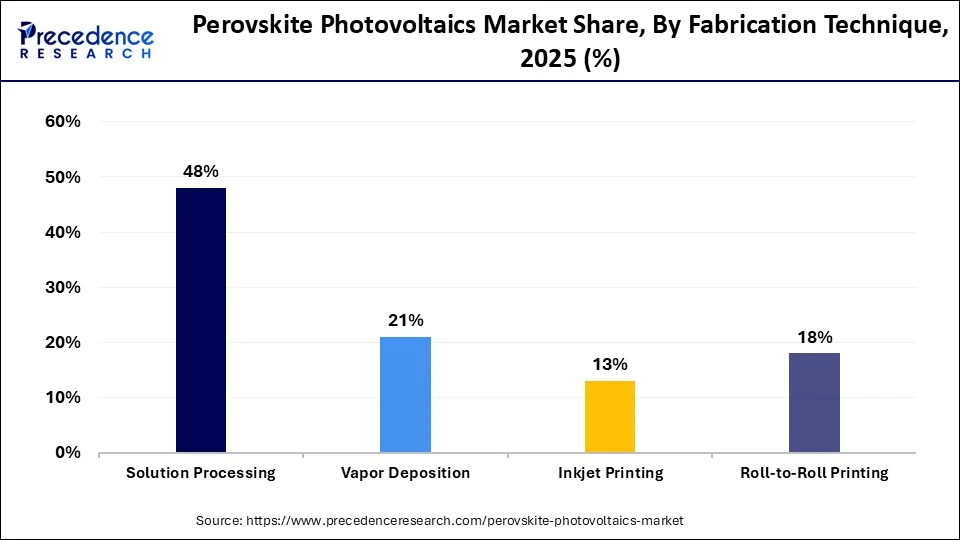
The roll-to-roll printing segment held an 18% share of the market in 2025 and is expected to grow at the fastest CAGR of 38.5% during the projection period. This is mainly due to continuous manufacturing reducing production costs and flexible module demand expanding rapidly. Perovskite materials can now be formulated into functional inks, making them perfectly suited for continuous liquid-to-solid deposition techniques such as slot-die coating and gravure printing. This processing supports the creation of flexible and semi-transparent solar cells. This makes the technology ideal for custom and unconventional integration, like portable electronics, vehicle-integrated photovoltaics (BIPV), and even smart windows.
The vapor deposition segment held a 21% share of the market in 2025 and is expected to grow at a CAGR of 29.1% during the projection period. This is due to uniform thin films and high precision. Vapor techniques yield highly uniform films with significantly fewer defects than solution methods, resulting in higher and more stable power conversion efficiencies.
Material Composition Insights
Which Material Composition Segment Led the Perovskite Photovoltaics Market?
The lead-based perovskites segment held a dominant position in the market with an 82% share in 2025, driven by superior efficiency. This maintains market leadership, and a mature research ecosystem accelerates innovation. Lead-based perovskites possess ideal band gaps and long charge-carrier diffusion lengths, alongside high optical absorption coefficients. This allows them to absorb sunlight across a wider spectrum compared to traditional silicon.
Perovskite Photovoltaics Market Share, By Material Composition, 2025-2035 (%)
| Material Composition | 2025 | CAGR (%) |
| Lead-based Perovskites | 82.00% (Dominating) | 29.6% |
| Lead-free Perovskites | 18.00% | 39.8% |
The lead-free perovskites segment held an 18% share of the market in 2025 and is expected to grow at the fastest CAGR of 39.8% during the projection period. This is mainly due to environmental regulations and toxicity concerns, as well as performance improvements. Governments and regulatory bodies globally are increasingly strict about the use of heavy metals in consumer electronics and large-scale manufacturing. Lead-free formulations reduce the long-term health hazards linked with panel manufacturing, disposal, and recycling, and also pave the way for truly sustainable, "cradle-to-grave" circular economy models for solar energy.
Application Insights
Why Did the Utility-scale Solar Power Segment Lead the Perovskite Photovoltaics Market?
The utility-scale solar power segment held the largest market share of 29% in 2025, driven by high-efficiency modules, energy transition policies, and large investments. Utility-scale developers are primed to now implement these new cells as perovskites can be easily integrated onto existing silicon production lines, creating tandem cells that tap into a wider spectrum of sunlight than either material could achieve alone.
Perovskite Photovoltaics Market Share, By Application, 2025-2035 (%)
| Application | 2025 | CAGR (%) |
| Utility-scale Solar Power | 29.00% | 31.5% |
| Building Integrated Photovoltaics (BIPV) | 21.00% | 34.8% |
| Consumer Electronics | 16.00% | 38.6% |
| Automotive | 12.00% | 33.7% |
| Aerospace & Defense | 8.00% | 32.4% |
| Indoor Energy Harvesting | 14.00% | 37.5% |
The consumer electronics segment held a 16% share of the market in 2025 and is expected to grow at the fastest CAGR of 38.6% during the projection period. This is mainly due to low-light performance that suits portable electronics, device miniaturization, and wearable technology. Perovskites can be tuned to absorb artificial light, making them ideal for powering indoor IoT devices and sensors. Moreover, solution-processed perovskites can be printed or sprayed directly onto device components, making them more cost-effective to produce at scale for consumer goods.
The building integrated photovoltaics (BIPV) segment held a 21% share of the market in 2025 and is expected to grow at a CAGR of 34.8% during the projection period. This is because perovskite materials can be customized for flexibility, semi-transparency, and light weight. These properties enable them to seamlessly replace conventional building materials such as glass windows and facades, allowing architects to integrate power generation directly into building envelopes, without disrupting the intended aesthetic.
End User Insights
How the Energy and Utilities Segment Dominated the Perovskite Photovoltaics Market?
The energy and utilities segment contributed the biggest market share of 37% in 2025, driven by renewable capacity additions and utilities investing in high-efficiency technologies. Utilities are aimed at maximizing power generation. Pairing perovskites with traditional silicon creates tandem cells that push efficiencies beyond the theoretical limits of standard silicon cells alone.
Perovskite Photovoltaics Market Share, By End User, 2025-2035 (%)
| End User | 2025 | CAGR (%) |
| Energy & Utilities | 37.00% |
31.2% |
| Residential | 15.00% | 32.7% |
| Commercial | 18.00% | 33.4% |
| Industrial | 11.00% | 31.8% |
| Consumer Electronics Manufacturers | 10.00% | 39.2% |
| Automotive Manufacturers | 5.00% | 36.1% |
| Government & Research Institutions | 4.00% | 28.9% |
The consumer electronics manufacturers segment held a 10% share of the market in 2025 and is expected to grow at the fastest CAGR of 39.2% during the projection period. This is mainly due to portable electronics integrating advanced photovoltaics, and wearable devices require lightweight energy sources. Perovskites can now efficiently convert ambient and artificial indoor light into electrical energy. This ability is greatly valuable for self-powered consumer goods and industrial sensors, eliminating the demand for frequent battery replacements.
The commercial segment held an 18% share of the market in 2025 and is expected to grow at a CAGR of 33.4% during the projection period. This is due to the technology's lightweight, flexible, and semi-transparent properties. These features enable seamless integration into building facades and windows (BIPV), thus, combined with a strong return on investment (ROI) driven by corporate net-zero mandates and also aggressive government sustainability incentives.
Market Regional Analysis: North America, Europe, Asia-Pacific
Asia Pacific Perovskite Photovoltaics Market Size and Growth 2026 to 2035
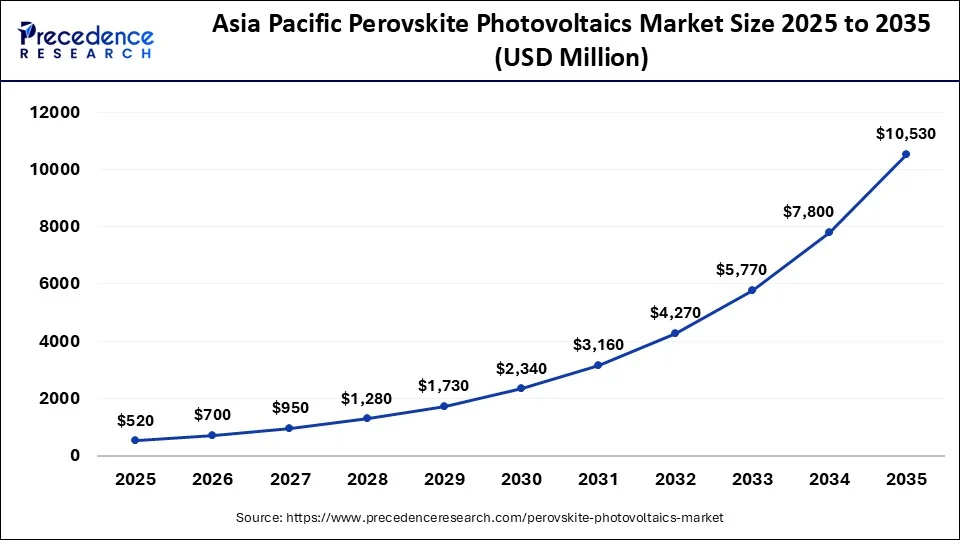
The Asia Pacific perovskite photovoltaics market size was evaluated at USD 520 million in 2025 and is projected to reach around USD 10,530 million by 2035, growing at a CAGR of 35.10% from 2026 to 2035.
How Asia-Pacific Dominated the Perovskite Photovoltaics Market?
Asia-Pacific held a major market share of 48% in 2025 and is expected to grow at the fastest CAGR of 35.1% in the coming years. This is due to the strong manufacturing ecosystem that supports commercialization, and government clean-energy programs accelerate capacity expansion. The region benefits from highly integrated supply chains, from precursor chemical synthesis to advanced deposition equipment, enabling ultra-low manufacturing costs.
China Market Analysis
China's market is driven by aggressive state policies under its 14th Five-Year Plan, a highly integrated supply chain that slashes manufacturing expenses, and world-leading research achieving solar cell efficiency.
Europe: The Second-Largest Market
Europe held the second-largest market share of 24% in 2025 and is expected to grow at a notable CAGR of 31.2% during the projection period, driven mainly by advanced photovoltaic research, which drives innovation; strong BIPV demand supports growth, and strict decarbonization policies encourage deployment. Europe is pioneering perovskite-on-silicon tandem solar cells, which drive standard cell efficiency past traditional physical limits. Research is heavily backed by the EU's CORDIS framework programs, accelerating commercial viability.
UK Market Analysis
The UK market is driven by government net-zero targets, pioneering R&D, and the growth of tandem solar technology. Sustained academic and even industrial funding from the UK government and European bodies continues to fund pilot deployment, manufacturing scaling, and structural stability studies.
How is the Significant Rise of North America in the Perovskite Photovoltaics Market?
North America held a 19% share of the market in 2025 and is expected to grow at a significant CAGR of 30.4% during the projection period, driven by increasing public funding for the commercialization of perovskite photovoltaics. Government organizations launch initiatives to support domestic manufacturing, strengthening supply chains and reducing reliance on imports. The increasing utility investments in the region support technology adoption.
U.S. Market Analysis
The U.S. market is mainly driven by surging electricity demand, rapid data center expansion, and strong government pushes for clean energy. The U.S. utility sector is heavily investing in perovskite-silicon tandem solar cells, as they improve overall power density and even significantly lower the levelized cost of electricity.
What Drives the Perovskite Photovoltaics Market in Latin America?
Latin America held a 5% share of the market in 2025 and is expected to grow at a lucrative CAGR of 29.8% during the projection period, driven by solar resource availability, renewable energy targets, and emerging markets. Regional governments are heavily focused on diversifying energy sources and decreasing reliance on fossil fuels. Supportive policies like feed-in tariffs and tax rebates are accelerating the transition.
Brazil Market Analysis
Brazil's growing prominence in the market is driven by strong institutional support and a push to lower manufacturing costs using scalable and print-based fabrication. Brazil has vast renewable energy goals and a rapidly expanding solar sector. Targeted local investments in R&D are assisting in adapting perovskite technology to regional climates, accelerating the shift toward sustainable energy.
Will the Middle East and Africa Grow in the Perovskite Photovoltaics Market?
The Middle East and Africa held a 4% share of the market in 2025 and are expected to grow at a notable CAGR of 30.6% during the projection period, driven by large-scale solar projects, high solar irradiance, and government diversification strategies. The high temperatures and even intense sunlight in the MEA region create ideal conditions to test and deploy high-efficiency tandem perovskite-silicon cells, which excel in high-heat environments compared to traditional silicon.
Saudi Arabia Market Analysis
Saudi Arabia's market is mainly driven by the nation's massive shift to renewable energy under Vision 2030, high institutional funding for hot-climate solar efficiency, and even cost-effective, scalable manufacturing. These factors aim to diversify the economy away from fossil fuels.
Market Competitive Landscape: Leading Companies and Strategies
The perovskite photovoltaics market is highly competitive, with established solar manufacturers, research institutions, startups, and material suppliers accelerating commercialization. Leading companies are focusing on enhancing power conversion efficiency, long-term stability, scalable manufacturing, and tandem solar cell integration with silicon technologies. Strategic collaborations, pilot production facilities, licensing agreements, and government-funded research initiatives are driving innovation and market expansion.
Intellectual property development, along with investments in advanced deposition techniques, provides competitive advantages. Firms are also emphasizing cost-effective production, durability, and sustainability to address commercialization challenges. As commercialization progresses, competition is anticipated to intensify through technological advancements, strategic partnerships, and even global manufacturing scale-up.
Perovskite Photovoltaics Market Companies
- Oxford PV
- Saule Technologies
- Microquanta Semiconductor
- Perovskia Solar AG
- Swift Solar
- P3C Technology and Solutions Pvt. Ltd.
- GCL Holdings Co. Ltd.
- Trina Solar
- Hanwha Solutions Corp.
- Tandem PV
Recent Developments Perovskite Photovoltaics Market (2025-2026)
- In June 2026, Oxford PV reported a 25.6% efficiency for a perovskite-silicon tandem module utilizing Fraunhofer ISE's Matrix Shingle architecture, marking the first successful integration of both technologies. The shingled, busbar-free design reduces resistive and shading losses while improving energy yield, durability, and module-level performance.(Source: https://www.pv-magazine.com)
- In January 2025, EneCoat Technologies, a Kyoto University PV technology spinoff, declared it achieved a power conversion efficiency of 30.4% in a four-terminal perovskite-silicon tandem solar cell developed in collaboration with Toyota Motor Corporation.(Source: https://www.pv-magazine.com)
Segments Covered in the Report
By Product Type
- Rigid Perovskite Solar Cells
- Glass-based
- Silicon Tandem Modules
- Flexible Perovskite Solar Cells
- Plastic Substrate
- Metal Foil Substrate
- Semi-transparent Perovskite Solar Cells
- Architectural Glass
- Greenhouse Panels
By Device Architecture
- Planar Structure
- n-i-p
- p-i-n
- Mesoporous Structure
- Tandem Structure
- Perovskite-Silicon
- Perovskite-CIGS
- Perovskite-Perovskite
By Fabrication Technique
- Solution Processing
- Spin Coating
- Slot-Die Coating
- Blade Coating
- Vapor Deposition
- Inkjet Printing
- Roll-to-Roll Printing
By Material Composition
- Lead-based Perovskites
- Hybrid Organic-Inorganic
- All-Inorganic
- Lead-free Perovskites
- Tin-based
- Germanium-based
- Bismuth-based
By Application
- Utility-scale Solar Power
- Building Integrated Photovoltaics (BIPV)
- Facades
- Roofing
- Windows
- Consumer Electronics
- Wearables
- Portable Chargers
- IoT Devices
- Automotive
- Aerospace & Defense
- Indoor Energy Harvesting
By End User
- Energy and Utilities
- Residential
- Commercial
- Industrial
- Consumer Electronics Manufacturers
- Automotive Manufacturers
- Government and Research Institutions
By Distribution Channel
- Direct Sales
- EPC Contractors
- Distributors and Wholesalers
- Online Sales
By Region
- North America
- Latin America
- Europe
- Asia-pacific
- Middle and East Africa
For inquiries regarding discounts, bulk purchases, or customization requests, please contact us at sales@precedenceresearch.com
Frequently Asked Questions





Ask For Sample
No cookie-cutter, only authentic analysis – take the 1st step to become a Precedence Research client
 Get a Sample




 sales@precedenceresearch.com
 Schedule a Meeting
