



Trade Surveillance Systems Market Revenue to Attain USD 16.60 Bn by 2035
Published: 11 May 2026
Author: Precedence Research



Trade Surveillance Systems Market Revenue and Trends 2026 to 2035
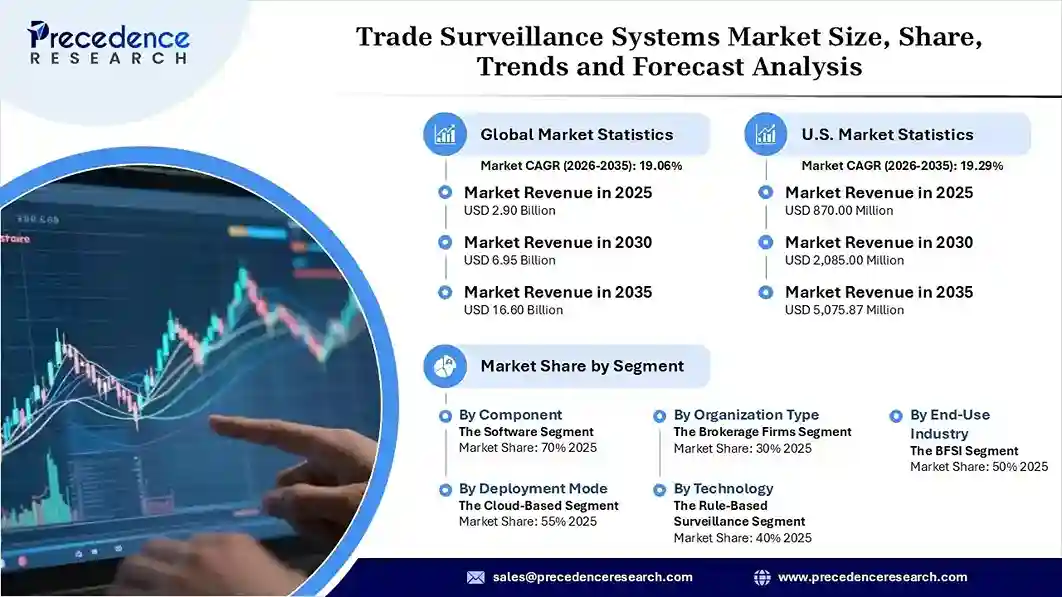
The global trade surveillance systems market revenue was valued at USD 2.90 billion in 2025 and is expected to attain around USD 16.60 billion by 2035, growing at a CAGR of 19.06% during forecast period. The market is driven by growing regulatory demands in international financial markets, rising complexity of electronic trading algorithms, and an increasing number of cases of insider trading and spoofing.
Market Overview
The trade surveillance systems market comprises software tools utilized by financial institutions, exchanges, and regulatory agencies to oversee trading activity and identify any market abuse practices. This market includes real-time systems capable of detecting suspicious orders and trades, post-trade surveillance systems to watch out for any insider trading, market manipulation, spoofing, and layering.
This market also includes algorithmic trading surveillance focused on the detection of market manipulation hidden in algorithmic trading strategies. Communication surveillance links trade activity with electronic messages and case management solutions, document investigations. These trade surveillance solutions have been adopted by banks, broker-dealers, hedge funds, proprietary trading companies, asset management organizations, and stock exchanges.
Major Trends Influencing the Market
AI-Powered Alert Reduction and True Positives Identification
The market is benefitting from the AI-based platforms in place of traditional rule-based engines, which produce thousands of false alerts on a daily basis, forcing compliance teams to manually analyze alerts. The AI-based platforms provide a natural language explanation for each alert. This enables analysts to instantly understand what caused a specific trade or communication to be flagged without having to spend time figuring out the pattern. In 2025, Behavox announced 30% year-over-year growth in annual recurring revenue due to the introduction of a new GPU for its quantum platform. It helped to reduce alert volumes by more than 60 percent, while delivering more than a fourfold increase in true positive detection in 15 languages.
Integration of Trade and Communications Surveillance Systems
Trade surveillance software vendors are increasingly integrating their systems with communication surveillance systems, enabling businesses to connect any suspicious trade activity with associated calls, emails, and messaging. By doing so, businesses can collect the “smoking gun” that allows for better reporting to regulators based on the detected trade behavior patterns and intentions. In 2025, NICE Actimize introduced the new generation of the X-Sight ActOne platform equipped with Agentic AI. This platform combines all fraud and financial crime prevention systems into one platform.
Government Initiatives to Enhance Financial Regulations
Governments across the world have been taking several steps towards updating their trade surveillance systems and closing up regulatory loopholes due to the increase in algorithmic trading, alternative trading systems, and risks associated with off-channel communications. Various governments have set stringent compliance norms on the trading algorithms that set order parameters and are tested under stringent pre-trade control regulations. In 2025, the U.S Commodity Futures Trading Commission said that it would improve its ability to monitor markets and detect fraud by adopting NASDAQ’s leading portfolio of surveillance technology products.
The Rise of Smart Surveillance: Big Money, Patents, and Data Overload
- In 2024-2026, large multinational banks across the globe are estimated to spend USD 5 -12 million per year on surveillance software, data integration, model tuning, and analyst operations. Nasdaq, NICE Actimize, and BAE Systems pressured such vendors to keep on winning multiple market banking deployments.
- In the final trade surveillance systems in 2024-2026, the most active investment channel featured private equity, exemplified by Terminus Capital Partners taking a majority stake in Eventus in February 2026 to speed up product innovation, selective acquisition, and global expansion. Monetary aspects were not revealed.
- At the time of 2024-2026, unstructured data will have become the most prominent source of data in trade surveillance, with industry projections showing that almost 80% of business data is already in unstructured forms (emails, chats, voice calls, video, and documents). This has largely raised the need for AI-based surveillance systems in the compliance aspects of capital markets.
Market Segmentation Overview
- By Component: The software segment led the trade surveillance systems market with 70% share in 2025, since it acts as the main analysis engine that is used to collect, analyze, alert, investigate, and produce reports on the trades. It is the backbone of trade surveillance platforms.
- By Component: The services segment held the second largest share of 30% in 2025. This is because financial institutions need continuous support for integrating the monitoring systems into their existing IT infrastructure, tailoring the asset class and trading strategy used, and validating and optimizing alert thresholds to minimize false positives.
- By Asset Class: The equities segment dominated the trade surveillance systems market with 30% share in 2025, since it comprises the most voluminous and active securities class, with millions of daily orders and transactions requiring close monitoring to prevent insider trading, market manipulation, spoofing, layering, and wash trading.
- By Asset Class: The derivatives segment is expected to expand at the highest CAGR during the forecast period, owing to the rapid growth in futures trading and options trading on indices, commodities, interest rate derivatives, and cryptocurrency derivatives.
- By Organization Type: The brokerage firms segment led the market with 30% share in 2025, due to the fact that brokerages are major venues where customer transactions take place. Moreover, brokerages are regulated as registered broker-dealers by legal statutes such as the Securities Exchange Act of 1934, thereby necessitating robust trade surveillance systems.
- By Organization Type: The exchanges segment is expected to grow at the fastest rate from 2026 to 2035, since exchanges themselves have the direct mandate of ensuring fair markets in compliance with their own regulations.
- By Technology: The rule-based surveillance systems segment dominated the trade surveillance systems market with 40% share in 2025, because of its importance for regulatory compliance across the board, as it is efficient in detecting straightforward and predictable trading anomalies.
- By Technology: The AI and machine learning segment is expected to expand at the highest CAGR during the forecast period, since it is capable of detecting new and sophisticated schemes of manipulation that cannot be detected by traditional rule-based systems, including multi-instrument spoofing and insider trading involving coded conversations.
- By End-Use Industry: The BFSI segment led the market with 50% share in 2025, because banks, broker-dealers, asset management firms, and hedge funds are the main regulated parties obligated by regulation to surveil their trading activities for any signs of malpractices.
- By End-Use Industry: The capital markets segment is expected to grow at the fastest rate from 2026 to 2035, since capital market organizations such as stock exchanges and alternative trading systems are increasingly employing sophisticated surveillance technologies to adhere to their own market integrity responsibilities.
Regional Analysis
North America led the trade surveillance systems market with 40% share in 2025, owing to the fact that it has the largest and most complicated financial markets, such as the New York Stock Exchange (NYSE) and Nasdaq. This region boasts various regulatory bodies like the Securities and Exchange Commission (SEC) and Commodity Futures Trading Commission (CFTC), which levy heavy penalties on market abuse.
The U.S. led the market in North America due to strict regulatory norms, extensive trading conducted electronically and using algorithms, and the significant presence of prominent surveillance software providers. Canada is a significant contributor to the market because of the regulation of the market by the Investment Industry Regulatory Organization of Canada (IIROC), and the presence of large banks and asset management firms that need effective surveillance solutions.
Asia Pacific is expected to expand at the highest CAGR during the forecast period, due to fast-paced growth in electronic trading and derivative trading, and the significant presence of regulators to improve the trade surveillance systems to meet the global benchmarks. China led the market in Asia Pacific because of its extensive stock and futures markets, increased regulation against market manipulation, and the China Securities Regulatory Commission’s efforts to install sophisticated trade surveillance technologies.
India is a notable contributor to the market owing to the large number of retail traders, increased volumes of derivative trades on the National Stock Exchange, and the Securities and Exchange Board of India’s implementation of stringent trade surveillance measures.
Trade Surveillance Systems Market Coverage
| Report Attribute | Key Statistics |
| Market Revenue in 2025 | USD 2.90 Billion |
| Market Revenue by 2035 | USD 16.60 Billion |
| CAGR from 2026 to 2035 | 19.06% |
| Quantitative Units | Revenue in USD million/billion, Volume in units |
| Largest Market | North America |
| Base Year | 2025 |
| Regions Covered | North America, Europe, Asia-Pacific, Latin America, and the Middle East & Africa |
Top Companies in the Trade Surveillance Systems Market
Nasdaq, NICE Actimize, IBM, Oracle, and Fenergo are some of the key players in the market that develop multi-asset class surveillance systems. Refinitiv, SIX Group, and Aquis Exchange deliver market surveillance solutions as part of their exchange software and market data services. ACA Group, b-next, and OneMarketData provide cloud-native cross-asset surveillance systems.
Segments Covered in the Report
By Component
- Software
- Services
By Deployment Mode
- Cloud-based
- On-premise
- Fixed Income
By Organization Type
- Exchanges
- Brokerage Firms
- Banks
- Asset Management Firms
- Regulatory Authorities
By Technology
- Rule-based Surveillance
- AI & Machine Learning-based Surveillance
- Big Data Analytics
By End-Use Industry
- BFSI
- Capital Markets
- Regulatory Bodies
By Region
- North America
- Latin America
- Europe
- Asia-pacific
- Middle and East Africa
Get this report to explore global market size, share, CAGR, and trends, featuring detailed segmental analysis and an insightful competitive landscape overview @ https://www.precedenceresearch.com/sample/8388
You can place an order or ask any questions, please feel free to contact us at sales@precedenceresearch.com |+1 804 441 9344