



Transradial Access Market Revenue to Attain USD 5.55 Bn by 2035
Published: 16 Apr 2026
Author: Precedence Research



Transradial Access Market Revenue and Trends 2026 to 2035
The global transradial access market revenue reached USD 2.50 billion in 2025 and is predicted to attain around USD 5.55 billion by 2035 with a CAGR of 8.30%. The market is growing due to increasing preference for minimally invasive cardiovascular procedures that offer lower complication rates, faster recovery, and improved patient comfort.
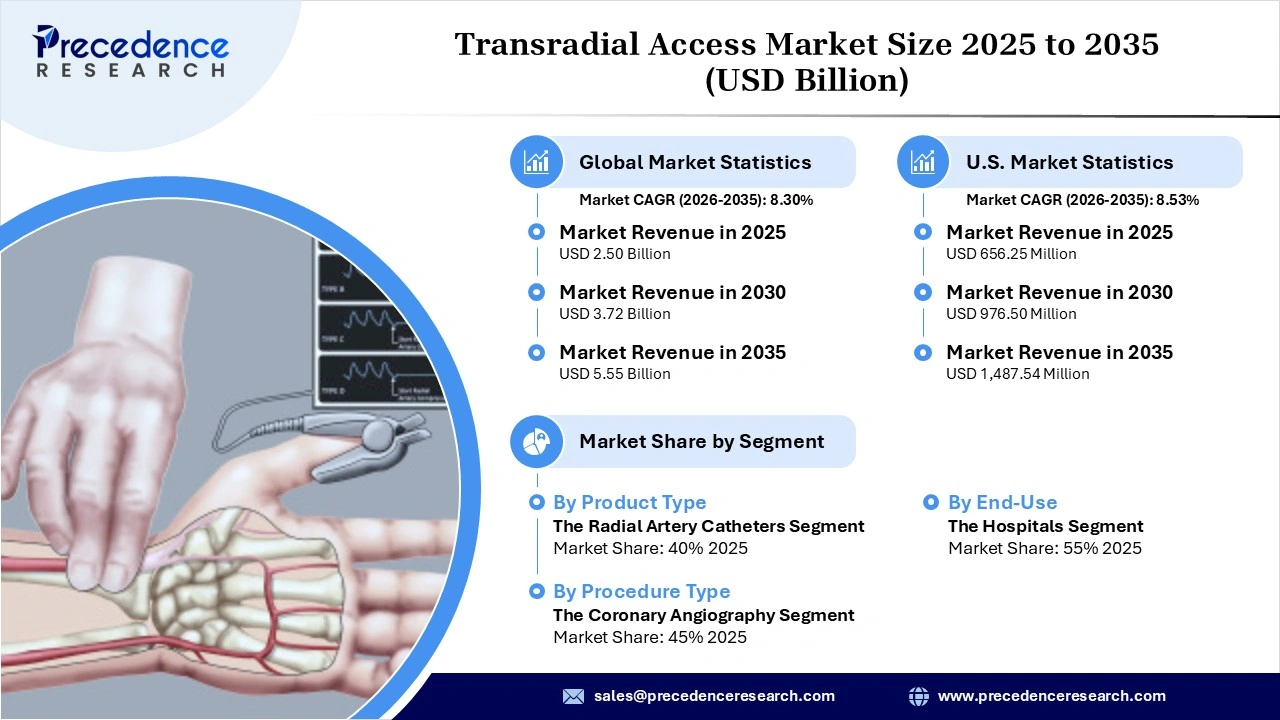
Market at a Glance
The transradial access market comprises a range of vascular access devices, including catheters, guidewires, sheaths, and closure systems, used primarily in diagnostic and interventional procedures via the radial artery. It is increasingly adopted across cardiology, peripheral, and neurovascular applications, driven by its lower complication rates, faster recovery times, and growing operator experience, making it a preferred standard over traditional access methods. Transradial access is expanding beyond traditional coronary procedures into broader interventional applications, including peripheral and neurovascular treatments. This growth is driven by advancements in device technology and increasing adoption across hospitals and outpatient settings.
What Drives the Transradial Access Market?
Increasing hospital and outpatient adoption
Hospitals and ambulatory surgical centers are rapidly adopting transradial access due to its cost-effectiveness and improved patient outcomes. Growing operator experience and training programs are further accelerating its integration into routine interventional practice.
Rising preference for minimally invasive procedures
The market is also driven by the growing shift toward minimally invasive cardiovascular and interventional procedures. Cardiovascular disease causes 17.9 million global deaths annually, so the procedural landscape is already wide. Compared to femoral access, transradial access offers lower bleeding risks, fewer complications, and faster patient recovery, making it increasingly preferred by clinicians.
Technological advancements in vascular access devices
Continuous innovation in catheters, guidewires, sheaths, and closure systems is improving the safety and success rate of transradial procedures. These advancements allow smoother navigation through complex anatomies, expanding their use across cardiology, peripheral, and neurovascular interventions.
Rising Adoption of Transradial Access in PCI
- One detailed registry study, reviewing 6,658,479 coronary-intervention (PCI) specimens from 1,906 locations within the United States, provides a solid procedural foundation for the widespread use of transradial access.
- Within this dataset, 40.4% of all PCI procedures were performed using transradial access, indicating that the radial technique has moved well beyond niche usage into mainstream clinical practice.
- The percentage of use increased rapidly, from 20.3% in 2013 to 57.5% in 2022, a remarkable 2.8 growth factor over a decade and a phenomenal shift in practice with one's chosen procedure to this extent.
- During high-risk procedures, radial access cases, such as STEMI, the use of radial access exploded from 13.3% to 55.6%, which showed a growing shift from sporadic usage to preferred approach even in very acute measures and at the utmost risk.
Market Segmentation Overview
- By product type, the radial artery catheters segment held a major revenue share of 40% in the market in 2025 due to their widespread adoption in coronary procedures as the standard access choice over femoral techniques. Their ability to enable precise navigation and reduce access-site complications has strengthened their dominance in high-volume cardiac interventions.
- By product type, the guidewires segment held the second-largest market share of 25% in 2025 and is expected to grow at a significant rate over the forecast period due to their key role in guiding catheters through complex arterial pathways. Advancements in material flexibility and design have improved procedural accuracy, making them critical for efficient navigation in challenging transradial cases.
- By procedure type, the coronary angiography segment dominated the transradial access market by holding a major revenue share of 45% in 2025, as it remains the most frequently performed procedure using radial access. Rising cardiovascular disease prevalence and increasing clinical preference for radial entry have solidified its role as the procedural foundation of the market.
- By procedure type, the percutaneous coronary intervention segment held the second-largest market share of 35% in 2025, driven by its strong compatibility with the advantages of transradial access. Faster recovery times and lower post-procedural complication rates compared to femoral access have driven its adoption in healthcare settings focused on efficiency and patient throughput.
- By end-use, the hospitals segment accounted for the largest share of 55.0% in the tranradial access market in 2025 due to their central role in managing complex and high-risk cardiovascular procedures. Hospitals possess advanced facilities, as well as qualified interventional cardiologists, which makes hospitals important centers for transradial operations, reinforcing their dominant position in the market.
- By end-use, the ambulatory surgical centers segment is the second-largest shareholder with 25% market share in 2025, driven by the growing shift toward outpatient care models. Increasing preference for minimally invasive procedures and faster recovery associated with radial access is enabling ASCs to manage a rising number of routine and less complex interventions.
Regional Analysis
North America dominated the transradial access market with a share of 35% in 2025 due to the early and widespread adoption of “radial-first” strategies across healthcare systems. The U.S. leads the region with high procedural volumes and well-established catheterization laboratories, where radial access is used in over 70-80% of catheterization procedures, supported by favorable reimbursement policies and clinical guidelines. Canada has shown steady growth in adoption, while Mexico’s gradual improvement reflects ongoing upgrades in cardiac care infrastructure. The region also benefits from its well-established healthcare systems.
Asia Pacific held the second-largest market share of 30% in 2025 and is expected to grow at the fastest CAGR during the forecast period, driven by improving healthcare access and rising volumes of cardiovascular procedures using radial techniques. Japan leads the region due to high procedural adoption and early uptake of minimally invasive methods, while China and India are witnessing strong growth supported by large patient populations and expanding healthcare infrastructure.
Transradial Access Market Coverage
| Report Attribute | Key Statistics |
| Market Revenue in 2025 | USD 2.50 Billion |
| Market Revenue by 2035 | USD 5.55 Billion |
| CAGR from 2026 to 2035 | 8.30% |
| Quantitative Units | Revenue in USD million/billion, Volume in units |
| Largest Market | North America |
| Base Year | 2025 |
| Regions Covered | North America, Europe, Asia-Pacific, Latin America, and the Middle East & Africa |
Top Companies in the Transradial Access Market
Terumo Corporation has played a key role in advancing radial-first technologies, establishing itself as a pioneer in the transradial access market. Abbott Laboratories and Boston Scientific have expanded their interventional portfolios to support the growing adoption of radial techniques. Meanwhile, Medtronic, Cordis, and Teleflex have strengthened their vascular access offerings, while Johnson & Johnson (through Ethicon) and Asahi Intecc have contributed innovations in surgical tools and guidewires. Additionally, Becton Dickinson, AngioDynamics, and Stryker have expanded their presence in vascular and adjacent interventional markets.
Segments Covered in the Report
By Product Type
- Radial Artery Catheters
- Guidewires
- Sheaths & Introducers
- Needles & Cannulas
- Balloon Dilatation Catheters
- Others
By Procedure Type
- Coronary Angiography
- Percutaneous Coronary Intervention (PCI)
- Angioplasty
- Endovenous Laser Therapy (EVLT)
- Others
By End-Use
- Hospitals
- Ambulatory Surgical Centers (ASCs)
- Specialized Cardiac Centers
- Others
By Region
- North America
- Latin America
- Europe
- Asia-pacific
- Middle and East Africa
Get this report to explore global market size, share, CAGR, and trends, featuring detailed segmental analysis and an insightful competitive landscape overview @ https://www.precedenceresearch.com/sample/8303
You can place an order or ask any questions, please feel free to contact us at sales@precedenceresearch.com |+1 804 441 9344