



Tylosin Market Revenue to Attain USD 1,532 Mn by 2035
Published: 22 Jun 2026
Author: Precedence Research



Tylosin Market Revenue and Trends 2026 to 2035
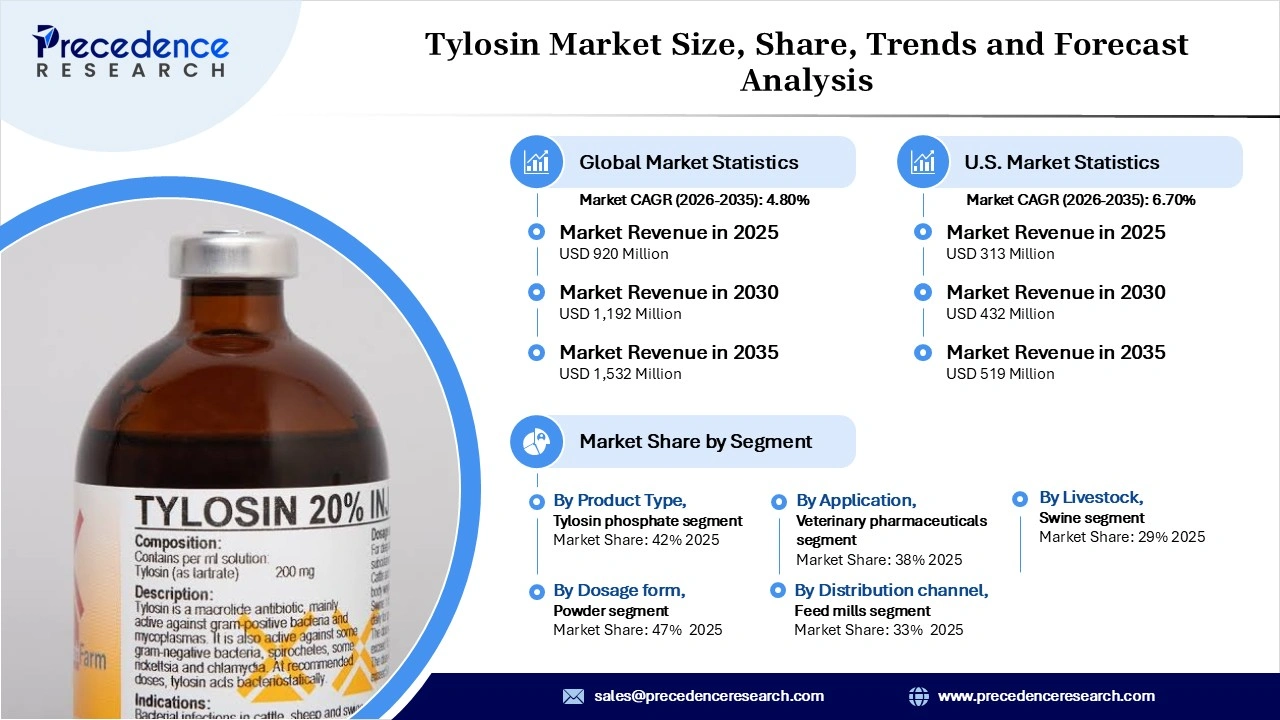
The global tylosin market revenue reached USD 920 million in 2025 and is predicted to attain around USD 1,532 million by 2035 with a CAGR of 5.30%. The market is gaining steady ground as commercial livestock producers race to curb bacterial outbreaks, improve feed efficiency, and protect rising global meat demand amid the rapid industrialization of poultry and swine farming.
Market at a Glance
The tylosin market encompasses the global trade, manufacture, and use of veterinary antibiotics for treating bacterial infections in livestock and poultry using tylosin. Intensive farming systems often require a high level of feeding to maintain herd health, increase feed yield, and prevent production losses. Tylosin is also extensively included in animal feed, injectable solutions, and soluble powders. This market ranges from the pharmaceutical industry that produces these products, feed additives manufacturers, distributors for veterinarians, to commercial livestock; the demand is highly consistent with increasing meat consumption and the growing industrialization of animal agriculture worldwide.
Tylosin is widely used in veterinary pharmaceuticals and medicated feeding supplements for animals suffering from disease management and preventive care. Its impacts range from poultry production facilities to swine farms and cattle ranching facilities through aquaculture infrastructure. Continuous enhancements in intensive animal husbandry infrastructure related to veterinary services and the controlled application of antibiotics are creating increasingly diversified possibilities in both developed industrial countries' economies and emerging markets.
Market Forecast for the Tylosin Market
Rising Poultry Output is Quietly Expanding the Antibiotics Pipeline
The market is expected to gain measurable traction as global poultry production keeps moving upward. The U.S. Department of Agriculture reported stronger broiler production forecasts for 2026 after observing higher hatchery placements and expanding turkey output. That matters commercially because larger flock density typically raises the risk of bacterial respiratory and enteric infections, where tylosin remains widely used in veterinary treatment protocols.
Rising Demand for Industrial Livestock Farming
Modern integrated poultry farming is becoming increasingly commercialized, particularly in Asia and Latin America. Organized farming systems rely heavily on disease-control programs because even a small bacterial outbreak can disrupt productivity and export supply chains. Growing adoption of feed management systems, controlled housing, and large-scale poultry integration is expected to create stable long-term demand for tylosin formulations in both preventive and treatment-based veterinary care.
Sales and Distribution of Antimicrobials for Use in Food-Producing Animals
- The U.S. FDA says sales and distribution of essential antimicrobials used in food-producing animals rose by 4% during 2024 to close to 6.2 million kilograms. The use of tylosin is returning to the forefront as a drug to cure respiratory and enteric bacterial problems.
- Swine comprised the highest proportion of antimicrobials at 42%, and cattle closely followed with 41%. Both sectors are important for the application of tylosin-based veterinary products.
- Tetracyclines represented close to 65% of all antimicrobial sales, highlighting the high dependence on antibiotic-based disease management in industrial animal agriculture.
- The FDA further noted that domestic cattle and swine biomass increased during the reporting period, indirectly strengthening long-term demand for livestock therapeutics and feed-grade antibiotics.
Market Segmentation Overview
- By product type, the tylosin tartrate segment dominated the tylosin market with a 58% market share in 2025 and is expected to maintain its leading position with a CAGR of 5.6% in the coming years, due to its higher solubility and efficacy profile and broad veterinary application range. Poultry producers extensively preferred the formulation because it supported rapid oral administration through feed and drinking water systems. Its broad commercial availability, along with strong usage of respiratory and enteric bacterial treatments, helped the segment maintain a larger market share in intensive livestock production environments.
- By application, the animal feed additives segment dominated the market with a 62% market share in 2025 and is expected to maintain its leading position with a CAGR of 5.5% in the coming years, as commercial farming systems continue prioritizing productivity enhancement and bacterial disease prevention. Tylosin needs in the realm of medicated feed applications are expected to be boosted by the development of commercial feed manufacturing infrastructure, particularly in developing poultry-producing countries. Increasing pressure to improve feed conversion ratios and reduce livestock mortality is also likely to reinforce future segment expansion.
- By livestock, the poultry segment dominated the market with a 41% market share in 2025 and is expected to maintain its leading position with a CAGR of 5.9% in the coming years, due to rapid poultry meat consumption growth. Bird population (especially poultry) levels of vulnerability in high-density operation settings and dependence on healthcare for livestock using feed-grade additives are expected to create a strong potential for continued demand for tylosin formulations in commercial poultry markets.
- By dosage form, the powder segment dominated the tylosin market with a 47% market share in 2025 and is expected to maintain its leading position with a CAGR of 5.7% in the coming years, as this trend is explained by livestock producers and feed manufacturers who want formulations that fit smoothly into the flow of large feed systems. The large amount of powder-based tylosin in poultry feed, its extended shelf life, economical means of transportation, and strong support from commercial farm operations, all together, supported its appeal.
- By distribution channel, the feed mills segment held a major revenue share of 38% in the market in 2025, due to growing medicated feed output and continuing progress in industrial livestock farming structures. With increased integration of poultry feeds coupled with a growing emphasis on feeding efficiency, leading commercial farms were inclined to source tylosin from a well-established upstream supply chain. Increasing feed additive utilization across poultry and swine operations further strengthened the segment’s market leadership.
- By distribution channel, the online veterinary distribution segment is steadily growing with a CAGR of 6.2% in the market between 2026 and 2035, as digital veterinary commerce steadily expands across livestock healthcare markets. Increasing online pharmaceutical procurement, improving rural product accessibility, and wider e-commerce infrastructure development are anticipated to accelerate purchasing through digital platforms. Convenience-driven buying behavior among livestock operators is also expected to support stronger online tylosin distribution growth over the coming years.
Regional Analysis
Asia-Pacific dominated the global tylosin market with a market share of 34% in 2025, due to fast-paced trends in livestock farming. Rising meat consumption, particularly poultry and pork, has significantly increased the need for tylosin as a feed antibiotic and therapeutic agent for livestock. China continued to expand due to its extensive swine and poultry industries, while India saw growth in commercial broiler farms alongside development in veterinary infrastructure. Larger feed production capacity supported by stronger incorporation of antibiotics into high-input farming also bolstered the region’s place as the leading market.
North America held the second-largest share of 28% in 2025, due to its highly organized commercial livestock industry and consistently high veterinary healthcare expenditure. High production in poultry and swine industries allowed for the high use of feeds with medication and the aggressive management of bacterial disease in intensive farming. In the U.S., there was an increase in the use of advanced feed-based therapeutic programs made possible through broad integration into poultry activity, while in Canada, there was an increase in investment to improve livestock health monitoring systems and modernize veterinary facilities. Greater emphasis on prevention and targeting productivity was driving regional demand for tylosin.
Tylosin Market Coverage
| Report Attribute | Key Statistics |
| Market Revenue in 2025 | USD 920 Million |
| Market Revenue by 2035 | USD 1,532 Million |
| CAGR from 2026 to 2035 | 5.30% |
| Quantitative Units | Revenue in USD million/billion, Volume in units |
| Largest Market | North America |
| Base Year | 2025 |
| Regions Covered | North America, Europe, Asia-Pacific, Latin America, and the Middle East & Africa |
Top Companies in the Tylosin Market
Elanco Animal Health and Zoetis maintained strong market visibility through extensive livestock therapeutic networks and broad production-animal healthcare offerings. Huvepharma and Phibro Animal Health expanded their presence in medicated feed additives and antibiotic products tailored for poultry, which are prevalent in industrial farming. European veterinary companies such as Ceva Santé Animale, Vetoquinol, Norbrook, and Dechra Pharmaceuticals broadened their influence with portfolios as varied as veterinary medicine and grew treatment potential for livestock. Simultaneously, Boehringer Ingelheim and Merck Animal Health continued with investments in disease prevention technologies as well as commercial therapeutic products supporting integrated animal health systems to service large-scale animal operations with poultry and swine.
Segments Covered in the Report
By Product Type
- Tylosin Tartrate
- Tylosin Phosphate
By Application
- Animal Feed Additives
- Veterinary Pharmaceuticals
By Livestock
- Poultry
- Swine
- Cattle
- Others
By Dosage Form
- Powder
- Injectable
- Oral Solution
- Premix
By Distribution Channel
- Veterinary Hospitals and Clinics
- Feed Mills
- Veterinary Pharmacies
- Online Veterinary Distribution
By Region
- North America
- Latin America
- Europe
- Asia-pacific
- Middle and East Africa
Get this report to explore global market size, share, CAGR, and trends, featuring detailed segmental analysis and an insightful competitive landscape overview @ https://www.precedenceresearch.com/sample/8505
You can place an order or ask any questions. Please feel free to contact us at sales@precedenceresearch.com |+1 804 441 9344