



Veterinary Urinalysis Market Revenue to Attain USD 2.05 Bn by 2035
Published: 15 Apr 2026
Author: Precedence Research



Veterinary Urinalysis Market Revenue and Trends 2026 to 2035
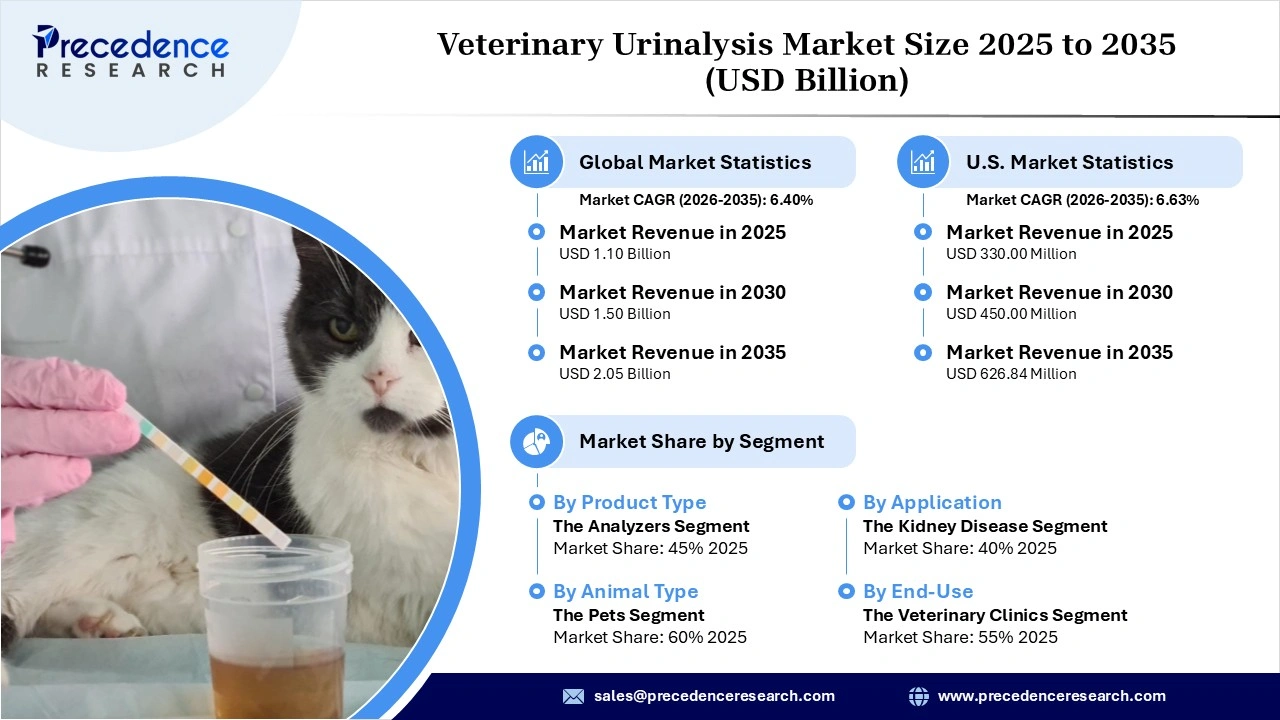
The global veterinary urinalysis market revenue surpassed USD 1.10 billion in 2025 and is predicted to attain around USD 2.05 billion by 2035, growing at a CAGR of 6.40%. The market is driven by the rising incidences of kidney stones in animals, rising pet ownership, and increased demand for prompt and precise diagnosis.
Promoting Animal Wellness Using Urinalysis
The veterinary urinalysis market involves the manufacturing, distribution, and deployment of diagnostic equipment and testing kits that can be used in diagnosing various ailments in animals through urinalysis. These diagnostic methods are used in detecting various diseases such as kidney dysfunction, metabolic syndromes, and other systemic disorders among companion animals as well as livestock.
This market has a broad array of products ranging from automated machines to test strips, kits, and consumables used in veterinary facilities such as hospitals and labs. Urinalysis helps veterinarians make quicker and more accurate decisions on diagnosis, therapeutic, and follow-up measures that benefit animals that live with humans as well as those on the farm. It is also a very important preventive measure because it helps detect possible problems even before they become serious.
What Drives the Veterinary Urinalysis Market?
AI-Driven Diagnosis System Enhancement
The application of AI in urine analysis is becoming more common within the veterinary field as a means of facilitating automated diagnosis and increasing precision in detecting specific components of urine sediments. These components include bacteria, red blood cells, and crystals. This development not only eases the task burden of the analysis but also enables fast delivery of the results, particularly in cases of infections of the urinary system and diseases associated with kidney function.
- In 2025, Zoetis unveiled a novel AI-based cytologic feature named AI Masses for its veterinary analyzer Vetscan Imagyst, which enables enhanced accuracy and decision-making.
Expansion of Point-of-Care Testing Services
With the introduction of portable point-of-care testing devices, the use of urinalysis procedures within veterinary practices and hospital environments has seen tremendous improvement. Portable devices permit veterinarians to conduct urine tests directly from clinical facilities and avoid sending specimens to external laboratory facilities. Automated processes and digital report generation also increase laboratory productivity and ensure reliable tracking of persistent urinary disorders and renal complications in animals.
Bionote USA launched its new Vcheck U Veterinary Urinalysis Analyzer in February 2026, which is intended to conduct both chemical and sediment tests on urine samples in a single machine, with the test results generated in about four minutes.
Government Assistance in Veterinary Diagnostics
Government initiatives play a key role in boosting veterinary diagnostics and laboratory capabilities that provide routine laboratory tests like urinalysis. Government policies are generally aimed at building veterinary workforce capabilities, funding diagnostic laboratories, and improving surveillance programs. Building up veterinary infrastructure facilitates early identification of illnesses as well as better preparation for new animal health issues that arise for both livestock and domestic animals.
- In 2025, the U.S Department of Agriculture(USDA) initiated measures that enhance veterinary workforce capability as well as diagnostic facilities that help in diagnosing livestock illnesses.
Prevalence of UTI in Companion Animals
The results from veterinary research published in November 2025 indicated a general prevalence rate of UTIs among companion animals, which was 26.1%, with a prevalence rate range of 8% to 58.9%. Dogs showed a higher prevalence rate of 44.6% than cats at 18.6%, and females showed a higher incidence rate of 30.1% than males at 14.6%.
Surging Pet Ownership and Regulatory Momentum Driving Diagnostic Expansion in Veterinary Urinalysis
- Pet ownership is still growing around the world, and it is estimated that in 2024, people will spend about $158 billion on pets, which directly drives the need to perform veterinary diagnostics, such as regular urinalysis testing.
- Increase in the dog population indicate that the number of dogs in the country grew steadily over the years, with a high of 89.7 million dogs in 2024, compared to the previous high of 52.9 million in 1996, driving higher diagnostic testing volumes.
- According to the European Medicines Agency, the regulatory activity has been increasing steadily, with 27 veterinary product evaluation applications received in 2024, demonstrating the ongoing innovation and regulatory approvals affecting diagnostic ecosystems.
Market Segmentation Overview
- By Product Type: The analyzers segment led the veterinary urinalysis market with a 45% share in 2025, due to the growing demand for automated, fast, and accurate diagnostics. Analyzers help to optimize the process and decrease the chance of errors.
- By Product Type: The test strips segment is expected to expand at the highest CAGR during the forecast period because of their affordability, ease of use, and the ability to deliver rapid results, which makes them useful for regular testing.
- By Animal Type: The pets segment dominated the market with 60% share in 2025, as there is a rapid rise in the number of companion animals and the expenditure incurred by pet owners towards healthcare for their pets.
- By Animal Type: The livestock segment is expected to grow at the fastest rate from 2026 to 2035, owing to an increase in the attention given to the management of animal health and prevention of diseases. This facilitates continued production, minimal losses, and optimal quality of meat, milk, and other animal products.
- By Application: The kidney disease segment led the market with 40% share in 2025 due to the fact that renal problems are one of the most prevalent medical conditions affecting animals, especially elderly ones, which require urinalysis for diagnosis and management.
- By Application: The urinary tract infections (UTIs) segment held the second largest share of 25% in 2025, since UTIs are quite common among pets as well as livestock. Early identification through a urine test is essential to avoid further complications.
- By End-Use: The veterinary clinics segment dominated the veterinary urinalysis market with a 55% share in 2025. This is because clinics are the main facility for conducting routine check-up examinations and testing, such as urinalysis, for animals.
- By End-Use: The animal hospitals segment held the second largest market share of 25% in 2025 because facilities often deal with complicated cases, which involve the need for thorough diagnosis through urine tests.
Regional Insights
North America led the veterinary urinalysis market with a 40% share in 2025, due to high rates of pet ownership, along with the spending levels on animal healthcare, making diagnostic tests very frequent. This region is also known for its availability of veterinary care infrastructure, along with the adoption of automated urinalysis instruments. The U.S. led the market in North America because of growing interest in preventive healthcare for pets and the widespread network of veterinary clinics. Canada is a notable contributor to the market, fueled by the growing investment in livestock and companion animal health surveillance.
Asia Pacific is expected to expand at the highest CAGR from 2026 to 2035, owing to the presence of a rapidly growing pet population, increasing awareness regarding animal healthcare, and rapidly rising establishment of veterinary clinics. The usage of advanced diagnostics and the development of livestock farming practices are also accelerating the market adoption in this region. China led the market in Asia Pacific due to an increase in disposable income and rising pet popularity, which has boosted the requirement for standard veterinary diagnostics. India is experiencing significant growth because of rising emphasis on livestock health management and preventive care for pets.
Veterinary Urinalysis Market Coverage
| Report Attribute | Key Statistics |
| Market Revenue in 2025 | USD 1.10 Billion |
| Market Revenue by 2035 | USD 2.05 Billion |
| CAGR from 2026 to 2035 | 6.40% |
| Quantitative Units | Revenue in USD million/billion, Volume in units |
| Largest Market | North America |
| Base Year | 2025 |
| Regions Covered | North America, Europe, Asia-Pacific, Latin America, and the Middle East & Africa |
Top Companies in the Veterinary Urinalysis Market
IDEXX Laboratories Inc., Abaxis Inc. (recently acquired by Zoetis), and Heska Corporation are rivals in the segment of point-of-care urinalysis analyzers. Thermo Fisher Scientific Inc. and Randox Laboratories Ltd. target the high-volume laboratory testing facilities. Mindray Medical International Ltd. and Arkray, Inc. cater to the need for automated urine analysis and sediment analysis. F. Hofmann-La Roche Ltd. and Alpha Diagnostics specialize in the provision of strips, urine analysis readers, and immunoassays. Both Virbac and VCA Inc. (a Mars Petcare company) offer urinalysis as part of their overall diagnostic service package.
Segments Covered in the Report
By Product Type
- Analyzers
- Reagents
- Test Strips
By Animal Type
- Pets
- Dogs
- Cats
- Livestock
- Cattle
- Sheep
- Goats
- Others
By Application
- Kidney Disease
- Urinary Tract Infections (UTI)
- Diabetes Mellitus
- Liver Disease
- Others
By End-Use
- Veterinary Clinics
- Animal Hospitals
- Research Institutes
- Others
By Region
- North America
- Latin America
- Europe
- Asia-pacific
- Middle and East Africa
Get this report to explore global market size, share, CAGR, and trends, featuring detailed segmental analysis and an insightful competitive landscape overview @ https://www.precedenceresearch.com/sample/8299
You can place an order or ask any questions, please feel free to contact us at sales@precedenceresearch.com |+1 804 441 9344