



Pressure Transducer Market Size, Key Companies, Company Market Share, Chip Production Volume, Wafer Capacity, Technology Adoption, Pricing Trends, Competitive Positioning, and Demand Analysis
Pressure Transducer Market (By Technology: Piezoresistive Strain Gauge, Capacitance, Others; By Pressure Type: Absolute Pressure, Gauge Pressure, Differential Pressure; By End-use: Automotive, Consumer Electronics, Industrial, Healthcare, Oil & Gas, Others) - Global Industry Analysis, Size, Trends, Leading Companies, Regional Outlook, and Forecast 2026 to 2035
Source: https://www.precedenceresearch.com/pressure-transducer-market
 Get a Sample
 Table Of Content


What is Pressure Transducer Market Size?
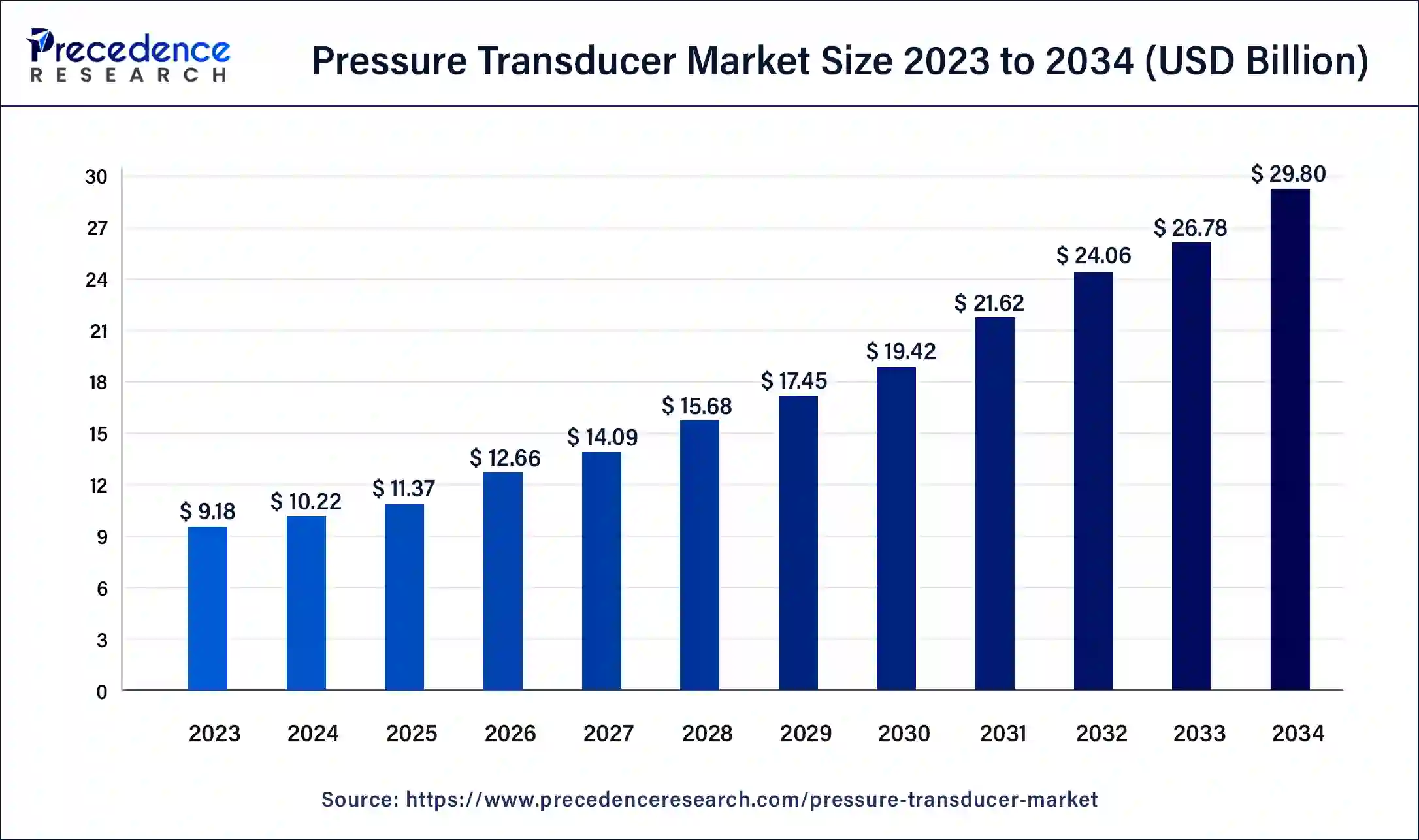
The global pressure transducer market size is calculated at USD 11.37 billion in 2025 and is predicted to increase from USD 12.66 billion in 2026 to approximately USD 32.62 billion by 2035, expanding at a CAGR of 11.11% from 2026 to 2035. The pressure transducers' benefits include being simple to construct, highly durable, lightweight, compact, highly sensitive, providing high stability, regulated output, economical, and designed on robust technologies that help the growth of the market.
Market Highlights
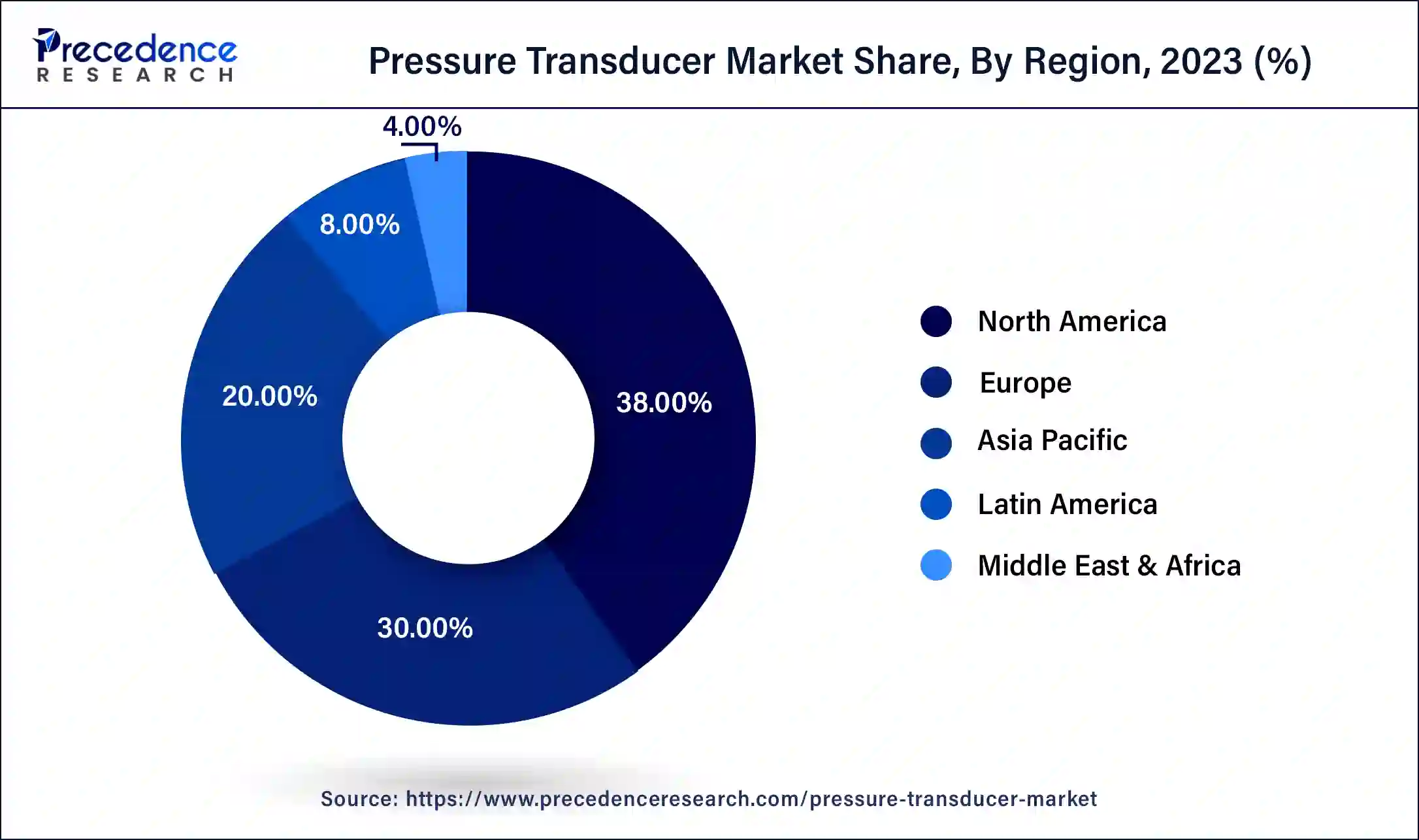
- North America accounted for the biggest market share of 38% in 2025.
- Asia Pacific is estimated to be the fastest-growing region during the forecast period of 2026-2035.
- By technology, the piezoresistive strain gauge segment dominated the market in 2025.
- By technology, the capacitance segment is anticipated to be the fastest-growing during the forecast period.
- By pressure type, the absolute pressure segment dominated the pressure transducer market in 2025.
- By pressure type, the gauge pressure segment is expected to be the fastest-growing during the forecast period.
- By end-use, the automotive segment dominated the pressure transducer market in 2025.
- By end-use, the industrial segment is anticipated to be the fastest-growing during the forecast period.
Pressure Transducer Market Overview: The Market Insights
The pressure transducer market refers to buyers and sellers of pressure transducers, also known as pressure transmitters, which are electromechanical devices designed to measure a high degree of precision. The pressure transducer is a device that measures fluid pressure with high accuracy and converts physical pressure into an electrical signal. The pressure transducers consist of a pressure-sensitive element like a diaphragm and electronic components for converting the information into electrical output signal. The benefits of pressure transducers include being highly durable and simple to construct, lightweight, compact, highly sensitive, etc.
Winsen Sensors provides pressure sensors or transmitters to industries as follows
- Marine Industry
- Oil and Gas Industry
- Consumer Electronics
- HVAC Systems
- Aerospace
- Industrial Automation
- Medical Devices
- Automotive Industry
How can AI Help the Pressure Transducers?
Artificial intelligence (AI) plays an important role in pressure transducers to improve capabilities in many ways, which helps the growth of the pressure transducer market. It helps in improved accuracy and sensitivity, real-time data processing for immediate feedback requirements in industrial applications, predictive maintenance by identifying trends and analyzing historical data, improved flexibility in wearable health devices benefit by enhancing their adaptability and performance, AI-based pressure transducers may be used with IoT (Internet of Things) systems to create smart environments. This use of AI makes pressure transducers more versatile and efficient.
- In June 2022, the industry's first battery-powered artificial intelligence (AI) or machine learning (ML) based acoustic event detection and sensor fusion alarm system (Smart Alarm System) was launched by Infineon Technologies AG. The solution includes Infineon's SNR analog XENSIV MEMS microphone IM73A135V01, XENSIV digital pressure sensor DPS310, and PSoC 62 microcontroller.
Pressure Transducer Market Growth Factors
- The advantages of pressure include being highly durable, simple to construct, lightweight, compact, sensitive, etc., which helps to the growth of the growth of the pressure transducer market.
- They provide regulated output and great stability, and these are designed with robust technologies and are economical.
- The pressure transducers measure fluid pressure with high accuracy and convert physical pressures into an electrical signal.
- These consist of pressure-sensitive elements like the diaphragm and electronic components for converting the information into an electrical output signal.
Pressure Transducer Market Key Trends
- Industrial automation growth: Rising adoption in Industry 4.0 for real-time monitoring and process efficiency. This trend is helping industries improve productivity while reducing operational errors and downtime.
- IoT-enabled sensors: Integration with connected systems for remote monitoring and predictive maintenance. It allows companies to make data-driven decisions and enhance equipment lifecycle management.
- Miniaturization (MEMS): Smaller, compact sensors gaining demand in medical and electronics applications. This enables their use in space-constrained environments without compromising performance.
- Focus on sustainability: Low-power and eco-friendly sensor designs supporting energy-efficient systems. Manufacturers are aligning with environmental regulations and reducing overall energy consumption.
- EV and automotive demand: Growing use in electric vehicles for battery, braking, and HVAC systems. This supports improved vehicle safety, performance, and energy management.
- Regulatory compliance: Strict standards driving high-accuracy and reliable sensor innovations. Companies are investing in advanced calibration technologies to meet global certification requirements.
- Wireless smart sensors: Adoption of wireless and self-diagnostic sensors reducing maintenance costs. These sensors simplify installation and improve operational flexibility across industries.
- Emerging market expansion: Increasing demand from Asia-Pacific due to industrial and infrastructure growth. Rising investments in manufacturing and energy sectors are accelerating market penetration.
Pressure Transducer Market Outlook: The Emerging Innovations
- Industry Growth Overview: Growing demand for industrial automation, integration of IoT and AI technologies, and automotive safety systems are responsible for the industry growth.
- Major Investors: Global asset management firms, major corporations, private equity, and venture capital firms are the major investors in the market.
- Startup Ecosystem: The development of highly specialized integrated solutions using advanced technologies is the focus of the startup ecosystem.
Market Scope
| Report Coverage | Details |
| Market Size in 2025 | USD 11.37 Billion |
| Market Size in 2026 | USD 12.66 Billion |
| Market Size by 2035 | USD 32.62 Billion |
| Market Growth Rate from 2026 to 2035 | CAGR of 11.11% |
| Largest Market | North America |
| Base Year | 2025 |
| Forecast Period | 2026 to 2035 |
| Segments Covered | Technology, Pressure Type, End-use, and Regions |
| Regions Covered | North America, Europe, Asia-Pacific, Latin America and Middle East & Africa |
Market Dynamics
Drivers
Increasing demand in the automotive industry
The increasing demand for pressure transducers in the automotive industry is contributing to the growth of the pressure transducer market. In aerospace and automotive industries, pressure transducers are used in all types of aircraft and vehicles to monitor hydraulic system pressure, engine oil pressure, fuel pressure, and tire pressure. The benefits of pressure transducers in the automotive industry include releasing pedestrian bags, rapidly activating airbags, detecting vapor leaking, stopping doors from catching fingers, the pressure of critical fluids, exhaust recirculation monitoring, automatic cleaning of exhaust filters, etc.
Restraint
Regulatory standards
The downsides of regulatory standards of pressure transducers include compliance fatigue, adaptability risks, unintended consequences, compliance costs, safety and quality are important, the burden of compliance, etc. These factors can hamper the growth of the pressure transducer market. The downsides of pressure transducers include being highly sensitive to environmental conditions, offering only moderate accuracy, not being reliable for high temperatures, giving delayed response to vibrations and shocks, providing only average accuracy in case of drifts, etc.
Opportunity
Rising demand in the consumer electronics industry
The increasing demand for pressure transducers in the consumer electronics industry can help the growth of the pressure transducer market. Pressure transducers are used in many industries, including wastewater, food & beverage, oil & gas, electronics, and more. It is designed to offer repeatability, accuracy, and reliability. Pressure transducers are used to change the fluid pressure into an electrical signal to control & check the pressure in electronic control systems.
Segment Insights
Technology Insights
The piezoresistive strain gauge segment dominated the pressure transducer market in 2025. Piezoresistive strain gauges are semiconductor materials that change in resistance when materials are compressed or stretched. Piezoresistive strain gauge pressure transducers are less expensive as compared to capacitive sensors. It offers high-resolution measurements and is highly resistant to dynamic pressure changes, shock, and vibration. Piezoresistive strain gauges, also called semiconductor strain gauges, produce about 90% of their output through piezoresistive effects.
- In May 2024, by using SE206 silicon strain gauge chips through glass sintering bond and 330B through thick film process, ‘Model 500G Piezoresistive Gauge Pressure Sensors' was developed by BCM Sensor.
The capacitance segment is expected to be the fastest-growing during the forecast period. The capacitance-based pressure transducer benefits include measuring pressure by detecting changes in electrical capacitance because of diaphragm movement.
Capacitance pressure transducer applications include ensuring the pump works efficiently, measuring liquid levels and flow rates, keeping an eye on airspeed, altitude, and other flight-related pressures, monitoring pressure in industrial processes, etc., contributing to the growth of the pressure transducer market.
- In April 2022, the availability of the first barometric pressure sensor based on the capacitive MEMS Technology was announced by Bosch Sensortec.
Pressure Type Insights
The absolute pressure segment dominated the pressure transducer market in 2025. The sum of atmospheric pressure and gauge pressure is absolute pressure. When pressure is measured relative to a perfect vacuum, it is known as absolute pressure. Absolute pressure applications include aviation and aerospace, research and scientific labs, and help maintain vacuum seals in food and pharmaceutical packaging, which helps the market flow.
- In April 2023, Continental launched the production of TPMS (Tire Pressure Monitoring System) for passenger cars at its Bengaluru Plant in India. It provides timely and accurate information to the driver about the status of the tire motion detection, temperature, and pressure.
The gauge pressure segment is estimated to be the fastest-growing during the forecast period. Gauge pressure is a technique of measuring water, gas, fluid, or steam intensity in a pressure-based machine, ensuring pressure changes or leaks that may influence the performance of the system.
The benefits of gauge pressures include back-lit capabilities in some pressure gauges, no parallax errors, no operation interpretation required, fast and accurate measurements in digital pressure gauges, gauge reading accuracy and longevity in modern pressure gauges, usefulness in many industries and applications like general test/service operations, mechanical engineering, and hydraulics. Pressure gauges are used to monitor liquid flow, fluid level, and filtration in many sectors. These are used in chemical and petrochemical production lines, clean rooms, power plants, and other places that help to grow the pressure transducer market.
- In February 2024, new strain gauge modules, J1939, and CAN Protocol Sleds for the FlexEdge Platform were launched by a manufacturer of advanced technologies that empowers industrial organizations to connect, access, and visualize their data, Red Lion.
The differential pressure segment is gaining strong traction because it is essential for measuring pressure variations between systems, especially in applications like flow measurement, HVAC, and filtration. In sectors like oil and gas, water treatment, and pharmaceuticals, where accurate pressure variation monitoring is crucial for process control and safety, these transducers are widely utilized. Adoption is being further fueled by the growing need for energy-efficient systems and regulatory compliance in industrial operations since differential pressure sensors improve system performance and lower energy consumption.
End-use Insights
The automotive segment dominated the pressure transducer market in 2025. The automotive industry has many uses for pressure transmitters and transducers. Cleaning exhaust filters, detecting hydraulic brakes, controlling emissions, checking spark ignition, internal combustion engines, and transmission are all applications that need highly reliable and accurate pressure measurement instrumentation that meets the most demanding automotive testing needs. Pressure transducers play an important role in the automotive sector in monitoring brake fluid pressure, tire pressure, and engine oil pressure. This helps to enhance fuel efficiency, vehicle safety, and overall performance.
The industrial segment is expected to be the fastest-growing during the forecast period. Pressure transducers are used in many industries, including automation, off-road equipment, medical, and automotive, which help the growth of the pressure transducer market. The benefits of pressure transducers include improved system efficiency and safety, easy integration with control systems, long lifespan with proper maintenance, lightweight and compact design, suitable for many industrial applications, compatibility with many signal outputs, high range of pressure measurement capabilities, and reliable and accurate pressure measurements. Sanitary pressure transducers are used in pharmaceutical or biotech industries.
- In June 2024, the launch of 3 gas, moisture, and flow measurement sensor technologies named- ‘T5MAX Transducer, HygroPro XP, and XMTCpro' designed to enhance safety performance and drive productivity in hydrogen and other applications across the energy and industrial sectors was announced by an energy technology company, Baker Hughes.
The consumer electronics segment is witnessing growing adoption of pressure transducers driven by the growing use of pressure sensors in wearable technology, smart home systems, and smartphones. Pressure transducers improve device functionality and user experience by performing tasks like attitude detection, touch sensitivity, and environmental monitoring. The use of pressure transducers in this market greatly increased due to ongoing advancements in small and low-power sensor technologies as well as the growing demand for smart devices worldwide.
Regional Insights
What is the U.S. Pressure Transducer Market Size?
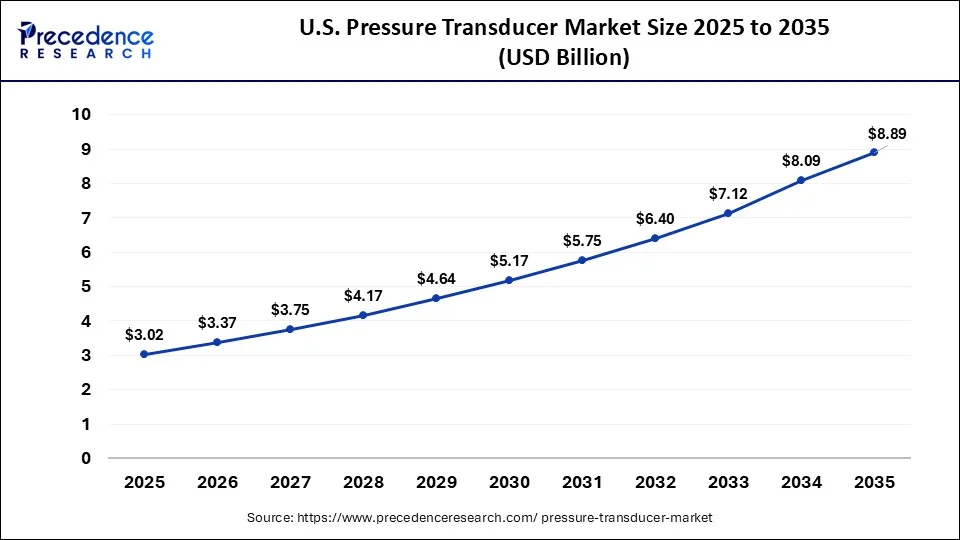
The U.S. pressure transducer market size is exhibited at USD 3.02 billion in 2025 and is projected to be worth around USD 8.89 billion by 2035, poised to grow at a CAGR of 11.40% from 2026 to 2035.
North America Driven by a Robust Automotive Industry
North America dominated the pressure transducer market in 2025. In the automotive industry of North America, there is a demand for pressure transducers for many applications like ESR (Exhaust Gas Recirculation) and TPMS (Tire Pressure Monitoring System), which drive the market flow. Increased demand for pressure transducers as a result of government regulations demanding pressure sensors in automobiles. Rising automotive production and industrialization demand for pressure transducers in North America contribute to the market's growth. The United States is the leading country in North America for the growth of the market.
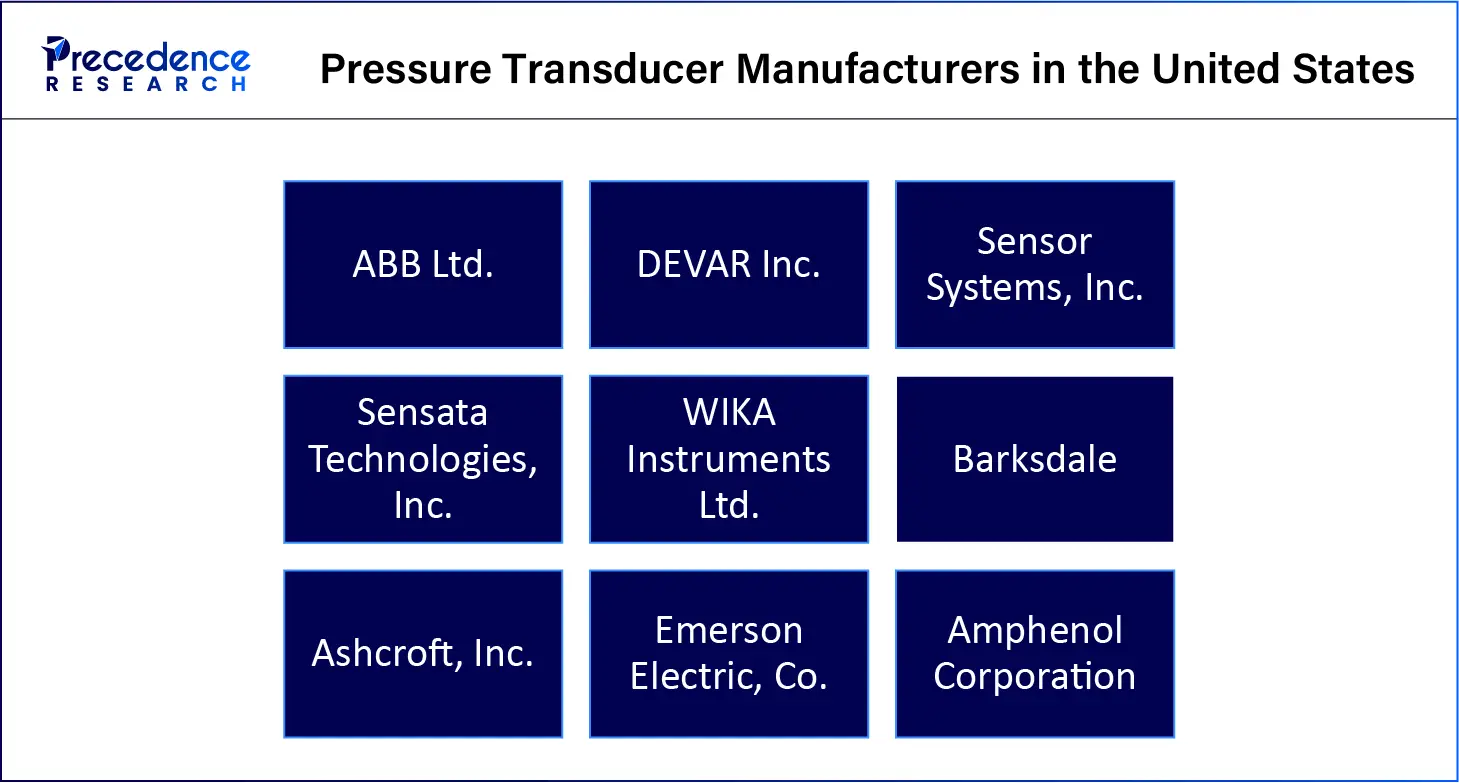
Pressure Transducer Manufacturers in the United States
Expanding Industries Drive Asia Pacific
Asia Pacific is estimated to be the fastest-growing during the forecast period of 2026-2035. The expansion of industrial processes and advanced technologies in the Asia Pacific region helps the growth of the pressure transducer market. The adoption of industrial utilization and automation to achieve optimization, high-performance efficiencies, and eliminate performance failures in the automated sector contributes to the market flow. The rising adoption of adoption and automation technologies across industries like consumer electronics, automotive, and manufacturing demand for pressure transducers.
- In November 2023, the digital asset performance management platform for instrumentation was launched by ABB Ltd. This platform is helpful for instrumentation and devices like pressure sensors, temperature sensors, level meters, and flow meters. It also helps to increase the efficiency of the operations in oil & gas, chemical, wastewater, water, and other industries.
Advanced Companies Stimulate U.S.
The U.S. consists of advanced companies that are increasing the production of pressure transducers. Moreover, the advanced automotive sector and growing R&D investments are promoting the development of sensors with enhanced accuracy, miniaturization, and smart features.
Expanding Automotive Sector Fuels India
India is experiencing an expansion in the automotive sector, which is increasing the development of pressure transducers. The growing government initiatives and adoption of automated systems are further driving their innovation. Affordable manufacturing is also increasing its production rates.
Advanced Industrial Base Boost Europe
Europe is expected to grow significantly in the pressure transducer market during the forecast period, due to the presence of an advanced industrial base, which is increasing the demand for pressure transducers for high-precision sensors. Therefore, the companies are focusing on enhancing their performance and developing miniaturized, IoT-based, and smart sensors, which is promoting the market growth.
Robust R&D Capabilities Propel UK
Due to the presence of robust R&D capabilities, the development of miniaturized pressure transducers is increasing in the UK. The companies are also developing sensors for aerospace, medical, and defence applications. This is increasing their development in compliance with stringent regulations.
How Are Government Initiatives Driving Growth in the Pressure Transducer Market?
Through a combination of industrial support programs and regulatory enforcement, government policies across regions are dramatically increasing demand for pressure transducers. The need for accurate pressure monitoring in automotive and industrial systems is growing due to strict emission standards like Bharat Stage VI and international safety regulations. The use of cutting-edge sensing technologies for real-time process control is also being encouraged by programs supporting Industry 4.0 and smart manufacturing. Through programs like Production-Linked Incentives (PLI), governments are also bolstering local supply chains for MEMS-based sensors by promoting domestic electronics and semiconductor manufacturing.
Additionally, the range of applications for pressure transducers in utilities and construction is growing due to investments in smart cities, water management, and infrastructure projects. Policies pertaining to clean energy and electric vehicles are increasing demand because these systems depend on precise pressure sensing for both performance and safety. Increasing the use of pressure sensors in medical devices is another way that healthcare expansion initiatives are helping. All things considered, these efforts are building a robust regulatory and investment-driven ecosystem that sustains market expansion.
Pressure Transducer Market Value Chain Analysis: Mapping the Opportunities
- Raw Material Procurement: Raw material procurement of the pressure transducer involves the pouring of materials like silicon, stainless steel, specialty alloys, and plastics from various suppliers.
Key players: TE Connectivity, KELLER. - Testing and Quality Control: Visual inspections, electrical performance checks, and comprehensive calibration are involved in the testing and quality control of pressure transducers.
Key players: Honeywell, WIKA. - Lifecycle Support and Recycling: Lifecycle support and recycling of pressure transducers involves regular maintenance, repair services, and calibration.
Key players: Honeywell, ABB.
Pressure Transducer Market Companies
- Honeywell International Inc.: A variety of pressure sensors and SmartLine ST 800 series are provided by the company.
- TE Connectivity: Piezoresistive and silicon-based sensors are provided by the company.
- Emerson Electric Co.: The company provides the Rosemount 3051 series.
- Endress + Hauser: Cerabar and Deltabar series are provided by the company.
- Wika Group: The company provides suitable sensors for industrial use, machine building, and hydraulics.
Other Major Key Players
- ABB Ltd.
- NXP Semiconductors
- Robert Bosch GmbH
- Panasonic Corporation
- Validyne Engineering
- Kulite Semiconductor Products, Inc.
- Setra Systems, Inc. (Fortive)
- Sensata Technologies, Inc.
- ControlAir, Inc.
- Amphenol Corporation (US)
- Emerson Electric Co. (US)
- Setra System, Inc.
- Omicron System Pvt Ltd.
- MICRO SENSOR CO., LTD
- Kistler Instrument, Corp.
- IFM Electronic GmbH
- Yokogawa Electric Corporation
- Schneider Electric SE
- TE Connectivity
- Siemens AG
- Anfield Sensors Inc.
- Amphenol Corporation
Recent Developments
- In February 2026, Yokogawa Electric Corporation announced the global release of the OpreX Pressure Transmitter EJX S Series. The new lineup features advanced silicon resonant sensor technology to provide superior accuracy and long-term stability for process industries. Its modular "Trusted Green" design reduces environmental impact and simplifies maintenance.
(Source: https://www.yokogawa.com) - In April 2026, Gefran announced and launched its latest integrated automation ecosystem at CHINAPLAS 2026. The showcase features the G-Mation platform and advanced sensor technologies designed specifically for the plastics processing market. The ecosystem aims to improve production performance through scalable control and real-time data integration for Smart Manufacturing.
(Source: https://www.industry-asia-pacific.com) - In September 2022, a new ‘Pressure Transducer' with a classic 2088 head that can be used in a harsh or humid environment for a long time for oil, air, and water was launched by the online shop supplying a high range of industrial automation products company, ATO.com.
- In May 2024, the SCP09 pressure sensor with OEM pin configuration, a reliable and versatile solution for hydraulic applications, was launched by a global leader in motion and control technologies, Parker Hannifin.
Segments Covered in the Report
By Technology
- Piezoresistive Strain Gauge
- Capacitance
- Others
By Pressure Type
- Absolute Pressure
- Gauge Pressure
- Differential Pressure
By End-use
- Automotive
- Consumer Electronics
- Industrial
- Healthcare
- Oil & Gas
- Others
By Region
- North America
- Asia Pacific
- Europe
- Latin America
- Middle East & Africa
For inquiries regarding discounts, bulk purchases, or customization requests, please contact us at sales@precedenceresearch.com
Frequently Asked Questions
Tags





Ask For Sample
No cookie-cutter, only authentic analysis – take the 1st step to become a Precedence Research client
 Get a Sample




 sales@precedenceresearch.com
 Schedule a Meeting
