



Privacy Preserving AI Market Trends, Companies, Revenue / Sales Performance, Subscriber Growth, Pricing Strategies, Cloud Adoption, Infrastructure Expansion, Competitive Landscape, and Industry Outlook
Privacy Preserving AI Market (By Offering: Software Platforms, Privacy-preserving AI development tools, Secure AI model training platforms, Infrastructure and Security Modules; By Technology: Federated Learning, Differential Privacy, Secure Multi-Party Computation (SMPC), Zero-Knowledge Proofs and Other PET Techniques; By Deployment Mode: Cloud-Based, On-Premise Deployments, Hybrid Deployments; By Application: Data Privacy and Secure Analytics, Fraud Detection and Risk Analytics, Customer Data Protection and Personalization, Other AI Privacy Applications; By Industry Vertical: BFSI (Banking, Financial Services, Insurance), Healthcare and Life Sciences, Government and Defense, Retail and E-commerce, Other Industries) - Global Industry Analysis, Size, Trends, Leading Companies, Regional Outlook, and Forecast 2026 to 2035
Source: https://www.precedenceresearch.com/privacy-preserving-ai-market
 Get a Sample
 Table Of Content


What is the Privacy Preserving AI Market Size in 2026?
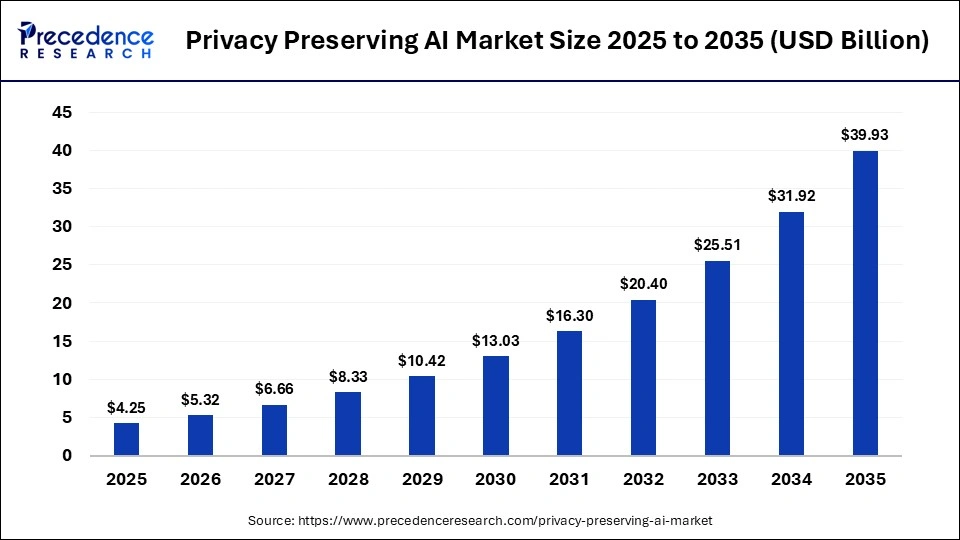
The global privacy preserving AI market size was calculated at USD 4.25 billion in 2025 and is predicted to increase from USD 5.32 billion in 2026 to approximately USD 39.93 billion by 2035, expanding at a CAGR of 25.10% from 2026 to 2035. The market is witnessing substantial growth due to strict regulations and the need for secure, decentralized data analysis to foster trust in AI, driving adoption of advanced technologies.
Key Takeaways
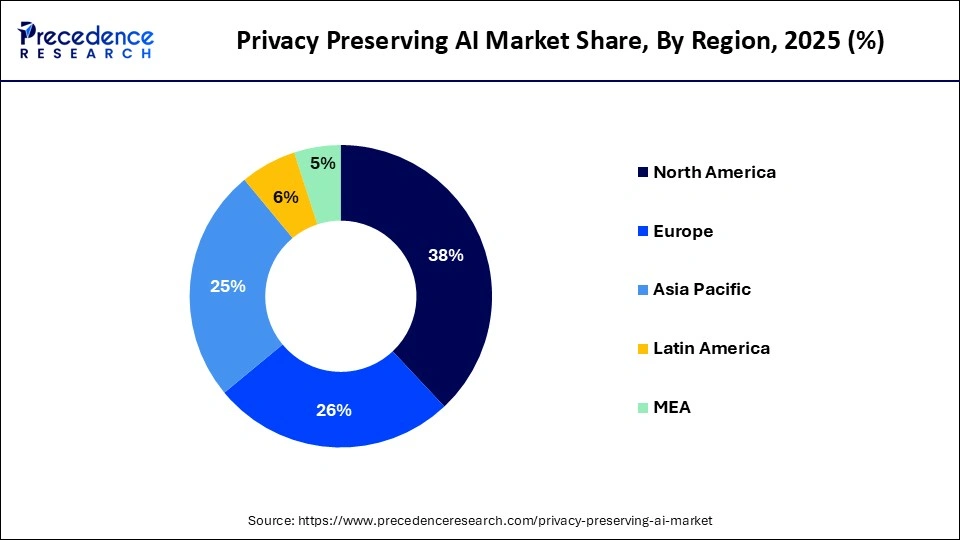
- North America dominated the market with a major market share of around 38% in 2025.
- Asia Pacific is expected to grow at the fastest CAGR between 2026 and 2035.
- By offering, the software platforms segment held the biggest market share of around 48% in 2025.
- By offering, the infrastructure and security modules segment is expected to expand at the fastest CAGR between 2026 and 2035.
- By technology, the federated learning segment accounted for the largest market share of about 29% in 2025.
- By technology, the homomorphic encryption segment is projected to grow at a solid CAGR between 2026 and 2035.
- By deployment mode, the cloud-based segment contributed the highest market share of around 54% in 2025.
- By deployment mode, the hybrid deployments segment is growing at a strong CAGR between 2026 and 2035.
- By application, the data privacy and secure analytics segment held a major market share of around 31% in 2025.
- By application, the healthcare data collaboration segment is expected to expand at a notable CAGR from 2026 to 2035.
- By industry vertical, the banking, financial services, and insurance (BFSI) segment captured the highest market share of 28% in 2025.
- By industry vertical, the healthcare and life sciences segment is poised to grow at a healthy CAGR between 2026 and 2035.
What is the Privacy Preserving AI Market?
The global privacy preserving AI market comprises technologies and platforms that enable artificial intelligence systems to process and analyze sensitive data while maintaining strict privacy protections. These technologies allow organizations to train AI models without exposing raw data through techniques such as federated learning, differential privacy, homomorphic encryption, and secure multi-party computation. Privacy-preserving AI solutions are widely used in sectors that handle highly sensitive data, including healthcare, finance, telecommunications, and government. Increasing regulatory requirements for data protection and the expansion of AI-driven analytics are major drivers of market growth.
Key Technological Shifts in the Privacy Preserving AI Market
The privacy preserving AI market is shifting from static, perimeter-based security to active, privacy-enhancing computation (PEC) and decentralized AI, driven by strict regulations and the intense demand to train models on private data. Models are increasingly brought to the data rather than moving data to a central server, allowing collaborative training across institutions while keeping data local. Instead of using real, sensitive data, organizations are generating privacy-safe synthetic data that retains the statistical patterns of the original data, mitigating risks of data leakage and re-identification. The integration of zero-knowledge proofs ensures that AI computations are both private and verifiable.
Major Market Trends
- Increased Federated Learning and Decentralized AI: Federated learning sends the AI model to the data, allowing models to learn from decentralized data without ever accessing raw, private information.
- Demand for Synthetic Data Generation for Training: Organizations are increasingly using generative AI to create synthetic data that mimics the statistical properties of real data but does not contain actual personal identifiers (PII).
- Adoption of Confidential Computing and Homomorphic Encryption: Confidential computing uses hardware-based Trusted Execution Environments (TEEs) to protect data during processing, ensuring that sensitive data is never exposed even while being processed in the cloud.
- Privacy-by-Design and AI Governance Frameworks: Privacy is moving from a compliance check to a fundamental design requirement. Organizations are adopting AI Risk Management Frameworks and Data Protection Impact Assessments to build privacy-preserving techniques into the AI lifecycle.
Market Scope
| Report Coverage | Details |
| Market Size in 2025 | USD 4.25 Billion |
| Market Size in 2026 | USD 5.32 Billion |
| Market Size by 2035 | USD 39.93 Billion |
| Market Growth Rate from 2026 to 2035 | CAGR of 25.10% |
| Dominating Region | North America |
| Fastest Growing Region | Asia Pacific |
| Base Year | 2025 |
| Forecast Period | 2026 to 2035 |
| Segments Covered | Offering, Technology, Deployment Mode , Application, Industry Vertical ,and region |
| Regions Covered | North America, Europe, Asia-Pacific, Latin America, and Middle East & Africa |
Segment Insights
Offering Insights
What Made Software Platforms the Dominant Segment in the Privacy Preserving AI Market?
The software platforms segment dominated the market with approximately 48% share in 2025. This is primarily because these platforms provide essential tools that simplify complex cryptographic techniques, such as homomorphic encryption and federated learning. They bundle encryption libraries, secure training environments, and governance dashboards, reducing the need for organizations to assemble standalone and complex cryptographic tools. Additionally, stringent data protection regulations compel businesses to adopt software that automates data mapping, consent management, and audit documentation, making it easier to implement advanced privacy technologies.
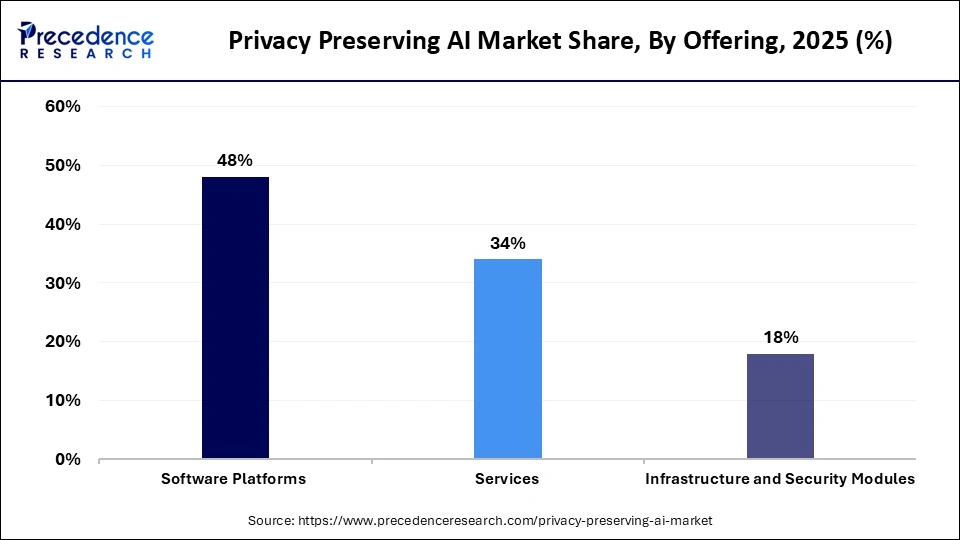
The infrastructure and security modules segment is projected to experience the fastest growth during the forecast period. This growth is driven by the increasing demand for confidential computing, hardware security modules, and secure, compliant data, which support advanced privacy-enhancing technologies. As organizations transition AI workloads to the cloud, there is a significant surge in the need for confidential computing through Trusted Execution Environments to isolate and secure data during processing by preventing data memorization, leaks, and model inversion attacks.
Technology Insights
How Did the Federated Learning Segment Lead the Privacy Preserving AI Market?
The federated learning segment led the market with about 29% share in 2025. This is due to its ability to enable collaborative model training across decentralized devices, such as smartphones, IoT devices, and hospital servers, without transferring raw data. Federated learning addresses the core challenge of data localization, allowing organizations to train AI models without moving data across geographical boundaries, which is crucial for compliance with strict privacy laws. Additionally, it integrates with other technologies to prevent information leakage during model aggregation.
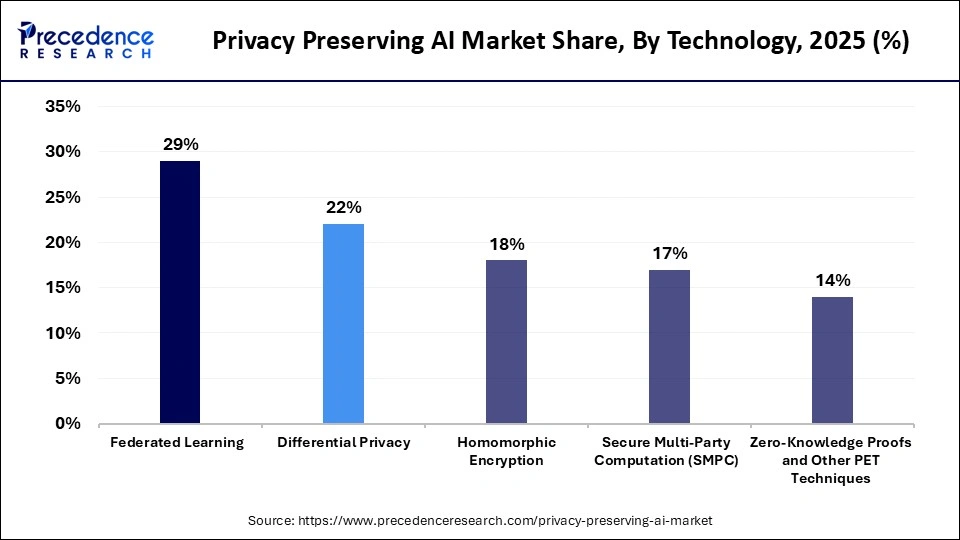
The homomorphic encryption segment is expected to grow at the fastest CAGR in the upcoming period because it allows AI models to train on and analyze encrypted data without requiring decryption. As AI adoption moves to the cloud, homomorphic encryption (HE) offers a zero-trust approach, ensuring data confidentiality even if a cloud provider is compromised. Major players, such as IBM, Microsoft, Google, and Zama, are investing in open-source tools, which lowers the barriers for integrating HE with AI. The implementation of stringent laws demanding data protection is driving the adoption in highly regulated sectors.
Deployment Mode Insights
Why Did the Cloud-Based Segment Dominate the Privacy Preserving AI Market?
The cloud-based segment dominated the market while holding about 54% share in 2025. The segment's dominance is attributed to the provision of scalable, on-demand infrastructure that integrates advanced privacy-enhancing technologies. These cloud platforms eliminate the need for significant upfront infrastructure investments, allowing smaller firms to access advanced, secure AI tools. They provide the computational power necessary for complex cryptographic techniques, which require extensive processing resources. Furthermore, these platforms facilitate the rapid and secure deployment of AI models across distributed data sources, addressing data security concerns effectively.
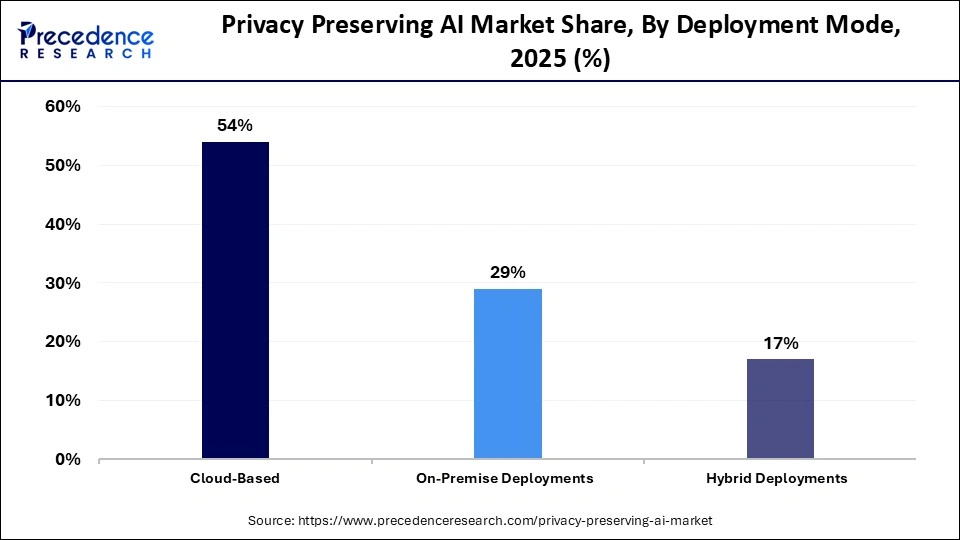
The hybrid deployments segment is expected to expand at the fastest rate during the forecast period. The growth of the segment is primarily attributed to the ideal balance these models offer between strict data sovereignty regulations and the need for cloud scalability. Hybrid models allow organizations to keep sensitive data in-country or on-premises, ensuring compliance. They permit companies to utilize on-premises infrastructure for data storage and security, while offloading heavy, encrypted training workloads to high-performance public clouds, minimizing the risk of data breaches during transit.
Application Insights
What Made Data Privacy and Secure Analytics the Leading Segment in the Privacy Preserving AI Market?
The data privacy and secure analytics segment led the market with about 31% share in 2025. This is because it enables organizations to extract insights from sensitive data, such as financial records, healthcare PHI, and personal PII, without compromising privacy. Technologies like homomorphic encryption, differential privacy, synthetic data generation, and confidential computing allow AI models to train and analyze data securely, minimizing the risk of breaches. The growing regulatory requirements for data protection and the need for cross-organizational collaboration further drive adoption, making this segment the most critical and fastest-growing in the market.
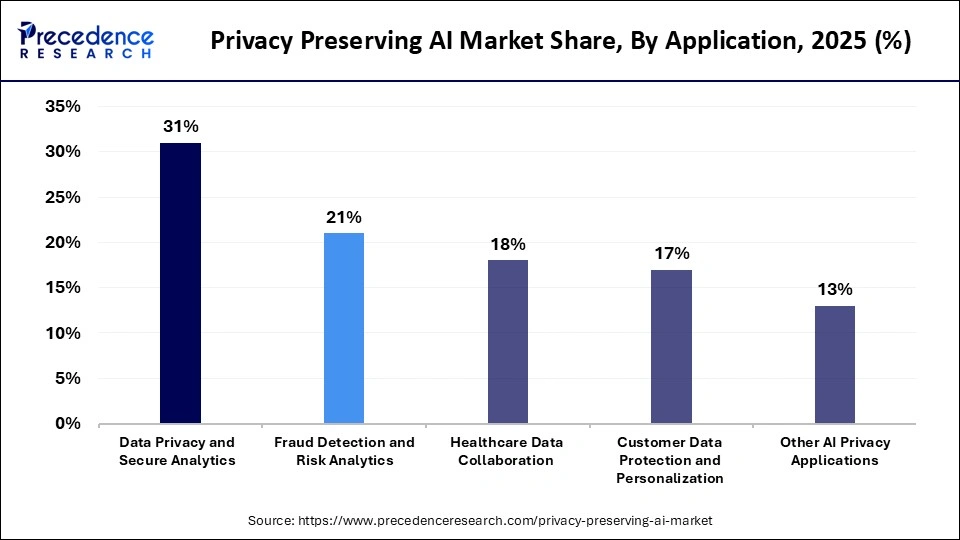
The healthcare data collaboration segment is expected to experience the fastest growth in the market. This growth is primarily driven by the urgent demand to unlock insights from siloed patient data while adhering to strict regulations. Technologies such as federated learning and data clean rooms enable institutions to collaborate on AI model training without exposing raw, sensitive, or personal health information. Privacy-preserving technologies accelerate drug discovery and clinical trials by enabling secure, cross-organizational analysis of genomics and patient records.
Industry Vertical Insights
Why Did the BFSI Segment Dominate the Privacy Preserving AI Market?
The banking, financial services, and insurance (BFSI) segment dominated the market with about 28% share in 2025. This is mainly due to the intense need for security, compliant data analysis, and fraud detection. BFSI institutions collaboratively train models for anti-money laundering and credit scoring across multiple banks without sharing sensitive, proprietary customer records. By adopting Privacy-Enhancing Technologies, banks can boost customer confidence, ensuring secure AI adoption in personalized banking services. The industry's high investment capacity in data security solutions, with a focus on adopting advanced technology, will push adoption.
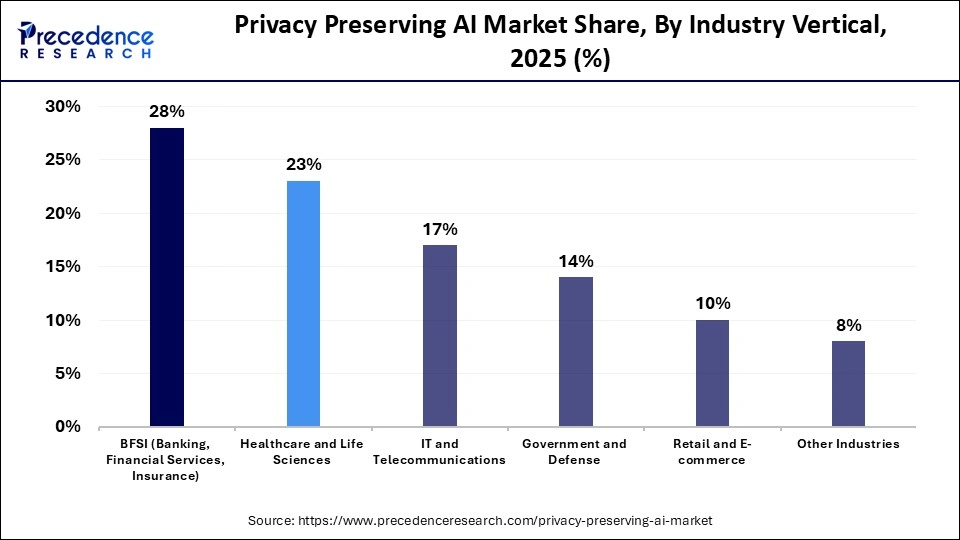
The healthcare and life sciences segment is expected to grow at the fastest rate during the forecast period. This is mainly due to the sensitive nature of medical data, including patient records, genomic information, and clinical trial datasets, which require strict privacy protections. Adoption of technologies like homomorphic encryption, differential privacy, and federated learning allows AI models to analyze data securely without exposing personal information. Increasing investments in AI-driven diagnostics, drug discovery, and personalized medicine, along with stringent data privacy regulations such as HIPAA, are further driving the demand for privacy-preserving AI solutions in this sector.
Regional Insights
North America Privacy Preserving AI Market Size and Growth 2026 to 2035
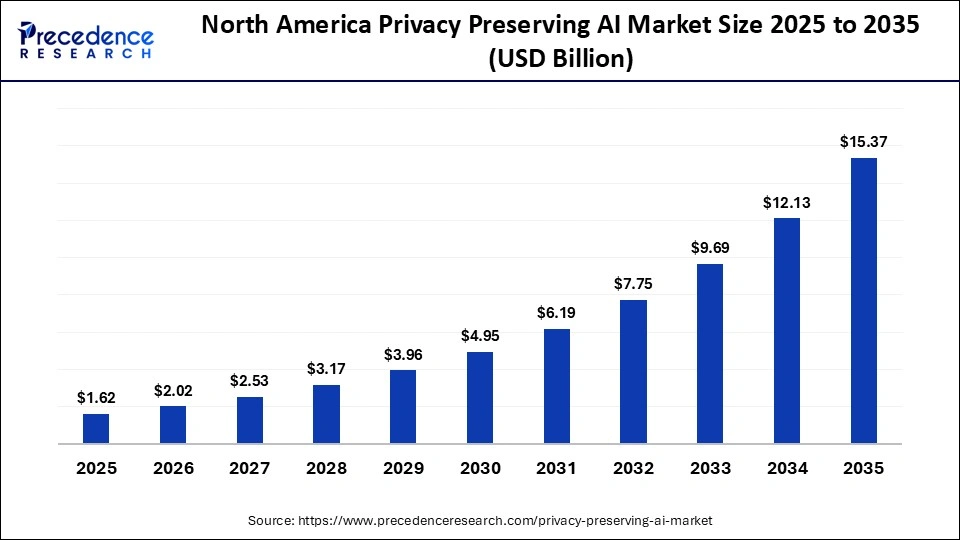
The North America privacy preserving AI market size is estimated at USD 1.62 billion in 2025 and is projected to reach approximately USD 15.37 billion by 2035, with a 25.23% CAGR from 2026 to 2035.
How Did North America Dominate the Privacy Preserving AI Market?
North America dominated the market while holding about 38% share in 2025. This dominance mainly stems from stringent regulations, heavy investment from tech giants, and advanced infrastructure. Robust data protection laws, such as the California Consumer Privacy Act (CCPA) and various state-level privacy acts, force companies to implement Privacy-Enhancing Technologies (PETs) to avoid heavy fines. The region hosts leading AI companies, including Google, Microsoft, AWS, and IBM, that invest heavily in federated learning, homomorphic encryption, and differential privacy. The BFSI sector in the region heavily uses these tools for secure fraud detection, and healthcare uses them for collaborative research without sharing patient data.
U.S. Privacy Preserving AI Market Size and Growth 2026 to 2035
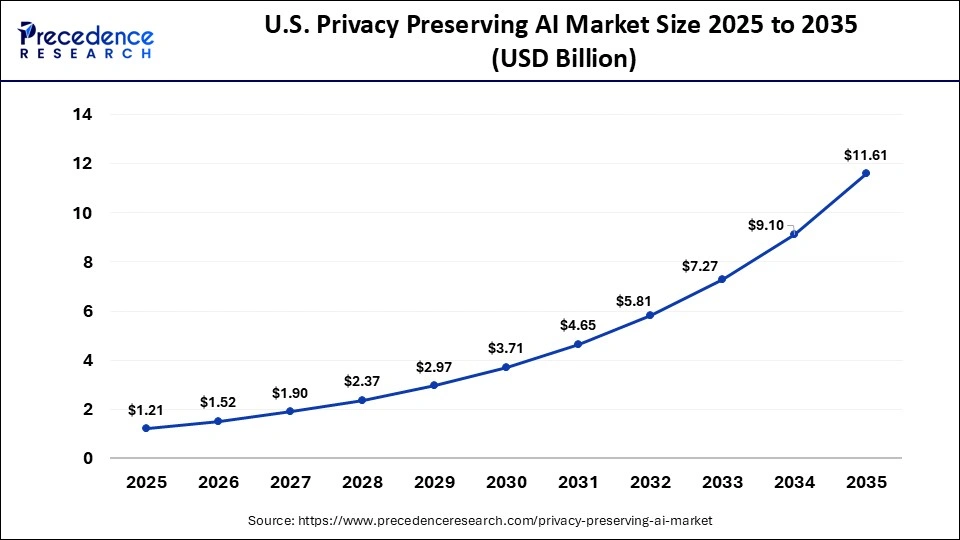
The U.S. privacy preserving AI market size is calculated at USD 1.21 billion in 2025 and is expected to reach nearly USD 11.61 billion in 2035, accelerating at a strong CAGR of 25.37% between 2026 and 2035.
U.S. Privacy Preserving AI Market Trends
The U.S. plays a dominant role within the region, mainly because it sets benchmarks for responsible AI, often emphasizing voluntary standards and industry-led frameworks for secure, cross-border AI adoption. U.S. tech giants, including IBM, Google, Microsoft, and AWS, are integrating privacy-enhancing technologies with cloud computing to maintain data utility. High-volume investment is fueling a robust ecosystem of privacy-focused startups.
Why is Asia Pacific Considered the Fastest-Growing Region in the Privacy Preserving AI Market?
Asia Pacific is expected to grow at the fastest CAGR during the forecast period. This is mainly due to rapid digitalization, strict new data sovereignty laws, and the need to unlock siloed data for AI training. The explosion of digital payments, such as UPI in India, Alipay, or WeChat Pay in China, creates a massive need for AI fraud detection that keeps user data private. New laws, such as India's Digital Personal Data Protection Act and China's Interim Generative AI Measures, require strict data handling, forcing companies to adopt Privacy-Enhancing Technologies and demand solutions for collaborative AI training.
India Privacy Preserving AI Market Trends
India represents an emerging market within the region, mainly due to its massive datasets and a large workforce in data science and machine learning. The Digital Personal Data Protection Act (2023) enforces strict, centralized, and consent-first data management, forcing local adoption of privacy-preserving techniques. India uses its unique, decentralized Data Empowerment and Protection Architecture (DEPA) to enable secure data collaboration and adopt on-device AI and confidential computing to comply with data regulations.
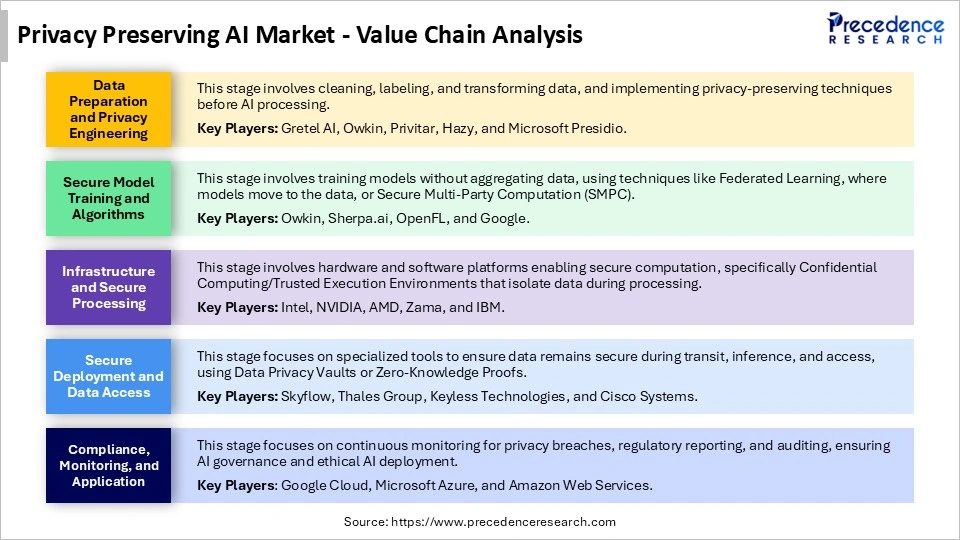
Privacy Preserving AI Market Value Chain Analysis
Privacy Preserving AI Market Companies
- IBM
- Microsoft
- Amazon Web Services (AWS)
- NVIDIA
- Zama
- Duality Technologies
- Intel Corp.
- Palantir Technologies
- Apple Inc.
- Owkin Inc.
- Meta
- Cisco Systems Inc.
- Private AI
- Enveil
Recent Developments
- In February 2026, Dataiku launched the 575 Lab, its Open Source Office, introducing two toolkits to enhance AI system transparency and governance. The projects include Agent Explainability Tools to clarify multi-step agent workflows for data scientists and compliance teams, and Privacy-Preserving Proxies to secure sensitive data while using closed-source models. Hannes Hapke, Director of the 575 Lab, emphasized the importance of trust in open source as AI systems become more autonomous.(Source: https://www.businesswire.com)
- In August 2025, Google unveiled VaultGemma, a small language model (SLM) with one billion parameters, trained using differential privacy to protect training data. Developed with input from DeepMind, this model is part of Google's Gemma family and aims to facilitate the exploration of privacy-preserving AI. VaultGemma can safely handle sensitive datasets without memorizing specific details, ensuring compliance with strict differential privacy standards.(Source: https://www.varindia.com)
- In March 2025, Canonical announced that Ubuntu Confidential VMs are available on Google Cloud's A3 series, featuring NVIDIA H100 Tensor Core GPUs. This combination provides secure, high-performance AI computing, addressing the need for data protection in industries relying on sensitive information. Ubuntu is the first OS to support Confidential GPU on Google Cloud, offering privacy and integrity across the AI lifecycle.(Source: https://canonical.com)
Segments Covered in the Report
By Offering
- Software Platforms
- Privacy-preserving AI development tools
- Secure AI model training platforms
- Services
- AI implementation and consulting
- Data privacy compliance services
- Infrastructure and Security Modules
By Technology
- Federated Learning
- Differential Privacy
- Homomorphic Encryption
- Secure Multi-Party Computation (SMPC)
- Zero-Knowledge Proofs and Other PET Techniques
By Deployment Mode
- Cloud-Based
- On-Premise Deployments
- Hybrid Deployments
By Application
- Data Privacy and Secure Analytics
- Fraud Detection and Risk Analytics
- Healthcare Data Collaboration
- Customer Data Protection and Personalization
- Other AI Privacy Applications
By Industry Vertical
- BFSI (Banking, Financial Services, Insurance)
- Healthcare and Life Sciences
- IT and Telecommunications
- Government and Defense
- Retail and E-commerce
- Other Industries
By Region
- North America
- Europe
- Asia-Pacific
- Latin America
- Middle East & Africa
For inquiries regarding discounts, bulk purchases, or customization requests, please contact us at sales@precedenceresearch.com
Frequently Asked Questions





Ask For Sample
No cookie-cutter, only authentic analysis – take the 1st step to become a Precedence Research client
 Get a Sample




 sales@precedenceresearch.com
 Schedule a Meeting
