



Process Plants Gas Turbine Market Trends, Companies, Contract Wins / Project Pipeline, Installed Capacity, Power Generation, Government Investment, Technology Adoption, Competitive Positioning, and Growth Forecast
Process Plants Gas Turbine Market (By Product Type: Heavy-Duty Gas Turbines, Aero-Derivative Gas Turbines; By Technology: Combined Cycle, Open Cycle; By Capacity: < 1 MW, 1-30 MW, >30-200 MW, >200 MW; By Application: Power Generation, Oil & Gas Processing, Chemical & Petrochemical, Others (e.g., CHP); By End-User: Process & Industrial Plants, Utilities/Power Producers, Oil & Gas Operators) - Global Industry Analysis, Size, Trends, Leading Companies, Regional Outlook, and Forecast 2026 to 2035
Source: https://www.precedenceresearch.com/process-plants-gas-turbine-market
 Get a Sample
 Table Of Content


What is the Process Plants Gas Turbine Market Size in 2026?
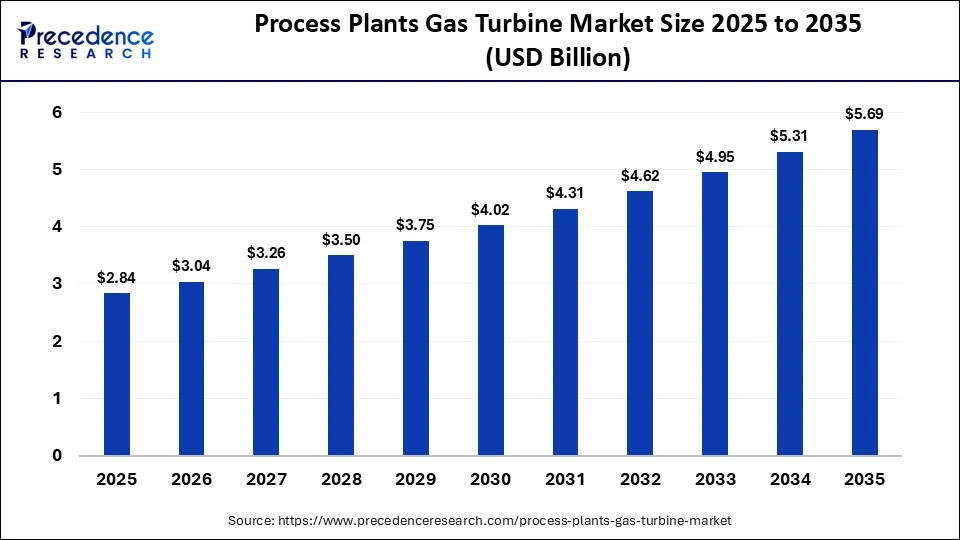
The global process plants gas turbine market size accounted for USD 2.84 billion in 2025 and is predicted to increase from USD 3.04 billion in 2026 to approximately USD 5.69 billion by 2035, expanding at a CAGR of 7.20% from 2026 to 2035. The market is driven by rising industrial power demand and the need for efficient, low-emission energy solutions.
Key Takeaways
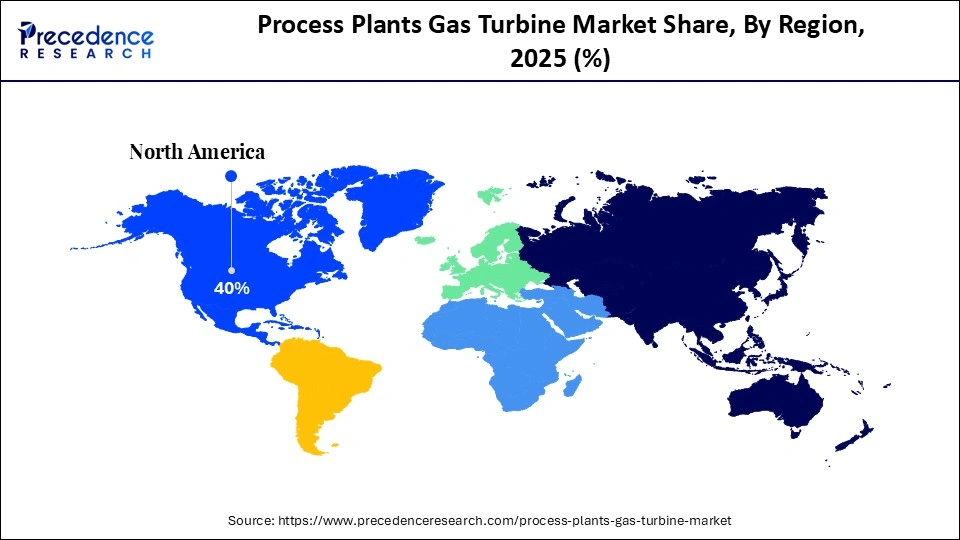
- North America dominated the process plants gas turbine market with a share of 40% in 2025.
- The Asia Pacific is expected to grow at a CAGR of 7.6% in the market during the forecast period.
- By product type, the heavy-duty gas turbines segment held a dominant position in the market with a share of 65% in 2025.
- By product type, the aero-derivative gas turbines segment is expected to grow at the fastest CAGR of 6.0% in the market between 2026 and 2035.
- By technology, the combined cycle segment held a major revenue share of 60% in the market in 2025.
- By technology, the open cycle segment is expected to grow with the highest CAGR of 6.1% in the market during the studied years.
- By capacity, the >30-200 mw segment led the global market with a share of 40% in 2025.
- By capacity, the 1-30 mw segment is expected to expand rapidly in the market with a CAGR of 6.3% in the coming years.
- By application, the power generation segment registered its dominance in the global market with a share of 40% in 2025.
- By application, the chemical & petrochemical segment is expected to expand at the fastest CAGR of 6.5% over the forecast period.
- By end-user, the process & industrial plants segment dominated the global market with a share of 50% in 2025.
- By end-user, the oil & gas operators segment is expected to grow at a CAGR of 6.6% between 2026 and 2035.
Market Overview
The process plants gas turbine market entails industrial gas turbine plants that are utilized in oil and gas, petrochemicals, refineries, and chemical plants. These turbines offer a local power supply and power-mechanical assistance. Gas turbines come in heavy-duty and aero-derivative designs. They are capable of working in either an open cycle or a combined cycle. They also emit fewer emissions than coal-based power systems.
The increasing industrialization and the expansion of refinery capacities boost market growth. The adoption is also supported by the increasing power generation requirement. Stringent environmental laws are promoting the adoption of cleaner natural gas-powered turbines. Digital monitoring and fuel flexibility are technological innovations that are boosting the growth of markets in most parts of the world.
How is AI Influencing the Process Plants Gas Turbine Market?
The process plants gas turbine market is being revolutionized by artificial intelligence, which is increasing operational efficiency, reliability, and performance. AI-based analytics are combined with sophisticated sensors and control to detect the actual turbine condition in terms of temperature, pressure, vibration, fuel flow, and exhaust composition and provide it in real-time. AI is also useful in optimizing combustion as it varies the proportion of fuel-air to maximize efficiency and reduce emissions. Additionally, AI-driven insights support lifecycle management, enabling plants to extend turbine lifespan, plan maintenance strategically, and meet stricter environmental and operational standards, making gas turbine operations smarter and more cost-effective.
Process Plants Gas Turbine Market Trends
- The installation of combined heat and power systems in refineries and chemical plants is increasing to enhance the efficiency of energy and reduce the overall use of emissions.
- Rising use of aero-derivative gas turbines due to their fast start-up, operational flexibility, and ability to handle variable industrial loads.
- Implementation of digital monitoring, predictive maintenance, and AI-based performance analytics is rising to improve the reliability of turbines, minimize downtime, and optimize the efficiency of lifecycle management.
- Growing demand for low-emission and hydrogen-ready gas turbines to meet stringent environmental regulations and support industrial decarbonization.
- Growing natural gas infrastructure development and expansion of petrochemical and refinery capacities are boosting the deployment of on-site gas turbine solutions.
Market Scope
| Report Coverage | Details |
| Market Size in 2025 | USD 2.84 Billion |
| Market Size in 2026 | USD 3.04 Billion |
| Market Size by 2035 | USD 5.69 Billion |
| Market Growth Rate from 2026 to 2035 | CAGR of 7.20% |
| Dominating Region | North America |
| Fastest Growing Region | Asia Pacific |
| Base Year | 2025 |
| Forecast Period | 2026 to 2035 |
| Segments Covered | Product Type, Technology, Capacity, Application, End-User, and Region |
| Regions Covered | North America, Europe, Asia-Pacific, Latin America, and Middle East & Africa |
Segment Insights
Product Type Insights
Why Did the Heavy-Duty Gas Turbines Segment Dominate the Market?
The heavy-duty gas turbines segment dominated the process plants gas turbine market, holding the largest share of 65% in 2025. This is because these turbines are suitable for large-scale and continuous industrial operations. These turbines are heavily used in refineries, petrochemical complexes, and chemical plants where high power output and extensive periods of operation are necessary. Heavy-duty turbines are built to be used in baseload requirements, where they have good durability and good efficiency in combined cycle systems, and they are less expensive to operate on a per megawatt basis during long lifecycles. A large number of process facilities are inclined toward heavy-duty turbine systems due to their proven effectiveness and the possibility of integration with heat recovery steam generators to cogenerate.
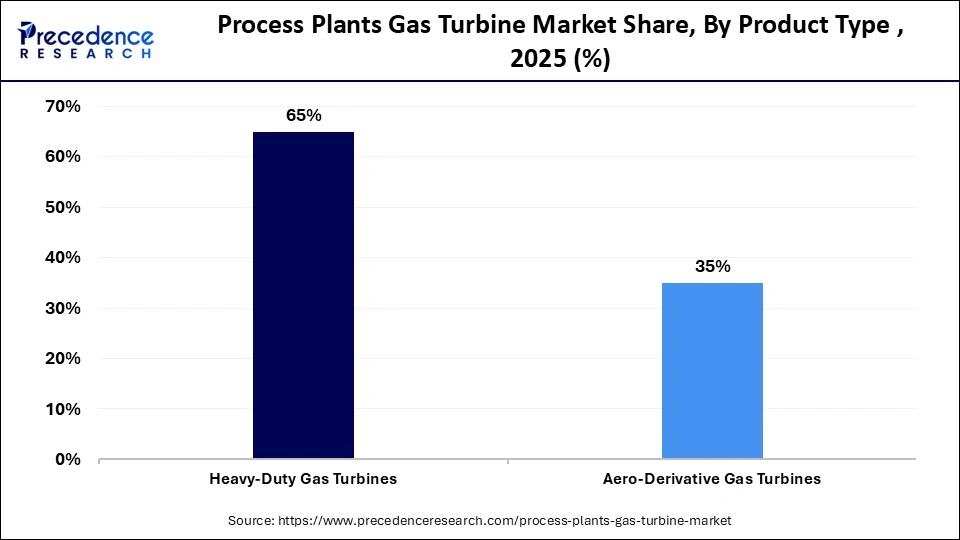
The aero-derivative gas turbines segment is expected to grow at a healthy CAGR of 6.0% in the market between 2026 and 2035. The growth of the segment is driven by rising demand for operational flexibility and rapid start-up capabilities. Modeled on aircraft engines, these turbines are lighter, smaller, and can reach full load quickly, making them ideal for variable industrial power requirements. Their efficiency under part-load conditions, shorter installation times, and compact footprint make them especially suitable for process industries, offshore platforms, and space-constrained facilities.
Technology Insights
Why Did the Combined Cycle Segment Lead the Process Plants Gas Turbine Market?
The combined cycle segment led the global market with a share of 60% in 2025 because of its high efficiency and energy optimization. Combined cycle systems take waste heat in the exhaust of the gas turbine and feed it into a heat recovery steam generator to generate more power in a steam turbine. Combined cycle technology is popular in the process industries due to the fact that it consumes less fuel, as well as operating costs and greenhouse gas emissions are minimized. This technology is greatly favored by refineries and petrochemical facilities that have constant power and steam demand.
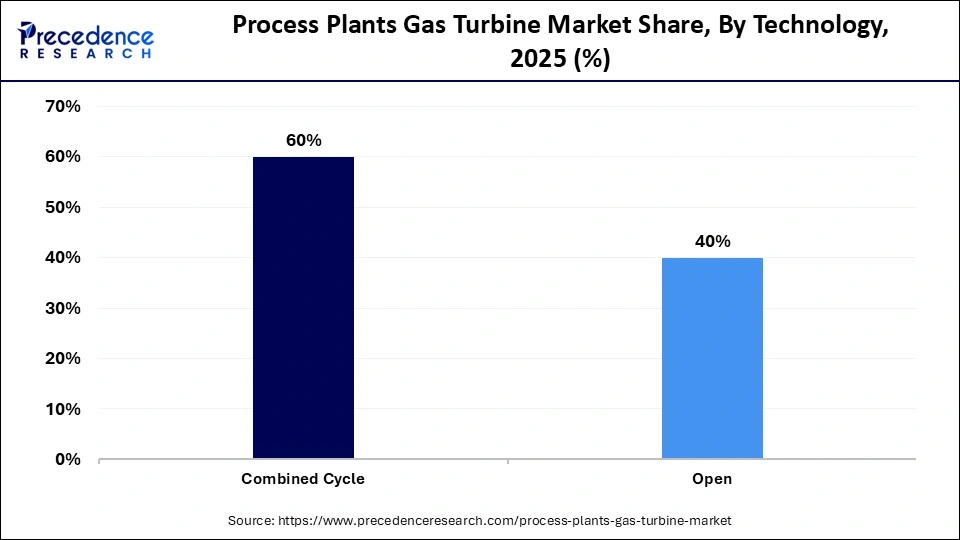
The open cycle segment is expected to grow at a robust CAGR of 6.1% between 2026 and 2035 because of its simple operation and easy and rapid deployment. The open-cycle gas turbine systems produce power without the use of exhaust heat to produce more energy, so they are applicable in peak load and emergency power production. Open cycle systems are used in many process plants as a backup power source or when operations are only a few minutes long, and a quick start-up is essential. Reduced start-up and reduced installation periods further encourage the growth of the segment, especially in emerging industrial areas.
Capacity Insights
Why Did the >30-200MW Segment Dominate the Process Plants Gas Turbine Market?
The >30-200 dominated the market with a 40% share in 2025 because this capacity range perfectly balances efficiency, flexibility, and cost-effectiveness for industrial and utility applications. Turbines in this range can meet the significant power demands of refineries, petrochemical plants, and manufacturing facilities while still allowing for operational flexibility and part-load efficiency. Their size and output make them suitable for both baseload and peak-demand operations, supporting continuous industrial processes and grid stability. Additionally, the widespread adoption of combined heat and power (CHP) systems and on-site generation solutions in this capacity range have further reinforced its market dominance.
The 1-30 MW segment is expected to expand at a CAGR of 6.3% over the forecast period, driven by the rising demand for medium-scale industrial power generation. Turbines with this capacity range provide a perfect tradeoff between the power output, efficiency, and cost, and hence they are suitable in refineries, petrochemical complexes, and large manufacturing plants. This range of capacity is preferable in industries to install combined heat and power facilities, which are effective in the production of electricity and steam. The fast rate of industrialization of the emerging economies is increasing the use of mid-sized turbines to serve the growing production plants.
Application Insights
Why Did the Power Generation Segment Dominate the Process Plants Gas Turbine Market?
The power generation segment dominated the global market with a share of 40% in 2025, since utilities and industrial facilities rely heavily on gas turbines to meet continuous and high electricity demands. Gas turbines provide fast start-up, operational flexibility, and high efficiency, making them suitable for both base-load and peak-load power generation. The growing adoption of on-site generation and combined heat and power (CHP) systems in process plants has further increased demand. Additionally, strict environmental regulations and the need for cleaner, low-emission power solutions have encouraged the replacement of older units with modern gas turbines, reinforcing the segment's dominance.
Process Plants Gas Turbine Market Share, By Application, 2025 (%)
| Application | Market Share (%) |
| Power Generation | 40% |
| Oil and Gas Processing | 30% |
| Chemical and Petrochemical | 20% |
| Others | 10% |
The chemical & petrochemical segment is expected to expand rapidly in the market with a CAGR of 6.5% in the coming years because of rising production capacity and increasing demand for specialty and bulk chemicals. The high-temperature heat and constant power consumed by these industries demand a continuous power supply with good reliability, which is only achievable through the use of gas turbines in combined heat and power. The increasing investments in petrochemical complexes, particularly in Asia and the Middle East, are increasing turbine installations. Additionally, the focus on energy efficiency and emission reduction is accelerating the adoption of modern gas turbine systems in this sector.
End-User Insights
Why Did the Process & Industrial Plants Segment Lead the Process Plants Gas Turbine Market?
The process & industrial plants segment held a major revenue share of 50% in the market in 2025, as there is massive use of gas turbines to provide continuous power and steam. Refineries, large manufacturing plants, and processing plants use gas turbines to ensure that they can be stable in operation. These plants focus on energy efficiency, cost optimization as well as emission compliance, and as a part of their energy strategy, turbine systems are considered. The installations of combined heat and power are widespread, especially in industrial plants, to meet the requirements of electricity and thermal energy.
The oil & gas operators segment is expected to grow at the fastest CAGR of 6.6% over the forecast period, owing to the increasing upstream and midstream operations. Gas turbines are popular in drill sites, offshore platforms, and pipeline compression stations to provide reliable power and mechanical drive applications. The need to explore new places, such as remote and offshore areas, demands the ability to have long-lasting and efficient turbine systems. Advanced turbines are also being used by the operators to comply with stricter standards of emission and enhance efficiency in their operations. Increasing investment in the LNG infrastructure and gas processing facilities also contributes to the related growth of segments.
Region Insights
North America Process Plants Gas Turbine Market Size and Growth 2026 to 2035
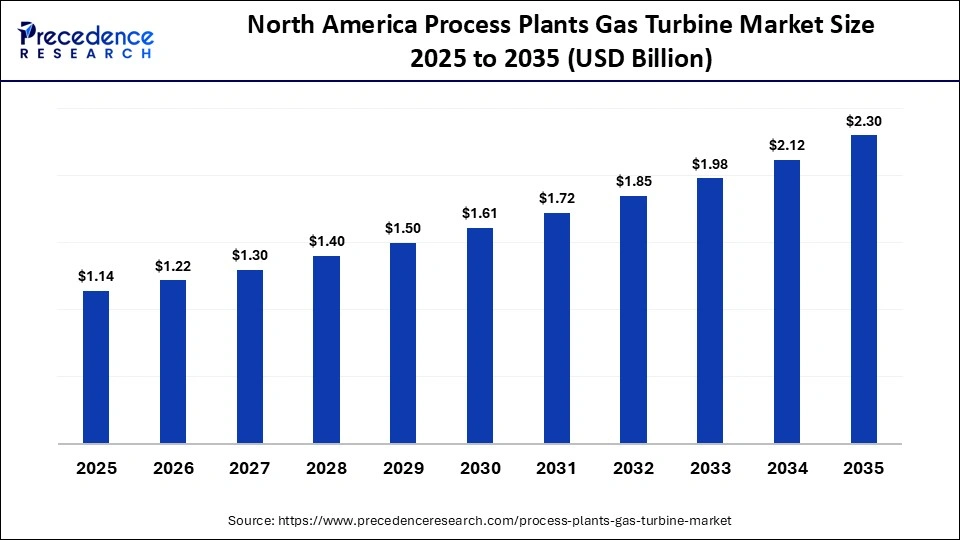
The North America process plants gas turbine market size is estimated at USD 2 billion in 2025 and is projected to reach approximately USD 5 billion by 2035, with a 2% CAGR from 2026 to 2035.
Why Did North America Lead the Global Process Plants Gas Turbine Market?
North America dominated the global process plants gas turbine market with a major share of 40% in 2025. This is because of its large industrial structure and expanding oil and gas exploration and production activities. The U.S. and Canada lead in refinery, petrochemical, and shale gas production, sustaining steady demand for gas turbines. Energy-intensive mining operations in the region further drive turbine usage for long-distance power supply. Regional dominance is reinforced by technological innovations and the presence of major turbine manufacturers, supporting continuous adoption and market growth.
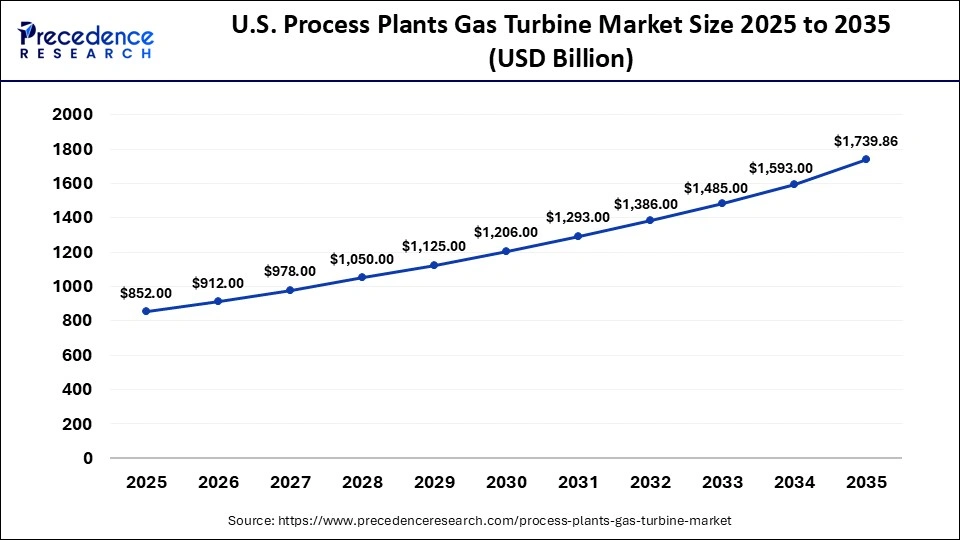
U.S. Process Plants Gas Turbine Market Size and Growth 2026 to 2035
The U.S. process plants gas turbine market size is calculated at USD 2 billion in 2025 and is expected to reach nearly USD 4 billion in 2035, accelerating at a strong CAGR of 2% between 2026 and 2035.
U.S. Market Analysis
The U.S. is considered the major contributor to the North American process plants gas turbine market due to increasing demand for reliable and efficient power generation in industrial and processing facilities. There is a rapid expansion of the oil & gas, petrochemical, and chemical processing sectors, which require high-capacity turbines to meet continuous energy demands. Additionally, the push for cleaner and more efficient energy solutions is driving the adoption of modern gas turbines with lower emissions and higher efficiency.
Why is Asia Pacific Undergoing the Fastest Growth in the Process Plants Gas Turbine Market?
Asia Pacific is expected to grow at the fastest CAGR of 7.6% in the upcoming period because of the rapid industrialization and increasing energy demand. Turbine installations are being triggered by the expansion of refineries and expanding petrochemical production capacity, especially in China, India, and Southeast Asia. Governments around the region are encouraging the use of cleaner energy technologies to lower the carbon intensity, driving the use of advanced gas turbines. Increasing investment in LNG infrastructure and industrial modernization also contributes to the growth of the market.
Process Plants Gas Turbine Market Companies
- General Electric
- Siemens Energy
- Mitsubishi Power, Ltd.
- Ansaldo Energia S.p.A.
- Baker Hughes Company
- Solar Turbines Incorporated
- Kawasaki Heavy Industries, Ltd.
- Rolls-Royce plc
- MAN Energy Solutions SE
- OPRA Turbines B.V.
- Bharat Heavy Electricals Limited (BHEL)
- Shanghai Electric Gas Turbine
- Flex Energy Solutions
- Vericor Power Systems
- Destinus Energy
Recent Developments
- In May 2025, Ansaldo Energia declared that the 1 GW Al Dhafra power plant commissioned by TAQA would run on their AE94.3A gas turbine in Abu Dhabi. The facility, which is projected to be commissioned by May 2027, should increase the reliability and energy security of the grid, and Ansaldo will provide the generators as well as the dominant installation and commissioning activities.(Source: https://www.enerdata.net)
- In May 2025, Baker Hughes won a contract with Frontier Infrastructure Holdings to supply 16 NovaLT gas turbines to date center projects in Texas and Wyoming. The turbines will also be able to produce up to 270 MW of dependable electricity, whereby Baker Hughes will also supply auxiliary systems and Brush generators to facilitate sustainable and technology-based energy solutions.(Source: https://investors.bakerhughes.com)
- In July 2025, Siemens Energy secured a USD 1.6 billion project, with Harbin Electric International as EPC contractor, to supply key technologies for the Rumah 2 and Nairyah 2 gas-fired power plants in Saudi Arabia. The plants, located in the western and central regions, will add 3.6 GW to the national grid, powering approximately 1.5 million homes. The deal also includes 25-year long-term maintenance agreements to ensure operational reliability.(Source: https://www.siemens-energy.com)
Segments Covered in the Report
By Product Type
- Heavy-Duty Gas Turbines
- Aero-Derivative Gas Turbines
By Technology
- Combined Cycle
- Open Cycle
By Capacity
- < 1 MW
- 1-30 MW
- >30-200 MW
- >200 MW
By Application
- Power Generation
- Oil & Gas Processing
- Chemical & Petrochemical
- Others (e.g., CHP)
By End-User
- Process & Industrial Plants
- Utilities/Power Producers
- Oil & Gas Operators
By Region
- North America
- Europe
- Asia-Pacific
- Latin America
- Middle East & Africa
For inquiries regarding discounts, bulk purchases, or customization requests, please contact us at sales@precedenceresearch.com
Frequently Asked Questions





Ask For Sample
No cookie-cutter, only authentic analysis – take the 1st step to become a Precedence Research client
 Get a Sample




 sales@precedenceresearch.com
 Schedule a Meeting
