



Procurement Software Market Trends, Companies, Revenue / Sales Performance, Subscriber Growth, Pricing Strategies, Cloud Adoption, Infrastructure Expansion, Competitive Landscape, and Industry Outlook
Procurement Software Market (By Deployment: Cloud-based, On-premise Hybrid; By Organization Size: Large Enterprises, Small & Medium Enterprises (SMEs); By Software/Module: Procure-to-Pay (P2P), Spend Analysis, E-Sourcing, Contract Lifecycle Management, Supplier Management; By End-User Industry: Manufacturing, Retail & Consumer Goods, BFSI, Healthcare, IT & Telecom, Others) - Global Industry Analysis, Size, Trends, Leading Companies, Regional Outlook, and Forecast 2026 to 2035
Source: https://www.precedenceresearch.com/procurement-software-market
 Get a Sample
 Table Of Content


What is the Procurement Software Market Size in 2026?
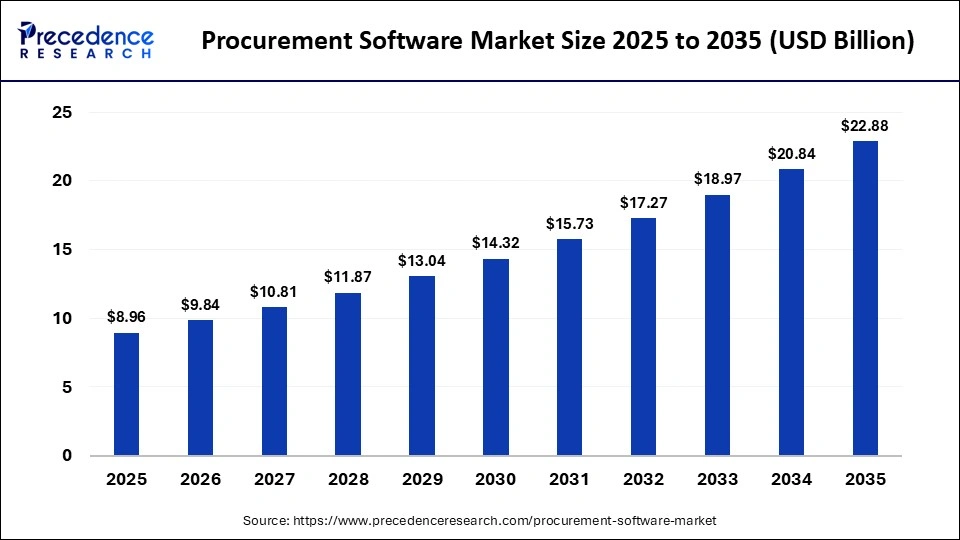
The global procurement software market size accounted for USD 8.96 billion in 2025 and is predicted to increase from USD 9.84 billion in 2026 to approximately USD 22.88 billion by 2035, expanding at a CAGR of 9.83% from 2026 to 2035. The inclusion of IT and related software in the procurement of goods and services enables real-time supplier risk-scoring, intelligent spend analysis, and autonomous negotiations.
Key Takeaways
- North America dominated the market in 2025.
- Asia Pacific is expected to grow at the fastest CAGR in the market during the forecast period.
- By deployment, the cloud-based segment dominated the market in 2025.
- By deployment, the hybrid segment in the market is expected to grow at a notable rate in the market during the forecast period.
- By organization size, the large enterprises segment dominated the market in 2025.
- By organization size, the small and medium enterprises segment is expected to grow at a significant rate in the market in 2025.
- By software/module, the procure-to-pay segment dominated the market in 2025.
- By software/module, the contract lifecycle management segment is expected to grow at the fastest CAGR in the market during the forecast period.
- By end-user industry, the manufacturing segment dominated the market in 2025.
- By end-user industry, the healthcare segment is expected to grow at the fastest CAGR in the market during the forecast period.
Procurement Software: Leading to Transformative Business Success
The procurement software market is leading due to a rapid shift from manual procurement processes to automated source-to-pay platforms. These platforms manage complex global supply chains and meet environmental sustainability goals. The prominent players like Coupa and SAP Ariba have integrated AI Copilots to automate contract drafting. Autonomous agents began to handle repetitive purchases and low-value tasks without manual intervention. The procurement software is designed to support onshoring and nearshoring strategies, which help to avoid supply chain disruptions.
How does AI Revolutionise the Procurement Software Market?
AI agents contribute to the sourcing and automatic negotiation for routine contracts across the massively expanding procurement software market. AI reduces legal review cycles by up to 90% and automates contract drafting that leads to precise contract management. AI and ML tools are leading in predictive analytics, which monitor weather, news, and financial data to offer early warning signals for supply chain disruptions. Machine learning is essential for spend analytics and drives operational efficiency.
Procurement Software Market Trends
- Integration of AI and Advanced Analytics: The emerging digital procurement trends in the procurement software market include the integration of generative AI and advanced analytics into procurement processes. AI-powered tools help procurement teams to analyze real-time data, improve decision-making, and enhance operational efficiency.
- Rise of Agile Procurement Processes: The companies are shifting towards agile procurement methods, which focus on speed, flexibility, and the ability to respond immediately to changes in the market. Procurement teams are utilizing digital tools to streamline their workflows.
- Procurement Technology Platforms: Cloud-based procurement platforms enable organizations to manage contracts, centralize supplier data, and streamline approvals more efficiently. With the integration of procurement software, teams monitor supplier performance, track key metrics in real-time, and reduce manual intervention, which leads to greater operational efficiency.
- Risk Management Strategies: With the rise of more complex global supply chains, procurement teams are expanding their risk management approaches to better handle supply chain disruptions. The use of risk assessment tools allows companies to monitor economic changes, supplier performance, and geopolitical events in real-time.
- Increased Focus on Sustainability: The companies are highly prioritizing the integration of sustainable practices throughout their procurement processes. This includes efforts to reduce environmental impact, ethical sourcing, and ensure compliance with global sustainability standards.
Market Scope
| Report Coverage | Details |
| Market Size in 2025 | USD 8.96 Billion |
| Market Size in 2026 | USD 9.84 Billion |
| Market Size by 2035 | USD 22.88 Billion |
| Market Growth Rate from 2026 to 2035 | CAGR of 9.83% |
| Dominating Region | North America |
| Fastest Growing Region | Asia Pacific |
| Base Year | 2025 |
| Forecast Period | 2026 to 2035 |
| Segments Covered | Deployment, Organization Size, Software/Module, End-User Industry, and Region |
| Regions Covered | North America, Europe, Asia-Pacific, Latin America, and Middle East & Africa |
Market Dynamics
Driver
Increasing Demand for Procurement Automation and Cost Optimization
Organizations are increasingly adopting procurement software to automate purchasing processes, supplier management, contract administration, and spend analysis. As businesses seek to reduce manual workloads and improve operational efficiency, procurement platforms help streamline workflows, minimize errors, and accelerate decision-making. The growing focus on cost optimization, transparency, and strategic sourcing is driving the widespread adoption of procurement software across industries.
Restraint
High Implementation Complexity and Integration Challenges
The implementation of procurement software is complex, particularly for large enterprises operating with legacy systems and multiple business applications. Integrating procurement platforms with existing enterprise resource planning (ERP), finance, and supply chain systems often requires significant time, technical expertise, and investment. These challenges can delay deployment timelines and discourage some organizations, especially small and medium-sized businesses, from adopting advanced procurement solutions.
Opportunity
Expansion of AI-Powered Procurement and Predictive Analytics
The growing integration of artificial intelligence (AI) and predictive analytics presents a significant opportunity for the procurement software market. AI-enabled procurement solutions can analyze spending patterns, identify sourcing opportunities, predict supplier risks, and automate routine procurement decisions. As organizations increasingly prioritize data-driven procurement strategies and supply chain resilience, demand for intelligent procurement platforms is expected to grow substantially in the coming years.
Segmental Insights
Deployment Insights
How Did the Cloud-based Segment Dominate the Procurement Software Market in 2025?
The cloud-based segment dominated the market in 2025 due to the increasing adoption of Software-as-a-Service (SaaS) solutions among organizations of all sizes, particularly small and medium-sized enterprises (SMEs). Cloud-based procurement platforms offer scalability, flexibility, lower upfront costs, and faster deployment compared to on-premises solutions. Businesses are increasingly leveraging cloud technologies to streamline procurement operations, improve supplier collaboration, enable remote access, and enhance real-time visibility across purchasing processes, contributing to the segment's market leadership.
The hybrid segment is expected to grow at the fastest CAGR during the forecast period as organizations seek to balance the scalability of cloud solutions with the security and control offered by on-premises infrastructure. Hybrid deployment models enable enterprises to maintain sensitive procurement data within private environments while leveraging cloud capabilities for analytics, collaboration, and process automation. The growing adoption of hybrid architectures in highly regulated industries and complex enterprise environments is expected to drive significant growth in this segment.
Organization Size Insights
What Made Large Enterprises the Dominant Segment in the Procurement Software Market in 2025?
The large enterprises segment dominated the market in 2025 owing to their extensive procurement activities, complex supplier networks, and strong investments in digital transformation initiatives. Large organizations are increasingly replacing traditional procurement systems with advanced software platforms that provide automated sourcing, spend analysis, supplier management, and risk assessment capabilities. These solutions help improve procurement efficiency, enhance supply chain resilience, and provide greater visibility across global purchasing operations.
The small and medium-sized enterprises (SMEs) segment is projected to grow at the fastest rate during the forecast period due to the rising availability of affordable cloud-based procurement solutions and subscription-based pricing models. SMEs are adopting procurement software to automate purchasing processes, reduce costs, improve supplier negotiations, and gain better control over spending. Additionally, user-friendly interfaces, mobile accessibility, and AI-powered analytics are making advanced procurement capabilities more accessible to smaller organizations.
Software/Module Insights
How Does the Procure-to-Pay Segment Dominate the Procurement Software Market in 2025?
The procure-to-pay (P2P) segment dominated the market in 2025 due to its ability to streamline the entire procurement cycle, from requisition and purchasing to invoicing and payment processing. Organizations are increasingly adopting integrated P2P solutions to improve operational efficiency, reduce manual errors, strengthen compliance, and gain real-time visibility into procurement spending. The growing use of automation, artificial intelligence, and predictive analytics for invoice processing and spend management has further strengthened the segment's market position.
The contract lifecycle management (CLM) segment is expected to grow at a notable rate during the forecast period due to increasing regulatory requirements, supplier risk management needs, and demand for improved contract visibility. Businesses are implementing AI-powered CLM solutions to automate contract creation, negotiation, compliance tracking, renewal management, and audit preparation. The growing emphasis on supply chain transparency and regulatory compliance is expected to accelerate adoption across industries.
End-User Industry Insights
Why Did the Manufacturing Segment Dominate the Procurement Software Market in 2025?
The manufacturing segment dominated the procurement software market in 2025 due to its extensive reliance on supplier networks, raw material sourcing, inventory management, and production planning. Manufacturers are increasingly investing in procurement software to improve supply chain visibility, automate vendor management, manage price volatility, and ensure uninterrupted production operations. The need for real-time procurement intelligence and supply chain resilience has made procurement software a critical tool for manufacturing organizations.
The healthcare segment is expected to grow at the fastest rate during the forecast period due to increasing pressure to optimize procurement costs, improve regulatory compliance, and enhance supply chain transparency. Hospitals, healthcare systems, and group purchasing organizations are adopting procurement platforms to manage medical supplies, pharmaceuticals, and equipment more efficiently. Growing digitalization efforts and the need for accurate tracking of healthcare products are expected to further support segment growth.
Regional Insights
North America Procurement Software Market Size and Growth 2026 to 2035
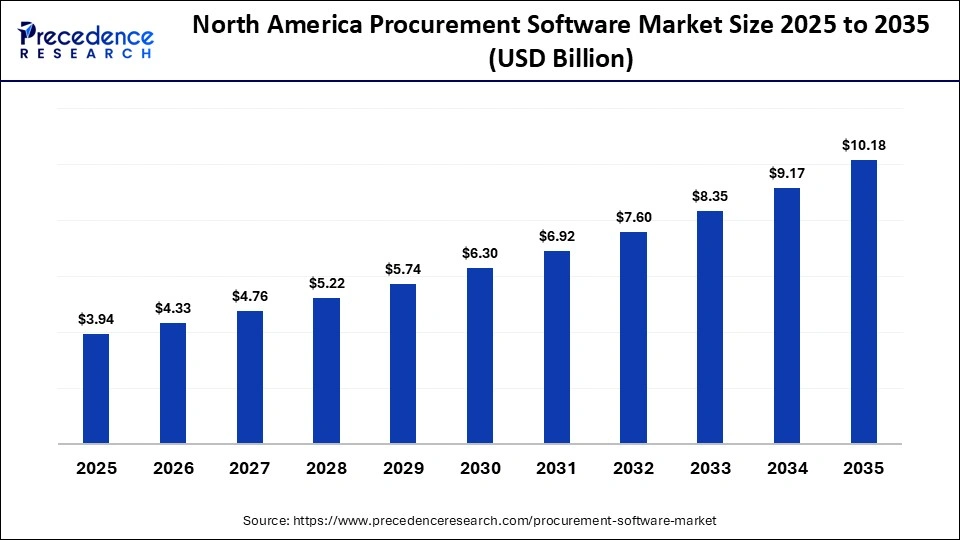
The North America procurement software market size is estimated at USD 3.94 billion in 2025 and is projected to reach approximately USD 10.18 billion by 2035, with a 9.96% CAGR from 2026 to 2035.
How does North America dominate the Procurement Software Market in 2025?
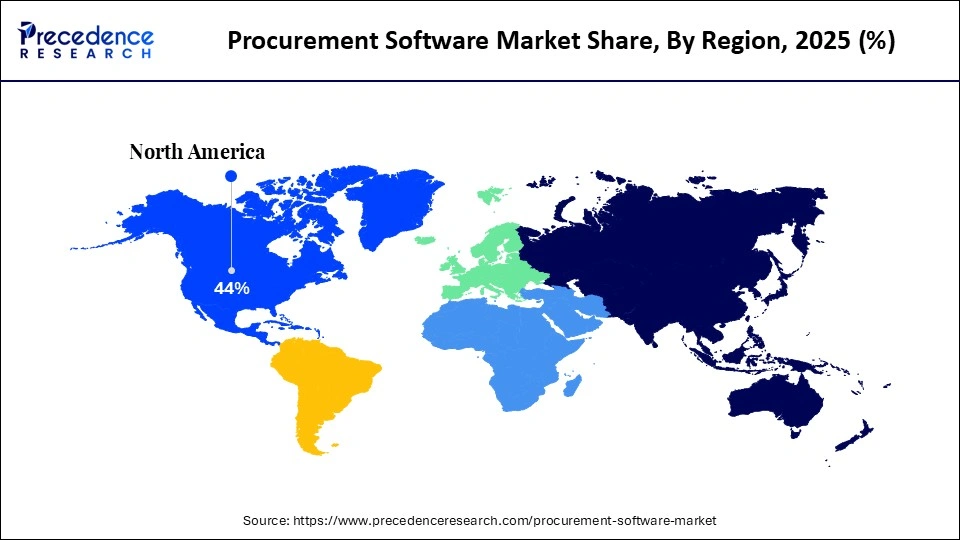
North America dominated the procurement software market in 2025, driven by its advanced digital infrastructure, widespread adoption of cloud technologies, and increasing integration of artificial intelligence (AI) and analytics into procurement processes. Organizations across the region are investing heavily in supply chain automation, spend management, supplier risk assessment, and compliance monitoring to improve operational efficiency and procurement transparency. Furthermore, government initiatives focused on IT modernization and supply chain resilience are accelerating the adoption of advanced procurement software solutions across both public and private sectors.
U.S. Procurement Software Market Size and Growth 2026 to 2035
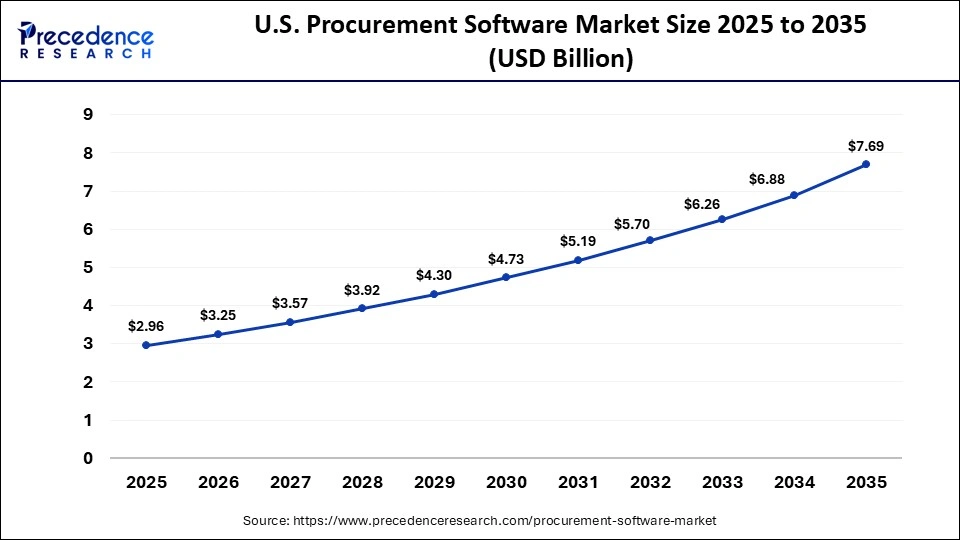
The U.S. procurement software market size is calculated at USD 2.96 billion in 2025 and is expected to reach nearly USD 7.69 billion in 2035, accelerating at a strong CAGR of 10.02% between 2026 and 2035.
U.S. Market Trends
The U.S. remains the largest contributor to the North American procurement software market due to the growing demand for AI-powered procurement automation, supply chain visibility, and digital transformation initiatives. Organizations are increasingly implementing electronic invoicing systems, intelligent sourcing platforms, and predictive analytics tools to improve procurement efficiency and regulatory compliance. Additionally, ongoing modernization of federal procurement frameworks is creating opportunities for advanced software vendors.
What Makes Asia Pacific the Fastest-Growing Region in the Procurement Software Market?
Asia Pacific is expected to register the fastest CAGR during the forecast period, driven by rapid digitalization, growing cloud adoption, manufacturing expansion, and government-led e-procurement initiatives. Businesses across the region are increasingly adopting AI-enabled procurement platforms to improve supplier management, streamline purchasing processes, and strengthen supply chain resilience. The expansion of digital infrastructure, rising investments in enterprise software, and increasing focus on procurement transparency are further supporting regional growth.
India Market Trends
India is witnessing strong growth in procurement software adoption as enterprises transition from traditional on-premises systems to cost-effective cloud-based Software-as-a-Service (SaaS) solutions. Government-led digital procurement initiatives, increasing adoption of e-tendering platforms, and growing demand for workflow automation are accelerating market expansion. The integration of AI, analytics, and digital procurement platforms is helping organizations improve operational efficiency and procurement transparency.
Why is Europe Considered a Significant Region in the Procurement Software Market?
Europe is expected to grow at a significant rate during the forecast period due to increasing regulatory requirements, sustainability initiatives, and public sector digital transformation programs. Organizations are adopting procurement software to improve supply chain visibility, ensure regulatory compliance, and support environmental, social, and governance (ESG) objectives. Additionally, European Union initiatives aimed at simplifying procurement procedures and enhancing digital ecosystems are driving software adoption across industries.
Germany Market Trends
Germany is leading the European market, driven by its strong industrial base, Industry 4.0 initiatives, and focus on digital procurement modernization. Companies are increasingly investing in AI-driven procurement platforms to enhance supply chain resilience, automate sourcing activities, and manage compliance requirements. Government-backed digitalization programs and standardized procurement frameworks are further contributing to market growth.
How is Latin America Emerging as a Growth Market for Procurement Software?
Latin America is expected to experience notable growth during the forecast period, driven by increasing adoption of e-procurement systems, cloud-based software solutions, and government digitalization initiatives. Organizations are leveraging procurement software to optimize spending, improve supplier management, and enhance procurement transparency. The growing focus on cost control, operational efficiency, and public sector modernization is creating favorable conditions for market expansion.
Brazil Market Trends
Brazil is leading the Latin American market due to rising cloud adoption, rapid digital transformation, and increasing demand for procurement automation. Government regulations promoting digital procurement processes and electronic marketplaces are encouraging organizations to modernize procurement operations. Additionally, AI-enabled procurement platforms are helping businesses improve supplier collaboration and spend management.
Why Is the Procurement Software Market Gaining Momentum in the Middle East & Africa?
The Middle East & Africa (MEA) market is growing steadily due to government-led digital transformation initiatives, increasing cloud adoption, and efforts to improve procurement transparency. Organizations are implementing centralized e-procurement platforms to streamline purchasing activities, enhance supplier visibility, and strengthen financial accountability. The growing use of advanced technologies such as AI, analytics, and blockchain is further supporting procurement modernization across the region.
Saudi Arabia Market Trends
Saudi Arabia is emerging as a major market for procurement software due to large-scale digital transformation programs, expanding public infrastructure projects, and increasing adoption of cloud-based enterprise solutions. Government agencies and private organizations are investing in automated procurement systems to improve efficiency, ensure transparency, and manage complex supplier networks. The country's focus on digital governance and economic diversification continues to create significant opportunities for procurement software providers.
Competitive Landscape
The procurement software market is highly competitive and characterized by the presence of global enterprise software providers, specialized procurement technology vendors, and emerging AI-driven procurement platforms. Market participants are focusing on enhancing their capabilities in strategic sourcing, supplier relationship management, spend analytics, contract lifecycle management, procure-to-pay (P2P), and supply chain risk management. Competition is intensifying as organizations increasingly seek integrated procurement solutions that deliver greater visibility, automation, compliance, and cost optimization across the procurement lifecycle.
Vendors are developing intelligent solutions that automate supplier selection, invoice processing, contract analysis, spend forecasting, and risk assessment. Strategic partnerships, acquisitions, and platform expansion remain key growth strategies among market leaders. Companies are acquiring niche procurement technology providers to strengthen their sourcing, supplier management, and analytics capabilities while expanding their customer base. Additionally, vendors are increasingly integrating procurement software with enterprise resource planning (ERP), finance, supply chain, and inventory management systems to provide end-to-end procurement visibility and operational efficiency.
Procurement Software Market Companies
- SAP Ariba
- Coupa Software
- Oracle Procurement Cloud
- GEP SMART
- Ivalua
- Jaggaer
- Basware
- Workday
- Zycus
- Zip
Top Companies in the Procurement Software Market and Their Offerings
- SAP Ariba: SAP Ariba Strategic Sourcing Suite, SAP Ariba Category Management, SAP Ariba Buying and Invoicing, SAP Ariba Supplier Management, SAP Business Network, intelligent contracting, etc.
- Coupa Software: Coupa Procurement, Smart Intake & Orchestration, Sourcing & Supplier Management, Navi Analytics Agent, Navi™ Knowledge Agent, Navi™ Bring Your Own AI Agent, AI-Powered Transaction Summaries, Coupa Pay, Coupa Card, SpendGuard, Supply Chain Control Tower, Unified Supplier 360 View.
- Oracle Procurement Cloud: Procurement contracts, sourcing, supplier management, purchasing, self-service procurement, supplier portal, procurement analytics.
- GEP SMART: Source-to-Contract (S2C), Procure-to-Pay (P2P), supplier and risk management, category management, Agentic AI & Gen AI, GEP QUANTUM.
- Ivalua: Intelligent Virtual Assistant (IVA), AI Orchestration Layer, autonomous AI agents, V10 platform update, ESG sustainability tools, etc.
Recent Developments
- In August 2025, Coupa Software, the leading AI platform, announced the launch of its virtual card capabilities in Japan to modernize B2B payments through strategic partnerships with local banks. The company aims to deliver embedded and secure payments in local currency, which is supported by the power of AI to manage money expenditure more intelligently. (Source: https://www.coupa.com)
- In October 2025, SAP Ariba presented the integration of AI, data, and applications through its SAP business suite to transform the next generation of enterprises. It has also launched a new network of role-based assistants that partners with humans to enhance performance. (Source: https://news.sap.com)
Segments Covered in the Report
By Deployment
- Cloud-based
- On-premise
- Hybrid
By Organization Size
- Large Enterprises
- Small & Medium Enterprises (SMEs)
By Software/Module
- Procure-to-Pay (P2P)
- Spend Analysis
- E-Sourcing
- Contract Lifecycle Management
- Supplier Management
By End-User Industry
- Manufacturing
- Retail & Consumer Goods
- BFSI
- Healthcare
- IT & Telecom
- Others
By Region
- North America
- Latin America
- Europe
- Asia-pacific
- Middle and East Africa
For inquiries regarding discounts, bulk purchases, or customization requests, please contact us at sales@precedenceresearch.com
Frequently Asked Questions
Tags





Ask For Sample
No cookie-cutter, only authentic analysis – take the 1st step to become a Precedence Research client
 Get a Sample




 sales@precedenceresearch.com
 Schedule a Meeting
