



PTFE Fabric Market Size, Share and Trends 2026 to 2035
PTFE Fabric Market (By Type: PTFE Coated Fabric, Non-PTFE-Coated Fabric; By Application: Architectural Membrane, Industrial Filtration, Electrical and Electronics, Transportation, Protective Apparel; By End-use: Architecture and Construction, Chemical Processing, Food Processing and Packaging, Electronics and Electrical, Automotive and Transportation, Others) - Global Industry Analysis, Size, Trends, Leading Companies, Regional Outlook, and Forecast 2026 to 2035
Source: https://www.precedenceresearch.com/ptfe-fabric-market
 Get a Sample
 Table Of Content


What is the PTFE Fabric Market Size?
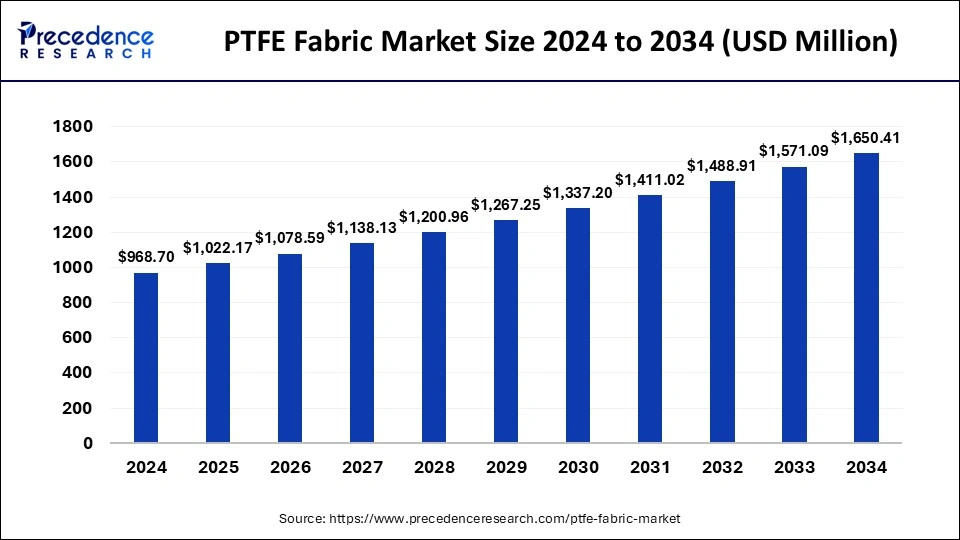
The global PTFE fabric market size was estimated at USD 1,022.17 million in 2025 and is predicted to increase from USD 1,078.59 million in 2026 to approximately USD 1,731.64 million by 2035, expanding at a CAGR of 5.41% from 2026 to 2035. The PTFE fabrics are used in clothes iron coatings, cookware coatings, waterproofing lining, outdoor gear, cycling gear, first responder wear, canopies, and fabric protection. These beneficial factors help to the growth of the market.
PTFE Fabric Market Key Takeaways
- In terms of revenue, the global PTFE fabric market was valued at USD 968.70 million in 2025.
- It is projected to reach USD 1,650.41 million by 2035.
- The market is expected to grow at a CAGR of 5.47% from 2026 to 2035.
- Asia Pacific dominated the market with the largest revenue share of 45% in 2025.
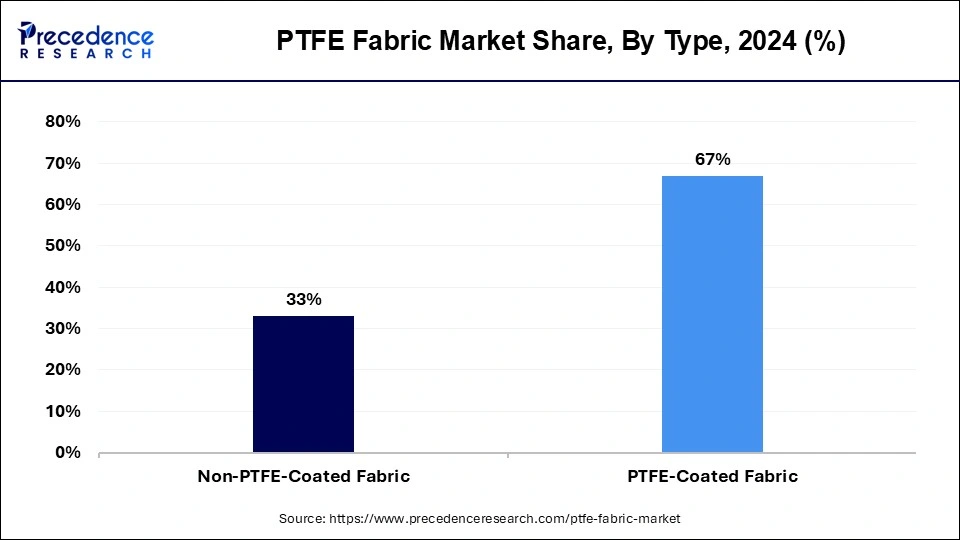
- By type, the PTFE-coated fabric segment has held a major revenue share of 67% in 2025.
- By application type, the architectural membrane segment has contributed more than 41% of revenue share in 2025.
- By application type, the industrial filtration segment is expected to be the fastest-growing during the forecast period.
- By end-use type, the architecture and construction segment dominated the PTFE fabric market in 2025 and is the fastest-growing segment during the forecast period.
What is the PTFE Fabric?
The PTFE fabric market encompasses the production, distribution, and sale of fabrics derived from polytetrafluoroethylene (PTFE), commonly recognized as Teflon, renowned for its remarkable attributes such as heat resistance, chemical resistance, low friction, and non-stick properties. PTFE stands for polytetrafluoroethylene, which is a type of synthetic polymer known as fluoropolymer. A fluoropolymer is a type of polymer that consists of fluorine and carbon molecules, and the main constituent of PTFE is TFE (Tetrafluoroethylene), which is a member of the fluorocarbon family.
The PTFE fabric is a low-maintenance option that offers exceptional strength, quality, and a long lifespan. UV light helps to become white or much lighter fabric by generating a clean and bright aesthetic. The self-cleaning properties of PTFE created by the Teflon coating permit the fabric to resist moisture and remain bright and clean after installation. These factors help to the growth of the market.
How is AI contributing to the PTFE Fabric Industry?
AI enhances the production of PTFE fabrics by means of intelligent inspection and smart production. Machine vision identifies defects immediately on fabric surfaces. Deep learning enhances defect classification. Predictive analytics achieves optimization of tension and coating parameters. Artificial intelligence predicts the failures of equipment. AI boosts the creation of more robust PTFE versions that can be used in severe industrial environments.
PTFE Fabric Market Growth Factors
- The PTFE fabric is a low-maintenance option that offers exceptional strength, quality, and a long lifespan that helps the growth of the PTFE fabric market.
- The PTFE fabric has many advantages due to its unique properties, including corrosion resistance, electrical properties, heat resistance, durability, self-cleaning, inert, and low friction.
- Due to its low friction properties, it is easy to clean and slippery. It is inert chemically which helps in resistance to most of the substance's reactions.
- It resists chemical and electrical corrosion and can withstand high-temperature resistance without degrading. These factors help to the growth of the market.
- The PTFE fabrics are used in clothes iron coating, cookware coatings, waterproofing lining, outdoor gear, cycling gear, first responder wear, canopies, and fabric protection. These applications help to the growth of the PTFE fabric market.
Market Outlook
- Industry Growth Overview: The filtration and chemical processing market requires the acceleration of the widespread use of durable PTFE in industry upgrading and EV production.
- Sustainability Trends: Recycled feedstocks and PFAS-free materials become popular in their use in PTFE manufacturing ecosystems as energy-efficient technologies are adopted.
- Major investors: Saint-Gobain, W. L. Gore and associates, Daikin industries, 3M, Taconic drive innovation and capacity building.
Market Scope
| Report Coverage | Details |
| Market Size by 2035 | USD 1,650.41 Million |
| Market Size in 2025 | USD 1,022.17 Million |
| Growth Rate from 2026 to 2035 | CAGR of 5.47% |
| Largest Market | North America |
| Base Year | 2025 |
| Forecast Period | 2026 to 2035 |
| Segments Covered | Type, Application, End-use, and Regions |
| Regions Covered | North America, Europe, Asia-Pacific, Latin America, and Middle East & Africa |
Market Dynamics
Drivers
Growing demand for PTFE fabric
The PTFE fabric applications include transportation, protective clothing, medical, filtration, construction, and food. These PTFE fabrics have a wide range of applications due to their properties dimensional properties, non-stick properties, and chemical resistance. Standard-grade PTFE applications include baking and food processing, as well as packaging machines/ heat sealing. The applications of PTFE fabric also include clothes iron coating, cookware coatings, waterproofing lining, outdoor gear, cycling gear, first responder wear, canopies, and fabric protection. The applications also include heat sealing, textile manufacturing, baking, food processing, manufacturing dress and other cloths, thermal insulation, conveyor belts, gaskets, seals, and bearing liners. These factors help the growth of the PTFE fabric market.
Restraint
Risks of PTFE fabric
The risks of PTFE fabric include it contains chemical compounds that may accumulate over time and do not break down. High levels of exposure to these compounds may lead to health risks like ovarian cancer, testicular, thyroid, and kidney. The PTFE fabric may cause toxins to enter the environment and the food. With more exposure to Teflon fumes, health problems may occur. Inhaling of these fumes may cause fever that leads to temporary flu-like symptoms, including body aches, chest discomfort, headaches, chills, shortness of breath, nausea, and fever. Limitations of PTFE fabric include low radiation, sensitivity to creep and abrasion, not weldable, high wear behavior in an unfilled state, low tensile yield strength and modulus, and non-melt processable material. These are unwieldable and may change shape under pressure. It may be with high costs. These factors may restrict the growth of the PTFE fabric market.
Opportunity
Research & development and advanced technologies
The use of advanced technologies in the PTFE fabric, including automation and mobile or digital technology, is changing. This nanoscale integration improves the material's durability, water-repellency, and breathability. The result is a more advanced and efficient PTFE fabric coating that restrains traditional applications and may offer exceptional performance in diverse settings. The PTFE fabric is used in various industries, such as safety and protection, life sciences, industrial, habitat, food & beverages, energy, electronics, consumer, aerospace, and automotive. These factors help the growth of the PTFE fabric market.
Segment Insights
Type Insights
The PTFE-coated fabric product type segment dominated the PTFE fabric market in 2025. The PTFE-coated fabrics are used for nonstick in the pharmaceutical industries, chemicals, aerospace, automotive, molding, heat sealing, and packaging.
These applications are due to their beneficial properties, including corrosion and chemical resistance, low friction and abrasion resistance, temperature resistance, non-wetting, creating little friction, resists UV rays, can withstanding extremes of cold and heat, not absorbing water, being non-flammable, self-cleaning, inert, durable, and providing good insulation from electricity which helps to the growth of the segment. These factors help the growth of the PTFE-coated fabric product type segment and contribute to the market growth.
Application Type Insights
The architectural membrane application type segment dominated the PTFE fabric market in 2025. The PTFE-coated fabric is extremely resistant to environmental impacts. These PTFE fabrics are highly flexible and are predestinated for retractable roofs and temporary structures. These can withstand heat impact and high UV radiations and are highly waterproof and translucent, extremely durable, and high quality. This is an ideal fabric for tensile membrane structures. The PTFE fabric provides translucent cladding, low maintenance, and durability, and it is the most aesthetic option for tensile architecture solutions and membrane structures, as well as many structural applications and architectural designs. These factors help the growth of the architectural membrane application type segment and contribute to the growth of the market.
The industrial filtration application type segment is the fastest-growing during the forecast period. The PTFE fabric is used for industrial filtration purposes to achieve the highest filtration efficiency, especially for sub-micron particles. The PTFE fabric filters are the adaptable choice for size-selective samplers. The PTFE fabric's unique properties are ideal for microscopic, gravimetric, and chemical analysis of sample particulates. These PTFE fabric filters are used for gas filtration, aerosol sampling, and air venting. The benefits of PTFE fabric filter for industrial filtration applications include better plant hygiene and better pick-up velocities because of better air flow, increased and consistent airflow because of lower pressure drop, related downtime, and less maintenance because of dust collector issues, pulse valve diaphragm and solenoids may long-laster because of less usage, and longer bag life which helps to the growth of the segment. These factors help to the growth of the industrial filtration application type segment and contribute to the growth of the PTFE fabric market.
End-use Type Insights
The architecture and construction end-use type segment dominated the PTFE fabric market in 2025 and is the fastest-growing segment during the forecast period. The PTFE fabrics are used for the architecture and construction sector due to their long-lasting and extremely durable properties. The PTFE properties also include translucent cladding, low maintenance, durability, and the most aesthetic option for tensile architecture and tensile architecture solutions. The PTFE fabric is extremely resistant to environmental impacts. For construction purposes, the PTFE fabrics are used for hoses and gas line pipes. Construction tools may also be strengthened and improved by PTFE fabric coating. The PTFE fabric is highly used in the construction industry because of its resistance to abrasion and corrosion.
The use of PTFE fabric helps to minimize stress on the steelwork construction, and the PTFE fabric coating helps to enhance the function of joint expansion, bridge bearings, gaskets, and slide bearings. These are also used to insulate pipes to prevent thermal bridging. The PTFE fabrics are used in architecture and construction because of their beneficial properties, including biocompatible, non-toxic, inert, resistance to corrosion, UV light, and weather, very high electrical resistance, solvents, and chemicals, low friction surface, non-stick properties, and very high working temperatures. These factors help the growth of the architecture and construction end-use type segment and contribute to the growth of the market.
Regional Insights
What is the Asia Pacific PTFE Fabric Market Size?
The Asia Pacific PTFE fabric market size surpassed USD 459.98 million in 2025 and is projected to attain around USD 790.24 million by 2035, poised to grow at a CAGR of 5.56% from 2026 to 2035.
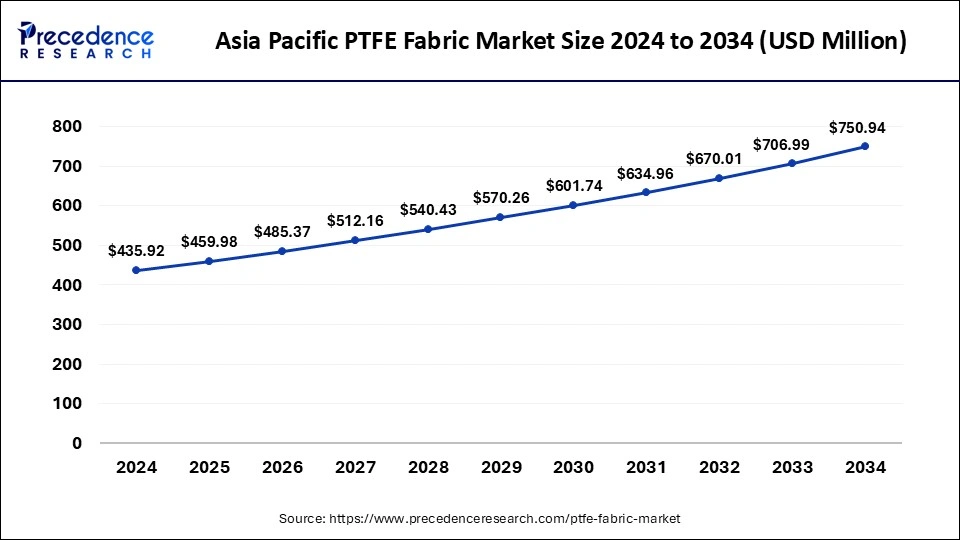
Asia Pacific held the dominating share in 2025. The PTFE fabric is highly used in the food processing industry to make conveyor belts. India is the leading country in terms of market growth. The PTFE fabrics are used as the wrapping and covering material in petroleum and chemical industries, high-temperature resistance material in desulphurizing material, and electrical industries for non-stick PTFE fiberglass for solar panels, which helps the growth of the market in Asia Pacific region. These factors help the growth of the PTFE fabric market in the Asia Pacific region.
China PTFE Fabric Market Trends
China controls the production of PFLE using integrated supply chains to export the product worldwide. The architectural membranes are in demand in infrastructure projects. The development of electric vehicles brings on research on the acoustic liners and high-temperature insulation material that are utilized in sophisticated mobility sectors.
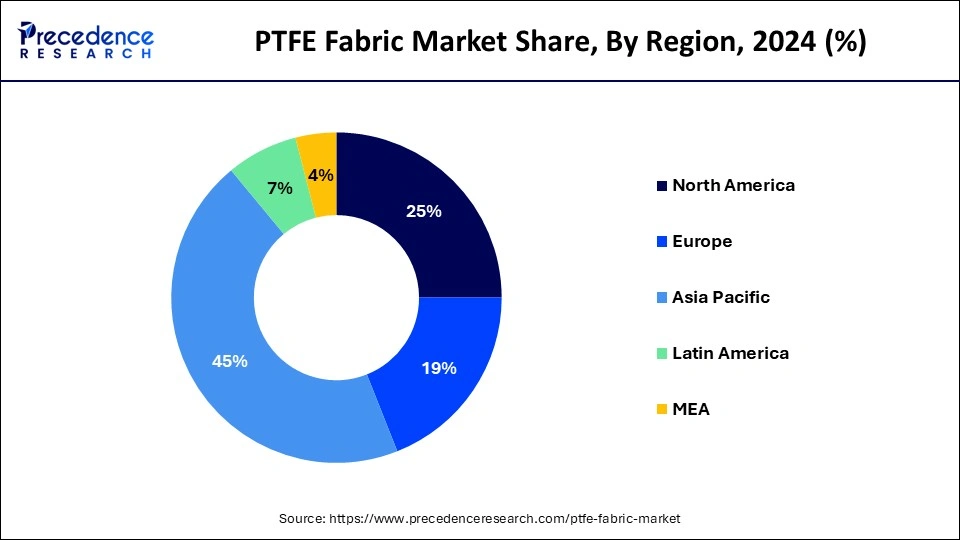
North America is observed to grow at a notable rate in the PTFE fabric market. The PTFE fabric has various applications, including a tray for baking products, transportation of quick-frozen foods by bakery items, and freezing chambers for drying fruits, biscuits, the tortilla industry, and confectionary items, which helps the growth of the market in the North American region. In the United States, PTFE fabric is used in various applications that help the growth of the market. The PTFE fabrics are highly used in many industrial applications in North America. These factors help to the growth of the market.
- In February 2022, in Canada, Textile Architecture 101 in Montreal Biodome extended its innovative expertise and services through a firm specializing in the design, construction, and fabrication of lightweight tensile structures and textile architectures, Sollertia.
U.S. PTFE Fabric Market Trends
The U.S. market is more focused on the need for aerospace and defense applications that involve the use of lightweight, durable composites. The use of PTFE felt filtration material is influenced by environmental compliance. Innovation revolves around the use of special PTFE-coated glass fabrics, which are used in processing, packaging, and industrial applications of high performance.
PTFE Fabric Market Companies
- Sinterama Group: It manufactures technical, home textile, and automotive polyester yarns based on the recycled Newlife fiber solutions of a sustainable nature.
- Fiberflon: Silicone-coated solutions, high-temperature conveyor belts, tapes, and fiberglass fabrics coated with PTFE are manufactured.
- Techbelt: Produces PTFE-coated belts and glass cloths to be used in baking, packaging, and high-temperature conveyor systems.
Other Major Key Players
- Emco Industrial Plastics, Inc
- Precision Coating Company, Inc.
- Woven Fabric Company
- Sefar AG
- Birdair, Inc
- Fothergill Group
- Daikin Industries, Ltd
- Taconic
- W.L. Gore & Associates Inc.
- The Chemours Company
- Saint-Gobain Performance Plastics Corporation
- Chukoh Chemical Industries
- W.F. Lake Corporation
Recent Developments
- In January 2026, Zeus launched PFX™, an innovative platform for catheter development emphasizing performance, design flexibility, and sustainability. The first product, PFX Flex™ Sub-Lite-Wall™, serves as a next-gen liner alternative to film-cast PTFE. (https://www.medicaldesignandoutsourcing.com )
- In January 2026, Confluent Medical Technologies unveils Filmcast Select™, a materials customization program allowing OEMs to customize performance attributes of PTFE and polyimide tubing. The program enhances flexibility, strength, and durability for next-generation minimally invasive devices. (https://www.medicaldesignandoutsourcing.com )
- In November 2022, the researchers considered a technique that offered a scalable, low-cost potential method for making wearable electronic devices. The devices include movement sensors, self-powered, and numerical touchpads in clothing, and the technique offers scalable and low-cost potential for making wearable devices using PTFE fabrics.
- In February 2024, a new fully synthetic wetlaid nonwoven for filtration was launched in Germany by Freudenberg. This new type is used for both air and liquid filtration, and applications include support for oil filtration media, support for PTFE membranes or nanofibers, and support for reverse osmosis membranes. This new material is also used in the composite industry or building & construction industry.
Segments Covered in the Report
By Type
- PTFE Coated Fabric
- Non-PTFE-Coated Fabric
By Application
- Architectural Membrane
- Industrial Filtration
- Electrical and Electronics
- Transportation
- Protective Apparel
By End-use
- Architecture and Construction
- Chemical Processing
- Food Processing and Packaging
- Electronics and Electrical
- Automotive and Transportation
- Others
By Geography
- North America
- Asia Pacific
- Europe
- Latin America
- Middle East & Africa
For inquiries regarding discounts, bulk purchases, or customization requests, please contact us at sales@precedenceresearch.com
Frequently Asked Questions
Tags





Ask For Sample
No cookie-cutter, only authentic analysis – take the 1st step to become a Precedence Research client
 Get a Sample




 sales@precedenceresearch.com
 Schedule a Meeting
