



Pulmonary Embolism Market Size, Companies, Share, Patient Volume, Treatment Adoption Rates, Pricing Analysis, Regulatory Landscape, Competitive Positioning, and Demand Forecast
Pulmonary Embolism Market (By Treatment Type: Anticoagulants, Thrombolytics, Mechanical Thrombectomy; By Patient Population: Patients with Symptomatic Pulmonary Embolism, Patients with Asymptomatic Pulmonary Embolism, Patients with High-Risk Pulmonary Embolism, By Drug Route Administration: Intravenous, Subcutaneous, Oral; By Drug Type: Direct Oral Anticoagulants (DOACs), Heparins, Vitamin K Antagonists; By End-Use Sector: Hospitals, Clinics, Ambulatory Surgical Centers) - Global Industry Analysis, Size, Trends, Leading Companies, Regional Outlook, and Forecast 2026 to 2035
Source: https://www.precedenceresearch.com/pulmonary-embolism-market
 Get a Sample
 Table Of Content


What is the Pulmonary Embolism Market Size?
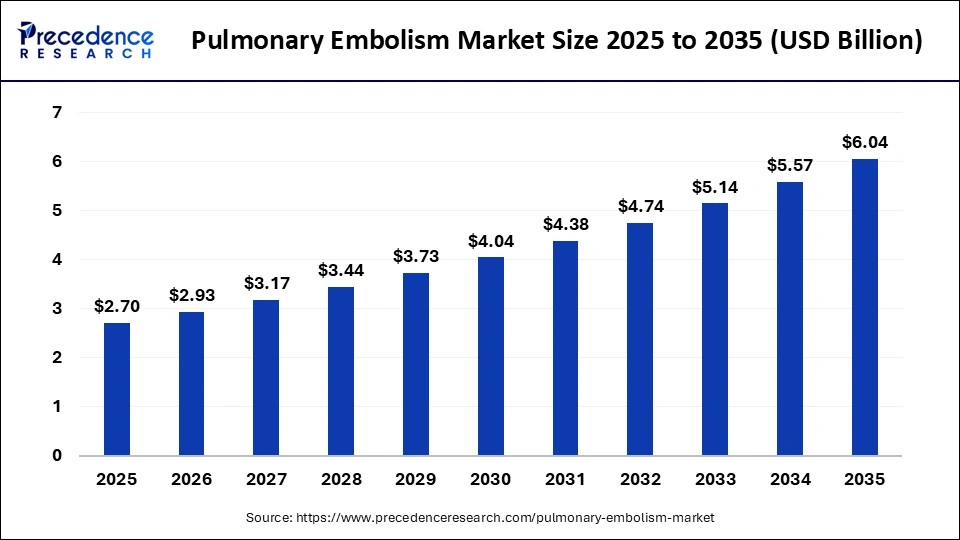
The global pulmonary embolism market size was calculated at USD 2.70 billion in 2025 and is predicted to increase from USD 2.93 billion in 2026 to approximately USD 6.04 billion by 2035, expanding at a CAGR of 8.38% from 2026 to 2035. The market growth is attributed to the increasing prevalence of venous thromboembolism, aging population, advancements in anticoagulant therapies, and rising healthcare expenditure.
Key Takeaways
- North America dominated the global pulmonary embolism market in 2025.
- Asia Pacific is expected to grow at the fastest CAGR in the market during the forecast period.
- By treatment type, the anticoagulants segment held a dominant position in the market in 2025.
- By treatment type, the thrombolytics segment is expected to grow at the fastest CAGR in the market during the forecast period.
- By patient population, the patients with symptomatic pulmonary embolism segment held a dominant position in the market in 2025.
- By patient population, the patients with high-risk pulmonary embolism segment are expected to grow at the fastest CAGR in the market during the forecast period.
- By drug route of administration, the intravenous segment held a dominant position in the market in 2025.
- By drug route of administration, the subcutaneous segment is expected to grow at the fastest CAGR in the market during the forecast period.
- By drug type, the DOACs segment held a dominant position in the pulmonary embolism market in 2025.
- By drug type, the heparins segment is expected to grow at the fastest CAGR in the market during the forecast period.
- By end-use sector, the hospitals segment held a dominant position in the market in 2025.
- By end-use sector, the clinics segment is expected to grow at the fastest CAGR in the market during the forecast period.
Market Overview
Pulmonary embolism is a life-threatening condition caused by the blockage of an artery in the lungs due to blood clot formation, which prevents blood flow. Risk factors include chronic conditions (cancer and cardiovascular diseases) and lifestyle factors (smoking and obesity).
The pulmonary embolism market growth is driven by the rising incidence rate of cardiovascular diseases, rising awareness among the population, rising elderly population, and advancements in diagnostic techniques. The market is focused on the prevention, management, and treatment of pulmonary embolism with the development, production, and commercialization of diagnostic tools and treatments. Rising healthcare expenditure, technological innovations, regulatory approvals, and evolving healthcare infrastructure are shaping the market.
How AI is Reshaping the Pulmonary Embolism Market?
Artificial Intelligence is rapidly reshaping the market by enhancing diagnostic accuracy, risk assessment, and clinical decision-making. AI-powered algorithms enable analysis of CT pulmonary angiograms and other medical images to detect early signs of pulmonary embolism with greater precision and identify high-risk patients to enable better treatment decisions. Advanced digital platforms enhance imaging workflows and automated detection and triage. AI incorporation is reducing mortality rates and improving patient outcomes by reducing diagnostic turnaround times, personalizing treatment planning, and improving workflow efficiency.
Pulmonary Embolism Market Trends
- Therapeutic Advancements and Drug Innovation: Rising adoption of direct oral anticoagulants (DOACs) and emergence of novel anticoagulants offering advantages such as improved safety profile, ease of use, patient adherence, and treatment outcomes.
- Shift Towards Minimally Invasive and Advanced Care: Adoption of catheter-directed thrombolysis, endovascular procedures, and precision-based treatment approaches, improving recovery and clinical effectiveness.
- Advancement in Diagnostic Technologies and Monitoring: Increasing use of AI-assisted image analysis, advanced diagnostics, integration of telemedicine, and remote patient monitoring to enhance recovery and clinical effectiveness.
- Personalized Treatment and Patient-Centric Care: Tailored treatment plans based on patient risk profiles, greater focus on risk stratification, and improved disease awareness to reduce mortality and complications.
- Rising Investment in Research and Disease Burden: Rising prevalence of risk factors such as obesity and sedentary lifestyles is driving demand for treatment, which is leading to strong research and development activity, clinical trials, collaborations, and innovation in therapeutic approaches.
Market Scope
| Report Coverage | Details |
| Market Size in 2025 | USD 2.70 Billion |
| Market Size in 2026 | USD 2.93 Billion |
| Market Size by 2035 | USD 6.04 Billion |
| Market Growth Rate from 2026 to 2035 | CAGR of 8.38% |
| Dominating Region | North America |
| Fastest Growing Region | Asia Pacific |
| Base Year | 2025 |
| Forecast Period | 2026 to 2035 |
| Segments Covered | Treatment Type, Patient Population, Drug Type, End-Use Sector, and Region |
| Regions Covered | North America, Europe, Asia-Pacific, Latin America, and Middle East & Africa |
Market Dynamics
Driver
Rising Cases of Venous Thromboembolism and Cardiovascular Disorders
Market drivers for pulmonary embolism include the increase in the number of patients affected by venous thromboembolism and cardiovascular diseases. The increasing incidences of deep vein thrombosis, obesity, cancers, and cardiovascular diseases, among others, will continue to fuel the market. Obesity, in addition to the aging population, will lead to pulmonary embolisms.
Restraint
High Treatment Costs and Bleeding Risks
The main hurdle in the pulmonary embolism market is the high cost of treatment and the dangers of bleeding. Treatment using advanced anticoagulation therapies, thrombolytic treatment methods, and catheter-based treatment procedures is an expensive affair that poses hurdles in developing nations. In addition, the danger of bleeding when treating with anticoagulation is likely to hinder the success of such procedures.
Opportunity
Growing Adoption of Advanced Anticoagulants and Minimally Invasive Therapies
The rise in usage of high-level anticoagulants, AI-assisted diagnostic technology, and thrombectomy systems would result in numerous growth opportunities within the market. Moreover, improved infrastructure within the medical sector, along with higher spending on emergency cardiac care, would contribute to market expansion.
Segment Insights
Treatment Type Insights
How did the Anticoagulants Segment Lead the Pulmonary Embolism Market?
The anticoagulants segment led the market in 2025. They have emerged as a dominant treatment, forming the foundation of both acute treatment and long-term prevention of recurrent clots. The dominance is supported by strong clinical evidence, a well-established efficacy and safety profile, and treatment guidelines. The widespread adoption of anticoagulants is due to their minimal monitoring requirements, lower bleeding risks, and predictable pharmacokinetics with comparable efficacy to traditional therapies like warfarin. Additionally, factors like aging populations and increased prevalence of cardiovascular disease are key drivers behind the growing preference for anticoagulants in managing pulmonary embolism.
The thrombolytics segment is expected to grow with the highest CAGR in the pulmonary embolism market between 2026 and 2035. They are emerging as an alternative since they offer rapid, life-saving clot dissolution in high-risk and acute pulmonary embolism. Advancements in drug formulations and increased clinical awareness have surged the use of thrombolytics. Additionally, increasing emergency care utilization and improved diagnostic speed are also accelerating demand for thrombolytic therapies.
Patient Population Insights
Which Patient Segment Dominated the Pulmonary Embolism Market in 2025?
The patients with symptomatic pulmonary embolism segment dominated the market in 2025, since these patients present with clear clinical symptoms, driving demand for immediate diagnosis and active therapeutic interventions. Key driving factors include greater mortality risk without treatment, improved outcomes with early diagnosis and treatment, and a higher risk of recurrence. To meet the rising management needs of patients with symptomatic pulmonary embolism, make them the largest contributors to the market demand.
The patients with high-risk pulmonary embolism segment are expected to grow at the highest CAGR in the market between 2026 and 2035, since these patients often face significant complications, boosting for immediate and intensive treatment. The segment is fueled by increasing awareness and improved diagnostic methods has increased identification and treatment rates.
Drug Route of Administration Insights
What made the Intravenous Segment Dominate the Pulmonary Embolism Market in 2025?
The intravenous segment dominated the market in 2025. It plays a critical role in the treatment of acute conditions effectively by the rapid onset of action. It is the most preferred route of administration in emergency and hospital settings, particularly for high-risk or unstable patients, since it enables rapid drug delivery, precise dose control, and continuous monitoring. Intravenous therapy is recommended as standard early management, supporting its adoption and market dominance.
The subcutaneous segment is expected to grow with a higher CAGR in the market between 2026 and 2035. The segment is emerging as the fastest-growing alternative due to an increase in outpatient treatments and a growing preference for self-administration among patients, reducing the need for hospital visits. Advances in drug formulations and innovations in biologics are driving the growth of the segment.
Drug Type Insights
Why DOACs Segment Dominated the Pulmonary Embolism Market in 2025?
The DOACs segment dominated the market in 2025, indicating their strong adoption in the treatment of pulmonary embolism by offering effective, safe, and highly convenient long-term anticoagulation. They provide more predictable pharmacokinetics, fixed dosing, minimal food and drug interactions, and less monitoring requirements compared to traditional warfarin treatment. Clinical guidelines have recommended DOACs as the first-line therapy for pulmonary embolism treatment. The market is sustained by rising cardiovascular disease burden and a growing aging population.
The heparins segment is expected to grow at the highest CAGR in the market between 2026 and 2035. It has an essential role in acute and hospital-based management of pulmonary embolism, where rapid anticoagulation is necessary. Their rapid growth can be attributed to their rapid onset, short half-life, and reversibility, enabling clinicians to closely control treatment in unstable patients. Clinical evidence demonstrates reduced clot formation and improved outcomes, supporting its growth in the market.
End-Use Sector Insights
How did the Hospitals Segment Lead the Pulmonary Embolism Market?
The hospitals segment dominated the market in 2025. They serve as the primary point of care and offer well-established infrastructure with advanced diagnostic technologies and access to life-saving therapies. Hospitals provide multidisciplinary teams of healthcare professionals (pulmonologists, radiologists, cardiologists, and emergency medicine specialists) who facilitate the establishment of Pulmonary Embolism Response Teams (PERT Teams), enabling accurate decision-making during emergencies, further strengthening the segment growth.
The clinics segment is expected to grow at the highest CAGR in the market between 2025 and 2035, because there is a shift in the patient care delivery from hospitals to outpatient and community-based settings. These facilities provide more accessible, affordable care and more convenient follow-up care, supporting the expansion of clinics. As healthcare systems focus on cost efficiency, accessibility, and continuity of care, clinics are rapidly expanding in the market.
Regional Insights
What Factors Have Driven the Dominance of North America in the Pulmonary Embolism Market?
North America dominated the global pulmonary embolism market in 2025, due to advanced healthcare infrastructure, high prevalence of risk factors, strong industry presence, and investments in research and development. Key driving factors include widespread availability of diagnostics, growing adoption of AI-powered imaging, access to high-quality treatment solutions, and the increasing incidence of cardiovascular disease. Growing awareness among healthcare professionals and the population, and the presence of key market players, are further driving the market dominance in the region. Strict regulatory requirements, supportive reimbursement policies, and access to advanced diagnostic procedures are leading the region's market share in the market.
U.S. Pulmonary Embolism Market
The U.S. market is expected to evolve at a higher CAGR during the forecast period. The market in the region is driven by advanced healthcare infrastructure, rising awareness, and widespread adoption of advanced diagnostic technologies. The region faces a high risk of cardiovascular disease due to lifestyle factors, obesity, diabetes, and smoking addiction, which continue to increase the incidence of pulmonary embolism. The region has strong support from the U.S. FDA, which enables faster approval and adoption of innovative therapies. The presence of leading pharmaceutical companies in the region accelerates clinical research and enhances treatment availability. The market is further driven by high healthcare spending and expanding outpatient management programs.
What makes Asia Pacific the Fastest Growing Region in the Market?
Asia Pacific is the fastest-growing region in the pulmonary embolism market due to increasing healthcare expenditure, rising awareness of pulmonary diseases, improved access to advanced healthcare systems, and a growing aging population. Countries like China, India, Japan, and South Korea are witnessing a high prevalence of cardiovascular risk factor therefore a higher demand for effective treatment. The region's expanding healthcare infrastructure, growing use of advanced diagnosis technologies, and evolving competitive landscape with companies like Novartis and AstraZeneca are accelerating market growth. Government initiatives, healthcare reforms, and rising medical expenditure are also enhancing treatment accessibility.
Indian Pulmonary Embolism Market
The India market accounted for the largest share in the region, driven by the country's large population, growing healthcare awareness, and increasing access to diagnostics. Enhanced healthcare access in the rural and urban populations, which contributes to earlier detection and management of pulmonary embolism cases, is driven by private and public initiatives. One of the key factors involved in the growth of the market is the government's investments in hospital infrastructure, expanding cardiac care units, and strong regional pharmaceutical manufacturing.
Is the Pulmonary Embolism Market Poised for Significant Growth in the Coming Decade in Europe?
Europe is expected to show significant growth during the forecast period. The use of mechanical thrombectomy devices is entering a fast growth phase, estimated to reach up to 31% penetration among high-risk individuals by 2030. Germany is anticipated to continue leading the European market, funded by a strong healthcare infrastructure and high spending.
Italy Market Trends
There is a strong shift toward minimally invasive techniques, like catheter-directed thrombolysis and even mechanical thrombectomy, as options to traditional thrombolytic therapy in Italy. Specialized, high-tech devices are thus increasingly demanded, with companies aiming for specialized thrombectomy devices for acute cases.
Will Emerging Therapies Redefine the Pulmonary Embolism Market in Latin America?
Latin America is expected to show notable growth during the forecast period. Catheter-directed thrombolysis and mechanical thrombectomy are emerging as vital alternatives to systemic thrombolysis for high-risk and even intermediate-risk patients. Increased diagnosis rates, thus driven by better access to computed tomography pulmonary angiography and even ventilation-perfusion scans, are expanding the treatable patient population.
Brazil Market Trends
The adoption of novel anticoagulants, like apixaban, rivaroxaban, and edoxaban, is transforming treatment by allowing easier outpatient management and enhanced safety profiles. Brazil's growing public health programs are enhancing access to essential medicines, fueling market growth. Increased usage of catheter-based therapies, along with mechanical thrombectomy devices for high-risk and even intermediate-risk patients, is a major trend.
How will Innovation Shape the Future of the Pulmonary Embolism Market in the Middle East and Africa?
The Middle East and Africa are expected to show lucrative growth during the forecast period, driven by the rising need for AI-based diagnostics, advanced mechanical thrombectomy, and increasing adoption of direct oral anticoagulants. AI algorithms are increasingly utilized to analyze CT pulmonary angiograms for rapid, early identification of pulmonary embolism. AI-driven models also assist in clinical decision-making to evaluate high-risk patients.
Saudi Arabia Market Trends
The market is experiencing significant expansion due to high incidences of venous thromboembolism associated with obesity, diabetes, and cardiovascular diseases, mainly within the Eastern and Riyadh regions. Aligned with Vision 2030, there is a drive to localize medical device manufacturing, mainly for transcatheter embolization solutions.
What are the Government Programs within the Pulmonary Embolism Sector?
- CDC has backed the program called “Stop the Clot, Spread the Word,” designed to raise public awareness about the dangers of pulmonary embolism.
- India's Government has made national guidelines on the prevention of venous thromboembolism and the management of pulmonary embolism with the assistance of the National Academy of Medical Sciences.
- The Australian Commission on Safety and Quality in Health Care has proposed a venous thromboembolism prevention clinical care standard to prevent cases of hospital-acquired pulmonary embolism.
- The CDC recommended the establishment of venous thromboembolism programs within hospitals to promote the prompt identification and treatment of patients.
- Multiple countries have assisted by initiating reimbursement policies and anticoagulation therapy programs.
Value Chain Analysis – Pulmonary Embolism Market
- Research and Development: Researching and developing anticoagulant drugs, thrombolytic medications, and diagnostic tools for pulmonary embolism.
Key Players: Pfizer Inc. and Bayer AG. - Clinical Trial and Regulatory Approval: This stage involves conducting clinical trials and granting licenses for pulmonary embolism drugs.
Key Players: Johnson & Johnson and Bristol Myers Squibb. - Formulation and Dose Preparation: Preparing oral and other drug forms from pulmonary embolism therapy products.
Key Players: Sanofi and Boehringer Ingelheim. - Packaging and Serialization: This stage is related to drug packaging, labeling, and serializing.
Key Players: Amcor plc, West Pharmaceutical Services.
Pulmonary Embolism Market Companies
- F. Hoffmann-La Roche Ltd.: F. Hoffmann-La Roche Ltd. is recognized as a major player in the pulmonary embolism industry, mainly offering diagnostic solutions and specialized therapeutics that tackle the underlying causes of thrombosis.
- Genentech Inc.: Genentech Inc. provides Activase, a recombinant tissue plasminogen activator, as a major therapeutic option for the pulmonary embolism industry, specifically accepted for the lysis of acute massive pulmonary embolism.
- GlaxoSmithKline plc: GlaxoSmithKline plc has remarkably divested its direct anticoagulants portfolio for treating venous thromboembolism and even pulmonary embolism. GSK is re-entering the related cardiovascular space by aiming at Pulmonary Hypertension (PH), a condition usually closely associated with severe pulmonary embolism.
Other Major Key Players
- Abbott
- Aspen Holdings
- AstraZeneca
- Baxter
- Bayer AG
- Boehringer Ingelheim International GmbH
- Bristol Myers Squibb Company
- Eli Lilly and Company
- Hikma Pharmaceuticals PLC
- Johnson & Johnson Private Limited
- Merck & Co., Inc.
- Mylan N.V.
- Pfizer Inc.
- Sanofi
- Teva Pharmaceutical Industries Ltd.
Recent Developments
- In May 2026, Viz.ai developed Viz Pulmonary Suite using AI to identify pulmonary embolisms, chronic obstructive pulmonary disease (COPD), and lung nodules in patients. The solution was designed to provide clinicians with assistance in identifying these diseases through AI technology. (Source: https://www.fiercehealthcare.com)
- In June 2025, Endovascular Engineering, Inc. announced the completion of patient enrollment in the pivotal cohort of the ENGULF investigational device exemption (IDE) study of its Helo thrombectomy system for the treatment of pulmonary embolism (PE). (Source: https://evtoday.com)
- In January 2025, Inquis Medical announced the completion of the enrollment of patients for its AVENTUS Clinical Trial, which is a pivotal Investigational Device Exemption (IDE) trial for the evaluation of the efficacy and safety of the company's Aventus Thrombectomy System developed for treating patients with pulmonary embolism (PE).(Source: https://inquismedical.com)
Segments Covered in the Report
By Treatment Type
- Anticoagulants
- Thrombolytics
- Mechanical Thrombectomy
By Patient Population
- Patients with Symptomatic Pulmonary Embolism
- Patients with Asymptomatic Pulmonary Embolism
- Patients with High-Risk Pulmonary Embolism
By Drug Route Administration
- Intravenous
- Subcutaneous
- Oral
By Drug Type
- Direct Oral Anticoagulants (DOACs)
- Heparins
- Vitamin K Antagonists
By End-Use Sector
- Hospitals
- Clinics
- Ambulatory Surgical Centers
By Region
- North America
- Asia Pacific
- Europe
- Latin America
- Middle East & Africa
For inquiries regarding discounts, bulk purchases, or customization requests, please contact us at sales@precedenceresearch.com
Frequently Asked Questions
Tags





Ask For Sample
No cookie-cutter, only authentic analysis – take the 1st step to become a Precedence Research client
 Get a Sample
.webp)



 sales@precedenceresearch.com
 Schedule a Meeting
