



Recycled Carbon Fiber Market Size, Share and Trends 2026 to 2035
Recycled Carbon Fiber Market (By Product: Chopped Carbon Fiber, Milled Carbon Fiber, Carbon Fiber Mat, Others; By Source: Automotive Scrap, Aerospace Scrap, Others; By Recycling Method: Mechanical Recycling, Chemical Recycling, Pyrolysis, Solvolysis, Others; By End-use Industry: Aerospace and Defence, Automotive, Wind Energy, Sports and Leisure, Construction, Electronics, Others) - Global Industry Analysis, Size, Trends, Leading Companies, Regional Outlook, and Forecast 2026 to 2035
Source: https://www.precedenceresearch.com/recycled-carbon-fiber-market
 Get a Sample
 Table Of Content


What is the Recycled Carbon Fiber Market Size?
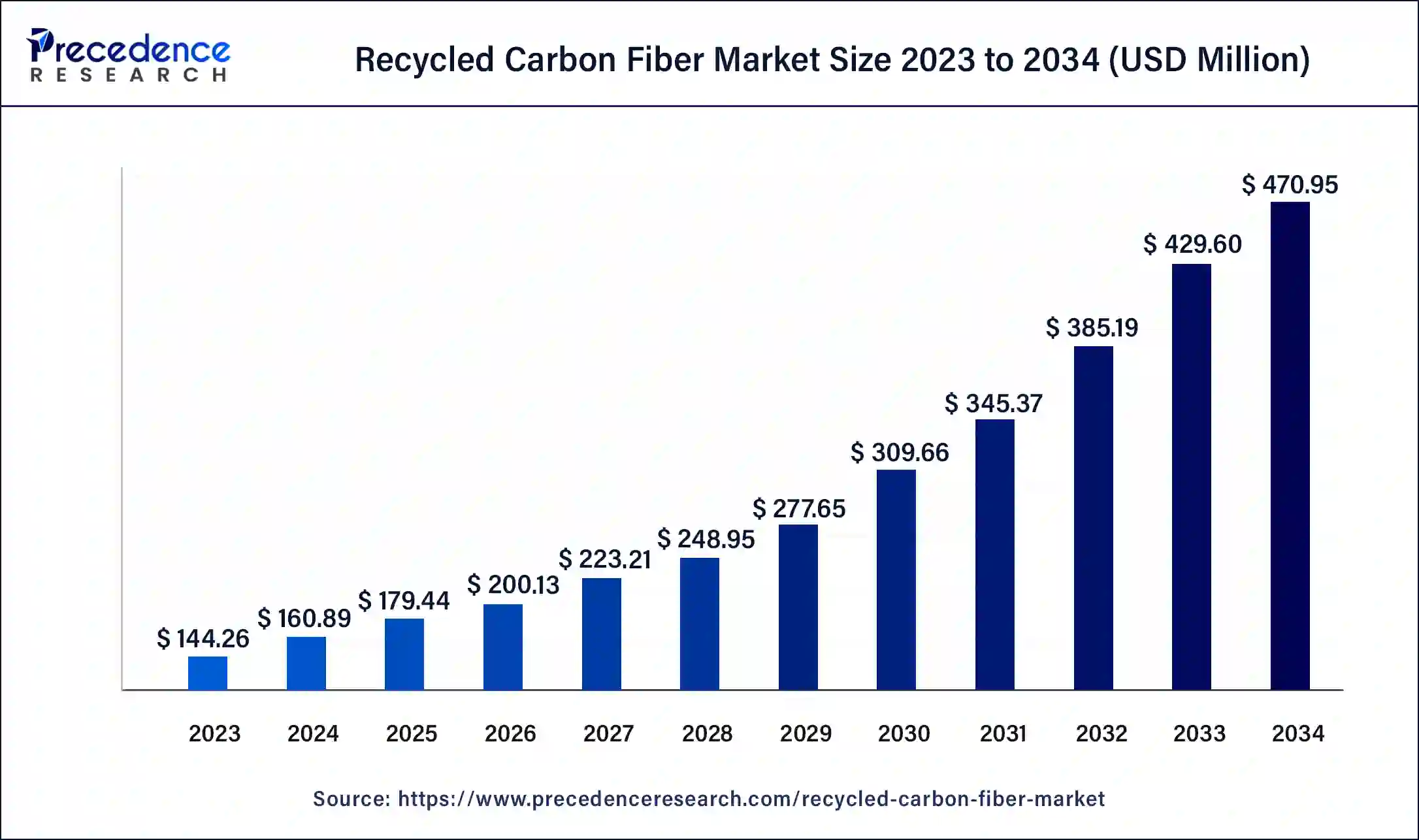
The global recycled carbon fiber market size was estimated at USD 200.13 million in 2026 and is anticipated to reach around USD 514.34 million by 2035, growing at a CAGR of 11.10% from 2026 to 2035. The market grows due to surging automotive and aerospace demand for cost-effective, sustainable, and lightweight materials to improve fuel efficiency and comply with strict carbon emission regulations.
Recycled Carbon Fiber Market Key Takeaways
- The global recycled carbon fiber market was valued at USD 200.13 million in 2026.
- It is projected to reach USD 514.34 million by 2035.
- The recycled carbon fiber market is expected to grow at a CAGR of 11.10% from 2026 to 2035.
- North America dominated the market with the largest market share of 40% in 2026.
- Asia Pacific is estimated to be the fastest growing during the forecast period of 2026 to 2035.
- By product type, the chopped carbon fiber segment has contributed more than 45% of the market share in 2026.
- By product type, the milled carbon fiber segment is the fastest growing during the forecast period.
- By source, the automotive scrap segment led the market with the largest market share of 50% in 2026.
- By source, the aerospace scrap segment is the fastest growing during the forecast period.
- By recycling method, the mechanical recycling segment has contributed more than 70% of the market share in 2026.
- By recycling method, the chemical recycling segment is the fastest-growing segment during the forecast period.
- By end-use industry type, the aerospace and defense segment has held the largest market share of 35% in 2026.
Market Overview
Recycled carbon fiber is the new form of regenerated fiber that has properties like corrosion resistance, good electrical conductivity, high modulus, and high strength. The recycled carbon fiber market deals with the production and marketing of recycled carbon fiber products to various industries for their use, such as energy storage, pressure vessels, sporting goods, marine, civil engineering, aerospace, and automotive industries. The increasing use of carbon fibers and their compounds and the simultaneous rise in carbon fiber waste need the recycling of carbon fibers.
In different sectors, several studies have been conducted on recycled carbon fibers and their applications, including lithium-ion battery materials, thermoelectric materials, and electromagnetic shielding materials. The recycled carbon fiber properties also include compressive strength, tensile strength, flexural strength, fracture characteristics, electrical properties, workability, microstructural properties, impact resistance, and durability help the growth of the market.
Recycled Carbon Fiber Market Growth Factors
- Concrete has low tensile and flexural strengths, and to increase tensile and flexural strength, environment-friendly recycled carbon fiber is used instead of fibers like basalt, glass, carbon, and steel.
- Recycled carbon fiber is used for cement composites due to its compressive strength properties. This helps to the growth of the recycled carbon fiber market.
- It is also used to overcome the problem of the formation of cracks in cement composites. It has impact resistance and durability, which is why it is used in cement composites.
- Increasing the electrical properties and decreasing the electrical resistivity property of cement composites' recycled carbon fiber is helpful.
- The use of recycled carbon fiber in cement increases their workability, which contributes to the growth of the market.
- Untreated recycled carbon fiber in cement composites is not appropriately bonded, while alkali-treated recycled carbon fiber is bonded appropriately in the cement composites.
Market Dynamics
Drivers
Environmental sustainability
There is a need for recycled carbon fiber for the recyclability and environmental sustainability of the materials, which will help the continuous growth of the recycled carbon fiber market. Increased importance on the reduction of carbon emissions implemented by the European Union and the United States Environmental Protection Agency. Recycled carbon fiber provides reasonable and eco-friendly or environmentally friendly replacements for raw carbon fiber. There is also a demand for eco-friendly and recyclable materials for environmental sustainability.
Cost and security of supply
For cost reduction, recycled carbon fibers are highly used. For raw carbon fiber, recycled carbon fiber is a good alternative. Manufacturers can save production costs by the use of waste materials. The carbon fiber industry faces the problem of the supply and demand of carbon fibers. The recycling of carbon fibers can overcome this issue. This helps to the growth of the recycled carbon fiber market.
Restraint
Challenges in carbon fiber recycling
Most of the product materials are not made from recycled carbon fibers or disposable materials because it is tough to find sufficient carbon fibers for recycling. Carbon fibers are not as strong as specific metals. Due to its brittleness, sudden or sharp impacts can shatter or crack. Carbon fiber costs more than aluminum, steel, or other options. Recycling carbon fiber is challenging because of its complex nature which makes it less environmentally friendly and sustainable than the other materials which are easy to use. There is a risk of shock because carbon fiber conducts electricity when it is not operated correctly and also if it is used in electrical applications. These factors may restrict the growth of the recycled carbon fiber market.
Opportunity
Utilization of recycled carbon fibers in thermoplastics
Increasing the use of recycled carbon fibers in thermoplastics can create highly specific stiffness materials and low-cost materials for various applications. This can be an opportunity because of their recycling availability and easy processibility. The demand for surface treatments can increase to improve surface functional groups and adhesion between polymer material and carbon fibers. This helps to the growth of the recycled carbon fiber market.
Segment Insights
Product Type Insights
Why is the Chopped Carbon Fiber Segment Expected to Grow Fastest Share of the Recycled Carbon Fiber Market?
The chopped carbon fiber segment held a major share of the recycled carbon fiber market in 2026 because of its versatility, affordability, and compatibility with thermoplastic and thermoset composites. The recycled chopped carbon fiber properties include low thermal expansion, dimensional stability, low density, high modulus, and high strength, which contribute to the growth of the segment. It is widely used in automotive parts, consumer goods, industrial equipment, and construction materials where lightweight strength is essential. These factors help the growth of the segment and contribute to the growth of the recycled carbon fiber market.
The milled carbon fiber segment is expected to grow at the fastest CAGR during the studied period in the recycled carbon fiber market. Milled carbon fiber is a strengthened material that is made up of glass fiber or chopped carbon with a length of less than 1mm. It is normally used to improve the mechanical features of compound materials. Recycled milled carbon fibers can be used to improve the strength of recycled carbon fibers that are made of waste carbon fiber for new applications, which contribute to the growth of the segment.
Source Insights
What made the Automotive Scrap Segment Lead the Recycled Carbon Fiber Market?
The automotive scrap segment accounted for a dominant revenue share in the recycled carbon fiber market in 2026, as vehicle production and end-of-life vehicle recycling continue to increase. Automobile scraps include a lot of heterogeneous materials, and due to this, there is a high use of recycled carbon fiber to achieve environmental sustainability. The rapid growth of electric vehicles has expanded the use of carbon fiber components, creating larger volumes of recyclable composite waste.
The aerospace scrap segment is expected to witness the fastest growth in the recycled carbon fiber market with a CAGR over the forecast period because aircraft manufacturing generates large quantities of high-grade composite waste with excellent mechanical properties. Composite materials, such as carbon materials, are largely used in the aerospace industry. In this sector, recycled carbon fibers are used to replace titanium and aluminium alloys. These factors further contribute to the growth of the recycled carbon fiber market.
Recycling Method Insights
Why Did the Mechanical Recycling Segment Dominate the Recycled Carbon Fiber Market?
The mechanical recycling segment led the global recycled carbon fiber market in 2026 because it offers a practical and cost-effective way to recover carbon fibers from composite waste. The process involves shredding and separating materials without using aggressive chemicals, making it suitable for large-scale industrial operations. The mechanical recycling method of carbon fiber has a recovery ratio that is higher than that of traditional thermolysis and two-step microwave methods. This method is used for virgin polymer production and helps reduce greenhouse gases, plastic pollution, and waste.
The chemical recycling segment is expected to witness the fastest growth in the recycled carbon fiber market, with a CAGR over the forecast period. The chemical recycling method for carbon fiber includes microwave-assisted thermolysis (MAT) and two-step pyrolysis (TSP). Two-step pyrolysis restricts fiber damage and conserves original mechanical characteristics. The chemical recycling method helps reduce landfill waste by using carbon fiber materials.
End-use Industry Type Insights
The aerospace and defense segment accounted for a major revenue share in the recycled carbon fiber market in 2026, due to its demand for lightweight, durable, and high-strength materials. In the aerospace sector, recycled carbon fibers are used to replace alloys, titanium, and aluminium. In the defense sector, recycled carbon fibers are used in protective equipment, building supplies, musical instruments, canoes, watches, hard hats, knives, drones, and other weapons. These factors further contribute to the growth of the recycled carbon fiber market.
Regional Insights
What Factors Made the North America Region the Dominant Region in the Market?
North America dominated the recycled carbon fiber market in 2026, due to its well-established aerospace, automotive, and defense industries, supported by advanced composite recycling technology and strong sustainability initiatives. A High demand for recycled carbon fibre in the automotive industries in the North American region. The U.S. leads the automotive and aerospace sectors in demand for recycled carbon fiber. In Canada, recycled carbon fiber is used in various sectors like planes, cars, industrial automation and robotics, sports equipment, medical equipment, and wind turbine blades, which helps the growth of the market.
What is the U.S. Recycled Carbon Fiber Market Size?
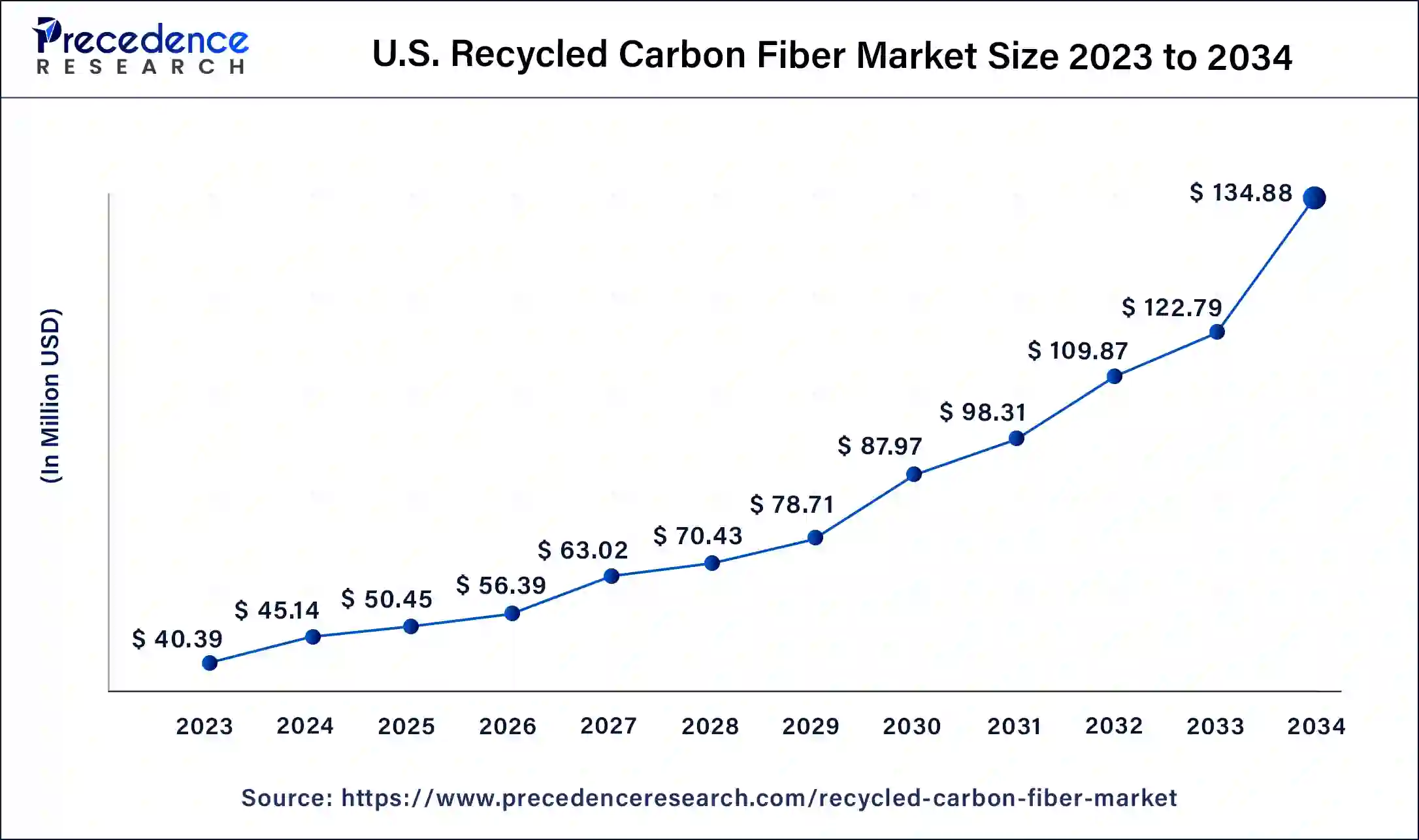
The U.S. recycled carbon fiber market size reached USD 56.39 million in 2026 and is expected to be worth around USD 147.52 million by 2035 at a CAGR of 11.10% from 2026 to 2035.
U.S. Market Trends
The United States represents the largest share of the recycled carbon fiber market in North America. The growth is driven by its extensive aerospace manufacturing, automotive production, and defense applications. Growing volumes of composite waste from aircraft production have created strong opportunities for recycling companies. Federal support for advanced recycling technologies and increasing use of recycled carbon fiber in automotive components, sporting goods, and industrial equipment continue to strengthen market growth.
Which Factors Drive the Fastest Growth in the Asia-Pacific Market?
Asia Pacific is expected to grow at the fastest CAGR in the recycled carbon fiber market during the forecast period. The growth is driven by rapid industrialization, expanding electric vehicle production, and increasing investments in renewable energy. The automotive and aerospace sectors of the Asia Pacific region have a high demand for recycled carbon fiber, not only for economic and environmental reasons, but also to increase their use in the aerospace, automotive, marine, and other sectors. This further supports the growth of the market.
China Market Trends
China represents the largest share of the recycled carbon fiber market in the Asia Pacific in 2026. The growth is driven by its large manufacturing base and growing focus on carbon neutrality. Expanding electric production, renewable energy projects, and industrial modernization continue to increase demand for sustainable composite materials. Government support for recycling infrastructure and circular economy development has accelerated investments in advanced recycling technologies. Strong domestic production capabilities and rising industrial applications position China as a major contributor to future market growth.
Which Factors Made Europe a Significantly Growing Region in the Market?
Europe is expected to grow at a considerable CAGR in the recycled carbon fiber market in the coming period. The growth is because of strict environmental regulations, ambitious circular economy goals, and widespread adoption of sustainable manufacturing practices. Automotive, aerospace, and wind energy industries continue expanding the use of recycled composite material to reduce emissions and production costs. Europe has laws and regulations that encourage the circular economy of composites and restrict the landfill disposal of composite materials.
Germany Market Trends
Germany leads the European recycled carbon fiber market in 2026, supported by its advanced automotive engineering, aerospace manufacturing, and strong industrial recycling capabilities. Demand continues to rise as electric vehicle manufacturers seek lightweight and sustainable materials to improve efficiency. European Union environmental policies and national innovation programs encourage greater use of recycled composites across manufacturing industries. Ongoing investments in recycling technologies and partnerships between material suppliers and automotive companies further strengthen Germany's position in the regional market.
What are the Advancements in the Market in Latin America?
Latin America held a considerable share of the recycled carbon fiber market in 2026, supported by expanding automotive manufacturing, industrial development, and increasing awareness of sustainable materials. Latin America has a growing interest in using recycled carbon fiber materials within the automotive assembly and for reinforcements in infrastructure projects. Growth in renewable energy (especially wind energy) results in more composite waste streams that can be processed through recycling plants within regions of Brazil and Mexico.
Brazil Market Trends
Brazil accounts for the largest share of the Latin American recycled carbon fiber market in 2026, due to its strong automotive manufacturing sector and expanding industrial base. Manufacturers are increasingly incorporating lightweight recycled materials to improve efficiency and meet sustainability objectives. The growing wind energy market in Brazil is resulting in increased volumes of composite scrap. Local manufacturers are utilizing recycled carbon fiber materials in automotive and construction applications, which is supporting the growth of the market.
What are the Key Trends in the Market in the Middle East and Africa Region?
The Middle East & Africa held a notable share of the recycled carbon fiber market in 2026, as governments diversify industrial economies and promote sustainable manufacturing practices. Growing investments in aerospace, construction, renewable energy, and transportation sectors are creating demand for lightweight composite materials. The growing acceptance of recyclables in the construction and transportation industries is also driving the demand for recycled carbon fiber. Increasing environmental awareness encourages greater adoption of recycled carbon fibers across multiple applications.
Saudi Arabia Market Trends
Saudi Arabia represents the leading market within the Middle East and Africa recycled carbon fiber market in 2026, supported by ongoing industrial diversification and investment in advanced manufacturing. National sustainability initiatives and large-scale infrastructure projects encourage the use of lightweight, durable materials across transportation, construction, and renewable energy sectors. The development of industrial innovation zones facilitates the establishment of a recycling industry for composite materials in the country. Growing interest in circular economy practices and industrial innovation is expected to increase demand for recycled composites.
Competitive Landscape
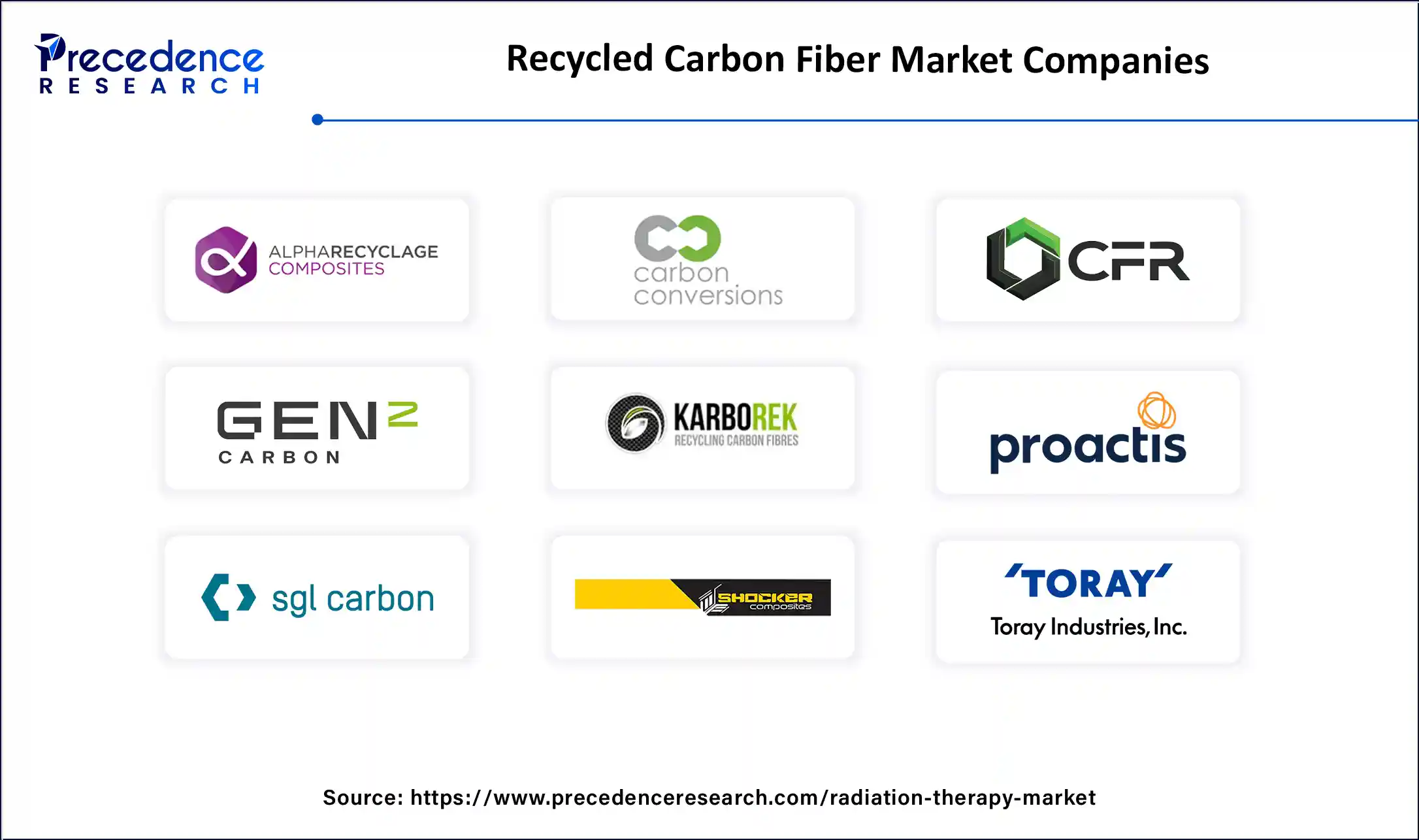
The recycled carbon fiber market is moderately consolidated, with competition centred on material quality, processing efficiency, and reliable supply. Leading companies such as Alpha Recyclage Composites, Carbon Conversion, Carbon Fiber Recylin Inc., Carbon Fiber Remanufacturing, Gen 2 Carbon, Karborek Recycling Carbon Fibers, Prokotex Corporation SA, SGL Carbon, Shoker Composites, Toray Industries, Vartega Inc are investing in advanced recycling technologies to recover high-performance fibers while lowering production costs. Strategic collaborations with aerospace, automotive, and wind energy manufacturers are helping suppliers secure long-term contracts and expand commercial applications.
To sustain future growth in the recycled carbon fiber market, companies should prioritize investments in advanced recycling technologies, expand partnerships with end-use industries, improve material performance, and develop cost-effective recycled carbon fiber solutions.
Value Chain Analysis of the Recycled Carbon Fiber Market
- Raw Material Sourcing: The recycled carbon fiber industry is very reliant on the ongoing sourcing of aerospace scrap, automotive manufacturing scrap, wind turbine blade scraps, and other composite materials from their product lifecycle at the end of their yield.
Key Players: Toray Industries, SGL Carbon, ELG Carbon Fibre, and Mitsubishi Chemical Group. - Material Processing and Conversion: The material processing and conversion phase consists of creating intermediate products by utilizing mechanical shredders, pyrolysis, solvolysis, and fibre re-sizing to restore the surface qualities of the material for its end use to produce non-wovens, pellets, and thermoplastic compounds for use in automotive, construction, and electronics.
Key Players: Carbon Conversions, Procotex, Vartega, and Shocker Composites. - Recycling & Waste Management: Efficient collection networks for composites, certification of dismantled composite structures, and waste segregation systems for compliance carry out the circular recovery of materials and reduce reliance on landfilling within the aerospace, wind energy, and industrial manufacturing industries.
Key Players: Veolia, Gen 2 Carbon, ELG Carbon Fibre, and CFK Valley Stade Recycling.
Recycled Carbon Fiber Market Companies
- Alpha Recyclage Composites
- Carbon conversion
- Carbon Fiber Recylin Inc.
- Carbon Fiber Remanufacturing
- Gen 2 Carbon
- Karborek Recycling Carbon Fibers
- Prokotex Corporation SA
- SGL Carbon
- Shoker Composites
- Toray Industries
- Vartega Inc
Recycled Carbon Fiber Market Recent Developments
- In July 2023, the wind turbine materials recycling contest was launched by the US Department of Energy. Most of the wind turbine materials may be economically recycled, including fiberglass and carbon fiber.
- In October 2023, a mass recycled carbon production facility was initiated by Apply Carbon. Apply Carbon has a capacity of 4000 metric tons and has completed the task of a fully automated production plant for recycled carbon fiber.
- In January 2024, $10 million was secured by the recycling of carbon fiber material specialist Vartega with equity financing led by Diamond Edge Ventures. This helps for a sustainable future.
- In February 2024, complete recyclable products by using recycled carbon fiber launched by Thermolysis at JEC World. Initiated the recycled carbon fiber (RCF) brand for the complete recycling of carbon fiber and their aim for zero waste. This helps with the production of carbon fiber reuse and recycling of the carbon fibers, and it is used in bicycle accessories such as fenders, light stands, cycling shoe boards, seats, pads, and bottle cages. These products have excellent mechanical strength characteristics and lightweight properties.
Segments Covered in the Report
By Product
- Chopped Carbon Fiber
- Milled Carbon Fiber
- Carbon Fiber Mat
- Others
By Source
- Automotive Scrap
- Aerospace Scrap
- Others
By Recycling Method
- Mechanical Recycling
- Chemical Recycling
- Pyrolysis
- Solvolysis
- Others
By End-use Industry
- Aerospace and Defence
- Automotive
- Wind Energy
- Sports and Leisure
- Construction
- Electronics
- Others
By Geography
- North America
- Europe
- Asia-Pacific
- Latin America
- Middle East and Africa
For inquiries regarding discounts, bulk purchases, or customization requests, please contact us at sales@precedenceresearch.com
Frequently Asked Questions





Ask For Sample
No cookie-cutter, only authentic analysis – take the 1st step to become a Precedence Research client
 Get a Sample




 sales@precedenceresearch.com
 Schedule a Meeting
