



Satcom Terminal Market Trends, Companies, Contract Wins / Project Pipeline, Defense Contracts, Procurement Volume, Government Spending, Production Capacity, Competitive Positioning, and Growth Outlook
Satcom Terminal Market (By Terminal Type: Fixed Satcom Terminals , Mobile Satcom Terminals; By Platform: Land, Airborne, Naval, Space-based (Lunar/Mars Exploration Interfaces); By Application: Defense and Security, Commercial Aviation, Maritime, Broadcasting, Emergency & Disaster Response, Remote Enterprises & Energy (Oil, Gas, Mining); By Frequency Band: L-band, C-band, X-band, Ku-band, Ka -band, Multi-band (Adaptive Terminals)) - Global Industry Analysis, Size, Trends, Leading Companies, Regional Outlook, and Forecast 2026 to 2035
Source: https://www.precedenceresearch.com/satcom-terminal-market
 Get a Sample
 Table Of Content


What is the Satcom Terminal Market Size in 2026?
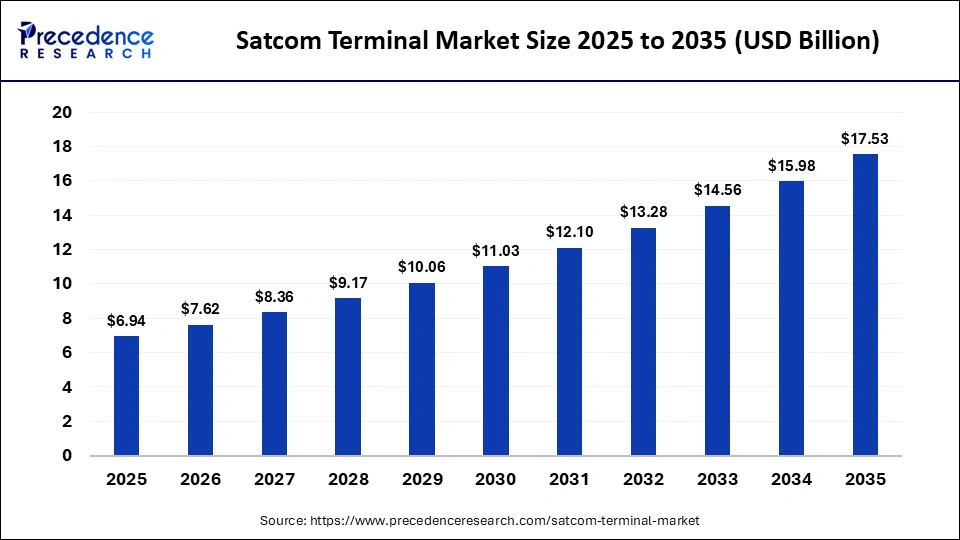
The global satcom terminal market size was calculated at USD 6.94 billion in 2025 and is predicted to increase from USD 7.62 billion in 2026 to approximately USD 17.53 billion by 2035, expanding at a CAGR of 9.70% from 2026 to 2035. The market is rapidly growing due to increasing demand for high-speed broadband connectivity, multi-orbit satellite connectivity, defense and aviation, and advanced AI-enabled terminal technologies.
Key Takeaways
- North America led the satcom terminal market in 2025.
- Asia Pacific is expected to grow at the highest CAGR during the forecast period.
- By terminal type, the fixed satcom terminals segment led the market with largest share of 55% in 2025.
- By terminal type, the mobile satcom terminals segment is expected to grow at the highest CAGR during the forecast period.
- By platform type, the land segment led the market in 2025.
- By platform type, the airborne segment is expected to expand at the highest CAGR from 2026 to 2035.
- By application type, the defense and security segment led the market in 2025.
- By application type, the remote enterprises and energy is expected to expand at the highest CAGR from 2026 to 2035.
- By frequency band type, the L-band segment led the market in 2025.
- By frequency band type, the Ka-band segment is expected to expand at the highest CAGR from 2026 to 2035.
What is the Satcom Terminal Market?
The satcom terminal market comprises technologies that facilitate communication between users on the ground and satellites in space. Satcom terminals transmit and receive voice, video, and data in the form of radio frequencies. The satellite communication terminals include various systems such as antennas, modems, RF systems, and software. These terminals can be fixed, portable, or mobile systems that can be mounted on vehicles, ships, and aircraft. Such systems are used for various applications by defense forces, aviation, maritime, telecom operators, and emergency service groups.
The antennas used in satcom terminals can be mechanically or even electronically controlled using a phased array technique for tracking fast-moving LEO and MEO satellites. The RF subsystem is used for frequency conversion and amplification. HPAs are used for amplifying uplink signals. Software modems optimize the communication links using adaptive coding, modulation schemes, and dynamic frequency selection. Modern satcom terminals can operate in multiple orbits, that is, GEO, MEO AND LEO. IoT and telemetry technology are integrated for defense, maritime, and industrial applications in remote areas.
What is the Role of AI in the Satcom Terminal Market?
The use of AI enhances the performance of satcom terminals. AI uses algorithms to evaluate signal quality, traffic levels, and environmental factors in real-time. Machine learning models evaluate satcom traffic levels and allocate sufficient bandwidth to critical communications. This feature is particularly important in defense, aviation, and broadband communications. AI is used to evaluate satcom terminal components for signs of impending failure, resulting in enhanced component reliability. Artificial intelligence algorithms are used to monitor satcom terminal connections and automatically switch to a different connection when needed.
What are the Satcom Terminal Market Trends?
- Collaborations and Partnerships: Electronics and telecom companies are collaborating with each other to design and develop better satcom terminals that can cater to higher bandwidth requirements and multiple satellite orbits. For instance, Cobham Satcom partnered with Space42 to design satcom terminals for the Thuraya satellite network.
- Government Initiatives: Governments are actively investing in the development of satcom terminals to enhance secure communication systems and military applications. Government agencies require satcom terminals that can function on multiple bands and are portable enough to meet military requirements. For instance, the U.S Air Force has funded a project to install advanced satcom terminals for aerial communication.
- Business Expansions: Satellite communication firms are expanding their infrastructure to meet growing demand for satcom terminals. The expansion of satellite broadband services and large constellations of LEO satellites has led organizations to expand their production capacity and infrastructure. For instance, SpaceX has expanded its production infrastructure for Starlink user terminals.
Market Scope
| Report Coverage | Details |
| Market Size in 2025 | USD 6.94 Billion |
| Market Size in 2026 | USD 7.62 Billion |
| Market Size by 2035 | USD 17.53 Billion |
| Market Growth Rate from 2026 to 2035 | CAGR of 9.70% |
| Dominating Region | North America |
| Fastest Growing Region | Asia Pacific |
| Base Year | 2025 |
| Forecast Period | 2026 to 2035 |
| Segments Covered | Terminal Type, Platform, Application, Frequency Band, and region |
| Regions Covered | North America, Europe, Asia-Pacific, Latin America, and Middle East & Africa |
Segmental Insights
Terminal Type Insights
Why Did the Fixed Satcom Terminals Segment Dominate the Satcom Terminal Market?
The fixed satcom terminals segment dominated the market in 2025. The market growth of this segment is because it offers high-capacity connectivity for permanent installations. Fixed satcom terminals are used in ground stations, telecom backhaul, military bases, and enterprise sites, where permanent connectivity is essential for smooth communications. Fixed terminals have larger antenna systems and power capabilities, enabling them to transmit stronger and more efficient signals. Satellite operators have developed their own ground infrastructure using fixed terminals to manage satellite traffic and data transmission.
The mobile satcom terminals segment is expected to grow at the highest CAGR from 2026 to 2035. The market growth of this segment is due to increasing demand for satellite connectivity in moving assets like aircraft, vessels, and military vehicles. This segment facilitates communication during movement and is essential for aviation connectivity, shipping, military operations, and disaster relief. Mobile satcom terminals incorporate advanced tracking technology with antennas to facilitate communication with satellites during motion.
Platform Type Insights
Why Did the Land Segment Dominate the Satcom Terminal Market?
The land segment dominated the market in 2025. The market growth of this segment is because a majority of satellite communication is land-based. This segment is used for providing services such as telecom backhaul operations, military communication networks, enterprise network processes, and disaster recovery networks. Defense and government organizations also require a large number of land terminals for providing tactical communication services.
The airborne segment is expected to expand at the highest CAGR during the forecast period. The market growth of this segment is due to an increase in demand for in-flight connectivity and real-time communication services used in aviation. There has been an increase in satellite networks used for low-Earth orbits, facilitating faster and more efficient aviation broadband services. The market growth of this segment is further driven by the rise in satellite communication services used by military aircraft and unmanned aerial vehicles for surveillance and navigation.
Application Type Insights
Why Did the Defense and Security Segment Dominate the Satcom Terminal Market?
The defense and security segment dominated the market in 2025. The market growth of this segment can be attributed to significant demand for satcom terminals for secured and reliable communication in defense activities carried out in remote and hostile environments. Satcom terminals enable defense forces to establish real-time communication for effective command and coordination. Such systems enable defense agencies to establish communication even when traditional communication systems are not available.
The remote enterprises and energy segment is expected to expand at the highest CAGR during the forecast period. The market growth of this segment is because these services operate in remote areas where land-based connectivity options are limited or unavailable. Satcom terminals offer stable connectivity for data transfer and coordination in these areas. The energy and mining industry is increasingly adopting digital technologies like IoT, autonomous equipment, and real-time data analysis. However, these technologies require stable connectivity, which can be achieved using satellite terminals even in offshore platforms, deserts, and mountainous areas.
Frequency Band Type Insights
Why Did the L-Band Segment Dominate the Satcom Terminal Market?
The L-band segment dominated the market in 2025. The market growth of this segment is because L-band offers reliable communication even in harsh weather conditions. The L-band operates on lower frequencies, which allows it to penetrate rain, clouds, and other atmospheric disturbances. Due to the reliable nature of this segment, it is widely used for mission-critical operations such as maritime communication, aviation, and military operations, where stable connectivity is necessary for voice, tracking, and data transmission.
The Ka-band segment is expected to expand at the highest CAGR during the forecast period. The market growth of this segment can be attributed to its ability to carry much higher speeds and bandwidths compared to lower frequency bands. Ka-band is used in modern high-throughput satellite systems to provide faster connectivity for aviation, maritime, and enterprise networks. As the need for broadband connectivity grows, more satcom terminals are being designed to operate in the Ka-band frequency range. The market growth of this segment is further driven by the launch of next-generation satellite networks.
Regional Insights
What Made North America the Leading Region in the Satcom Terminal Market?
North America dominated the market in 2025. The market growth in this region is because of its advanced satellite communication infrastructure and the presence of key space and telecom companies. Governments have significantly invested in defense and aerospace sectors where satcom terminals are widely used for secure and effective communication, surveillance, and mission operations on land, sea, and in the air. The increasing demand for satellite broadband, mobile, and remote communications is fueling the growth of advanced satcom terminals in the region.
U.S Satcom Terminal Market Analysis
The U.S. leads the market in North America owing to its robust satellite communication infrastructure. This country has a significant presence of satellite communication operators, technology companies, and satcom terminal manufacturers. The presence of numerous key players in the industry facilitates constant innovation and widespread adoption of satcom terminals. The U.S. has high defense spending, which contributed to the demand as military and government institutions use satellite communication terminals to facilitate communication in land vehicles, ships, and aircraft.
What Made Asia Pacific the Fastest Growing Region in the Satcom Terminal Market?
Asia Pacific is expected to grow at the highest CAGR from 2026 to 2035. The market growth in this region can be attributed to the rapid development of satellite communication systems in emerging economies. This region is witnessing a rise in the demand for satellite communication in aviation, maritime, and defense applications. Governments and telecom operators in the Asia Pacific are using satcom terminals for communication in large geographic regions and island nations. The market growth in this region is further driven by an increase in space programs and satellite launches.
China Satcom Terminal Market Trends
China leads the market in the Asia Pacific due to its significant investments in satellite communication infrastructure. These investments are aimed at developing advanced satcom technology for commercial, defense, and government use. This country has numerous communication satellites, which drive the demand for satcom terminals for broadband connectivity, communication, and broadcasting. Moreover, the increasing aviation, maritime, and defense industries in China are boosting the market adoption.
Satcom Terminal Market Companies
- Cobham Satcom
- Hughes Network Systems
- Viasat
- L3Harris Technologies
- Intellian Technologies
- Kymeta Corporation
- Thales Group
- Rohde and Schwarz
- Campbell Scientific
- Samsung Electronics
- Panasonic Avionics
- Raytheon Technologies
- Thuraya Telecommunications
- Iridium Communications
- Inmarsat
Recent Developments
- In October 2025, Sharp Corporation launched a 5G NTN-compatible user terminal, which is optimized for LEO satellite connectivity. This product offers high-speed broadband connectivity for moving platforms and remote areas, including 5G NTN connectivity to connect satellite and terrestrial networks. This product was recognized in CEATEC 2025 for its innovative capabilities in mobile connectivity and multi-orbit support. (Source: https://global.sharp)
- In March 2025, Orbit Communication Systems launched MPT30Ka, a Ka-band satcom terminal intended for on-the-move military and marine applications. This terminal provides robust mobile connectivity, including beam tracking and adaptive modulation to ensure stable connectivity in harsh environmental conditions. (Source: https://orbit-cs.com)
- In July 2025, ALL.SPACE launched the Hydra MAX Satcom Terminal, which is a dual-beam and full-duplex Ka-band terminal capable of providing up to 1 GHz aggregate bandwidth. This terminal offers high-throughput satellite connectivity for commercial and military applications, including simultaneous uplink and downlink capabilities. (Source: https://www.all.space)
Segments Covered in This Report
By Terminal Type
- Fixed Satcom Terminals
- Mobile Satcom Terminals
By Platform
- Land
- Airborne
- Naval
- Space-based (Lunar/Mars Exploration Interfaces)
By Application
- Defense and Security
- Commercial Aviation
- Maritime
- Broadcasting
- Emergency & Disaster Response
- Remote Enterprises & Energy (Oil, Gas, Mining)
By Frequency Band
- L-band
- C-band
- X-band
- Ku-band
- Ka -band
- Multi-band (Adaptive Terminals)
By Region
- North America
- Latin America
- Europe
- Asia-pacific
- Middle and East Africa
For inquiries regarding discounts, bulk purchases, or customization requests, please contact us at sales@precedenceresearch.com
Frequently Asked Questions
Tags





Ask For Sample
No cookie-cutter, only authentic analysis – take the 1st step to become a Precedence Research client
 Get a Sample




 sales@precedenceresearch.com
 Schedule a Meeting
