



Self-Healing Networks Market Size, Share and Trends 2026 to 2035
Self-Healing Networks Market (By Component: Software, Service; By Deployment: Cloud, On-Premise; By Enterprise Size: Large Enterprise, Small and Medium Enterprise; By Application: Networking Configuration & Provisioning, Network Traffic Management, Root Cause Analysis, Network Access Control, Security Compliance Management, Others (Policy Management); By End-use: Academia, BFSI, Government, Healthcare, IT & Telecom, Manufacturing, Retail, Others) - Global Industry Analysis, Size, Trends, Leading Companies, Regional Outlook, and Forecast 2026 to 2035
Source: https://www.precedenceresearch.com/self-healing-networks-market
 Get a Sample
 Table Of Content


What is the Self-Healing Networks Market Size?
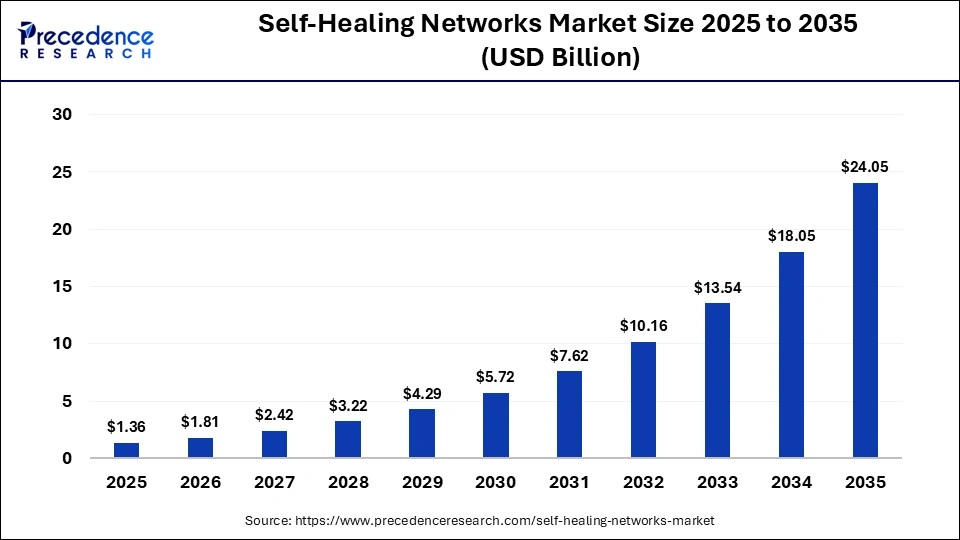
The global self-healing networks market size accounted for USD 1.36 billion in 2025 and is predicted to increase from USD 1.81 billion in 2026 to approximately USD 24.05 billion by 2035, expanding at a CAGR of 33.28% from 2026 to 2035. The market growth is attributed to the rapid adoption of AI-driven automation, cloud native architectures, and intelligent self-healing capabilities across telecom and enterprise networks.
Market Highlights
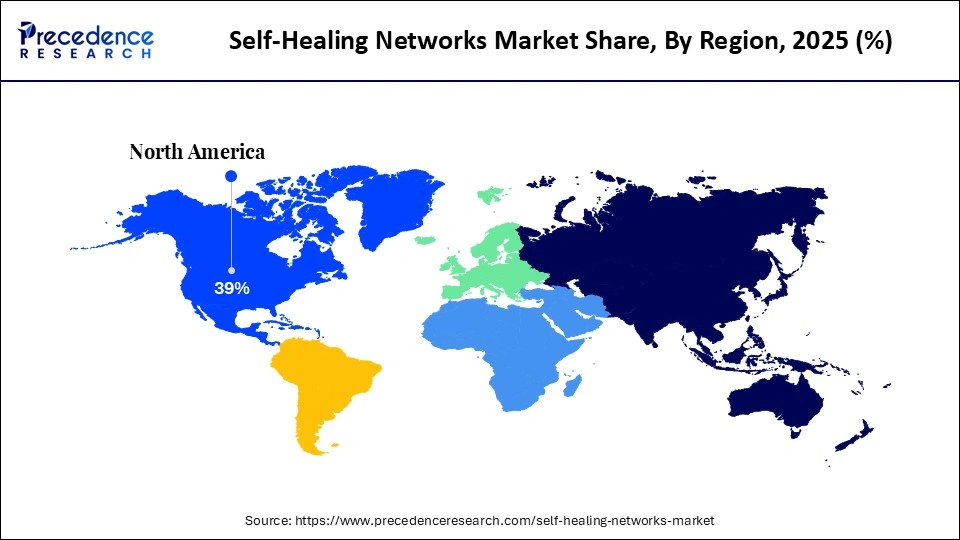
- North America dominated the market with the largest market share of 39% in 2025.
- The Asia Pacific is expected to grow at the fastest CAGR between 2026 and 2035.
- By offering, the software segment contributed the highest market share in 2025.
- By offering, the services segment is growing at a strong CAGR between 2026 and 2035.
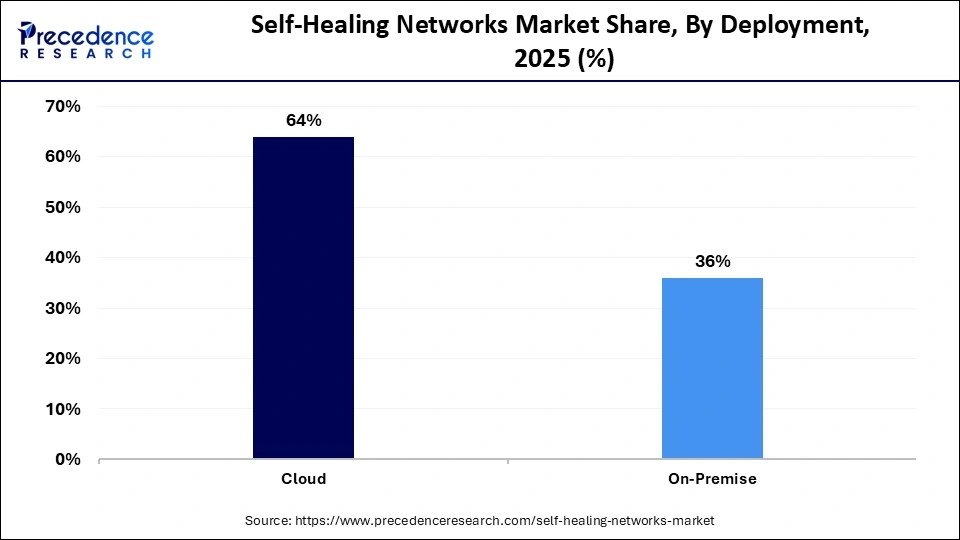
- By deployment, the cloud segment held a major market share of 64% in 2025.
- By deployment, the on-premises segment is expected to expand at a notable CAGR from 2026 to 2035.
- By enterprise size, the large enterprises segment captured the highest market share in 2025.
- By enterprise size, the small and medium enterprises segment is poised to grow at a rapid CAGR between 2026 and 2035.
- By application, the networking configuration & provisioning segment generated the biggest market share in 2025.
- By application, the network traffic management segment is expanding at the fastest CAGR between 2026 and 2035.
- By end-user, the IT and telecom segment accounted for the largest market share in 2025.
- By end-user, the healthcare segment is projected to grow at a solid CAGR between 2026 and 2035.
Market Overview
The self-healing networks market is being driven by the global shift toward autonomous telecommunications operations. Closed-loop control and AI-based automation result in less human intervention and enhanced resilience. Self-healing, self-optimization, and self-protection functions of protocols are supported by the GSMA AI Telco Troubleshooting Challenge, sponsored by ETSI, IEEE GenAINet, ITU, and TM Forum. Furthermore, the cities and large enterprises adopting these technologies report significant reductions in manual troubleshooting and improved service stability as network complexity grows.
Impact of Artificial Intelligence on the Self-Healing Networks Market
The self-healing networks market has significant shifts due to artificial intelligence that determines the way networks detect, diagnose, and repair issues. The AIs inspect and examine live network data to identify anomalies before they lead to outage errors. Moreover, the network providers implement AI-based automation of 5G, edge, and cloud environments to allow dynamically allocating resources and choosing traffic most efficiently.
Self-Healing Networks Market Growth Factors
- Rising Demand for 5G and Beyond Networks: The expansion of 5G and early 6G trials is driving the adoption of self-healing networks to maintain high reliability and low latency.
- Propelling AI-Enabled Network Operations: The rise of AI-powered monitoring and predictive analytics is propelling autonomous remediation and service optimization across networks.
- Boosting Private Network Expansion: Adoption of private 5G and enterprise networks in industrial, healthcare, and logistics sectors is boosting self-healing technology implementation.
Self Healing Networks Market Quantitative Insights and Recent Industry Developments
- According to collaborative research by IBM Institute for Business Value (IBM IBV) and TM Forum, as of 2025, only 6% of global Communication Service Providers (CSPs) report having achieved Level 4 (highly autonomous) network operations, signaling active deployment of self-healing and advanced closed-loop automation capabilities.
- As of 2025, over 30 global communications service providers (CSPs) across Asia, Europe, Africa, and the Middle East have completed TM Forum Autonomous Network Level Assessments (ANLET), a key step toward validating AI-enabled fault detection and automated remediation capabilities in network domains.
- A TM Forum case study of China Mobile's autonomous network deployment showed that advanced automation and intelligent agents led to a 30 % reduction in fault-related mean time to repair (MTTR), indicating tangible reductions in downtime from self-healing-oriented network operations.
- Industry shifts in India's telecom sector point to a substantial capital expenditure pivot, with ₹2.5-3 lakh crore (USD 30-36 billion) earmarked over the next 3-5 years for future-ready network infrastructure, including AI-driven optimization technologies central to autonomous and intent-based networking roadmaps.
Market Breakthroughs in Self-healing Networks Market
- Zero Trust Security Integration Across Automated Networks: Zero-trust architectures are defined as default design principles in 2026, which provide non-stop verification among users, devices, and services to ensure autonomous control loops are secured. The trend shows the growing confidence in self-healing automation, which makes sure to uphold security policies are upheld across all levels of the network.
- Advanced RAN Automation Through Strategic OEM Transfers: In 2025, Nokia purchased the RAN Intelligent Controller resources of HPE to enhance the automated RAN orchestration and enable the multi-vendor, AI-assisted radio control. The trend is intensifying the intelligent RAN activities that enhance the responsiveness of the network and prepare the operator to undergo a smooth transition to 6G without the heavy use of manual labor.
Market Scope
| Report Coverage | Details |
| Market Size in 2025 | USD 1.36 Billion |
| Market Size in 2026 | USD 1.81 Billion |
| Market Size by 2035 | USD 24.05 Billion |
| Market Growth Rate from 2026 to 2035 | CAGR of 33.28% |
| Dominating Region | North America |
| Fastest Growing Region | Asia Pacific |
| Base Year | 2025 |
| Forecast Period | 2026 to 2035 |
| Segments Covered | Component, Deployment, Enterprise Size, Application, End-Use, and Region |
| Regions Covered | North America, Europe, Asia-Pacific, Latin America, and Middle East & Africa |
Segment Insights
Component Insights
Software segment dominated the self-healing networks market in 2025. Driven by SDN-based platforms, which allow operators to dynamically program network behavior and respond to faults automatically. Furthermore, the global shift from hardware-centric designs toward AI-centric, automated network management is expected to fuel the segment growth.
The service segment is expected to grow at the fastest rate in the coming years, as businesses are putting increased investments in professional and managed services to implement, tune, and sustain self-healing functions. Additionally, the services are gaining traction as networks become more complex and adaptive, requiring expert oversight alongside autonomous tools.
Deployment Insights
Cloud segment held the largest revenue share in the self-healing etworks market in 2025, due to the use of cloud-native network functions in scalability, automation, and real-time resilience by the operators. The bodies and cloud partners provided platforms that enabled carriers to operate AI-based automation using elastic compute and quick upgrades. According to Omdia data, cloud infrastructure has increased by 12% in 2025, indicating that the growing trend in the deployment of cloud-based technologies in the coming years.
On-premises segment is expected to grow at the fastest rate in the coming years, owing to the interest that enterprises and carriers have in ultra-low latency, data control, and sovereignty needs. Furthermore, the increased demand for on‑prem solutions is further facilitated by high performance and data governance, offering operators choice, control, and resilience across deployments.
Enterprises Size Insights
Large enterprises segment dominated the self-healing networks market in 2025, as they handle sophisticated network processes demanding sophisticated automation and resiliency plans. These organizations use an AI-based self-healing network to ease the manual workload and increase the uptime of multi-domain infrastructures. Additionally, the large enterprises also lead adoption in the market, as they face stricter service level agreements and regulatory requirements that mandate robust resilience and rapid fault recovery.
Small and medium enterprises segment is expected to grow at the fastest CAGR in the coming years, owing to the growing use of automation to ease the control of networks and cut expenses. SMEs embrace cloud automation systems that decrease barriers to entry by decreasing dependence on huge internal teams of IT. Moreover, advanced self-healing technology trends position SMEs to adopt autonomous network behaviors in future years as solutions become more modular, scalable, and cost-effective.
Application Insights
Network traffic management segment held the largest revenue share in the self-healing networks market in 2025, as operators face unprecedented data demands and must keep performance stable under heavy load. AIs in traffic routing and load balancing enable the operators to reach their service level expectations without constant manual intervention. Furthermore, the embedded advanced traffic analytics operators enhance uptime and user experience, which is expected to boost the segment dominance in the coming years.
Root cause analysis (RCA) segment is expected to grow at the fastest rate in the coming years, as networks are increasingly relying on in-depth diagnostic intelligence to reduce the duration of outages and the cost of operation. Moreover, the standardization efforts from GSMA, ETSI, ITU, and TM Forum further align RCA frameworks to ensure cross-vendor interoperability in real deployments.
Vertical Insights
The IT and telecom segment dominated the self-healing networks market in 2025, due to the growing complexity of 5G traffic, massive IoT demands, and high quality of service requirements that operators were dealing with. Furthermore, the adoption of self-healing technologies is also encouraged by standards in 3GPP and ITU, which add self-organizing network capabilities and smart control to the very sophisticated cellular standards.
The healthcare segment is expected to grow at the fastest rate in the coming years, as it increasingly depends on resilient, low-latency network connectivity for critical clinical applications. The 5G and AI integration in healthcare systems facilitate real time patient monitoring with sub 15 ms latency and high prediction accuracy.
Regional Insights
How Big is the North America Self-Healing Networks Market Size?
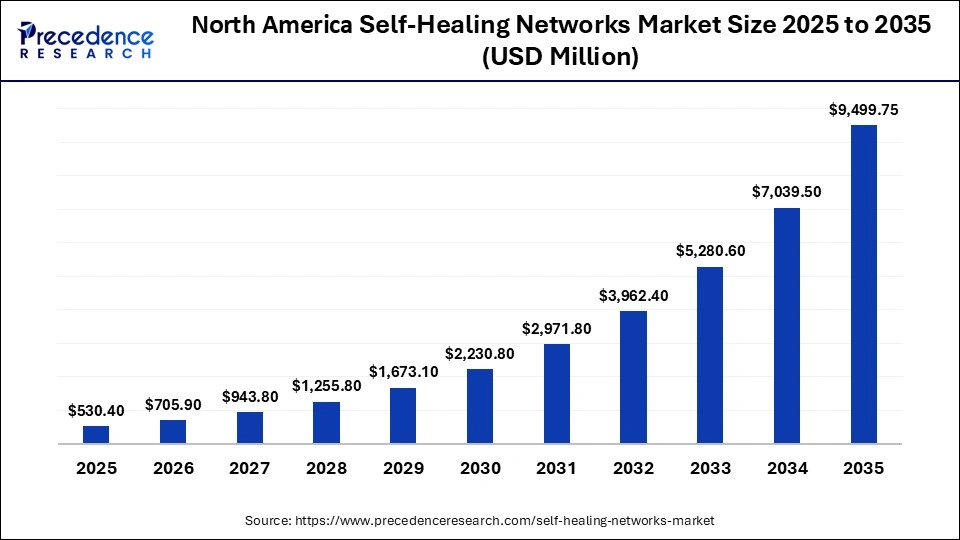
The North America self-healing networks market size is estimated at USD 530.40 million in 2025 and is projected to reach approximately USD 9,499.75 million by 2035, with a 33.45% CAGR from 2026 to 2035.
North America Self-Healing Networks Market Trends
North America led the self-healing networks market, capturing the largest revenue share in 2025. Due to the aggressive integration of intent-based automation frameworks by operators into 5G and multi-domain infrastructures to enhance their performance and resiliency. Additionally, the wide ecosystem of innovation present in the region facilitates investment in cloud and edge deployments of self-healing technology in this region.
What is the Size of the U.S. Self-Healing Networks Market?
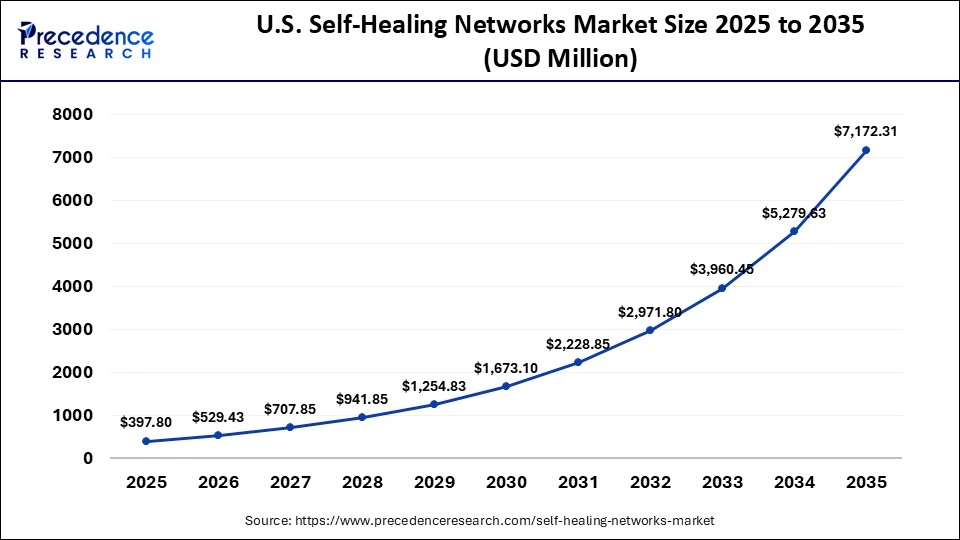
The U.S. self-healing networks market size is calculated at USD 397.80 million in 2025 and is expected to reach nearly USD 7,172.31 million in 2035, accelerating at a strong CAGR of 33.54% between 2026 and 2035.
U.S. North America's Leader in Autonomous Network Innovation
U.S. leads the market in North America due to its forefront in autonomous network automation technologies. The US carriers and cloud providers embraced AI-led network management and self-healing solutions sooner than the majority of the rest of the world. Furthermore, the strategic cooperation with AI and cloud giants, and regulatory support, also make the U.S. a trial site of next-generation autonomous network technologies.
Why Asia Pacific is Poised for Explosive Growth in Autonomous Network Adoption
Asia Pacific is anticipated to grow at the fastest rate in the market during the forecast period, as carriers and governments in this region prioritize digital transformation, AI integration, and 5G expansion to support massive connectivity growth and innovation. Furthermore, with a strong 5G network build-outs underlying these trends, such as billions of connections in the forecast, Asian Pacific is a rapidly expanding epicentre of automated network adoption and innovation in the coming years.
China Driving Asia Pacific's Autonomous Network Growth
China is leading the charge in the Asia Pacific market, owing to the growing trend of self-healing network development for 5G and automation uptake. The leading carriers of the country, such as China Mobile, China Telecom, and China Unicom, are heavily investing on AI powered fault detection and automated network orchestration to cover an expansive network footprint in urban and rural areas. Moreover, the china also drives the extended application of self-healing security systems and the zero-touch provisioning to maintain reliability in the face of increasing traffic loads.
Who are the Major Players in the Global Self-Healing Networks Market?
The major players in the self-healing networks market include VMware, Inc., SolarWinds Corporation, Nokia Corporation, ManageEngine, Juniper Networks, Inc., IBM Corporation, and Huawei Technologies Co., Ltd.
Recent Developments
- In June 2026, NWN announced an expanded vision for its AI-powered Network-as-a-Service, Intelligent Connectivity. The platform integrates HPE Networking, Juniper Mist AI, Cisco Meraki, and Cisco enterprise solutions. It offers full visibility, automation, and performance insights across enterprise networks. Powered by NWN's EMP, it unifies AI-enhanced observability, security, automation, and lifecycle management.
- In September 2025, Ribbon Communications introduced Acumen, an AI-driven automation platform for service providers and enterprises. It helps navigate complex operations and accelerates the adoption of autonomous networks. The platform enhances network modernization, security, and operational efficiency. Ribbon targets global service providers and critical infrastructure operators with this solution.
- In October 2025, Aprecomm launched AIVRA, a self-learning AI agent for ISPs. It provides real-time access to operational data via a unified text-based query engine. The tool streamlines decision-making, reduces complexity, and improves efficiency. AIVRA will be available to customers and partners by March 2026.
Segments covered in the report
By Component
- Software
- Core HR
- Employee Collaboration & Engagement
- Recruiting
- Talent Management
- Workforce Planning & Analytics
- Others
- Service
- Integration & Deployment
- Support & Maintenance
- Training & Consulting
By Deployment
- Cloud
- On-Premise
By Enterprise Size
- Large Enterprise
- Small and Medium Enterprise
By Application
- Networking Configuration & Provisioning
- Network Traffic Management
- Root Cause Analysis
- Network Access Control
- Security Compliance Management
- Others (Policy Management)
By End-use
- Academia
- BFSI
- Government
- Healthcare
- IT & Telecom
- Manufacturing
- Retail
- Others
By Region
- North America
- Europe
- Asia-Pacific
- Latin America
- Middle East & Africa
For inquiries regarding discounts, bulk purchases, or customization requests, please contact us at sales@precedenceresearch.com
Frequently Asked Questions





Ask For Sample
No cookie-cutter, only authentic analysis – take the 1st step to become a Precedence Research client
 Get a Sample




 sales@precedenceresearch.com
 Schedule a Meeting
