



Space Materials Market Trends, Leading Companies, Company Revenue / Sales Performance, Manufacturing Capacity, Defense Contracts, Export Analysis, Pricing Metrics, Competitive Landscape, and Industry Outlook
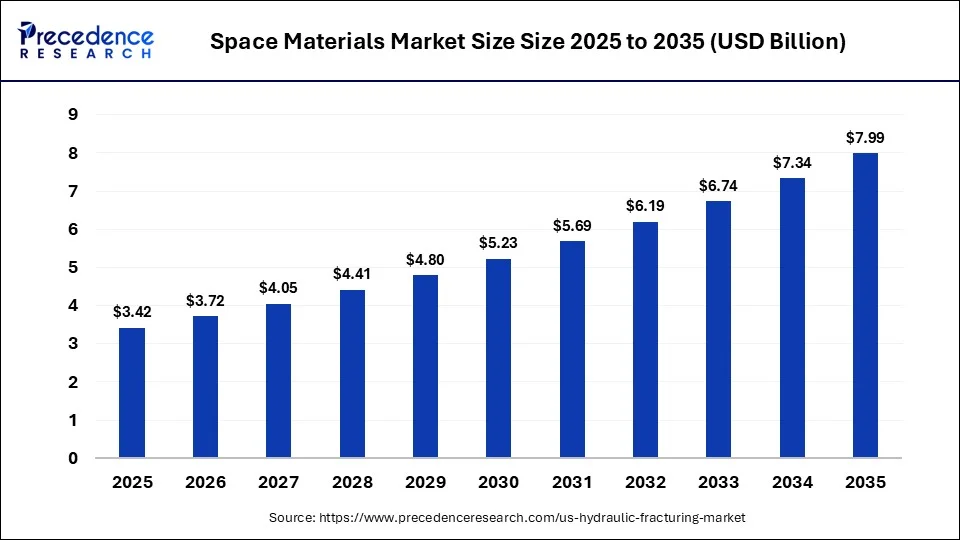
The space materials market reached USD 3.72 billion in 2026. This growth is driven by increasing production of spacecraft and growing satellite constellation deployment. These trends were analyzed by Vidyesh Swar, Senior Research Analyst, to curate this report. He conducted in-depth research related to different space materials, their widespread adoption for multiple purposes, end-user requirements, key player innovations, and buyer intelligence. The report benefits raw material suppliers, manufacturers, R&D and materials testing labs, and orbital logistics and return service providers.
Source: https://www.precedenceresearch.com/space-materials-market
 Get a Sample
 Table Of Content


Space Materials Market Size, Share, Trends, and Forecast Analysis 2035
The space materials market is forecasted to expand from USD 3.72 billion in 2026 to USD 7.99 billion by 2035, growing at a CAGR of 8.85% from 2026 to 2035. The market is mainly driven by increasing launch cadence, the development of reusable launch systems, lunar exploration, and expanding space station infrastructure. Vidyesh Swar has over 5 years of experience in the Aerospace and Defense sector. He identified that material durability is essential to ensure longevity in reusable rockets and spacecraft. Thus, companies are shifting their focus towards wear-resistant coatings, radiation-resistant materials, and self-healing composites.
Key Takeaways
- According to OECD, 329 space launches carried about 4,900 objects in space in 2025.
- By material type, the carbon fiber composites segment dominated the market with a share of 25.65% in 2025.
- By material function analysis, the structural materials segment held the largest market share of 34.65% in 2025.
- By application analysis, the satellites segment accounted for the highest market share of 31.85% in 2025.
- By material technology, the conventional materials segment contributed the biggest market share of 32.85% in 2025.
- By region, North America held a major market share of 38.65% in 2025.
- Qualification infrastructure, aerospace-grade manufacturing, traceability, and proximity are important demand indicators in all regions.
- NASA currently supports multiple projects, facilitating the development of carbon nanotube composites and additive manufactured materials.
- Space material buyers consider material consistency, cost, traceability, environmental test data, and supply continuity while purchasing space materials.
- The rapid expansion of space constellation, commercialization, and the increasing number of lunar and deep-space programs are major drivers of the market.
How is the Space Materials Market Growing Through 2035?
The space materials market is growing rapidly at a CAGR of 8.85% from 2026 to 2035, driven by recent developments in space materials, increasing government and private investments in advanced space research, and the rising integration of advanced technologies and smart materials. The space economy is witnessing rapid shifts with the launch of satellites and the need for higher spacecraft production. According to a recent OECD report, 329 space launches carried around 4,900 objects into space in 2025, while more than 14,000 operational satellites were in orbit at year-end.
Expert Analyst View - Market Size
The supplied market forecast implies approximately 2.34 times expansion between 2025 and 2035, creating opportunities for material suppliers that can combine low mass with thermal stability, radiation resistance, dimensional stability, and manufacturability. The market growth is attributed to the growing development of high-performance composites, ceramic systems, nanomaterials, multifunctional materials, and advanced polymers. Space materials face challenges related to authorization, as they must undergo extensive environmental and reliability testing.
Segmentation Analysis
Which Material Type Segment Dominated the Space Materials Market?
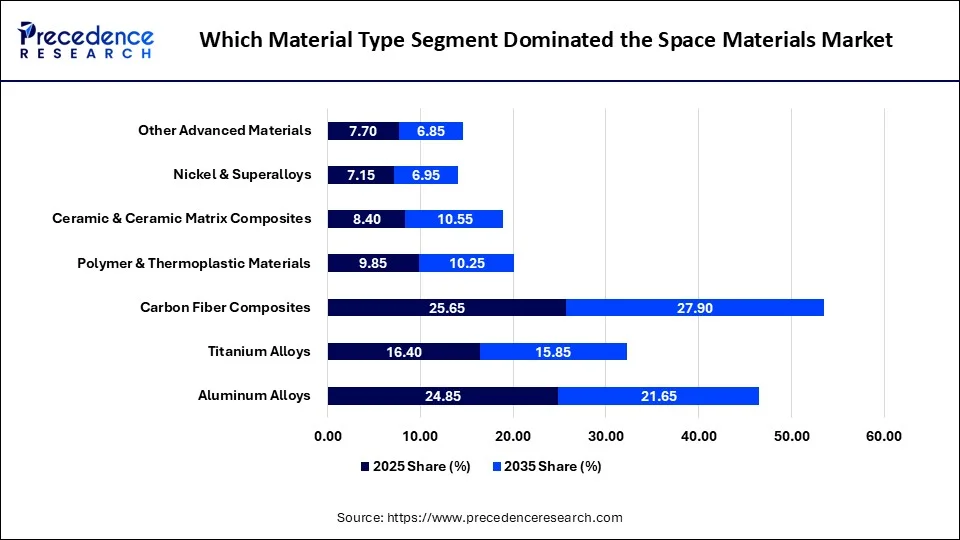
Carbon fiber composites held the largest market share of 25.65% in 2025 and are expected to show slight growth through 2035, with a market share of 27.9%. This dominance is a result of lightweight, robust, and scalable structures. The ceramic & ceramic matrix composites segment is projected to expand at the highest CAGR of 11.15% over the studied period. Ceramic materials are in high demand as they can withstand high temperatures up to 1,6000C and are lighter than metals. In addition, aluminum alloys, titanium alloys, nickel & superalloys, and other advanced materials are expected to reduce their market shares during the forecast period.
Expert Analyst View - Material Type
The slight decline in demand for aluminum alloys is strategically significant rather than a sharp decrease in aluminum in absolute terms. Aluminum still holds priority as space materials, but at the same time mass reduction per unit of structural performance is also increasingly important. Thus, stakeholders prefer using materials that provide similar properties as that of aluminum, including the lightweight property. NASA scientists are currently working on developing carbon-nanotube-reinforced structures intended to reduce mass by an estimated 25% versus carbon-fiber-reinforced polymers and up to 50% versus aluminum in applicable structures.
How the Structural Materials Segment Dominated the Space Materials Market?
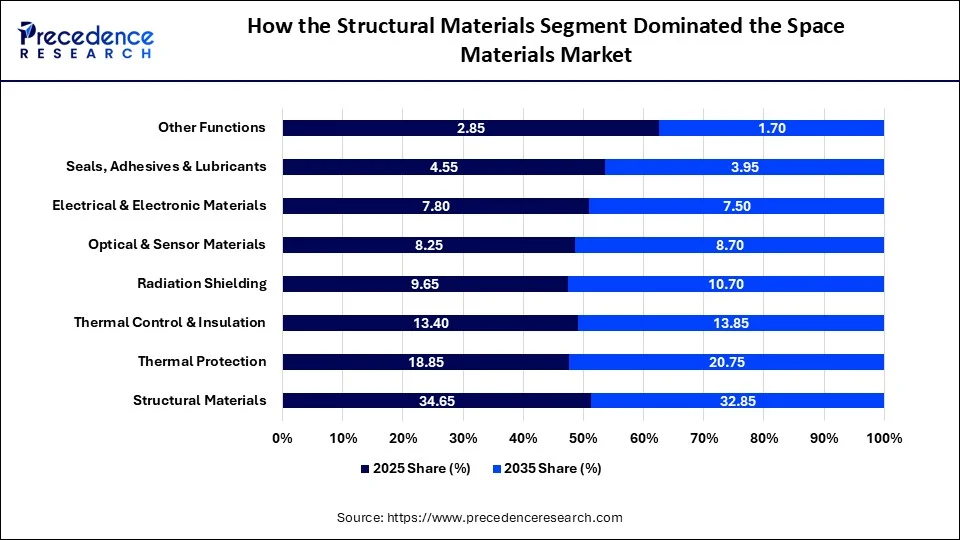
Structural materials remained the largest market shareholder with a share of 34.65% in 2025 and is expected to remain dominant with a share of 32.85% in 2035. The market shares of thermal protection, thermal control & insulation, and radiation shielding are projected to witness growth in market shares between 2025 and 2035. These functions reflect the increasing diversity of missions, including reusable launch vehicles, lunar missions, deep-space exploration, and crewed infrastructure.
Expert Analyst View - Material Function Analysis
Thermal protection and radiation shielding are technically the most demanding functional analytical methods. ESA testing programs are conducted to evaluate outgassing, mechanical strength, and contamination by exposing materials to vacuum, thermal cycling, ionizing radiation, UV, and atomic oxygen. For suppliers, this means the value proposition increasingly moves beyond the base material toward qualified material systems, coatings, adhesives, surface treatments, and application-specific engineering.
Why Are Space Materials Predominantly Used for Satellites?
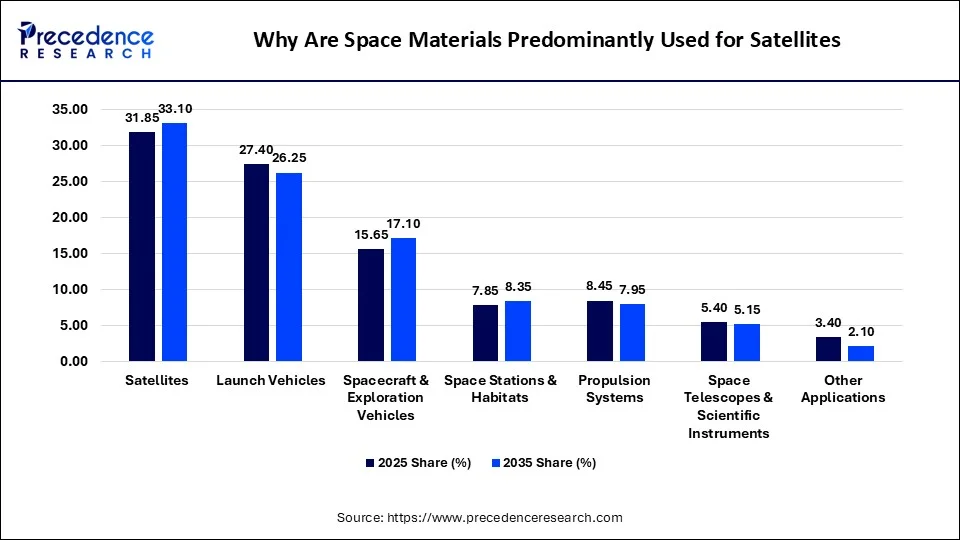
Satellites demand the highest amount of space materials, accounting for a market share of 31.85% in 2025. They are projected to remain dominant through 2035 with a market share of 33.10%. OECD reported that over 14,000 satellites were operational by the end of 2025, while commercial operators accounted for 88% of satellites launched during 2025. The spacecraft & exploration vehicles segment is expected to grow at the fastest CAGR of 9.82% during the forecast period. Moreover, the demand for space materials is apparently high in launch vehicles, space stations & habitats, and propulsion systems.
Expert Analyst View - Application Analysis
Space materials are widely used for satellites due to the increasing constellation deployment and satellite production. Exploration vehicles and spacecraft offer a different value proposition owing to smaller production volumes but greater material intensity per mission. They are widely required due to their thermal protection, dimensional stability, radiation tolerance, and extreme-environment performance.
Which Material Technology Segment Led the Space Materials Market?
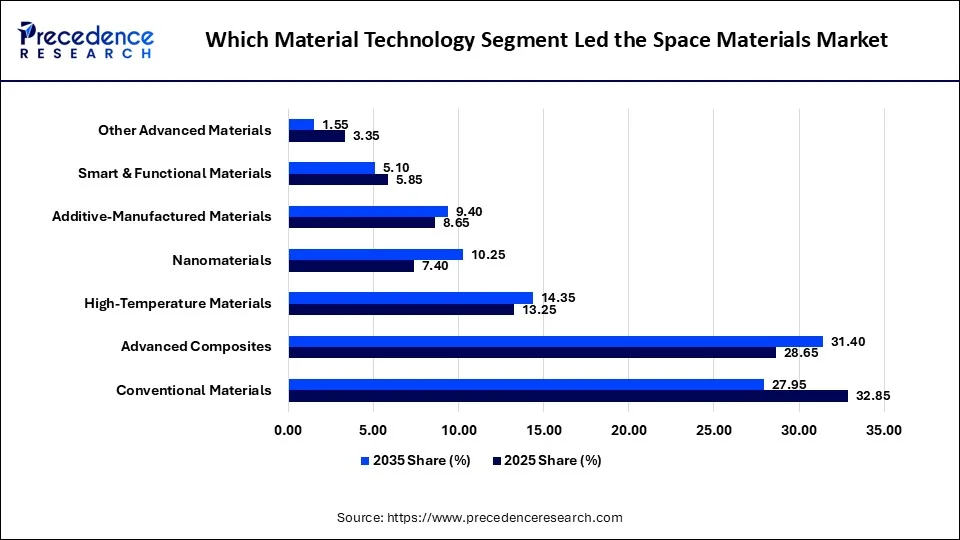
Conventional materials held the largest market share of 32.85% in 2025, but advanced composites are expected to overtake and dominate the material technology segment with a share of 31.4% in 2035. Nanomaterials are projected to grow at the highest CAGR of 12.2% during the forecast period, owing to advances in nanomaterial technology and their superior properties compared to other materials. NASA has active technology programs involving carbon-nanotube composites, high-temperature composites, and additive manufacturing for space propulsion and structural applications.
Expert Analyst View - Material Technology
Nanomaterials are in high demand and are the future of space materials, as they provide high strength, thermal conductivity, electrical conductivity, radiation shielding, and sensing. NASA's Superlightweight Aerospace Composites program is targeting CNT-based structures for applications, including pressure vessels, trusses, and future lunar/Mars vehicles.
Researchers leverage additive manufacturing to produce innovative materials that are difficult to produce using conventional machines. A NASA-supported project involved the production of ceramic rocket-engine components through additive manufacturing, targeting over 10 times reduction in fabrication time and cost and potential payload improvement of more than 10% through complex integrated geometries.
What are the Trends in Space Platform Analysis?
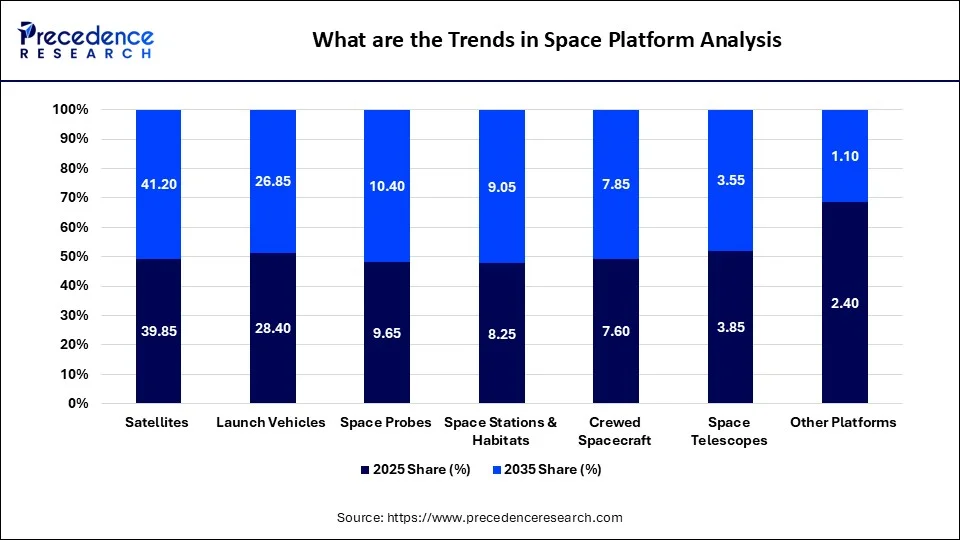
Satellites held a major market share of 39.85% in 2025 and remain dominant with a share of 41.2% in 2035. Launch vehicles held the second-largest share in 2025, at 28.4%. Space stations & habitats are expected to expand at a rapid CAGR of 9.88% from 2026 to 2035, while space probes grew at a CAGR of 9.73%. Moreover, crewed spacecraft and space telescopes also hold significant importance.
Expert Analyst View - Space Platforms
The demand for space materials in space stations & habitats is increasing due to the expansion of orbital infrastructure and exploration programs. Satellite platforms combine the largest material volumes with the strongest production scalability. Space stations & habitats and crewed spacecraft require materials with fire safety, low toxicity, low outgassing, radiation shielding, and long-term reliability.
Which is the Preferred Manufacturing Process for Space Materials?
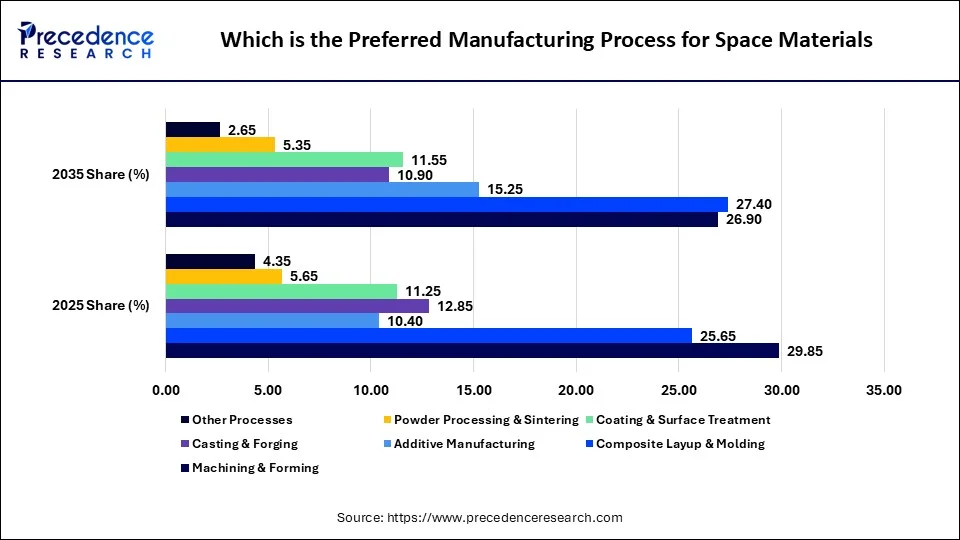
Machining & forming remain the largest manufacturing process at 29.85% in 2025. The second-largest market shareholder is composite layup & molding with a share of 25.65% in 2025. Additive manufacturing is expected to expand at the highest CAGR of 12.9% during the forecast period, owing to the development of customized, complex materials with desired properties.
Expert Analyst View - Manufacturing Process
The manufacturing transition is essential as material selection and manufacturing processes are interconnected. According to NASA, advanced manufacturing technologies for both terrestrial and in-space purposes will make commercial and exploration missions more efficient and affordable. Automated fiber placement and out-of-autoclave composites can reduce part count and enable integrated geometries. Syensqo identifies automated fiber placement for launch-vehicle primary structures and composite manufacturing for cryogenic tanks and payload fairings.
Which End-User is the Highest Consumer of Space Materials?
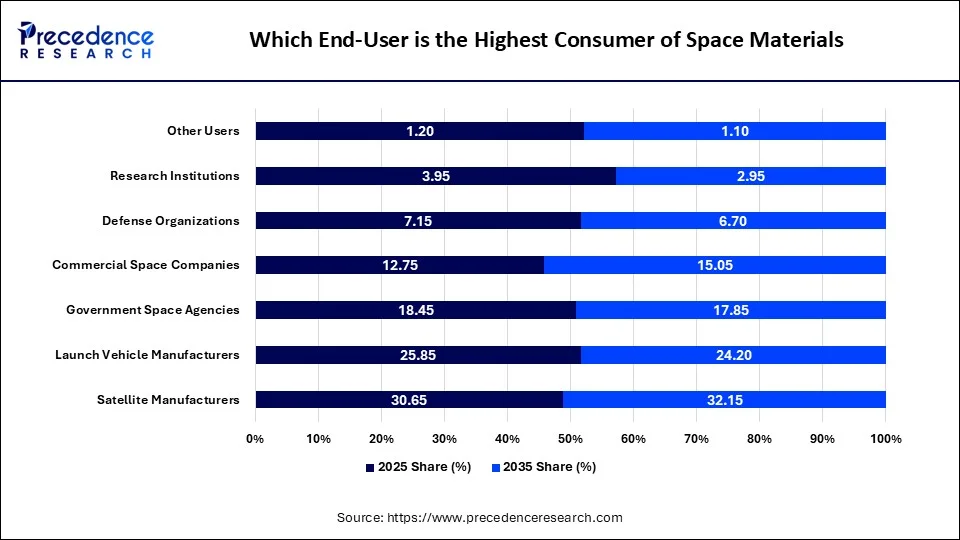
Satellite manufacturers are the biggest end-users of space materials, accounting for a market share of 30.65% in 2025. It is expected to remain the largest market shareholder through 2035, with a share of 32.15%. Commercial space companies are projected to grow at a rapid CAGR of 10.75% from 2026 to 2035, increasing their shares from 12.75% to 15.05%. Apart from this, launch vehicle manufacturers and government space agencies are essential end-users of space materials.
Expert Analyst View - End-Users
Several government organizations launch initiatives and programs that generally emphasize qualification history, reliability, and long-term availability. The high CAGR of commercial space companies is due to their focus on cost, production speed, weight reduction, and design flexibility of space materials. This leads to the development of sustainable and innovative space materials. According to the OECD, private operators accounted for the launch of 88% of total satellites launched in 2025, aligning with the increasing role of commercial demand in space infrastructure.
Regional Analysis
Which Regions are at the Forefront of Driving the Demand for Space Materials?
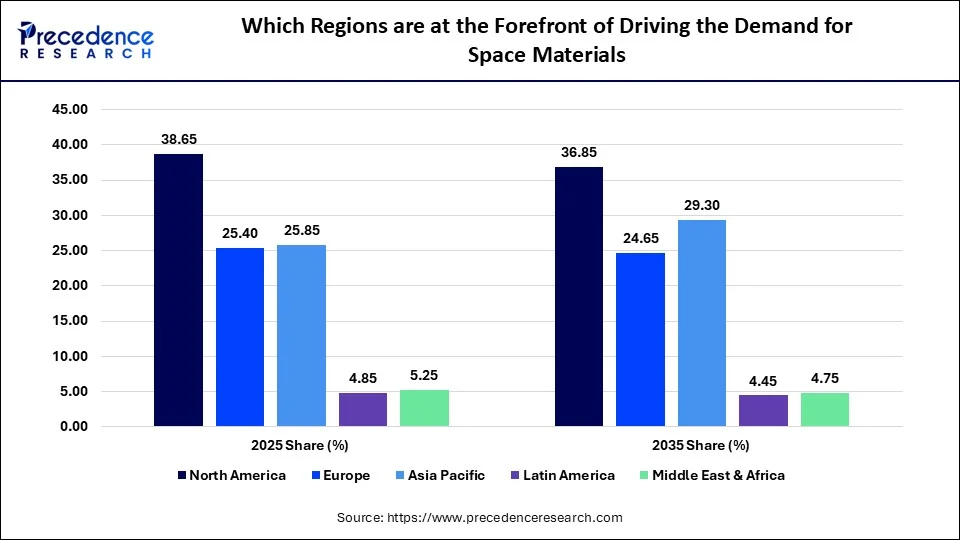
North America dominated the market with a share of 38.65% in 2025, due to favorable government policies and advanced technological infrastructure. Asia-Pacific held 25.85% of market share in 2025 and is expected to experience the fastest growth with a CAGR of 10.15% during the predicted timeframe. Countries like China, Japan, and India increasingly prioritize new satellite launches and rapid spacecraft development. Europe remains a major technology and qualification center for specialized spacecraft materials that held a market share of 25.4% in 2025.
Expert Analyst View - Regional Analysis
The presence of key players, such as American Elements and AMETEK Specialty Metal Products, are major suppliers and producers of space materials in the U.S. North America and Asia-Pacific are the biggest innovators of space technology and are increasing reliance on space-based assets for communication and other purposes. Both regions witness an increase in investments in space-related capabilities and an acceleration of national and commercial space programs. OECD reported that the U.S. represented approximately 55% of global launches in 2025, while China conducted 92 launch attempts.
Japan is also continuing the development of its H3 launch architecture; JAXA's 2025 launch records show H3 missions carrying QZS-6 and HTV-X1, alongside additional planned H3 activity. India's focus is on cost-effective launch services and small satellite deployment. The Indian government develops a regional manufacturing ecosystem, with ISRO continuing to publish annual program and activity reports.
Which are the Regional Demand Indicators of Space Materials?
| Indicator | North America | Europe | Asia Pacific | Strategic Material Implication |
| Satellite Deployment | Very High | High | Very High | Composites, aluminum, polymers |
| Launch Activity | Very High | Moderate | Very High | Composites, superalloys, thermal protection |
| Commercial Space | Very High | Growing | High | Lightweight and cost-efficient materials |
| Government Exploration | Very High | High | High | Advanced composites, CMCs, shielding |
| Human Spaceflight | High | High | High | Radiation, thermal and low-outgassing materials |
| Additive Manufacturing | High | High | High/Growing | Metal and ceramic AM materials |
| Advanced Composite R&D | Very High | Very High | High | Carbon fiber, thermoplastic, CNT composites |
| Material Qualification Infrastructure | Very High | Very High | Growing | Certified/traceable materials |
In North America, almost all regional demand indicators experience high demand, including satellite deployment, launch activity, commercial space, and government exploration. Meanwhile, Europe has extremely high demand for advanced composite R&D and material qualification infrastructure. However, the demand for commercial space is increasing rapidly in Europe. Asia-Pacific mainly focuses on satellite deployment and launch activities, with growing demand for additive manufacturing.
Expert Analyst View - Demand Indicators
The most attractive regional supplier strategy is therefore not simply based on material volume. Qualification infrastructure, aerospace-grade manufacturing, traceability, and proximity to spacecraft/launcher OEMs can be equally important competitive factors.
Which Companies are at the Forefront of Space Materials Market?
Hexcel
The 2025 Form 10-K of Hexcel provides unusually useful visibility into the aerospace materials business as it isolates defense, space, and other from commercial aerospace. In 2025, Hexcel's defense, space, and other sector generated revenue of USD 747 million, the composite materials sector generated USD 536 million, and the engineered products sector generated sales of USD 211 million. Total sales of Composite Materials were USD 1.516 billion. These figures represent Hexcel's end-market disclosures and must not be interpreted as space-material revenue alone.
ATI
ATI reported revenue of USD 4.587 billion in 2025, of which the aerospace and defense segment generated sales of USD 3.112 billion, accounting for 68% of total sales. ATI provides a wide range of portfolio of titanium and titanium-based alloys, nickel-based alloys, superalloys, powdered alloys, and engineered components.
Syensqo
Syensqo offers a dedicated space-and-launch materials portfolio, including structural composites, high-temperature ablatives, primers, adhesives, and thermoplastic composites. Its space portfolio includes CYCOM, MTM, MX, FM, and Torlon products. The company's products address rocket motor cases, payload fairings, primary structures, nozzles, and cryogenic tanks.
ArianeGroup
ArianeGroup offers composite structures, propulsion-related materials, carbon/carbon, and thermal protection materials. Its P120C booster leverages a carbon-fiber structural casing and carbon/carbon composite nozzle materials that operate with combustion gases around 3,000oC. The company also offers Norcoat's thermal-protection portfolio, including carbon-phenolic composites and carbon-felt materials, while its thermal-protection technologies have flown on more than 100 Ariane rockets.
In March 2026, ArianeGroup signed a contract covering 27 Ariane 6 shipsets, with large lightweight carbon-fiber structures provided by Airbus Defense and Space, offering a concrete indication of increasing composite content in launcher production.
Other important technology suppliers
Some essential suppliers of space materials include Materion, DuPont, Vespel, and Kapton. Materion specializes in space-oriented aluminum-silicon metal-matrix composites, beryllium, niobium alloys and other advanced materials with high strength, low mass, vibration, and thermal-cycling requirements.
What is the Current R&D Pipeline of Advanced Materials?
NASA focuses on developing multifunctional space material, rather than replacing one material with another.
Some of the current technological developments of NASA are listed below:
| Technology | Current Development Signal | Potential Space Application |
| Carbon Nanotube Composites | NASA SAC program | Tanks, habitats, trusses |
| CNT/PGS Carbon-Fiber Composites | >10× thermal conductivity vs typical CF composites | Radiators, heat exchangers |
| Self-Healing Smart Composites | Radiation shielding + damage monitoring | Habitats, spacecraft structures |
| Zero-CME Carbon-Fiber Laminates | Moisture-insensitive material architecture | Telescope structures, optical benches |
| Additive Ceramic Components | >10× potential cost/time reduction | Rocket chambers and thrusters |
| High-Temperature CMCs | SiC/SiC and C/SiC development | Propulsion and thermal systems |
NASA's R&D pipeline includes carbon nanotube composites for tanks, habitats, and trusses; CNT/PGS carbon-fiber composites for radiators and heat exchangers; self-healing smart composites for habitats and spacecraft structures; zero-CME carbon-fiber laminates for telescope structures and optical benches; additive ceramic components for rocket chambers and thrusters; and high-temperature CMCs for propulsion and thermal systems.
Expert Analyst View - R&D Pipeline
NASA's R&D pipeline indicates a shift toward materials that perform multiple engineering functions simultaneously. NASA funds and supports several projects to develop advanced space materials for widespread applications. These projects create opportunities for suppliers with proprietary material formulations and manufacturing processes.
What Does the Buyer Intelligence Data Indicate in the Space Materials Market?
| Buyer Group | Primary Purchase Criteria | High-Value Requirements |
| Satellite OEMs | Weight, reliability, dimensional stability | CFRP, aluminum, thermal-control materials |
| Launch OEMs | Mass, thermal resistance, manufacturing speed | Carbon composites, ablatives, CMCs |
| Propulsion OEMs | Temperature and mechanical strength | Superalloys, CMCs, carbon-carbon |
| Space Agencies | Qualification, reliability, traceability | Qualified materials and processes |
| Defense Space Programs | Radiation, survivability, reliability | Shielding, advanced composites |
| Commercial Space Companies | Cost, lead time, weight | Thermoplastics, composites, AM materials |
| Research Institutions | Performance and customization | Nanomaterials, smart materials |
| Habitat/Crewed Programs xx | Safety, outgassing, radiation | Polymers, shielding, thermal systems |
Space-material buyers prioritize multiple parameters when purchasing space materials depending on their requirements. Satellite OEMs consider weight, reliability, and dimensional stability, while commercial space companies consider cost, lead time, and weight of space materials. Research institutions are ahead in developing nanomaterials and smart materials for various use cases.
Expert Analyst View - Buyer Intelligence
Most essential commercial differentiators include qualification history, material consistency, traceability, environmental test data, supply continuity, and engineering support. Cost is the most common consideration among space-material buyers, especially among commercial constellations. However, affordable space materials may fail to align with qualification considerations, enhancing integration and mission risk.
What are the Major Growth Factors of the Space Materials Market?
Satellite Constellation Expansion
The increasing number of satellite constellations potentiates the demand for space materials. At the end of 2025, there were more than 14,000 operational satellites, with U.S. organizations operating 76% of active satellites.
Higher Launch Cadence
Higher launch cadence enhances the demand for structural composites and thermal protection materials. OECD reported 329 launches and 4,900 objects in 2025.
Commercialization
The rise in private operators leads to the commercialization of space materials. Private operators accounted for 88% of satellites launched in 2025, up sharply 23% in 2010.
Lightweighting
Lightweight space materials can potentially improve payload economics or enable additional payload.
What are the Potential Market Challenges in the Space Materials Market?
Qualification Time and Cost
New materials need to be approved for qualification, which is a time-consuming and costly process, enhancing the time to market.
Extreme-Environment Degradation
Extreme environmental considerations like thermal cycling, vacuum, radiation, and UV can lead to product degradation.
Supply Chain Concentration
Certain high-performance fibers, resins, superalloys, and specialty materials are supplied through a limited number of suppliers, limiting their widespread availability to global stakeholders.
Manufacturing Scalability
Nanomaterials and advanced composites can demonstrate excellent laboratory performance but require consistent commercial-scale manufacturing and quality control.
Experts Insights
The space materials market is entering a phase in which material performance, manufacturing technology, and mission architecture are interconnected. Conventional aluminum and titanium alloys will remain in demand due to their established qualification pathways and well-developed supply chain infrastructure. But the demand is gradually shifting to advanced materials, such as carbon-fiber composites, thermoplastics, nanomaterials, and additive-manufactured materials.
Since space missions are high-risk and zero-legacy, space primes and launch providers prioritize reliability and supply chain security over minor performance gains. The combination of higher launch cadence, satellite proliferation, and government exploration programs is broadening the addressable market. NASA's contribution to the technology sector leads to the development and commercialization of CNT composites, advanced thermal composites, and additive-manufactured ceramics.
The most essential long-term competitive advantage will come from qualified material systems rather than individual raw materials in the coming years. Suppliers that focus on combining formulation/IP, processing technology, environmental testing, qualification documentation, and long-term supply assurance will capture more value from the expanding space infrastructure ecosystem.
Our Experts
- The primary market research process was carried out by Vidyesh Swar, Senior Research Associate, who also designed the methodology and did market segmentation, regional trend analysis, buyer intelligence, competitive analysis, and forecasts, laying the foundation for the analytical part of the report.
- Aman Singh, Head of Research, has gathered and checked regulatory policies, company financial information, and various other quantitative information sources, which were obtained independently, thereby increasing the quality of evidence supporting the calculations of the market values.
- Aditi Shivarkar, VP Research, has validated and refined the research material, verified facts, corrected inconsistencies, and completed the research document, making it accurate and to the point.
Space Materials Market Segments Covered in the Report
By Material Type
- Aluminum Alloys
- Titanium Alloys
- Carbon Fiber Composites
- Polymer & Thermoplastic Materials
- Ceramic & Ceramic Matrix Composites
- Nickel & Superalloys
- Other Advanced Materials
By Material Function
- Structural Materials
- Thermal Protection
- Thermal Control & Insulation
- Radiation Shielding
- Optical & Sensor Materials
- Electrical & Electronic Materials
- Seals, Adhesives & Lubricants
- Other Functions
By Application
- Satellites
- Launch Vehicles
- Spacecraft & Exploration Vehicles
- Space Stations & Habitats
- Propulsion Systems
- Space Telescopes & Scientific Instruments
- Other Applications
By Material Technology
- Conventional Materials
- Advanced Composites
- High-Temperature Materials
- Nanomaterials
- Additive-Manufactured Materials
- Smart & Functional Materials
- Other Advanced Materials
By Space Platform
- Satellites
- Launch Vehicles
- Space Probes
- Space Stations & Habitats
- Crewed Spacecraft
- Space Telescopes
- Other Platforms
By Manufacturing Process
- Machining & Forming
- Composite Layup & Molding
- Additive Manufacturing
- Casting & Forging
- Coating & Surface Treatment
- Powder Processing & Sintering
- Other Processes
By End User
- Satellite Manufacturers
- Launch Vehicle Manufacturers
- Government Space Agencies
- Commercial Space Companies
- Defense Organizations
- Research Institutions
- Other Users
By Region
- North America
- Europe
- Asia Pacific
- Latin America
- Middle East & Africa
For inquiries regarding discounts, bulk purchases, or customization requests, please contact us at sales@precedenceresearch.com
Frequently Asked Questions





Ask For Sample
No cookie-cutter, only authentic analysis – take the 1st step to become a Precedence Research client
 Get a Sample




 sales@precedenceresearch.com
 Schedule a Meeting
