



Sports Drink Market Size, Key Companies, Company Market Share, Production Volume, Consumption Trends, Pricing Analysis, Export & Import Dynamics, Competitive Positioning, and Demand Forecast
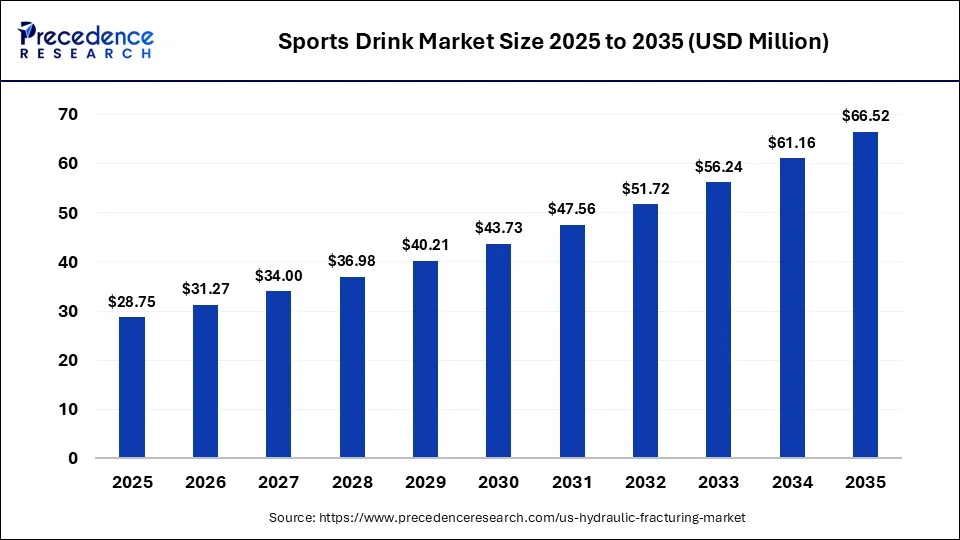
The sports drink market was valued at USD 31.27 million in 2026 and is projected to grow at a CAGR of 8.75% through 2035. Market growth is driven by rising sports and fitness participation, increasing consumer focus on hydration and electrolyte replenishment, and growing demand for functional beverages supporting performance and recovery. Key trends include the expansion of electrolyte-enhanced, low- and zero-sugar, and functional formulations, alongside growing adoption of powder and tablet formats as convenient alternatives to ready-to-drink products. Expanding fitness culture, premiumization, e-commerce penetration, and demand for healthier hydration options are expected to create new opportunities for sports drink manufacturers and functional beverage providers through 2035.
Source: https://www.precedenceresearch.com/sports-drink-market
 Get a Sample
 Table Of Content


Sports Drink Market Size, Demand, and Trends Analysis 2035
The sports drink market is forecasted to expand from USD 31.27 million in 2026 to USD 66.52 million by 2035, growing at a CAGR of 8.75% from 2026 to 2035.
Key Takeaways
- Growth is shifting from athletes to everyday wellness. Fitness users, recreational exercisers and lifestyle consumers now form the main addressable growth pool.
- Future growth will come from higher value per purchase (premiumization) as well as volume, driven by advanced electrolyte blends and non-athlete consumption.
- Isotonic drinks remain the largest product category. Electrolyte-enhanced and low- or zero-sugar formulations are gaining disproportionate momentum as consumers move away from traditional high-sugar products.
- Ready-to-drink (RTD) products dominate current revenue, but powders and tablets are gaining quickly on portability, shelf life, customization, lower cost per serving and suitability for online sales.
- North America is the largest regional market. Asia Pacific is the fastest-growing, supported by rising incomes, urban fitness participation, sports infrastructure, e-commerce and hot climates.
- E-commerce and direct-to-consumer (DTC) channels are expected to grow fastest, while convenience and specialty fitness channels remain important for impulse and on-the-go consumption.
- The competitive landscape is highly concentrated in developed markets. In the U.S., the top three brands hold about 88.9% of category sales, and the largest brand alone holds about 62.6%.
- The market is evolving into a two-speed structure. Incumbents compete on scale, distribution and brand familiarity, while specialist and digital-native brands compete on formulation, credibility, premium pricing and community.
- Future share gains are expected to come from segment expansion (zero-sugar, electrolyte, powder/tablet and premium performance products) rather than substitution within traditional isotonic drinks.
- Sugar reduction is a structural challenge. Brands must balance the performance benefit of carbohydrates against growing demand for healthier positioning.
- Key white-space opportunities include personalized hydration, condition-specific electrolyte blends, functional ingredients, clean-label products and advanced delivery formats.
- M&A over the next five years is likely to target premium electrolyte brands, functional-hydration technologies, digital capabilities and established distribution networks.
Sports Hydration Expands Beyond Traditional Athletic Consumption
The category is transitioning from a narrowly defined athlete-replenishment product into a broader functional hydration market, supported by rising fitness participation, endurance sports, gym culture, outdoor activity, heat exposure, and consumer interest in electrolytes and recovery.
North America remains the largest regional market, while Asia Pacific represents the fastest-growing major region, supported by rising disposable incomes, urban fitness participation, sports infrastructure, e-commerce penetration, and high-temperature environments. Isotonic beverages remain the largest product category, while electrolyte-enhanced and lower-sugar formulations are gaining disproportionate attention.
The market is structurally concentrated in developed retail markets but increasingly fragmented at the premium, clean-label, powder, tablet, direct-to-consumer, and specialized hydration levels.
Key Coverage
- Isotonic products remain the largest category
- Asia Pacific represents the strongest structural growth opportunity
- Growth is shifting from traditional high-sugar formulations toward electrolyte, zero/low-sugar, and functional-hydration products
- Retail, convenience, fitness, and digital commerce increasingly overlap as consumption channels
Volume Expansion and Premiumization Strengthen the Market Growth Outlook
Growth for the market is driven by increased consumption frequency as well as higher value per consumption instance. Expansion in the past was driven by growing sports activity as well as improved retail presence while future expansion will be increasingly driven by premium hydration, advanced electrolyte blends as well as consumption by non-athletes.
Full analysis of the market is modeled through revenues, retail volumes, average selling prices, frequency of consumption, regional contribution as well as product mix.
Key Coverage
- Incremental revenue opportunity.
- Regional contribution to absolute growth.
- Product-level revenue and volume forecasts.
- Price-volume-mix analysis.
- Base, upside, and downside scenarios.
Isotonic Drinks Lead, While Functional Hydration Captures New Demand
Isotonic beverages account for the largest share of the global sports drink market, benefiting from established consumer awareness and broad availability. Hypotonic products are gaining momentum where consumers prioritize rapid hydration with lighter carbohydrate loads, while hypertonic products retain relevance for endurance and post-exercise carbohydrate replenishment.
A second structural segmentation divides the market into ready-to-drink beverages, powders, tablets, and concentrated formats. Ready-to-drink products dominate current revenue because of convenience, but powders and tablets offer advantages in transportation economics, customization, shelf life and digital distribution.
By consumer group, traditional athletes remain important, but fitness users, recreational exercisers and lifestyle consumers increasingly represent the addressable growth pool.
Key Coverage
- Isotonic, hypotonic and hypertonic revenue shares
- Ready-to-drink versus powder/tablet formats
- Electrolyte concentration and formulation positioning
- Athlete versus fitness versus lifestyle consumption
- Offline versus online channel contribution
- Premium versus mass-market products
- Fastest-growing product and consumer segments
Market Dynamics - Hydration, Health and Performance are Converging
The strongest demand driver is the expansion of functional hydration from sports-specific consumption into everyday wellness. Consumers increasingly associate electrolytes with hydration, recovery, and physical performance rather than only competitive sport.
At the same time, sugar remains a structural challenge. Traditional sports beverages often rely on carbohydrates for rapid energy replenishment, but health-conscious consumers increasingly seek zero-sugar or reduced-sugar alternatives. This creates formulation tension between physiological performance and mainstream health positioning.
Climate conditions also matter: heat exposure, outdoor work, endurance activities, and rising temperatures increase the practical relevance of hydration products.
Key Coverage
- Sports and fitness participation
- Hydration awareness
- Sugar reduction
- Electrolyte demand
- Premiumization
- Climate and heat exposure
- Digital fitness influence
Companies Shaping the Sports Drink Market
| Company | Headquarters | Market Position | Core Strength | Major Applications/Segments |
| PepsiCo | U.S. | Global leader | Scale, distribution, sports marketing | Mainstream, performance |
| The Coca-Cola Company | U.S. | Global leader | Bottling network, portfolio breadth | Mainstream, premium hydration |
| Otsuka Holdings | Japan | Regional/global specialist | Electrolyte hydration | Everyday hydration, Asia |
| Suntory Holdings | Japan | Regional leader | Beverage distribution | Sports/lifestyle hydration |
| Red Bull | Austria | Performance beverage leader | Brand and sports ecosystem | Performance, active lifestyle |
| Monster Beverage | U.S. | Functional beverage challenger | Energy/performance platform | Active lifestyle |
| Keurig Dr Pepper | U.S. | Major beverage platform | Distribution and channel reach | Hydration, functional beverages |
| Abbott Laboratories | U.S. | Functional nutrition player | Science-backed nutrition | Hydration/nutrition |
| Danone | France | Health-focused player | Wellness portfolio | Functional hydration |
| Nestlé | Switzerland | Global nutrition platform | Scale and nutrition expertise | Functional beverages |
| Lucozade Ribena Suntory | U.K. | European specialist | Sports hydration | Sports/performance |
| Electrolit | Mexico/U.S. | Hydration challenger | Electrolyte positioning | Hydration/recovery |
| Nuun | U.S. | Specialty hydration | Tablets/electrolytes | Fitness/endurance |
| Liquid I.V. | U.S. | Premium hydration challenger | Powder/electrolytes | Wellness/fitness |
| Skratch Labs | U.S. | Endurance specialist | Performance nutrition | Cycling/endurance |
| LMNT | U.S. | Premium electrolyte specialist | High-electrolyte formulation | Fitness/keto |
| BioSteel | Canada/U.S. | Sports nutrition specialist | Athlete-focused products | Sports/performance |
| Tailwind Nutrition | U.S. | Endurance specialist | Hydration/fueling | Endurance sports |
| Prime Hydration | U.S. | Digital-native challenger | Youth/social-media reach | Lifestyle/fitness |
| Pocari Sweat/Otsuka | Japan | Asian hydration leader | Scientific hydration positioning | Everyday/sports hydration |
| Isostar | Switzerland | European sports nutrition player | Endurance products | Sports/performance |
| Hammer Nutrition | U.S. | Niche endurance specialist | Specialized fueling | Endurance sports |
How Concentrated is the Sports Drink Competitive Landscape, and Which Players are Best Positioned to Capture the Next Growth Cycle?
The sports drink market remains highly concentrated in its largest developed markets, where scaled beverage companies benefit from extensive retail distribution, high brand recognition, and established relationships with grocery, convenience, fitness, and foodservice channels. In the U.S., the three leading mainstream sports drink brands collectively account for approximately 88.9% of category sales, with the largest brand alone representing about 62.6%, highlighting the significant advantage of scale in shelf access and consumer awareness. At the same time, premium electrolyte specialists, functional hydration brands, and digital-native entrants are expanding the competitive boundary by targeting consumers seeking low-sugar formulations, differentiated electrolyte profiles, and performance-specific benefits.
Our analysis indicates that competitive intensity is increasingly shifting from traditional brand scale toward a combination of distribution power, functional differentiation, and consumer engagement. Large incumbents continue to control the largest revenue pools and retail networks, but challengers can compete effectively in narrower, higher-value segments without matching incumbent distribution footprints. Our assessment is that the most defensible challenger positions are emerging where products combine measurable functional benefits with strong community, fitness, athlete, or digital positioning. This creates a two-speed competitive structure: mass-market brands compete primarily on availability, price, and familiarity, while specialist brands compete on formulation, credibility, premium pricing, and consumer loyalty.
The most significant implication is that future share gains are likely to come from segment expansion rather than simple substitution within the traditional isotonic category. Low- and zero-sugar hydration, electrolyte-enhanced products, powders and tablets, premium performance nutrition, and everyday functional hydration provide challengers with opportunities to capture higher-value consumer occasions. For incumbents, the strategic priority is therefore to defend distribution leadership while accelerating product innovation and premiumization; for challengers, success will depend on converting strong niche engagement into repeat purchases and broader omnichannel distribution.
Which Companies Hold the Strongest Competitive Advantages, and Where are the Key Capability Gaps Emerging?
The competitive landscape spans scaled beverage companies, established sports hydration brands, premium electrolyte specialists, and digital-native challengers, creating significant differences in revenue scale, distribution reach, product breadth, pricing power, and consumer engagement. In the U.S., the three leading mainstream sports drink brands collectively account for approximately 88.9% of category sales, while the largest brand holds about 62.6%, demonstrating the value of brand scale and retail access. At the corporate level, leading participants also operate across much larger beverage portfolios, while specialist brands increasingly concentrate on higher-value segments such as electrolyte-enhanced hydration, low- and zero-sugar products, powders, and performance nutrition.
Competitive advantage is increasingly determined by the combination of distribution scale and product specialization rather than market share alone. Large players retain a structural advantage in shelf availability, marketing investment, manufacturing scale, and omnichannel distribution, whereas specialist companies can differentiate through targeted formulations, premium positioning, athlete credibility, and direct consumer relationships. Our assessment is that this creates clear capability gaps between incumbent and challenger models: incumbents generally possess superior reach and scale, while challengers can move faster in emerging functional categories and respond more precisely to evolving consumer preferences.
In our view, the most significant strategic implication is that companies seeking future share gains will need to strengthen capabilities beyond their traditional competitive advantages. Established players have an opportunity to capture premium growth by expanding functional, low-sugar, and performance-oriented portfolios, while challengers must demonstrate repeat purchasing and scale distribution without diluting their specialist positioning. The strongest competitive positions are therefore likely to emerge among companies that can combine brand equity, retail penetration, formulation innovation, premium pricing, digital engagement, and consumer loyalty.
Sports Drink Market Segments
By Product Type
- Isotonic
- Hypotonic
- Hypertonic
- Electrolyte-Enhanced
- Protein-Enhanced / Recovery Drinks
By Form
- Ready-to-Drink (RTD)
- Powder
- Tablets / Effervescent Tablets
- Concentrates
By Sugar Content
- Regular / Full-Sugar
- Low-Sugar
- Zero-Sugar / Sugar-Free
By Ingredient / Functional Benefit
- Electrolytes
- Carbohydrates
- Vitamins & Minerals
- Amino Acids / BCAAs
- Protein
- Caffeine / Energy Ingredients
- Natural / Plant-Based Ingredients
By Consumer Type
- Professional Athletes
- Recreational Athletes
- Fitness & Gym Consumers
- Endurance / Outdoor Sports Participants
- General / Everyday Hydration Consumers
By Application / Occasion
- Pre-Workout
- During-Workout / Performance
- Post-Workout / Recovery
- Everyday Hydration
- Endurance Sports
- Team & Competitive Sports
By Distribution Channel
- Supermarkets & Hypermarkets
- Convenience Stores
- Drugstores / Pharmacies
- Specialty Sports & Fitness Stores
- E-Commerce
- Direct-to-Consumer (DTC)
- Gyms & Fitness Centers
- Foodservice / Other Channels
By Price Tier
- Economy
- Mid-Range
- Premium
By Packaging
- Bottles
- Cans
- Pouches
- Sachets
- Tubes / Containers
- Other Formats
By Region
- North America
- U.S.
- Canada
- Europe
- Germany
- U.K.
- France
- Italy
- Spain
- Rest of Europe
- Asia Pacific
- China
- Japan
- India
- Australia
- South Korea
- Rest of Asia Pacific
- Latin America
- Middle East & Africa
For inquiries regarding discounts, bulk purchases, or customization requests, please contact us at sales@precedenceresearch.com
Frequently Asked Questions





Ask For Sample
No cookie-cutter, only authentic analysis – take the 1st step to become a Precedence Research client
 Get a Sample




 sales@precedenceresearch.com
 Schedule a Meeting
