



Transcutaneous Electrical Nerve Stimulation (TENS) Market Size, Production Volume, Sales Performance, Export & Import Dynamics, Adoption Rates, Recycling Rate, Material Efficiency, Market Share Analysis, and Demand Trends
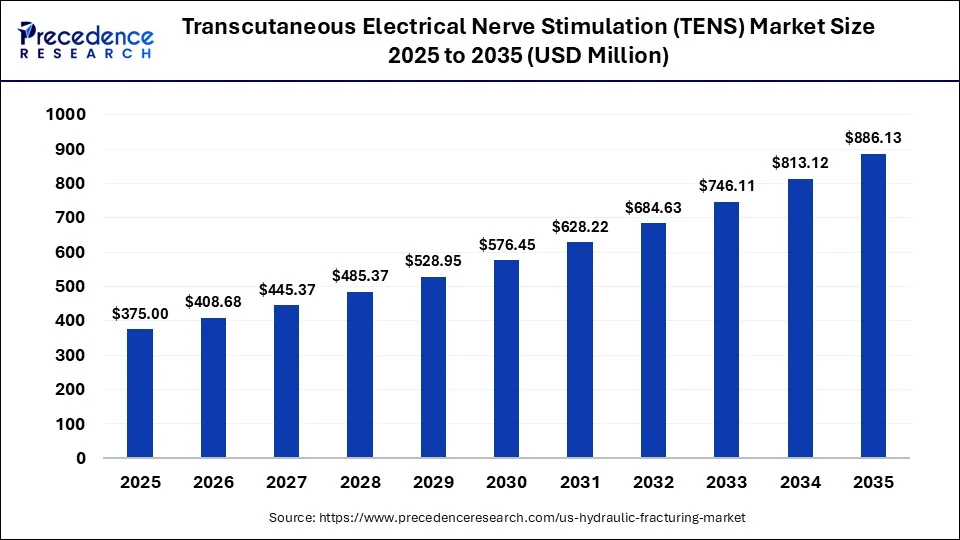
The transcutaneous electrical nerve stimulation (TENS) market was valued at USD 375 million in 2025, expanding at a CAGR of 8.98% by 2035. This growth is supported by the rising need for non-invasive, opioid-free pain management and a shift toward self-managed and portable recovery solutions. The market growth was evaluated by our senior healthcare research analyst, Deepa Pandey. She researched thermoelectric modules, thermally expandable microcapsules, and transmission electron microscopy equipment. Her research helps medical product manufacturers, healthcare providers, biotechnology companies, and investors with competitive benchmarking and strategic decision-making.
Source: https://www.precedenceresearch.com/transcutaneous-electrical-nerve-stimulation-market
 Get a Sample
 Table Of Content


Transcutaneous Electrical Nerve Stimulation (TENS) Market Trends, Growth and Market Size Analysis
The transcutaneous electrical nerve stimulation (TENS) market is forecasted to expand from USD 408.68 billion in 2026 to USD 886.13 billion by 2035, growing at a CAGR of 8.98% from 2026 to 2035. The surging demand for compact, wireless, smartphone-connected TENS units that enable users to customize therapy discreetly on the go is the driving factor for the market. Deepa Pandey, who has more than 5 years of experience in healthcare research, has found that the rising prevalence of chronic musculoskeletal conditions and an aging global demographic drive market growth. The market is divided into single-channel and dual-channel devices used for back pain, sports injuries, arthritis, and postoperative recovery across home care and clinical settings.
Key Takeaways
- By product type, the portable TENS devices segment led the market with a share of 36.85% in 2025.
- By modality, the conventional TENS segment led the market with a 48.65% share in 2025.
- By application, the chronic pain management segment captured a major revenue share of 34.85% in 2025.
- By end user, the hospitals segment captured the largest market share of 25.65% in 2025.
- By patient type, the adults segment led the market with a share of 78.85% in 2025.
- OMRON Healthcare Co., Ltd. announced the acquisition of Life Log Technology, Inc. to support the growth of OMRON Healthcare's digital health business, a key focus area of the firm's long-term business strategy, shaping the Future 2030.
- The most recent FDA approved TENS devices are FT-247 Series TENS/EMS by Hivox Biotek and TENS 7000 Rechargeable 4 Channel by Shenzhen Dongdixin.
- A 2023 systematic review/meta-analysis identified 58 eligible studies and 38 for meta-analysis examining TENS effects on pain-related sensory measures.
- Zynex reported supplies revenue of $132.7 million in 2024, demonstrating the commercial importance of consumables within an electrotherapy business.
How Large Will the Transcutaneous Electrical Nerve Stimulation (TENS) Market Become by 2035?
The TENS market is developing around the wider shift toward non-pharmacological pain management, outpatient rehabilitation, and home-based care. The commercial opportunity is increasingly moving beyond conventional clinic-driven stimulators toward portable, wearable, rechargeable, and digitally controlled devices. At the same time, the underlying addressable population is driven by the high prevalence of chronic musculoskeletal and neuropathic pain, mainly among older adults.
Which Product Type Holds the Largest Market Share in 2025?
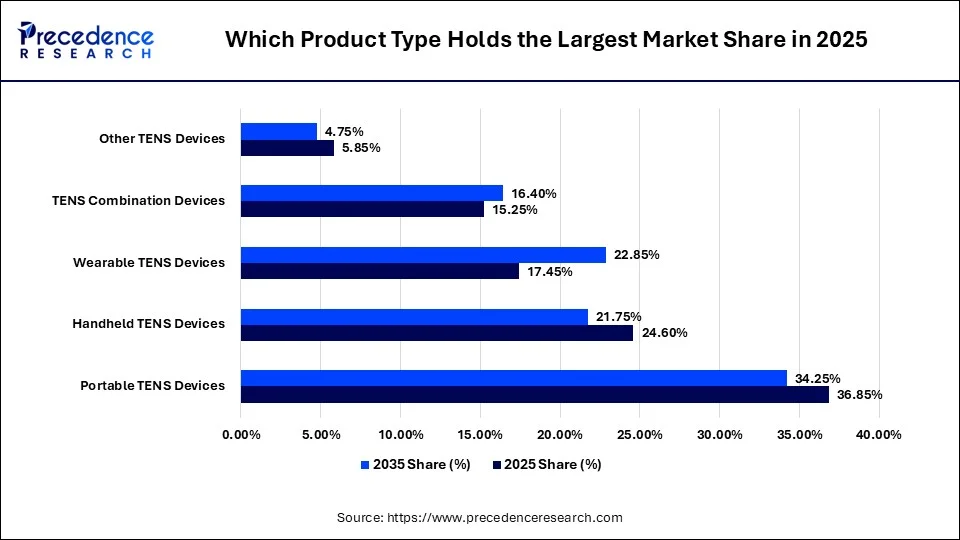
Portable TENS devices remain the largest product category with a 2025 market share of 36.85% due to a global shift toward drug-free pain relief, advancements in miniaturized wireless technology, and the rising demand for home-based healthcare, but wearable devices are anticipated to gain more than 5 percentage points of share by 2035 as consumers want non-pharmacological alternatives to manage pain without taking extra pills or facing drug side effects. More individuals prefer managing health issues independently at home rather than making frequent hospital trips. Moreover, their supplied 12.15% CAGR reflects the change toward discreet, wireless, and continuously accessible pain-management formats.
Technology Direction
The FDA currently classifies transcutaneous nerve stimulators for pain relief as Class II medical devices under regulation 882.5890. The classification covers devices utilizing electrical stimulation via electrodes placed on the skin and requires 510(k) premarket review.
Recent regulatory activity demonstrates continued product development:
| Recent TENS Regulatory Indicator | Result |
| Hivox FT-247 TENS/EMS 510(k) decision | Jun-26 |
| Shenzhen Dongdixin rechargeable 4-channel TENS 510(k) decision | Jun-26 |
| Shenzhen Jiantuo TENS/EMS 510(k) decision | May-25 |
| Hong Qiangxing TENS/EMS 510(k) decision | Dec-25 |
| Wuxi Jiajian TENS 510(k) decision | Mar-24 |
These recent clearances indicate continuing entry of portable, OTC, and combination TENS/EMS apparatus into the U.S. regulatory market.
Expert Analyst View - Product Type
The consumer shift towards wearable devices and TENS combination devices expands the application areas of TENS devices and their widespread use for multiple disorders. This is also supported by evolving regulatory landscapes by regulatory authorities, resulting in new product launches.
Which Modality Is Growing Fastest?
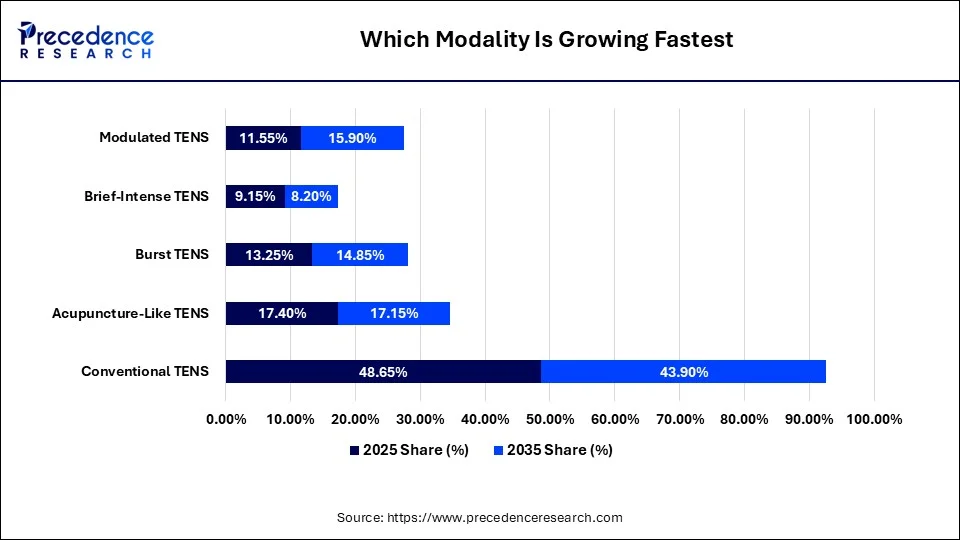
Conventional TENS dominated in the modality segment with a share of 48.65% in 2025 due to its established clinical use and simple operating profile. Patients look for non-addictive alternatives to avoid the side effects and dependency risks associated with long-term pharmaceutical painkillers and opioids. Even post-pandemic habits favor self-managed recovery and portable, professional-grade devices that users can operate easily at home. Moreover, modulated TENS has the highest supplied CAGR of 12.20% as programmable stimulation and treatment personalization become more important. Standard fixed-frequency TENS therapy can cause the nervous system to adapt, decreasing pain relief over time. Further, modulated settings delay this adaptation, eventually keeping the treatment effective for longer periods.
Expert Analyst View - Modality
The long-term opportunity is likely to move toward programmable, adaptive stimulation, rather than a complete replacement of conventional TENS. Thus, clinical users still value simple protocols; meanwhile, connected devices can offer clinicians and patients greater control over stimulation intensity, frequency, and treatment schedules.
Which Application of the Transcutaneous Electrical Nerve Stimulation (TENS) Market Holds the Largest Market Share in 2025?
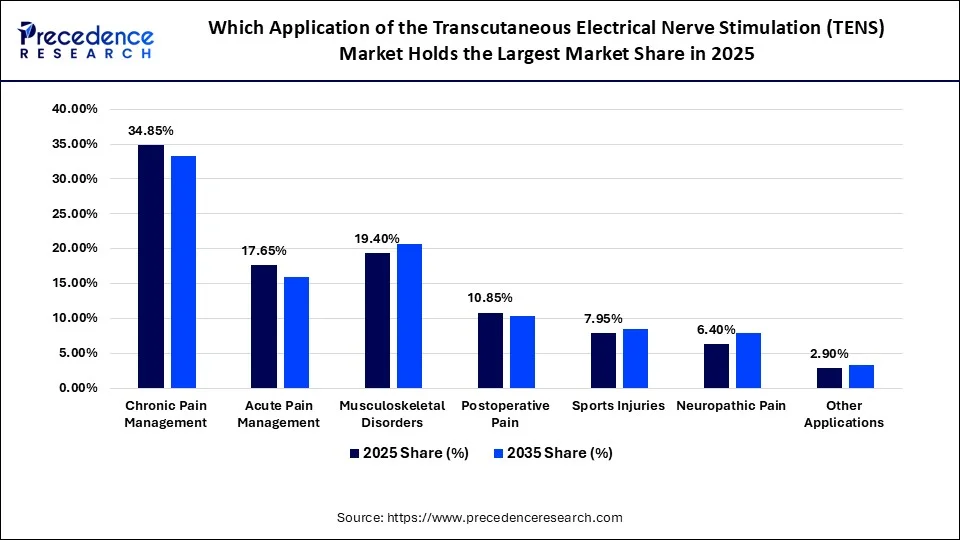
Chronic pain management is the largest application, holding 34.85% of market share in 2025. This is due to the growing prevalence of chronic pain disorders and the demand for non-invasive pain management options. Meanwhile, neuropathic pain has the strongest supplied growth rate with a CAGR of 11.55% over the studied period. Musculoskeletal disorders also gain share due to the large rehabilitation and physical therapy population.
Chronic Pain Creates a Large Addressable Population
| U.S. Chronic Pain Indicator | Jul-05 |
| Adults with chronic pain | 24.30% |
| Adults with high-impact chronic pain | 8.50% |
| Women with chronic pain | 25.40% |
| Men with chronic pain | 23.20% |
| Women with high-impact chronic pain | 9.60% |
| Men with high-impact chronic pain | 7.30% |
| Chronic pain among adults aged 65+ | Higher than overall adult prevalence |
Chronic pain among adults aged 65+ Higher than overall adult prevalence CDC data showed that 24.3% of U.S. adults experienced chronic pain in 2023, while 8.5% experienced high-impact chronic pain. Moreover, both measures increased with age. The prevalence of chronic pain offers a substantial potential population for non-pharmacological pain-management technologies, although not all chronic-pain patients are appropriate candidates for TENS.
Additional Historical Indicator
In 2021, nearly 51.6 million U.S. adults experienced chronic pain, which includes 17.1 million with high-impact chronic pain. This offers a useful statistical basis for illustrating the scale of the population's underlying need for pain-management devices.
Expert Analyst View - Application
TENS devices are used for a wide range of disorders, including chronic pain, postoperative pain, sports injuries, and neuropathic pain. The rising prevalence of these disorders potentiates the need for advanced TENS devices.
Which End User Holds the Largest Market Share in 2025?
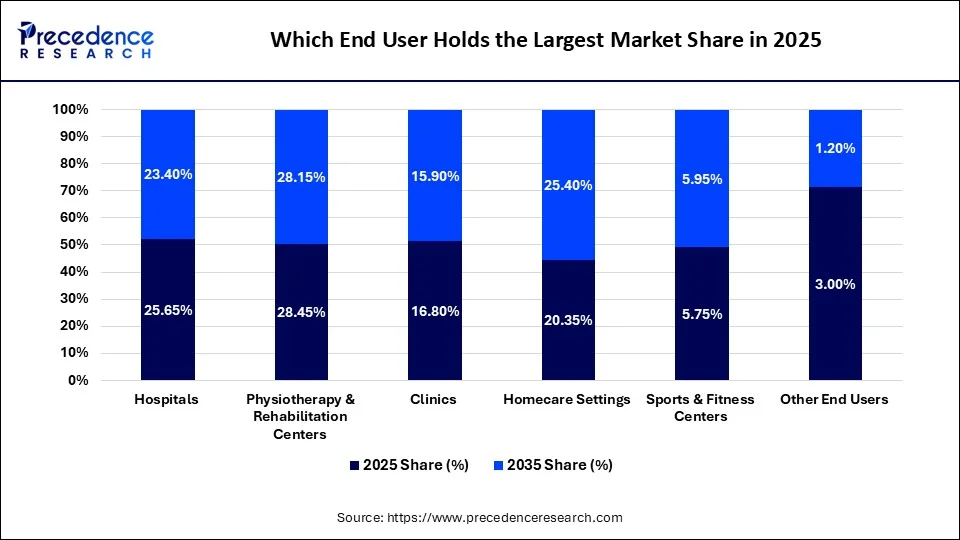
Physiotherapy and rehabilitation centers presently represent the largest end-user group, with a share of 28.45% in 2025, but homecare is anticipated to gain more than five percentage points of share by 2035, owing to the widespread availability of portable and wearable devices and the growing geriatric population. This supports the broader change toward decentralized pain management.
Real Company Indicator - Homecare Model
Zynex offers a useful example of the home-use business model. Its devices are small, portable, and battery-operated, with electrodes connected to an electrical pulse generator. The firm's NexWave combines IFC, TENS, and even NMES in one device.
Zynex Commercial and Device Data
| Zynex Indicator | 2024 |
| Total revenue | USD 192.4M |
| Device revenue | USD 59.6M |
| Supplies revenue | USD 132.7M |
| Device revenue growth | 1% |
| Supplies revenue growth | 6% |
| Total revenue growth | 4% |
| Device orders growth | 16% |
| Operating income | USD 6.0M |
| Net income | USD 3.0M |
| Operating cash flow | USD 12.7M |
| Adjusted EBITDA | USD 10.9M |
Zynex's reported revenue covers a wider electrotherapy portfolio and should not be interpreted as TENS-only revenue. However, the firm's business demonstrates the recurring-revenue opportunity created by TENS-related consumables. Supplies, mainly electrodes and batteries, generated USD 132.7 million, or about 69% of total revenue, in 2024. The recurring electrode and battery model states that TENS businesses can generate revenue beyond the initial device sale, creating an important aftermarket opportunity.
Product Portfolio
| Product | Function |
| NexWave | IFC + TENS + NMES |
| NeuroMove | EMG-triggered electrical stimulation |
| InWave | Electrical stimulation for urinary incontinence |
| E-Wave | NMES |
| M-Wave | NMES |
| Electrodes | Recurring consumable |
| Batteries | Recurring consumable |
Zynex reported that its 2024 device orders rose 16%, assisting in expanding its installed customer base and subsequently rising recurring supplies revenue.
Expert Analyst View - End User
The end-user market segment has witnessed a major shift from treatment in hospitals and clinics to treatment in the comfort of patients' homes. Technological advancements in TENS devices has led to this change, benefiting companies dealing with homecare models.
Which Distribution Channel Holds the Largest Market Share in 2025?
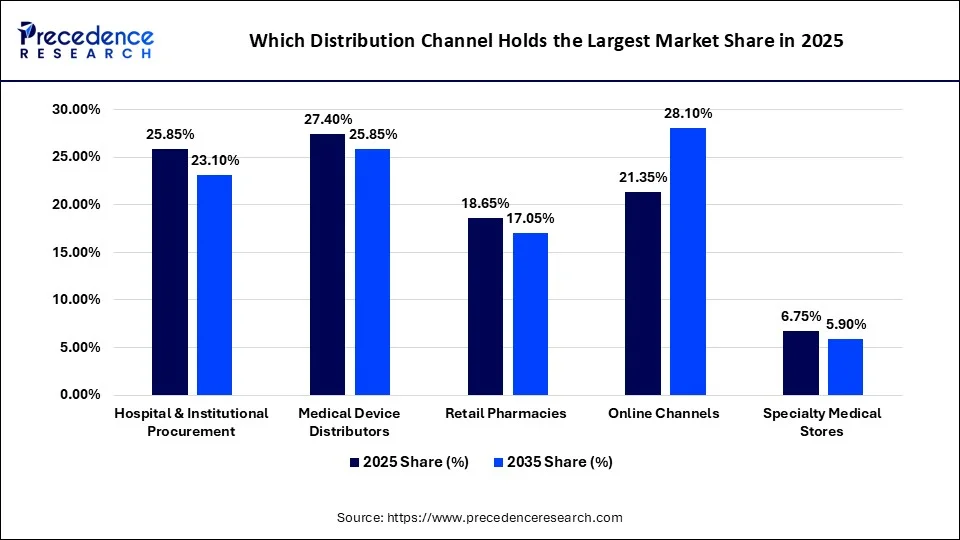
Medical device distributors presently lead distribution with a market share of 27.40% in 2025, as patients and clinics increasingly favor drug-free options such as TENS units to manage chronic pain, also avoiding the side effects of medications. Moreover, modern TENS devices combine electrical stimulation with multimodal therapies such as heat, cold compresses, or red light therapy, demanding specialized distribution to reach diverse retail and clinical buyers.
Online channels have the strongest growth profile and are anticipated to become the second-largest distribution route by 2035 due to the rising rates of chronic back pain, arthritis, and muscle soreness, which drive people to treat pain at home. Major platforms such as Amazon and direct-to-consumer brand websites make comparing and then buying devices simple. Companies use targeted online ads along with social media to educate buyers about non-invasive pain relief.
Expert Analyst View - Distribution
The online opportunity is mainly important for lower-complexity portable and OTC TENS devices. Moreover, professional prescription-oriented devices will continue to depend more heavily on clinicians, distributors, and institutional procurement, creating a two-tier commercial model:
- Professional TENS: clinician-led + distributor/institutional.
- Consumer/home TENS: retail + online + direct-to-consumer.
Which Patient Type Holds the Largest Market Share in 2025?
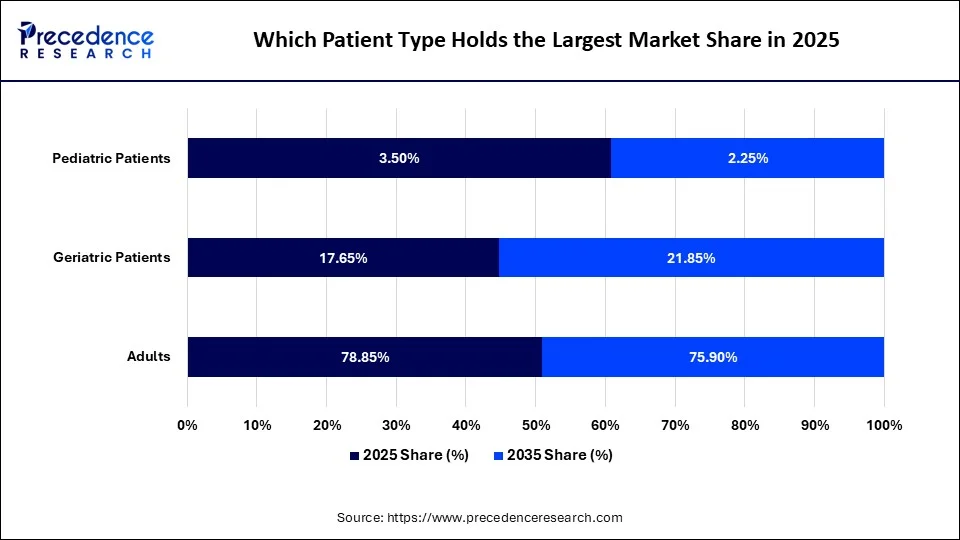
Adults account for the majority of need, but geriatric patients are anticipated to gain share rapidly in the coming years with a CAGR of 11.30%. Aging populations are mainly relevant because chronic musculoskeletal conditions, and neuropathic conditions, become more prevalent with age.
Expert Analyst View - Patient Demographics
The geriatric segment is commercially attractive as it combines several demand drivers, including the rising prevalence of chronic musculoskeletal conditions, neuropathic symptoms, and osteoarthritis, along with the growing awareness of postoperative rehabilitation, increased home care utilization, and the greater demand for non-invasive approaches.
Which Region Holds the Largest Market Share in 2025?
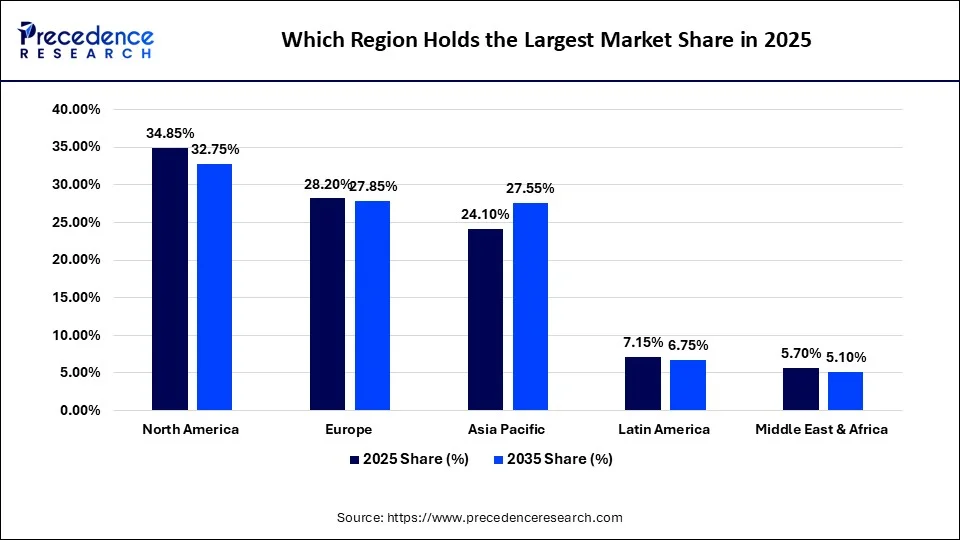
North America leads the supplied 2025 regional model with a share of 34.85%, as increasing population of older adults contributes to higher rates of arthritis, joint inflammation, and musculoskeletal injuries. Producers are introducing portable, wireless, and smartphone-connected devices that make self-managed home care easier and more convenient.
Further, insurance coverage and public-private healthcare frameworks fund the purchase of durable medical equipment combined with home-use therapeutic units, and Asia Pacific has the strongest growth rate and is anticipated to approach Europe's share by 2035 as organizations are investing billions in new software, IT services, combined with data center infrastructure. Businesses across the region are adopting cloud computing, AI, and Internet of Things (IoT) tools to lower costs and enhance work speed. National programs supporting Industry 4.0 and smart cities are encouraging advanced manufacturing and digital adoption.
Expert Analyst View - Regions
North America benefits from mature medical device distribution and established rehabilitation infrastructure. Europe has strong physiotherapy utilization and a long-established non-pharmacological treatment ecosystem. Asia Pacific is the most important growth opportunity, as healthcare infrastructure, rehabilitation services, and home-based medical-device adoption are expanding simultaneously.
FDA Regulatory Landscape
| Regulatory Indicator | Detail |
| Device category | Transcutaneous electrical nerve stimulator |
| FDA class | Class II |
| Regulation | 21 CFR 882.5890 |
| Premarket pathway | 510(k) |
| Main product code | GZJ |
| OTC product code | NUH |
| Review specialty | Neurology |
| Recognized electrical-stimulation standard | IEC 60601-2-10 |
| Recognized TENS standard | AAMI ANSI NS4 |
The FDA states that TENS devices for pain relief are Class II devices subject to 510(k) review. OTC TENS devices are separately classified under product code NUH. Moreover, the regulatory pathway is established, but producers must still demonstrate substantial equivalence and comply with applicable safety and performance requirements.
Recent FDA TENS Device Activity
| Applicant | Device | Decision |
| Hivox Biotek | FT-247 Series TENS/EMS | Jun-26 |
| Shenzhen Dongdixin | TENS 7000 Rechargeable 4 Channel | Jun-26 |
| Shenzhen Jiantuo | TENS & EMS | May-25 |
| Hong Qiangxing | TENS & EMS | Dec-25 |
| Wuxi Jiajian | TENS WMPS2-1 | Mar-24 |
| Shenzhen Yuehua Xinsen | TENS & PMS Unit | Apr-22 |
Recent FDA clearances show continued product activity in rechargeable, multi-channel TENS/EMS along with OTC configurations.
Expert Analyst View - Regulation
The regulatory data show that the technology is not stagnant. Product differentiation is increasingly occurring around form factor, channel count, portability, combination stimulation, rechargeable architecture, and home-use functionality rather than simply the underlying TENS principle.
Clinical Evidence and Technology Adoption
Recent evidence remains mixed but increasingly nuanced.
| Evidence Indicator | Result |
| Systematic-review manuscripts screened in one 2023 review | 22,252 |
| Studies included in systematic review | 58 |
| Studies included in meta-analysis | 35 |
| Fibromyalgia studies in 2024 meta-analysis | 12 |
| Patients in fibromyalgia meta-analysis x | 944 |
| Fibromyalgia pain effect size | SMD -0.61 |
| Fibromyalgia disability effect size | SMD -0.27 |
| Fibromyalgia physical QoL effect | SMD 0.26 |
A 2023 systematic review/meta-analysis determined 58 eligible studies and 35 for meta-analysis examining TENS effects on pain-related sensory measures. Moreover, a 2024 meta-analysis covering 12 studies and even 944 fibromyalgia patients found improvements in pain, disability, and physical quality of life, with a pooled pain effect size of SMD -0.61. Evidence is strongest for certain pain conditions along with rehabilitation contexts, rather than being uniformly conclusive across all conditions. This makes clinical positioning and even appropriate patient selection important for producers and providers.
Important Market Consideration
A broader overview of Cochrane reviews states 51 TENS-related randomized controlled trials involving 2,895 participants, but rated the overall evidence as very low quality, as many studies were small and had methodological limitations. Moreover, this creates both a limitation and an opportunity: producers with stronger clinical evidence, standardized protocols, and even outcome data can differentiate themselves from low-cost commodity devices.
Technology Development Priorities
| Technology Feature | Market Direction |
| Wireless connectivity | Increasing |
| Bluetooth/app control | Increasing |
| Rechargeable batteries | Increasing |
| Compact form factor | Increasing |
| Wearable electrodes | Increasing |
| Multi-channel stimulation | Increasing |
| TENS + EMS combination | Increasing |
| Programmable modes | Increasing |
| Treatment-data tracking | Emerging |
| Personalized stimulation | Emerging |
| Disposable/replaceable electrodes | Established recurring model |
| Remote monitoring | Emerging |
Current TENS devices available in the market are well-equipped with wireless connectivity, Bluetooth/app control, rechargeable batteries, wearable electrodes, multi-channel stimulation, and programmable modes. However, constant efforts are made to incorporate treatment-data tracking, personalized stimulation, and remote monitoring in TENS devices to serve a large patient population, including the geriatric population.
Expert Analyst View - Technology
The most attractive product-development direction is connected wearable TENS. The device becomes more commercially valuable when it combines stimulation with digital control, treatment tracking, and reusable or replacement electrode economics. The supplied model supports this trend: wearable devices rise from 17.45% to 22.85% share, meanwhile modulated TENS grows from 11.55% to 15.90%.
Buyer Intelligence - Major Buyer Groups
| Buyer Group | Main Requirement | Key Purchase Driver |
| Hospitals | Clinical pain management | Reliability and clinical evidence |
| Physiotherapy Centers | Rehabilitation | Programmability and versatility |
| Pain Clinics | Chronic pain | Treatment effectiveness |
| Orthopedic Clinics | Musculoskeletal pain | Patient outcomes |
| Sports Rehabilitation Centers | Injury recovery | Portability and treatment flexibility |
| Homecare Providers | Long-term patient use | Ease of use |
| Retail Pharmacies | Consumer products | Price and brand |
| Online Retailers | Home-use products | Product variety and consumer ratings |
| Medical Device Distributors | Professional devices | Regulatory clearance and margin |
| Patients/Consumers | Self-management | Convenience and affordability |
Clinical buyers prioritize performance, evidence, and reliability, while home-use buyers place greater impact on portability, battery life, ease of use, and price.
Buyer Intelligence - Procurement Criteria
| Procurement Criterion | Importance |
| Device safety | Very High |
| Regulatory clearance | Very High |
| Clinical evidence | Very High |
| Reliability | Very High |
| Ease of use | High |
| Programmable stimulation | High |
| Portability | High |
| Battery life | High |
| Electrode quality | High |
| Replacement-electrode availability | High |
| Price | High |
| Warranty/service | High |
| Wireless connectivity | Increasing |
| App integration | Increasing |
| Data tracking | Increasing |
The major non-avoidable factors that are looked upon while purchasing TENS devices include device safety, regulatory clearance, clinical evidence, and clearance. Furthermore, customers/users prefer ease of use, programmable stimulation, portability, high battery life, electrode quality, replacement-electrode availability, price, and warranty/service. These factors help companies to stand out their products in the competitive market. Apart from these, wireless connectivity, app integration, and data tracking are emerging factors in upcoming devices.
Expert Analyst View - Buyer Intelligence
The TENS buyer is becoming more segmented. Hospitals and physiotherapy centers want clinically reliable devices, while users increasingly expect smartphone-style convenience. Suppliers therefore demand separate professional and consumer product strategies. Recurring electrode purchases also create an attractive aftermarket model. Zynex's 2024 supplies revenue of USD 132.7 million states the commercial significance of consumables within an electrotherapy business.
Competitive Landscape
Key Companies to Track
- Zynex
- Omron Healthcare
- DJO / Enovis
- Beurer
- TensCare
- Roscoe Medical
- EMS Physio
- BioMedical Life Systems
- NeuroTrac
- Axelgaard
- iReliev
- Carex Health Brands
Competitive Positioning
| Competitive Area | Market Direction |
| Low-cost portable devices | High-volume segment |
| Clinical TENS systems | Professional segment |
| TENS + EMS | Expanding |
| Wearable TENS | High-growth |
| Wireless/app-connected TENS | Emerging high-value segment |
| Rechargeable systems | Increasingly standard |
| Multi-channel devices | Growing |
| Consumables | Recurring revenue opportunity |
| Clinical evidence | Differentiating factor |
| Homecare solutions | Major growth opportunity |
Expert Analyst View - Competitive Landscape
The competitive landscape can be divided into three groups:
Professional Electrotherapy Companies
These compete mainly through clinical distribution, physiotherapy networks, physician relationships, and reimbursement pathways.
Consumer Medical-Device Brands
These focus on portable, easy-to-use products sold via retail and online channels.
Technology-Focused Entrants
These are increasingly differentiating via wearability, app control, wireless connectivity, and treatment personalization.
The strongest future competitive position will likely belong to firms combining clinical credibility, connected technology, recurring consumables, and homecare distribution. Zynex offers a strong example of this model as its business combines prescription electrotherapy devices with recurring electrode and battery sales.
Expert Analyst View - Buyer Intelligence
The most attractive buyer segments are:
- Physiotherapy and rehabilitation centers
- Homecare providers
- Pain-management clinics
- Orthopedic clinics
- Sports rehabilitation centers
- Hospitals
- Online medical-device retailers
- Medical-device distributors
- Retail pharmacies
- Direct consumers
The most commercially attractive combination is homecare, wearable TENS, and online distribution. This combination works with all three of the fastest-moving trends in the supplied data: homecare growth, wearable-device growth, along with online-channel expansion. For professional suppliers, the stronger opportunity remains multi-modality systems, clinical evidence, and recurring electrode sales.
Emerging Market Opportunities
| Opportunity | Commercial Potential |
| Wearable TENS | Very High |
| Wireless/app-connected devices | High |
| Homecare TENS | Very High |
| Online distribution | Very High |
| TENS + EMS combination | High |
| Rechargeable devices | High |
| Neuropathic-pain applications | High |
| Geriatric pain management | High |
| Sports rehabilitation | Moderate-High |
| Personalized stimulation | Emerging |
| Remote monitoring | Emerging |
| Recurring electrode sales | High |
Over the coming years, the market is witnessing strong growth due to the increasing development of wearable TENS, homecare devices, and online distribution of devices across diverse geographical locations. Companies are actively involved in research of personalized stimulation and remote monitoring, driving the market future.
Main Segment Snapshot
| Segmentation | Largest Segment in 2025 | Share | Fastest-Growing Segment |
| Product Type | Portable TENS Devices | 36.85% | Wearable TENS Devices |
| Modality | Conventional TENS | 48.65% | Modulated TENS |
| Application | Chronic Pain Management | 34.85% | Neuropathic Pain |
| End User | Physiotherapy & Rehabilitation Centers | 28.45% | Homecare Settings |
| Distribution Channel | Medical Device Distributors | 27.40% | Online Channels |
| Patient Type | Adults | 78.85% | Geriatric Patients |
| Region | North America | 34.85% | Asia Pacific |
Experts Insights
The transcutaneous electrical nerve stimulation (TENS) market is morphing from a traditional analgesics business into a known and growing consumer healthcare and pharmaceutical chain. This is back, and shoulder pain dominates utilization, followed by arthritis, nerve pain, and muscle recovery. It is anticipated to scale significantly over the next decade, with wider electrotherapy and pain-management device networks commanding billions in valuation. It is projected to grow steadily as the need for drug-free, non-invasive pain relief increases globally.
Our Experts
Primary market research was conducted by Deepa Pandey, followed by methodology development and analysis of market segmentation, regional trends, competitive developments, and forecasts, which laid the foundation of the report.
Aman was responsible for sourcing and validating regulatory filings, company financial information, trade statistics, and other independently sourced quantitative datasets to build the evidence base behind the Market Estimations.
Aditi carefully read the entire research paper, did the quality check, validated the findings, corrected the content for inconsistencies, and gave the final report, thus ensuring accuracy and clarity.
Transcutaneous Electrical Nerve Stimulation (TENS) Market Segments List
By Product Type
- Portable TENS Devices
- Handheld TENS Devices
- Wearable TENS Devices
- TENS Combination Devices
- Other TENS Devices
By Modality
- Conventional TENS
- Acupuncture-Like TENS
- Burst TENS
- Brief-Intense TENS
- Modulated TENS
By Application
- Chronic Pain Management
- Acute Pain Management
- Musculoskeletal Disorders
- Postoperative Pain
- Sports Injuries
- Neuropathic Pain
- Other Applications
By End User
- Hospitals
- Physiotherapy & Rehabilitation Centers
- Clinics
- Homecare Settings
- Sports & Fitness Centers
- Other End Users
By Distribution Channel
- Hospital & Institutional Procurement
- Medical Device Distributors
- Retail Pharmacies
- Online Channels
- Specialty Medical Stores
By Patient Type
- Adults
- Geriatric Patients
- Pediatric Patients
By Region
- North America
- Europe
- Asia Pacific
- Latin America
- Middle East & Africa
For inquiries regarding discounts, bulk purchases, or customization requests, please contact us at sales@precedenceresearch.com
Frequently Asked Questions





Ask For Sample
No cookie-cutter, only authentic analysis – take the 1st step to become a Precedence Research client
 Get a Sample
.webp)



 sales@precedenceresearch.com
 Schedule a Meeting
