



UAE Artificial Intelligence Market Trends, Companies, Revenue / Sales Performance, Subscriber Growth, Pricing Strategies, Cloud Adoption, Infrastructure Expansion, Competitive Landscape, and Industry Outlook
Gautam Mahajan is an AI research specialist and tracks the size and technology segmentation of the domestic AI market, foreign investment deals in sovereign investments and government adoption programs, and compute infrastructure buildout. His research provides detailed market intelligence, competitive benchmarking, and strategic advice that helps enterprise technology buyers, government digital transformation teams, and sovereign and institutional investors in making technology decisions. The UAE artificial intelligence market is estimated to reach USD 213 billion by 2035.
Source: https://www.precedenceresearch.com/uae-artificial-intelligence-market
 Get a Sample
 Table Of Content


UAE Artificial Intelligence Market Size and Forecast 2026 to 2035
Based on his research background and experience in both the fields of artificial intelligence (AI) and technology, Gautam Mahajan believes that the UAE artificial intelligence market is at a stage of more advanced commercialization. The UAE is positioning itself as an integral part of its economy and technology by having strong government initiatives around AI, and demand for intelligent applications from enterprise customers is growing.
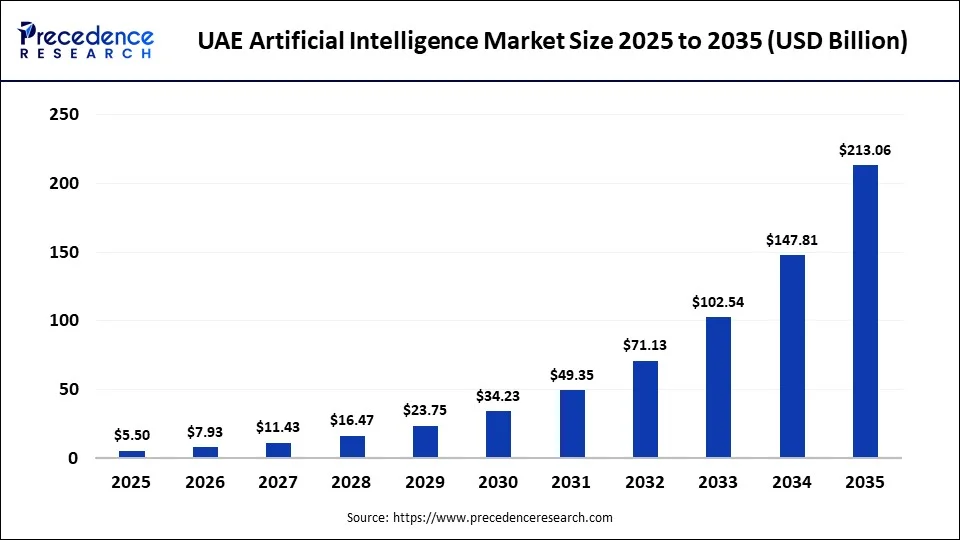
The UAE artificial intelligence market is estimated at USD 7.93 billion in 2026 and is projected to grow to around USD 213.06 billion by 2035, growing at a CAGR of 44.15% over the forecast period, or a decade's growth multiple of ~38.7 times. The UAE government program that will move 50% of all public services to autonomous AI systems within two years. The UAE being the first country in the world to rank first among such AI deployments and a 5-gigawatt sovereign compute deployment at Stargate UAE are all obvious factors driving growth.
Ten Findings Before the Detail
- The market is expected to grow by about 38.7× during the forecast period, from USD 7.93 in 2026 to ~USD213B in 2035. This is one of the fastest tracks of AI market growth in the country recorded in any country.
- The UAE is in 1st place in AI adoption, as 70.1% of its working-age people are using AI. This has increased from 64.0% and 59.4% earlier in 2025 and is more than twice the U.S. rate of 28.3%.
- AI's contribution to UAE GDP is anticipated to be USD 96 billion, which is close to 13.6–14 per cent of GDP, and the largest GDP contribution of all the GCC nations by AI till 2030-2031.
- The Abu Dhabi investment arm "MGX" has invested in a USD 49B fund for AI investments. It is also a key partner of Microsoft and BlackRock in their global collaboration on Artificial Intelligence infrastructure to unlock USD 100B in deployable capital.
- Stargate UAE is projected to be the world's biggest AI compute development on the Caspian other than in the USA. The planned 5-gigawatt AI data-center field in Abu Dhabi, UAE, is projected to be the world's largest compute development outside of the USA. The first phase, 200MW, is scheduled to be completed by 2026.
- The UAE government has pledged to implement 50% of all government services by autonomous Agentic AI in two years. The policy was announced in 2026 and is a world-first agreement.
- UAE-based AI startups raised USD 519 million in 2025, with 60% of all AI investments underpinning the UAE's leading role in AI startup funding in the MENA region in terms of dollars raised.
- In 2025 alone, Abu Dhabi's base of AI companies grew by 67%, to the tune of some 700 companies.
- There has been more than a threefold increase in demand for AI talent over four years. Demand for AI talent has more than tripled over four years. UAE's job posting rate for AI roles jumped from roughly 1.0% to 3.2% of all job postings between 2021 and 2025, surpassing the rate in other countries such as the US, UK, Germany and France.
- Representing 19% to 29% of the home market, generative AI is growing the most, with a 50.1% CAGR. The category of AI technology is predicted to be the biggest by 2035.
Market Overview
The Country That Decided to Become an AI Economy
The UAE is one of the few countries that have integrated AI into their national DNA. It appointed the first-ever Minister of State for Artificial Intelligence five years before the release of ChatGPT, in 2017. Ever since, policy, capital, and infrastructure development have been ongoing to keep up with this early commitment's path. It has its National AI Strategy 2031; sovereign investment vehicle MGX has announced that it has opened a USD 49B fund focused on AI; Abu Dhabi is rolling out a 5-gigawatt data center campus, and the government announced that it would transition 50% of its government services to autonomous, agentic AI in two years, by 2026.
The UAE domestic AI market is comparatively small in absolute value, with an expected 2025 value of USD 5.50B, which is less than the market value of one MGX transaction. Given its 44.15% CAGR and the role of its capital investment in the sector. However, it remains one of the best markets to watch in terms of the most convincing territories in the country when it comes to AI. This report reviews the market from the market-entry and investment point of view: what the government has already been involved in, what the companies are doing, where start-up capital is flowing, and which emirate (Dubai and Abu Dhabi) is better equipped to spotlight opportunities in the next decade.
Key Insight: The UAE is ranked 1st in the world for AI adoption, whereby 70.1% of the working-age population is using AI. This is not an "AI wave" position, but rather the outcome of a thoughtful policy over the past ten years.
Ten-Year Trajectory: USD5.50B - USD213.06B
The market is projected to swell to USD 213 billion by 2035, a 10-year growth rate of 38.7 times at the stated 44.15% CAGR, owing to the compound trajectory of the market. Every 20 months almost doubles, a growth rate that stands in stark contrast to the rate of most traditional market sizing exercises. It's also essential to be explicit about what this domestic figure actually reflects. It doesn't track the sovereign capital invested in and around artificial intelligence infrastructure in the UAE, and that's something very different from what AI product and service revenue is generated by. This should be tracked separately, as two distinct types of money are spent on one type of infrastructure versus the other. Anyone using this domestic figure as a proxy for total UAE AI-related capital activity is likely to understate the real picture by a wide margin, a gap this report returns to in more depth shortly.
Key Insight: This domestic market value reflects the value of AI products and services and not the capital being deployed around them, and the value of the investment volumes being deployed in the market vs the value being generated from the market are fundamentally different here. Both of which deserve to be monitored, with MGX's USD 49 billion fund approximately equal to 9 times the domestic market value of AI in 2025.
Source: Precedence Research Database
Recent Developement in UAE Artificial Intelligence Market
Mar 2024 - MUBADALA/G42
MGX launches as a dedicated AI investment vehicle
Abu Dhabi's Artificial Intelligence and Advanced Technology Council revealed details about MGX, which is the spin-off of Mubadala alongside G42, with AI infrastructure, semiconductors, and core AI technologies as the targets.
WHY IT MATTERS: Established the sovereign investment vehicle that would go on to become one of the world's most active AI capital allocators within two years.
SOURCE: Mubadala, "Abu Dhabi Launches Comprehensive Global Investment Strategy on Artificial Intelligence" (Mar 2024)
Apr 2024 - MICROSOFT/G42
Microsoft invests $1.5B in G42
Microsoft has pledged and announced a $1.5B investment into the UAE's national AI champion, G42, to help rapidly deploy AI infrastructure and technologies throughout the Middle East.
WHY IT MATTERS: The investment helped to broker a strategic partnership between a leading US hyperscaler and the UAE's flagship AI firm, with this extended in the March 2025 sovereign cloud announcement.
SOURCE: CSIS, "The United Arab Emirates' AI Ambitions"
May 2025 - G42/OPENAI/ORACLE/NVIDIA
Stargate UAE announced 5GW AI data-center campus
G42, OpenAI, Oracle, Nvidia, Cisco and SoftBank unveiled a planned 5-gigawatt (GW) Abu Dhabi AI data center campus known as Stargate UAE. In addition, there was an agreement with the U.S. for an initial supply of up to 500,000 Nvidia advanced AI chips per year, and a UAE agreement for continued supply of advanced Nvidia AI chips.
WHY IT MATTERS: The project will be the largest in compute infrastructure outside of the United States, and directly support the UAE's wider ambitions for artificial intelligence.
SOURCE: ValueAddVC, "UAE AI Investment Strategy: G42, ADNOC, MGX, and the Gulf's $100B+ Bet"
Mar 2025 - MICROSOFT/G42
Abu Dhabi's AI-native government sovereign cloud partnership announced
G42 is being extended to serve as a development partner to Microsoft for sovereign cloud and AI infrastructure. This is a project to serve Abu Dhabi's plan to be the world's first AI-native government (2025-2027) and will work on over 11 million interactions each day.
WHY IT MATTERS: Abu Dhabi's AI-native Government operations green light is targeted by a clear 2027 timeline, setting the City's goals as among the loftiest public-sector AI timelines among governments.
SOURCE: Khaleej Times, "AI expected to contribute over $96 billion to the UAE's GDP by 2031" (Jun 2025)
Jan 2025 - PRESIGHT AI
Presight AI raises $150M
In 2022, Presight AI, a spin-off of G42, raised $150M from a group of investors that saw ADQ feature among its members.
WHY IT MATTERS: It was one of the biggest funding rounds for a UAE startup at the time and further solidified the UAE's standing in spin-out creation in addition to direct investment.
SOURCE: Asia Lifestyle Magazine, "UAE AI Companies Accelerate Growth With New Funding, Partnerships, And Model Launches In 2025"
Jul 2026 - BLOOMBERG/MGX
MGX closes $49B AI fund above target
The flagship AI fund, MGX, is stood up at $49B, surpassing its planned target. The city has already sunk part of the money into investments, from Aligned Data Centres' $40B purchase to Anthropic's $65B Series H Round and OpenAI's $300B valuation round, and the city's space on the board of AI company xAI.
WHY IT MATTERS: This is an example of how the fund's investment strategy has seen MGX rapidly onboard from a new, early-stage investment opportunity created in 2024 to one of the world's largest and most active investment opportunities designed for AI in just under 2 years.
SOURCE: Qz, "Abu Dhabi's MGX closes $49 billion AI fund above target" (Jul 2026)
Apr 2026 - UAE CABINET
UAE announces 50% of government services to Agentic AI within two years
The UAE Cabinet, led by Sheikh Mohammed bin Rashid Al Maktoum, President and Prime Minister of the UAE, announced a protocol that will see 50% of government sectors, services, and functions move to the new structure by 2025 in a world first. It also calls for all federal employees and staff to receive AI training.
WHY IT MATTERS: The initiative is the first time a nationwide government AI objective has been published that is tangible and measurable over a timeframe, and offers a clear metric for government sector adoption and market transformation for AI initiatives.
SOURCE: Gulf News, "UAE to Shift 50% of Government Services to Autonomous AI Within Two Years" (Apr 2026)
UAE Artificial Intelligence Market Companies Analysis 2025-2026
A market anchored by two sovereign-backed national champions (G42, MGX) and a dense layer of accelerators, telcos, and infrastructure providers around them.
G42 - ABU DHABI, UAE
- Role: National AI champion cloud, LLMs, healthcare AI, fintech automation.
- Relevance: $1.5B Microsoft investment (2024); anchor partner in Stargate UAE and MGX; OpenAI partnership since April 2024.
MGX - ABU DHABI, UAE
- Role: Sovereign AI investment vehicle.
- Relevance: Closed $49B AI fund (Jul 2026); invested in OpenAI, Anthropic, xAI; co-anchors the $100B AI Infrastructure Partnership.
Presight AI - ABU DHABI, UAE
- Role: Data analytics and AI-driven intelligence, spun out of G42.
- Relevance: Raised $150M (Jan 2025) from Temasek, ADQ, and other investors.
Khazna Data Centers - ABU DHABI, UAE
- Role: AI-ready data-center infrastructure, majority-owned by G42.
- Relevance: Added 90MW of liquid-cooled AI-ready capacity in October 2024.
Mubadala Investment Company - ABU DHABI, UAE
- Role: Sovereign wealth fund, ~$370B AUM.
- Relevance: Founding partner of MGX; primary capital source behind Abu Dhabi's AI investment strategy.
Hub71 - ABU DHABI, UAE
- Role: Government-backed startup ecosystem and accelerator.
- Relevance: Facilitated $2.17B in cumulative startup funding by 2024; runs Hub71+ AI and Presight AI Accelerator programs.
Dubai Future Foundation - DUBAI, UAE
- Role: Government innovation and AI regulatory sandbox operator.
- Relevance: Runs Dubai Future Accelerators; central to Dubai's AI policy and pilot-testing ecosystem.
Etisalat by e&/du - UAE (NATIONAL TELCOS)
- Role: AI infrastructure, enterprise AI, and connectivity providers.
- Relevance: Core enablers of cloud and edge AI deployment across UAE enterprise and government end users.
Regional Analysis
Abu Dhabi Is Closing the Gap on Dubai
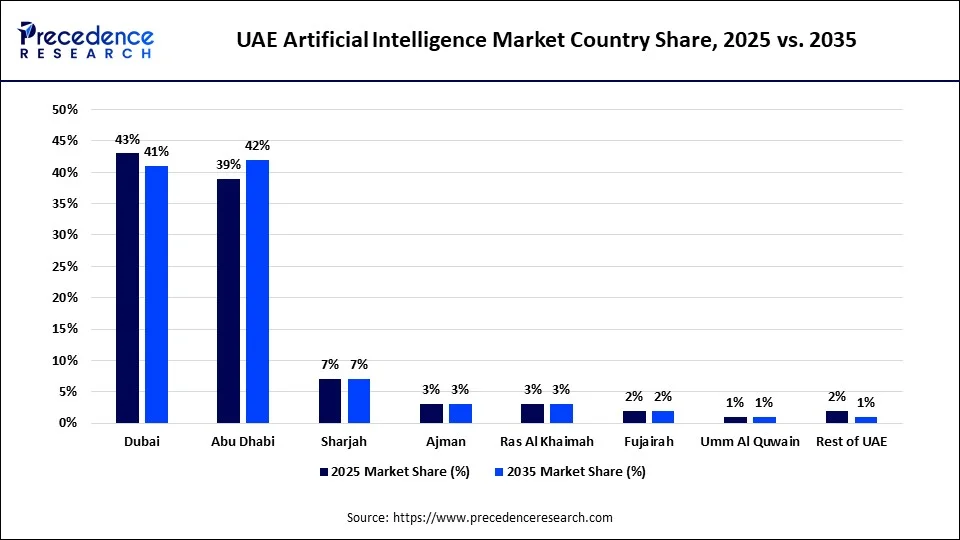
The UAE artificial intelligence market saw Dubai having the largest segment in 2025, accounting for 43% of the market, but its presence is expected to wane marginally to 41% of the market share by 2035 due to competition from the other emirates. The second-largest city has closely trailed Abu Dhabi at 39% in 2025, but is poised to surpass Dubai and take over as the nation's biggest AI market by 2035 at 42%. The change is attributed to the relative thrust in sovereign investment activity within Abu Dhabi, in the form of forays into G42, MGX and Stargate UAE, as well as the development of major computing power and AI infrastructure.
The education, research, and technology ecosystem of Sharjah was responsible for maintaining its 7% share of the total in both 2025 and 2035, whereas the shares of Ajman and Ras Al Khaimah in both years were 3%. Fujairah had a growth rate of 2%, and Umm Al Quwain had a growth rate of 1% in 2025 and 2035. When it comes to future concentration, the Rest of the UAE fell from 2% to 1%, clearly demonstrating the faster concentration of the market in the two major AI hubs.
Key Insight: Abu Dhabi's move from 39% to 42% signifies an evident shift in leadership and its rise towards becoming the leader in AI investments. This is being powered by sovereign investments and large-scale infrastructure plans, potentially ahead of Dubai in 2035.
Source: Precedence Research Database
Emirate Growth Momentum (CAGR Ranking)
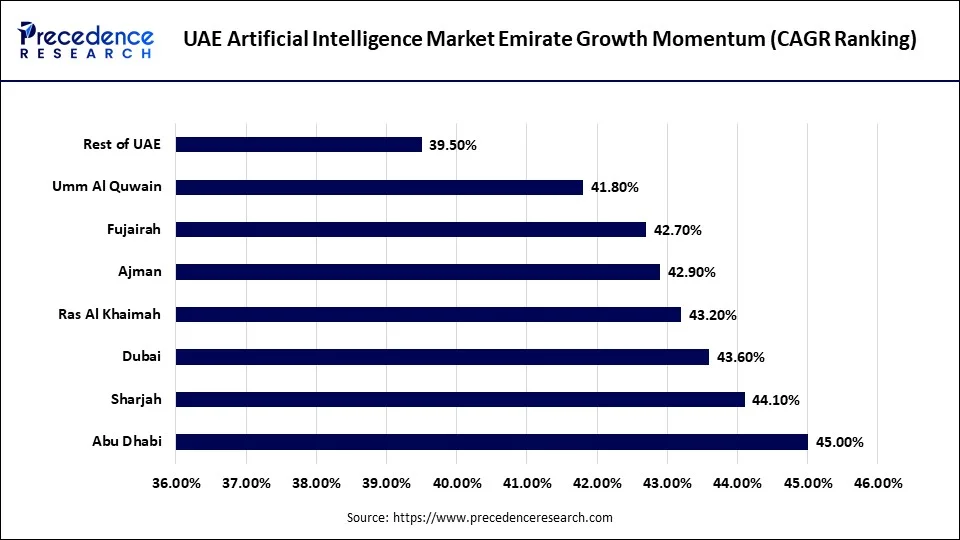
The AI industry in Abu Dhabi is poised to experience the highest growth rate among the UAE emirates, at 45.0% CAGR in the five years ending in 2035, cementing its position as a key contributor to the sustainable growth of the UAE's AI economy. It is nourished by focused sovereign investment, government-backed AI programs, and a wide range of use cases in healthcare and energy. In comparison, the 44.1% CAGR for Sharjah is propelled by the city's education and research environment, manufacturing base, and growing digital transformations. With a robust technology and financial services ecosystem, Dubai's smart-city initiatives, its tourist industry, and the general adoption of AI in the enterprise. The city is anticipated to expand at a 43.6% CAGR in the coming years.
Key Insight: Abu Dhabi experienced the highest CAGR of 45.0% and accounted for the highest share of 42% in the market compared with the other emirates and is following a concentration of sovereign investment and AI infrastructure.
Source: Precedence Research Database
The Ten Statistics That Matter Most For This Market
Almost an order of magnitude larger than the domestic product market, which is the sizing market. The sovereign and infrastructure capital markets are almost an order of magnitude larger in this market. The UAE's Mubadala and G42 investment arm, MGX, has invested more than its initial objectives in its USD 49 billion AI fund. This has now invested in three of the world's most promising AI labs, such as OpenAI, Anthropic, and xAI, in addition to acquiring the infrastructure to create AI in the UAE. As a standalone investment, Microsoft is investing USD 1.5 billion in G42 in 2024, while dedicating and making a multi-partner commitment to providing workshops in an AI data-center campus in Abu Dhabi, announced in May 2025.
Key Insight: The total investment directed towards AI by foreign parties is likely to be many tens of times (and perhaps as much as a few hundred times) greater than this report's estimate of the USD 5.50 billion to USD 213 billion UAE domestic market.
SOURCE: Qz, "Abu Dhabi's MGX closes $49 billion AI fund above target"; CSIS, "The United Arab Emirates' AI Ambitions"; ValueAddVC, "UAE AI Investment Strategy."
AI Contribution to UAE GDP
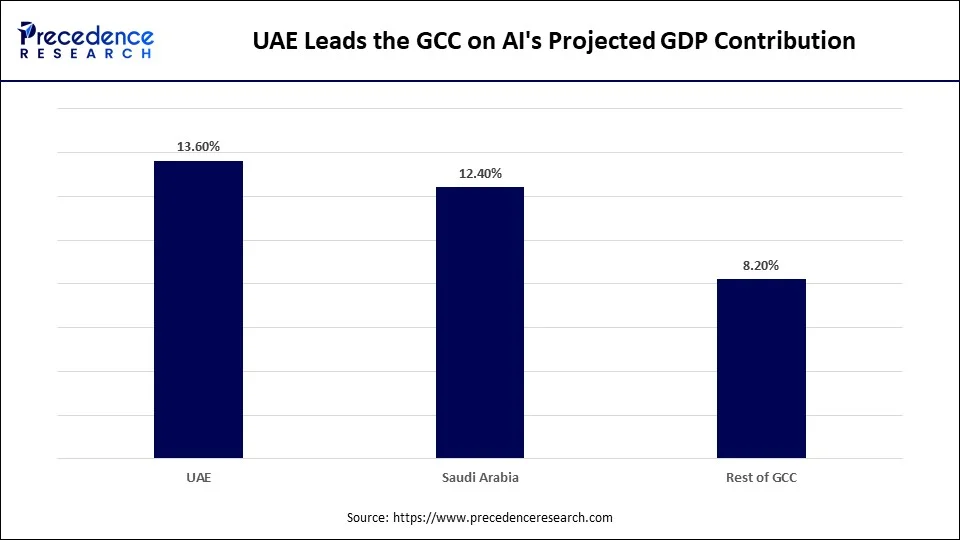
The impact of AI on the UAE economy is estimated to be between USD 96 billion and USD 97.8 billion by 2030-2031, representing about 13.6 to 14% of the country's economy. The most pronounced among all the GCC nations, ahead of Saudi Arabia with 12.4% of the country's economy. Such a forecast is only relevant in a framework where the government shapes the country's digital economy as a crucial economic infrastructure, as opposed to a specific technology industry alongside other industries.
Key Insight: the UAE digital economy is expected to hit 20% of GDP in the region of USD 140 billion by 2031 and will be largely represented by AI at some point in that time.
SOURCE: Khaleej Times, "AI expected to contribute over $96 billion to the UAE's GDP by 2031" (Jun 2025, updated May 2026); PwC Middle East AI analysis.
Government AI Investment & Spending
| Program | Detail |
| Agentic AI Government Framework (2026) | It is expected to see 50 per cent of UAE government sectors, services and operations autonomous using Agentic AI, the world's first framework aimed at that goal, to be realised within two years. |
| Abu Dhabi AI-Native Government Strategy (2025-2027) | The nation's sovereign cloud and artificial intelligence infrastructure being built with Microsoft-G42 is meant to handle more than 11 million interactions with the government every day. |
| Dubai AI Programme | The government has targeted 50,000 of its employees to be trained in artificial intelligence skills. |
| UAE AI Fund |
The government has established a $500M fund to support AI startups and the adoption of AI in general. |
Key Insight: UAE's Federal Government has mandated that all employees receive AI-specific training within the framework of the 2026 Agentic AI. This government-wide upskilling exercise is done at such a large scale that it serves as an excellent forecast for demand for AI-as-a-Service and Consulting in the Government & Public Sector segment.
SOURCE: Arabian Business, "UAE targets 50% government AI automation in two years" (2026); Gulf News, "UAE to Shift 50% of Government Services to Autonomous AI"; Khaleej Times, "UAE races to lead global AI economy."
AI Adoption Rate Among UAE Businesses
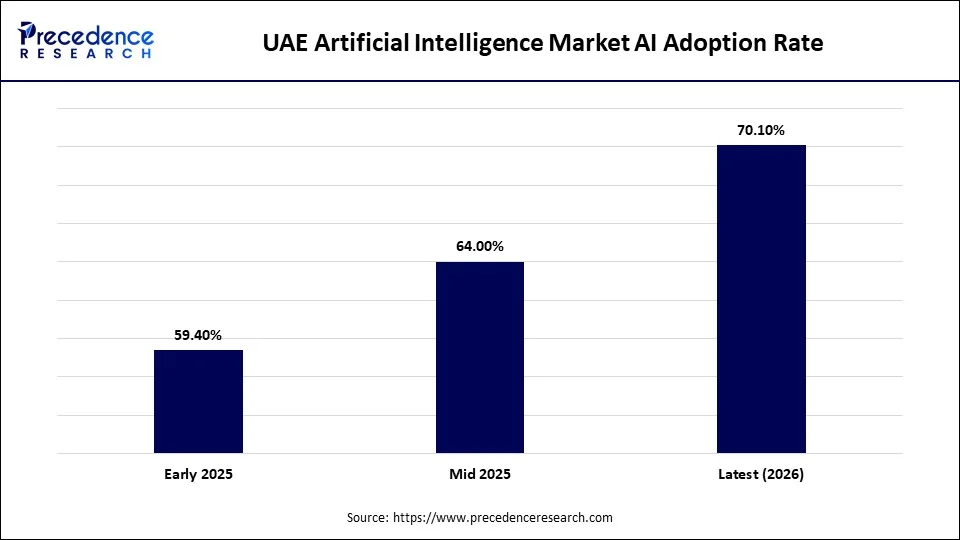
The UAE was the top country in the world in terms of AI adoption among the working-age population. Increasing from 59.4% to 64.0% to 70.1% in 2025, 2026, and 2027, respectively, far higher than the U.S.'s 28.3% and Singapore's 60.9%. On its own, PwC's Middle East Workforce survey revealed that the UAE's employees are using AI more in the workplace than the global average, at 72% versus 54%. It's the timing that makes this conception of the lead, not just the latest AI-smangling pastiche.
The UAE's national AI service strategy is nearly four years old, predating the wave of generative AI that has swept the vast majority of countries today, achieving soaring levels of trust and adoption in part due to the UAE's foresight in leading the world in the execution of AI services. The UAE launched an AI strategy as early as 2017, which paved the way for most of the world's citizens to now experience working with functioning government AI services. This was even specifically credited by Microsoft in its report as a strong catalyst for their high level of trust. Thus, a high adoption rate of these capabilities on that exact date.
Key Insight: UAE's adoption lead is due to policy sequencing; a 2017 UAE national AI strategy came before the wave of generative AI, and this early launch is reflected in the trust data too, with 67% of the UAE respondents expressing trust in AI, compared with only 32% of the U.S. respondents.
SOURCE: Microsoft AI Economy Institute, "Global AI Adoption in 2025"; Khaleej Times, "UAE tops global AI adoption rankings"; PwC Middle East, "Workforce Hopes and Fears Survey 2025."
Generative AI Adoption Rate
In terms of how often their employees use generative AI, the region outperforms the global average at 28%, matching the Middle East segmentation finding in this market. This indicates that generative AI is the fastest-growing technology segment being tracked across the UAE market, while 32% of regional workers report using it daily. Both measure different parameters, one on a sub-regional level for the day by user and the other on a national level for a given category. But the trends similarly suggest that generative AI is gaining on the pack relative to any other category of AI in this region.
Key Insight: A 32% regional daily generative AI usage rate, ahead of the 28% global benchmark, lines up directionally with this report's own segment data showing generative AI as the UAE market's fastest-growing technology category, even though the two figures are not measuring identical things.
SOURCE: PwC Middle East, "Middle East Workforce Hopes and Fears Survey 2025: UAE findings"; Microsoft AI Economy Institute, "Global AI Adoption in 2025."
Number of AI Startups in the UAE
Abu Dhabi alone counted roughly 700 AI-focused firms as of 2025. That count grew 67% in a single year, a pace of company formation that is difficult to sustain without both capital availability and genuine founder demand pulling in the same direction at once. The emirate's flagship program for startups, the Hub71, had already enabled USD 2.17 billion in total funding for AI startups until 2024. Thus expanding beyond the ad hoc funding of the international cross-segment to provide a named source of capital for AI founders in the region.
Key Insight: The number of AI-related companies in Abu Dhabi increased by 67% in just one year to about 700, a rate of company formation more typically seen when both capital and real demand for AI are going up, rather than up without down and vice versa.
SOURCE: Founder Connects, "How UAE Investors Support AI Startups" (2026).
AI Startup Funding
This is the simplest inflation-adjusted, dollar-based basis for comparing private capital velocity of AI across the nation on an annual basis. The USD 519 million raised by UAE AI startups in 2025 alone represents a massive amount of institutional VC and strategic funding. Gained by AI companies across the country in the second half of 2024. The most noteworthy aspect, however, is the focus on the UAE region. Equity investment in AI startups reached 60% of all investments in AI startups across the entire Middle East North Africa (MENA) region in 2025. This is much higher than would be expected based on the UAE's population and GDP share within the region.
Key Insight: In 2025, the UAE's share of all investments in AI startups in the MENA region 60% exceeds the country's population and GDP share of the region. Indicating that it is not just among multiple potential destinations but is the preferred choice for investments in AI startups across the region.
SOURCE: Founder Connects, "How UAE Investors Support AI Startups"; Asia Lifestyle Magazine, "UAE AI Companies Accelerate Growth With New Funding" (2025).
AI Talent & Workforce Size
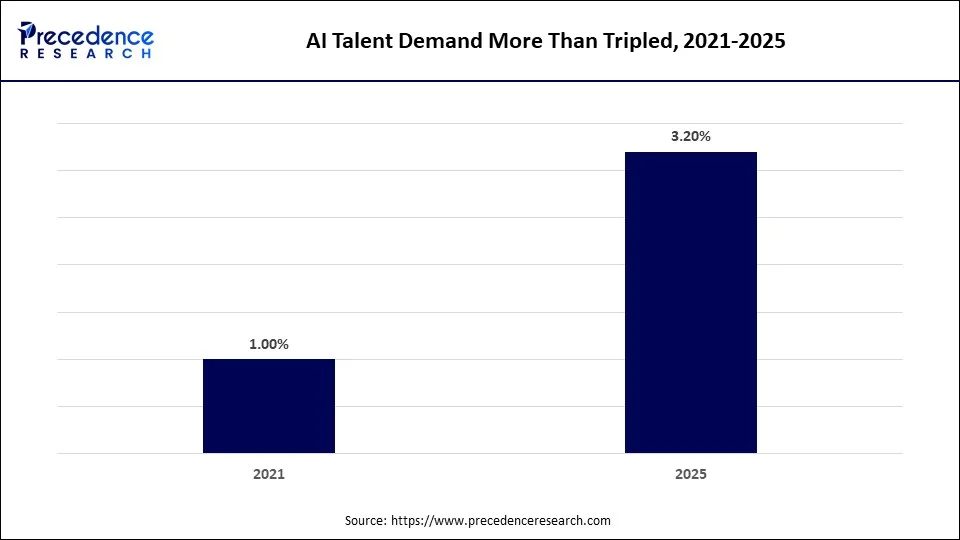
The UAE is one of the world's fastest-expanding AI talent markets, with more than a third of all job postings from 1.0 - 1.8% in 2021 to 3.2% in 2025 demanding AI skills. According to a study by PwC which found that France, the United Kingdom, Germany, and the United States were trailing in their share of job postings for AI skills. The median AI-skills wage premium went up to 62% from the 57% it had been the previous year. The increasing value of the premium suggests the labor market isn't oversupplied with AI skills, but that the premium originates from true talent scarcity. Maybe the most unusual revelation of all in the whole report lies right here.
Key Insight: Contrary to popular belief, AI is proving to lead to a hiring race and not a firing race, as key companies in the top 20% of AI exposure saw growth rates of 52% in staffing sizes, compared to those of other companies.
SOURCE: PwC, "2026 AI Jobs Barometer: UAE analysis"; MIT Sloan Management Review Middle East, "UAE Companies Expand Recruitment for AI Talent."
AI Compute Infrastructure Capacity
Established in May 2025 by a partnership of G42, OpenAI, Oracle, Nvidia, Cisco, and SoftBank, Stargate UAE is expected to be a five-gigawatt AI data center campus in Abu Dhabi. They have plans to deliver the initial 200-megawatt project and the first 1-gigawatt phase by 2026. Comparing it to a typical data center doesn't help make this five-gigawatt single-campus deal comprehensible. It is located at the level of a large national electric power grid's entire dedicated AI computing.
It's roughly what the entire dedicated national grid would be for AI compute, outside of America. A framework agreement between the United States and UAE governments, signed in May 2025. This allows the country to import 500,000 of Nvidia's most powerful AI chips per year, with about 100,000 set aside specifically for G42. The rest allocated among some of the U.S. hyperscalers already running in the region. This was in contrast to a much smaller number and something that came before the much larger Stargate data center. Khazna Data Centers announced in October 2024 an addition of 90 megawatts of AI-ready capacity.
Key Insight: Abu Dhabi would be hosting the biggest AI compute build in the world outside of the U.S. with a single campus commitment of 5 gigawatts of compute power.
SOURCE: ValueAddVC, "UAE AI Investment Strategy: G42, ADNOC, MGX, and the Gulf's $100B+ Bet"; Asia Lifestyle Magazine, "UAE AI Companies Accelerate Growth."
Number of AI-Enabled Government Services
The UAE aims to transform 50% of government services to autonomous agentic AI by the year 2026, and preliminary progress is promising. Its future-readiness score for AI-powered immigration and visa services was 95.6%, and over 11 million government-citizen-business interactions are already occurring on the nation's new AI infrastructure. Finally, it's not just the scale of this target that makes it somewhat more plausible for a normal government AI move, but something that's inscribed in the 2026 implementation framework itself.
Key Insight: There are many ways to connect the adoption of AI technologies to career and leadership performance assessments, but the 2026 framework does so. This is a structural measure that most governments simply don't use, as it encourages this when it becomes an internal measure of performance, which is much more likely to actually represent the delivery of the policy.
SOURCE: Gulf News, "UAE to Shift 50% of Government Services to Autonomous AI Within Two Years"; Digital Dubai, "UAE: 50% Government Services to AI in Two Years."
Segmental Analysis
Technology: Generative AI Becomes the Largest Category
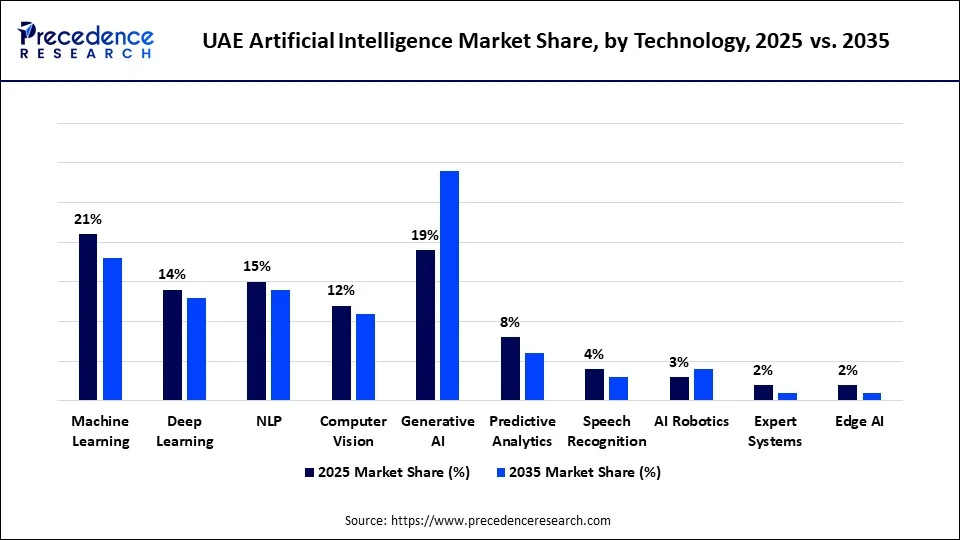
With a 21.0% technology share in 2025, machine learning remains the most mature of the technologies for the foreseeable future. It is projected to decline slightly in share of technology, dropping to 18.0% by 2035, but will still grow at a CAGR of 42.2% annually. The generative AI segment also has the fastest growth CAGR at 50.1% as it mounts a rampage to take over the leaderboard, leaving expectations of a 29.0% share by 2035, compared with 19.0% in 2025. A government and enterprise base that embraced AI at an early stage and embraced it in a recent wave of deployment. That was massively generative-AI-based, constructing new AI systems that are generative AI-first, rather than adding generative AI to the existing machine learning ecosystem of slow-growing markets. That is a significantly different position to start from, and it comes across quite vividly when equated with the position of the two leaders.
Key Insight: By 2035, the most significant technology level advancement for the UAE's enterprise and government AI initiatives is their adoption of generative AI over machine learning (ML), with 29% of deciders opting for generative AI first, compared to 18% for machine learning.
Source: Precedence Research Database
Organization Size: SMEs Are Closing the Gap on Large Enterprises
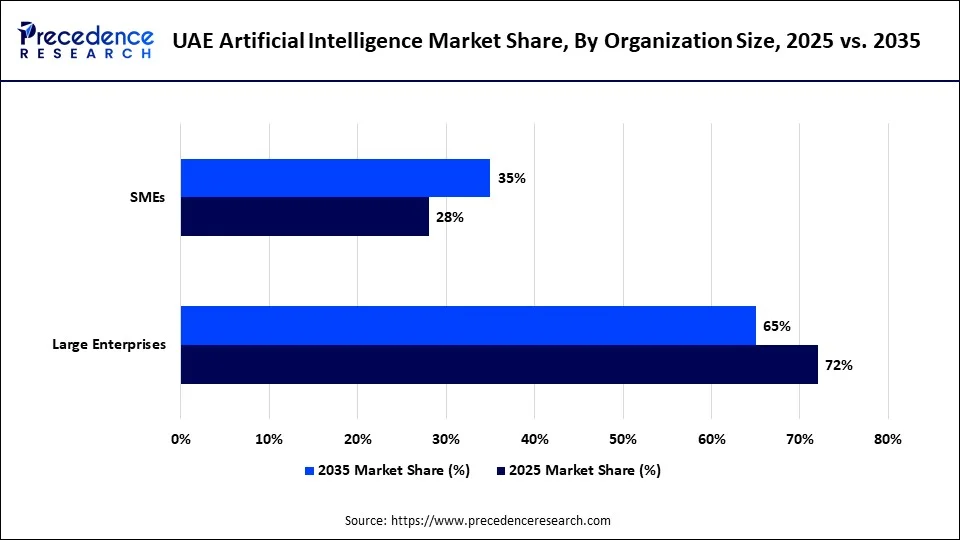
Large enterprises held a commanding majority market share in 2025 at 72.0%. They usually have more assets and technical talent to allocate to early investments in AI, with large enterprise share dropping marginally to 65.0% by 2035, but still increasing at a 42.9% CAGR. SMEs are the vehicles helping to fill that gap, with their share rising from 28.0% to 35.0% at a 47.8% CAGR, almost five percent short compared with large enterprise companies.
That convergence isn't likely to be due to a sudden change in SME ambition, but rather due to the pricing strategy. The AI-as-a-Service offerings, which allow small organizations to access AI technology without the through-the-roof upfront investment in infrastructure. They are also doing far better than the average in the market, using AI provided in a consumption-based pricing model; that's what ultimately pushes smaller organizations into competition with larger ones.
Key Insight: At the same time as large enterprises grow by almost 5% in CAGR, SMEs come in seven points behind, similar to how AI-as-a-service pricing has reduced the investment barriers that typically keep SMEs from enterprise-grade deployment.
Source: Precedence Research Database
Component: Software Extends Its Majority Lead
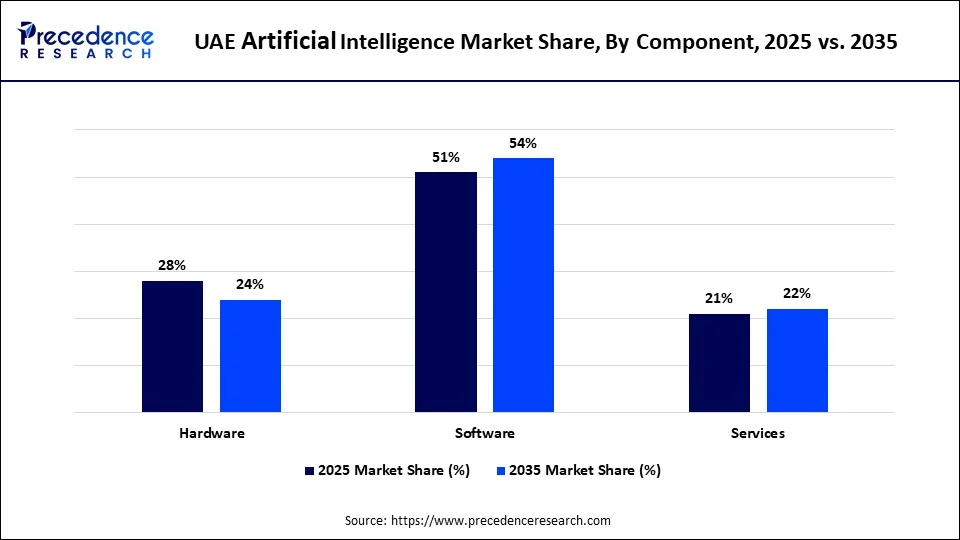
Software already commanded a clear majority of the component in 2025 at 51.0% share, and rather than facing erosion the way majority leaders often do as a market matures. It extends that lead further to 54% by 2035 while growing at 44.8% annually, the fastest of the three components tracked in this segment. In contrast, hardware registered the lowest growth in the category with a decrease from 28.0% to 24.0%. That separation is one I think one has to have a seat at, as it's the only place I can see where the highest percentage of AI spending won't be hardware-installed-based, but where physical compute and equipment have also had a promise and influence over the rising revenue for years before software has taken over.
Key Insight: In contrast to the UAE's light industrial base and cloud-first approach to the AI market, which is already primarily a software and platform market today and will remain that way in 2025, software has a majority in AI in the UAE and will continue to outsell hardware-installed base for the foreseeable future.
Source: Precedence Research Database
Deployment: Cloud Extends Its Lead as On-Premises Declines
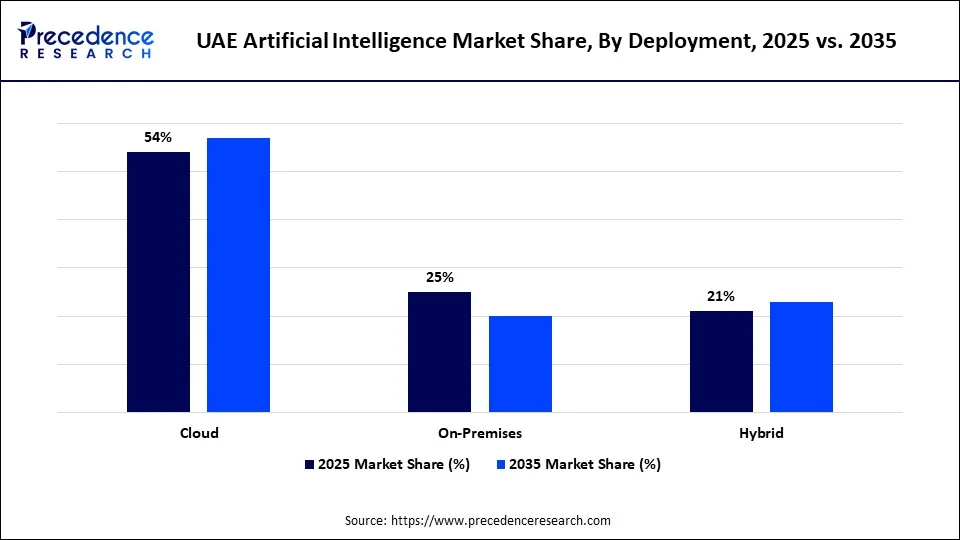
Previously, cloud had the biggest piece of this pie at 54.0% in 2025, but it continues to grow its share to 57.0% in 2035 at a growth rate of 44.8% per year. On-premises deployment, on the other hand, is losing share (-2.5%) and only seeing 39.7% growth, making it the one deployment type in this entire segment to lose share and experience a downturn in growth rate. That mix alone is quite tell-tale, with the UAE being driven to use data-sovereignty protocols and the government sector being in a security-sensitive industry that could be estimated to be a negative for on-premises solutions. Part of the reason, I believe, is that the country has crafted its own cloud strategy, as in Microsoft and G42's sovereign cloud partnership, which is surely one of the more significant.
Key Insight: On-premises, the sole category to record a fall in share and a sub-market CAGR, is the clear loser when it comes to the deployment-mix argument in this market that has strong data-sovereignty and government-security requirements.
Source: Precedence Research Database
Expert Insights
The UAE AI industry is evolving from a novice era of trials to large-scale commercialization across the government sector and large industries. In my view, some great new opportunities are forming where the different components of AI platforms, cloud infrastructure, generative AI, data analytics, and intelligent automation come together. Government initiatives, growth of digital infrastructure, and the increasing penetration of enterprises will have a significant influence on market competitiveness in the upcoming 10 years in the UAE. I expect to see the demand for generative AI, machine learning, computer vision, natural language processing, and AI-powered enterprise solutions continue as organizations work to enhance performance in several different areas, including productivity, customer experiences, operational efficiency, and decision-making. Finance firms well-placed to hold the nation's growing investment and uptake trend in AI should be those that can develop scalable AI platforms, have robust data security and cybersecurity capabilities, build strategic partnerships, and offer sector-specific solutions.
Our Experts
Gautam Mahajan has spearheaded the main market research, methodology preparation, market segmentation, application analysis, competitive developments, analysis, and forecasting for the report, making it the analytical underpinning of the report.
Aman handled the collection and validation of government publications, company disclosures, technology investment data, infrastructure statistics, and other independently sourced quantitative data that contributed to a robust evidence base for the market estimates.
Aditi checked the entire research paper, did quality checks, confirmed the findings, altered the paper for refinement, removed inconsistencies, and finalized the research paper, making it accurate and understandable.
Complete Market Sementation
Every category tracked in the underlying dataset, beyond the four segments selected for deep-dive analysis.
By Component
- Hardware
- Software
- Services
By Technology
- Machine Learning
- Deep Learning
- Natural Language Processing
- Computer Vision
- Generative AI
- Predictive Analytics
- Speech Recognition
- AI Robotics
- Expert Systems
- Edge AI
By Offering
- AI Platforms
- AI Solutions
- AI Applications
- AI Infrastructure
- AI-as-a-Service
- AI Consulting & Integration Services
- Managed AI Services
By Deployment
- Cloud
- On-Premises
- Hybrid
By Organization Size
- Large Enterprises
- Small & Medium-sized Enterprises
By Application
- Predictive Analytics
- Fraud Detection & Risk Management
- Customer Service & Virtual Assistants
- Process Automation
- Cybersecurity
- Recommendation Systems
- Computer Vision
- Autonomous Systems
- Healthcare Diagnostics
- Smart City & Infrastructure Management
- Other Applications
By End User
- Government & Public Sector
- Banking, Financial Services & Insurance
- Healthcare & Life Sciences
- Retail & E-commerce
- IT & Telecommunications
- Energy & Utilities
- Manufacturing
- Transportation & Logistics
- Real Estate & Construction
- Education
- Media & Entertainment
- Travel & Hospitality
- Defense & Security
- Other End Users
By Region (EMIRATE)
- Dubai
- Abu Dhabi
- Sharjah
- Ajman
- Ras Al Khaimah
- Fujairah
- Umm Al Quwain
- Rest of UAE
The Questions This Report Deliberately Leaves Open
- If a foreign AI company comes to the UAE via government procurement, a G42/MGX tie-up, or via an AI startup purchase from among those supported by Hub71, should it be chosen?
- What will happen to the projected 42% share in the market by 2035 in Abu Dhabi if Dubai's commercial and tourism technology base increases its own investment in AI?
- How do you price “the SME segment”-what their value is worth and what pricing model you can use without lowering value for “the Large Enterprise contracts”?
- What are the revenue growth prospects for the segment in the near future, considering the Generative AI applications of customer service, healthcare diagnostics, and autonomous systems, with 50.1% CAGR?
- With job postings over tripling since 2021, is the UAE facing a talent shortage in AI, or is it a market opportunity, in terms of services and consulting?
- Is the difference between the $5.50B domestic AI informatics product market and the $49B+ MGX fund two separate investment theses or one?
- What regulatory and compliance requirements are included with the UAE's future mandate around Agentic AI, and who will be best equipped to satisfy the requirements first?
- Is the decline in on-premises deployment from 25% to 20% a lasting trend, or could data-sovereignty requirements in Defense & Government reverse it?
- Which non-UAE GCC markets, including Saudi Arabia with its 12.4% AI GDP contribution, represent the next-best expansion opportunities for a UAE-proven AI vendor?
- How should an AI cybersecurity vendor price against the Cybersecurity application segment's steady 44.2% CAGR compared with faster-growing categories?
- What M&A opportunities could connect telecommunications infrastructure players such as Etisalat and du with AI platform and application vendors?
- Given Stargate UAE's 5GW scale, what downstream advantage in compute availability could UAE-based AI companies gain over regional competitors by 2028?
- How should a healthcare AI vendor sequence its UAE market entry given Healthcare & Life Sciences' above-market 45.2% CAGR but relatively modest 10–11% end-user share?
- What happens to the Hardware segment's share, which declines from 28% to 24%, if the UAE's sovereign chip-import capacity of 500,000 Nvidia units annually becomes a bottleneck rather than an enabler?
- Which AI Consulting & Integration Services providers are best positioned to support the government's mandated 50% Agentic AI transition?
- Does the UAE's concentration of AI startup funding, representing 60% of the MENA total, crowd out or encourage funding for AI startups in neighboring GCC markets?
- What productivity and ROI benchmarks should UAE enterprise buyers require before committing to Large Enterprise-scale AI deployments?
- How should vendors prioritize the eight National AI Strategy sectors transport, health, space, energy, water, education, environment, and traffic when developing their public-sector go-to-market strategy?
References
- Khaleej Times "UAE races to lead global AI economy with sovereign compute and 2031 digital targets"
https://www.khaleejtimes.com/business-technology-review/uae-bets-on-artificial-intelligence-supremacy-to-power-digital-future
Data used: digital economy GDP target, AI GDP contribution figure. - CSIS "The United Arab Emirates' AI Ambitions"
https://www.csis.org/analysis/united-arab-emirates-ai-ambitions
Data used: MGX formation, Microsoft-G42 investment, AI Infrastructure Partnership scale. - Qz "Abu Dhabi's MGX closes $49 billion AI fund above target"
https://qz.com/abu-dhabi-mgx-ai-fund-49-billion-070126
Data used: MGX fund closing size, portfolio company investments (Anthropic, OpenAI, xAI, Aligned Data Centres). - ValueAddVC "UAE AI Investment Strategy: G42, ADNOC, MGX, and the Gulf's $100B+ Bet"
https://valueaddvc.com/blog/uae-ai-ambitions-g42-adnoc-and-the-gulfs-100b-ai-investment-strategy
Data used: Stargate UAE capacity and timeline, US-UAE Nvidia chip import framework. - Asia Lifestyle Magazine "UAE AI Companies Accelerate Growth With New Funding, Partnerships, And Model Launches In 2025"
https://www.asialifestylemagazine.com/uae-ai-companies-2025-boom/
Data used: G42 Series B, Presight AI funding, Khazna Data Centers capacity addition. - Founder Connects "How UAE Investors Support AI Startups"
https://www.founderconnects.com/blog/uae-investors-support-ai-startups
Data used: UAE AI startup funding (2025), MENA share, Abu Dhabi AI firm count and growth rate, Hub71 funding facilitation. - Gulf News "UAE to Shift 50% of Government Services to Autonomous AI Within Two Years"
https://gulfnews.com/uae/government/uae-to-move-50-of-government-services-to-ai-within-two-years-1.500516798
Data used: 2026 Agentic AI government framework, employee training mandate. - Arabian Business "UAE targets 50% government AI automation in two years with new Agentic AI framework"
https://www.arabianbusiness.com/business/technology/uae-targets-50-government-ai-automation-in-two-years-with-new-agentic-ai-framework
Data used: government AI transformation framework detail. - Microsoft AI Economy Institute "Global AI Adoption in 2025"
https://www.microsoft.com/en-us/corporate-responsibility/topics/ai-economy-institute/reports/global-ai-adoption-2025/
Data used: UAE population-level AI adoption/diffusion rate (59.4%→64.0%→70.1%), global country ranking. - PwC "2026 AI Jobs Barometer: UAE analysis"
https://www.pwc.com/m1/en/publications/ai-jobs-barometer-uae-2026.html
Data used: AI job posting share growth (2021–2025), wage premium trend. - PwC Middle East "Middle East Workforce Hopes and Fears Survey 2025: UAE findings"
https://www.pwc.com/m1/en/issues/upskilling/hopes-and-fears-2025/hopes-and-fears-uae-2025.html
Data used: UAE employee AI usage rate, generative AI daily usage rate (regional).
For inquiries regarding discounts, bulk purchases, or customization requests, please contact us at sales@precedenceresearch.com
Frequently Asked Questions





Ask For Sample
No cookie-cutter, only authentic analysis – take the 1st step to become a Precedence Research client
 Get a Sample




 sales@precedenceresearch.com
 Schedule a Meeting
