



U.S. Ambulatory Surgery Center Market Size, Key Companies, Company Product Portfolio, Hospital Procurement Trends, Manufacturing Capacity, Sales Performance, Regulatory Approvals, Company Market Share, and Forecast
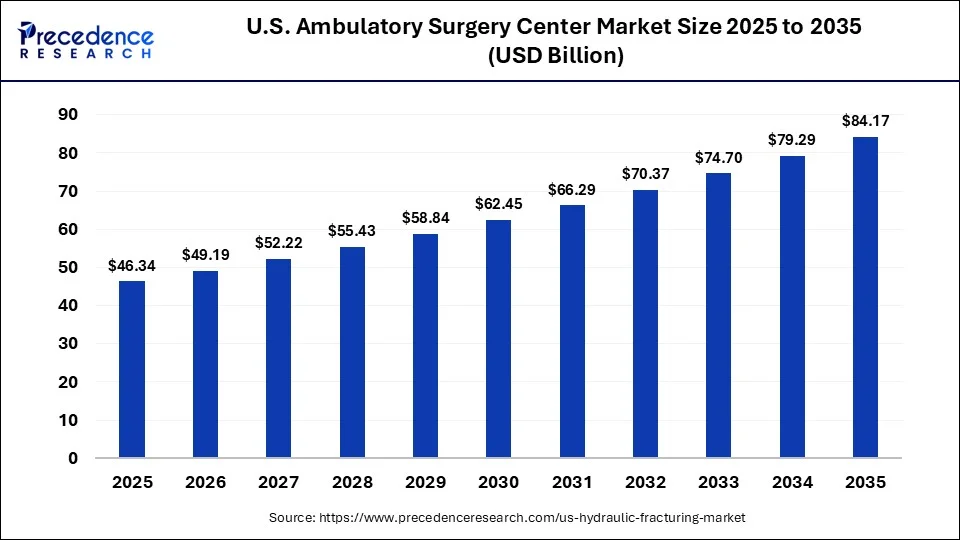
The U.S. ambulatory surgery center (ASC) market was valued at USD 49.19 billion in 2026 and is projected to grow at a CAGR of 6.15% through 2035. The growth of the market is driven by increasing migration of procedures from hospital outpatient departments to ASCs, growing physician participation, rising demand for cost-efficient outpatient care, favorable reimbursement economics, and advances in minimally invasive and also higher-acuity procedures. Major trends include the expansion of ophthalmic, gastroenterology, orthopedic, ENT, and cardiovascular procedures, alongside greater acceptance of robotic surgery, advanced imaging, digital patient management, as well as enhanced anesthesia technologies. Expanding ASC infrastructure, payer and provider focus on lower-cost sites of care, and continued consolidation via acquisitions and joint ventures are anticipated to create new opportunities for ASC operators, technology vendors, healthcare providers, and investors through 2035.
Source: https://www.precedenceresearch.com/us-ambulatory-surgery-center-market
 Get a Sample
 Table Of Content


U.S. Ambulatory Surgery Center Market Growth, Innovations and Market Size Forecast 2035
The U.S. ambulatory surgery center market is expanding as healthcare providers, physicians, and payers increasingly shift appropriate procedures from inpatient hospitals and hospital outpatient departments toward lower-cost outpatient settings. The U.S. ambulatory surgery center market is forecasted to expand from USD 49.19 billion in 2026 to USD 84.17 billion by 2035, growing at a CAGR of 6.15% from 2026 to 2035.
 Key Takeaways
- The U.S. ambulatory surgery center market was estimated at USD 49.19 billion in 2026 and is projected to reach approximately USD 84.17 billion by 2035.
- The U.S. has approximately 6,000-6,600 Medicare-certified ASCs, highlighting the market's substantial scale and fragmentation.
- Only about one-third of freestanding ASCs are linked with larger multi-site operators, leaving a large independent and locally affiliated market.
- The market is expected to grow at an 6.15% CAGR through 2030-2032, supported by site-of-care migration and higher-value outpatient procedures.
- A leading national operator reported 3.5% same-facility case growth and 1.5% revenue-per-case growth in 2025, demonstrating the impact of procedure volume and case value.
- The market includes 3.5%-7% growth scenarios, reflecting different assumptions for procedure migration, capacity expansion, and revenue development.
- The five largest multi-site operators collectively account for only about 22% of U.S. ASC centers, underscoring the fragmented competitive structure.
- The largest ASC operator represents approximately 8% of centers, followed by operators with approximately 5%, 4%, 2%-3%, and 2% shares.
- A major national operator reported nearly 539 ASC interests as of mid-2026, while another leading operator reported 158 ASCs at year-end 2025.
- The market covers 12 major specialty categories, including orthopedics, ophthalmology, gastroenterology, pain management, ENT, general surgery, urology, gynecology, cardiovascular, spine, podiatry, and other specialties.
Outpatient Migration is Expanding a Large, Fragmented, Physician-Linked Surgical Market
The underlying market opportunity is larger than the reported revenue growth rate. The U.S. has approximately 6,000-6,600 Medicare-certified ASCs, while only about one-third of freestanding ASCs are linked with larger multi-site operators. Thus, the remaining remain independent or locally affiliated. This fragmentation creates a substantial acquisition, de novo development, affiliation, and management-services opportunity.
The requirement is being reshaped by the migration of appropriate procedures from inpatient hospitals along with hospital outpatient departments toward lower-cost outpatient settings. Orthopedics, gastroenterology, pain management, ophthalmology, ENT, urology, and other procedural specialties form the core addressable pool. The higher-acuity orthopedic and cardiovascular procedures are thus expanding the clinical boundary of the ASC model. The market is therefore best understood through reimbursement, case acuity, procedure volume, utilization, payer mix, and physician alignment, rather than revenue alone.
Key Coverage
- Specialty and procedure-level opportunity.
- ASC count, procedure volume, and facility economics.
- Ownership and physician-alignment structures.
- Utilization, case migration, and capacity economics.
- Medicare, commercial payer, and reimbursement dynamics.
- State-level and metropolitan opportunity.
- Competitive market share and consolidation.
Market Size and Forecast - Revenue Growth is Being Supported by Both Case Migration and Higher-Value Procedures
The U.S. ASC market was estimated at USD 49.19 billion in 2026. Published estimates range from approximately USD 84.17 billion by 2035, reflecting differences in inclusion of diagnostic activities, professional services, and affiliated operations. The underlying growth equation is more important than the headline CAGR, i.e., case migration, procedure complexity, revenue per case, reimbursement growth, and new-center capacity. For example, a leading national operator in 2025 was reported to have same-facility case growth of 3.5% and revenue-per-case growth of 1.5%, demonstrating how modest procedure growth can translate into substantially higher facility revenue when acuity as well as reimbursement improve.
Key Coverage
- 3.5-7% market-growth scenarios.
- Incremental revenue opportunity.
- Procedure-volume contribution.
- Revenue-per-case evolution.
- State and specialty forecasts.
- Base/upside/downside cases.
Segmentation Analysis - Orthopedics and Other High-Value Procedures are Expanding the Addressable Pool
Market segmentation includes specialty, procedure, center type, ownership, payer, acuity, and geography rather than conventional product categories.
Ophthalmology, gastroenterology, orthopedics, pain management, ENT, general surgery, gynecology, urology, and other procedural specialties are main medical services offered through ASCs. Single-specialty centers provide concentrated throughput economics, and multispecialty facilities diversify payer exposure and improve room utilization.
Ownership formats like physician-only, physician-corporate, physician-hospital, and hospital-linked structures produce different economics, governance models, and acquisitions. Independent ASCs dominate the market, while large operators increasingly pursue joint ventures and de novo facilities.
Key Coverage
- Specialty and procedure segmentation.
- Single- vs multispecialty centers.
- Physician, hospital, and corporate ownership.
- Payer segmentation.
- High-, medium-, and low-acuity procedures.
- Revenue and case-volume contribution.
- Fastest-growing procedure categories.
Market Dynamics - Site-of-Care Migration is the Central Structural Growth Engine
Three forces dominate market expansion.
Firstly, site-of-care migration. Procedures that once required hospital admission increasingly qualify for outpatient treatment as of minimally invasive techniques, improved anesthesia, better perioperative protocols, and shorter recovery times.
Secondly, payer economics. ASCs can usually deliver comparable procedures at lower facility cost than hospital-based settings, thus strengthening payer incentives to steer appropriate cases toward outpatient facilities.
Thirdly, physician alignment. Equity participation can align surgeons with facility utilization, and scheduling efficiency, along with investment decisions. Meanwhile, research on ASC ownership dynamics also indicates that physician ownership can rise following private-equity investment, reinforcing the significance of physician alignment in the operating model.
Constraints include anesthesia availability, labor shortages, state certificate-of-need requirements, capital requirements, payer contracting, and limits on migrating increasingly complex procedures.
Key Coverage
- Site-of-care migration
- Procedure eligibility expansion
- Payer steering
- Physician ownership economics
- Labor and anesthesia constraints
- Certificate-of-need exposure
- Case-acuity migration
Leading Companies - 24 Participants Shaping U.S. ASC Competition
| Company | Headquarters | Market Position | Core Strength | Major Applications/Segments |
| United Surgical Partners International | Dallas, TX | Market leader | Scale/JVs | Multispecialty |
| SCA Health | Deerfield, IL | National leader | Physician partnerships | Multispecialty |
| AmSurg | Nashville, TN | National operator | Specialty ASC networks | GI/ophthalmology |
| HCA Healthcare | Nashville, TN | Major health-system operator | Integrated outpatient network | Multispecialty |
| Surgery Partners | Brentwood, TN | National specialist | Physician-led facilities | Surgical specialties |
| Community Health Systems | Franklin, TN | Regional operator | Hospital-linked outpatient | Multispecialty |
| Surgery Center Development | U.S. | Development platform | De novo centers | Multispecialty |
| Regent Surgical Health | Westchester, IL | ASC specialist | JV/development | Multispecialty |
| Covenant Surgical Partners | Nashville, TN | Specialty platform | Physician partnerships | GI/ENT |
| AMSURG-affiliated specialty platforms | U.S. | Specialty network | GI/ophthalmology | Specialty ASC |
| Compass Surgical Partners | Raleigh, NC | Development operator | De novo/JV | Multispecialty |
| Surgical Care Affiliates-affiliated platforms | U.S. | National network | Physician alignment | Multispecialty |
| US Eye | Largo, FL | Specialty platform | Ophthalmology | Eye surgery |
| Covenant Physician Partners | U.S. | Specialty operator | Physician alignment | GI |
| Surgery Center Services | U.S. | Regional operator | ASC management | Multispecialty |
| Surgical Management Professionals | Sioux Falls, SD | ASC operator | Management/JVs | Multispecialty |
| Physicians Endoscopy | Doylestown, PA | Specialty platform | GI partnerships | GI |
| Gastro Health | Miami, FL | Specialty network | GI ecosystem | GI/endoscopy |
| EyeSouth Partners | Atlanta, GA | Specialty platform | Ophthalmology | Eye surgery |
| US Digestive Health | Philadelphia, PA | Specialty network | GI | GI/endoscopy |
| OrthoLoneStar-affiliated ASC platforms | Texas | Regional specialty | Orthopedics | Orthopedic surgery |
| Regent-affiliated centers | U.S. | JV operator | Physician alignment | Surgical specialties |
| Regional physician-owned ASC groups | U.S. | Fragmented leaders | Local physician relationships | Specialty/multispecialty |
| Hospital-system-affiliated ASC platforms | U.S. | Regional scale | Referral integration | Multispecialty |
Which Competitive Dynamics Will Determine Who Captures the Next Wave of U.S. ASC Growth?
The U.S. ambulatory surgery center (ASC) market remains highly fragmented. The country has roughly 6,000-6,600 medicare-certified ASCs, while the five largest multi-site operators collectively account for only about 22% of centers; the largest operator represents approximately 8%, followed by operators with approximately 5%, 4%, 2-3%, and 2%, respectively. This structure indicates that a substantial portion of the market remains controlled by independent, regional, physician-owned, and hospital-affiliated facilities. At the same time, leading national platforms are expanding through acquisitions, joint ventures, as well as de novo development, creating a competitive environment in which scale and local physician alignment are becoming complementary rather than mutually exclusive.
This research mainly indicates that the market's competitive battleground is changing from simply owning more facilities to controlling higher-value procedure volumes and maximizing facility-level productivity. The difference between center-count share and economic share is especially important: a large ASC network does not necessarily translate into proportional revenue leadership as facility size, case acuity, reimbursement, specialty mix, physician productivity, and operating-room utilization vary substantially. Orthopedics, gastroenterology, ophthalmology, and other high-volume or increasingly high-acuity specialties is expected to influence future competitive positioning, while physician recruitment, utilization management, payer contracting, and the ability to migrate appropriate procedures from hospital settings will determine revenue growth and margins.
As per our view, the fragmented ownership structure creates a substantial consolidation and collaboration opportunity, but successful expansion will depend more on physician alignment and even local market economics than on acquisition scale alone. A major national operator reported nearly 539 ASC interests as of mid-2026, while another leading operator reported 158 ASCs at year-end 2025, thus illustrating the widening scale gap between national platforms and smaller operators. Moreover, the continued presence of thousands of independent centers suggests that the addressable consolidation pool remains significant.
Which Company Capabilities Will Separate ASC Leaders from the Rest of the Market?
The U.S. ASC landscape combines national platforms with hundreds of facility interests, regional operators, specialty-focused networks, physician-led centers, and hospital-affiliated facilities. With nearly 6,000-6,700 Medicare-certified ASCs and the five largest multi-site operators representing only about 22% of centers, competitive strength is not determined by scale alone. The underlying differences in procedure volumes, physician alignment, geographic density, specialty mix, facility utilization, payer exposure, and acquisition capabilities offer a more meaningful basis for assessing which companies can sustain growth.
Our analysis indicates that the strongest ASC platforms are differentiated by their ability to convert network scale into higher facility productivity and attractive economics. Firms with broader footprints may benefit from centralized procurement, revenue-cycle infrastructure, payer relationships, along with greater access to acquisition capital, while physician-led and specialty-focused operators can compete via clinical expertise, physician loyalty, and concentrated procedure volumes. Our assessment is that the interaction between these capabilities, not any single operating metric, will increasingly determine whether an operator can successfully expand its footprint while protecting margins and then maintaining physician alignment.
In our view, company-level performance should therefore be evaluated via a combination of scale, operational capability, growth quality, and strategic positioning. The most important indicators include ASC and facility count, revenue growth, specialty, relevant revenue, and procedure exposure, physician relationships, geographic presence, operating-room capacity and utilization, acquisition and de novo activity, technology adoption, and investment priorities.
U.S. Ambulatory Surgery Center Market Segments
By Specialty
- Orthopedics
- Ophthalmology
- Gastroenterology
- Pain Management
- ENT / Otolaryngology
- General Surgery
- Urology
- Gynecology
- Cardiovascular
- Spine
- Podiatry
- Other Specialties
By Procedure Type
- Cataract & Ophthalmic Procedures
- Gastrointestinal Endoscopy
- Orthopedic & Musculoskeletal Procedures
- Spine Procedures
- Pain Management Procedures
- ENT Procedures
- General Surgical Procedures
- Urological Procedures
- Gynecological Procedures
- Cardiovascular Procedures
- Other Procedures
By Payer
- Medicare
- Medicaid
- Commercial Insurance
- Medicare Advantage
- Self-Pay / Other
By Ownership Model
- Physician-Owned
- Hospital-Owned / Hospital-Affiliated
- Corporate / ASC Management Company-Owned
- Joint Venture
- Private Equity-Backed
- Other Ownership Models
By Facility Type
- Single-Specialty ASCs
- Multi-Specialty ASCs
By Acuity / Procedure Complexity
- Low-Acuity Procedures
- Moderate-Acuity Procedures
- Higher-Acuity / Advanced Outpatient Procedures
By Development / Operating Model
- Existing / Mature ASC
- De Novo ASC
- Acquired ASC
- Joint-Venture Development
- Hospital-to-ASC Conversion / Migration
By Procedure Migration Potential
- Established ASC Procedures
- Emerging Hospital-to-ASC Procedures
- Newly ASC-Eligible Procedures
- Future / High-Potential Migration Procedures
By Technology Adoption
- Conventional Minimally Invasive Surgery
- Robotic-Assisted Surgery
- Advanced Imaging
- Digital Patient Management / Scheduling
- Remote Monitoring
- Advanced Anesthesia & Patient-Monitoring Technologies
By Country
- Northeast
- Midwest
- South
- West
For inquiries regarding discounts, bulk purchases, or customization requests, please contact us at sales@precedenceresearch.com
Frequently Asked Questions





Ask For Sample
No cookie-cutter, only authentic analysis – take the 1st step to become a Precedence Research client
 Get a Sample
.webp)



 sales@precedenceresearch.com
 Schedule a Meeting
