



U.S. Biosolids Management Market Size, Share and Trends 2026 to 2035
U.S. Biosolids Management Market (By Process/Treatment Method: Anaerobic Digestion, Aerobic Digestion (including Heat Drying), Composting, Land Application, Incineration/Thermal Treatment, Landfilling, and Nutrient Removal/Recovery; By Product Type/Quality: Class A (Pathogen-Free, Safe for Unrestricted Use), Class A EQ (Exceptional Quality), Class B (Less Stringent, Limited-Use), and Class AB/Intermediate; By Application: Agricultural Land Application, Non-Agricultural Land Application, Energy Recovery, and Other Uses; By End-User: Municipalities (Wastewater Authorities), Industrial Facilities, Farmers/Agricultural Businesses, and Landscapers/Land Restoration Entities) Industry Size, Share, Growth, Trends 2025-2035
Source: https://www.precedenceresearch.com/us-biosolids-management-market
 Get a Sample
 Table Of Content


The U.S. biosolids management market size accounted for USD 399 million in 2025 and is predicted to touch around USD 699.86 million by 2035, growing at a CAGR of 5.78% from 2026 to 2035. The U.S. market is driven by strict environmental rules, the pressing need for sustainable waste-to-energy, and costs for traditional disposal methods.
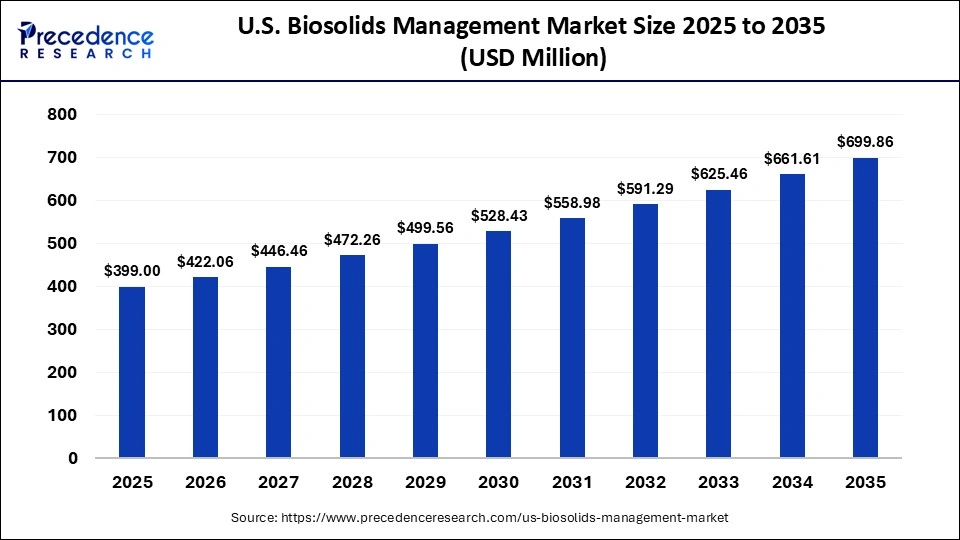
U.S. Biosolids Management Market Statical Scope
| Reports Attributes | Statistics |
| Market Size in 2025 | USD 399 Million |
| Market Size in 2026 | USD 422.06 Million |
| Market Size by 2035 | USD 699.86 Million |
| CAGR 2026 to 2035 | 5.78% |
| Base Year | 2025 |
| Forecast Period | 2026 to 2035 |
The U.S. biosolids market is both environmental and economic, supported by over 15,000 publicly owned treatment facilities that produce millions of dry metric tons of treated sewage sludge each year. Its significance lies in managing urban waste, generating renewable energy, and providing essential nutrients for agriculture. Biosolids serve as effective, eco-friendly fertilizers and soil conditioners that reduce dependence on commercial nitrogen, improve soil moisture retention, and supply important micronutrients.
Advanced wastewater treatment plants use anaerobic digestion to process biosolids, producing biogas and assisting municipalities in meeting green energy and sustainability goals. Proper processing and disposal are crucial for public health, preventing the buildup of untreated sewage, and complying with strict federal regulations such as EPA Part 503.
U.S. Biosolids Management Market, By Process/Treatment Method, 2025
| Segments | Shares (%) |
| Anaerobic Digestion | 22.40% |
| Aerobic Digestion (including Heat Drying) | 16.80% |
| Composting | 15.30% |
| Land Application | 19.70% |
| Incineration/Thermal Treatment | 11.40% |
| Landfilling | 6.80% |
| Nutrient Removal/Recovery | 7.60% |
- Anaerobic Digestion - Anaerobic digestion (AD), with a share of 22.40% in 2025, is leading the U.S. biosolids market as it changes sewage sludge from a disposal problem into a useful resource. By breaking down organic waste without oxygen, AD allows for renewable energy production (biogas/RNG), decreases the volume of biosolids, and creates nutrient-rich digestate for agricultural fertilizer.
- Aerobic Digestion (including heat drying) - Aerobic digestion and heat drying, with a share of 16.80% in 2025, play a key role in the U.S. market as they produce high-quality, stable Class A biosolids. This method significantly reduces waste volume and transportation expenses. Importantly, it converts sludge into a marketable, pathogen-free fertilizer that is easy to handle and perfect for agricultural and commercial reuse.
- Composting - Composting, with a share of 15.30% in 2025, is crucial in the U.S. Biosolids Management Market as it turns treated wastewater sludge into Class A organic soil amendments. This method diverts waste from landfills, naturally removes pathogens, and supports the circular economy by replenishing depleted soil with vital nutrients.
U.S. Biosolids Management Market, By Product Type/Quality, 2025
| Segments | Shares (%) |
| Class A (Pathogen-Free, Safe for Unrestricted Use) | 34.80% |
| Class A EQ (Exceptional Quality) | 24.60% |
| Class B (Less Stringent, Limited-Use) | 31.70% |
| Class AB/Intermediate | 8.90% |
- Class A (pathogen-free, safe for unrestricted use) - Class A biosolids, with a share of 34.80% in 2025, dominate the U.S. market as they are treated to eliminate pathogens, complying with strict EPA Part 503 standards for unrestricted use. This flexibility allows them to be sold commercially as bagged fertilizers or soil conditioners for residential lawns and public areas, generating significant revenue compared to restricted Class B options.
- Class A EQ (Exceptional Quality) - The Class A EQ (Exceptional Quality) segment, with a share of 24.60% in 2025, is one of the most regulated levels of treated wastewater sludge in the U.S. Biosolids Market. It is important as it meets strict pathogen reduction and low pollutant limits, permitting unrestricted public contact, agricultural use, and retail sales without the strict permits needed for lower-grade alternatives.
U.S. Biosolids Management Market, By Application, 2025
| Segments | Shares (%) |
| Agricultural Land Application | 46.20% |
| Non-Agricultural Land Application (e.g., Landscaping, Forestry, Land Reclamation) | 21.80% |
| Energy Recovery (Biogas Production, Heat/Energy Generation) | 19.40% |
| Other Uses (e.g., Compost, Industrial) | 12.60% |
- Agricultural Land Application - The agricultural land application segment, with a share of 46.20% in 2025, dominates the U.S. biosolids management market, fueled by the vast area of U.S. farmland and regulatory changes against ocean dumping. It offers significant economic, environmental, and agricultural benefits.
- Non-Agricultural Land Application (e.g., landscaping, forestry, land reclamation) - The Non-Agricultural Land Application segment, with a share of 21.80% in 2025, plays a crucial role in the U.S. Biosolids Management Market as it provides a necessary and scalable solution for municipal wastewater solids, helping to keep waste out of landfills while also improving soil and preventing erosion on barren or degraded lands.
U.S. Biosolids Management Market, By End-User, 2025
| Segments | Shares (%) |
| Municipalities (Wastewater Authorities) | 51.60% |
| Industrial Facilities (e.g., Food Processing, Manufacturing) | 18.70% |
| Farmers/Agricultural Businesses | 20.90% |
| Landscapers/Land Restoration Entities | 8.80% |
- Municipalities (wastewater authorities) - The municipalities and wastewater authorities segment, with a share of 51.60% in 2025, is the leading driver of the U.S. biosolids management market. Local governments and utilities manage the ongoing, large-scale production and disposal of sewage sludge, which drives the demand for treatment technologies and beneficial reuse in the industry.
- Industrial Facilities (e.g., food processing, manufacturing) - The industrial facilities segment, with a share of 18.70% in 2025, is the fastest-growing in the U.S. biosolids management market. It is crucial due to the strict regulatory requirements faced by manufacturing plants, the need for specialized dewatering technologies, and the consistent production of large volumes of organic sludge from the food and beverage industries.
Competitive Landscape
The U.S. biosolids management market is a well-established and strictly regulated industry that is moving towards resource recovery, renewable energy production, and PFAS reduction. Major companies lead the market by providing comprehensive services, including wastewater treatment, thermal hydrolysis, land application, and the production of commercial fertilizers.
- Synagro Technologies is the largest biosolids management company in the U.S. They provide services such as residuals management, transportation, composting, land application, and product marketing, including Synagro Granulite fertilizer pellets.
- Casella Waste Systems, Inc. operates mainly in the Northeast, focusing on zero-waste solutions, organics recycling, and agricultural land application programs.
- Denali Water Solutions specializes in beneficial reuse, offering services like liquid residuals management, dewatering, composting, and land application for farms.
- BCR Environmental is a technology licensor that offers patented treatment systems, such as CleanB and Neutralizer, which transform wastewater solids into Class A/EQ (Exceptional Quality) biosolids without using traditional energy-heavy digestion methods.
- Lystek International delivers proprietary thermal hydrolysis systems and patented technologies, including the Lystek THydro process, which turn biosolids into valuable biofertilizers and biogas.
- Cambi ASA is a leading global provider of Thermal Hydrolysis Process (THP) technology in the U.S., which pre-treats sludge to enhance biogas production and create Class A biosolids.
Segments Covered in the Report
By Process/Treatment Method
- Anaerobic Digestion
- Aerobic Digestion (including Heat Drying)
- Composting
- Land Application
- Incineration/Thermal Treatment
- Landfilling
- Nutrient Removal/Recovery
By Product Type/Quality
- Class A (Pathogen-Free, Safe for Unrestricted Use)
- Class A EQ (Exceptional Quality)
- Class B (Less Stringent, Limited-Use)
- Class AB/Intermediate
By Application
- Agricultural Land Application
- Non-Agricultural Land Application
- Energy Recovery
- Other Uses
By End-User
- Municipalities (Wastewater Authorities)
- Industrial Facilities
- Farmers/Agricultural Businesses
- Landscapers/Land Restoration Entities
For inquiries regarding discounts, bulk purchases, or customization requests, please contact us at sales@precedenceresearch.com
Frequently Asked Questions





Ask For Sample
No cookie-cutter, only authentic analysis – take the 1st step to become a Precedence Research client
 Get a Sample




 sales@precedenceresearch.com
 Schedule a Meeting
