U.S. Electric Vehicle (EV) Charging Station Market Size, Share and Trends 2026 to 2035
U.S. Electric Vehicle (EV) Charging Station Market (By Level of Charging: Level 1, Level 2, and Level 3; By Charging Station Type: AC Charging, DC Charging, and Wireless Charging; By Power Output: <11KW, 11KW–50KW, and 50KW; By Vehicle Type: Passenger Cars, Battery Electric Vehicle (BEV), Plug-in Hybrid Vehicle (PHEV), Heavy Commercial Vehicles, Light Commercial Vehicles, and Two-wheelers & Scooters; By Installation Type: Fixed, Portable, Residential, and Commercial; By Connector Type: Normal Charging, Type 2, CCS, CHAdeMO, Tesla SC, and GB/T; By Application: Private and Public; By Mounting Type: Wall Mount, Pedestal Mount, and Ceiling Mount; By Charging Service: EV Charging Service and Battery Swapping Service; By End User: Commercial EV Charging Stations and Residential EV Charging Stations) Industry Size, Share, Growth, Trends 2025-2035
 Get a Sample
 Table Of Content


The U.S. electric vehicle (EV) charging station market size is calculated at USD 22.52 Billion in 2025 and is predicted to attain around USD 190.45 Billion by 2035, expanding at a CAGR of 23.8% from 2026 to 2035. The Market is driven by the growing adoption of EVs by consumers and businesses, significant federal and state incentives, and the need to reduce "range anxiety".
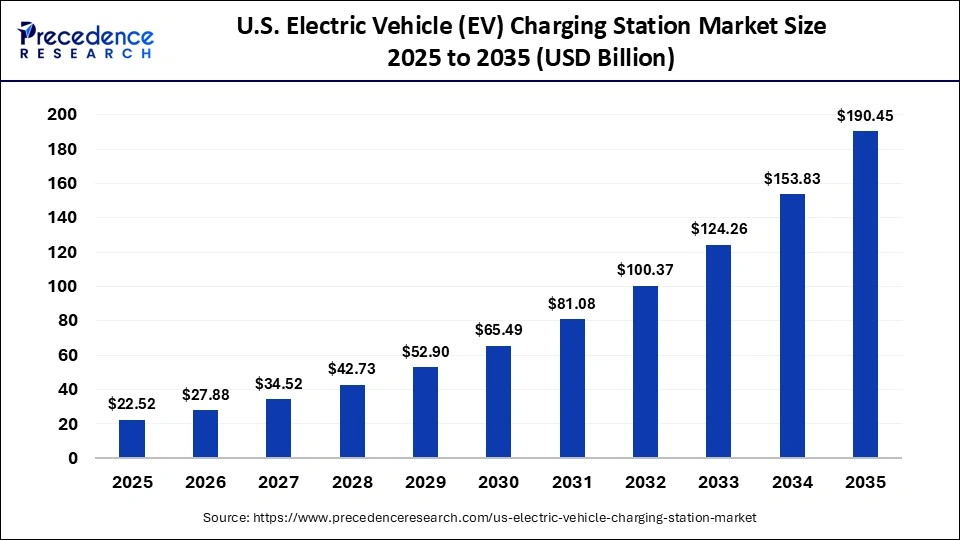
U.S. Electric Vehicle (EV) Charging Station Market Statical Scope
| Reports Attributes | Statistics |
| Market Size in 2025 | USD 22.52 Billion |
| Market Size in 2026 | USD 27.88 Billion |
| Market Size by 2035 | USD 190.45 Billion |
| CAGR 2026 to 2035 | 23.8% |
| Base Year | 2025 |
| Forecast Period | 2026 to 2035 |
The market is essential as it addresses "range anxiety", promotes widespread EV adoption, and helps in the transition to a clean energy economy. A strong, publicly available charging network is crucial for making zero-emission travel feasible for long trips and everyday use. Tackling the issue of charging availability helps alleviate range anxiety and encourages potential buyers to move from internal combustion engine (ICE) vehicles to EVs.
Additionally, the charging infrastructure sector serves as a major economic catalyst, driving investments in manufacturing, software development, and specialized installation jobs. Innovative "smart charging" and bi-directional technologies enable EVs to help stabilize the local electrical grid, store surplus renewable energy (like solar), and enhance energy resilience. Businesses, shopping centers, and local governments that install EV charging stations attract eco-conscious consumers and boost property values.
U.S. Electric Vehicle (EV) Charging Station Market, By Level of Charging, 2025 (%)
| Segments | Shares (%) |
| Level 1 | 12.80% |
| Level 2 | 56.90% |
| Level 3 | 30.30% |
- Level 1 - Level 1 charging, with a share of 12.80% in 2025, is essential in the U.S. market as it reduces entry barriers. By using regular household outlets, it enables apartment renters and budget-minded buyers to charge without costly panel upgrades. This is especially important for fleet operators and hybrid or smaller battery EVs that need local, overnight charging.
- Level 2 - Level 2 chargers (240V), with a share of 56.90% in 2025, play a dominant role in the U.S. EV market as they provide a good balance between charging speed and infrastructure costs. They add 12 to 80 miles of range per hour and are fundamental for residential, workplace, and public destination charging, meeting the daily needs of most EV drivers.
U.S. Electric Vehicle (EV) Charging Station Market, By Charging Station Type, 2025 (%)
| Segments | Shares (%) |
| AC Charging | 60.80% |
| DC Charging | 34.70% |
| Wireless Charging | 4.50% |
- AC Charging - The AC charging segment, with a share of 60.80% in 2025, mainly Level 1 (120V) and Level 2 (240V), leads the U.S. EV market. It is vital as it facilitates everyday "destination" and overnight charging at homes, workplaces, and retail locations, covering the majority of vehicle charging requirements.
- DC Charging - DC fast charging, with a share of 34.70% in 2025, is essential for widespread EV adoption in the U.S. It alleviates range anxiety during long trips and assists urban drivers who do not have private garages. By providing quick "refuels" similar to traditional gas stations, it makes EVs feasible for daily use and long-distance travel.
U.S. Electric Vehicle (EV) Charging Station Market, By Vehicle Type, 2025 (%)
| Segments | Shares (%) |
| Passenger Cars | 34.80% |
| Battery Electric Vehicle (BEV) | 26.70% |
| Plug-in Hybrid Vehicle (PHEV) | 13.20% |
| Heavy Commercial Vehicles | 7.90% |
| Light Commercial Vehicles | 9.40% |
| Two-wheelers & Scooters | 8.00% |
- Passenger Cars - The passenger car segment, with a share of 34.80% in 2025, is the leading force of the U.S. EV charging station market, generating the highest consumer volume and usage rates. Since personal vehicles need frequent and widespread charging across various residential, commercial, and highway sites, they are the main driver for nationwide infrastructure investments.
- Battery Electric Vehicle (BEV) - The Battery Electric Vehicle (BEV) segment, with a share of 26.70% in 2025, is a key player in the U.S. EV charging market. As BEVs operate solely on electricity and do not have backup combustion engines, they depend entirely on public and private chargers, making them the crucial source of revenue for the charging infrastructure industry.
U.S. Electric Vehicle (EV) Charging Station Market, By Application, 2025 (%)
| Segments | Shares (%) |
| Private | 46.80% |
| Public | 53.20% |
- Private - The private EV charging sector, with a share of 46.80% in 2025, which includes home, workplace, and fleet depots, is crucial to the U.S. market. This segment reduces dependence on public infrastructure, alleviates "range anxiety," and facilitates the logistics needed for electrifying corporate fleets.
- Public - The public charging sector, with a share of 53.20% in 2025, plays a dominant role in the U.S. EV market by addressing range anxiety, offering necessary infrastructure for millions of Americans who lack private garages or driveways, and enabling long-distance travel through fast-charging corridors on highways.
U.S. Electric Vehicle (EV) Charging Station Market, By End User, 2025 (%)
| Segments | Shares (%) |
| Commercial EV Charging Stations | 61.70% |
| Residential EV Charging Stations | 38.30% |
- Commercial EV Charging Stations - The commercial EV charging sector, with a share of 61.70% in 2025, leads the U.S. market as it helps eliminate range anxiety for long trips, supports commercial fleets like delivery and ride-sharing, and provides charging options for urban renters. It generates most of the market revenue, paving the way for profitable Charging-as-a-Service (CaaS) business models and attracting significant federal funding.
- Residential EV Charging Stations - The residential EV charging segment, with a share of 38.30% in 2025, is fundamental to EV adoption in the U.S. Since most EV owners prefer to charge their vehicles overnight at home, residential charging hardware constitutes the highest number of installed chargers, acting as a key driver for the widespread acceptance of passenger electric vehicles.
Competitive Landscape
The U.S. EV charging market is driven by control of the ecosystem, hardware innovation, and software platforms. Key players compete using subscription models, smart energy management, and public-private partnerships supported by federal programs like the NEVI Formula Program.
- Tesla, Inc. runs the leading Supercharger network, providing high-speed proprietary charging for Tesla vehicles and is working to allow access for other automakers through the NACS (North American Charging Standard).
- ChargePoint offers both hardware and software solutions and operates one of the largest open EV charging networks globally, serving public, fleet, and residential needs.
- Electrify America, created from the Volkswagen settlement, has one of the largest ultra-fast DC public networks in the U.S., aimed at cross-country highway routes.
- EVgo focuses on fast DC charging (up to 350 kW) in urban areas and collaborates extensively with retail chains and grocery stores.
- Blink Charging provides a variety of EV charging equipment and cloud-based software for commercial, residential, and municipal uses.
- ABB and Siemens are industrial hardware leaders supplying heavy-duty, ultra-fast DC charging equipment, energy storage solutions, and smart grid integration.
- BP Pulse and Shell Recharge are major oil and energy companies making significant investments in ultra-fast corridor charging and expanding into fleet management software.
Segments Covered in the Report
By Level of Charging
- Level 1
- Level 2
- Level 3
By Charging Station Type
- AC Charging
- DC Charging
- Wireless Charging
By Power Output
- <11KW
- 11KW–50KW
- 50KW
By Vehicle Type
- Passenger Cars
- Battery Electric Vehicle (BEV)
- Plug-in Hybrid Vehicle (PHEV)
- Heavy Commercial Vehicles
- Light Commercial Vehicles
- Two-wheelers & Scooters
By Installation Type
- Fixed
- Portable
- Residential
- Commercial
By Connector Type
- Normal Charging
- Type 2
- CCS
- CHAdeMO
- Tesla SC
- GB/T
By Application
- Private
- Public
By Mounting Type
- Wall Mount
- Pedestal Mount
- Ceiling Mount
By Charging Service
- EV Charging Service
- Battery Swapping Service
- By End User
- Commercial EV Charging Stations
- Residential EV Charging Stations
For inquiries regarding discounts, bulk purchases, or customization requests, please contact us at sales@precedenceresearch.com
Frequently Asked Questions





Ask For Sample
No cookie-cutter, only authentic analysis – take the 1st step to become a Precedence Research client




 sales@precedenceresearch.com
 Schedule a Meeting