



U.S. Ethanol Market Size, Share and Trends 2026 to 2035
U.S. Ethanol Market (By Source: Grain-Based, Sugar & Molasses Based, and Second Generation; By Purity: Denatured and Undenatured; By Application: Fuel & Fuel Additives, Industrial Solvents, Beverages, Disinfectant, Personal Care, and Others) Industry Size, Share, Growth, Trends 2025-2035
 Get a Sample
 Table Of Content


The U.S. ethanol market size is calculated at USD 38.02 Billion in 2025 and is predicted to attain around USD 64.7 Billion by 2035, expanding at a CAGR of 5.46% from 2026 to 2035. The market is mainly driven by federal regulations such as the Renewable Fuel Standard (RFS), increasing international demand for exports, and its affordability as an octane-enhancing gasoline additive.
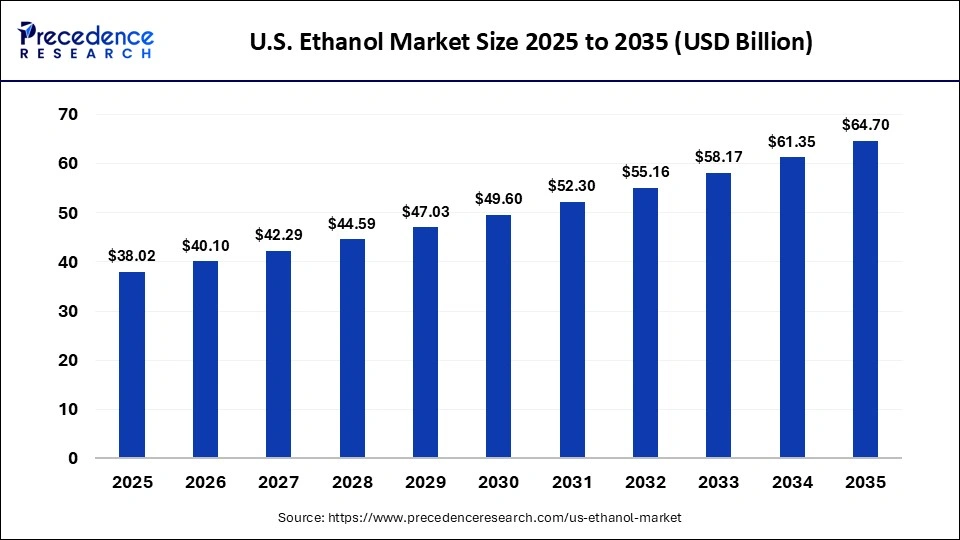
U.S. Ethanol Market Statical Scope
| Reports Attributes | Statistics |
| Market Size in 2025 | USD 38.02 Billion |
| Market Size in 2026 | USD 40.1 Billion |
| Market Size by 2035 | USD 64.7 Billion |
| CAGR 2026 to 2035 | 5.46% |
| Base Year | 2025 |
| Forecast Period | 2026 to 2035 |
The market is crucial globally as it supports agricultural stability, boosts national energy independence, and helps lower transportation emissions. It acts as a significant economic foundation, contributing billions to GDP and creating thousands of rural jobs while also providing nutritious animal feed by-products. By using about a third of the domestic corn harvest, the industry establishes a reliable, high-demand market that benefits U.S. farmers. As the largest global supplier, the U.S. replaces hundreds of millions of barrels of crude oil imports each year, protecting the domestic fuel supply from international political instability.
Ethanol is cleaner than regular petroleum, which reduces tailpipe emissions. The shift to low-carbon ethanol in the U.S., supported by carbon capture and storage (CCS) technology, is significantly boosting the sustainable aviation fuel (SAF) sector. The U.S. has been a net exporter of ethanol, achieving record export earnings by sending cleaner-burning fuel to more than 80 countries.
U.S. Ethanol Market, By Source, 2025 (%)
| Segments | Shares (%) |
| Grain-Based | 73.80% |
| Sugar & Molasses Based | 18.40% |
| Second Generation | 7.80% |
- Grain-Based - The grain-based segment, with a share of 73.80% in 2025, mainly led by corn, is dominating the U.S. ethanol market. It drives domestic fuel blending costs, supports the agricultural economy through animal feed byproducts, and positions the U.S. as a key global exporter.
- Sugar & Molasses Based - The sugar and molasses-based segment, with a share of 18.40% in 2025, plays a significant role in the U.S. ethanol market by offering cost-effective raw materials from sugar byproducts. It ensures sustainable production methods and helps producers adhere to low-carbon fuel standards while reducing greenhouse gas (GHG) emissions compared to traditional grain sources.
- Second Generation - The Second Generation (2G) segment, with a share of 7.80% in 2025, known for cellulosic ethanol, is crucial to the U.S. ethanol market as it addresses the "food vs. fuel" issue by utilizing non-food biomass such as agricultural residues, forestry waste, and energy crops instead of edible crops. This approach reduces greenhouse gas (GHG) emissions and helps in meeting regulatory requirements under the Renewable Fuel Standard (RFS).
U.S. Ethanol Market, By Purity, 2025 (%)
| Segments | Shares (%) |
| Denatured | 88.30% |
| Undenatured | 11.70% |
- Denatured - The denatured segment, with a share of 88.30% in 2025, leads the U.S. ethanol market as it helps the product to avoid high beverage alcohol excise taxes. By adding small amounts of denaturants (like hydrocarbons), the ethanol becomes unsuitable for human consumption, facilitating its widespread use in motor fuel blending, industrial solvents, and household cleaners.
- Undenatured - Undenatured ethanol (pure, unmixed alcohol), with a share of 11.70% in 2025, is vital in the U.S. market as it caters to highly regulated industries where additives are not allowed, such as pharmaceutical manufacturing, botanical extraction, and food and beverage production. Unlike denatured ethanol, it retains its complete purity, supporting specialized chemical and consumable applications.
U.S. Ethanol Market, By Application, 2025 (%)
| Segments | Shares (%) |
| Fuel & Fuel Additives | 69.60% |
| Industrial Solvents | 10.40% |
| Beverages | 5.80% |
| Others | 5.20% |
| Disinfectant | 5.10% |
| Personal Care | 3.90% |
- Fuel & Fuel Additives - The fuel and fuel additives segment, with a share of 69.60% in 2025, dominates the U.S. ethanol market as it provides stability and revenue for the industry. Ethanol serves as a key oxygenate and octane booster, enabling refiners to meet environmental regulations and achieve cleaner combustion.
- Industrial Solvents - The industrial solvents sector, with a share of 10.40% in 2025, plays a vital role in the U.S. ethanol market by decreasing dependence on fuel demand. It allows producers to comply with stringent environmental regulations, offers a profitable market for high-purity ethanol, and helps key manufacturing industries such as pharmaceuticals and personal care.
Competitive Landscape
The U.S. ethanol market is very consolidated, led by large agricultural companies and specialized biorefineries. These firms mainly produce fuel-grade ethanol but are increasingly moving towards specialty industrial alcohols, carbon capture, and Sustainable Aviation Fuel (SAF) to comply with changing renewable requirements.
- POET, LLC is the largest ethanol producer globally. POET runs nearly 30 bioprocessing facilities. They provide a range of products from standard fuel ethanol to high-purity industrial alcohols, corn oil, and animal feed.
- Archer Daniels Midland (ADM) is a major player in agriculture. ADM produces large quantities of fuel ethanol as well as food-grade and beverage-grade ethyl alcohol. Their range also includes industrial solvents, pharmaceutical-grade alcohols, and renewable chemical feedstocks.
- Valero Energy Corporation is one of the biggest petroleum refiners in the U.S. Valero operates over a dozen ethanol plants. They mainly offer high-octane fuel ethanol and distiller grains for animal nutrition.
- Green Plains Inc. With significant biorefineries in the Midwest, Green Plains provides high-protein feed ingredients, ultraclean industrial alcohols, and advanced biofuel technology aimed at reducing carbon intensity.
- Cargill, Incorporated is a global food and agriculture company. Cargill offers both industrial and fuel-grade ethanol, backed by their extensive grain processing and commodities trading operations.
- Marquis Energy operates large single-site production facilities. Marquis primarily focuses on anhydrous fuel-grade ethanol and high-quality distiller grains.
- The Andersons, Inc. A significant agricultural company with several ethanol joint ventures, providing bulk fuel ethanol, corn oil, and livestock feed.
Segments Covered in the Report
By Source
- Grain-Based
- Sugar & Molasses Based
- Second Generation
By Purity
- Denatured
- Undenatured
By Application
- Fuel & Fuel Additives
- Industrial Solvents
- Beverages
- Disinfectant
- Personal Care
- Others
For inquiries regarding discounts, bulk purchases, or customization requests, please contact us at sales@precedenceresearch.com
Frequently Asked Questions
Tags





Ask For Sample
No cookie-cutter, only authentic analysis – take the 1st step to become a Precedence Research client




 sales@precedenceresearch.com
 Schedule a Meeting



