



U.S. Infant Incubator Market Size, Companies, Share, Patient Volume, Treatment Adoption Rates, Pricing Analysis, Regulatory Landscape, Competitive Positioning, and Demand Forecast
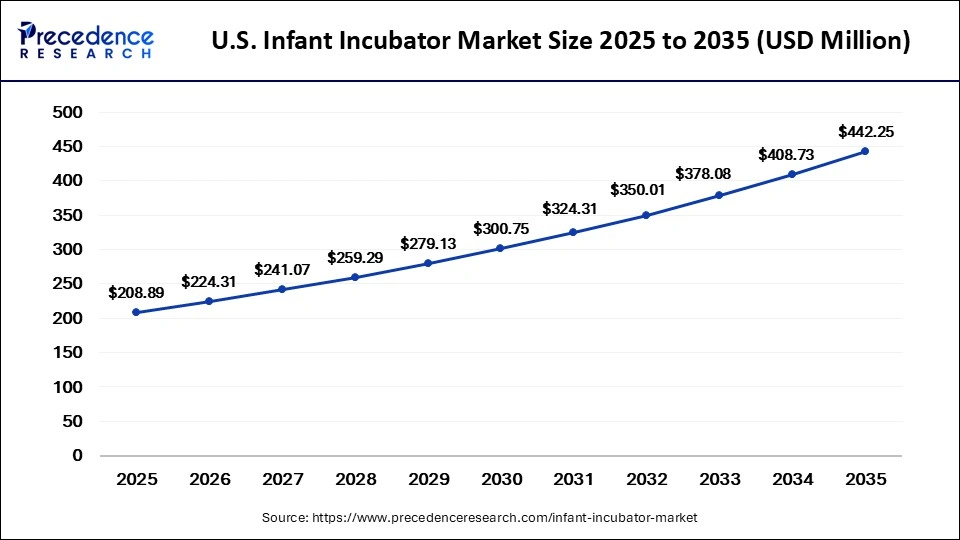
Rohan Patil, a Healthcare Industry Expert, highlights that the U.S. infant incubator market has reached USD 224.31 million in 2026 and is on track to reach USD 442.25 million by 2035, advancing at a CAGR of 7.79%. Key U.S. infant incubator market companies shaping the market include Cardinal Health, Dragerwerk AG & Co. KGaA, GE Healthcare, while major growth segments span By Product, By Application, By End User.
Source: https://www.precedenceresearch.com/us-infant-incubator-market
 Get a Sample
 Table Of Content


US Infant Incubator Market Size and Forecast 2026 to 2035
The US infant incubator market size accounted for USD 208.89 million in 2025 and is predicted to increase from USD 224.31 million in 2026 to approximately USD 442.25 million by 2035, expanding at a CAGR of 7.79% from 2026 to 2035. The market is driven by the rising prevalence of preterm births, increasing neonatal intensive care unit (NICU) admissions, advancements in neonatal care technologies, expanding healthcare infrastructure, and growing government investments in maternal and infant healthcare services.
Key Takeaways
- By product, the normal incubator segment dominated the market in 2025.
- By product, the transport incubator segment is likely to grow at a significant CAGR during the forecast period.
- By application, the neonatal hypothermia & low birth weight segment held the largest share of the market in 2025.
- By application, the jaundice segment is expected to grow with the highest CAGR during the forecast period.
- By end-user, the maternity & pediatric hospitals segment dominated the market in 2025.
- By end-user, the hospitals segment is expected to grow at a notable CAGR during the forecast period.
Market Overview
The U.S. infant incubator market is experiencing significant growth due to ongoing technological advancements in medical devices. The increasing mortality rate has prompted hospitals to deploy advanced incubators to provide advanced treatments. Governments of various regions are highly focused on strengthening the pediatric healthcare infrastructure. Several companies are rapidly investing in developing high-quality incubators for public hospitals, supporting market growth.
What is the role of AI in the U.S. Infant Incubator Market?
AI is transforming the U.S. infant incubator market by optimizing incubator microenvironments, predicting critical health events, and automating workflows to support overwhelmed clinical staff. Nowadays, smart incubators are equipped with IoT sensors, which can extract high-dimensional physiological data of respiration, heart rate, and oxygen saturation into AI models. Moreover, AI algorithms help in the detection of various diseases, including grading hypoxic-ischemic encephalopathy (HIE) from EEGs and screening for retinopathy of prematurity (ROP).
What are the Major Trends in the U.S. Infant Incubator Market?
- Partnerships: Various medical device brands are partnering with healthcare service providers to deploy incubators in hospitals.
- Investments: The private and public companies are investing significantly in developing smart incubators to deliver high-quality care to newborns.
- Establishment of New Neonatal Facilities: The U.S. government is largely focused on establishing neonatal facilities in different areas.
Market Report Coverage and Key Metrics
| Report Coverage | Details |
| Market Size in 2025 | USD 208.89 Billion |
| Market Size in 2026 | USD 224.31 Billion |
| Market Size by 2035 | USD 442.25 Billion |
| Market Growth Rate from 2026 to 2035 | CAGR of 7.79% |
| Base Year | 2025 |
| Forecast Period | 2026 to 2035 |
| Segments Covered | Product, Application, and End User |
Market Dynamics
Drivers
Expansion of the Medical Device Industry
The expansion of the medical device industry is driving the U.S. infant incubator market by accelerating the development and availability of advanced neonatal care equipment with enhanced monitoring, temperature regulation, and infection-control capabilities. Increased investments from medical device manufacturers, healthcare providers, and technology companies are supporting innovation in smart incubators that integrate sensors, connectivity, and real-time patient monitoring to improve neonatal outcomes. Additionally, collaborations between hospitals and medical device companies are facilitating the adoption of modern neonatal care technologies, increasing the deployment of infant incubators across neonatal intensive care units (NICUs) throughout the United States.
Restraint
High Production Cost and Supply-Chain Vulnerabilities
The market is facing numerous problems in its daily operations. Firstly, the cost of raw materials used in the manufacturing of incubators is growing significantly, which emphasizes the need for companies to increase the overall price of incubators to gain maximum profits, thereby restraining the market growth. Secondly, the supply-chain issues due to trade conflicts have also hampered the industry to some extent.
Opportunity
ML-based Incubators and Artificial Womb Technology
Key players are engaged in manufacturing next-generation incubators that are integrated with Machine Learning to analyze infant cries and predict care interventions. Also, the bioengineers are engaged in designing fluid-filled incubators to copy the natural, protective environment of the uterus to support micro-preterm infants. Thus, the rapid advancements in ML-enabled incubators and ongoing R&D of artificial womb technology are anticipated to create several opportunities for the market players in the coming years.
Market Segmentation Analysis
Product Insights
The Normal Incubator Segment Dominated the Market in 2025
The normal incubator segment dominated the U.S. infant incubator market by holding the largest share in 2025. This is due to the surging deployment of normal incubators in pediatrics units to provide a safe and stable environment for premature, low-birth-weight, and critically ill newborns. These incubators are capable of controlling humidity and temperature and protecting against infection. The leading manufacturers of normal incubators include Fisher & Paykel Healthcare, International Biomedical Ltd., and Drägerwerk AG & Co. KGaA.
The transport incubator segment is expected to grow at a significant CAGR during the forecast period. This is mainly due to its capability to prevent dangerous heat loss, shield the baby from vibrations, and provide continuous oxygen, ventilation, and vital-sign monitoring during transit. These incubators are installed in hospitals to safely move critically ill or premature newborns between various hospital departments. The top companies dealing in transport incubators include Novos Medical Systems, Fanem Ltd, and Pluss Advanced Technologies Pvt. Ltd.
Application Insights
What Made Neonatal Hypothermia & Low Birth Weight the Dominant Segment in the Market?
The neonatal hypothermia & low birth weight segment dominated the market in 2025. This is due to the environmental problems that result in low birth weight among the girl child in this nation. The healthcare centers are equipped with advanced incubators to provide high-quality treatment to patients suffering from neonatal hypothermia.
The jaundice segment is projected to grow at the highest CAGR during the forecast period. This is due to the increasing prevalence of jaundice among newborn boys across the U.S. The doctor prefers using transport incubators to treat jaundice, and modern hospitals are integrated with advanced facilities to enhance jaundice treatment.
End-User Insights
The Maternity & Pediatric Hospitals Segment Led the Market in 2025
The maternity & pediatric hospitals segment led the U.S. Infant Incubator Market in 2025 due to its central role in delivering specialized neonatal and maternal care services, including high-risk deliveries and intensive newborn care. These hospitals are equipped with advanced neonatal intensive care units (NICUs), where infant incubators are extensively used for temperature regulation, respiratory support, and infection control in preterm and critically ill infants.
The hospitals segment is likely to grow at the fastest CAGR during the forecast period. This is due to the increasing number of high-risk pregnancies and rising demand for advanced neonatal care services within hospital settings. Continuous expansion of neonatal intensive care units (NICUs), along with growing investments in hospital infrastructure and advanced medical technologies, is further accelerating the adoption of infant incubators.
State-Wise Analysis
- New York: The growing demand for advanced life-support systems from the pediatric units has increased the application of hybrid incubators. The leading brands of medical devices are investing rapidly in opening new production centers in New York. The tier-1 hospitals in New York include Mount Sinai and NYU Langone.
- Florida: Florida is one of the leading states in the market with a high number of preterm births, which increases the requirement for advanced incubators for crucial thermoregulation and providing essential respiratory support. Major hospital chains, including Central Florida's healthcare systems, are making significant investments to upgrade their neonatal units with cutting-edge convertible warmers and IoT-integrated smart systems to deliver superior care.
- California: The hospitals in California are deploying AI-enabled neonatal systems to support real-time tracking of a newborn. The investments made through the state health programs and private entities allow the pediatric units to deploy advanced neonatal care systems. Several startup brands are coming up with their incubators to support the local treatment facilities.
US Infant Incubator Market Value Chain Analysis
- Raw Materials Sourcing
The raw materials used in the manufacturing of infant incubators consist of metals, medical-grade plastics, and electronic components.
Key Companies: Sinopec, Dow Chemical, LyondellBasell.
- Clinical Trials and Regulatory Approvals
Clinical trials of infant incubators are essential to evaluate the safety, thermoregulation, and usability of new neonatal devices.
Key Companies: Intertek, FDA, and BSI Group America.
- Distribution Channel
Infant incubators are predominantly distributed by a proper supply chain that comprises direct sales to hospitals, regional medical equipment distributors, and online healthcare platforms.
Key Companies: GE Healthcare, Inspiration Healthcare Group plc., and Natus Medical Incorporated.
Market Competitive Landscape: Leading Companies and Strategies
The U.S. infant incubator market is highly consolidated, with leading companies holding more than 60% of the overall market share. Top companies operating in this market include Cardinal Health, Drägerwerk AG & Co. KGaA, GE Healthcare, Natus Medical Incorporated, Medtronic, BD, Vyaire, Utah Medical Products, Inc., Ambu A/S, Inspiration Healthcare Group plc, Atom Medical Corp, Fisher & Paykel Healthcare Limited, Masimo, and Phoenix Medical Systems (P) Ltd. These manufacturers are engaged in designing infant incubators and adopting various strategies, such as product launches and collaborations, to increase their dominance in the U.S.
- In February 2025, Cardinal Health opened a new distribution center in Fort Worth, Texas, U.S. This distribution center was established to deliver a wide range of medical devices to consumers in the U.S.
Top Companies Operating in the US Infant Incubator Market
- Cardinal Health
- Dragerwerk AG & Co. KGaA
- GE Healthcare
- Koninklijke Philips N.V
- Medtronic
- BD
- Vyaire
- Inspiration Healthcare Group plc.
- Atom Medical Corp
- Fisher & Paykel Healthcare Limited
- Masimo
- Phoenix Medical Systems (P) Ltd.
- Utah Medical Products, Inc.
- Ambu A/S
- Natus Medical Incorporated
Recent Developments US Infant Incubator Market (2025-2026)
- In April 2026, the Health Foundation of Central Massachusetts invested US$1.1 million. This investment was provided to Seven Hills Foundation for delivering superior childcare in the U.S.(Source: https://philanthropistsnotebook.com)
- In January 2026, MoM Incubators Limited announced that the FDA had approved the essential incubator. This incubator is designed to provide thermoregulation for premature babies across the U.S.(Source: https://finance.yahoo.com)
- In January 2026, HCA Florida St. Lucie Hospital opened a new state of the art Level II neonatal intensive care unit. This unit was established to deliver high-quality neonatal care in the U.S.(Source: https://www.hcafloridahealthcare.com)
Segments Covered in the Report
By Product
- Hybrid Incubator
- Normal Incubator
- Transport Incubator
By Application
- Neonatal Hypothermia & Low Birth Weight
- Jaundice
- Others
By End User
- Hospitals
- Maternity & Pediatric Hospitals
- Others
For inquiries regarding discounts, bulk purchases, or customization requests, please contact us at sales@precedenceresearch.com
Frequently Asked Questions
Tags





Ask For Sample
No cookie-cutter, only authentic analysis – take the 1st step to become a Precedence Research client
 Get a Sample




 sales@precedenceresearch.com
 Schedule a Meeting
