



U.S. K-Beauty Products Market Trends, Leading Companies, Company Revenue / Sales Performance, Retail Sales, Production Volume, Consumer Spending, Market Penetration, Competitive Landscape, and Industry Outlook
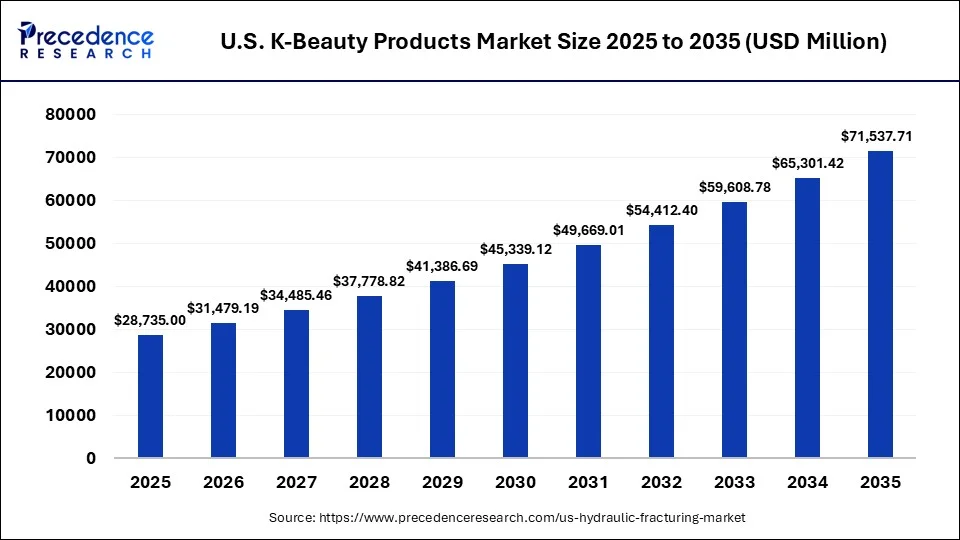
The U.S. K-Beauty products market was valued at nearly USD 31,479.19 million in 2026 and is projected to reach around USD 71,537.71 million by 2035, thus expanding at a CAGR of approximately 9.55%. Market growth is generally driven by rising consumer acceptance of Korean skincare, social-media-driven product discovery, strong demand for ingredient-led formulations, and expanding e-commerce and even specialty beauty distribution. Key trends beauty devices and multifunctional skincare. Further, the increasing mainstream retail penetration, premiumization, repeat purchases, and expansion into haircare, makeup, and device-enabled beauty are anticipated to create new opportunities for K-Beauty brands across the U.S. through 2035.
Source: https://www.precedenceresearch.com/us-k-beauty-products-market
 Get a Sample
 Table Of Content


U.S. K-Beauty Products Market Trends, Share, and Growth Analysis 2035
The U.S. K-beauty products market is forecasted to expand from USD 31,479.19 million in 2026 to USD 71,537.71 million by 2035, growing at a CAGR of 9.55% from 2026 to 2035.
 Key Takeaways
- U.S. K-Beauty has moved from a niche import category to a mainstream beauty segment, with rising household penetration and repeat purchasing.
- Skincare remains the dominant K-Beauty category in the U.S., accounting for the largest share of market revenue, while makeup, haircare, body care, and beauty devices are expanding the addressable opportunity.
- Growth is supported by both new customer acquisition and higher repeat consumption, rather than depending only on price increases. Household penetration, purchase frequency, premiumization, and channel expansion are all contributing to growth.
- Online channels remain central to K-Beauty discovery and sales, but physical retail is becoming increasingly important for availability, credibility, and repeat purchases.
- Social media and creator-led discovery play a major role in product adoption, particularly among Gen Z and Millennials. Hero ingredients and products can move from social discovery to online sales and eventually into physical retail.
- The market is expanding beyond traditional multi-step skincare routines, with opportunities emerging in cushion makeup, masks, hair treatments, body care, lip products, and at-home beauty devices.
- Hero products remain important for customer acquisition, but sustainable growth increasingly depends on repeat purchases and broader product portfolios.
- The competitive landscape is shifting from viral visibility toward durable market presence. Brands increasingly need strong products, distinctive ingredients, pricing discipline, reliable supply, retail access, and omnichannel execution.
- Leading and fast-growing brands identified in the report include Laneige, Anua, COSRX, Beauty of Joseon, Medicube, TIRTIR, and SKIN1004, with their momentum linked to digital visibility, hero products, repeat demand, and expanding distribution.
- Omnichannel expansion is becoming a major competitive requirement. Marketplaces and social commerce are effective for discovery and acquisition, while specialty beauty and mass retail can support broader reach and retention.
U.S. K-Beauty Has Grown from a Niche Import to a Mainstream, Online-Driven Category
K-Beauty is no longer a niche in the U.S. market. It is now a real growth driver for the beauty industry. The U.S. K-Beauty market was worth USD 31,479.19 million in 2026 and is estimated to reach about USD 71,537.71 million by 2035, thus growing at 9.55% CAGR per year from 2026 to 2035. Skincare accounts for about 73.4% of sales, and online channels make up about 57.1% of the broader market. The clearest sign of this change is how many households now use K-Beauty. In 2026, about 25% of households use Korean beauty products. Repeat purchases have also nearly doubled. In simple terms, users are no longer just trying K-Beauty out. They are making it part of their routine and buying it again.
Key Coverage
This report covers the U.S. K-beauty market from 2026 to 2035, with market size estimates and forecasts. It breaks the market down by product category, price tier, and sales channel, and looks at how many consumers buy, how usually they repurchase, and who they are by age and demographic group.
It also examines how dependent the U.S. is on Korean imports and how distribution economics work for brands selling. It tracks the shift from online-first brands to physical retail, ranks alongside benchmarks, leading brands against each other, and explains how regulations, tariffs, and local production could affect the market. Finally, it highlights untapped growth opportunities in skincare, haircare, makeup, and beauty devices.
Both New Shoppers and Higher Repeat Consumption Support Market Growth
The K-Beauty market is benefiting from a combination of new shopper adoption and higher repeat consumption. Growth is supported by rising household penetration, increasing product frequency, premiumization, and broader channel availability rather than relying solely on price increases. As consumers add more K-Beauty products to their routines, repeat purchases are also creating additional revenue opportunities across skincare, makeup, and other product categories.
U.S. retail sell-through data provides another indication of this momentum, with K-Beauty sales showing 38% year-over-year growth. Differences between this figure and other market estimates reflect variations in market definitions, including product scope, retail versus wholesale valuation, and channel coverage.
The report addresses these differences by applying a bottom-up market sizing framework that considers brand sales, imports, channel margins, retail sell-through, and category coverage. This approach provides a clearer view of the underlying market opportunity and separates actual consumption growth from differences created by market measurement methods.
Key Coverage
- New shopper adoption and repeat consumption as growth contributors.
- Revenue impact of premiumization and broader channel expansion.
- Retail sell-through versus wholesale/import market value.
- Regional and state-level market opportunities.
- Base, upside, and downside market scenarios.
- Revenue-to-volume bridge to distinguish consumption growth from price-led growth.
Which Beauty Segments Lead Growth and How are Makeup, Haircare and Beauty Devices Reshaping the Market?
Facial skincare is the main source of value, which includes cleansers, toners, moisturizers, serums, masks, and sun care. The same pattern shows up in Koreas overall cosmetics exports. Other categories made up the rest. In the U.S., demand is widening beyond the traditional 10-step skincare routine. Cushion foundations, masks, hair treatments, body care, lip products, and at-home beauty devices are all opening up new revenue opportunities for K-Beauty brands.
The full report breaks down demand by product, skin concern, price tier, ingredient, consumer age group, sales channel, retailer, gender, online platform, and region. It highlights both the biggest revenue categories and the fastest-growing subcategories.
Key Coverage
- Skincare, makeup, haircare, and body care.
- Cleansing, treatment, and moisturizing products.
- Sunscreen and functional skincare.
- Sheet masks and hydrogel masks.
- Cushion and lip makeup.
- Beauty devices and device-linked skincare.
- Mass, masstige, premium, and luxury price tiers.
How is Social Commerce Turning Korean Product Innovation Into Mainstream U.S. Demand?
The growth is being driven by four factors working simultaneously which are new and exciting products, discovery through social media, affordable prices, and repeat purchases. K-Beauty shoppers are about 42% more likely to try new beauty brands than the average consumer. They are also 28% more likely to live in higher-income households above USD 80,000 and 28% more likely to use TikTok.
This creates a clear pattern. A hero ingredient or product format gains attention via creators, which drives online searches. Moreover, it then sells quickly on online marketplaces and becomes a strong candidate for stores. There are also risks. Because new products are easy to find, they usually have short life cycles. Brands may depend heavily on discounts, face copycat products, and see their cost of acquiring customers rise.
Key Coverage
- K-culture and social media influence.
- Gen Z and Millennial adoption.
- Premium versus affordable positioning.
- Ingredient-led product discovery.
- Hero product economics.
- Repeat purchases and customer loyalty.
- Customer acquisition costs.
Tentative Leading Company Universe
| Company / Brand | Headquarters | Market Position | Core Strength |
| Amorepacific | Seoul | Global beauty leader | Broad multi-brand skincare portfolio |
| COSRX | Seoul | Digital skincare leader | Snail mucin and active-ingredient formulations |
| APR / Medicube | Seoul | High-growth challenger | Skincare devices and clinical-style skincare |
| LG Household & Health Care | Seoul | Diversified beauty leader | Premium and masstige beauty brands |
| Laneige | Seoul | Global premium brand | Hydration-focused skincare and sleeping masks |
| Sulwhasoo | Seoul | Luxury skincare leader | Premium herbal and heritage-based skincare |
| Beauty of Joseon | Seoul | Digital-native brand | Hanbang-inspired skincare |
| Anua / The Founders | Seoul | Fast-growing challenger | Heartleaf and sensitive-skin solutions |
| Goodai Global / SKIN1004 | Seoul | Emerging multi-brand player | Centella-based skincare |
| TIRTIR | Seoul | Fast-growing makeup brand | Cushion foundations and complexion products |
| CLIO Cosmetics | Seoul | Color-cosmetics leader | Makeup and color cosmetics |
| Able C&C | Seoul | Established beauty player | Mass-market skincare and makeup |
| TONYMOLY | Seoul | Accessible K-Beauty brand | Sheet masks and affordable skincare |
| Nature Republic | Seoul | Mass-market global brand | Natural-ingredient skincare |
| VT | Seoul | Innovation-focused brand | Reedle Shot and advanced skincare |
| Torriden | Seoul | High-growth specialist | Hydration and skin-barrier products |
| d'Alba Global | Seoul | Premium challenger | Facial mists and premium serums |
| Mediheal | Seoul | Mask-care specialist | Sheet and hydrogel masks |
| Round Lab | Seoul | Skincare specialist | Birch-based and barrier-support skincare |
| Mixsoon | Seoul | Indie digital challenger | Minimalist and single-ingredient formulations |
| Purito Seoul | Seoul | Clean-beauty specialist | Sensitive-skin and barrier-care products |
| Haruharu Wonder | Seoul | Ingredient-focused specialist | Fermented and sensitive-skin formulations |
| rom&nd | Seoul | Digital makeup leader | Lip products and color cosmetics |
| Olive Young | Seoul | Beauty retail ecosystem leader | K-Beauty retail, discovery, and distribution |
Competitive Dynamics Shaping the U.S. K-Beauty Market
The U.S. K-Beauty market is moving from a trend-based, online-first category to a larger, more mature market sold across many channels. As a result, repeat purchases, strong hero products, pricing power, retail access, and a broad brand portfolio matter more than ever. Skincare is still the biggest revenue source, but brands are also expanding into makeup, haircare, sun care, and even beauty devices. Online-first brands have shown that going viral can win customers quickly. Moreover, lasting U.S. market share now depends on turning that attention into repeat buyers, getting users to try more products, and securing space in physical stores.
Our analysis shows that success is shifting away from social media buzz alone. Winning brands will combine effective products, strong hero products, distinctive ingredients, smart pricing, a flexible supply chain, and then strong execution across online and in-store channels. Brands that turn online popularity into national retail presence can reach more users and rely less on any single marketplace or social platform. The market is expected to stay fragmented, with many brands competing. Moreover, larger players are likely to gain an edge in regulatory compliance, retailer negotiations, marketing efficiency, inventory availability, and new product launches, so the market will become more concentrated over time.
In our view, the key battleground is the change from a "viral brand" to a "lasting U.S. beauty platform." This favors brands with products that customers rebuy often, unique formulations, affordable premium pricing, and even an established U.S. distribution network. It puts more pressure on smaller brands that depend on just a few viral products. To identify leaders, emerging brands, challengers, and capability gaps, this report compares competitors on the following, such as U.S. revenue exposure, pricing, hero products, product and category mix, channel reach, digital visibility, product innovation, manufacturing capabilities, retail expansion, geographic reach, and recent strategic moves.
Which Customer and Channel Dynamics Will Determine How K-Beauty Brands Scale Across the U.S. Market?
U.S. K-Beauty purchasing is increasingly digital-first but omnichannel in execution, with e-commerce accounting for approximately 55-65% of category sales, depending on market definition and channel coverage. Furthermore, marketplaces and brand-owned digital channels remain vital for product discovery, while mass retail, drugstores, specialty beauty, and Korean or Asian beauty stores are becoming increasingly essential for physical availability and repeat purchasing. The strongest growth opportunities thus extend beyond acquiring online customers to rising repeat purchase, SKU penetration, basket size, and conversion from digital discovery into physical retail.
Our analysis indicates that channel economics are becoming as important as user awareness in determining competitive performance. Brands with strong hero products can generate rapid online need, but sustained scale demands broader distribution, appropriate price architecture, reliable inventory, and channel-specific product strategies. Our assessment is that Gen Z and Millennials will remain key discovery and adoption cohorts, while demand increasingly broadens across age groups and user needs, mainly in skincare, sun care, anti-aging, barrier repair, acne care, and ingredient-led products. This creates a measurable distinction between brands that generate short-term social engagement and those capable of building durable customer lifetime value.
The most significant implication is the demand to optimize the transition from “discovery channel” to “retention channel.” Marketplaces and social commerce can thus accelerate customer acquisition, while specialty beauty and mass retail can expand reach, enhance product visibility, and strengthen credibility; moreover, excessive dependence on a single channel can increase platform exposure, pricing pressure, and customer-acquisition costs. The greatest opportunity lies in integrated omnichannel models that coordinate pricing, hero-SKU availability, promotions, retailer placement, digital engagement, and repeat-purchase programs rather than treating each channel independently.
Which Brands are Capturing the Greatest Share of the U.S. K-Beauty Market and What Separates Market Leaders from Fast-Growing Challengers?
The U.S. K-Beauty market is still spread across many brands, but share is starting to concentrate among those with high online visibility, strong hero products, loyal repeat buyers, and growing U.S. distribution. In online sales, Laneige, Anua, COSRX, and Beauty of Joseon hold leading positions. Medicube, TIRTIR, SKIN1004, and other fast-rising brands are growing quickly via top-selling products and wider channel reach. In short, market share depends not just on how many products a brand sells, but on how well it turns demand for individual products into a lasting presence in the category.
The key difference between leaders and challengers is how well they turn online buzz into lasting market share. A strong hero product can quickly win visibility and new users, but staying at the top demands repeat purchases, disciplined pricing, new product lines, reliable stock, and a move into physical stores. We expect future market leaders to be brands that build several fast-selling product lines rather than depend on one viral product or ingredient trend.
Because of this, brands should be ranked on a broad set of measures, not just revenue or online visibility. This report compares brands on U.S. market share, e-commerce performance, estimated revenue, category share, product range, hero product strength, channel reach, retail expansion, pricing, innovation, customer retention, and even geographic reach. This approach assists us in identifying established leaders, emerging brands, high-growth challengers, and brands that are well known but have not yet reached comparable sales.
Which Technologies and Ingredient Innovations Will Define the Next Growth Cycle of the U.S. K-Beauty Market?
K-Beauty innovation is moving beyond basic hydration and brightening products. The focus is now on products built around active ingredients and then supported by technology. Key areas include PDRN (polynucleotides), fermented, peptides, and microbiome-friendly formulas, retinoids, barrier-repair products, centella-based soothing products, and at-home devices using LED, microcurrent, RF, and even EMS. Skincare, which makes up most K-Beauty demand, provides the biggest opportunity. Innovation here supports higher prices, clearer differentiation, and even repeat purchases, so brands depend less on short-lived trends to win new customers.
We believe the most valuable innovations will provide a clear consumer benefit, use a distinctive formulation approach, and then be easy to manufacture at scale. A new ingredient alone will not create a lasting advantage. Products must deliver proven results, fit into existing routines, stay reasonably priced, and even encourage repeat buying. We see PDRN, peptides, microbiome, advanced barrier care, fermented formulas, and device-linked skincare as the strongest candidates for the next cycle. They support premium pricing while meeting proven needs such as skin recovery, anti-aging, hydration, and firmness.
The strategic takeaway is a shift from selling single "new ingredients" to offering complete beauty solutions. Brands that pair effective actives with credible clinical claims, convenient formats, personalized routines, and even at-home devices can earn more revenue per customer and thus expand beyond traditional skincare. This creates room to build larger product ecosystems, but it also raises the significance of strong formulation skills, technology partnerships, regulatory readiness, intellectual property, and fast time to market.
Key Strategic Questions
- Which U.S. K-Beauty product categories will generate the highest incremental revenue through 2035, and what will drive their growth?
- Which skincare subcategories have the strongest combination of market size, growth rate, repeat purchase frequency, and pricing power?
- How will the revenue mix between skincare, makeup, haircare, body care, and beauty devices change through 2035?
- Which K-Beauty ingredients and product formats are moving from short-term trends to sustainable consumer demand?
- What role will PDRN, peptides, microbiome-focused formulations, fermented ingredients, and advanced barrier-care products play in future market growth?
- How much additional revenue can K-Beauty brands generate by expanding from skincare into makeup, haircare, body care, and beauty devices?
- Which consumer demographics offer the greatest untapped growth opportunity beyond Gen Z and Millennials?
- How are consumer purchase motivations changing from trend-driven discovery toward functional skincare and long-term beauty routines?
- Which price tiers will capture the strongest growth, and how will premiumization affect K-Beauty purchasing in the U.S.?
- How are K-Beauty brands balancing affordable-premium positioning with premium and luxury positioning in the U.S. market?
U.S. K-Beauty Products Market Segments
By Product Type
- Skincare
- Cleansers
- Toners
- Essences
- Serums & Ampoules
- Moisturizers & Creams
- Face Masks
- Sunscreen & Sun Care
- Eye Care
- Other Skincare
- Makeup
- Face Makeup
- Eye Makeup
- Lip Makeup
- Other Makeup
- Haircare
- Shampoos
- Conditioners
- Hair Treatments & Masks
- Scalp Care
- Styling Products
- Body Care
- Body Wash
- Body Lotions & Creams
- Exfoliators
- Hand & Foot Care
- Beauty Devices
- Facial Cleansing Devices
- LED Devices
- Microcurrent Devices
- RF/EMS Devices
- Other At-Home Beauty Devices
By Skincare Function
- Hydration & Moisturization
- Anti-Aging & Wrinkle Care
- Brightening & Pigmentation
- Acne & Blemish Care
- Skin Barrier Repair
- Soothing & Sensitive Skin
- Sun Protection
- Pore & Sebum Control
- Firming & Elasticity
- Other Skin Concerns
By Key Ingredient
- Hyaluronic Acid
- Snail Mucin
- Centella Asiatica
- Niacinamide
- Retinol/Retinoids
- Vitamin C
- Ceramides
- Peptides
- Probiotics/Fermented Ingredients
- PDRN/Polynucleotides
- Rice Extract
- Green Tea
- Other Ingredients
By Price Tier
- Mass
- Masstige / Affordable Premium
- Premium
- Luxury
By Product Format
- Creams & Lotions
- Gels
- Serums & Ampoules
- Essences
- Mists
- Sheet Masks
- Hydrogel Masks
- Cleansing Balms & Oils
- Sticks
- Cushions
- Patches
- Powders
- Other Formats
By Consumer Demographics
- Gen Z
- Millennials
- Generation X
- Baby Boomers
- Men
- Women
- Unisex
By Distribution Channel
- E-Commerce
- Brand-Owned Websites / DTC
- Online Marketplaces
- Social Commerce
- Offline
- Specialty Beauty Stores
- Drugstores & Pharmacies
- Mass Merchandisers
- Department Stores
- Korean/Asian Beauty Stores
- Other Retail
By Consumer Purchase Motivation
- Skincare Routine & Maintenance
- Anti-Aging
- Acne/Blemish Management
- Hydration
- Skin Brightening
- Clean/Ingredient-Conscious Beauty
- Trend/Social-Media Discovery
- Premium Beauty
- Korean Culture/K-Beauty Affinity
By Consumer Usage Frequency
- Daily-Use Products
- Weekly/Occasional Products
- Treatment/Course-Based Products
By Country
- Northeast
- Midwest
- South
- West
For inquiries regarding discounts, bulk purchases, or customization requests, please contact us at sales@precedenceresearch.com
Frequently Asked Questions
Tags





Ask For Sample
No cookie-cutter, only authentic analysis – take the 1st step to become a Precedence Research client
 Get a Sample




 sales@precedenceresearch.com
 Schedule a Meeting
