



U.S. Face Creams and Moisturizers Market Size, Key Companies, Company Product Portfolio, Manufacturing Output, Sales Performance, Cost Structure, Distribution Channels, Company Market Share, and Competitive Landscape
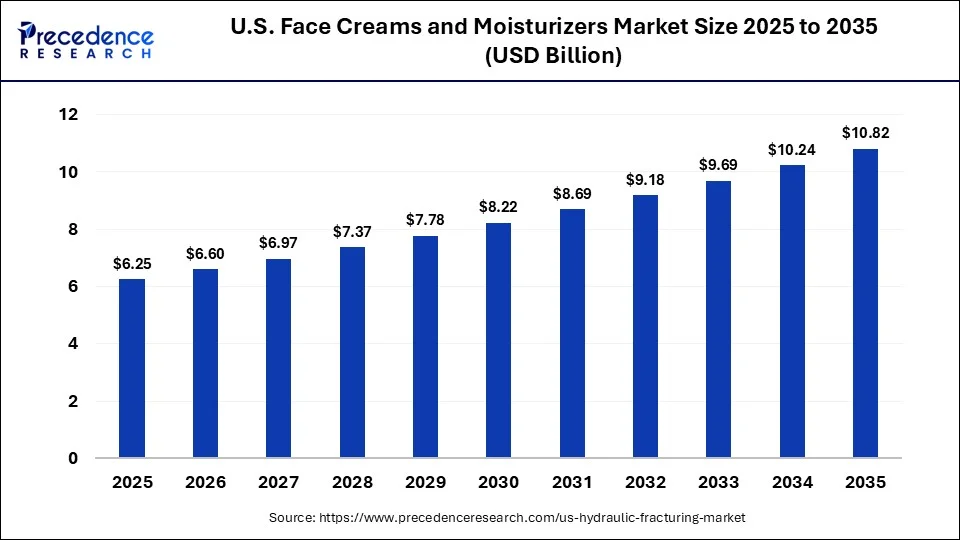
The U.S. face creams and moisturizers market reached USD 6.60 billion in 2026. Factors contributing to growth include increased awareness of skin care, preference for natural ingredients, and proliferation of personalization. The report is curated by Senior Research Analyst, Vidyesh Swar, and is of significance to stakeholders engaged in the face creams & moisturizers value chain, including manufacturers of products, contract manufacturers, raw material providers, ingredient innovators, and distributors.
Source: https://www.precedenceresearch.com/us-face-creams-and-moisturizers-market
 Get a Sample
 Table Of Content


U.S. Fae Creams and Moisturizers Market Size, Share, Trends, and Growth Forecast 2035
The U.S. face creams and moisturizers market is forecasted to expand from USD 6.60 billion in 2026 to USD 10.82 billion by 2035, growing at a CAGR of 5.64% from 2026 to 2035.
Key Takeaways
- The U.S. face creams and moisturizers market is a mature but resilient category, supported by frequent product replenishment, a broad consumer base, premiumization, and growing demand for skincare products with specific functional benefits.
- Face cream remains the leading product segment, but consumer preference is gradually shifting toward lighter facial moisturizers that offer hydration, skin penetration, and multifunctional benefits.
- Value remains central to purchasing decisions. Mass/economy products accounted for 58.4% of the market in 2025, while masstige products are emerging as a strong middle ground by combining premium ingredients, clinical claims, and accessible pricing.
- Product differentiation is increasingly tied to efficacy rather than price alone. Consumers are showing stronger interest in ingredients such as ceramides, hyaluronic acid, niacinamide, peptides, and antioxidants, particularly when these ingredients are linked to clear skin benefits.
- Multifunctionality is becoming an important growth lever. Products that combine hydration with barrier repair, anti-aging, brightening, acne care, or sensitivity management can address several consumer needs within a single routine.
- Competition is shifting from brand visibility toward proof and performance. Dermatological credibility, clinical substantiation, formulation technology, distribution strength, and consumer trust are becoming more important differentiators across mass, prestige, masstige, and digital-native brands.
- Omnichannel distribution remains critical. Offline channels accounted for 69.2% of the market in 2025, while e-commerce is gaining importance for product discovery, reviews, replenishment, and advertising.
- Innovation is moving beyond basic hydration. Retinoids, microbiome positioning, niacinamide, encapsulation technologies, gel-cream textures, and longer-lasting hydration are shaping formulation development.
The strongest white-space opportunities sit between clinical efficacy and affordability, particularly in barrier-repair products, multifunctional moisturizers, masstige formulations, men's skincare, personalized recommendations, sustainable packaging, and post-procedure skincare. - Future growth will depend on balancing effectiveness with accessibility. Persistent inflation and tariffs could increase trade-down behavior, while dermocosmetics, customized skincare, multifunctionality, and digital purchasing provide upside opportunities.
How is the U.S. Face Creams and Moisturizers Market Evolving?
The growth is fueled by increased purchasing frequency, premiumization, formulation customization, dermatologically-formulated positioning, and the evolution of moisturizers into multipurpose skincare.
The growth profile of the market indicates a mature and resilient consumer category rather than an emerging one. This can be attributed to a wider consumer base, shorter replenishment cycles, and premium pricing enabled by clinically backed ingredients.
Coverage Highlights
- CAGR & incremental revenue opportunity
- Growth contribution at product level
- Price tier scenarios
- Offline and online growth scenarios
- Base case, upside and downside cases
Segmentation Analysis
Which Product and End-User Segments Held the Largest Market Share in 2025?
In terms of product, face cream was the dominating product segment in the face creams and moisturizers market in the U.S. in 2025 because of the fact that it offers intensive healing and deep nourishment capabilities. But the face creams and moisturizers market is expected to experience a trend of switching over to facial moisturizers due to their better properties, including hydration, high skin penetration, and lightness.
In terms of ingredient, the synthetic formulations category held the market share of around 64.8% in 2025 due to their affordability and availability. This shows that conventional technology continues to dominate despite natural/clean label/bio-derivative positioning gaining visibility.
In terms of end-user, female consumers category held the largest market share in 2025 because of their awareness about the look of their skin, even though use of the product by males is growing. The estimation reveals that almost three-quarters of people, i.e., 74%, consider self-care and wellness in their beauty routine.
In terms of price tier, mass/economy products held the highest market share of 58.4% in 2025, highlighting the importance of value and affordability in addition to the premium and prestige products.
Currently, the best strategy is between the mass and the prestige categories. Masstige products provide premium ingredients, clinically driven claims, and great packaging at affordable prices.
Coverage Highlights
- By Product: Face Cream, Facial Moisturizer, Face Gel
- By Ingredient: Synthetic, Natural/Other
- By End User: Women, Men
- By Price Tier: Mass/Economy, Mid-Range, Premium
- By Distribution: Offline, Online
- By Function: Hydration, Barrier Repair, Anti-Aging, Brightening, Acne/Sensitivity, Multifunctional
- By Skin Type: Dry, Oily, Combination, Sensitive, Normal
- Largest, fastest-growing and emerging subsegments
What are the Major Growth Factors and Challenges of the U.S. Face Creams and Moisturizers Market?
However, there is no doubt that American consumers look for products to achieve certain skin results instead of hydration only, including ceramides, hyaluronic acid, niacinamide, peptides, antioxidants, and many other active substances. According to the recent survey report, around 67% of American purchasing females admitted that they purchased products with more than one functionality, and 89% of those customers who prefer multifunctional products considered moisturizers to be their first choice. Therefore, products with hydration, barrier reinforcement, anti-aging, brightening, and sensitivity-managing functionalities are expected to have high growth potential.
According to our analysis, this trend makes the value proposition of efficacy-based moisturizers more powerful. Indeed, the multifunctionality of skincare products is a critical factor as customers like to buy products that combine several steps in their routine. Besides, inflation and tariff-driven price pressure force consumers to think before making any purchases and compare mass, masstige, and prestige products. According to the 2025 research, only 14% of American beauty customers claimed that high price means high quality. Therefore, efficacy becomes even more important than the premium signalling through price increases.
From our perspective, the primary strategic implication is the battleground moving to “more efficacy per dollar”. Products that have proven capabilities through known ingredients, dermatologist-endorsed positioning, and effective performance claims will have a stronger hand in terms of defending price. Brand- or premium-price-driven differentiation creates value challenges.
The complete analysis takes into consideration the effects of ingredient-driven innovation, dermatologist-endorsed products, skin barrier positioning, multifunctional products, anti-aging trends, needs of sensitive and acne-prone skin, premiumization against trade-down dynamics, inflationary effect, and social commerce trends. In addition, the report differentiates between the trends that are expected to be enduring versus more transitory due to economic dynamics.
What is the Conclusion of the U.S. Face Creams and Moisturizers Market Pricing Analysis?
The pricing of face creams and moisturizers is influenced by the complexity of the formulation, concentration of the active ingredients, clinical proof, packaging, brand value, logistics costs, and positioning. The preference of the consumers lies with mass products; however, prestige products could command significantly higher ASPs if there is clinically relevant differentiation.
There are disruptive products entering the price battlefield, and they are masstige products that claim to be dermatologically tested and dermatologist-approved. This helps justify their slightly high pricing but still less than luxury skincare products.
Mass products have prices ranging between $2 and $35, whereas the prices of prestige products are from $30 to $100. Luxury/branded products have prices between $150 and $600.
Coverage Highlights
- ASP by product and price tier
- Mass versus masstige versus prestige pricing
- Price-per-ounce analysis
- Promotion and discount intensity
- Gross-margin economics
- Packaging and formulation cost drivers
- Retailer and distributor economics
- Price elasticity
- Premiumization and trade-down scenarios
What is the Value Chain and Channel Economics of the U.S. Face Creams and Moisturizers Market?
There is a high volume of formulation manufacturing, wide distribution of the products through retailers, and replenishment of products in this market. The entire value chain of U.S. face creams and moisturizers starts from research and development to formulation, manufacturing, brand marketing, distribution through retailers, and directly to consumers.
Offline channels had a share of 69.2% of the market in 2025 in the distribution channel. Digital commerce is becoming increasingly important for discovering products, product reviews, replenishment of products, and product advertising.
Beauty e-commerce sales saw an increase in 2025, reflecting the growth of digital commerce. Sephora.com had beauty sales worth USD 3.46 billion in 2025, while Ulta.com had beauty sales worth USD 2.46 billion.
Coverage Highlights
- Raw-material and packaging economics
- Formulation and contract manufacturing
- Brand-to-retailer economics
- Wholesale versus DTC margins
- Retailer markups
- E-commerce economics
- Inventory and replenishment
- Promotional intensity
- Supply-chain localization
- Import exposure and tariff sensitivity
Which Competitive Capabilities are Most Critical as Global, Dermocosmetic, Masstige, and Digital Native Brands Converge?
The highly fragmented competitive nature of the face creams & moisturizers market in the United States arises as a result of the presence of international mass brands, scientific dermocosmetics, luxury skincare companies, and digital-native brands in the market. The important competitive change is the breakdown of traditional channel barriers. Mass market brands are creating premium products with dermatologist endorsement. Luxury skincare brands are stressing efficacy and active ingredients, while masstige brands are positioning themselves between mass and luxury brands.
Our analysis shows that competitive differentiation is moving from simply brand visibility towards a proof-and-performance approach. Consumer messaging based on ceramides, hydration, skin barrier repair, retinoids, and peptides is increasingly serving as a proof of efficacy and relevance. Scientific credibility, high distribution frequency, consumer trust, discovery through digital channels, and pricing strategy need to be combined in order to be successful in the market.
Scale has become an inadequate strategy for ensuring competitive advantage. The luxury brands can provide a brand with the necessary distribution and investment power, however, masstige brands have the potential to combine portfolio, ingredients communication, social media presence, and lower prices.
The full report further benchmarks the competitive environment by strategic group, evaluates the positioning of leading players across mass, dermocosmetic, prestige, masstige, and digital-native models, and examines the capability gaps that could influence future market-share shifts.
Tentative Leading Company Universe
| Company | Headquarters | Market Position | Core Strength | Major Applications/Segments |
| L'Oréal | France | Global leader | Dermatological + mass + luxury skincare | Face creams, moisturizers, barrier care |
| Procter & Gamble | U.S. | Mass/premium leader | Olay and broad retail reach | Anti-aging, moisturization |
| Kenvue | U.S. | Consumer-health skincare leader | Neutrogena, Aveeno | Hydration, sensitive skin, derm care |
| Estée Lauder Companies | U.S. | Prestige leader | Clinique and premium skincare | Moisturizers, anti-aging |
| Beiersdorf | Germany | Skin-care specialist | NIVEA, Eucerin, Aquaphor | Mass and dermocosmetics |
| Unilever | U.K. | Global consumer leader | Broad personal-care portfolio | Moisturization, mass skincare |
| Shiseido | Japan | Prestige specialist | Shiseido, Drunk Elephant | Premium skincare |
| e.l.f. Beauty | U.S. | Fast-growth challenger | Accessible masstige | e.l.f. SKIN, Naturium, rhode |
| Galderma | Switzerland | Dermatology specialist | Cetaphil | Sensitive and barrier care |
| Kao | Japan | Global skincare player | Kao skincare portfolio | Moisturization and skin health |
| Amorepacific | South Korea | Asian skincare leader | Ingredient and K-beauty expertise | Hydration, premium skincare |
| LVMH | France | Luxury ecosystem | Premium beauty and Sephora | Prestige skincare |
| Clarins Group | France | Premium specialist | Botanical and anti-aging formulations | Premium moisturizers |
| Coty | U.S./France | Beauty portfolio player | Prestige and mass beauty | Skincare extensions |
| L'Occitane Group | Luxembourg | Premium natural specialist | Botanical positioning | Face care |
| RoC Skincare | U.S. | Dermatological specialist | Retinol/anti-aging | Anti-aging moisturizers |
| Edgewell Personal Care | U.S. | Consumer-care challenger | Skincare and personal care | Mass skincare |
| Vanicream / Pharmaceutical Specialties | U.S. | Sensitive-skin specialist | Fragrance-free formulations | Sensitive/dry skin |
| Revision Skincare | U.S. | Professional skincare specialist | Clinical positioning | Anti-aging and hydration |
| Colgate-Palmolive | U.S. | Consumer-health player | Skin-health exposure | Specialty skincare |
| Tatcha | U.S./Japan | Prestige niche | Ritual and premium skincare | Hydration and anti-aging |
| First Aid Beauty | U.S. | Sensitive-skin specialist | Barrier and sensitive care | Facial moisturizers |
| Dr. Jart+ / Estée Lauder ecosystem | South Korea/U.S. | K-beauty/derm hybrid | Barrier and treatment skincare | Creams and masks |
| The Honest Company | U.S. | Clean/consumer challenger | Clean-label positioning | Facial and sensitive skincare |
Why Scale Leaders and Fast-Growth Challengers Need Different KPIs?
Analysis of market share separates the scale of the category, growth rate, and strategic importance of the category. Parent Company's skincare revenues do not match the revenues of face moisturizers; thus, the competitive ranking has to consider product-level exposure wherever possible.
Beauty companies with various brands/products have scale advantage due to diversification. e.l.f. Beauty brought in USD 1.64 billion in revenues in FY26, which was 25% growth compared to FY25, whereas the revenues of its e.l.f. SKIN were USD 200 million in FY26. Naturium earned net revenues of about USD 250 million globally.
The consumer business of Beiersdorf made 8.18 billion in 2025. Its North America sales grew by 3.8%, and the leading products included Eucerin, Aquaphor, and Chantechille.
Coverage Highlights
- Estimated U.S. face-moisturizer market shares
- Top 5 and Top 10 competitive groups
- Brand-level versus parent-company exposure
- Revenue growth
- Share gain/loss
- Mass/masstige/prestige positioning
- Competitive concentration
- Emerging challenger ranking
What Does the Product Portfolio Benchmarking Implications of the U.S. Face Creams and Moisturizers Market?
Competitive product portfolios consist of basic moisturizers, luxurious creams, barrier repair creams, gel moisturizers, anti-aging products, sunscreen moisturizers, night creams, and hypoallergenic products. The best combinations are products that offer everyday replenishment together with value-added treatment-based formulas. There is growing demand for doctor-endorsed products. Some companies have started marketing their face moisturizers as skin care products along with beauty purposes.
What are the Innovations Fueling the U.S. Face Creams and Moisturizers Market?
Innovation in face creams and moisturizers is based on formulation science and delivery performance. Research and development activities are being conducted for the creation of innovative formulations with the help of retinoid, microbiome, niacinamide, and encapsulation technologies. Such products are anticipated to exhibit enhanced performance attributes like gel-cream texture and longevity of hydration. Rising numbers of product launches mean that formulation innovations are combined with consumer needs to create commercially viable products.
Complexity of formulation is an important factor, as basic hydration is of utmost importance. There is an emphasis on developing multifunctional products that not only address the needs of consumers but also enhance efficacy. Our belief is that formulation innovations that are characterized by functional performance, sensory performance, and clinical substantiation will definitely make an impression in the market.
Innovations that integrate functionality, delivery, and credibility are of utmost importance. Hence, the most important implication here is that brand leaders in the future would be those brands that can deliver innovation in the form of visible, credible, and consistent consumer benefits.
The deeper analysis evaluates the innovation landscape at the technology and formulation levels, including the type of active ingredients, encapsulation approaches, microbiome positioning, hydration-performance claims, and clinical validation.
What is the Potential Usage of the U.S. Face Creams and Moisturizers?
The target consumer for U.S. face creams & moisturizers are people having dry skin, sensitive skin, and skin that is prone to acne. Many consumers know about anti-aging products, ingredient-based products, and dermatological-based products. The male consumers are also aware of grooming, making their requirement for face creams & moisturizers. Consumers between the ages of 35 to 54 use most moisturizers, whereas younger consumers like lightweight and ingredient-based products.
What is the Geographic Landscape of the U.S. Face Creams and Moisturizers Market?
National companies have an inherent advantage of wide reach via pharmacies, mass retailers, beauty specialty stores, and e-commerce channels, offering them a structural advantage in terms of geographic reach and accessibility. The geographic competitive benchmark examines U.S. regional sales, geographic reach, penetration of e-commerce, and regional product launches.
Geographic competitive advantage is moving beyond physical reach and relying more on national presence and digitally driven geographic relevance. Physical presence in retail stores development of e-commerce, as well as specialty-beauty penetration allows brands to create demand in certain consumer clusters without having a physical reach similar to the incumbents. Our analysis shows that regional geographies can serve as white space opportunities and not as fragmented competitive environments.
Expanding strategies must balance geographic reach and local relevance to consumers. National brands will be able to benefit from their scale to drive availability and acquisition, while new entrants can focus on underpenetrated geographies, channels, or consumer groups before expansion.
More detailed analysis of the market includes regional sales contribution, retail reach, e-commerce reach, and regional launches of products.
Why is Omnichannel Availability Important for Competitiveness?
There was an increase of 23% in sales of Ulta's skincare and wellness products. This shows that the importance of skincare is increasing in specialty beauty retailers.
The entire report covers the following:
- Mass merchants
- Drugstores/pharmacies
- Beauty specialty
- Department stores
- Grocery/convenience
- Amazon and marketplaces
- Brand websites
- Social commerce
- Subscription/replenishment
- Dermatology/professional channels
Why is Portfolio Expansion Shifting to High-Growth Skincare Segments?
Major market players concentrate on acquiring high-growth brands, venturing into new adjacent skincare segments, and building premium capabilities. The e.l.f. portfolio is a good example of the challenger approach, where Naturium and Rhode have helped the company increase its presence in the skincare segment significantly. Apart from that, the introduction of J-beauty and K-beauty products creates a disruption in the regional market.
The analysis evaluates:
- Acquisitions
- Brand acquisitions
- Product launches
- Retail partnerships
- Licenses
- Dermatology partnerships
- Capability for manufacturing
- Expansion of digital products
- Geographical expansion
What is the Company Strategic Positioning Landscape of the U.S. Face Creams and Moisturizers Market?
The strategic segmentation of the market includes market leaders, technology/science leaders, growth leaders, and specialists. Market leaders build their strategies around scale, distribution, and a wide portfolio. Tech leaders build their strategy around dermatological credibility, clinical evidence, and formulation innovation. Growth leaders build their strategy around masstige and digitally native brands. Specialists build their strategy around products for sensitive skin, anti-aging, clean beauty, and professional skincare.
What Does the Regulatory Landscape of U.S. Face Creams & Moisturizers Say?
The U.S. FDA has developed the Modernization of Cosmetics Regulation Act (MoCRA). This act is concerned with adverse event reporting, facility registration, product listing, safety substantiation, and other requirements. Based on the product claims under which it is marketed, regulatory compliance is determined. The simple moisturizing ability, in addition to having the potential to modify the structure of skin and disease treatment, causes the product to change its regulatory classification. If it contains SPF, it also has OTC drug regulations.
Coverage Highlights
- MoCRA compliance
- Facility registration
- Product listing
- Safety substantiation
- Adverse-event reporting
- Ingredient restrictions
- Cosmetic vs. drug claims
- Regulatory requirements for SPF
- Sustainability of packaging
- Recyclability
- Transparency of ingredients
What is the White-Space Analysis of the U.S. Face Creams and Moisturizers Market?
The biggest white space opportunity exists between clinical efficacy and affordable prices. There are other white spaces in the market where unserved consumer segments, affordable clinical interventions, and sensory packaging exist. Some of the most lucrative white spaces include:
- Barrier-repair moisturizers for sensitive and compromised skin
- Multifunctional moisturizers that replace multiple routine steps
- Masstige formulations that combine premium formulations with affordable pricing
- Men's facial moisturizers for male grooming
- Personalized product recommendations using digital tools
- Refillable/sustainable packaging
- Post-procedure and aesthetic-treatment skincare
How do Brand Trust and Formulation Credibility Raise Entry Barriers?
| Force | Assessment | Strategic Interpretation |
| Supplier Power | Medium | Ingredients are broadly available, but specialized actives and packaging can create dependency |
| Buyer Power | High | Consumers can switch easily and compare thousands of products |
| New Entrants | Medium-High | Digital commerce lowers distribution barriers, but brand trust and compliance remain barriers |
| Substitutes | Medium | Serums, facial oils, masks, and hybrid products compete for skincare spend |
| Rivalry | High | Mass, prestige, dermocosmetic, masstige and indie brands compete simultaneously |
What is the PESTLE Analysis of the U.S. Face Creams and Moisturizers Market?
- Political: tariffs and policies can impact imported raw materials, packaging, and the final product.
- Economic: inflation makes promotion more sensitive and leads to trade-down trends.
- Social: skincare regimes have become complex for consumers, especially the young generation.
- Technological: digital skin evaluation, artificial intelligence advice, and social commerce enhance product discoverability.
- Legal: the MoCRA enhances legal compliance and claims scrutiny.
- Environmental: reducing packaging, recyclable materials, and ingredient sustainability play an important role in positioning brands.
What are the Future Opportunities of the U.S. Face Creams and Moisturizers Market?
The market trends point to further category growth fueled by growing skin care usage frequency, multifunctional offerings, and premiumization, according to the base case. In turn, the future of the market is vulnerable to macro factors, such as persistent inflation, tariffs' impact, and trade-down behavior of consumers preventing further premiumization and lowering the frequency of purchases. Rapid adoption of dermocosmetics, customized skincare, multifunctionality, and online purchasing creates upside potential for the market.
The next phase of growth for the face creams and moisturizers market will hinge upon the brand's ability to combine effectiveness with accessibility and customization. The availability of premium and mass products means that consumers are not abandoning expensive skincare products, but rather are being choosier about what benefits they are ready to pay for. Multifunctionality, dermatology, custom formulas, and digital purchasing can become a way to provide consumers with value while minimizing premiumization.
The most important implication is that the future competition will demand five competencies at once - dermatological credibility, high-frequency distribution, differentiation through formulation technology, value pricing, and digital consumer engagement. The upside case favors brands that successfully translate personalization, dermocosmetic positioning, and multifunctionality into scalable demand. The downside case highlights the risk of premium compression and lower purchase frequency if inflationary pressure persists.
The full outlook analysis further quantifies the base, upside, and downside growth scenarios, evaluates the contribution of routine skincare penetration, multifunctionality, premiumization, dermocosmetics, personalized skincare, and digital commerce, and assesses the potential impact of inflation, tariffs, trade-down behavior, and purchase-frequency changes. The report also benchmarks the strategic capabilities required to capture incremental growth and identifies the product, pricing, channel, and consumer-positioning opportunities most aligned with each scenario.
U.S. Fae Creams and Moisturizers Market Segments
By Product Type
- Face Creams
- Face Moisturizers
- Gel-Based Moisturizers
- Lotion-Based Moisturizers
- Emulsion-Based Moisturizers
- Balm/Ointment-Based Moisturizers
- Water-Based Moisturizers
By Skin Type
- Normal Skin
- Dry Skin
- Oily Skin
- Combination Skin
- Sensitive Skin
By Function
- Hydration
- Anti-Aging
- Skin-Barrier Repair
- Brightening
- Acne & Blemish Care
- Sun Protection
- Soothing & Sensitive-Skin Care
- Multifunctional
By Ingredient
- Hyaluronic Acid
- Ceramides
- Niacinamide
- Peptides
- Retinoids
- Antioxidants
- Botanical/Natural Ingredients
- Others
By Price Range
- Mass
- Masstige
- Premium
- Luxury
By Distribution Channel
- Supermarkets & Hypermarkets
- Pharmacies & Drugstores
- Specialty Beauty Stores
- Department Stores
- Convenience Stores
- Online/E-commerce
- Direct-to-Consumer (DTC)
- Dermatology Clinics & Medical Channels
By Consumer Age Group
- Gen Z
- Millennials
- Generation X
- Baby Boomers
- Seniors
By Formulation Positioning
- Conventional
- Dermatologist-Recommended
- Clean Beauty
- Natural/Organic
- Clinical/Science-Based
- Vegan/Cruelty-Free
- Multifunctional
By End User
- Women
- Men
- Unisex
By Country
- Northeast
- Midwest
- South
- West
For inquiries regarding discounts, bulk purchases, or customization requests, please contact us at sales@precedenceresearch.com
Frequently Asked Questions





Ask For Sample
No cookie-cutter, only authentic analysis – take the 1st step to become a Precedence Research client
 Get a Sample




 sales@precedenceresearch.com
 Schedule a Meeting
