



US Medical Devices Market Size, Companies, Share, Patient Volume, Treatment Adoption Rates, Pricing Analysis, Regulatory Landscape, Competitive Positioning, and Demand Forecast
US Medical Devices Market (By Product Type: Diagnostic Devices, Therapeutic Devices, Assistive and Rehabilitation Devices, Others; By End-User: Hospitals, Ambulatory Surgical Centers (ASCs), Diagnostic Centers, Home Healthcare Settings, Clinics, Long-term Care Facilities, Research and Academic Institutes; By Sales Channel: Direct Sales (Distributors & Dealers), Indirect Sales, Online Sales) - Industry Analysis, Size, Trends, Leading Companies, Regional Outlook, and Forecast 2026 to 2035
Source: https://www.precedenceresearch.com/us-medical-devices-market
 Get a Sample
 Table Of Content


US Medical Devices Market Size and Forecast 2026 to 2035
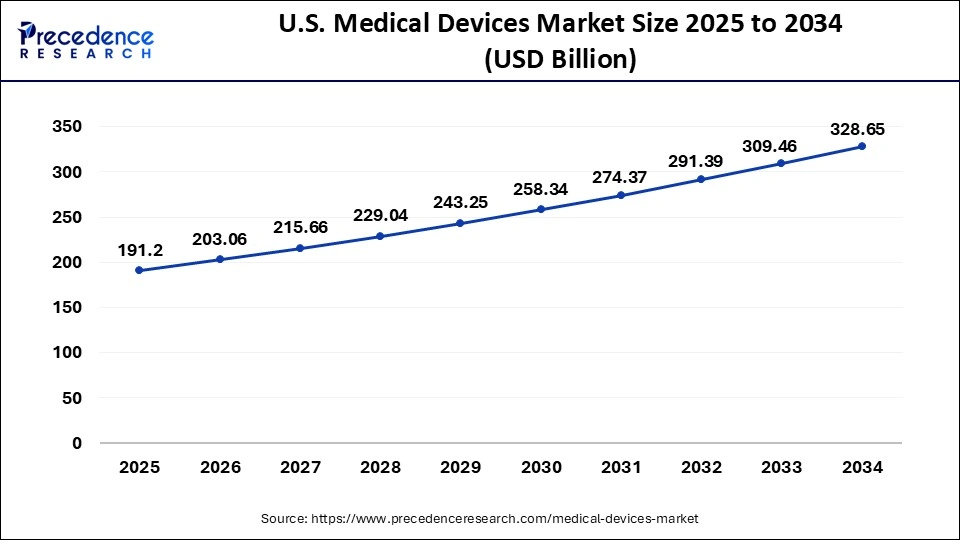
The US medical devices market size accounted for USD 191.20 billion in 2025 and is predicted to increase from USD 203.06 billion in 2026 to approximately USD 346.19 billion by 2035, expanding at a CAGR of 6.20% from 2026 to 2035. The market growth is attributed to increasing adoption of advanced medical technologies, expanding healthcare infrastructure, and continuous innovation in diagnostic and therapeutic devices.
Key Takeaways
- By product type, the therapeutic devices segment held the largest market share in 2025.
- By product type, the assistive and rehabilitation devices segment is expected to expand with the highest CAGR during the forecast period.
- By end-user, the hospitals segment held the largest market share in 2025.
- By end-user, the home healthcare settings segment is expected to grow with the fastest CAGR between 2026 and 2035.
- By sales channel, the direct sales segment dominated the market in 2025.
- By sales channel, the online sales segment is expected to grow with the highest CAGR during the forecast period.
Market Overview
The rising adoption of advanced medical devices is a key driver supporting growth in the U.S. medical devices market. Medical devices include diagnostic imaging systems, surgical robots, cardiovascular devices, platforms for patient monitoring, and software powered healthcare devices.
The technologies aid the clinician in accurately diagnosing patients, providing efficient workflow, and making more personalized treatment decisions. Furthermore, the rising healthcare expenditures continue to drive innovation and growth across the U.S. market.
Impact of Artificial Intelligence on the U.S. Medical Devices Market
The medical devices industry in the U.S. is undergoing a transformation driven by artificial intelligence (AI), with its applications significantly impacting the accuracy of diagnosis, clinical velocity, and patient results. The adoption of AI is steadily gaining momentum in the field of imaging systems, surgical robots, patient monitoring platforms, and diagnostic software, to name a few.
Cancer, cardiovascular diseases, and neurological diseases can be detected more efficiently with the help of AI-driven imaging technology. AI-powered devices are also being effectively used in the healthcare industry to streamline operations, minimize workloads, and aid in quicker decision-making regarding treatment.
Market Report Coverage and Key Metrics
| Report Coverage | Details |
| Market Size in 2025 | USD 191.20 Billion |
| Market Size in 2026 | USD 203.06 Billion |
| Market Size by 2035 | USD 346.19 Billion |
| Market Growth Rate from 2026 to 2035 | CAGR of 6.20% |
| Base Year | 2025 |
| Forecast Period | 2026 to 2035 |
| Segments Covered | Product, End User, and Sales Channel |
Market Dynamics
Drivers
Increasing Prevalence of Chronic Diseases and Age-Related Conditions
The increasing prevalence of chronic diseases and age-related conditions is anticipated to drive the market in the coming years. Need continuous diagnosis, monitoring, and treatment interventions are needed for cardiovascular disease, diabetes, cancer, respiratory disease, and orthopedic disease.
Device manufacturers are still in the process of creating less traumatic solutions that can make patients better and return to their routines faster. Strong demand for disease management technologies supports steady expansion across multiple medical device categories.
Restraint
Stringent Regulatory and Compliance Requirements
Stringent regulatory and compliance requirements are expected to increase product development timelines and commercialization costs, hindering the market. For small and medium-sized manufacturers, the challenge of dealing with changing compliance requirements can mean limited resources. Additionally, the ongoing supply chain vulnerabilities continue influencing procurement strategies and operational planning throughout the industry.
Opportunity
Surging Healthcare Expenditures and Hospital Technology Investments
Surging healthcare expenditures and hospital technology investments are estimated to create immense opportunities for the players competing in the market. This shift to clinical practice is aided by robotic surgical systems, next-generation endoscopy technology, navigation systems, and image-guided technology.
- According to the CMS 2026 report, National Health Expenditure (NHE) grew by 7.2% to USD 5.3 trillion in 2024, which is USD 15,474 per person, and accounted for 18.0% of the Gross Domestic Product (GDP).
Leading manufacturers such as Intuitive Surgical, Stryker, Johnson & Johnson MedTech, and Medtronic are still bringing new robotic platforms to the market. Furthermore, the trend of precision medicine and personalized healthcare is likely to increase demand for sophisticated medical technologies.
Market Segmentation Analysis
Product Type Insights
The Therapeutic Devices Segment Dominated the Market in 2025
The therapeutic devices segment dominated the U.S. medical devices market in 2025 due to the increasing utilization of devices designed to treat chronic and acute medical conditions. Investments in cardiovascular devices, orthopedic implants, surgical systems, infusion pumps, and respiratory care equipment were ongoing at hospitals and specialty centers. Consistent year-on-year demand for products throughout the year was driven by strong procedure volumes in cardiology, orthopedics, oncology, and neurology.
The assistive and rehabilitation devices segment is expected to grow at the fastest CAGR from 2026 to 2035, driven by an increasing demand for assistive and rehabilitation devices that facilitate mobility, independence, and functional recovery. The number of musculoskeletal disorders, neurological conditions, and post-surgical rehabilitation needs is increasing, and this is continuing to drive segment growth.
The Centers for Disease Control and Prevention estimates that more than 61 million adults in the United States have disabilities, supporting demand for mobility and assistive technologies.
End User Insights
The Hospitals Segment Dominated the Market in 2025
The hospitals segment led the U.S. medical devices market in 2025 due to the concentration of complex diagnostic, surgical, and therapeutic services within hospital systems. The American Hospital Association reported over 6,100 hospitals in the U.S. that treat millions of patients each year in hospital inpatient and outpatient care facilities. Additionally, the constant upgrading of facilities further strengthened the demand for complex medical devices and digital health platforms.
The home healthcare settings segment is expected to expand rapidly between 2026 and 2035, owing to the shift from conventional clinical settings to home settings. The increased uptake of digital health platforms further solidifies the use of digital health services through HHC settings.
Sales Channel Insights
The Direct Sales Segment Dominated the Market in 2025
The direct sales (distributors and dealers) segment held the largest U.S. medical devices market share in 2025 due to the extensive use of specialized distribution networks across healthcare facilities. Medical equipment purchasing was still being handled by designated hospitals or ambulatory surgical centres distributors. Medical equipment continued to be purchased by the hospital or ambulatory surgical centres, or designated distributors for physician practices.
The online sales segment is expected to grow at the highest CAGR between 2026 and 2035, driven by the rising usage of such platforms by HCPs. Healthcare organizations are increasingly continuing to grow their digital transformation efforts for technologies that facilitate technology-based procurement strategies.
U.S. Medical Devices Market: Country-Level Analysis
Why Did California Lead the Market?
The Californian market is driven by its high concentration of medical device manufacturers, research institutions, and healthcare technology companies. The state is home to hundreds of companies in the medical technology sector and hosts some of the largest operations of Abbott, Edwards Lifesciences, Intuitive Surgical, Hologic, Penumbra, and emerging medical technology innovators.
The state is home to over 400 hospitals and several of the nation's biggest healthcare systems, which means a huge rollout of medical devices. California's strength in industry development was reinforced by high research activity, high venture investment activity, and a vast healthcare infrastructure.
U.S. Medical Devices Market Value Chain Analysis
- Raw Material & Electronic Component Sourcing
Medical device production begins with medical-grade polymers, metals, semiconductors, sensors, and electronic components.
Key Players: DuPont, 3M, TE Connectivity, Amphenol, Texas Instruments, Analog Devices
- Component Manufacturing & Device Production
Manufacturers convert raw materials into diagnostic, therapeutic, monitoring, and surgical device components.
Key Players: Medtronic, Abbott, Boston Scientific, Stryker, Becton Dickinson (BD), Baxter International
- Device Assembly, Testing & Regulatory Compliance
Companies assemble finished devices and conduct quality, safety, sterilization, and regulatory validation processes.
Key Players: Philips, GE HealthCare, Siemens Healthineers, Edwards Lifesciences, Zimmer Biomet, Olympus Corporation
- Distribution to Healthcare Providers & End Users
Finished devices move through distributors and dealers to hospitals, clinics, laboratories, and home healthcare settings.
Key Players: Cardinal Health, McKesson, Owens & Minor, Medline Industries, Henry Schein, Cencora
Market Competitive Landscape: Leading Companies and Strategies
The U.S. medical devices market is moderately consolidated with global leaders and specialized innovators. Major companies include Medtronic, Abbott, Stryker, Boston Scientific, and GE HealthCare. These companies offer a wide portfolio of products, good clinical connections, and distribution systems. Competition continues to be fierce in cardiovascular imaging, orthopedic, surgical, monitoring, and other segments.
New challenges keep evolving in the competition landscape, including stringent global regulations, integrating complex software, and ensuring robust cybersecurity. Medtronic's Hugo platform program of ongoing expansion in 2025 helped advance capabilities in the field of robotic surgery. Future competition is expected to intensify as AI-enabled devices and software-driven technologies gain broader clinical adoption.
U.S. Medical Devices Market Companies
- Stryker
- Johnson & Johnson Services, Inc.
- Danaher
- Boston Scientific Corporation
- BD (Becton, Dickinson, and Company)
- Abbott
Recent Developments U.S. Medical Devices Market (2025-2026)
- In June 2026, Medtronic announced key milestones for its Hugo robotic-assisted surgery (RAS) system, submitting 510(k) clearances for general surgery, gynecologic surgery, and LigaSure RAS instruments. They completed enrollment in a Gynecology IDE clinical study and received clearance for ProGrip Advanced mesh for robotic-assisted hernia repair. (Source: https://news.medtronic.com)
- In June 2026, Johnson & Johnson announced a USD 1 billion investment in Jacksonville, Florida, to enhance its Vision operations. This includes building a new distribution facility and advancing manufacturing capacities for ACUVUE contact lenses, reinforcing their commitment to improving eye health for over 40 million patients globally. (Source: https://www.jnj.com)
Segments Covered in the Report
By Product Type
- Diagnostic Devices
- Imaging Devices
- X-ray
- MRI (Magnetic Resonance Imaging)
- CT (Computed Tomography)
- Ultrasound
- Nuclear Imaging (PET/SPECT)
- In-vitro Diagnostic (IVD) Devices
- Immunoassay Analyzers
- Clinical Chemistry Analyzers
- Hematology Analyzers
- Molecular Diagnostics
- Coagulation Analyzers
- Endoscopy Devices
- ECG/EKG Machines
- Patient Monitoring Devices
- Others
- Imaging Devices
- Therapeutic Devices
- Surgical Devices
- Electrosurgical Devices
- Powered Surgical Instruments
- Minimally Invasive Surgical Instruments
- Cardiovascular Devices
- Pacemakers
- Defibrillators
- Stents
- Catheters
- Orthopedic Devices
- Joint Reconstruction
- Trauma Fixation Devices
- Arthroscopy Devices
- Spinal Devices
- Respiratory Devices
- Ventilators
- Nebulizers
- CPAP/BiPAP Devices
- Dialysis Equipment
- Infusion Pumps
- Insulin Delivery Devices
- Others
- Surgical Devices
- Assistive and Rehabilitation Devices
- Hearing Aids
- Mobility Aids (Wheelchairs, Walkers, Prosthetics)
- Exoskeletons
- Robotic Rehabilitation Devices
- Others
- Others
- Disposable Medical Supplies (Syringes, Gloves, Bandages)
- Wearable Devices
- Smart Health Devices (IoT-enabled devices)
- Implantable Devices (Cochlear implants, Neurostimulators)
By End-User
- Hospitals
- Ambulatory Surgical Centers (ASCs)
- Diagnostic Centers
- Home Healthcare Settings
- Clinics
- Long-term Care Facilities
- Research and Academic Institutes
By Sales Channel
- Direct Sales (Distributors & Dealers)
- Indirect Sales
- Third Party Distributors
- Retail Pharmacies
- Online Sales
- Direct to Consumer Sales
- B2B E-commerce Platforms
- Others
For inquiries regarding discounts, bulk purchases, or customization requests, please contact us at sales@precedenceresearch.com
Frequently Asked Questions





Ask For Sample
No cookie-cutter, only authentic analysis – take the 1st step to become a Precedence Research client
 Get a Sample




 sales@precedenceresearch.com
 Schedule a Meeting
