



US Skin Repair Market Size, Companies, Share, Patient Volume, Treatment Adoption Rates, Pricing Analysis, Regulatory Landscape, Competitive Positioning, and Demand Forecast
Rohan Patil, a Healthcare Industry Expert, highlights that the US skin repair market has reached USD 25.98 billion in 2026 and is on track to reach USD 47.43 billion by 2035, advancing at a CAGR of 6.84%. Key US skin repair market companies shaping the market include Procter & Gamble, The Estée Lauder Companies, Johnson & Johnson, while major growth segments span product type, product form, application, distribution channel, end-user.
Source: https://www.precedenceresearch.com/us-skin-repair-market
 Get a Sample
 Table Of Content


US Skin Repair Market Size and Forecast 2026 to 2035
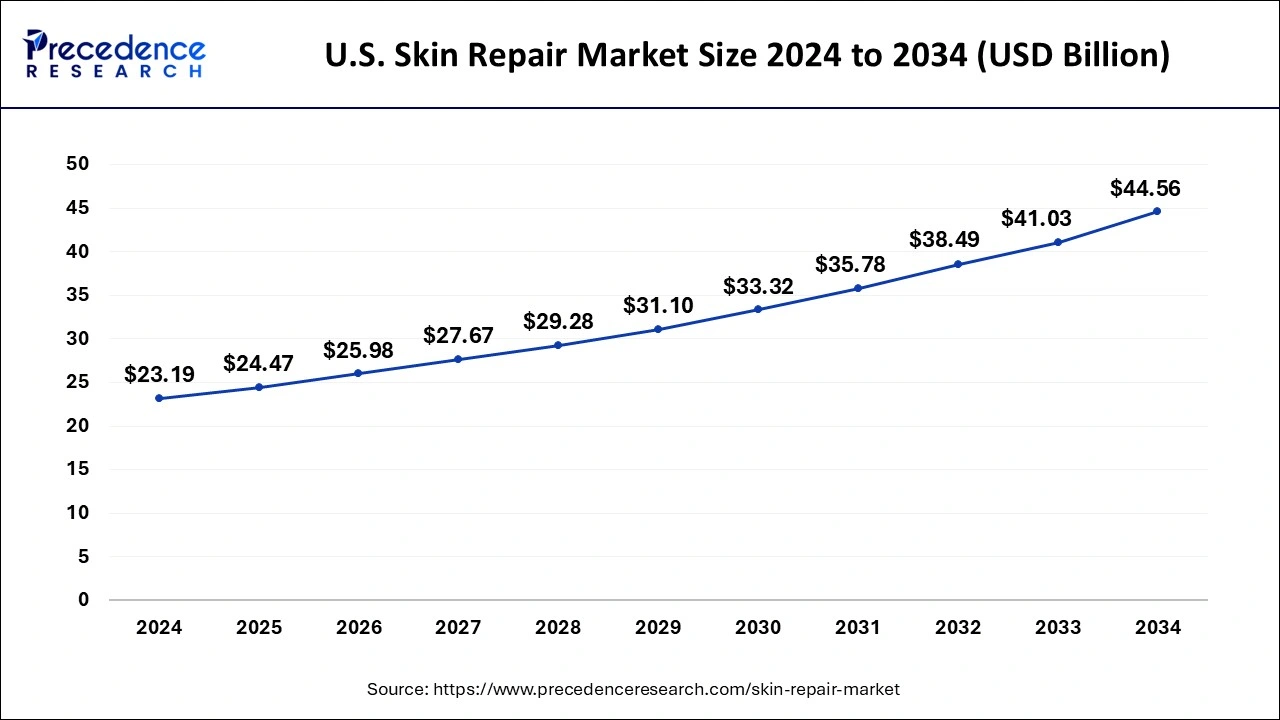
The US skin repair market size accounted for USD 24.47 billion in 2025 and is predicted to increase from USD 25.98 billion in 2026 to approximately USD 47.43 billion by 2035, expanding at a CAGR of 6.84% from 2026 to 2035. The growing focus on reducing skin problems of the people and the surging deployment of advanced technologies in the cosmetics industry drive the market expansion.
Key Takeaways
- By product type, the topical creams and ointments segment dominated the market in 2025.
- By product type, the wound care products segment is expected to grow with a significant CAGR during the forecast period.
- By product form, the ointments segment held the largest market share in 2025.
- By product form, the creams segment is expected to rise with the highest CAGR during the forecast period.
- By application, the surgical wounds segment held a significant share of the market in 2025.
- By application, the diabetic foot ulcers segment is anticipated to expand with the fastest growth during the forecast period.
- By distribution channel, the hospital pharmacies segment led the market in 2025.
- By distribution channel, the retail pharmacies segment is expected to grow at a notable CAGR during the forecast period.
- By end-user, the hospitals and clinics segment dominated the market in 2025.
- By end-user, the skincare and aesthetic centers segment is anticipated to rise with a considerable CAGR during the forecast period.
Market Overview
The U.S. skin repair market is gaining rapid traction due to the rise in the number of skincare clinics in this nation. The growing demand for anti-aging creams among women, as well as the increasing proliferation of online shopping, has contributed to the market expansion. In addition, the surging adoption of skin repair devices by dermatologists, along with numerous product launches, accelerates the industrial development.
What is the Significance of AI in the U.S. Skin Repair Industry?
Artificial intelligence is significantly contributing to the growth of the skin repair industry in the U.S. AI algorithms use computer vision to study wound images in real time for detecting signs of infection and classifying tissue types more quickly than manual assessments. In cosmetic dermatology, AI-enabled platforms help in evaluating user selfies to analyze hydration, pigmentation, and aging patterns. Skincare product companies are deploying AI to accelerate ingredient discovery and optimize supply chains.
- In September 2025, Nolla Health launched an AI-enabled skin health platform in the U.S. This platform was designed to deliver advanced skincare treatment to the patients of this nation.
What are the Trends of the U.S. Skin Repair Industry?
- Business Expansions: Top companies are investing significantly in opening new production centers to increase the manufacturing of skin care items.
- Establishment of Skin Care Centers: Numerous private investors are inaugurating skin care centers in urban areas to deliver high-quality dermal care to the patients.
- Surging Cases of Burns: The growing cases of industrial burns have increased the demand for advanced ointments to deliver instant relief to patients.
- Government Initiatives: The U.S. government has launched numerous policies to strengthen the healthcare sector.
Market Report Coverage and Key Metrics
| Report Coverage | Details |
| Market Size in 2025 | USD 24.47 Billion |
| Market Size in 2025 | USD 25.98 Billion |
| Market Size by 2035 | USD 47.43 Billion |
| Growth Rate from 2026 to 2035 | CAGR of 6.84% |
| Base Year | 2025 |
| Forecast Period | 2026 to 2035 |
| Segments Covered | Product Type, Product Form, Application, Distribution Channel, and End-user |
Market Dynamics
Drivers
Opening of Dermal Clinics and Commercialization of High-Quality Creams
Private companies are engaged in establishing new dermal clinics across the U.S. These clinics are inaugurated to deliver advanced skincare treatment to the consumers of this nation. The leading brands are making significant investments in innovating high-quality creams for the people of the U.S. Thus, the opening of dermal centers and the launch of advanced skincare creams have boosted the market growth.
- In April 2026, Pur Skin Clinic opened a new center in Seattle. This new dermal clinic was established to provide high-quality skincare treatment in this region.
Restraint
Growing Prices of Ingredients and Supply Chain Issues
The U.S. skin repair industry encounters numerous problems in its day-to-day operations. The cost of essential ingredients used in the production of skincare products is growing rapidly, which poses a threat to market players. Ongoing geopolitical issues in different regions have disturbed the supply chain across the U.S. region, thereby hampering industrial growth.
Opportunity
3D Bioprinting and Laser Treatment
3D-printed cells are helping doctors to treat patients who have undergone severe burns and chronic wound treatment by accelerating actual skin tissue regeneration. Laser treatment is used to reduce wrinkles and scars, remove blemishes, and enhance overall skin texture and tone. Thus, the advancements in 3D bioprinting and laser treatment are expected to create opportunities for the market players in the upcoming days.
State-Wise Analysis
- New Jersey Market Trends: The growing prevalence of psoriasis has increased the demand for topical creams that are manufactured using brepocitinib. The rise in the number of dermatology clinics and the surging adoption of moisturizers and lotions by women contributed to the industrial growth.
- Minneapolis Market Insights: The increasing focus of skincare companies on establishing new R&D centers for developing advanced dermal care items has boosted the market expansion. The growing cases of melanoma and rosacea have increased the demand for high-quality creams to treat these chronic disorders.
- Texas Market Trends: The surge in the number of dermal clinics has enabled people to visit these centers on a regular basis to maintain their skin quality. Cream manufacturers are making significant investments in opening new production units to increase the manufacturing output in this region.
Market Segmentation Analysis
Product Type Insights
The Topical Creams and Ointments Segment Dominated the Market in 2025
The topical creams and ointments segment led the market in 2025. This is owing to the growing use of topical creams to reduce inflammation, redness, and itching. Healthcare brands have started using JAK inhibitors and PDE4 inhibitors for manufacturing topical ointments, that finds application in the treatment of psoriasis.
The wound care products segment is expected to expand with a significant CAGR during the forecast period. This is due to the surging demand for saline sprays & washes and hydrogel dressing solutions from the hospitals. Top companies dealing in wound care products are opening new manufacturing units in the U.S.
Product Form Insights
What Made Ointments the Dominant Segment in the Market?
The ointments segment held the dominant market share in 2025. This is due to the growing use of ointments for treating minor cuts, scrapes, and burns on the human body. Some common types of ointments that are used regularly include topical steroids, moisturizers, and antibiotics.
The creams segment is expected to grow with the highest CAGR during the forecast period. This is owing to the surging demand for anti-aging creams from celebrities to maintain their good looks. Leading players are engaged in the research and development of water-free creams for delivering a long-lasting effect.
Application Insights
The Surgical Wounds Segment Held the Largest Market Share in 2025
The surgical wounds segment held the largest revenue share in the market in 2025. This is due to the rising cases of domestic skin burns, which increase the application of surgeries for getting cured. Skin care companies are investing rapidly in developing high-quality ointments to deliver fast relief in surgical wounds.
The diabetic foot ulcers segment is expected to rise with the highest CAGR during the forecast period. This is due to the growing use of antibiotic creams and advanced dressings for the treatment of diabetic foot ulcers. Several hospitals in the U.S. that provide superior diabetic foot ulcer treatment include Mass General Brigham, the Mayo Clinic, and Mount Sinai Health System.
Distribution Channel Insights
What Made Hospital Pharmacies the Dominant Segment in the Market?
The hospital pharmacies segment led the market in 2025. This is owing to the rising cases of road accidents, which have increased the demand for pads and dressings in hospital pharmacies for undergoing emergency surgeries. The hospital chains are making significant investments in constructing pharmacies on their premises.
The retail pharmacies segment is expected to grow at a notable CAGR during the forecast period. This is due to the availability of a wide range of skincare products in the retail pharmacies across the U.S. Some pharma companies are opening their new branches to deliver 24/7 services to the consumers in this region.
End-User Insights
The Hospitals and Clinics Segment Dominated the Market in 2025
The hospitals and clinics segment contributed the biggest market share in 2025. This is due to the surging focus of the government on modernizing public hospitals to deliver efficient treatments. Hospitals are deploying advanced skin repair devices for plastic surgeries and scar removal.
The skincare and aesthetic centers segment is likely to rise with a considerable CAGR during the forecast period. This is owing to the surging preference of consumers to visit skincare clinics to enhance their skin quality. Numerous aesthetic brands are involved in opening new centers to deliver high-quality dermal treatment to the consumers of the U.S. region.
U.S. Skin Repair Market Value Chain Analysis
- Raw Materials Sourcing
Raw materials used in the production of skincare items comprise water/solvents, lipids, humectants, and emulsifiers.
Key Players: Archer Daniels Midland, BASF SE, and Kerry Group.
- Clinical Trials and Regulatory Approval
Clinical trials for skincare products are conducted to test safety, efficacy, and tolerance on human beings using a mix of expert dermatological grading, laboratory instruments, and participant feedback.
Key Players: Auriga Research, Velocity Clinical Research, Pierre Fabre, and DeNova Research.
- Distribution Channel
Skin repair solutions are distributed through a mix of professional, retail, and digital channels in the U.S. region.
Key Players: Amazon, Walmart, and Procter & Gamble.
Market Competitive Landscape: Leading Companies and Strategies
The U.S. skin repair market is highly fragmented, due to the presence of numerous established players and the proliferation of new entrants in this field. Leading companies operating in this sector include Procter & Gamble, The Estée Lauder Companies, Johnson & Johnson, CeraVe, and Cetaphil. These brands are constantly engaged in the research and development of skin care products and adopting several tactics, such as product launches and business expansions, to compete in this expanding sector. Some of the skincare startups in the U.S. include Curology, Proven Skincare, KraveBeauty, and Starface.
- In January 2026, Estee Lauder launched two skincare items in the U.S. These items include futurist hydraplump lip balm and the daywear glow boost gel cleanser, which are designed for delivering protection against winter dryness.
Skin care brands have started using hyaluronic acids and peptides to lower the side effects, including redness, dryness, and peeling. Healthcare companies are making significant investments to launch medicated skin repair items in the U.S. Ongoing advancements in the neurocosmetics sector and innovations related to solid formulations will reshape the future landscape.
Recent Developments
- In May 2026, Olive Young opened a retail store in Pasadena, California. This store was established to deliver a wide range of skincare products to consumers in the U.S.(Source: https://www.forbes.com)
- In May 2026, Amorepacific launched MAMONDE. MAMONDE is a Korean skincare brand designed for the people of the U.S.
(Source: https://www.globalcosmeticsnews.com) - In April 2026, Brown Bee launched a new range of skin tanning products in the U.S. This new range consists of gradual tanning lotions, self-tanning mousses, and skincare-infused face serums.(Source: https://www.beautypackaging.com)
Top Companies in the U.S. Skin Repair Market
- Procter & Gamble
- The Estée Lauder Companies
- Johnson & Johnson
- CeraVe
- Cetaphil
- SkinCeuticals
- Drunk Elephant
- Naturium
- Glossier
- NU Skin
Segments Covered in the Report
By Product Type
- Topical Creams and Ointments
- Moisturizers and Lotions
- Serums and Elixirs
- Wound Care Products
- Skin Repair Devices
By Product Form
- Creams
- Ointments
- Gels
- Pads and Dressings
- Other Forms
By Application
- Burns
- Diabetic Foot Ulcers
- Surgical Wounds
- Traumatic Wounds
- Pressure Sores
- Others
By Distribution Channel
- Retail Pharmacies
- Online Retail
- Hospital Pharmacies
- Specialty Stores
- Others
By End-user
- Hospitals and Clinics
- Home Care Settings
- Skincare and Aesthetic Centers
- Others
For inquiries regarding discounts, bulk purchases, or customization requests, please contact us at sales@precedenceresearch.com
Frequently Asked Questions





Ask For Sample
No cookie-cutter, only authentic analysis – take the 1st step to become a Precedence Research client
 Get a Sample




 sales@precedenceresearch.com
 Schedule a Meeting
