



U.S. Orthopedics Market Trends, Leading Companies, Company Revenue / Sales Performance, Procedure Volume, Healthcare Spending, Technology Adoption, Reimbursement Analysis, Competitive Landscape, and Growth Outlook
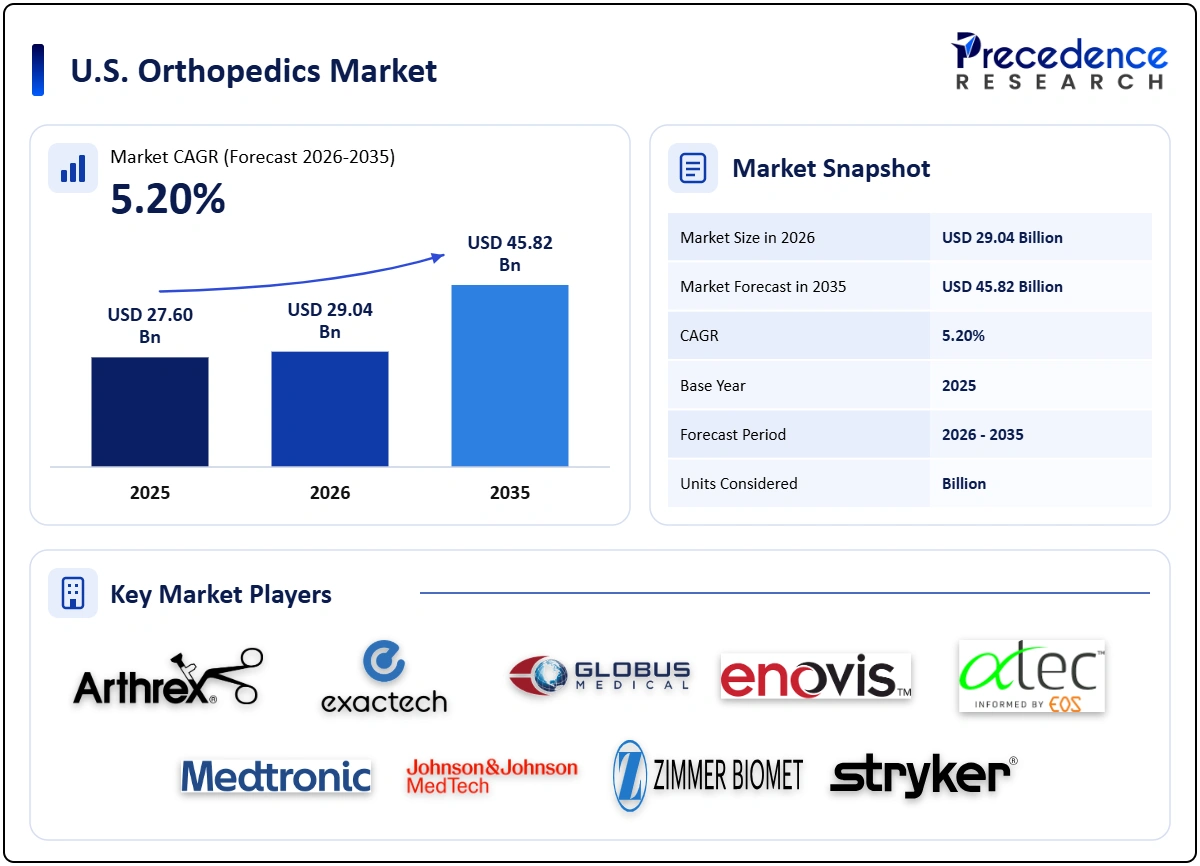
Payal Rabde, a Healthcare Industry Expert, highlights that the U.S. orthopedics market has reached USD 29.04 billion in 2026 and is on track to reach USD 45.82 billion by 2035, advancing at a CAGR of 5.20%. Key U.S. orthopedics market companies shaping the market include Stryker, Zimmer Biomet, Johnson & Johnson, while major growth segments span product, end-user .
Source: https://www.precedenceresearch.com/us-orthopedics-market
 Get a Sample
 Table Of Content
Key Takeaways
Market Size & Growth Outlook
- Market size in 2025: USD 27.60 billion
- Estimated market size in 2026: USD 29.04 billion
- Projected market size by 2035: USD 45.82 billion
- CAGR (2026-2035): 5.20%
Regional Market Spotlight
- The South region led with a 38.00% share in 2025 and is projected to be the fastest-growing region, at a CAGR of 5.93% from 2026 to 2035.
- In 2025, West accounted for 22.00% of the market share.
- Midwest contributed 21.00% of the market share in 2025.
Segmental Spotlight
- By product, joint reconstruction accounted for the largest share at 38.00% of the market in 2025.
- In 2025, hospitals represented the largest end-user category, capturing a 70.00% share.
U.S. Orthopedics Market Size, 2025-2035 (USD Billion)
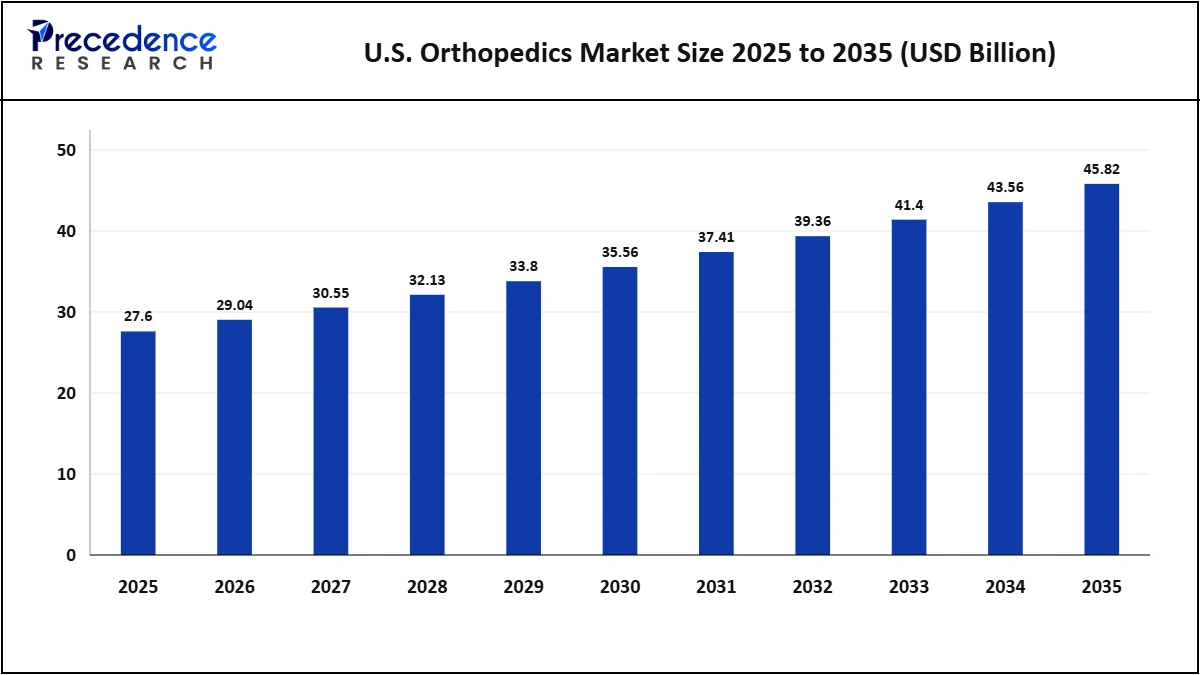
Note: 2025 is the base year; 2026-2035 values are forecasts.
Sources: Expert interviews, secondary sources, Precedence Research database, and Precedence Research analysts.
The U.S. orthopedics market is expected to increase from USD 27.60 billion in 2025 to USD 45.82 billion by 2035, at a CAGR of 5.20%. Rising demand for joint, spine, and soft-tissue procedures among ageing and active populations is driving growth. Wider use of surgical robotics, expansion of ASCs, and adoption of digital health solutions are further supporting the market, which is projected to reach USD 35.56 billion by 2030.
Analyst View: The U.S. orthopedics market benefits from rising demand for joint, spine, and soft-tissue procedures, driven by an ageing population and active lifestyles. Robotics, minimally invasive techniques, and expanding ASC adoption are strengthening surgical efficiency and supporting market growth.
Market Trends
- Robotic-assisted joint replacement: Systems such as Mako, ROSA, and VELYS are gaining adoption across hospitals. Their integration with manufacturer-specific implants is making robotic platform placements an important factor in implant market share.
- Outpatient joint and spine surgery: Growing adoption of same-day discharge procedures is allowing ASCs to perform more knee, hip, and lumbar surgeries that traditionally required hospital stays.
- Cementless and 3D-printed implants: Advanced porous titanium implants are gaining popularity due to their potential to improve long-term fixation, particularly among younger and more active patients.
- Soft-tissue healing technology: Bioinductive and advanced suture-based implants are being adopted to support tissue healing and reduce the risk of re-tears following rotator cuff repair.
- Remote recovery monitoring: Wearable devices and mobile applications are helping surgeons track patients' movement, pain levels, and recovery progress after surgery, even outside clinical settings.
Market Dynamics
The U.S. orthopedics market is primarily driven by an ageing yet active population, increasing demand for joint replacements, fracture repair, and soft-tissue procedures. Robotic-assisted surgery and the shift toward outpatient care are reshaping surgical practices and implant preferences. However, pricing pressures from hospitals, bundled payment models, and insurers continue to moderate revenue growth despite rising procedure volumes.
Drivers
Ageing population
The growing elderly population in the U.S. is increasing the incidence of osteoarthritis and age-related fractures. This is driving demand for knee and hip replacements, trauma procedures, and revision surgeries for previously implanted devices.
Active lifestyles
Older adults expect to stay active and choose joint replacement earlier than past generations. Meanwhile, sports injuries among younger people drive ligament, meniscus, and shoulder repair. Both groups widen the pool of surgical patients.
Robotic and enabling technology
Robots improve implant positioning and give hospitals a marketing edge. Hospitals that invest in a robot tend to grow their joint programs, and companies use robots to secure long-term implant contracts.
Shift to ambulatory surgical centers
CMS's inclusion of total knee and hip replacements on the ASC-covered procedures list, alongside growing adoption by commercial insurers, is accelerating the shift toward outpatient orthopedic care. Lower facility costs and faster scheduling are encouraging more procedures in ASCs, supporting overall market volume growth.
Market Drivers - Impact & CAGR Contribution (2026-2035)
| Driver | Impact | ≈ CAGR Contribution | Time Horizon | Key Regions |
| Ageing population | High | +2.03 pp | Short to long term | U.S.-wide, strongest in South |
| Active lifestyles | Medium | +1.71 pp | Medium to long term | U.S.-wide, fastest uptake in South |
| Robotic and enabling technology | Medium | +1.46 pp | Short to medium term | U.S.-wide |
| Shift to ambulatory surgical centers | Low | +1.14 pp | Long term | South |
Note: Contributions are indicative estimates of each factor's effect on annual growth.
Sources: Expert interviews, secondary sources, Precedence Research database, and Precedence Research analysts.
Demographics are the biggest driver of the U.S. orthopedics market, followed by active lifestyles and robotic technology. The ASC shift has a growing effect, particularly in the South.
Restraints
Implant pricing pressure
Hospitals, group purchasing organizations, and bundled payment programs continue to drive implant price reductions, particularly in mature segments such as primary knee and hip replacements. This pricing pressure limits revenue growth despite steady procedure volumes.
Payer scrutiny of spine fusion
Stricter prior authorization requirements and evidence-based coverage policies are limiting approvals for certain spinal fusion procedures, potentially slowing growth in this major market segment.
Staff and operating room capacity
Shortages of anesthesia providers, nurses, and surgical technicians constrain surgical scheduling and limit procedure volumes across hospitals, restricting overall market growth.
Market Restraints - Impact & Negative CAGR Contribution (2026-2035)
| Restraint | Impact | ≈ Negative CAGR Contribution | Time Horizon | Key Regions |
| Implant pricing pressure | High | -0.51 pp | Short to medium term | U.S.-wide |
| Payer scrutiny of spine fusion | High | -0.38 pp | Medium term | Smaller and price-sensitive markets |
| Staff and operating room capacity | Medium | -0.25 pp | Short term | South and other mature markets |
Note: Contributions are indicative estimates of each factor's effect on annual growth.
Sources: Expert interviews, secondary sources, Precedence Research database, and Precedence Research analysts.
Pricing pressure is the main brake, as hospitals and bundled payment programs push implant prices down. Spine scrutiny and staffing limits add smaller drags.
Opportunities
ASC-ready implant systems
Single-use instrument kits and compact robotic systems designed for outpatient settings are gaining traction as more orthopedic procedures shift to ASCs, creating opportunities for manufacturers offering cost-effective, streamlined solutions.
Shoulder and extremities
Rising demand for shoulder, foot, and ankle procedures is creating growth opportunities beyond traditional knee and hip reconstruction, particularly in segments with fewer established competitors.
Orthobiologics
Growing adoption of biologic solutions for bone and tendon healing is expanding treatment options while creating opportunities for manufacturers to strengthen product portfolios and capture higher-margin revenue.
U.S. Orthopedics Market Segmentation: 2025 Share and Size
U.S. Orthopedics Market by Product, 2025-2035 Share (%)
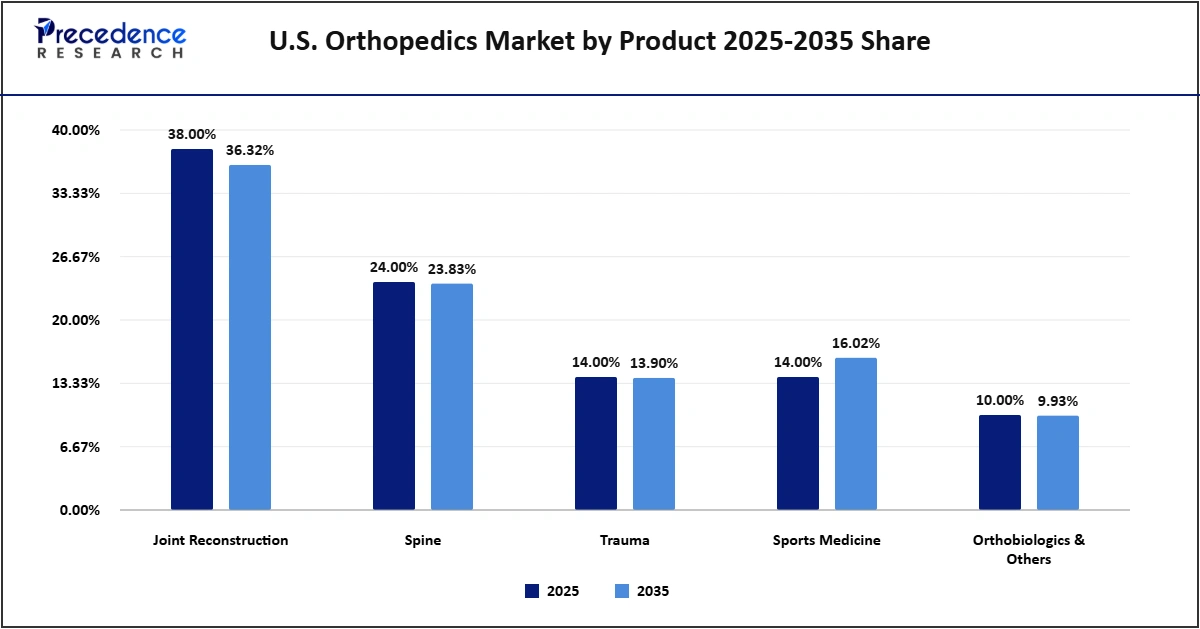
Note: 2025 is the base year; 2035 shares and CAGRs are forecasts.
Sources: Expert interviews, secondary sources, Precedence Research database, and Precedence Research analysts.
Joint reconstruction is the backbone of U.S. orthopedics because knee and hip replacements are among the most common operations in the country. Spine is the second pillar, though growth there is more selective. Sports medicine and extremities are the most dynamic areas, helped by active ageing and new soft-tissue repair technology.
Joint Reconstruction: With a market contribution of 38.00% in 2025, joint reconstruction is expected to witness sustained expansion at a CAGR of 4.73% from 2026 to 2035. Joint reconstruction leads due to the high volume of knee and hip replacement procedures driven by an ageing population and rising osteoarthritis prevalence.
Spine: The segment held a substantial 24.00% share of the market in 2025, with growth projected at a 5.13% CAGR through 2035. Fusion hardware, interbody cages, and navigation make up most spine revenue. Growth is moderate as payers scrutinize fusion, but enabling technology and outpatient spine surgery are lifting demand.
Trauma: In 2025, the segment represented 14.00% of the overall market and is expected to achieve a CAGR of 5.13% over the 2026-2035 period. Trauma growth is driven by an ageing population, rising osteoporosis prevalence, and increasing fall-related fractures, sustaining demand for reliable fracture fixation devices.
Sports Medicine: The segment's market share stood at 14.00% in 2025, while its growth trajectory is expected to reflect a CAGR of 6.63% during 2026-2035. Sport Medicine is driven by rising sports-related injuries, increasing participation in physical activities among older adults, and growing adoption of minimally invasive arthroscopic and advanced soft-tissue repair techniques.
Orthobiologics & Others: This segment accounted for 10.00% of the market in 2025 and is projected to grow at a CAGR of 5.13% during the forecast period. Orthobiologics & Others segment growth is supported by increasing adoption of biologic solutions for bone and tendon healing, rising use in spine fusion and trauma procedures, and demand for advanced regenerative treatment options.
U.S. Orthopedics Market by End User, 2025-2035 Share (%)
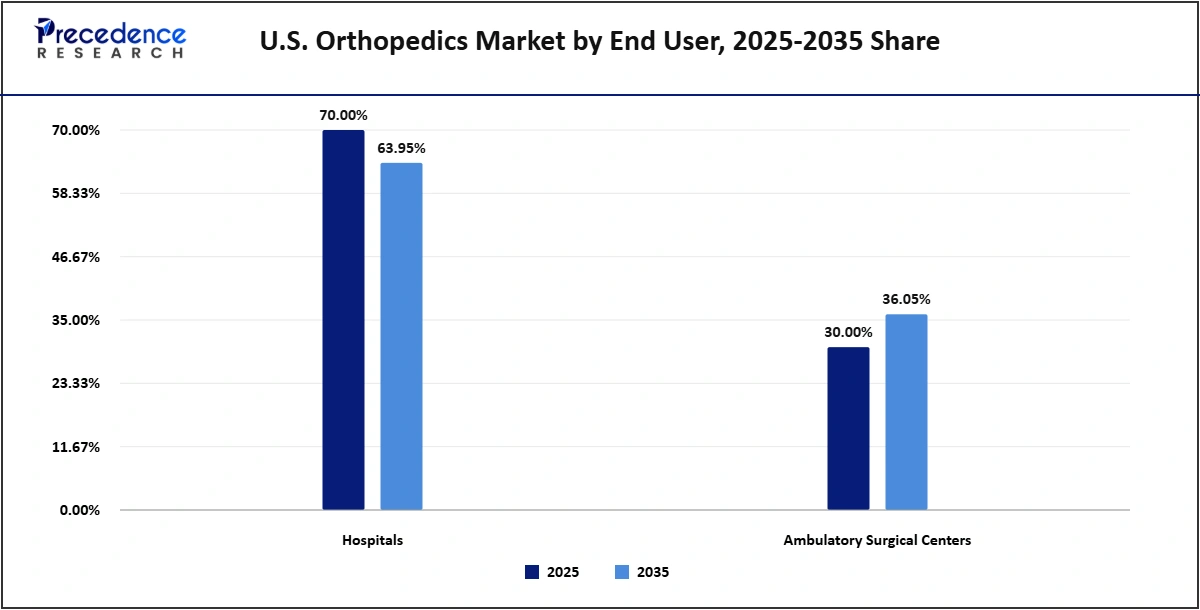
Note: 2025 is the base year; 2035 shares and CAGRs are forecasts.
Sources: Expert interviews, secondary sources, Precedence Research database, and Precedence Research analysts.
Hospitals still perform most orthopedic surgery, but the outpatient shift is stronger here than in almost any other specialty. Total knee and hip replacement were added to the CMS ASC covered list, and many spine procedures are following.
Hospitals: The segment captured 70.00% of the total market in 2025 and is anticipated to register a CAGR of 4.25% between 2026 and 2035. Hospitals lead due to their advanced surgical infrastructure, specialized clinical expertise, and capacity to handle complex orthopedic procedures, revision surgeries, and high-risk patients.
Ambulatory Surgical Centers: With a market contribution of 30.00% in 2025, ambulatory surgical centers are expected to witness the fastest expansion at a CAGR of 7.15% over the forecast period. The segment growth is driven by the shift toward cost-effective outpatient surgeries, faster patient discharge, lower facility costs, and increasing adoption of joint replacement and sports medicine procedures in ASCs.
Analyst View: Joint reconstruction dominates the U.S. orthopedics market, supported by high knee and hip replacement volumes and rising osteoarthritis prevalence, while sports medicine is growing fastest due to increasing sports-related injuries and adoption of minimally invasive procedures. Hospitals continue to be the most popular end-user sector due to their ability to handle complicated surgeries, while ambulatory surgical centers are growing at the quickest rate due to the migration of orthopedic procedures to ASCs.
Country Analysis
U.S. Orthopedics Market by Country, 2025 Share (%)
| Country | 2025 Share | 2035 Share | CAGR 2026-2035 |
| South | 38.00% | 40.72% | 5.93% |
| West | 22.00% | 21.04% | 4.73% |
| Midwest | 21.00% | 20.08% | 4.73% |
| Northeast | 19.00% | 18.16% | 4.73% |
Note: 2025 is the base year; 2035 shares and CAGRs are forecasts.
Sources: Expert interviews, secondary sources, Precedence Research database, and Precedence Research analysts.
Orthopedic demand is driven by population ageing and activity levels. The South leads in market share and growth, supported by a growing retiree population and strong migration inflows. The Northeast maintains high per-capita procedure rates due to its concentration of specialized hospitals and advanced healthcare facilities.
Regional Insights
South: In 2025, the region represented 38.00% of the overall market and is expected to achieve a CAGR of 5.93% over the 2026-2035 period. South region is growing due to its large and expanding retiree population, rising migration to states such as Texas and the Carolinas, and increasing demand for age-related orthopedic procedures.
West: The region's market share stood at 22.00% in 2025, while its growth trajectory is expected to reflect a CAGR of 4.73% during 2026-2035. The West's growth is driven by a physically active population, strong demand for sports medicine and joint procedures, and well-established integrated healthcare systems supporting advanced orthopedic treatments.
Midwest: This region accounted for 21.00% of the market in 2025 and is projected to grow at a CAGR of 4.73% from 2026 to 2035. The Midwest benefits from a strong orthopedic manufacturing base, established medical device companies, and leading healthcare systems with high-volume joint replacement programs.
Northeast: The region captured 19.00% of the total market in 2025 and is anticipated to register a CAGR of 4.73% between 2026 and 2035. The Northeast benefits from a high concentration of specialized orthopedic hospitals and elevated per-capita procedure rates, sustaining demand for orthopedic implants and surgical technologies.
Analyst View: The South dominates the market and is expected to grow fastest, driven by population ageing, retiree migration, and rising procedure volumes. While the Midwest makes use of its well-established orthopedic manufacturing base, the West benefits from active lifestyles and a robust market for sports medicine. The Northeast's high per-capita procedure rates and specialist hospitals sustain consistent demand.
Competitive Landscape
Table: Top 10 Companies in the U.S. Orthopedics Market
| Rank | Company Name | 2025 Share (%) | Key Products / Business | Headquarters |
| 1 | Stryker | 20.00% | Mako, joint replacement, trauma and spine | United States |
| 2 | Zimmer Biomet | 18.00% | Knees, hips and ROSA robotics | United States |
| 3 | Johnson & Johnson MedTech (DePuy Synthes) | 14.00% | Joints, trauma and VELYS | United States |
| 4 | Smith+Nephew | 7.00% | Joints, sports medicine and CORI | United Kingdom |
| 5 | Globus Medical | 7.00% | Spine and trauma | United States |
| 6 | Medtronic | 6.00% | Spine and Mazor robotics | Ireland |
| 7 | Arthrex | 6.00% | Sports medicine | United States |
| 8 | Enovis | 3.00% | Joints and extremities | United States |
| 9 | ATEC Spine | 2.00% | Spine systems | United States |
| 10 | Exactech | 1.00% | Joints and shoulders | United States |
Note: Company shares are 2025 estimates.
Sources: Company press releases, expert interviews, secondary sources, Precedence Research database, and Precedence Research analysts.
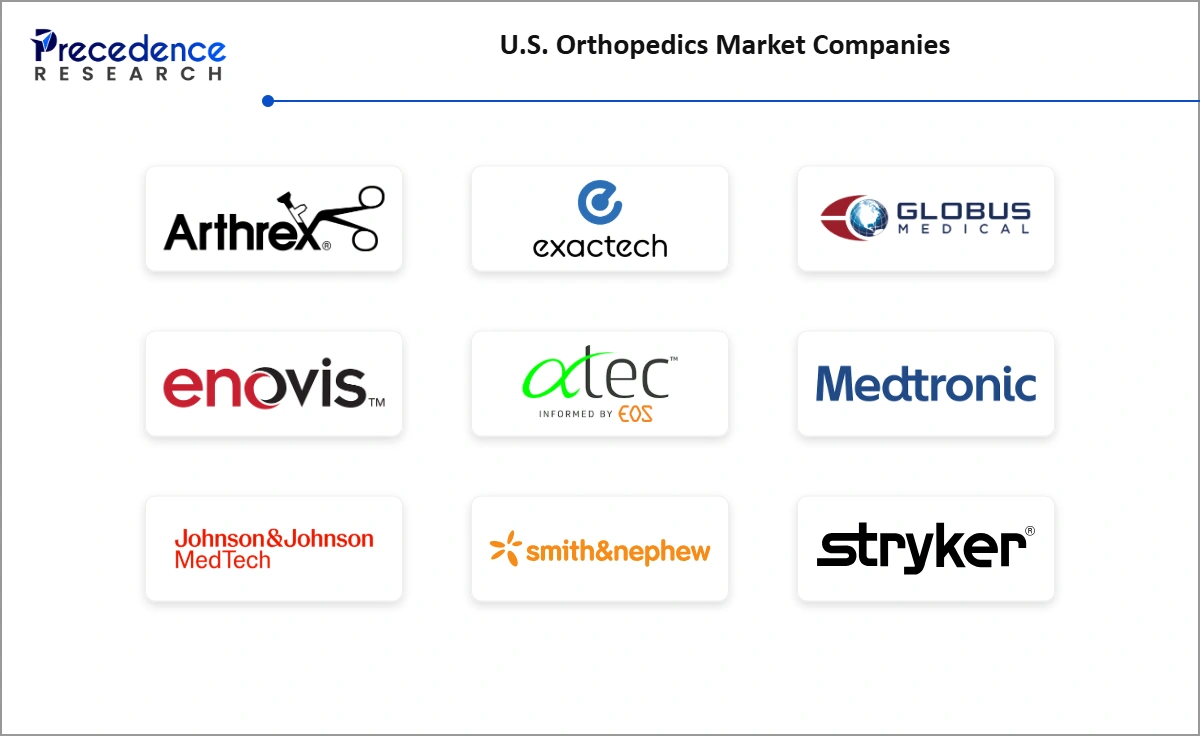
Stryker led the U.S. orthopedics market with an estimated 20.00% share of 2025 revenue, followed by Zimmer Biomet at 18.00% share and Johnson & Johnson MedTech (DePuy Synthes) at 14.00% share. Stryker leads with mako, joint replacement, trauma, and spine; Zimmer Biomet competes with knees, hips, and ROSA robotics; and Johnson & Johnson MedTech (DePuy Synthes) offers joints, trauma, and VELYS. Smith+Nephew, Globus Medical, Medtronic, Arthrex, Enovis, ATEC Spine, and Exactech compete through joints, sports medicine and CORI, spine and trauma, spine and Mazor robotics, sports medicine, joints and extremities, spine systems, and joint and shoulders.
The top 10 companies captured 84% of 2025 revenue, while the remaining 16.01% was shared among many smaller implant manufacturers. The U.S. orthopedics market is concentrated among a handful of large implant makers, and competition centers on implant design, robotics and navigation, surgeon relationships, ASC-ready instrument sets, and pricing.
Company Snapshots
Stryker: Headquartered in the United States, Stryker captured 20.00% of the U.S. orthopedics market in 2025, built largely on Mako, joint replacement, trauma, and spine. The Precedence Research Companies Quadrant places it as a Leader.
Zimmer Biomet: The company competes mainly through knees, hips, and ROSA robotics. From its base in the United States, it captured roughly 18.00% of 2025 revenue and is rated a Leader in the Precedence Research Companies Quadrant.
Johnson & Johnson MedTech (DePuy Synthes): With about 14.00% of the U.S. orthopedics market in 2025, Johnson & Johnson MedTech (DePuy Synthes) draws on joints, trauma, and VELYS. The company is based in the United States and appears as a Leader in the Precedence Research Companies Quadrant.
Smith+Nephew: Based in the United Kingdom, it accounted for a 7.00% share in 2025. Its joints, sports medicine, and CORI keep it in the Leader group of the Precedence Research Companies Quadrant.
Globus Medical: Representing a 7.00% share in 2025 makes Globus Medical a notable participant in the U.S. orthopedics market. It is headquartered in the U.S., focuses on spine and trauma, and is classed as a Leader in the Precedence Research Companies Quadrant.
Medtronic: This company built its estimated 6.00% position in the U.S. orthopedics market around spine and Mazor robotics. Headquartered in Ireland, it is shown as a Leader in the Precedence Research Companies Quadrant.
Arthrex: Most of Arthrex's presence in this market comes from sports medicine. The company is headquartered in the United States, held roughly 6.00% of 2025 revenue, and is rated an Innovator in the Precedence Research Companies Quadrant.
Enovis: In 2025, Enovis contributed 3.00% share of the U.S. orthopedics market. Its range is built around joints and extremities, and the company is based in the U.S. It is placed as an Innovator in the Precedence Research Companies Quadrant.
ATEC Spine: Operating from the United States, ATEC Spine, a subsidiary of Alphatec Holdings, Inc., offers spine systems. That portfolio gave it about 2.00% of the U.S. orthopedics market in 2025 and a position as an Innovator in the Precedence Research Companies Quadrant.
Exactech: About 1.00% of 2025 revenue in the U.S. orthopedics market went to Exactech, whose business here centers on joints and shoulders. The company is headquartered in the United States, and the Precedence Research Companies Quadrant rates it as an Innovator.
Companies Ecosystem
The U.S. orthopedics ecosystem links material suppliers, implant makers, distributors & reps, hospitals & ASCs, and regulators & payers, with each stage adding value before products reach end users.
U.S. Orthopedics Market Ecosystem
| Ecosystem Stage | Role in the Market | Key Companies |
| Material Suppliers | Supply titanium, cobalt-chrome, and polyethylene | Material makers |
| Implant Makers | Design and make implants | Stryker, Zimmer Biomet, DePuy Synthes |
| Distributors & Reps | Support surgeons | Sales agencies |
| Hospitals & ASCs | Perform surgery | Health systems, ASCs |
| Regulators & Payers | Clear and pay | FDA, CMS |
Sources: Company press releases, expert interviews, secondary sources, Precedence Research database, and Precedence Research analysts.
Material Suppliers: Implant-grade metals and highly cross-linked polyethylene come from a small group of qualified suppliers, and additive manufacturing is adding porous titanium powders to this tier.
Implant Makers: The largest makers combine implants with robots and instruments so that hospitals buying a platform also commit to its implants.
Distributors & Reps: Orthopedic sales representatives attend many procedures, manage instrument sets, and build surgeon relationships that often decide implant choice.
Hospitals & ASCs: Hospitals handle complex and revision surgery, while surgeon-owned ASCs increasingly perform routine joint and sports procedures.
Regulators & Payers: FDA clearances, CMS bundled payment programs, and ASC coverage rules shape both pricing and where surgery happens.
Value in the U.S. orthopedics market flows from upstream material and technology suppliers to manufacturers and service providers, then through distribution partners to end users. Companies that integrate several stages or build long-term relationships with end users capture a larger share of this value.
Precedence Research Companies Quadrant
The Precedence Research Companies Quadrant positions key participants in the U.S. orthopedics market by market strength, reflecting revenue scale, market share, and geographic reach, and by innovation and growth strategy, reflecting product portfolio breadth, R&D intensity, and partnerships. Positions reflect each company's estimated 2025 share of the U.S. orthopedics market and our assessment of its product innovation, portfolio breadth, and partnerships.
Sources: Company press releases, expert interviews, secondary sources, Precedence Research database, and Precedence Research analysts.
Leaders: Stryker, Zimmer Biomet, Johnson & Johnson MedTech (DePuy Synthes), Smith+Nephew, Globus Medical, and Medtronic combine high market share with broad portfolios and strong innovation.
Innovators: Arthrex, Enovis, ATEC Spine, and Exactech bring newer technologies and specialized products.
Recent Development
- January 2026: Smith+Nephew completed its acquisition of Integrity Orthopaedics, developer of the Tendon Seam rotator cuff repair system, strengthening its shoulder repair portfolio alongside the REGENETEN Bioinductive Implant with advanced biomechanical shoulder repair technology.
U.S. Orthopedics Market Segments
By Product
- Joint Reconstruction
- Spine
- Trauma
- Sports Medicine
- Orthobiologics & Others
By End User
- Hospitals
- Ambulatory Surgical Centers
By Region
- South (Texas, Florida, Georgia, North Carolina, Rest of South)
- West (California, Arizona, Colorado, Washington, Rest of West)
- Midwest (Illinois, Ohio, Michigan, Indiana, Rest of Midwest)
- Northeast (New York, Pennsylvania, New Jersey, Massachusetts, Rest of Northeast)
Research Methodology: The U.S. orthopedics market was defined as orthopedic devices sold in the United States, including joint reconstruction implants (knee, hip, shoulder and extremities), spinal implants and devices, trauma fixation, sports medicine devices, orthobiologics and enabling technologies such as robotics and navigation, used in hospitals, ambulatory surgical centers and specialty orthopedic clinics. The 2025 base year was built bottom-up from demand volumes and average prices by product, end user and region, and checked top-down against the market-specific revenues of leading companies and public industry data. Segment, regional and company values were allocated from product and end user and region demand. Key estimates were verified by cross-checking company disclosures, regulatory and industry data, and published third-party estimates, and inputs that could not be reconciled were excluded. All segment, regional, and company figures were reconciled to the same 2025 base year, and the 2026-2035 forecast, which applies a constant CAGR from the 2025 base, was recalculated and validated.
Analyst View: The U.S. orthopedics market is expected to witness steady growth, driven by an ageing population, rising musculoskeletal conditions, and increasing demand for joint replacement, spine, and sports medicine procedures. The shift toward outpatient surgeries, growing adoption of robotic-assisted technologies, and advances in orthobiologics will create additional growth opportunities. However, pressure on implant prices, payer monitoring, and hospital budgetary restrictions are probably going to limit the market's total growth.
Sources and References
- BioSpace. "Smith+Nephew completes acquisition of Integrity Orthopaedics; establishes unrivalled portfolio for shoulder repair". January 2026. Press release. (Source: biospace.com)
For inquiries regarding discounts, bulk purchases, or customization requests, please contact us at sales@precedenceresearch.com
Frequently Asked Questions





Ask For Sample
No cookie-cutter, only authentic analysis – take the 1st step to become a Precedence Research client
 Get a Sample




 sales@precedenceresearch.com
 Schedule a Meeting
