



U.S. Recycled Metal Market Size, Share and Trends 2026 to 2035
U.S. Recycled Metal Market (By Metal Type: Ferrous and Non-Ferrous; By End User: Construction, Transport & Automotive, Industrial Machinery, Electronics, Defense, Packaging, Military, Consumer Goods, and Others) Industry Size, Share, Growth, Trends 2025-2035
 Get a Sample
 Table Of Content


The U.S. recycled metal market size was estimated at USD 660 million in 2025 and is projected to be worth around USD 1140.26 million by 2035, growing at a CAGR of 5.62% from 2026 to 2035. The market is driven by strong industrial demand, environmental sustainability, and cost efficiency. Key factors include the need for eco-friendly manufacturing, increasing prices of mined raw materials, and a strong collection system.
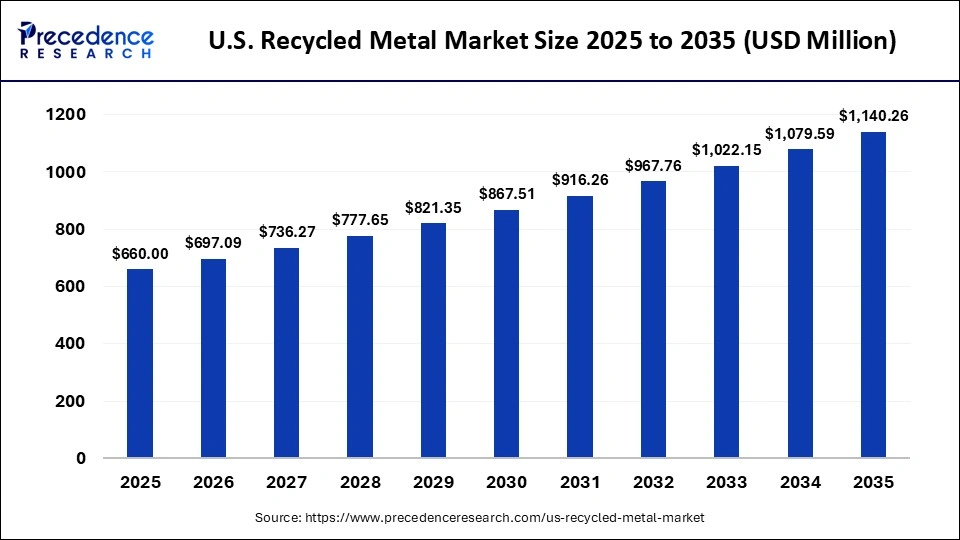
U.S. Recycled Metal Market Statical Scope
| Reports Attributes | Statistics |
| Market Size in 2025 | USD 660 Million |
| Market Size in 2026 | USD 697.09 Million |
| Market Size by 2035 | USD 1140.26 Million |
| CAGR 2026 to 2035 | 5.62% |
| Base Year | 2025 |
| Forecast Period | 2026 to 2035 |
Recycled metal plays a crucial role as it conserves natural resources, saves energy, and lowers greenhouse gas emissions. In the U.S., significant tonnes of metal are recycled each year, promoting a sustainable circular economy. Recycling metals like steel, aluminum, and copper uses 60% to 95% less energy than mining new ores. It significantly reduces carbon dioxide emissions and minimizes overall air and water pollution. This process keeps large quantities of material out of local landfills and protects natural habitats from harmful mining practices.
Metals can be melted down and reused multiple times without losing their essential structural properties. It helps preserve limited raw materials like iron ore, coal, and copper for future generations. Additionally, it supports a strong domestic recycling and manufacturing industry that contributes to the economy.
U.S. Recycled Metal Market, By Metal Type, 2025 (%)
| Segments | Shares (%) |
| Ferrous | 71.00% |
| Non-Ferrous | 29.00% |
- Ferrous - The ferrous segment, with a share of 71.00% in 2025, leads the U.S. recycled metal market by supplying large amounts of raw materials for domestic steel production, reducing energy consumption and emissions, and supporting key industrial sectors.
- Non-Ferrous - The non-ferrous segment, with a share of 29.00% in 2025, plays a crucial role in the U.S. recycled metal market due to its high economic value, significant energy savings, and essential support for modern technology, electric vehicles, and infrastructure. Important factors driving this significance include the recycling of aluminum and copper, high market margins, and the ability to recycle infinitely without losing quality.
U.S. Recycled Metal Market, By End User, 2025 (%)
| Segments | Shares (%) |
| Construction | 24.00% |
| Transport & Automotive | 19.00% |
| Industrial Machinery | 14.00% |
| Electronics | 10.00% |
| Packaging | 9.00% |
| Consumer Goods | 8.00% |
| Others | 7.00% |
| Defense | 6.00% |
| Military | 3.00% |
- Construction - The construction segment, with a share of 24.00% in 2025, accounts for the largest revenue share in the U.S. recycled metal market. It is a major consumer of secondary metals like structural steel and rebar, and it generates a large amount of heavy scrap through the demolition of buildings and infrastructure.
- Transport & Automotive - The transport and automotive segment, with a share of 19.00% in 2025, is crucial to the U.S. recycled metal market as it generates a large amount of scrap metal, is a primary consumer of secondary metals, and significantly contributes to the circular economy and the production of lightweight vehicles.
- Industrial Machinery - The industrial machinery segment, with a share of 14.00% in 2025, is essential to the U.S. recycled metal market as it generates high volumes of uniform scrap, improves processing efficiency with specialized equipment, and supports sustainable manufacturing supply chains.
- Electronics - The electronics segment, with a share of 10.00% in 2025, is important in the U.S. recycled metal market as it provides valuable precious metals, essential non-ferrous metals, and addresses the rapid growth of e-waste. Discarded electronic devices contain high concentrations of reusable resources that traditional mining cannot efficiently match.
Competitive Landscape
The U.S. metal recycling market is somewhat consolidated and led by major companies like Nucor Corporation, Commercial Metals Company (CMC), and Radius Recycling. These top players concentrate on scrap processing, integrating electric arc furnaces (EAF), and establishing regional collection networks.
- Nucor Corporation operates a wide network of scrap recycling centers, including River Metals Recycling and Advantage Metals Recycling, along with brokerage offices. It uses 100% recycled scrap metal in its Electric Arc Furnace (EAF) mini mills to produce new steel products.
- Commercial Metals Company (CMC) provides comprehensive metal recycling, steel fabrication, and rebar production. It converts discarded scrap metal into structural steel products for construction and industrial use through advanced EAF technology.
- Radius Recycling, previously known as Schnitzer Steel Industries, specializes in recycling ferrous and non-ferrous metals, auto dismantling, and selling used auto parts. It runs over 100 processing facilities in North America, turning scrap into low-carbon finished steel.
- Steel Dynamics (OmniSource) focuses on industrial scrap processing, metal trading, and brokerage services, vertically integrating metal recycling streams to supply its eco-friendly EAF steel mills.
- SA Recycling handles the processing and recycling of both ferrous and non-ferrous scrap and boasts one of the largest networks of scrap yards and advanced recycling centers in the U.S.
Segments Covered in the Report
By Metal Type
- Ferrous
- Non-Ferrous
By End User
- Construction
- Transport & Automotive
- Industrial Machinery
- Electronics
- Defense
- Packaging
- Military
- Consumer Goods
- Others
For inquiries regarding discounts, bulk purchases, or customization requests, please contact us at sales@precedenceresearch.com
Frequently Asked Questions





Ask For Sample
No cookie-cutter, only authentic analysis – take the 1st step to become a Precedence Research client




 sales@precedenceresearch.com
 Schedule a Meeting



