



U.S. Retail Logistics Market Size, Share and Trends 2026 to 2035
U.S. Retail Logistics Market (By Type: E-Commerce Retail Logistics and Conventional Retail Logistics; By Solution Type: Supply Chain Solutions, Transportation Management, Commerce Enablement, Reverse Logistics & Liquidation, and Others; By Mode of Transport Type: Roadways, Airways, Railways, and Waterways) Industry Size, Share, Growth, Trends 2025-2035
 Get a Sample
 Table Of Content


The U.S. retail logistics market size is calculated at USD 66.64 Billion in 2025 and is predicted to attain around USD 218.33 Billion by 2035, expanding at a CAGR of 12.6% from 2026 to 2035. The market is mainly driven by the rapid rise of e-commerce, growing consumer needs for quick and dependable deliveries, and significant investments in warehouse automation.
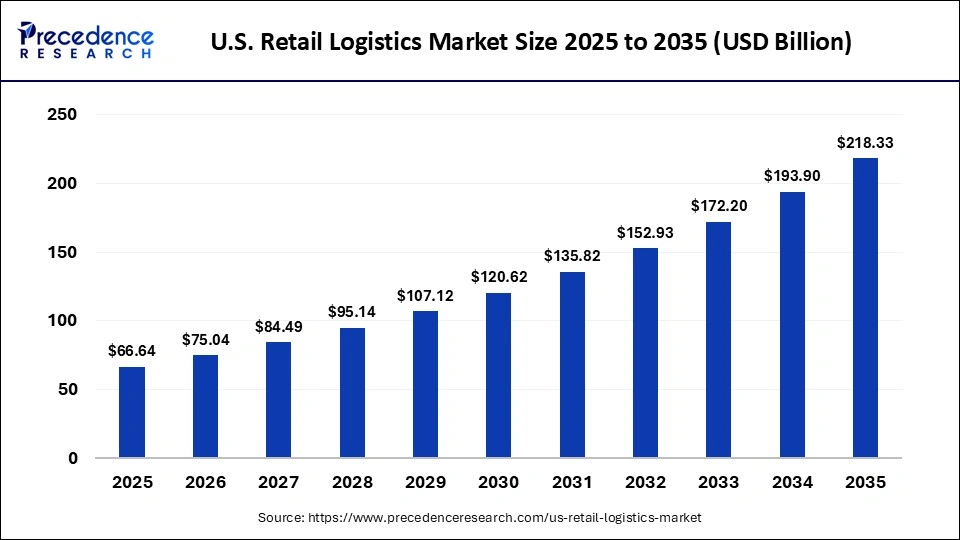
U.S. Retail Logistics Market Statical Scope
| Reports Attributes | Statistics |
| Market Size in 2025 | USD 66.64 Billion |
| Market Size in 2026 | USD 75.04 Billion |
| Market Size by 2035 | USD 218.33 Billion |
| CAGR 2026 to 2035 | 12.6% |
| Base Year | 2025 |
| Forecast Period | 2026 to 2035 |
The market is crucial as it supports e-commerce expansion, meets customer delivery needs, and streamlines supply chain costs. It serves as the essential link between manufacturers, physical stores, and online shoppers. It integrates online orders with in-store pickups (such as curbside services) to help retailers increase sales smoothly. It handles quick shipping options, including same-day deliveries, to satisfy high customer demands.
It employs advanced tools like artificial intelligence, real-time GPS tracking, and warehouse automation to reduce errors and cut shipping costs. It also efficiently manages large volumes of customer returns to safeguard store profits.
U.S. Retail Logistics Market, By Type, 2025 (%)
| Segments | Shares (%) |
| E-Commerce Retail Logistics | 57.30% |
| Conventional Retail Logistics | 42.70% |
- E-Commerce Retail Logistics - The e-commerce retail logistics sector, with a share of 57.30% in 2025, is crucial in the U.S. retail logistics market, leading in growth rates, and pushing supply chains to meet complex needs like quick home delivery and high product return rates.
- Conventional Retail Logistics - The traditional retail logistics sector, with a share of 42.70% in 2025, is a key component of the U.S. retail logistics market as it offers high-volume physical distribution, supports consistent in-store consumer demand, and depends on efficient, cost-effective bulk supply chains.
U.S. Retail Logistics Market, By Solution Type, 2025 (%)
| Segments | Shares (%) |
| Supply Chain Solutions | 28.40% |
| Transportation Management | 24.70% |
| Commerce Enablement | 22.10% |
| Reverse Logistics & Liquidation | 15.80% |
| Others | 9.00% |
- Supply Chain Solutions - The supply chain solutions sector, with a share of 28.40% in 2025, plays a dominating role in the U.S. retail logistics market by increasing efficiency, ensuring timely fulfillment, and managing inventory. It accounts for the largest revenue share by optimizing omnichannel operations, managing reverse logistics, and incorporating cloud technologies for real-time tracking.
- Commerce Enablement - The commerce enablement sector, with a share of 22.10% in 2025, is important in the U.S. retail logistics market as it simplifies online order processing, connects digital storefronts with fulfillment networks, and directly enhances customer satisfaction.
U.S. Retail Logistics Market, By Mode of Transport Type, 2025 (%)
| Segments | Shares (%) |
| Roadways | 66.60% |
| Airways | 13.80% |
| Railways | 10.70% |
| Waterways | 8.90% |
- Airways - The airways sector, with a share of 13.80% in 2025, is vital in the U.S. retail logistics market as it offers unmatched delivery speed, facilitates quick cross-border e-commerce, and protects high-value or perishable goods.
- Railways - The railways sector, with a share of 10.70% in 2025, is essential to the U.S. retail logistics market as it provides high-capacity intermodal transport, reduces long-distance costs, and alleviates highway congestion.
Competitive Landscape
The U.S. retail logistics market is a competitive field led by tech-savvy integrated carriers, large contract logistics firms, and major e-commerce players like Amazon and Walmart, which drives consumer demands for quick service and transparency.
- Amazon and Walmart have extensive fulfillment networks, advanced logistics automation, and offer same-day or next-day delivery, setting the standard for modern omnichannel retail.
- UPS and FedEx provide a wide parcel delivery network, fast shipping options, integrated return services, and digital tracking tools that many third-party retailers depend on.
- GXO Logistics specializes in contract logistics, offering large warehousing solutions, automated e-commerce fulfillment, and reverse logistics for leading global apparel and consumer brands.
- DHL Supply Chain provides tailored warehousing, multi-modal domestic transport, and strong global forwarding services for both physical and online retail networks.
- C.H. Robinson runs North America's largest temperature-controlled logistics network, offering digital freight brokerage, fresh produce transport (Robinson Fresh), and data-driven supply chain consulting.
- XPO Logistics focuses on less-than-truckload (LTL) transportation and last-mile delivery across the U.S., particularly for heavy or bulky retail items like furniture and appliances.
Segments Covered in the Report
By Type
- E-Commerce Retail Logistics
- Conventional Retail Logistics
By Solution Type
- Supply Chain Solutions
- Transportation Management
- Commerce Enablement
- Reverse Logistics & Liquidation
- Others
By Mode of Transport Type
- Roadways
- Airways
- Railways
- Waterways
For inquiries regarding discounts, bulk purchases, or customization requests, please contact us at sales@precedenceresearch.com
Frequently Asked Questions





Ask For Sample
No cookie-cutter, only authentic analysis – take the 1st step to become a Precedence Research client



 sales@precedenceresearch.com
 Schedule a Meeting



