



Wearable Smart Baby Monitor Market Size, Key Companies, Company Market Share, Chip Production Volume, Wafer Capacity, Technology Adoption, Pricing Trends, Competitive Positioning, and Demand Analysis
Wearable Smart Baby Monitor Market (By Connectivity: Wi-Fi, Bluetooth, Cellular; By Type: Audio Only, Video Only, Audio and Video; By Features: Two-Way Audio, Night Vision, Motion Detection, Temperature and Humidity Monitoring, Sleep Tracking; By Distribution Channel: Online, Offline) - Global Industry Analysis, Size, Trends, Leading Companies, Regional Outlook, and Forecast 2026 to 2035
Source: https://www.precedenceresearch.com/wearable-smart-baby-monitor-market
 Get a Sample
 Table Of Content


What is the Wearable Smart Baby Monitor Market Size?
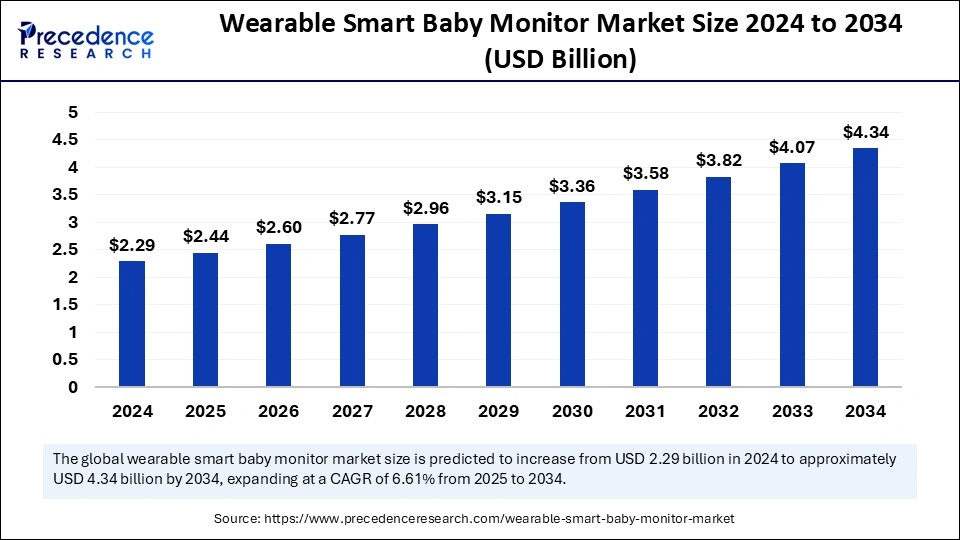
The global wearable smart baby monitor market size was estimated at USD 2.44 billion in 2025 and is predicted to increase from USD 2.60 billion in 2026 to approximately USD 4.60 billion by 2035, expanding at a CAGR of 6.55% from 2026 to 2035. Rising concerns about children's safety drive the growth of the wearable smart baby monitor market.
Wearable Smart Baby Monitor Market Key Takeaways
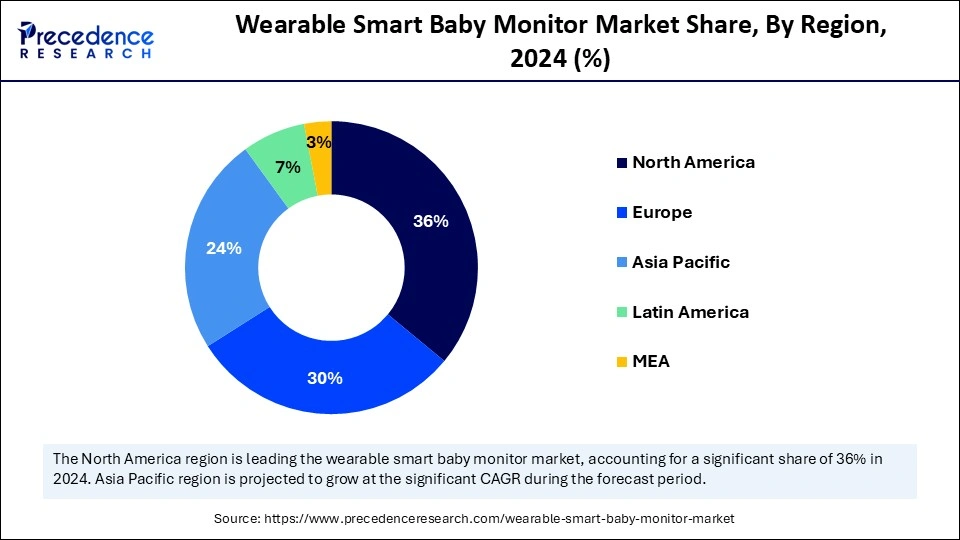
- North America dominated the market with the largest market share of 36% in 2025.
- Asia Pacific is expected to be the fastest-growing region in the coming years.
- By connectivity, the Wi-Fi segment has held the biggest market share in 2025.
- By connectivity, the Bluetooth segment is likely to grow at a rapid pace in the upcoming period.
- By type, the audio and video segment held the largest market share in 2025.
- By type, the video-only segment is projected to grow at the fastest rate during the forecast period.
- By features, the two-way audio segment dominated the market in 2025.
- By features, the motion detection segment is expected to witness notable growth over the studied period.
- By distribution channel, the offline segment led the market in 2025.
- By distribution channel, the online segment is anticipated to expand at the fastest rate in the coming years.
Market Overview
The wearable smart baby monitor market is growing rapidly due to rising concerns about children's safety that are emerging with the adoption ofsmart home technologies such as smart speakers. Smart baby monitoring systems monitor the baby's condition 24×7. They measure parameters regarding the baby's health, such as heartbeat rate and body temperature, that can then be displayed in the mobile application, offering valuable insights into a baby's development. The smart baby monitoring system helps parents and caretakers manage time and makes it easier for them to monitor babies' health remotely. These monitors are extremely efficient in improving children's safety. Features like motion detection and two-way audio communications enhance safety by enabling parents to stay connected with their children, even from their workplace.
Role of AI in Wearable Baby Monitors
The integration of Artificial Intelligence into wearable baby monitors improves functionality. It provides parents with peace of mind so they can monitor their babies' health in real-time instead of being intrusive. AI has proven to be a powerful tool in smart diagnosis, early detection, and lifelong well-being in pregnancy monitoring. With an advanced monitor that uses AI, it is possible to learn babies' patterns and provide alerts to parents. Moreover, AI analyzes data from monitors, providing insights into babies' health issues and ensuring timely responses before they become serious.
Wearable Smart Baby Monitor Market Growth Factors
- The increasing demand for predictive baby monitors is expected to boost the growth of the market in the coming years. These monitors notify parents about potential health issues of children by identifying anomalies in sleep patterns, temperature, or breathing, enabling timely responses to real concerns.
- Ongoing technological advances further boost the growth of the market. Advanced monitoring solutions utilize cutting-edge technologies to provide precise and real-time data for healthcare professionals. It transforms healthcare delivery by allowing remote monitoring, predictive analytics, and continuous data collection, which enables doctors to make informed decisions and improve babies' care.
- Rising government initiatives contribute to market expansion. Governments around the world are launching various programs and offering subsidies to help families afford childcare services.
Market Scope
| Report Coverage | Details |
| Market Size by 2035 | USD 4.60 Billion |
| Market Size in 2025 | USD 2.44 Billion |
| Market Size in 2026 | USD 2.60 Billion |
| Market Growth Rate from 2026 to 2035 | CAGR of 6.55% |
| Dominating Region | North America |
| Fastest Growing Region | Asia Pacific |
| Base Year | 2025 |
| Forecast Period | 2026 to 2035 |
| Segments Covered | Connectivity, Type, Features, Distribution Channel, and Regions |
| Regions Covered | North America, Europe, Asia-Pacific, Latin America, and Middle East & Africa |
Market Dynamics
Drivers
Advancements in Wearable Technology
Ongoing advancements in wearable technology drive the growth of the wearable smart baby monitor market. Advancements in sensor technology enable more accurate and continuous monitoring of babies' vital signs. There is an increasing trend of continuous health monitoring of children, which is being transformed by advanced wearable sensing tools, wireless communication, energy-efficient microprocessors, and high-performance data processing abilities. Wearable smart baby monitor systems enable real-time tracking of physiological parameters and seamlessly transmit critical health data to clinicians, parents, and caretakers. Furthermore, these systems integrate modern sensors capable of detecting external threats like falling, providing immediate alerts to parents. The growing demand for enhanced safety and real-time health monitoring features further drives the growth of the market.
Restraint
Cybersecurity Risks and High Costs
The implementation of Wi-Fi-connected baby monitors raises concerns among parents about data privacy. Wearable monitors are vulnerable to hacking as they gather sensitive information about babies' health and behavior. The risk of breaches compromising babies' privacy and safety has led to consumer hesitation and regulatory scrutiny. Moreover, wearable smart baby monitors are costlier than low-end monitoring systems, limiting the growth of the market.
Opportunity
DSP Technology
The adoption of digital signal processing (DSP) technology is creating novel industry standards for wireless security in baby monitors, providing a suitable wireless solution tailored for children. DSP enhances the processing of signals from sensors, providing accurate data about babies' vital signs. This innovation eliminates the trade-off between performance and safety, confirming optimal monitoring abilities. Furthermore, recent advancements in wearable systems, specifically smart skin-interfaced wearables, are expanding physiological monitoring capabilities. These innovations present significant opportunities for growth in the wearable smart baby monitor market.
Segment Insights
Connectivity Insights
The Wi-Fi segment dominated the wearable smart baby monitor market with the largest share in 2025. Wi-Fi-connected monitors provide more flexibility as Wi-Fi provides more coverage than Bluetooth. This enables parents to monitor their babies remotely. These monitors seamlessly transfer data to the cloud before sending it to internet-connected mobile devices. Moreover, Wi-Fi's higher bandwidth makes it easier to transmit data, enabling a timely response.
The Bluetooth segment is likely to grow at a rapid pace in the upcoming period. This wireless connectivity allows parents to monitor babies within the home. This reduces the need for outdated data downloads. This system receives signals wirelessly, allowing consumers to transmit data from their mobile or computer device to the monitor without the need to connect cables. Moreover, Bluetooth-connected baby monitors are cheaper than other monitors, making them affordable for parents with low budgets.
Type Insights
The audio and video segment held the largest share of the wearable smart baby monitor market in 2024. Audio and video monitors provide parents a vital safety feature, offering additional protection for their babies' well-being. These monitors are vital for remotely monitoring babies' comfort and health. These monitors also offer two-way communications, enhancing monitoring experiences. With more flexibility of audio and video baby monitors, parents can move in their house environment while continuously keeping an eye on their babies.
The video-only segment is projected to grow at the fastest rate during the forecast period. Video-only baby monitors allow parents to visually keep track of their babies' movements from remote locations. This further enables parents to judge if the baby needs help or not. Moreover, video-only monitors enhance children's safety by providing a comprehensive monitoring experience.
Feature Insights
The two-way audio segment dominated the market in 2025. This is mainly due to the increase in the demand for advanced safety features among parents. Two-way audio features allow parents to give quick responses to their children. This feature enables parents to communicate directly with their children, promoting a sense of security. Two-way audio permits the user to calm their baby with their voice, sing lullabies, or offer reassurance when required.
The motion detection segment is expected to witness notable growth over the studied period. Motion detection features monitor babies' movements to give a complete picture of their babies' surroundings. This, in turn, enhances security and allows parents to respond quickly to potential hazards. Parents can keep a close watch on their children, even from the workplace, with a reliable baby monitor. This is specifically beneficial for monitoring sleep patterns and ensuring the baby sleeps safely and peacefully.
Distribution Channel Insights
The offline segment led the wearable smart baby monitor market with the largest share in 2025. Offline stores, such as specialty stores and department stores, offer perceptible results and deeper involvement and connection with the consumers. Offline distribution channels are ideal for small businesses to strengthen their bond with local consumers and create a strong local presence. These stores allow consumers to physically check the quality of products and interact with them, enhancing satisfaction and buying experience.
The online segment is anticipated to expand at the fastest rate in the coming years. This is mainly due to the rise of e-commerce. Online platforms enable consumers to buy products from the comfort of their homes. These platforms also enable manufacturers and distributors to reach a broader consumer base. They provide easy doorstep delivery and exciting discounts, attracting more consumers.
Regional Insights
What is the U.S. Wearable Smart Baby Monitor Market Size?
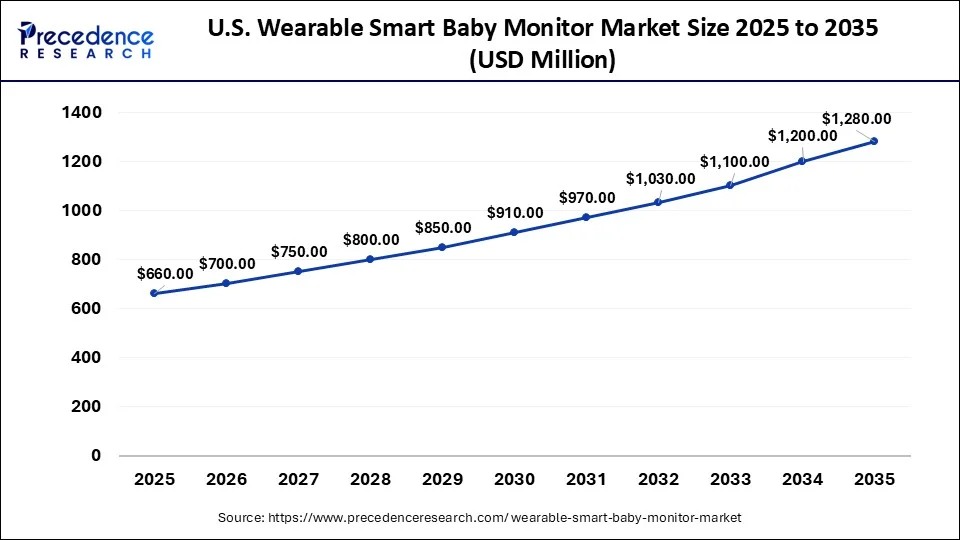
The U.S. wearable smart baby monitor market size was exhibited at USD 660 million in 2025 and is projected to be worth around USD 1,280 million by 2035, growing at a CAGR of 6.85% from 2026 to 2035.
North American Wearable Smart Baby Monitor Market
North America held the largest share of the market in 2025. This is mainly due to the increase in birth rates and the high adoption of advanced monitoring technologies. The rise in dual-income families also boosted the demand for smart baby monitors. High disposable income enables parents to spend on childcare products. Moreover, there is a strong emphasis on child safety, boosting the demand for wearable smart baby monitors in this region.
The U.S. is a major contributor to the market. Tech-savvy parents and caretakers are increasingly adopting advanced technologies for children's safety. With wearable smart baby monitors, parents can keep an eye on their babies from remote locations. The rising women's participation in the workforce further supports market expansion.
Asia Pacific Wearable Smart Baby Monitor Market
Asia Pacific is projected to witness the fastest growth in the coming years. With the rising disposable income and the number of dual-income families, there is a significant increase in childcare products. Governments around the region are also placing a strong emphasis on children's safety, encouraging parents to utilize smart technologies that enhance children's safety. The rising birth rates and working populations further support regional market growth.
India can have a stronghold on the market. The rising disposable income is enabling consumers to spend extra on smart products and services for their babies. Increasing awareness among parents and caretakers about the benefits of wearable smart baby monitors in children's safety contributes to market expansion. These smart devices not only streamline simple daily routines but also improve the parenting experience along with their complex functionalities. The rising consumer interest in cutting-edge solutions further boosts the market.
European Wearable Smart Baby Monitor Market
Europe is expected to grow at a notable rate in the foreseeable period. There is a high adoption of modern technologies among parents for the care of their children. Rising disposable income and working populations in the region influence the market. European governments are promoting the use of technologies to improve children's safety. There is an increasing popularity of smart home technology, creating a conducive environment for the integration of smart baby monitors.
What are the Advancements in the Wearable Smart Baby Monitor Market in Europe?
Europe is expected to witness significant growth in the market. Governments across various countries, such as Germany, France, and the UK, support the growth and innovation of childcare services and products. Additionally, the rise in employment of women worldwide is forcing parents to adopt smart baby monitors and devices when they are not present at home. Significant investments and other initiatives are also gaining traction.
Germany Wearable Smart Baby Monitor Market Trends
The increasing number of tech-savvy parents is a key driver pushing the adoption of such technologies. Companies operating in the smart baby monitors market are increasingly investing in the development of intelligent devices for the real-time monitoring of babies.
Latin America's Growing Wearable Smart Baby Monitor Industry
Latin America is expected to witness substantial growth in the market. This growth is fueled by various factors such as increasing infant safety concerns, rising disposable incomes, and rising consumer expenditure on baby-care products. Key drivers for market growth are advancements in product features such as temperature sensing, heart rate monitoring, and wireless connectivity. Countries such as Brazil and Mexico are leading players.
Brazil Wearable Smart Baby Monitor Market Trends
The country demonstrates significant export potential and is focusing on developing low-energy consumption models, catering to the global trend of sustainability. Going forward, the region is striving to grow its position as an innovative, tech-driven, and eco-friendly player in the market.
The Middle East and Africa Region Growing Wearable Smart Baby Monitor Industry
The Middle East and Africa are expected to witness steady growth in the upcoming years due to a rapid rise in industrialization, which would further drive the growth. Rise in per capita income, recovery of economic conditions, and increase in government spending on the development of advanced child care technology are some of the factors anticipated to boost the adoption of smart baby monitors, especially in countries like Saudi Arabia, the UAE, and Dubai.
Saudi Arabia Wearable Smart Baby Monitor Market Trends
The rising number of women working and stepping out of their houses is one of the key factors contributing to market growth. The integration of AI and various intelligent features such as baby cry detection, humidity and temperature measurements, etc., is also gaining traction.
Wearable Smart Baby Monitor Market Companies
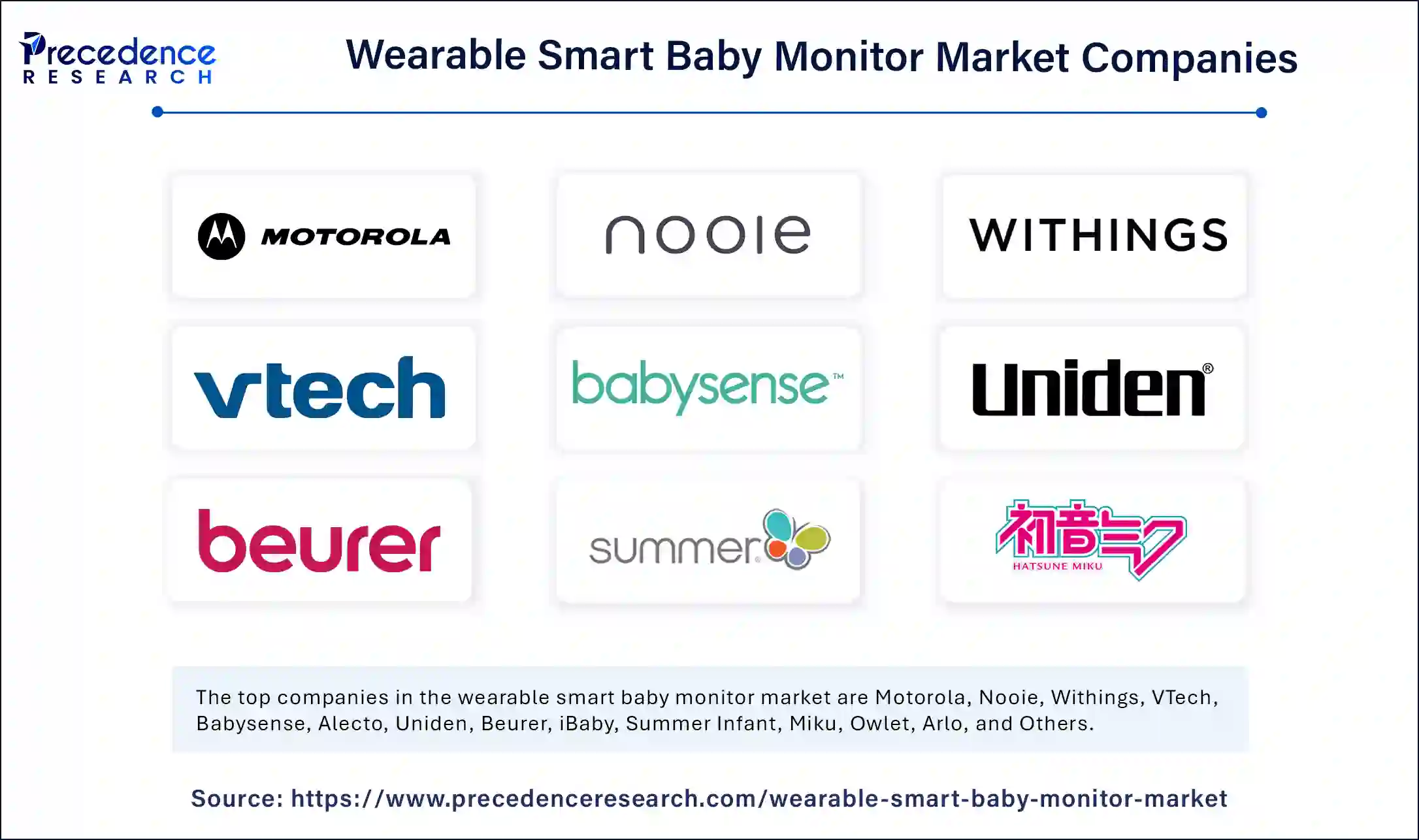
- Motorola
- Nooie
- Withings
- VTech
- Babysense
- Alecto
- Uniden
- Beurer
- iBaby
- Summer Infant
- Miku
- Owlet
- Arlo
- Angelcare
- Nanit
Recent Developments in the Market
- In August 2023, Masimo, a global leader in non-invasive monitoring technologies, announced the release of the Stork smart home baby monitoring system for the U.S. market. This system provides parents and caregivers with a continuous and accurate view of their baby's health data.
- In July 2022, Cubo Ai launched the AI Sleep Sensor Pad to augment its award-winning Cubo Ai Plus Smart Baby Monitor at the TTA Pavilion. This new addition is designed to detect and monitor the baby's breathing motion.
Segments Covered in the Report
By Connectivity
- Wi-Fi
- Bluetooth
- Cellular
By Type
- Audio Only
- Video Only
- Audio and Video
By Features
- Two-Way Audio
- Night Vision
- Motion Detection
- Temperature and Humidity Monitoring
- Sleep Tracking
By Distribution Channel
- Online
- Offline
By Region
- North America
- Europe
- Asia Pacific
- Middle East & Africa
- Latin America
For inquiries regarding discounts, bulk purchases, or customization requests, please contact us at sales@precedenceresearch.com
Frequently Asked Questions





Ask For Sample
No cookie-cutter, only authentic analysis – take the 1st step to become a Precedence Research client
 Get a Sample




 sales@precedenceresearch.com
 Schedule a Meeting
