


Anti-Aging Market Revenue, Leading Companies, Company Technology / Innovation, Treatment Adoption Rates, Pricing Metrics, Supply Chain Performance, Competitive Positioning, and Industry Trends
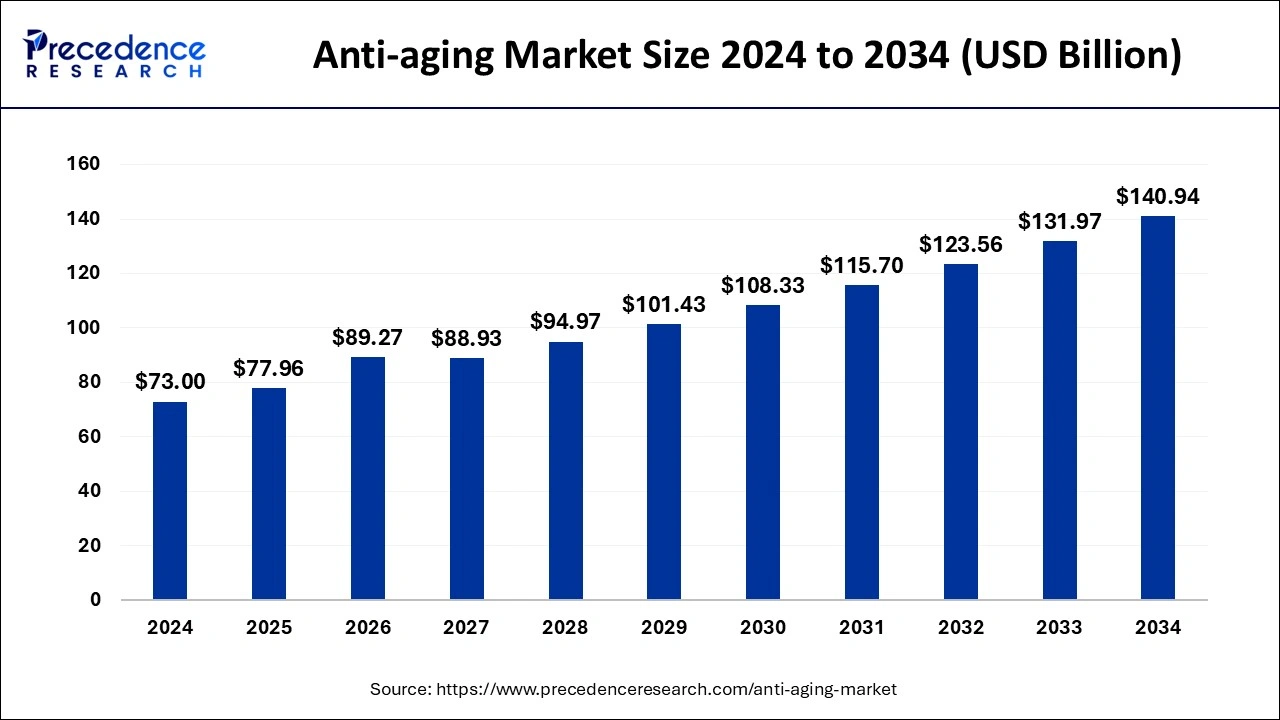
The global Anti-Aging Market was valued is projected to grow from USD 83.21 billion in 2026 to USD 149.54 billion by 2035, expanding at a CAGR of 6.73% from 2026 to 2035. Growth is driven by rising beauty consciousness, an aging population, technological advancements, personalized skincare, and increasing demand for non-invasive treatments. North America held the largest share of 40% in 2026, while Asia Pacific is expected to grow at the fastest rate.
Source: https://www.precedenceresearch.com/anti-aging-market
 Get a Sample
 Table Of Content


What is the Anti-aging Market Size?
The global anti-aging market size is predicted to increase from USD 83.21 billion in 2026 to approximately USD 149.54 billion by 2035, expanding at a CAGR of 6.73% from 2026 to 2035. The global anti-aging market growth is attributed to the rising technological advancements through biotechnology and genomics.
Key Takeaways
- Global aesthetic procedures reached approximately 38 million in 2026, including around 20.5 million non-surgical procedures.
- Botulinum toxin and hyaluronic acid fillers were two of the largest non-surgical categories, with approximately 7.8 million and 6.3 million procedures, respectively.
- Anti-aging skincare is one of the broadest addressable categories because of its high consumer penetration and recurring purchase cycle.
- Medical aesthetics is a higher-value, more treatment-intensive segment, increasingly supported by repeat-treatment economics rather than one-time purchases.
- Premiumization is creating multiple pricing tiers, with willingness to pay increasingly linked to perceived efficacy and clinical evidence.
- Value capture is increasingly determined by control over formulation or treatment technology, clinical credibility, practitioner access, and customer relationships.
- The competitive landscape is highly fragmented, as no single company controls the full ecosystem across skincare, aesthetics, devices, supplements, and longevity.
- Company-wide revenue, such as that of L'Oréal, Galderma, and AbbVie, should not be treated as direct anti-aging market share because many companies operate across multiple categories.
- Crown Laboratories' acquisition of Revance illustrates how M&A is being used to accelerate capability acquisition across aesthetic and therapeutic dermatology.
- North America and Europe provide mature demand, while Asia Pacific adds consumer and treatment growth through rising disposable income and aesthetic acceptance.
- Base, upside, and downside scenarios run through 2036 across product categories, procedures, technologies, consumer groups, and geographies.
Market Size & Forecast - Aging Demographics and Preventive Wellness Support Sustained Market Expansion
The market's growth is not dependent on a single product category. Skincare continues to be a big revenue generator, with medical aesthetics, ingestible beauty, at-home devices and longevity products growing the addressable market. As consumer receptivity to using topicals with professional care grows, this is also fostering a more seamless age-management system.
The analysis further quantifies the market by product category, treatment type, technology, consumer age group, gender, application, distribution channel, and geography.
Key Coverage
- 2026 market baseline and 2035 forecast
- Historical growth and forecast CAGR
- Incremental revenue opportunity
- Regional market contribution
- Segment-level growth comparison
- Market maturity and penetration analysis
Segmentation Analysis - Skincare Leads the Broad Consumer Base While Aesthetics and Longevity Expand Premium Revenue Pools
The anti-aging market is segmented across skincare, medical aesthetics, ingestible products, hair and scalp solutions, devices, and longevity-oriented interventions, with additional segmentation by application, consumer demographic, distribution channel, and geography.
Anti-aging skincare represents one of the broadest addressable categories because of its high consumer penetration and recurring purchase cycle. Products including moisturizers, serums, sunscreens, retinoid-based formulations, peptides, antioxidants, and barrier-support products benefit from daily or near-daily usage.
Medical aesthetics represents a higher-value but more treatment-intensive segment. The higher transaction value and clinic visits for injectables, energy-based procedures, skin resurfacing, skin tightening and regenerative aesthetic treatments result in increased clinic visits, etc.
The market is also seeing increasing convergence between beauty and wellness. Supplements, nutrition, sleep and exercise supplements, and longevity supplements are now being considered by consumers within a wider picture of maintaining appearance and functional health.
By application, the market is divided between preventive anti-aging, which attracts younger consumers through sun protection, collagen-support products, and early aesthetic treatments, and corrective anti-aging, the more conventional positioning of the category. By consumer age group, demand spans younger consumers adopting preventive routines and older consumers, including the population aged 60 years and above, while gender segmentation covers female and male consumers.
By price tier, mass-market skincare competes through accessibility, brand recognition, and broad distribution, while premium skincare supports higher price points through advanced active ingredients, clinical positioning, and personalization. Ingestible and wellness products include supplements, nutrition, sleep and exercise supplements, and longevity supplements.
Key Coverage
- Product and treatment segmentation
- Skincare versus professional aesthetics
- Injectables and energy-based technologies
- Supplements and ingestible beauty
- Home-use devices
- Longevity and preventive wellness products
- Preventive versus corrective applications
- Mass-market versus premium price tiers
- Demographic, age group, and gender segmentation
- Distribution channel and geographic segmentation
Which Demand Shifts are Turning Anti-aging From Corrective Beauty into a Broader Age-Management Market?
The structural basis for the market is population aging, and it is expected that the number of people over 60 will grow from about 1 billion in 2020 to 1.4 billion in 2030 and 2.1 billion in 2050. But no longer are the older consumers the ones mostly affected by the demand. Anti-aging becomes a more preventative, category that is attracting younger consumers, as well as sun protection, collagen-support products, and early aesthetic treatments, which are increasingly being seen as more preventative than corrective.
Our analysis indicates that premiumization and measurable efficacy are becoming increasingly important determinants of consumer demand. Consumers are showing greater willingness to pay for clinically positioned formulations, dermatologist-developed products, advanced active ingredients, personalized regimens, and professional treatments when benefits are clearly demonstrated. Our assessment is that this is raising the importance of clinical evidence, visible outcomes, ingredient transparency, and personalization relative to conventional brand positioning alone.
Medical aesthetics reinforces this shift through the growing acceptance of minimally invasive procedures and shorter recovery times. With approximately 20.5 million non-surgical aesthetic procedures performed globally in 2026, including around 7.8 million botulinum toxin procedures and 6.3 million hyaluronic acid filler procedures, the market is increasingly supported by repeat-treatment economics rather than one-time purchases. In our view, the most significant implication is that recurring treatment demand can strengthen customer lifetime value and create more predictable revenue opportunities across clinics, manufacturers, and associated service providers.
In addition, the report assesses demand across different age categories, types of products, treatments, and prices, as well as the role of premiumization, frequency of procedures, and the use of advanced technologies. Furthermore, it analyzes buying patterns and geographic segmentation to identify key opportunities and threats in the market. The report differentiates between long-term trends and short-term demand fluctuations and evaluates how the industry can benefit from preventive aging, a personalized approach, non-surgical interventions, and evidence-based segmentation.
How are Premiumization and Treatment Economics Reshaping Pricing Across the Anti-aging Market?
Pricing in the anti-aging market varies significantly by product category, positioning, and delivery model. Mass-market skincare competes primarily through accessibility, brand recognition, formulation claims, and broad distribution, while premium skincare supports higher price points through advanced active ingredients, clinical positioning, formulation technology, personalization, and brand equity. Our analysis indicates that price differentiation is increasingly linked to perceived efficacy rather than product category alone, making clinical evidence, ingredient quality, and visible outcomes important drivers of willingness to pay.
Professional aesthetics operates under a different pricing structure, as transaction values depend on more than the product or procedure itself. Key factors include practitioner expertise, treatment complexity, product dosage, technology costs, clinic location, treatment frequency, and ongoing maintenance requirements. Injectables and device-based procedures can therefore generate substantially higher transaction values than conventional topical products. Our assessment is that recurring treatment requirements further strengthen the economics of professional aesthetics, as repeat procedures can increase customer lifetime value while creating more predictable revenue streams for providers.
In our view, the most significant implication is that premiumization is creating multiple pricing tiers rather than a single upward pricing trend. Consumers may accept higher prices when the perceived benefit is supported by measurable efficacy, professional expertise, advanced formulations, or treatment outcomes, while mass-market products remain important for volume-driven consumption. The report therefore evaluates price positioning, treatment frequency, premiumization, customer acquisition economics, perceived efficacy, and pricing differences across skincare products, injectables, and device-based treatments to identify where higher pricing is supported by underlying consumer and treatment economics.
The analysis further provides a granular assessment of product-level and treatment-level pricing, premium versus mass-market positioning, transaction values, treatment frequency, maintenance requirements, and the relationship between price and perceived efficacy. Where sufficient structured data are available, these pricing variables can also be organized into a dataset by product category, treatment type, price tier, geography, treatment frequency, and other relevant fields, enabling filtering and benchmarking alongside the broader strategic analysis.
Where is Value Being Captured Across the Anti-aging Value Chain, and How is Channel Integration Changing Market Economics?
The anti-aging value chain spans active ingredients, formulation technologies, pharmaceutical-grade materials, device components, and packaging, followed by manufacturers, distributors, retailers, e-commerce platforms, aesthetic clinics, dermatologists, and consumers. This structure creates distinct value pools across topical skincare, injectable products, devices, and professional services. Our analysis indicates that value capture is increasingly determined by control over formulation or treatment technology, clinical credibility, practitioner access, and customer relationships rather than manufacturing capability alone.
The economics become more complex in medical aesthetics, where manufacturers must address manufacturing quality, practitioner training, regulatory compliance, clinical support, and treatment-center penetration in addition to product development. By contrast, skincare companies compete more heavily on formulation innovation, brand development, clinical claims, and distribution reach. Our assessment is that this difference creates structurally different routes to scale: product-led businesses can expand through retail and digital distribution, while aesthetic businesses depend more heavily on professional networks and clinic adoption.
In our view, the most significant shift is the increasing integration of manufacturers, clinics, retailers, and direct-to-consumer channels. Manufacturers developing direct relationships with clinics and consumers can gain greater control over customer engagement and demand visibility, while retailers are expanding private-label and digitally enabled offerings. At the same time, e-commerce and direct-to-consumer channels are widening access to premium skincare and personalized product recommendations. From our assessment, this creates an opportunity for businesses that can combine product differentiation with stronger channel control, while increasing competitive pressure on intermediaries that add limited differentiation.
The report further evaluates value creation and value capture across each stage of the chain, including input materials, formulation, manufacturing, distribution, retail, e-commerce, clinics, professional practitioners, and end consumers. The analysis examines channel economics, integration strategies, distribution reach, clinic penetration, private-label activity, direct-to-consumer adoption, and the role of clinical and practitioner capabilities in determining commercial scalability. Where sufficiently granular information is available, these variables can also be structured by value-chain stage, product category, channel, geography, manufacturing capability, clinic network, and distribution model to support filtering and benchmarking alongside the strategic analysis.
Which Technologies are Most Likely to Expand the Anti-aging Market Beyond Conventional Skincare and Aesthetic Treatments?
Technology development is shifting the anti-aging market toward more targeted, measurable, and personalized interventions. Advanced skincare is increasingly incorporating peptides, retinoids, growth-factor-related technologies, antioxidants, barrier-support ingredients, and biomimetic formulations, while medical aesthetics is expanding across neuromodulators, dermal fillers, biostimulators, radiofrequency, ultrasound, laser, and light-based systems. Our analysis indicates that the key technology shift is not simply the introduction of new ingredients or devices, but the movement toward solutions designed to deliver more specific outcomes with greater control over treatment intensity and results.
Device innovation is increasingly focused on treatment precision, reduced downtime, and broader outpatient applications, while combination treatments are expanding the range of concerns that can be addressed through coordinated interventions. Our assessment is that technologies capable of improving treatment predictability and extending the addressable patient or consumer base are likely to have greater commercial significance than innovations based solely on technical novelty. This is particularly relevant as consumers and practitioners place greater emphasis on visible outcomes, convenience, and measurable efficacy.
Digital technologies are adding another layer through skin analysis, personalized product recommendations, treatment planning, tele-dermatology, and AI-enabled consumer engagement. In our view, the most significant implication is that personalization can increasingly connect product selection, treatment planning, and ongoing consumer engagement into a more integrated experience. From our assessment, this creates opportunities for companies that can combine formulation or device innovation with data-driven personalization, while also increasing the importance of evidence, user experience, and technology-enabled differentiation.
The report also assesses the technology development trends for ingredient platforms, formulation technologies, aesthetic devices, treatment approaches, combination procedures, personalization technologies, and AI applications. It evaluates technology maturity, commercial relevance, adoption rates, and areas of influence on treatment outcomes and consumer engagement. An overview of the most established and developing technologies is presented, along with an outlook on how new technologies can disrupt the addressable market or treatment economics and differentiate providers.
Key Coverage
- Active-ingredient innovation
- Injectable technologies
- Energy-based aesthetic devices
- Home-use technologies
- Personalized skincare
- AI-enabled skin assessment
- Digital treatment planning
- Product and technology pipelines
How are Regulatory Requirements and Sustainability Standards Reshaping Market Access Across Anti-aging Products and Treatments?
Regulatory requirements differ materially across cosmetics, supplements, medical devices, and pharmaceutical or biologic aesthetic products, creating distinct market-access pathways based on product classification and the nature of claims made. Products positioned around therapeutic or clinical outcomes can face substantially greater regulatory requirements than conventional cosmetics. Our analysis indicates that the boundary between cosmetic positioning and clinically oriented claims is increasingly important to commercial strategy, as stronger efficacy positioning can increase differentiation while also creating additional regulatory obligations.
Medical aesthetics is particularly sensitive to product safety, manufacturing standards, practitioner requirements, labeling, and post-market monitoring. Regulatory differences across the U.S., Europe, Asia Pacific, and emerging markets can influence product launches, approval pathways, practitioner adoption, and the pace of geographic expansion. Our assessment is that regulatory readiness is becoming a market-access capability rather than a compliance function alone, particularly for companies seeking to scale products or procedures across multiple jurisdictions.
Sustainability is adding another dimension to product development and market positioning through increasing attention to packaging reduction, ingredient sourcing, manufacturing practices, refill systems, traceability, and responsible beauty expectations. In our view, the most significant implication is that companies increasingly need to balance product efficacy, safety, regulatory compliance, and environmental positioning rather than optimize any single attribute independently. This creates opportunities for differentiated formulations, packaging models, and sourcing strategies that can demonstrate both performance and responsible production practices.
The report further evaluates regulatory requirements by product category and geography, clinical and therapeutic claims, safety and manufacturing standards, practitioner requirements, labeling, post-market monitoring, ingredient transparency, packaging practices, sourcing, refill models, and sustainability considerations. The analysis assesses how these factors influence market entry, product launches, geographic expansion, innovation priorities, and long-term competitive positioning across established and emerging anti-aging markets.
How is Competition Fragmenting Across the Anti-aging Market as Companies Target Different Value Pools?
The anti-aging competitive landscape remains highly fragmented because no single company controls the full ecosystem spanning skincare, medical aesthetics, devices, supplements, wellness, and longevity products. Competition is therefore distributed across multiple value pools, with participants differentiating through brand strength, clinical capabilities, technology platforms, practitioner access, consumer engagement, and distribution reach. Our analysis indicates that market structure is increasingly defined by category-specific competitive advantages rather than by a single integrated anti-aging business model.
The competitive universe includes L'Oréal, Estée Lauder, Procter & Gamble, Unilever, Beiersdorf, Shiseido, Kao, Amorepacific, Rohto, Galderma, AbbVie, Merz Aesthetics, Revance, Crown Laboratories, Teoxane, InMode, Candela, Cutera, Cynosure, Nu Skin, Amway, Thorne, Elysium Health, and Nestlé Health Science. Their positioning varies materially. Beauty companies derive strength from brand portfolios and global distribution, aesthetic manufacturers from clinical products and practitioner networks, device companies from technology platforms, and wellness players from consumer engagement and subscription-oriented models.
Our assessment is that this fragmentation creates different competitive battlegrounds rather than a uniform market hierarchy. Companies with strong consumer brands can leverage distribution and repeat purchasing, while aesthetic and device businesses depend more heavily on clinical credibility, practitioner adoption, technology differentiation, and treatment economics. Wellness and longevity players compete through engagement, personalization, and broader lifestyle propositions. In our view, the most significant implication is that competitive strength must be assessed against the specific value pool and business model in which each participant operates, rather than through company scale alone.
The report further benchmarks the competitive landscape across market positioning, product and treatment portfolios, technology capabilities, distribution reach, practitioner networks, consumer engagement, geographic presence, strategic initiatives, and category exposure. It also evaluates how companies are positioned across skincare, aesthetics, devices, wellness, supplements, and longevity, providing a structured basis for comparing capabilities, identifying competitive gaps, and assessing areas of strategic expansion. Where sufficiently granular information is available, the competitive dataset can track company, category, product or technology, geography, channel, positioning, and key competitive capabilities to support filtering and benchmarking alongside the strategic analysis.
Which Companies Have the Greatest Exposure to Anti-aging Value Pools, and Why Does Corporate Scale Not Equal Market Share?
Company-level financial performance provides useful evidence of competitive scale, but corporate revenue should not be treated as direct anti-aging market share because many companies operate across multiple categories.
L'Oréal reported approximately €44.05 billion in total sales in 2026, with Dermatological Beauty contributing approximately €7.2 billion. Galderma generated approximately USD 5.21 billion in 2025 sales, including approximately USD 2.57 billion from Injectable Aesthetics, comprising approximately USD 1.47 billion from neuromodulators and USD 1.10 billion from fillers and biostimulators.
AbbVie reported approximately USD 4.86 billion in Aesthetics revenue in 2026, including approximately USD 2.60 billion from Botox Cosmetic and USD 993 million from the Juvederm Collection.
The report separates company-wide revenue from estimated category-specific market share and benchmarks companies by relevant anti-aging submarket.
| Company | Headquarters | Market Position | Core Strength | Major Applications/Segments |
| L'Oréal | France | Global beauty leader | Premium and dermatological skincare portfolio | Skincare, dermatological beauty |
| Estée Lauder | United States | Global prestige beauty leader | Premium anti-aging skincare brands | Premium skincare |
| Procter & Gamble | United States | Global consumer goods leader | Mass-market skincare and distribution scale | Mass-market skincare |
| Unilever | United Kingdom | Global consumer goods leader | Broad skincare brand portfolio | Mass and premium skincare |
| Beiersdorf | Germany | Global skincare specialist | Dermatologist-positioned skincare brands | Skincare, sun care |
| Shiseido | Japan | Global beauty leader | Premium skincare and Asia Pacific presence | Premium skincare |
| Kao | Japan | Beauty and personal care participant | Skincare and personal care products | Skincare |
| Amorepacific | South Korea | Asian beauty leader | Korean skincare innovation | Skincare |
| Rohto | Japan | Consumer health participant | Skincare and ophthalmic consumer products | Skincare |
| Galderma | Switzerland | Dermatology and aesthetics leader | Injectable aesthetics and dermatological skincare | Injectables, skincare |
| AbbVie (Aesthetics) | United States | Aesthetics leader | Botox Cosmetic and Juvederm Collection | Injectables, medical aesthetics |
| Merz Aesthetics | Germany | Aesthetics specialist | Neuromodulators, fillers and energy-based devices | Injectables, devices |
| Revance | United States | Aesthetics specialist | Neuromodulator and aesthetic portfolio | Injectables |
| Crown Laboratories | United States | Dermatology and aesthetics participant | Aesthetic and therapeutic dermatology | Skincare, aesthetics |
| Teoxane | Switzerland | Filler specialist | Hyaluronic acid dermal fillers | Injectables |
| InMode | Israel | Device specialist | Minimally invasive energy-based platforms | Aesthetic devices |
| Candela | United States | Device specialist | Laser and energy-based aesthetic systems | Aesthetic devices |
| Cutera | United States | Device specialist | Energy-based aesthetic systems | Aesthetic devices |
| Cynosure | United States | Device specialist | Laser, light and body-contouring systems | Aesthetic devices |
| Nu Skin | United States | Direct-selling participant | Anti-aging skincare and wellness products | Skincare, wellness |
| Amway | United States | Direct-selling participant | Skincare, nutrition and wellness products | Skincare, supplements |
| Thorne | United States | Supplements specialist | Science-based nutritional supplements | Ingestible, wellness |
| Elysium Health | United States | Longevity specialist | Longevity-oriented supplements | Longevity, ingestible |
| Nestlé Health Science | Switzerland | Nutrition and health leader | Nutrition and wellness products | Supplements, wellness |
Which Competitive Capabilities Matter Most Across the Different Anti-aging Market Segments?
Competitive positioning varies across product and business models. Skincare leaders benefit from broad portfolios, brand recognition, retail access, and marketing scale. Medical aesthetics companies compete more heavily on clinical evidence, product performance, practitioner relationships, treatment economics, and technology differentiation.
The analysis benchmarks leading participants across product breadth, technology, geographic reach, manufacturing capabilities, clinical positioning, distribution, customer access, innovation pipelines, and strategic partnerships.
The report also evaluates which competitive capabilities are most relevant to specific anti-aging subsegments rather than applying a single ranking methodology across the entire market.
Which Strategic Developments and M&A Moves Are Reshaping Competitive Positioning Across the Anti-aging Market?
Strategic activity across the anti-aging market is increasingly focused on portfolio expansion, complementary technology access, distribution strengthening, and broader consumer-health or aesthetic platforms. The acquisition of Revance by Crown Laboratories strengthened the acquirer's position across aesthetic and therapeutic dermatology products, illustrating how M&A can combine complementary product portfolios and capabilities. Our analysis indicates that strategic transactions are increasingly being used to accelerate capability acquisition rather than relying solely on internally developed products and technologies.
Our assessment is that differentiated formulations, aesthetic technologies, consumer brands, clinical capabilities, and distribution networks represent the primary strategic assets attracting acquisition interest. This reflects the fragmented structure of the market, where companies may possess strength in one value pool but require additional capabilities to expand into adjacent categories. We believe this makes portfolio adjacency and capability complementarity important considerations when evaluating strategic transactions.
In our view, the most significant implication is that M&A can influence competitive positioning through both portfolio breadth and greater control across the value chain.
Transactions that combine complementary products, technologies, clinical capabilities, or distribution networks can broaden market access while potentially increasing operational integration. The strategic impact therefore depends not only on transaction size but also on portfolio overlap, geographic expansion, vertical integration, and the ability to leverage existing commercial infrastructure.
The report evaluates strategic developments and M&A across transaction rationale, target capabilities, product and technology overlap, geographic expansion, portfolio adjacency, vertical integration, distribution access, clinical capabilities, and potential effects on market concentration. The analysis also distinguishes capability-driven transactions from portfolio-expansion moves to assess how strategic activity is reshaping competitive positioning across skincare, medical aesthetics, devices, wellness, and related anti-aging value pools.
How Do North America and Europe Sustain Mature Demand While Asia Pacific Drives Consumer and Treatment Growth?
Regional dynamics differ according to demographics, disposable income, aesthetic acceptance, healthcare infrastructure, regulation, and consumer behavior.
North America represents a major revenue pool due to high spending on premium skincare, established aesthetic infrastructure, strong consumer awareness, and high adoption of minimally invasive procedures.
Europe benefits from mature skincare markets, established dermatology and aesthetic practices, and strong demand for premium formulations.
Asia Pacific represents an important growth opportunity due to rising disposable income, expanding middle-class populations, growing beauty expenditure, and increasing acceptance of aesthetic treatments. South Korea, Japan, China, and other markets are also contributing to innovation and consumer-led product development.
The analysis compares regional market size, segment mix, pricing, procedure adoption, consumer behavior, regulatory conditions, and competitive intensity.
Where Can Personalization, Preventive Aging, Combination Treatments, and Longevity Unlock New Revenue Pools?
The market continues to develop beyond conventional anti-wrinkle skincare. Significant opportunities are emerging around personalized skincare, combination aesthetic treatments, skin-health platforms, ingestible beauty, home-use devices, regenerative aesthetics, scalp and hair aging solutions, and longevity-oriented consumer products.
A major white space lies in connecting products and services into integrated age-management programs. Consumers increasingly seek solutions that combine topical products, professional treatments, nutrition, wellness, and personalized guidance rather than relying on a single intervention.
Companies capable of combining clinical credibility, personalization, digital engagement, and recurring revenue models may capture a larger share of this emerging ecosystem.
Which Market Segments and Growth Drivers Could Generate the Greatest Incremental Value in Anti-aging Through 2035?
The anti-aging market is evolving from a predominantly cosmetic category into a broader age-management ecosystem spanning beauty, aesthetics, wellness, and longevity. Under the base case, continued demographic aging, premiumization, preventive skincare, and aesthetic procedure adoption provide multiple demand drivers supporting market expansion through 2035. Our analysis indicates that this diversification of demand is structurally important because growth is increasingly supported by both earlier consumer engagement and more advanced professional interventions.
Our assessment is that future market expansion will depend increasingly on the pace at which emerging technologies translate into commercially accessible products and treatments. An upside scenario could be supported by faster adoption of personalized products, regenerative aesthetics, advanced devices, and longevity-oriented interventions, while tighter regulation, affordability pressures, ingredient constraints, or weaker discretionary spending could moderate growth under a downside scenario. These scenarios highlight the sensitivity of different market segments to consumer spending, regulatory access, technology adoption, and treatment economics.
In our view, the most significant implication is the varying market attractiveness by segment, geography, consumer group, technology, and business model rather than following a uniform growth trajectory. From our assessment, opportunities are likely to be strongest where structural demographic demand intersects with premiumization, preventive behavior, technology adoption, and differentiated treatment or product economics. The report therefore evaluates both established value pools and emerging opportunities while distinguishing structural growth drivers from scenario-dependent upside.
The full analysis assesses base, upside, and downside scenarios through 2035 across product categories, aesthetic procedures, technologies, consumer groups, and geographic markets. It evaluates market attractiveness using indicators such as growth potential, demand drivers, technology adoption, consumer behavior, regulatory conditions, competitive intensity, and value-creation opportunities, identifying the segments and business models with the strongest potential for incremental market value under each scenario.
Key Strategic Questions Addressed
- What is the size of the anti-aging market?
- What are the major segments of the anti-aging market?
- What is driving growth in the anti-aging market?
- Which region holds a significant share of the anti-aging market?
- What are the key trends in the anti-aging market?
- Who are the leading companies in the anti-aging market?
- What is the outlook for the anti-aging market through 2036?
Anti-aging Market Segments
By Product /Treatment Category
- Anti-Aging Skincare
- Medical Aesthetics
- Injectables
- Energy-Based Devices
- Ingestible Beauty and Longevity Products
- Hair and Scalp Solutions
- Home-Use Anti-Aging Devices
By Skincare Product Type
- Moisturizers
- Serums
- Sunscreens
- Retinoid-Based Formulations
- Peptides
- Antioxidants
- Barrier-Support Products
By Technology / Treatment
- Neuromodulators (Botulinum Toxin)
- Dermal Fillers (Hyaluronic Acid)
- Biostimulators
- Radiofrequency
- Ultrasound
- Laser
- Light-Based Systems
- Skin Resurfacing
- Skin Tightening
- Regenerative Aesthetic Treatments
By Distribution Channel
- Retailers
- E-Commerce and Direct-to-Consumer
- Aesthetic Clinics
- Dermatologists
By Region
- North America
- Europe
- Asia Pacific
For inquiries regarding discounts, bulk purchases, or customization requests, please contact us at sales@precedenceresearch.com
Frequently Asked Questions
Tags





Ask For Sample
No cookie-cutter, only authentic analysis – take the 1st step to become a Precedence Research client
 Get a Sample




 sales@precedenceresearch.com
 Schedule a Meeting