



Predictive Maintenance Market Size, Digital Transformation, Technology Investment, Adoption Rates, Customer Acquisition, and Competitive Landscape
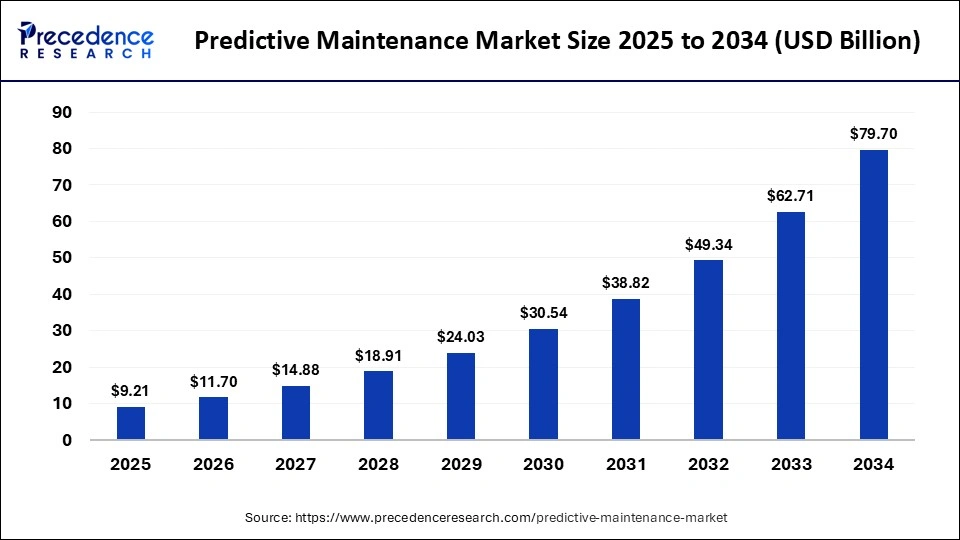
The global predictive maintenance market was estimated at USD 9.21 billion in 2025 and is projected to reach approximately USD 94.27 billion by 2035, expanding at a CAGR of 26.19%. The predictive maintenance market growth is driven by rising adoption of AI, IoT, machine learning and advanced analytics, increasing demand for real-time equipment monitoring, and the need to reduce downtime and maintenance costs.
Source: https://www.precedenceresearch.com/predictive-maintenance-market
 Get a Sample
 Table Of Content


What is Predictive Maintenance Market Size?
The global predictive maintenance market size accounted for USD 9.21 billion in 2025 and is anticipated to reach around USD 94.27 billion by 2035, growing at a CAGR of 26.19% between 2026 to 2035 The predictive maintenance market is driven by rising adoption of artificial intelligence, Internet of Things (IoT), machine learning and advanced analytics to enable real time monitoring of equipment.
Market Highlights
- By component, the solutions segment will have the largest market share from 2026 to 2035
- By deployment mode, the cloud-based segment is expected to have the highest CAGR from 2026 to 2035, and the segment has dominated the market in 2025.
- By organization size, large enterprises have the largest market share by 2032 and are expected to grow with the highest CAGR from 2026 to 2035
- The North American region is expected to grow well during the forecast period from 2026 to 2035.
Market Overview
Many maintenance methods are designed in order to understand and analyze the condition of awful working equipment in an organization edit helps in analyzing or predicting the requirement of maintenance for the equipment. Rapid urbanization and digitalization across many countries in the globe is creating demand for put work in maintenance methods. By predicting the time period when the maintenance for equipment is required the breakdown of a machine can be avoided. Across all the developing nations and developed nations, there is a growing demand for reducing the maintenance cost of industrial equipment and this factor is expected to drive market growth during the forecast period.
During the pandemic due to disrupted supply chains and stringent laws for social distancing, the manufacturing capacity had reduced to a great extent. Due to a shortage of supply of various hardware which is required for the maintenance of the equipment the growth of this market had reduced. The COVID-19 pandemic had largely affected the predictive maintenance market. Just like all the other sectors the IT infrastructure had also seen a negative impact during the pandemic.
Not just the IT industry but many other industries were affected as manufacturing was reduced to a great extent. Predictive Maintenance is extremely important in most manufacturing companies and offshore oil and gas industries because if at there is a breakdown of equipment the manufacturing will be hampered and the operation and maintenance cost will it be high which will affect the market. As predictive maintenance in decreases maintenance costs and due to this reason the market is expected to grow during the forecast period.
Why is AI Integral to Predictive Maintenance Solutions?
Artificial Intelligence is changing the landscape of the overall ICT domain. AI has been integrated into predictive maintenance solutions to enhance data analysis capabilities and predict early failures in equipment. Also, the integration of AI in predictive maintenance systems helps in enhancing real-time detection, automating scheduling, and improving anomaly detection processes. Moreover, numerous AI developers are investing significantly to develop AI-enabled predictive maintenance solutions to cater to the end-user industries across the globe.
- In October 2025, Webfleet partnered with Questar. This partnership is aimed at launching an AI-based predictive maintenance solution for enhancing fleet management.
Predictive Maintenance Market Growth Factors
Most of industrial organizations and businesses the most important priorities are to improve the performance of the industry to increase the reliability of the equipment in order to provide a safe environment for the workers. Organizations are supportive of predictive maintenance because it helps in providing them with the highest return on most of their critical assets. taking keen interest on maintaining their existing equipment and maximizing the return all this equipment or through use of this equipment as it helps in reducing the overall cost to the industry. Companies are taking efforts in order to use their resources to cut down the cost in manufacturing a product. Organizations are adopting predictive maintenance in order to reduce the operational cost or to refrain from buying new equipment in case the old ones break down. All of this software designed by different companies are extremely helpful in providing notifications her guarding the upcoming maintenance of all the equipment.
Early diagnosis of the equipment switch needs maintenance in the future is issued at least a few weeks or months before the actual damage could happen to the equipment. This software is designed in such a way as the diagnose the issues with the equipment overhead of their breakdown. All of the manufacturing industries find predictive maintenance solutions extremely important as they help in reducing equipment downtime. The use of this software helps in increasing the reliability on this equipment and predictive maintenance helps in reducing the expenditure which could be incurred on the maintenance of these vehicles which in turn helps in increasing productivity. Owing to all of these reasons the market is expected to see growth in the future. Any sort of problem with the equipment in the manufacturing industry disrupts all of the functions. Factoring industries and extremely competitive industries and just like all other sectors the manufacturing sector it's always striving to function in a way to meet the increasing demands of the customers. The equipment needs to be efficient in order to meet the production requirements. The use of predictive maintenance software or solutions will help in achieving efficiency. Predictive maintenance solutions are able to monitor the possibilities of failure in any equipment. The use of these solutions helps in maximizing the output of the devices by deploying the available limited resources.
The satisfaction of the stakeholders is also improved with the use of these solutions as they help in enhancing productivity and quality. Most of the developed economies have adopted predictive maintenance solutions in order to evaluate their assets. The use of artificial intelligence, and big data or providing many opportunities for the growth of this market. There's an increasing demand for product maintenance solutions across a lot of medium-scale enterprises and small-scale enterprises in developing as well as developed nations. Predictive maintenance solutions are used to cross many sectors like retail E-commerce, telecommunication, government and public sectors, financial sectors, and insurance sectors. The use of these solutions helps in providing real-time data which assists in prompt actions from the manufacturers. Increased use of the solutions across all industries in the globe it's due to the growing awareness of these solutions and their reliability.
Market Trends
- Growth in industrial IoT - Industries are increasingly adopting industrial IoT, which increases the use of connected sensors that capture temperature, vibrations, pressure, and enable greater visibility into asset health and help in detecting potential problems before occurring.
- AI powered predictive analytics - Artificial intelligence and machine learning are the central parts of predictive maintenance. These help companies in identifying abnormal equipment behaviour, forecasting component degradation, estimating potential risks and improving maintenance timing.
- Shift towards edge computing - Industries are shifting towards edge computing due to more predictive maintenance workload. Processing data locally can support quicker alerts and decisions while reducing dependence on continuous cloud connectivity.
Market Outlook
- Industry growth overview - The predictive maintenance market is rising due to manufacturers and asset intensive industries adopting IoT, artificial intelligence and analytics to reduce downtime and control maintenance costs.
- Global expansion - The adoption of predictive maintenance is spreading across China, India, Brazil, and the Middle East due to increasing industrial modernization and Industry 4.0 adoption.
- Major Investors - Established technology companies and industrial players are investing in industrial IoT, edge computing, and digital twins. Major investors in the market include Bessemer Venture Partners, Baillie Gifford, Revolution, Armira and Sabre Partners.
- Startup ecosystem - The startup ecosystem in the market is focused on developing specilaized solutions for machine monitoring, AI diagnostics and robotic based inspections.
Market Scope
| Report Coverage | Details |
| Market Size in 2025 | USD 9.21 Billion |
| Market Size in 2026 | USD 11.70 Billion |
| Market Size by 2035 | USD 94.27 Billion |
| Market Growth Rate from 2026 to 2035 | CAGR of 26.19% |
| Dominating Region | North America |
| Fastest Growing Region | Asia Pacific |
| Base Year | 2025 |
| Forecast Period | 2026 to 2035 |
| Segments Covered | Type, Installation Type, Material, Application, Voltage Rating, End user, Insulation Material, and Region |
| Regions Covered | North America, Europe, Asia-Pacific, Latin America, and Middle East & Africa |
Market Dynamics
Drivers
Data management and analysis is a process that requires human intervention, however, decision-making is mostly a manual process as artificial intelligence cannot rule out the conditions for the selection of the correct alternative. Here the important role comes in when the investigation of large quantities of data begins. This data needs to be reformulated into a predictive format. Various technological industries are making efforts to perform analysis with the help of artificial intelligence which will help to ease out the process of data interpretation. This in turn helps to obtain direct insights from the system. This system provides multiple industries to opt for artificial intelligence in order to interpret the information accurately. The introduction of cloud technology and machine-to-machine transfer for information has propelled the need for revaluation of the data received from industries, cameras, and sensors. However, this system does not supply information on its own without being fed into the system in a tangible format.
Restraints
With the increasing advancements in predictive fatigue maintenance, the market is demanding for an experienced and skilled workforce. An expert system in the field of networking, application, and cybersecurity is the need of the hour which is required to be developed by the industries. The operational cost of the final work to be done will be reduced to a great extent with the development of these technologies. The Internet of things needs to be browsed for having an estimate regarding the outcomes in order to prevent failures and optimize the results by developing the latest technologies that are competent to supply a strong analysis. These processes mainly include heavy use of artificial intelligence along with ML. Expert employees are essential for dealing with artificial intelligence-based technologies and IoT data. Hence the training of the current workforce as per the technological advancements becomes the need of the hour for the developing market to record considerable growth during the forecast period.
Opportunities
Proper data interpretation and management of information has become a very important function with the increasing adoption of artificial intelligence pertaining to the absence of human intervention in certain sectors of the market. With the recent adoption of artificial intelligence, a huge amount of data can be processor in a fraction of a second and can be converted into product information. This information can be combined with the internet of things to produce data. The Internet of things can be clubbed with artificial intelligence to obtain quality services and hence deliver the same. The inclusion of artificial intelligence in the core system of the companies will further help in the technology to develop as the market grows. The constant increase in the large size of data created and cloud technology helps to enhance in the handling of the information. The need for export and skilled labor force helps to create multiple employment opportunities for the population.
Challenges
With the inclusion of newly developed technology the company software also needs to be updated. The company systems need to be developed at par with the existing technology. With the increasing adoption of new technologies, the complexity in maintaining these systems also increases, which in turn challenges the market to keep up with the pace of its peers. The constantly altering business uncertainties are challenging the companies as they need to update their artificial intelligence system in order to extract meaningful data having a high rate of accuracy.
Segment Insights
Component Insights
On the basis of components, the solutions segment in the predictive maintenance market will have the highest market share during the forecast period. The segment has seen significant growth in recent years. The solution segment is expected to grow well during the forecast period as it is extremely important in predicting the failure of the equipment in the future. Solutions are designed in a way that helps in identifying the cause of failure in the equipment. Increasing adoption of productive maintenance solutions by various sectors like the banking and financial sectors, manufacturing sectors, health care sector, etc is expected to drive the market during the forecast period.
Continuous development in cloud technology call mom machine to machine communication and big data have efficiently provided new possibilities for analyzing the information which is derived from the industrial equipment. The users are able to gain valuable data which helps them in making sound decisions regarding the maintenance of the equipment. However the shortage of skilled workforce or trained technicians could hamper the growth of the market. The lack of a skilled workforce is hampering the growth of the solutions segment as many industries are planning to adopt productive maintenance solutions. The solution segment induces prompt actions relating to the equipment. The services-based segment is expected to grow well during the forecast period.
Deployment Mode Insights
On the basis of the mode of deployment, the cloud-based segment is expected to have the highest compound annual growth rate during the forecast. The segment has dominated the market in the past. The use of the cloud-based deployment mode helps in providing cost benefits to organizations. Cloud-based segments are extremely cost-effective as all the information is stored in a cloud and there is no need for a lot of maintenance at the premise where the software is used. In the case of cloud-based solutions, the cost of employing expert technicians for maintenance is cut down. in the case of the on-premise segment the need for having expert technicians increases.
Training these technicians to handle the maintenance of the software solutions leads to an increase in operational costs. As all of these costs are significantly cut down in the cloud-based segment it helps in providing a competitive advantage to the organization. The use of cloud-based deployment provides many other benefits like direct control and fast data processing which may not be the case in an on-premise deployment. In the cloud-based segment, the maintenance of data is extremely easy and this segment is expected to see good growth during the forecast period.
Organization Size Insights
On the basis of the size of an organization, large enterprises have the largest market share in the predictive maintenance market and it is expected to grow with the highest compound annual growth rate during the forecast period till the year 2032. In large enterprises, disruption of any of the equipment could lead to a greater impact and the use of predictive maintenance solutions in large enterprises becomes a necessity in order to prevent heavy losses for the company. The use of predictive maintenance solutions in large enterprises also provides a cost-cutting feature as it is able to reduce extra charges on additional maintenance in case the machines break down. There is a growing demand for predictive maintenance solutions in small enterprises and medium enterprises. The use of these solutions is expected to grow in the small enterprises and medium enterprises segment during the forecast period.
Segment Insights
Why Did North America Dominate the Predictive Maintenance Market?
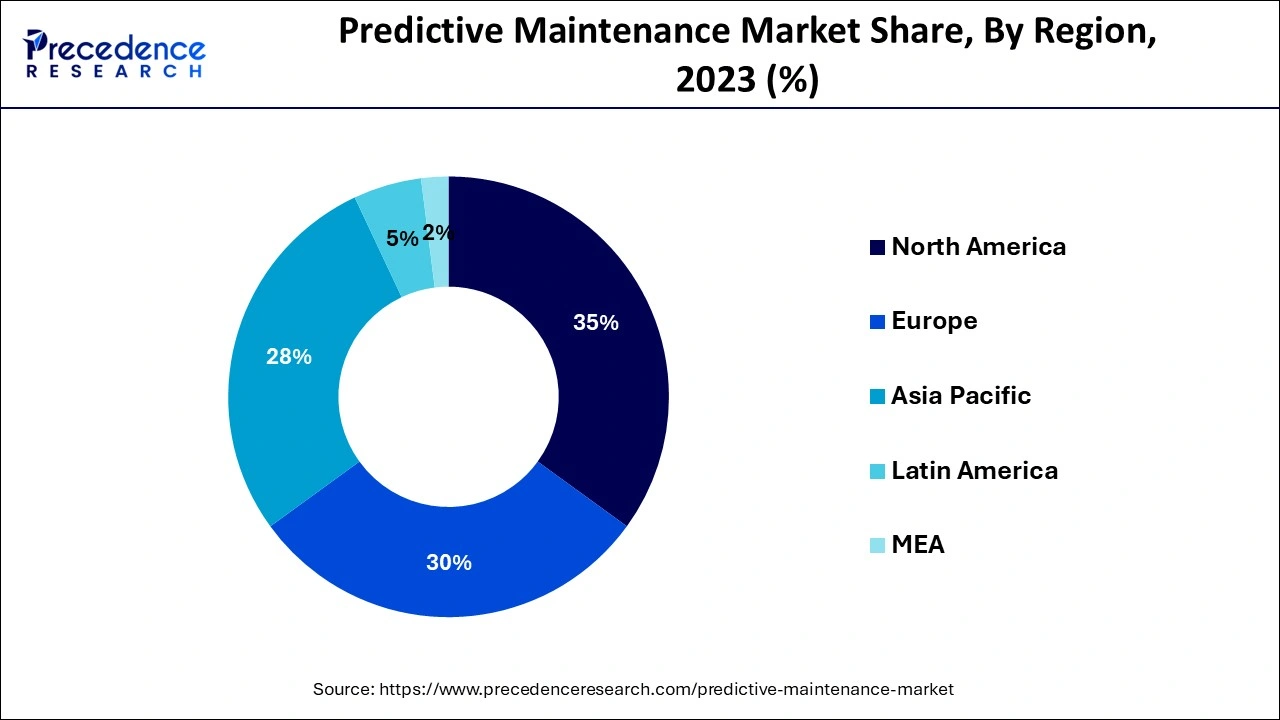
The predictive maintenance market is expected to grow well in the North American region. North American region has dominated the market in the past and is expected to dominate in the coming years. The presence of major market players in the North American region is expected to drive the growth of this market. Due to the increasing technological advancements or developments in this region, the market is expected to see growth. The number of predictive maintenance market players is growing in the North American region.
U.S. Predictive Maintenance Market Size and Growth 2026 to 2035
The United States represents the largest share of the predictive maintenance market in North America. The growth is driven by strong adoption of artificial intelligence, cloud computing, machine learning and industrial Internet of Things (IoT). Aerospace, manufacturing and utilities are the major users of predictive maintenance. Manufacturers are increasingly connecting equipment sensors with analytics to detect failure and reduce unplanned downtime, which helps in reducing operational costs. Centres such as California, Texas and New York are major adopters of predictive maintenance due to their large manufacturing ecosystems.
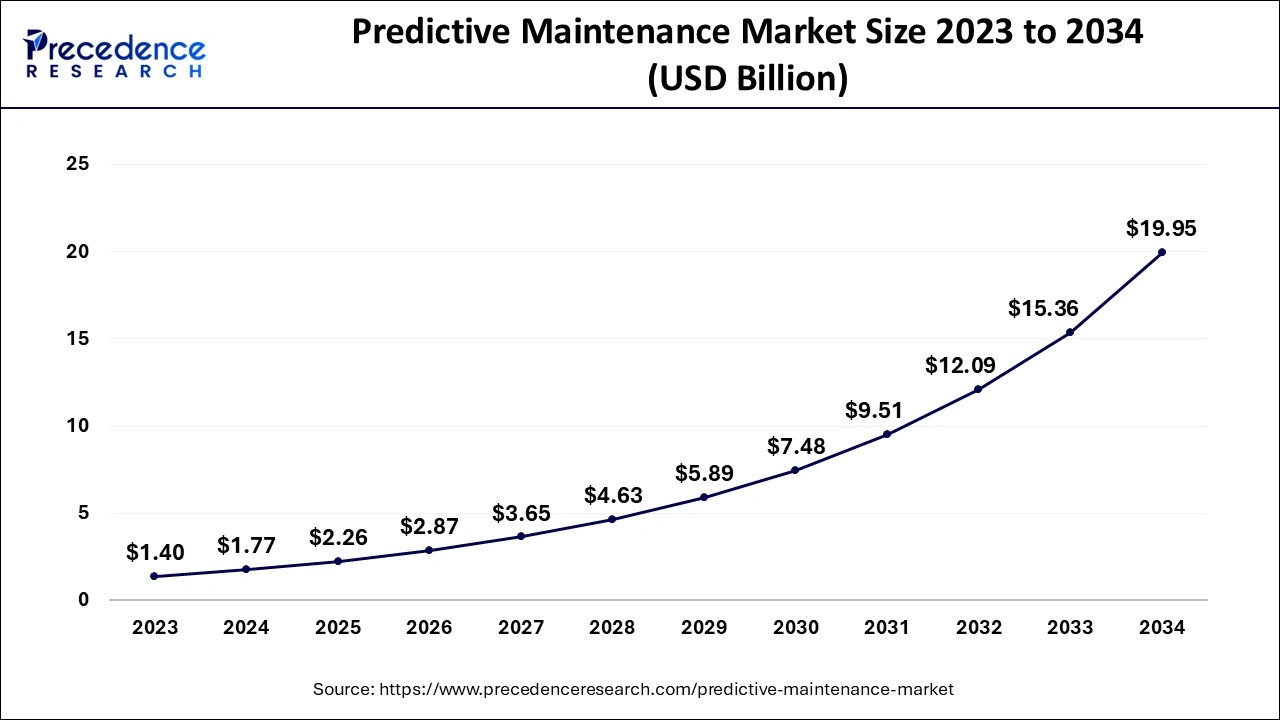
The U.S. predictive maintenance market size is estimated at USD 2.26 billion in 2025 and is expected to be worth around USD 23.66 billion by 2035, growing at a CAGR of 26.47% from 2026 to 2035
What Makes Asia Pacific the Fastest-Growing Region in the Predictive Maintenance Market?
Like the developed nations the developing nations are also seeking technological advancements and innovations to achieve maximum output by maintaining their assets or equipment. There's an increasing demand for maintenance solutions across the Asia Pacific region expected to show steady growth during the forecast period. The use of these solutions across many countries like India, Japan, and China of the Asia Pacific region is due to its reliability and efficiency. Increase in the small and medium-scale manufacturing industries in developing nations like China, and Japan the demand for predictive maintenance solutions is expected to grow in this region. The use of these solutions across many industries and the use of advanced technology is expected to drive the market in the Asia Pacific region during the forecast period. The European market is also expected to grow well durable growth in the number of competitors in this regions
China Market Trends
China accounts for the largest share of the predictive maintenance market in Asia-Pacific in 2025. The growth is driven by growing industrial modernization and smart manufacturing initiatives. The predictive maintenance is increasing adopting across automotive, electronics, machinery, chemicals and other large scale manufacturing industries. The government in the country is promoting smart factory programs, Industry 4.0 and large scale integration of AI, IoT, and industrial analytics across factories. Rising labour costs and the need for higher production efficiency encourage factories to use connected equipment.
What Drives the European Predictive Maintenance Market?
The surging demand for AI-integrated predictive maintenance solutions in the logistics sector in several nations, such as Germany, France, the UK, Italy, and Sweden, is a major factor driving the market within Europe. Moreover, increasing investments by the government for deploying advanced maintenance systems in the defense sector are expected to foster the growth of the market in this region.
Germany Market Trends
Germany leads the European predictive maintenance market in 2025 because predictive maintenance can be easily integrated into its established Industry 4.0 manufacturing models. The wide adoption of predictive maintenance across automotive, machinery, chemicals, and electronics helps with real-time monitoring, which reduces machine downtime and enhances productivity. The country's growth is further driven by its strong engineering base and the presence of major industrial technology development and adoption.
Why is Latin America Considered a Significant Region in the Predictive Maintenance Market?
Latin America is considered a significant region in the market. The growing adoption of system-integrated solutions in large enterprises across various nations, including Argentina, Brazil, and Peru, is reinforcing the region's position in the market. Moreover, technological advancements in the manufacturing sector are expected to propel the growth of the market in this region.
Brazil Market Trends
Brazil accounts for the largest share of the Latin American predictive maintenance market in 2025, as manufacturers are increasingly investing in Industry 4.0, industrial IoT, cloud computing and artificial intelligence. The growing use of connected sensors enables real time monitoring and helps in identifying potential failures before breakdown. Industries such as mining, oil and gas, energy, metals, and pulp and paper are increasingly deploying predictive maintenance to improve operational efficiency, to prevent failure of expensive equipment and minimize downtime.
How is the Opportunistic Rise of the Middle East & Africa in the Predictive Maintenance Market?
The Middle East & Africa (MEA) is expected to grow at a lucrative rate during the forecast period. This growth is driven by the rapid deployment of cloud-based predictive maintenance solutions in the life sciences industry across numerous countries, including the UAE, Saudi Arabia, South Africa, and Qatar. Additionally, numerous government initiatives aimed at developing advanced technologies and the rapid expansion of SMEs are expected to contribute to the market.
Saudi Arabia Market Trends
Saudi Arabia represents the leading market within the Middle East and Africa predictive maintenance market in 2025, supported by its oil and gas, petrochemicals, utilities, manufacturing and large infrastructure projects. Industries are adopting connected devices, integration of artificial intelligence, IoT, automation, and AI analytics to improve asset reliability, reduce maintenance costs and increase operational efficiency. The National economic diversification and smart infrastructure projects encourage the use of advanced industrial technologies.
Competitive Landscape
The predictive maintenance market is highly competitive, with established technology and industrial companies competing through AI, IoT, cloud platforms and asset management solutions. The key players in the market include IBM Corporation, Siemens, Rockwell Automation, Honeywell International Inc, General Electric Company, Cisco Systems, Inc., Microsoft, Robert Bosch GmbH and Schneider Electric SE. IBM Corporation and Siemens remain leaders in the predictive maintenance market due to their strong enterprise software, industrial automation and established customer base.
For future growth in the predictive maintenance market, companies should focus on more accurate AI models, industrial systems, easy integration, strong cybersecurity and affordable solutions for small and medium sized businesses to increase adoption.
Top Companies in the Predictive Maintenance Market and Their Offerings
- IBM Corporation - A United States based company grown from computing equipment into a major enterprise technology provider.
- Key offerings - IBM Maximo Application Suite, which combines asset management, IoT data, AI driven analytics and maintenance planning.
- Microsoft Corporation - A United States based global cloud and enterprise technology provider.
- Key offerings - Microsoft Azure AI, Azure IoT, and Azure Digital Twins
- SAP SE - A German company that became one of the world's leading enterprise software companies.
- Key offerings - SAP Predictive Asset Insights Solution, which integrates predictive analytics and machine learning into Enterprise Resource Planning (ERP).
- Siemens AG - A Germany based industrial engineering and automation company.
- Key offerings - Siemens Xcelerator, Senseye Predictive Maintenance.
- General Electric (GE Vernova / GE Digital) - A United States based company that expanded its predictive maintenance capabilities through partnerships involving robotics and cloud technology.
- Key offerings - provides SmartSignal predictive maintenance software platform via GE Digital,
Predictive Maintenance Market Companies
- Microsoft(US)
- Google (US)
- SAP(Germany)
- Splunk (US)
- IBM(US)
- Oracle (US)
- OPEX Group (UK)
- GE (US)
- Schneider Electric (France)
- AWS (US)
- SAS Institute (US)
- Software AG (Germany)
- TIBCO Software (US)
- Hitachi (Japan)
- HPE (US)
- Altair (US)
- PTC (US)
- RapidMiner (US)
- Dingo (Australia)
Reccent Development
- In July 2026, Razor Labs, a global leader in AI powered predictive maintenance for mining, launched DataMind AI™ 5.0, a major evolution of its predictive maintenance platform, which will expand predictive maintenance to support the complete maintenance decision making process. This platform bridges the gap between early data warning and field execution for mining operations.
- In January 2026, CellVoyant launched FateView. FateView is an online predictive cell analytics platform designed to accelerate the drug development process.
(Source: https://www.selectscience.net) - In December 2025, Treon launched an AI-enabled predictive maintenance solution. This solution is designed for checking the anomalies in material handling equipment. (Source: https://equipmentfinancenews.com)
- In May 2025, Augury launched an AI-based predictive maintenance solution. This solution is designed to prevent failures in slow-rotating machinery.
(Source: https://inspenet.com)
Key Market Developments
- SAS Institute launched its SAS Viya platform in May 2021. This solution helped in providing information and analysis efficiency by integrating data management solutions into its other cloud solution the SASViya platform which will be a boon to the users.
- TIBCO Data Virtualization and TIBCO EBX were launched in May 2021 by TIBCO Software. This software is important as they provide the users with a great amount of data potential.
Segments Covered in the Report
By Component
- Solutions
- Integrated
- Standalone
- Service
- Managed Services
- Professional Services
- System Integration
- Support and Maintenance
- Consulting
By Deployment Mode
- On-premises
- Cloud
- Public Cloud
- Private Cloud
- Hybrid Cloud
By Organization Size
- Large Enterprises
- Small and Medium-sized Enterprises (SMEs)
By Vertical
- Government and Defense
- Manufacturing
- Energy and Utilities
- Transportation and Logistics
- Healthcare and Life Sciences
By Region
- North America
- Europe
- Asia-Pacific
- Latin America
- Middle East & Africa (MEA)
For inquiries regarding discounts, bulk purchases, or customization requests, please contact us at sales@precedenceresearch.com
Frequently Asked Questions





Ask For Sample
No cookie-cutter, only authentic analysis – take the 1st step to become a Precedence Research client
 Get a Sample




 sales@precedenceresearch.com
 Schedule a Meeting
