



3D IC and 2.5D IC Packaging Market Size, Key Companies, Company Market Share, Chip Production Volume, Wafer Capacity, Technology Adoption, Pricing Trends, Competitive Positioning, and Demand Analysis
3D IC and 2.5D IC Packaging Market (By Packaging Technology: 3D Wafer-Level Chip-Scale Packaging (WLCSP), 3D Through-Silicon Via (TSV), 2.5D; By Application: MEMS/Sensors, Logic, Imaging & Optoelectronics, Memory, LED, Others (Power, Analog & Mixed Signals, RF, Photonics); By End Use: Consumer Electronics, Industrial, Telecommunications, Automotive, Military & Aerospace, Medical Devices) - Global Industry Analysis, Size, Trends, Leading Companies, Regional Outlook, and Forecast 2026 to 2035
Source: https://www.precedenceresearch.com/3d-ic-and-25d-ic-packaging-market
 Get a Sample
 Table Of Content


What is the 3D IC and 2.5D IC Packaging Market Size?
The global 3D IC and 2.5D IC packaging market size accounted for USD 66.96 billion in 2025 and is predicted to increase from USD 74.15 billion in 2026 to approximately USD 182.76 billion by 2035, expanding at a CAGR of 10.56% from 2026 to 2035. The increasing production of compact and high-performance electronic devices is expected to boost the growth of the market during the forecast period.
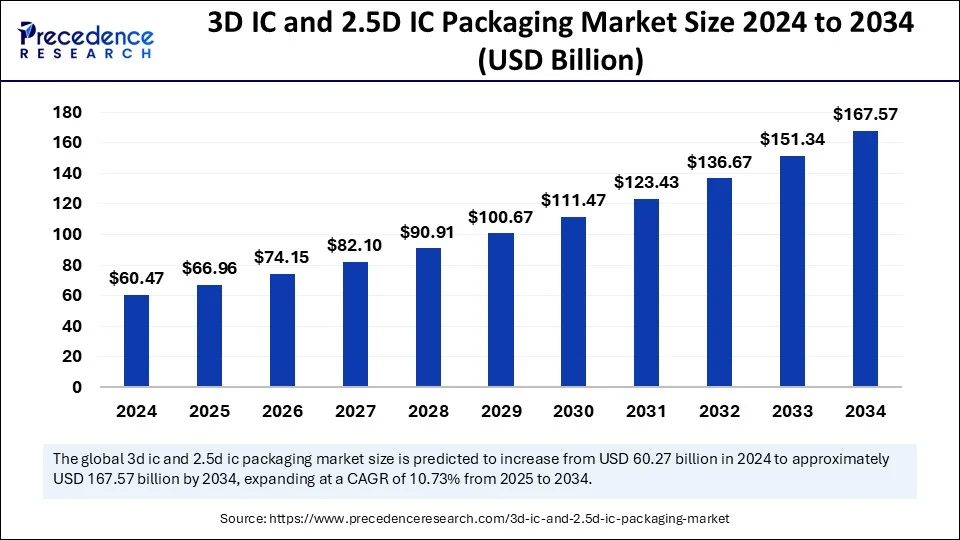
3D IC and 2.5D IC Packaging Market Key Takeaways
- Asia Pacific dominated the 3D IC and 2.5D IC packaging market in 2025.
- North America is expected to witness the fastest growth during the forecast period.
- By packaging technology, the 3D wafer-level-chip-scale packaging (WLCSP) segment captured the biggest market share in 2025.
- By application, the MEMS/Sensors segment held the largest market share in 2025.
- By end use, the consumer electronics segment led the market in 2025.
What is the 3D IC and 2.5D IC Packaging?
The 3D IC packaging consists of the integration of multiple layers or vertical stacking of dies, which helps create a three-dimensional structure. On the other hand, the 2.5D IC packaging is the integration of multiple chips or dies with a silicon interposer or organic substrate. Ongoing advancements in semiconductor packaging technologies are one of the key factors boosting the growth of the 3D IC and 2.5D IC packaging market. These packaging solutions are easy to integrate into the complex and smaller architecture of the electronics devices. There is a rising demand for consumer electronics, which is boosting the growth of this market. In addition, the rising government initiatives to boost the production of semiconductors directly impact this market's growth.
Impact of AI on the 3D IC and 2.5D IC Packaging Market
Artificial intelligence (AI) plays a significant role in the development of 3D IC and 2.5D IC packaging. AI technology helps in identifying new materials, which can help enhance the quality, reliability, and performance of these IC packaging solutions. AI and machine learning (ML) algorithms can help accelerate the research and development processes. These algorithms analyze huge amounts of data to find materials or compositions that suit specific applications. It helps in evaluating novel materials through data analysis for enhanced packaging solutions. AI-based systems can assist in manufacturing, improving production output. AI also automates tedious tasks and reduces errors, ensuring that the packaging meets stringent quality standards. With AI's predictive maintenance capabilities, it is possible to identify flaws in manufacturing processes and avoid sudden disruptions. AI tools can help maintain consistent quality as any defect is quickly identified in real time. AI technology helps optimize operations, accelerate R&D activities, enhance efficiency, and maintain quality, further boosting this market's growth.
3D IC and 2.5D IC Packaging Market Growth Factors
- The growing adoption of high-end computing, data centers, and advanced technologies across various industries is boosting the growth of the market.
- Advancements in semiconductor manufacturing technologies further boost market growth.
- The increasing demand for semiconductors all over the world is propelling the growth of this market.
- The rising production and adoption of consumer electronics worldwide are driving the growth of the market.
- The growing demand for high-performance and smart electronics contributes to market growth.
- The rising semiconductor research and development supports market expansion.
Market Outlook
- Industry Growth Overview: The need to vertically stack and integrate heterogeneous chiplets to meet AI computing and mobile innovation requirements increases the demand.
- Sustainability Trends: Environmentally friendly high-density semiconductor package solutions are supported by an energy-saving process and better thermal conductivity.
- Major investors: TSMC, Intel, Samsung Electronics, SK Hynix, ASE Technology, Amkor Technology, Broadcom, and STMicroelectronics are investing a lot of money in next-generation packaging techniques.
Market Scope
| Report Coverage | Details |
| Market Size by 2035 | USD 182.76 Billion |
| Market Size in 2025 | USD 66.96 Billion |
| Market Size in 2026 | USD 74.15 Billion |
| Market Growth Rate from 2026 to 2035 | CAGR of 10.56% |
| Dominated Region | Asia Pacific |
| Fastest Growing Market | North America |
| Base Year | 2025 |
| Forecast Period | 2026 to 2035 |
| Segments Covered | Packaging Technology, Applications, End Use, and Regions. |
| Regions Covered | North America, Europe, Asia-Pacific, Latin America and Middle East & Africa |
Market Dynamics
Drivers
Growing Demand for High-Performance Consumer Electronics
The rising demand for high-performance consumer electronics is a key factor driving the growth of the 3D IC and 2.5D IC packaging market. 3D IC and 2.5 D IC packaging enable the stacking of multiple semiconductor chips, improving processing power and memory bandwidth. This further enhances the overall performance of electronic devices. With the rising penetration of internet services all over the world, the adoption of consumer electronics such as smartphones, tablets, gaming consoles, wearables, and laptops is increasing rapidly. For instance, in the third quarter of 2024, smartphone shipments reached 46 million units, with 5.6% year-over-year growth in India alone. As the production and adoption of consumer electronics rise, so does the need for semiconductors, which significantly boosts the demand for 3D IC and 2.5 IC packaging. In addition, the growing trend of miniaturization in electronic devices drives market growth. As electronic devices become more compact, the 3D IC and 2.5D IC packaging emerge as an ideal solution to improve devices' performance and efficiency.
Restraint
Technical Challenges
The technical challenges involved in manufacturing processes are the major factors limiting the growth of the 3D IC and 2.5D IC packaging market. 3D IC and 2.5D IC packaging techniques are used to combine various chips into one pack. However, combining different technologies into one package creates heat dissipation and power management challenges. Moreover, ensuring the compatibility and reliability of these packaging is challenging. The manufacturing processes of these packaging are complex, requiring specialized equipment. This, in turn, increases the production costs, limiting the market growth.
Opportunity
Focus on Sustainability
Stringent regulations regarding environmental sustainability are encouraging electronic device manufacturers to focus on sustainable practices. This, in turn, boosts the demand for 3D IC and 2.5 IC packaging. This packaging led to the development of power-efficient devices, reducing energy consumption and carbon emissions. Moreover, 3D IC and 2.5 IC packaging increase the lifespan of consumer electronics by reducing the replacement of semiconductor chips and overall weight. With the rising production of compact electronics, the need for smaller packaging sizes is increasing, creating lucrative opportunities in the market.
Segment Insights
Packaging Technology Insights
The 3D wafer-level chip-scale packaging (WLCSP) segment dominated the 3D IC and 2.5D IC packaging market in 2025. The segment growth is mainly driven by the rise in the production of compact electronic devices. This packaging technology offers compact packaging, reducing the overall weight of electronic devices. There is a necessity for packaging solutions for smaller and lighter components in modern electronic devices. This packaging allows the integration of advanced cooling solutions, which is effective in densely packed circuits. Such aspects make this packaging a popular choice.
The 3D through-silicon via (TSV) segment is projected to grow at the fastest rate in the coming years. 3D TSV packaging technology is used to connect multiple semiconductor dies. This technology is suitable for smaller, faster, and more power-efficient devices. The rising demand for high-performance electronic devices is expected to drive segmental growth.
Application Insights
The MEMS/Sensors segment led the 3D IC and 2.5D IC packaging market with the largest share in 2025. This is mainly due to the rising miniaturization of electronic devices, which boosts the demand for micro-electro-mechanical systems (MEMS). 3D IC and 2.5D IC packaging are essential for MEMS and sensors. With multiple vertical die stacking or blending of different components in one package, the MEMS size can be reduced without affecting the performance. It also helps sensors to be properly integrated into different applications in minimum space like in medical devices, automobiles, and wearables.
The imaging & optoelectronics segment is expected to grow at a rapid pace during the forecast period. The 3D IC and 2.5D IC packaging enable the integration of multiple sensors in a compact space, improving the performance of imaging systems and optoelectronics. This packaging enables the development of more compact imaging and optical devices. The rising demand for imaging systems and optoelectronic devices in various industries supports segmental growth.
End Use Insights
The consumer electronics segment dominated the 3D IC and 2.5D IC packaging market in 2025. The growth of the segment is mainly driven by the increasing demand for consumer electronics across the world. The rise in the necessity of memory requirements in electronics like smartphones has boosted the demand for advanced memory technology integration. As the production and demand for consumer electronics increases, so does the need for 3D IC and 2.5D IC packaging to stack multiple semiconductors die. The rising demand for high-performance compact electronic devices further sustain the segment's position.
Regional Insights
Asia Pacific held the largest share of the 3D IC and 2.5D IC packaging market in 2025. The regional market growth is driven by the strong presence of the semiconductor manufacturing industry, boosting the demand for advanced packaging solutions. The region is home to some of the leading electronics, automotive, and medical device manufacturing companies, boosting the demand for semiconductors. Governments around the region are also investing heavily to boost the domestic production of semiconductors. A significant rise in the production of consumer electronics further bolstered the market growth in the region.
Countries like China, Japan, India, Taiwan, and South Korea play a crucial in the Asia Pacific 3D IC and 2.5D IC packaging market. Taiwan is the world's largest producer of semiconductors, followed by South Korea and China. In addition, China is a major hub for electronic device manufacturing, boosting the demand for semiconductor chips, and so does the need for advanced packaging technologies. Moreover, the rising production of smart electronics and automotive components contributes to market growth.
North America is poised to witness the fastest growth during the forecast period. The region boasts leading automotive, semiconductor, aerospace, and medical device companies, which is a key factor boosting the growth of the market in the region. There is a high demand for smart and cutting-edge consumer electronics, like smartphones, tablets, and laptops, in which advanced packaging technologies, including 3D IC and 2.5D IC packaging, play a crucial role in improving performance and efficiency. In addition, the rising adoption of advanced technologies like AI-driven systems and Internet of Things (IoT) devices contributes to regional market growth.
The U.S. is expected to have a stronghold on the North American 3D IC and 2.5D IC packaging market. The country is home to leading semiconductor companies such as NVIDIA and Intel, providing a strong foundation for advancing IC packaging technologies. There is a high demand for high-end consumer electronics, such as wearables and smart appliances, which rely on semiconductor chips. Moreover, the increasing demand for high-performance computing and data centers boosts market growth.
What are the Advancements in the 3D IC and 2.5D IC Packaging Market in Europe?
Europe is projected to show notable growth during the forecast period. The rising government initiatives to boost domestic semiconductor production support regional market growth. For instance, the European Union has implemented the European Chips Act to boost semiconductor production and reduce reliance on external suppliers. Under this Act, the region aims to increase its share of global semiconductor production to 20% by 2030. In addition, the rising adoption of advanced technologies, increasing demand for smart consumer electronics, and the presence of well-known automakers that are focusing on boosting the production of EVs are expected to drive market growth in the region.
Germany Market Trends
Supportive initiatives such as the European Chips Act are helping in further boosting research and development, as well as local manufacturing of advanced semiconductor packaging. Collaborations between leading companies and research institutions are gaining traction, thus accelerating innovation, with uses ranging from smart electronics to next-generation automotive systems. Sustainability initiatives are also gaining traction, influencing design and manufacturing processes.
What are the Key Trends in the 3D IC and 2.5D IC Packaging Market in Latin America?
Latin America is expected to witness significant growth in the market as the region is steadily gaining attention and industries are shifting toward advanced semiconductor technologies. The region is also witnessing growing adoption in areas such as consumer electronics, telecommunications, IoT devices, and industrial automation, in which miniaturization and high performance are important. Countries like Brazil and Argentina are leading players.
Brazil Market Trends
Although the country's market landscape is still developing compared to global leaders, it is showing strong capability, with increasing investments and interest driving the demand for compact, efficient, and next-generation electronic solutions.
How is the Middle East and Africa Region Growing in the 3D IC and 2.5D IC Packaging Market?
The Middle East and Africa region is expected to have significant growth all throughout the forecast period. This is because the region is pushing toward more compact and high-performance electronic systems, particularly in countries like Saudi Arabia, the UAE and South Africa. Companies are also increasingly investing in research and development to enhance the reliability and scalability of these technologies.
Saudi Arabia Market Trends
Industry stakeholders in the region are recognizing the value of these advanced packaging technologies, especially for applications demanding high integration density, enhanced processing power, and smooth form factors. Rising demand for high-performance computing and advancements in semiconductor technology are key drivers propelling market expansion.
Value Chain Analysis of the 3D IC and 2.5D IC Packaging Market
- Raw Material Procurement: Procurement of high-purity substrate materials and special chemicals used in the structural foundation of the chip.
Key players: Sumco, GlobalWafers, Siltronic - Wafer Fabrication: Core manufacturing In which circuits are created by repetitions of deposition and planarization steps.
Key players: Samsung Electronics, Intel, GlobalFoundries - Photolithography and Etching: Accurate circuit structure patterning by light, then chemical removal.
Key players: ASML, Nikon, Canon - Doping and Layering: Adding impurities and creating a layer of thin films that create functioning semiconductor elements.
Key players: Applied Materials, Tokyo Electron (TEL), Lam Research - Assembly and Packaging: Assembly of different dies by stacking or interposers to amplify the performance and protection.
Key players: ASE Technology, Amkor Technology, JCET Group
3D IC and 2.5D IC Packaging Market Companies
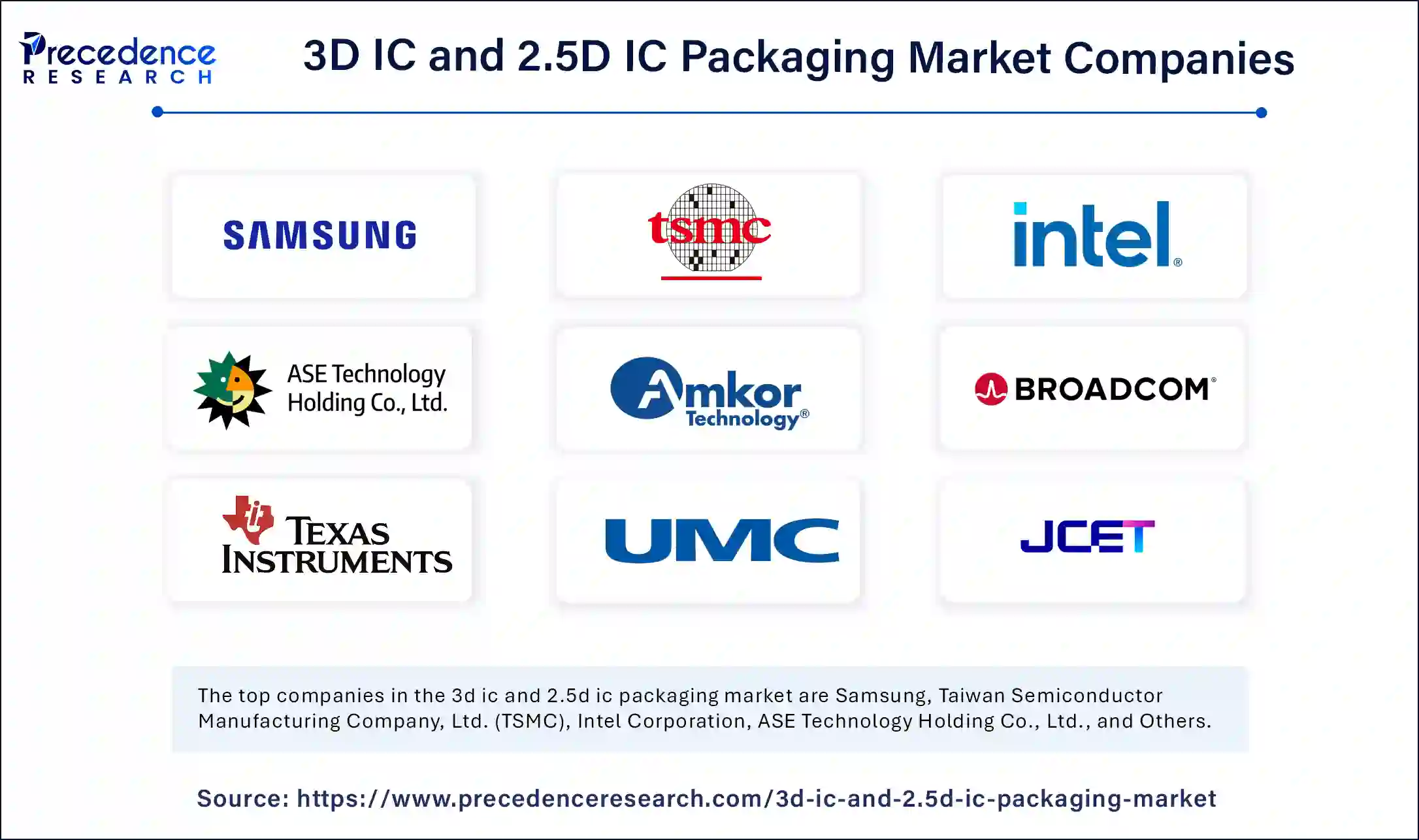
- Samsung: Provides I-Cube interposer packaging and X-Cube vertical stacking with the capability of integrating memory and achieving better bandwidth in a variety of advanced semiconductor applications.
- Taiwan Semiconductor Manufacturing Company, Ltd. (TSMC): CoWoS high-density integration and SoIC chip stacking. 3DFabric: TSMC offers heterogeneous performance-based packaging architectures on computing applications based on heterogeneous chip stacking.
- Intel Corporation: Specifications: EMIB bridge-based connectivity, Foveros stacking providing increased processing density and flexible chip integration, in advanced designs.
Other Major Key Players
- ASE Technology Holding Co., Ltd.
- Amkor Technology
- Broadcom
- Texas Instruments Inc.
- United Microelectronics Corporation (UMC)
- JCET Group Co., Ltd.
- Powertech Technology Inc.
Recent Developments
- In December 2025, CityUHK's research team secured funding from the RAISe+ Scheme to tackle metallisation challenges in packaging 3D integrated circuit semiconductor chips. This research is driven by the increasing demand for enhanced chip performance and reliability due to emerging technologies. (https://www.eurekalert.org )
- In October 2024, a leading semiconductor company, Faraday Technology Corporation, announced its plans to utilize Ansys RaptorX for on-chip electromagnetic modeling solutions. This will help improve the development of advanced packaging designs for the 3D and 2.5D ICs (integrated circuits).
- In June 2024, Siemens unveiled its Calibre 3D Thermal software, which helps offer chip and package inward thermal analysis, especially for 3D ICs. This software will help stack multiple layers of silicon wafers, boosting performance and improving sustainability.
Segments Covered in the Report
By Packaging Technology
- 3D Wafer-Level Chip-Scale Packaging (WLCSP)
- 3D Through-Silicon Via (TSV)
- 2.5D
By Application
- MEMS/Sensors
- Logic
- Imaging & Optoelectronics
- Memory
- LED
- Others (Power, Analog & Mixed Signals, RF, Photonics)
By End Use
- Consumer Electronics
- Industrial
- Telecommunications
- Automotive
- Military & Aerospace
- Medical Devices
By Region
- Asia Pacific
- North America
- Europe
- Latin America
- Middle East and Africa (MEA)
For inquiries regarding discounts, bulk purchases, or customization requests, please contact us at sales@precedenceresearch.com
Frequently Asked Questions





Ask For Sample
No cookie-cutter, only authentic analysis – take the 1st step to become a Precedence Research client
 Get a Sample




 sales@precedenceresearch.com
 Schedule a Meeting
