



Acaricides Market Size, Companies, Share, Crop Production Volume, Yield Analysis, Export & Import Trends, Pricing Metrics, Competitive Positioning, and Demand Forecast
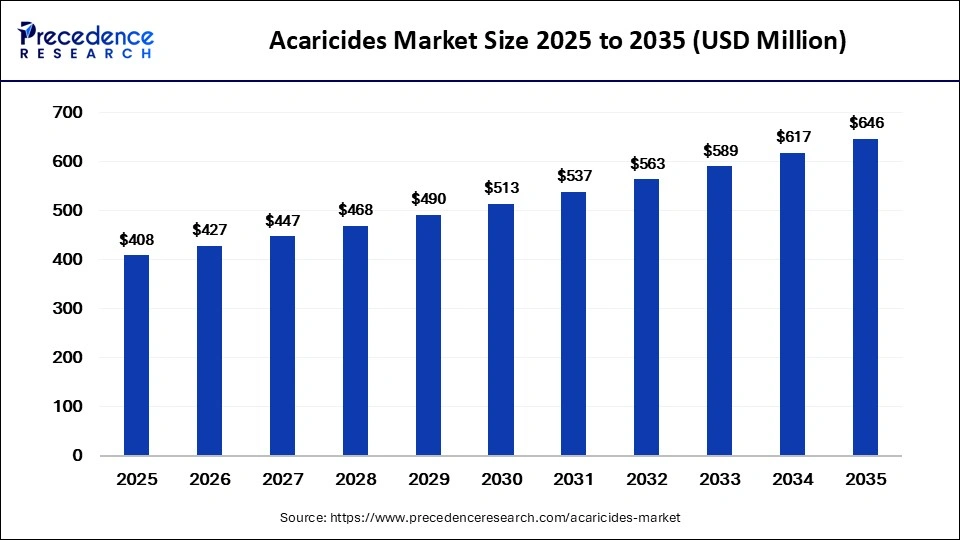
Saurabh Bidwai, an Agriculture Industry Expert, reports that the acaricides market reached USD 427.18 million in 2026 and is forecast to reach USD 645.87 million by 2035, expanding at a CAGR of 4.70%. Key acaricides market companies including BASF SE, Bayer AG, Syngenta Group, are advancing the market across segments such as type, formulation, mode of action, application, target pest, distribution channel.
Source: https://www.precedenceresearch.com/acaricides-market
 Get a Sample
 Table Of Content


Acaricides Market Size and Forecast 2026 to 2035
The global acaricides market size accounted for USD 408.00 million in 2025 and is predicted to increase from USD 427.18 million in 2026 to approximately USD 645.87 million by 2035, expanding at a CAGR of 4.70% from 2026 to 2035. The market is driven by the rising demand to maximize agricultural productivity and safeguard crops from devastating mite and tick infestations.
Key Takeaways
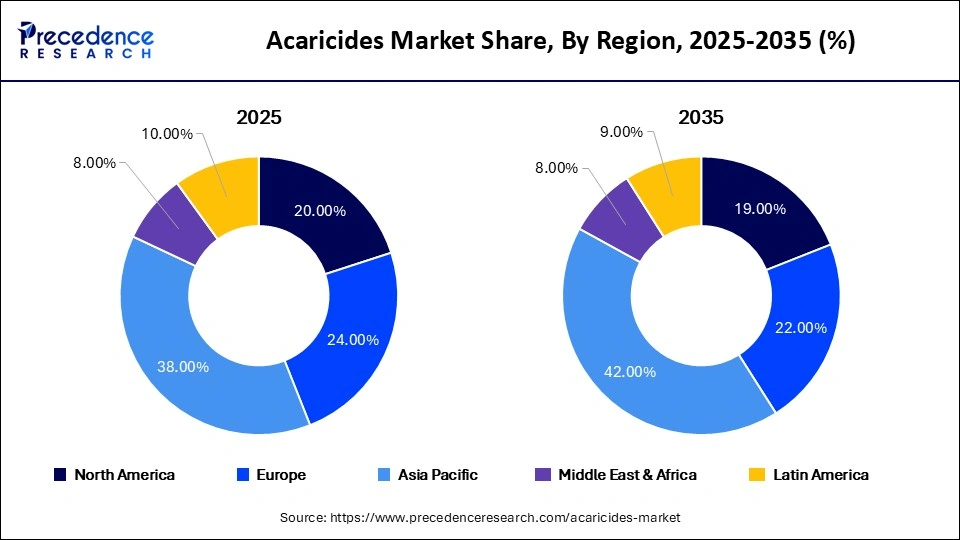
- Asia-Pacific dominated the global acaricides market with a share of 38% in 2025 and is expected to sustain its dominance with a CAGR of 5.8% during the forecast period.
- Europe held the second-largest market share of 24% in 2025.
- By type, the tetronic and tetramic acid derivatives segment led the global market with a share of 28% in 2025.
- By type, the biological acaricides segment is expected to grow at the fastest CAGR of 10.3% between 2026 and 2035.
- By formulation, the suspension concentrates (SC) segment accounted for the highest revenue share of 39% in the market in 2025.
- By formulation, the water dispersible granules (WDG) segment is expected to grow at the fastest 7% CAGR between 2026 and 2035.
- By mode of action, the contact acaricides segment held the largest revenue share of 46% in the market in 2025.
- By mode of action, the systemic acaricides segment is expected to grow at the highest CAGR of 5.8% during the forecast period.
- By application, the fruits and vegetables segment dominated the acaricides market with a share of 36% in the market in 2025.
- By application, the ornamental plants segment is expected to expand rapidly with a CAGR of 6% between 2026 and 2035.
- By target pest, the spider mites segment accounted for a revenue share of 48% in the market in 2025 and is expected to grow at the fastest CAGR of 5.1% over the studied period.
- By target pest, the ticks segment held the second-largest market share of 24% in 2025.
- By distribution channel, the direct sales segment accounted for a revenue share of 41% in the market in 2025.
- By distribution channel, the online agricultural platforms segment is expected to grow at the fastest 8.5% CAGR between 2026 and 2035.
Market Overview
The acaricides industry refers to the global trade, production, and distribution of chemical and biological agents, collectively known as acaricides or miticides, designed to kill and control mites and ticks. The market is mainly driven by the rising need to control mites and ticks that cause devastating yield losses in agriculture and even transmit diseases in livestock. A growing global population, shrinking arable land, and the demand to maximize food productivity compel farmers to accept these specialized pesticides.
How is AI Influencing the Acaricides Market?
Artificial intelligence (AI) is transforming the market by changing pest management from reactive to highly proactive strategies. AI-based predictive analytics and computer vision enable farmers to anticipate mite outbreaks and execute precise, localized sprayings. This drastically decreases chemical usage, cuts operational costs, and minimizes environmental impacts. Integrating the Internet of Things (IoT) with AI has contributed to the development of smart monitoring systems. Cameras and leaf sensors track environmental conditions and even pest population levels, transmitting data directly to mobile devices or farm management software. This replaces manual, time-consuming plant inspections with instant, automated data.
Acaricides Market Trends
- It is driven by the growing consumer need for sustainable farming and stricter government regulations on synthetic chemicals. There is a prominent change toward eco-friendly, naturally derived acaricides.
- Mites and ticks rapidly develop immunity to traditional chemicals. This has spurred chemical innovation, with firms investing in new active ingredients to provide long-lasting shock control and effective resistance management.
- End-users are increasingly combining chemical treatments with biological controls and also mechanical practices to guarantee supply chain stability and protect non-target organisms.
Market Report Coverage and Key Metrics
| Report Coverage | Details |
| Market Size in 2025 | USD 408.00 Million |
| Market Size in 2026 | USD 427.18 Million |
| Market Size by 2035 | USD 645.87 Million |
| Market Growth Rate from 2026 to 2035 | CAGR of 4.70% |
| Dominating Region | Asia Pacific |
| Fastest Growing Region | Europe |
| Base Year | 2025 |
| Forecast Period | 2026 to 2035 |
| Segments Covered | Type, Formulation, Mode of Action, Application, Target Pest, Distribution Channel, and Region |
| Regions Covered | North America, Europe, Asia-Pacific, Latin America, and Middle East & Africa |
Market Dynamics
Drivers
Rising Need for Effective Mite and Tick Control Across Agriculture and Animal Health
The rising need for effective mite and tick control drives the market, as these pests cause severe crop damage and even transmit fatal diseases to livestock. Safeguarding global food supplies and maintaining veterinary health demands consistent, high-yield agricultural production and healthy livestock. Rapid population expansion and shifting dietary patterns have led to an unprecedented need for dairy and meat products, forcing farmers to protect animal welfare and herd productivity by utilizing consistent acaricidal treatments.
Restraint
Compliance Costs
Compliance costs act as a major market restraint because strict environmental and safety rules force chemical firms to invest heavily in prolonged R&D, toxicity testing, and registration processes. These barriers delay new product launches, restrict formulation flexibility, and price smaller producers out of the market, ultimately restricting the number of approved acaricide options available.
Opportunity
The Shift to Bio-Based Acaricides
The shift to bio-based acaricides represents a transformative opportunity for the global market, driven by the escalating need for sustainable agriculture and strict pesticide-residue limits. This green transition is opening lucrative avenues for producers to capitalize on the growing organic farming sector. Conventional synthetic chemicals face diminishing returns as mites and ticks rapidly develop physiological resistance. Bio-based acaricides provide novel modes of action, disrupting this resistance cycle.
Market Segmentation Analysis
Type Insights
The Tetronic and Tetramic Acid Derivatives Segment Held the Largest Market Share of 28% in 2025
The tetronic and tetramic acid derivatives segment dominated the acaricides market with a share of 28% in 2025, owing to its high efficacy against resistant mites, selective pest targeting, and strong adoption in horticulture. Mites and whiteflies rapidly developed resistance to older and traditional acaricides. Tetronic and tetramic acid derivatives offered a crucial rotational tool with novel modes of action.
Acaricides Market Share, By Type, 2025-2035 (%)
| Type | 2025 | 2035 | CAGR(%) |
| Organophosphates | 24.00% | 18.00% | 2.8% |
| Pyrethroids | 18.00% | 15.00% | 3.2% |
| Organochlorines | 4.00% | 2.00% | 1.0% |
| Carbamates | 12.00% | 10.00% | 3.4% |
| Tetronic & Tetramic Acid Derivatives | 28.00% | 32.00% | 6.1% |
| Biological Acaricides | 11.00% | 20.00% | 10.3% |
| Others | 3.00% | 3.00% | 3.5% |
The biological acaricides segment held 11% share of the market in 2025 and is expected to grow at the fastest CAGR of 10.3% during the projection period. This is mainly due to sustainability requirements, regulatory support for biopesticides, and reduced environmental impact. A massive change in organic farming and sustainable agricultural practices has increased biopesticide uptake. Biological options are vital for controlling destructive pests while protecting helpful predators, soil health, and beneficial insects.
The organophosphates segment held a 24% share of the market in 2025 and is expected to grow at a 2.8% CAGR during the projection period. This is due to niche applications, historical adoption, and restricted market presence. Farmers favor organophosphorus compounds because they target the pest's nervous system, providing rapid action and reliable control even under heavy infestations. They remain a highly economical choice for large-scale operations in developing markets.
Formulation Insights
The Suspension Concentrates (SC) Segment Dominated the Market with 39% of Market Share in 2025
The suspension concentrates (SC) segment dominated the acaricides market with a share of 39% in 2025, owing to the high efficacy, reduced solvent usage, and increasing farmer preference. Mites have short life cycles and frequently develop high levels of pesticide resistance. The SC format enables producers to easily pair multiple active ingredients and advanced adjuvants in a single suspension to combat resistance while adhering to modern Integrated Pest Management (IPM) guidelines.
Acaricides Market Share, By Formulation, 2025-2035 (%)
| Formulation | 2025 | 2035 | CAGR(%) |
| Suspension Concentrates (SC) | 39.00% | 42.00% | 5.4% |
| Emulsifiable Concentrates (EC) | 31.00% | 27.00% | 3.6% |
| Wettable Powders (WP) | 15.00% | 11.00% | 2.7% |
| Water Dispersible Granules (WDG) | 11.00% | 16.00% | 7.0% |
| Others | 4.00% | 4.00% | 3.8% |
The water dispersible granules (WDG) segment held an 11% share of the market in 2025 and is expected to grow at the fastest CAGR of 7% during the projection period. This is mainly due to environmental benefits and increasing adoption in developed markets. Intensive farming practices and changing global climate conditions have contributed to an increase in phytophagous (plant-eating) mite infestations, which severely damage high-value crops such as cotton, vegetables, and fruit orchards.
The emulsifiable concentrates (EC) segment held a 31% share of the market in 2025 and is expected to grow at a CAGR of 3.6% during the projection period. This is due to familiarity among growers and effective field performance. Intensive farming combined with changing climatic conditions has accelerated the prevalence of mite infestation, for example, red spider mites in horticulture, boosting the global need for reliable miticides and acaricides. Beyond crops, acaricides are vital for eradicating ticks that spread devastating illnesses, such as babesiosis and theileriosis, in livestock operations. High-density animal husbandry has led to sustained veterinary and agricultural needs.
Mode of Action Insights
Why Did the Contact Acaricides Segment Lead the Acaricides Market?
The contact acaricides segment held a dominant position in the market with a 46% share in 2025, driven by rapid pest control, broad crop compatibility, and cost-effectiveness. High-density livestock farming has escalated the demand to control ticks and mites that affect animal healthcare and productivity, ensuring a safe supply of meat and dairy products.
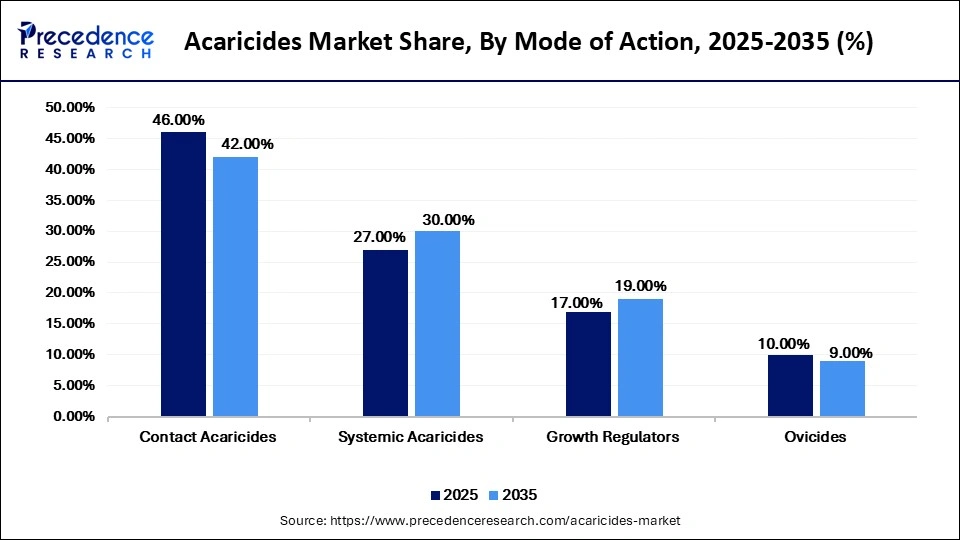
The systemic acaricides segment held a 27% share of the market in 2025 and is expected to grow at the fastest CAGR of 5.8% during the projection period. This is mainly due to the longer protection period, enhanced efficacy, and reduced application frequency. Overuse of traditional contact-based pesticides has contributed to high rates of acaricide resistance in both crop pests and livestock ticks. This has prompted farmers to use newer systemic acaricides with novel, targeted modes of action to break resistance cycles.
The growth regulators segment held a 17% share of the market in 2025 and is expected to grow at a CAGR of 5.5% during the projection period. This is due to effective resistance management, target-specific action, and growing adoption of integrated pest management. Acaricides are crucial in animal husbandry for controlling ticks and preventing vector-borne diseases, for example, babesiosis and theileriosis. Advanced topical and sustained-release growth regulator formulations protect dairy and meat productivity.
Application Insights
What Made the Fruits and Vegetables Segment Dominant in the Acaricides Market?
The fruits and vegetables segment dominated the global market with a share of 36% in 2025. This is due to high susceptibility to mite infestations, quality-sensitive crops, growing global consumption, and export market requirements. Fruits and vegetables are highly susceptible to mite infestations, which cause significant yield losses and also degrade quality. Protecting these high-value crops is economically vital for farmers, resulting in a disproportionately high usage of acaricides in this segment compared to traditional row crops.
Acaricides Market Share, By Application, 2025-2035 (%)
| Application | 2025 | 2035 | CAGR(%) |
| Fruits & Vegetables | 36.00% | 38.00% | 5.5% |
| Cereals & Grains | 18.00% | 17.00% | 3.9% |
| Oilseeds & Pulses | 12.00% | 11.00% | 4.0% |
| Cotton | 16.00% | 15.00% | 4.2% |
| Plantation Crops | 8.00% | 9.00% | 5.3% |
| Ornamental Plants | 7.00% | 8.00% | 6.0% |
| Others | 3.00% | 2.00% | 3.5% |
The ornamental plants segment held a 7% share of the market in 2025 and is expected to grow at the fastest CAGR of 6% during the projection period. This is mainly due to greenhouse cultivation growth, premium plant quality requirements, and urban landscaping trends. The growing popularity of houseplants and urban landscaping has increased the vulnerability of indoor spaces to spider mites and other pests. This has expanded the market beyond commercial nurseries to everyday consumers and retail gardening stores.
The cereals and grains segment held an 18% share of the market in 2025 and is expected to grow at a CAGR of 3.9% during the projection period. This is due to a large cultivation area, yield protection requirements, and commercial farming expansion. Cereals and grains are the bedrock of global food security. With the global population rapidly increasing, farmers are under pressure to prevent devastating yield and post-harvest losses caused by destructive pests such as the red spider mite.
Target Pest Insights
Which Target Pest Segment Dominated the Acaricides Market?
The spider mites segment held the largest market share of 48% in 2025. This is due to widespread crop damage, resistance management requirements, and high infestation frequency. Spider mites thrive and reproduce rapidly in hot, dry weather. Further, global climate variability has extended the seasons and regions where these pests proliferate. Growing environmental knowledge and strict regulations have spurred the development of naturally derived bioacaricides. The market is changing towards selective products that control mites without harming beneficial predatory insects or the environment.
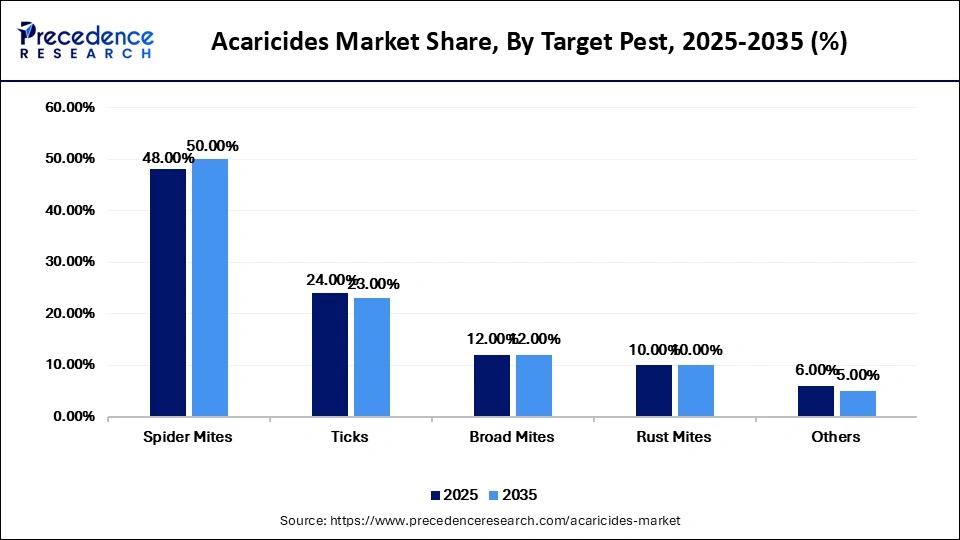
The rust mites segment held a 10% share of the market in 2025 and is expected to grow at the fastest CAGR of 4.7% during the projection period. This is mainly due to citrus and fruit crop protection, export quality standards, and yield preservation needs. Changing weather patterns and warmer temperatures offer an ideal, extended breeding environment for mites, leading to faster reproduction cycles and wider geographic spread, which mandates more frequent chemical and biological treatments.
The ticks segment held a 24% share of the market in 2025 and is expected to grow at the fastest CAGR of 4% during the projection period. This is mainly due to the livestock protection requirements, veterinary applications, and disease transmission concerns. Tick populations frequently develop evolutionary resistance to traditional chemical treatments. This phenomenon has driven the market forward as agricultural producers and researchers continuously invest in new, advanced formulations to combat resistant species.
Distribution Channel Insights
What Made the Direct Sales Segment Dominant in the Acaricides Market?
The direct sales segment dominated the global market with the largest share of 41% in 2025. This is due to large commercial farms, long-term supplier agreements, technical support services, and bulk procurement benefits. Mites are rapidly developing resistance to older chemical acaricides. This has driven the commercialization of compounds with novel modes of action and sustainable botanical formulations.
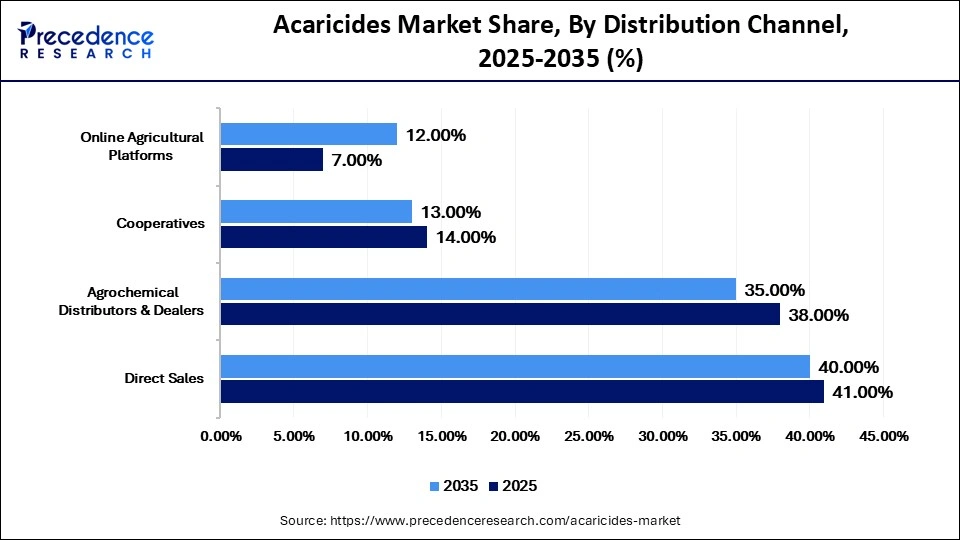
The online agricultural platforms segment held a 7% share of the market in 2025 and is expected to grow at the fastest CAGR of 8.5% during the projection period. This is mainly due to digital agriculture adoption, improved product accessibility, and price transparency. Agritech and e-commerce platforms connect farmers directly with leading agrochemical manufacturers, eliminating intermediaries and ensuring fairer pricing and product authenticity.
The agrochemical distributors and dealers segment held a 38% share of the market in 2025 and is expected to grow at the fastest CAGR of 4% during the projection period. This is mainly due to the farmer advisory support and product accessibility. Rising seasonal temperatures globally have caused massive outbreaks of pests such as the red spider mite. This forces farmers to turn to local dealers for rapid-action miticides to prevent sudden crop destruction.
Market Regional Analysis: North America, Europe, Asia-Pacific
Asia Pacific Acaricides Market Size and Growth 2026 to 2035
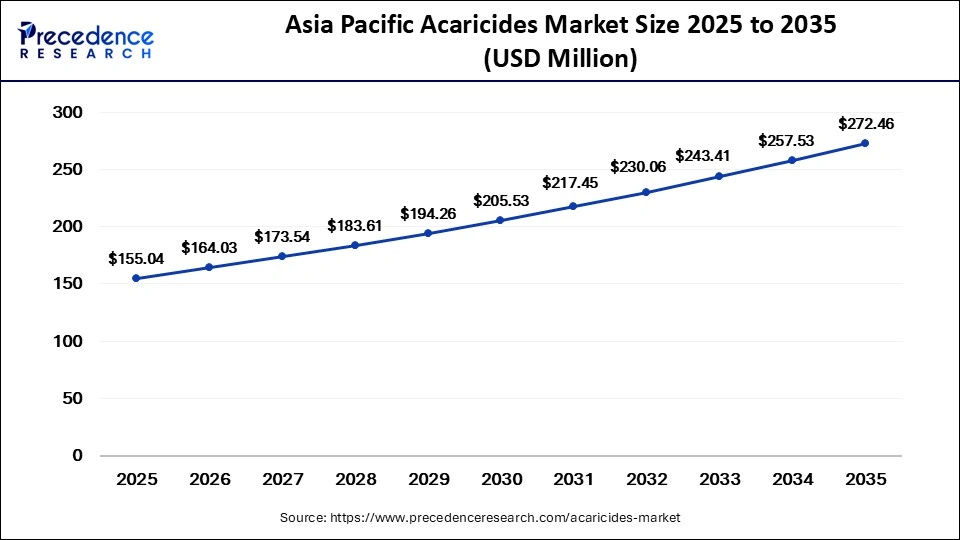
The Asia Pacific Acaricides market size was evaluated at USD 155.04 million in 2025 and is projected to reach around USD 272.46 million by 2035, growing at a CAGR of 5.80% from 2026 to 2035.
Which Factors Drive the Acaricides Market in Asia-Pacific?
Asia-Pacific held a major market share of 38% in 2025 and is expected to sustain as a leader with a CAGR of 5.8% in the upcoming period. This is due to the expanding agricultural production, high incidence of mite infestations, and rising crop protection awareness. Pests like the red spider mite have developed high resistance to traditional insecticides, driving the need for specialized, targeted acaricide formulations. Broad adoption of IPM practices assists farmers in utilizing sustainable, targeted acaricides that protect crop quality without degrading the environment.
China Market Analysis
The Chinese market is undergoing a significant transformation, characterized by shifting regulatory standards and a rising emphasis on sustainable crop protection. As agricultural practices modernize, the industry continues to integrate advanced technologies to enhance pest management and minimize environmental impact.
Europe: The Second-Largest Market
Europe held the second-largest share of 24% in 2025 and is expected to grow at a notable CAGR of 4.3% during the projection period, driven mainly by the growing greenhouse cultivation and regulatory support for precision farming. Changing climatic conditions have expanded the geographic spread and life cycles of destructive mites, such as the red spider mite, demanding continuous and aggressive pest control. Farmers are increasingly adopting IPM practices. These require specialized acaricides that protect crops and animals while minimizing ecological footprints and harmful chemical residues.
UK Market Analysis
The UK market is driven by an expanding agricultural sector and strict environmental regulations. The market is witnessing steady growth as the need for sustainable farming and even organic food pushes producers toward bio-based and eco-friendly miticides.
Will the Middle East and Africa Grow in the Acaricides Market?
The Middle East and Africa held an 8% share of the market in 2025 and are expected to grow at a CAGR of 4.6% during the projection period, driven by increasing food security initiatives, rising pest pressure in arid climates, and growth in commercial farming. With increasing environmental awareness and stricter rules on chemical pesticide residues, there is a surge in the need for eco-friendly, biological acaricides. These sustainable solutions assist in maintaining soil quality and protecting non-target organisms.
Saudi Arabia Market Analysis
Saudi Arabia's market is driven by the country's rising agricultural output, such as dates and citrus, and the demand to protect livestock from tick-borne diseases. Beyond crop protection, acaricides are vital in Saudi livestock farming to prevent severe tick-borne diseases like theileriosis and anaplasmosis in cattle.
What Drives the Acaricides Market in North America?
North America held a 20% share of the market in 2025 and is expected to grow at a significant CAGR of 4.1% during the projection period, driven by a strong commercial farming sector and advanced crop protection technologies. Acaricides are heavily used to protect cattle and other livestock from harmful ticks that transmit debilitating diseases such as babesiosis and anaplasmosis.
U.S. Market Analysis
The U.S. market is driven by the agricultural sector and a rising demand for veterinary care to manage tick-borne diseases in livestock. Acaricides are vital for tick and mite control in beef and dairy cattle. The increasing prevalence of tick-borne diseases has increased veterinary acaricide adoption.
How is the Opportunistic Rise of Latin America in the Acaricides Market?
Latin America held a 10% share of the market in 2025 and is expected to grow at a notable CAGR of 4.5% during the projection period, driven by increasing pest resistance challenges, expansion of crop protection spending, and rising demand for yield optimization. Monoculture farming systems and year-round cultivation cycles in regions such as Brazil and Argentina have led to sustained mite and tick pressure. Pests such as the red spider mite thrive in hot, dry conditions, causing devastating yield and quality losses.
Brazil Market Analysis
Brazil's market is driven heavily by massive cash crops such as soybeans, citrus, and coffee, and extensive cattle farming. Older organophosphates are facing re-registration threats and phase-outs. Consequently, suppliers and distributors are prioritizing pyrethroids, insect growth regulators, and newer multi-mode chemistry rotations.
Market Competitive Landscape: Leading Companies and Strategies
The acaricides market is moderately consolidated, with major players competing through product innovation, regulatory compliance, geographic expansion, and strategic partnerships. Major firms focus on developing effective and environmentally sustainable acaricide formulations to tackle growing concerns regarding resistance management and environmental safety. Leading participants invest significantly in research and development to introduce novel active ingredients and even integrated pest management solutions. Competition is intensified by mergers, acquisitions, and collaborations aimed at strengthening product portfolios and market presence. Regional and local manufacturers also contribute to market dynamics by providing cost-effective products, particularly in emerging economies where agricultural productivity remains a key priority.
Acaricides Market Companies
- BASF SE
- Bayer AG
- Syngenta Group
- FMC Corporation
- Corteva Agriscience
- UPL Limited
- ADAMA Agricultural Solutions
- Sumitomo Chemical Co., Ltd.
- Nissan Chemical Corporation
- Nufarm Limited
- Indofil Industries Limited
- PI Industries Ltd.
- Acaricide India Private Limited
- Valent BioSciences LLC
- Certis Biologicals
Recent Developments Acaricides Market (2025-2026)
- In March 2026, BASF Agricultural Solutions successfully closed its acquisition of AgBiTech. The acquisition is anticipated to enable faster scaling and wider adoption of biological solutions and reinforces BASF's commitment to provide farmers with more effective and diversified insect control options. (Source: https://www.basf.com)
- In October 2025, CropChem launched Perseus Duo, an acaricide and insecticide that combines Spirodiclofen and Abamectin. With this innovation, farmers now have access to a strategic tool for controlling mites in citrus and coffee crops.(Source: https://www.agribusinessglobal.com)
Segments Covered in the Report
By Type
- Organophosphates
- Pyrethroids
- Organochlorines
- Carbamates
- Tetronic & Tetramic Acid Derivatives
- Biological Acaricides
- Others
By Formulation
- Suspension Concentrates (SC)
- Emulsifiable Concentrates (EC)
- Wettable Powders (WP)
- Water Dispersible Granules (WDG)
- Others
By Mode of Action
- Contact Acaricides
- Systemic Acaricides
- Growth Regulators
- Ovicides
By Application
- Fruits and Vegetables
- Cereals and Grains
- Oilseeds and Pulses
- Cotton
- Plantation Crops
- Ornamental Plants
- Others
By Target Pest
- Spider Mites
- Ticks
- Broad Mites
- Rust Mites
- Others
By Distribution Channel
- Direct Sales
- Agrochemical Distributors and Dealers
- Cooperatives
- Online Agricultural Platforms
By Region
- North America
- Latin America
- Europe
- Asia-pacific
- Middle and East Africa
For inquiries regarding discounts, bulk purchases, or customization requests, please contact us at sales@precedenceresearch.com
Frequently Asked Questions
Tags





Ask For Sample
No cookie-cutter, only authentic analysis – take the 1st step to become a Precedence Research client
 Get a Sample




 sales@precedenceresearch.com
 Schedule a Meeting
