



Additive Binder Jets Market Size, Companies, Share, Production Capacity, Raw Material Pricing, Export & Import Analysis, Manufacturing Cost, Competitive Positioning, and Demand Forecast
Additive Binder Jets Market (By Material: Metal Powders, Composites/Ceramics, Sand, Others; By Machine Size: Medium, Small, Large, Other; By End Use: Industrial, Aerospace, Automotive, Other; By Sales Channel Direct OEM: Distributors, Integrators, Other) - Global Industry Analysis, Size, Trends, Leading Companies, Regional Outlook, and Forecast 2026 to 2035
Source: https://www.precedenceresearch.com/additive-binder-jets-market
 Get a Sample
 Table Of Content


What is the Additive Binder Jets Market Size in 2026?
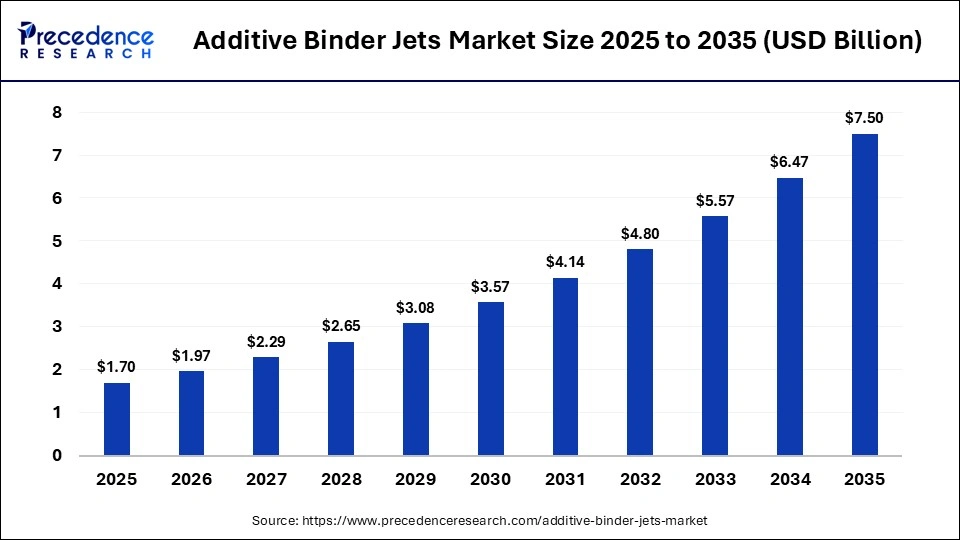
The global additive binder jets market size accounted for USD 1.70 billion in 2025 and is predicted to increase from USD 1.97 billion in 2026 to approximately USD 7.50 billion by 2035, expanding at a CAGR of 16.00% from 2026 to 2035. The market is driven by the growing adoption of metal and ceramic 3D printing for rapid prototyping, complex part manufacturing, and cost-efficient production across automotive, aerospace, and industrial sectors.
Key Takeaways
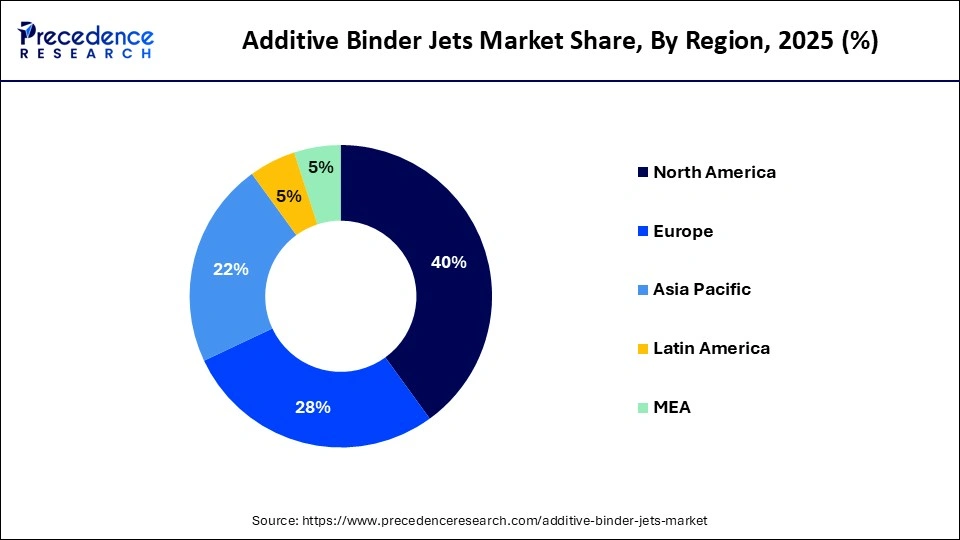
- North America dominated the additive binder jets market with the highest share of 40% in 2025.
- Asia Pacific is expected to grow at the fastest CAGR of 16.5% during the forecast period.
- By material, the metal powders segment dominated the market with the largest share of 45% in 2025.
- By material, the composites/ceramics segment is expected to grow at a 14.7% CAGR during the forecast period.
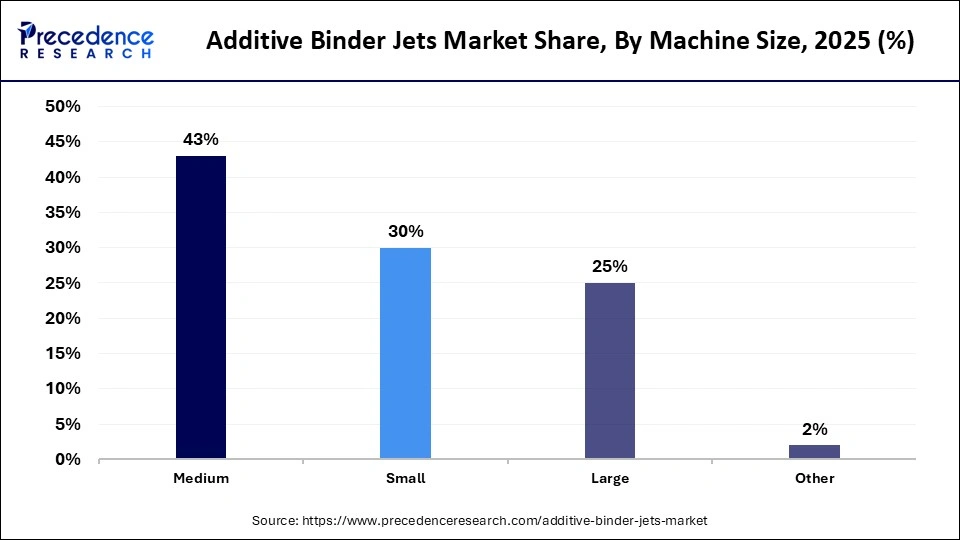
- By machine size, the medium segment held the maximum market share of 43% in 2025.
- By end use, the industrial segment dominated the market with the largest share of 50% in 2025.
- By end use, the aerospace segment is expected to grow at a significant rate during the forecast period.
- By sales channel, the direct OEM segment contributed the largest market share of 57% in 2025.
- By sales channel, the integrators segment is observed to grow at the fastest rate during the forecast period.
What are Additive Binder Jets?
Additive Binder Jets is an additive manufacturing (3D printing) technology where a liquid binder selectively joins powder particles layer by layer to form parts. Widely used for metal, ceramic, sand, and other materials, this process enables the production of complex geometries with high throughput and minimal tooling. It's adopted across industrial, aerospace, automotive, healthcare, and related sectors due to cost efficiency, scalable production, and design flexibility. Key growth drivers include increasing demand for lightweight components, customized parts, and advanced manufacturing integration.
How Technological Advancements are Influencing the Additive Binder Jets Market?
Technological advancements are significantly shaping the market by improving precision, speed, and material efficiency. AI integration optimizes the process, such as defect detection and risk predictions. Machine learning aids defect detection in metal parts and predictive maintenance. Automation and real-time monitoring enhance print accuracy and consistency, while AI-driven quality inspection systems detect flaws in complex geometries, reducing waste and production costs. Additionally, innovations in high-performance powders and binder formulations, combined with AI-assisted process control, are expanding the use of binder jetting for aerospace, automotive, and industrial applications.
Additive Binder Jets Market Trends
- Digital Integration: Binder jet systems are increasingly linked with ERP and MES platforms, enabling real-time monitoring, predictive maintenance, and automated quality checks to boost reliability and reduce manual oversight.
- Industry Partnerships: Collaborations between material experts like Sandvik and GE Additive are accelerating the commercialization and innovation in additive binder jet systems.
- Efficiency Gains: The technology eliminates tooling, shortens lead times from weeks to day and lowers costs for production runs between 100-10,000 units compared to machine or casting.
- Supply Chain Resilience: Distributed manufacturing with binder jets produces reliance on centralized facilities, cuts shipping costs, and supports on-demand production with digital inventories.
- Quality Consistency: Automated monitoring and feedback systems ensure repeatable accuracy and surface finishes across batches.
Market Scope
| Report Coverage | Details |
| Market Size in 2025 | USD 1.70 Billion |
| Market Size in 2026 | USD 1.97 Billion |
| Market Size by 2035 | USD 7.50 Billion |
| Market Growth Rate from 2026 to 2035 | CAGR of 16.00% |
| Dominating Region | North America |
| Fastest Growing Region | Asia Pacific |
| Base Year | 2025 |
| Forecast Period | 2026 to 2035 |
| Segments Covered | Material, Machine Size, End Use, Sales Channel Direct OEM, and Region |
| Regions Covered | North America, Europe, Asia-Pacific, Latin America, and Middle East & Africa |
Segment Insights
Material Insights
Why Did the Metal Powders Segment Dominate the Additive Binder Jets Market?
The metal powders segment dominated the market, accounting for around 45% share in 2025. This is mainly due to the widespread application of metal powders in the aerospace and automotive industries. Metals like stainless steel, aluminum, and titanium are commonly used. These metal powders offer precision and durability, making them ideal for producing lightweight complex metal parts.
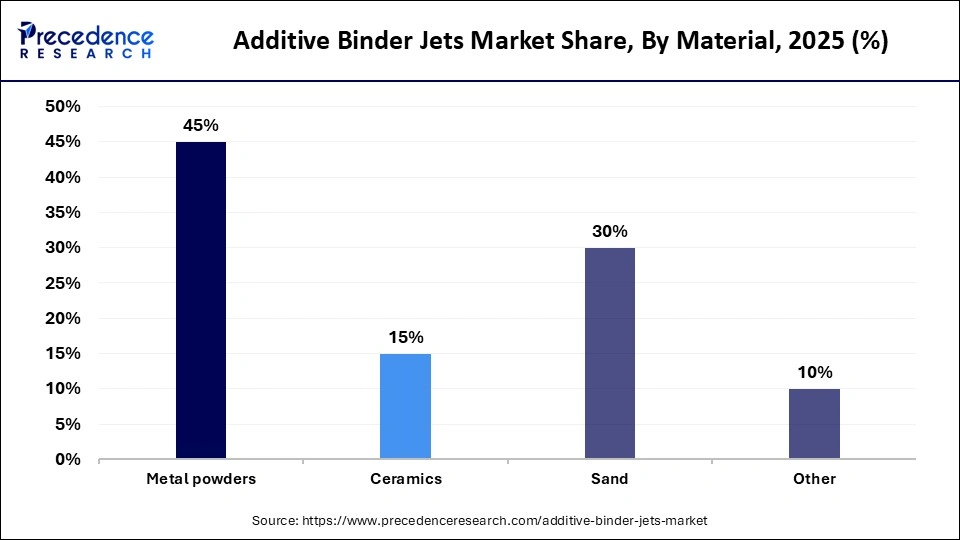
The composites/ceramics segment is expected to grow at the fastest CAGR of 14.7% during the forecast period due to their high strength-to-weight ratio, thermal stability, and wear resistance, making them ideal for aerospace, automotive, and industrial applications. Binder jetting allows complex geometries and customized designs that are difficult to achieve with traditional manufacturing, enhancing the appeal of ceramic and composite parts.
Additionally, advancements in powder formulations and sintering techniques are improving the mechanical performance and reliability of these materials. The rising demand for lightweight, high-performance, and durable components is further accelerating the adoption of composites and ceramics in binder jet 3D printing.
Machine Size Insights
Why Did the Medium Segment Dominate the Market in 2025?
The medium segment dominated the additive binder jets market with the largest share of 43% in 2025 and is expected to grow at the fastest CAGR of 14.5% in the coming years. This is due to the ability of medium-sized additive binder jets to streamline production, reduce lead times, and offer flexible material options. These jets have become a cornerstone for distributed manufacturing strategies, enhancing supply chain resilience and enabling on-demand production with consistent quality.
They cater to a wide range of applications in automotive, aerospace, and industrial sectors, where precision and scalability are both required. They offer faster production times compared to large-scale systems and greater flexibility than small-scale units, making them the preferred choice for prototyping, small-batch production, and functional parts.
End Use Insights
What Made Industrial the Leading Segment in the Additive Binder Jets Market?
The industrial segment led the market while holding a major share of 50% in 2025. This is because the industrial sector benefits from the technology's ability to produce light yet durable components with complex geometries essential for modern aircraft design. Industrial users prioritize precision, scalability, and material versatility, which binder jetting provides for metals, ceramics, and composites. The ability to produce intricate geometries, reduce material waste, and accelerate production cycles aligns with industrial efficiency goals, driving widespread adoption.
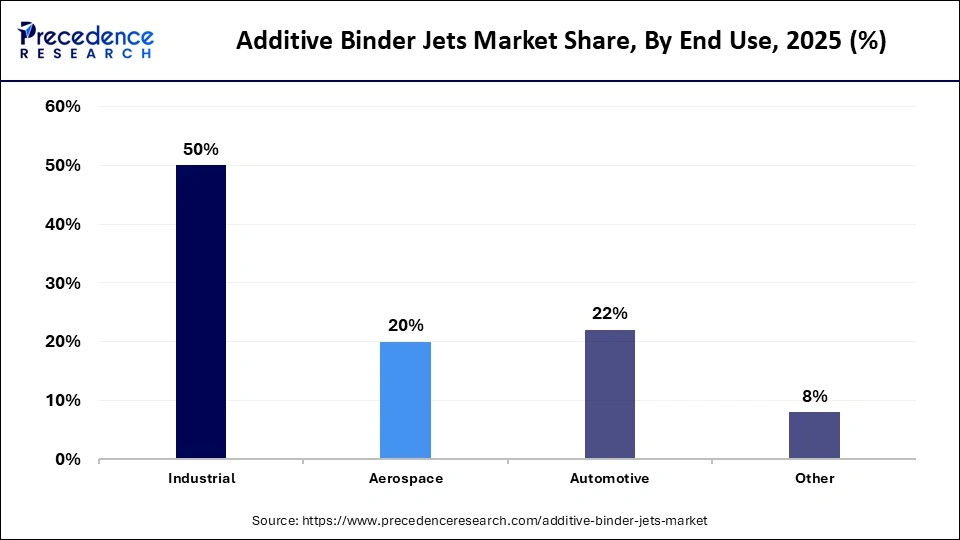
The aerospace segment is expected to grow at a significant CAGR during the projection period. This is primarily due to the increasing demand for lightweight, high-strength, and complex components that improve fuel efficiency and performance. Binder jetting allows the production of intricate geometries and customized parts, such as brackets, ducts, and turbine components, which are difficult or costly to manufacture using traditional methods.
Sales Channel Insights
Why Did the Direct OEM Segment Lead the Additive Binder Jets Market?
The direct OEM segment led the market with a 57% share in 2025 as original equipment manufacturers provide customized solutions and direct support to customers in industries such as aerospace and automotive. OEMs leverage binder jetting for rapid prototyping, functional parts, and low- to medium-volume production of complex components, reducing time-to-market and development costs. OEMs play an integral role in ensuring that binder jets meet specific operational requirements and quality standards.
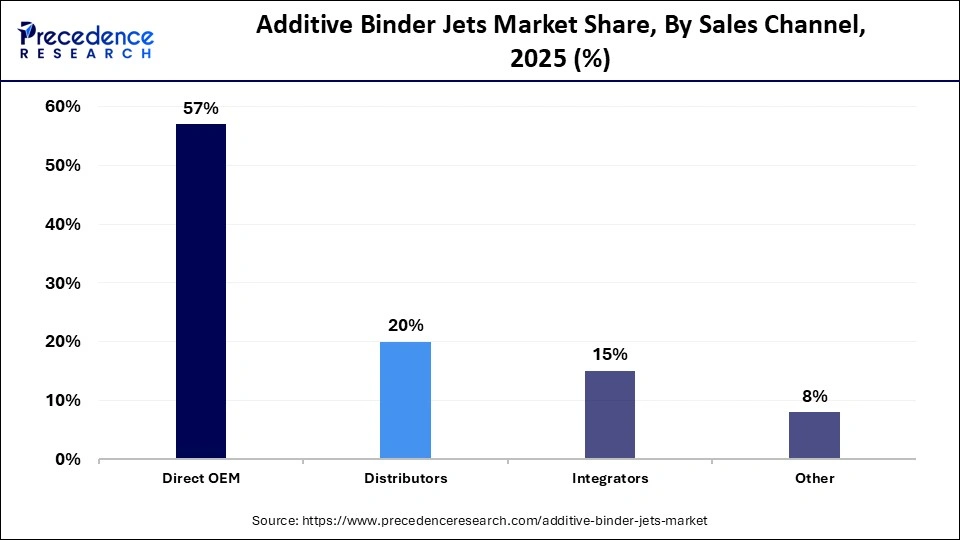
The integrators segment is expected to grow at the fastest rate in the coming years because system integrators provide end-to-end solutions, including hardware, software, materials, and post-processing services, which simplify adoption for manufacturers. They enable companies, especially SMEs and new entrants, to implement binder jetting without heavy upfront investment in expertise or infrastructure. Integrators also offer AI-driven process optimization, training, and technical support, ensuring high-quality, reliable production.
Regional Insights
North America Additive Binder Jets Market Size and Growth 2026 to 2035
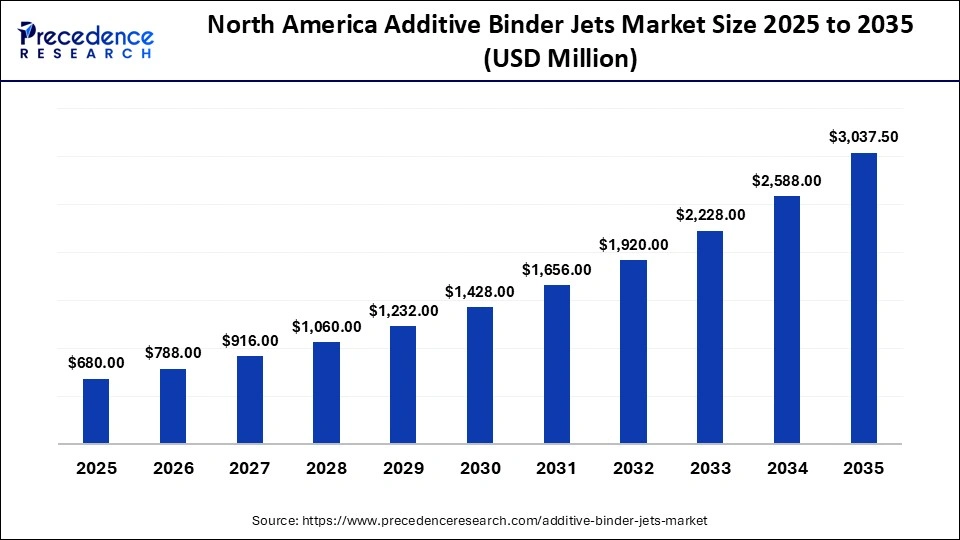
The North America additive binder jets market size is estimated at USD 680.00 million in 2025 and is projected to reach approximately USD 3,037.50 million by 2035, with a 16.15% CAGR from 2026 to 2035.
What Made North America the Dominant Region in the Market?
North America dominated the additive binder jets market with the largest revenue share of 40% in 2025. The region's dominant position in the market is attributed to strong government support for cutting-edge manufacturing and 3D printing projects. This growth is mirrored globally by a surging demand within the automotive sector, where binder jetting is utilized for both rapid prototyping and the mass production of metal parts. Furthermore, the increased demand for personalized medical devices, such as implants and prosthetics, has opened lucrative growth opportunities, drawing significant interest from both stakeholders and private investors.
U.S. Additive Binder Jets Market Size and Growth 2026 to 2035
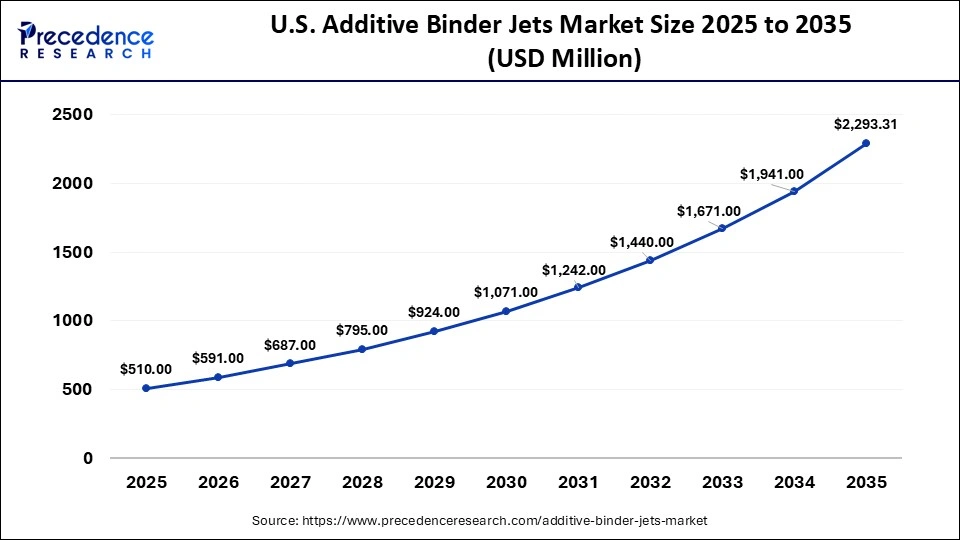
The U.S. additive binder jets market size is calculated at USD 510.00 million in 2025 and is expected to reach nearly USD 2,293.31 million in 2035, accelerating at a strong CAGR of 16.22% between 2026 and 2035.
U.S. Market Analysis
The U.S. leads the North American additive binder jets market. The growth of the market in the U.S. is driven by increasing applications across energy, oil & gas, medical, and automotive sectors. In the energy sector, companies like ExxonMobil use binder jetting to produce complex, corrosion-resistant downhole tools for oil and gas operations. The automotive industry is increasingly adopting the technology for electric vehicle components, while FDA-cleared 3D-printed implants are advancing medical applications. Additionally, NASA supports academic partnerships and research initiatives to develop space-grade advanced materials using binder jetting, further boosting the country's market leadership.
What Makes Asia Pacific the Fastest-Growing Region in the Additive Binder Jets Market?
Asia Pacific is expected to grow at the fastest CAGR of 16.5% throughout the forecast period, driven by the expanding manufacturing sector, increasing investments in advanced manufacturing technologies, and the presence of a large consumer base. Leading countries like China, Japan, India, and South Korea are spearheading the integration of binder jetting across diverse fields, including aerospace, healthcare, automotive, and consumer electronics. This surge in demand is further fueled by regional commitment to maximizing industrial output and operational efficiency.
China Market Analysis
Market expansion in China is largely the result of state-led manufacturing modernization and substantial funding for technical infrastructure. National security mandates have compelled aerospace and other sectors to prioritize binder jetting. The country boasts a robust automotive industry, which is leveraging this technology for electric vehicle battery systems, with companies like Geely forming strategic partnerships to produce lightweight structural EV components. These developments are further supported by strong academic investments, reinforcing local R&D capabilities and accelerating industrial implementation.
How is the Opportunistic Rise of Europe in the Additive Binder Jets Market?
Europe is expected to grow at a notable rate in the market, driven by stringent regulations promoting greener manufacturing practices. The rising demand for customized components across industries is also accelerating adoption. Aerospace applications are expanding through programs with the European Space Agency, with Airbus Defence and Space qualifying binder jet components for satellite use in 2025. Additionally, MTU Aero Engines is advancing research on turbine blade manufacturing using specialized nickel alloys processed via binder jetting, further supporting regional growth.
UK Market Analysis
The demand for additive binder jetting in the UK is rising as industries such as aerospace, automotive, and consumer goods manufacturing are adopting more advanced production technologies. Additive binder jets are gaining traction for their ability to produce high-quality components quickly and efficiently, helping companies meet rising market demands while minimizing material waste. Continued industrial innovation and a strong emphasis on sustainability are expected to sustain growth in the market.
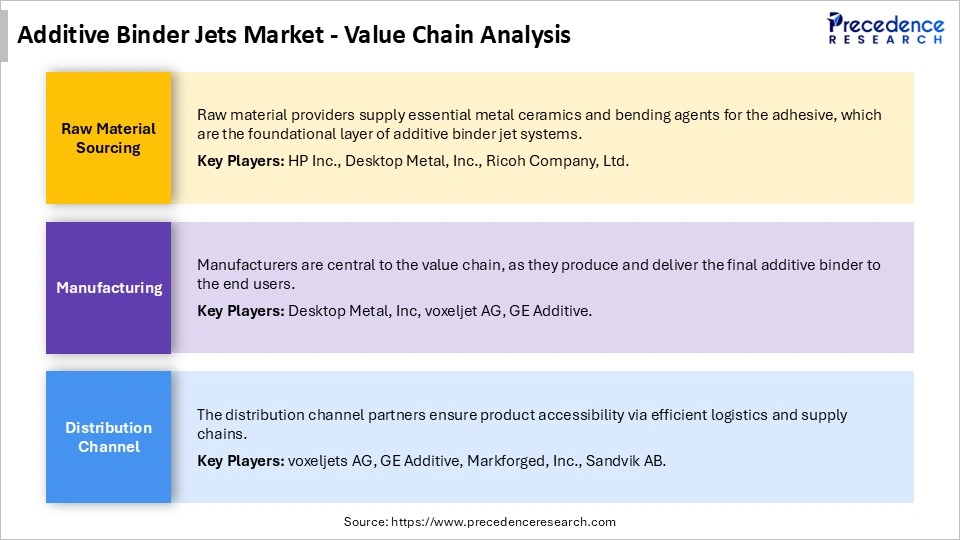
Additive Binder Jets Market Value Chain Analysis
Additive Binder Jets Market Companies
- HP Inc.
- Desktop Metal, Inc
- ExOne
- voxeljets AG
- GE Additive
- Digital Metal AB
- Ricoh Company, Ltd.
- Toshiba Corporation
- Stratasys Ltd.
- 3D Systems Corporation
- Markforged, Inc.
- Sandvik AB
- Renishaw plc
- EOS GmbH
- Mimaki Engineering Co., Ltd
Recent Developments
- In 2026, Multi Station announced a partnership to distribute high-productivity sand binder jet systems in France and North Africa.
- In 2025, DEF manufacturing acquired GHI Corp for USD 200 million, consolidating its position as market leader in metal binder jets. This drives future growth and innovation within the industry by introducing smart manufacturing techniques.
- In 2026, the INDO-MIM, Bangalore, is currently operating four binder jet printers at its Bangalore location, partnering with leaders like Desktop Metal, ExOne, and HP to develop new production-ready materials.
Segments Covered in the Report
By Material
- Metal Powders
- Composites/Ceramics
- Sand
- Others
By Machine Size
- Medium
- Small
- Large
- Other
By End Use
- Industrial
- Aerospace
- Automotive
- Other
By Sales Channel Direct OEM
- Distributors
- Integrators
- Other
By Region
- North America
- Europe
- Asia-Pacific
- Latin America
- Middle East & Africa
For inquiries regarding discounts, bulk purchases, or customization requests, please contact us at sales@precedenceresearch.com
Frequently Asked Questions
Tags





Ask For Sample
No cookie-cutter, only authentic analysis – take the 1st step to become a Precedence Research client
 Get a Sample




 sales@precedenceresearch.com
 Schedule a Meeting
