



Advanced Wind Turbine Blade Material Market Trends, Companies, Contract Wins / Project Pipeline, Installed Capacity, Power Generation, Government Investment, Technology Adoption, Competitive Positioning, and Growth Forecast
Advanced Wind Turbine Blade Material Market (By Blade Design: Horizontal Axis Blades, Vertical Axis Blades, Hybrid Blades; By Material Type: Carbon Fiber, Glass Fiber, Epoxy Resins, Thermoplastic Composites, Bamboo Composites; By End Use Application: Onshore Wind Farms, Offshore Wind Farms, Small-Scale Wind Turbines; By Production Technology: Prepreg Technology, Infusion Technology, 3D Printing Technology) - Global Industry Analysis, Size, Trends, Leading Companies, Regional Outlook, and Forecast 2026 to 2035
Source: https://www.precedenceresearch.com/advanced-wind-turbine-blade-material-market
 Get a Sample
 Table Of Content


What is Advanced Wind Turbine Blade Material Market Size in 2026?
The global advanced wind turbine blade material market size was calculated at USD 11.09 billion in 2025 and is predicted to increase from USD 11.81billion in 2026 to approximately USD 20.84 billion by 2035, expanding at a CAGR of 6.51% from 2026 to 2035. This market is growing due to rising renewable energy installations and demand for durable yet lightweight turbine components.
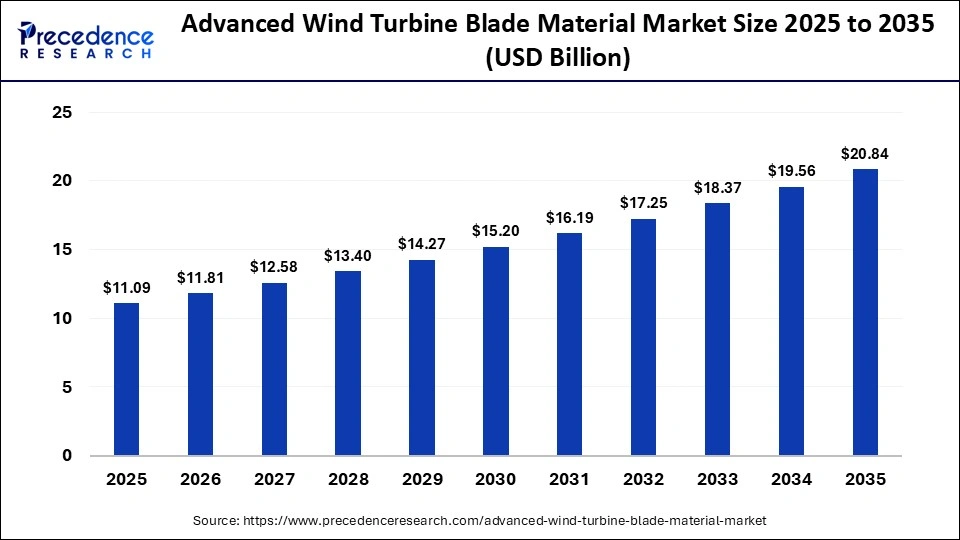
Key Takeaways
- North America dominated the global advanced wind turbine blade material market in 2025.
- Asia Pacific is expected to grow at the fastest CAGR between 2026 and 2035.
- By blade design, the horizontal axis blades segment generated the biggest market share in 2025.
- By blade design, the vertical axis blades segment is expanding at the fastest CAGR between 2026 and 2035.
- By material type, the carbon fiber segment contributed to the highest market share in 2025.
- By material type, the glass fiber segment is growing at a strong CAGR between 2026 and 2035.
- By end-use application, the onshore wind farms segment held a major market share in 2025.
- By end-use application, the offshore wind farms segment is expected to expand at the fastest CAGR from 2026 to 2035.
- By production technology, the prepreg technology segment held the biggest market share in 2025.
- By production technology, the infusion technology segment is expanding at the fastest CAGR between 2026 and 2035.
What Drives Growth in the Advanced Wind Turbine Blade Material Market?
The advanced wind turbine blade material market is expanding steadily as a result of the expansion of renewable energy projects and the growing emphasis on carbon emission reduction across the world. Wind energy installations are growing both onshore and offshore, and manufacturers are seeking high-strength lightweight materials like carbon fiber composites and sophisticated resins to increase turbine lifespan and efficiency. The market is expanding even faster thanks to government incentives encouraging the development of clean energy and technological developments in blade design. Innovative materials that can tolerate greater mechanical stress while preserving structural stability are also becoming more necessary as turbines get bigger and have longer blades.
How is AI Driving Innovation in the Advanced Wind Turbine Blade Material Market?
Artificial Intelligence plays a crucial role in driving innovation in the wind turbine blade material market by improving design efficiency, material selection, and predictive maintenance. Before physical production, AI-driven simulation tools analyze material strength, aerodynamic performance, and stress distribution to help manufacturers optimize blade structures. Additionally, machine learning models help determine the best composite materials to increase durability while lowering weight. Furthermore, monitoring systems powered by AI can identify structural fatigue and microcracks in blades, enabling early maintenance and prolonging turbine life. AI integration lowers development costs while simultaneously increasing operational reliability and total energy output.
Major Market Trends
- Growing Use of Carbon Fiber Composites: Manufacturers are increasingly adopting carbon fiber materials to produce lighter and stronger blades, enabling higher efficiency and longer turbine lifespan.
- Expansion of Offshore Wind Projects: Rising offshore wind installations drive demand for advanced materials that can withstand harsh marine environments and high wind loads.
- Development of Longer Blade Designs: The shift toward larger turbines with extended blade lengths increases the need for high-strength, fatigue-resistant composite materials.
- Focus on Sustainable and Recyclable Materials: Companies are investing in recyclable resins and eco-friendly composites to reduce environmental impact and support circular economy goals.
- Integration of Smart Monitoring Technologies: Advanced sensors embedded in blades help monitor structural health and improve maintenance efficiency.
- Technological Advancements in Resin Systems: Innovations in epoxy and thermoplastic resins enhance blade durability, flexibility, and manufacturing efficiency.
- Automation in Blade Manufacturing: Automated production processes improve precision, reduce material waste, and lower overall manufacturing costs.
Future Market Outlook
- Rapid Renewable Energy Expansion in Emerging Markets: Growing investments in wind power infrastructure across developing economies create strong demand for advanced blade materials.
- Rising Offshore Wind Farm Investments: Large-scale offshore projects provide opportunities for high-performance composite material suppliers.
- Blade Recycling and Circular Economy Solutions: Increasing regulatory focus on blade disposal opens new opportunities for recyclable material innovation.
- Demand for High-Capacity Wind Turbines: The development of next-generation mega turbines creates demand for ultra-lightweight and high-strength materials.
- Aftermarket Repair and Maintenance Materials: The expanding installed base of turbines increases the need for advanced repair composites and maintenance solutions.
- Strategic Partnerships with Turbine Manufacturers: Collaboration between material suppliers and wind turbine OEMs can accelerate innovation and market penetration.
- Government Incentives for Clean Energy Projects: Supportive policies and subsidies for renewable energy projects enhance long-term growth prospects for advanced blade material providers.
Market Scope
| Report Coverage | Details |
| Market Size in 2025 | USD 11.09 Billion |
| Market Size in 2026 | USD 11.81 Billion |
| Market Size by 2035 | USD 20.84 Billion |
| Market Growth Rate from 2026 to 2035 | CAGR of 6.51% |
| Dominating Region | North America |
| Fastest Growing Region | Asia Pacific |
| Base Year | 2025 |
| Forecast Period | 2026 to 2035 |
| Segments Covered | Blade Design, Material Type, End Use Application, Production Technology, and region |
| Regions Covered | North America, Europe, Asia-Pacific, Latin America, and Middle East & Africa |
Segment Insights
Blade Design Insights
What Made Horizontal-Axis Blades the Dominant Segment in the Market?
The horizontal-axis blades segment dominated the advanced wind turbine blade material market in 2025 because they provide more power output, improved aerodynamic performance, and increased efficiency when compared to other designs. Their dominant position in the market is bolstered by their extensive use in both onshore and offshore projects, as well as their compatibility with large-scale commercial wind turbines. Additionally, the mature technology, ease of integration with standard turbine systems, and extensive global deployment make horizontal-axis blades the preferred choice for both manufacturers and developers.
The vertical-axis blades segment is expected to grow at the fastest CAGR in the coming years because of their suitability for low wind and urban settings. They are becoming increasingly popular in distributed and small-scale wind energy projects due to their easier design, ability to reduce maintenance needs, and the capacity to capture wind from various directions. Their demand is supported by growing interest in decentralized renewable energy systems. Additionally, as technology advanced, they became more efficient and more commercially viable than before.
Material Type Insights
Why Did the Carbon Fiber Segment Dominate the Advanced Wind Turbine Blade Material Market?
The carbon fiber segment dominated the market in 2025 due to its enhanced stiffness, fatigue resistance, and superior strength-to-weight ratio. Because of these characteristics, manufacturers are able to create lighter and longer blades, increasing turbine output and efficiency. The use of carbon fiber was further encouraged by the growing need for large-capacity turbines. It is also perfect for offshore installations because of its resilience in harsh weather. Additionally, carbon fiber lowers the total weight of the turbine, which saves money on installation and transportation.
The glass fiber segment is expected to grow at the fastest CAGR during the projection period because of its enhanced performance qualities and cost-effectiveness. Compared to carbon fiber substitutes, glass fiber composites are more durable while maintaining lower production costs. Mid-sized turbine manufacturers find this material appealing because it is still widely accessible and simple to process. Its mechanical strength and lifespan performance are also being enhanced by raising R&D investments.
End Use Application Insights
Why Did the Onshore Wind Farms Segment Dominate the Market?
The onshore wind farms segment dominated the advanced wind turbine blade material market in 2025 because of the government's strong support for land-based renewable projects, their easier maintenance, and their lower installation costs. The substantial market share of onshore wind was a result of the extensive installation of this capacity in both developed and emerging economies. Faster project approvals and established grid connectivity are further advantages of onshore projects. Additionally, this segment has seen consistent investments due to lower operational risks when compared to offshore projects.
The offshore wind farms segment is expected to expand at the highest CAGR in the coming years because of increasing funding for offshore projects with large capacities. The need for cutting-edge blade materials that can survive challenging marine conditions is being driven by stronger and more reliable wind speeds at sea. To reach clean energy goals, governments are investing more money in offshore wind infrastructure. The demand for sophisticated composite materials for larger offshore turbines is driving this market's expansion.
Production Technology Insights
Why Did the Prepreg Technology Segment Dominate the Advanced Wind Turbine Blade Material Market?
The prepreg technology segment dominated the market in 2025 because it guarantees better structural performance, increased material consistency, and accurate resin distribution. This technology is popular for high-performance turbines because it increases blade strength and lowers manufacturing defects. Additionally, it facilitates quicker curing cycles and better production quality control. Prestigious turbine manufacturers depend on prepreg materials to satisfy stringent durability and safety requirements.
The infusion technology segment is expected to grow at the highest CAGR in the market throughout the forecast period. This is because of its ability to provide better scalability and reduced production costs. It enables producers to efficiently create large blades while upholding standards of quality. The method lowers production-related energy and material waste. The increasing need for affordable wind turbines is driving a broader use of infusion-based production techniques.
Regional Analysis
Why Did North America Dominate the Advanced Wind Turbine Blade Material Market?
North America dominated the advanced wind turbine blade material market by holding a major share in 2025. This is due to substantial wind energy capacity installations, strong renewable energy policies, and technological advancements in blade manufacturing. Supportive government incentives and continued infrastructure investments further reinforced regional growth. The presence of leading material suppliers and turbine manufacturers strengthened the market's supply chain, while ongoing upgrades and expansions of existing wind farms increased demand for advanced, high-performance blade materials.
U.S. Advanced Wind Turbine Blade Material Market Analysis
The U.S. is a major contributor to the North American market due to substantial state and federal backing for wind farm installations and renewable energy initiatives. The demand for advanced turbine blade materials was bolstered by significant investments in the expansion of onshore and offshore wind capacity. Leading material suppliers and turbine manufacturers were present, which helped sustain market expansion. The adoption of high-performance blade technologies was also accelerated by tax breaks and clean energy regulations.
How is the Opportunistic Rise of Asia Pacific in the Market?
Asia Pacific is expected to grow at the fastest rate in the market due to the rising production of wind energy in nations like China and India. Strong market momentum in the region is being driven by rising electricity demand and growing investments in renewable energy projects. Regional market growth is also supported by government programs encouraging the domestic production of wind components. Advanced blade materials are becoming more in demand as offshore wind projects expand throughout the region.
India Advanced Wind Turbine Blade Material Market Analysis
The Indian market is growing due to increasing investments in offshore wind development and renewable energy infrastructure. Government incentives for clean energy and rising private-sector participation are accelerating market expansion. Additionally, the growing number of turbine installations and the domestic production of wind components are driving demand for advanced, high-performance blade materials.
Value Chain Analysis
- Resource Extraction:
This stage ensures foundational materials (e.g., CFRP, GFRP, epoxy resins) are sourced from specialized producers to meet quality and performance needs.
Key Players: Toray Industries, Inc., Owens Corning, Teijin Limited, Huntsman Corporation - Material Processing & Composite Manufacturing
This stage involves converting raw fibers and resins into prepregs, fabrics, and composite sheets ready for blade fabrication.
Key Players: Gurit Holding AG, Hexcel Corporation, Solvay - Blade Fabrication & Assembly
This stage involves producing full wind blade structures using advanced composites through molding, infusion, or automated layups.
Key Players: TPI Composites, Inc., LM Wind Power
Top Companies Operating in the Market
- Toray Industries, Inc.
- Hexcel Corporation
- SGL Carbon
- Owens Corning
- Teijin Limited
- Mitsubishi Chemical Group
- China Jushi Co., Ltd.
- Taishan Fiberglass Inc.
- Arkema S.A.
- Olin Corporation
- Huntsman Corporation
- Evonik Industries
- Westlake Corporation
- BASF SE
Recent Developments
- In February 2026, Vestas announced the launch of its updated sustainability strategy, achieving a 94% recyclability rate for its turbine rotors. The company introduced a new circularity roadmap aimed at reaching 100% recyclable blades by 2030 through advanced chemical recycling. This initiative includes the deployment of CETEC technology to break down epoxy resins, allowing old blades to be repurposed into new high-grade turbine components. (Source: https://www.vestas.com)
- In December 2025, Suzlon Group announced plans to establish three new AI-enabled smart blade manufacturing units across India. These facilities will integrate advanced robotics and digitalization to enhance the production precision and efficiency of high-performance turbine components. The expansion aims to meet surging demand for large-scale wind projects while optimizing the manufacturing of complex blade materials. (Source: https://economictimes.indiatimes.com)
- In August 2025, Envision Energy announced that its next-generation two-blade smart wind turbine completed over 500 days of stable operation, representing a significant breakthrough in wind technology. (Source: https://www.prnewswire.com)
Segments Covered in the Report
By Blade Design
- Horizontal Axis Blades
- Vertical Axis Blades
- Hybrid Blades
By Material Type
- Carbon Fiber
- Glass Fiber
- Epoxy Resins
- Thermoplastic Composites
- Bamboo Composites
By End Use Application
- Onshore Wind Farms
- Offshore Wind Farms
- Small-Scale Wind Turbines
By Production Technology
- Prepreg Technology
- Infusion Technology
- 3D Printing Technology
By Region
- North America
- Europe
- Asia-Pacific
- Latin America
- Middle East & Africa
For inquiries regarding discounts, bulk purchases, or customization requests, please contact us at sales@precedenceresearch.com
Frequently Asked Questions





Ask For Sample
No cookie-cutter, only authentic analysis – take the 1st step to become a Precedence Research client
 Get a Sample




 sales@precedenceresearch.com
 Schedule a Meeting
