



Aerospace NDT Market Trends, Companies, Contract Wins / Project Pipeline, Defense Contracts, Procurement Volume, Government Spending, Production Capacity, Competitive Positioning, and Growth Outlook
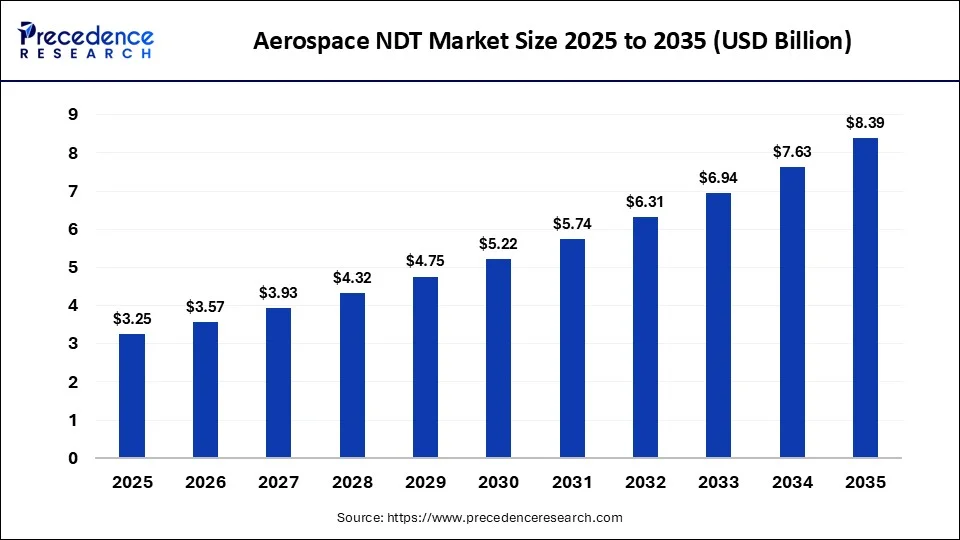
Laxmi Narayan, an Aerospace and Defence Industry Expert, identifies strong market momentum in the aerospace NDT market, which reached USD 3.57 billion in 2026 and is projected to attain USD 8.39 billion by 2035 at a CAGR of 9.95%. Major aerospace NDT market companies, including Applus Services SA, Baker Hughes Company, compete across critical segments such as technique, component, aircraft type, application, inspection method, end user, region.
Source: https://www.precedenceresearch.com/aerospace-ndt-market
 Get a Sample
 Table Of Content


Aerospace NDT Market Size and Forecast 2026 to 2035
The global aerospace NDT market size is predicted to increase from USD 3.57 billion in 2026 to approximately USD 8.39 billion by 2035, expanding at a CAGR of 9.95% from 2026 to 2035.
Key Takeaways
- By technique, ultrasonic testing segment dominated the market with a share of 31% in 2026.
- By technique, radiographic testing segment held a 16% share of the market in 2026 and is expected to grow at a rapid CAGR of 11.3% between 2026 and 2035.
- By component, equipment segment dominated the market with a share of 42% in 2026.
- By component, software segment held a 14% share of the market in 2026 and is expected to grow at the fastest CAGR of 11.9% between 2026 and 2035.
Market Size Description
The global aerospace non-destructive testing industry amassed a valuation of USD 3.57 billion in 2026 and is expected to grow at a CAGR of 9.95% till 2035. The number of aerospace inspections run in 2026 through NDT is nearly 148 million. The aerospace NDT market is projected to expand at a CAGR of approximately 9.95% from 2026 to 2035. Thus outpacing its volume growth data. The sophistication of the equipment and hardware built into the inspection devices is reflected in the 2026 specification price of a typical NDT system, which is an average of USD 92,000. The price for service providers averages USD 245 per inspection. The expected increase is slight, at a CAGR of 2.80% during the forecast period. Collectively, these figures all show a market that is increasing in size. Also in the number of parts being inspected and how often they want to do so, at least when it comes to airlines and MROs.
Regulatory pressure sits at the center of that demand, and 2026 has been bringing its own evidence pack. In March 2026, the FAA published a new Airworthiness Directive (AD) for Boeing 767-200 and Boeing 767-300 series airplanes. That mandated that nondestructive testing (NDT) be performed at lap joints in fuselage skin for scribe-line cracking. The same mandate was recently issued for Sikorsky helicopters. It is to take effect in July 2026. This involves repetitive fluorescent penetrant inspection of yaw pedal damper housings after a loss of tail rotor authority was reported.
Standards bodies and certification frameworks remain strong. This is a main support for the technological credibility of the market. The method-level standards for the performance of eddy current, ultrasonic, and penetrant testing of aerospace structures. They are published by ASTM International, SAE International, and the International Organization for Standardization, respectively. Nadcap has remained the mortar for special processes throughout the aircraft supply chain, and non-Nadcap suppliers will lose large airframe orders. ATA Specification 105 maintains the hierarchy of Level I, II, and III certification. They are based on the seriousness of the component to be inspected and the sensitivity of the method itself. Aircraft safety inspection will likely continue to influence how new AI and automation tools are adopted across the industry over the next decade.
Market Snapshot
The market is dominated by North America. Features tons of airframe manufacturers, engine OEMs, and MRO providers, and a lot of regulatory activity from the FAA. On the other hand, the Asia-Pacific region is making strong headway as it experiences the highest growth amongst the major regions. Aircraft production is booming in India and China, with regional commercial fleets and new MRO capacity continuing to grow. The change in growth momentum in that region is linked to the solution providers. They are gaining the majority of these new orders via their inspection techniques and types of aircraft.
Executive Insights
In 2026, digital transformation won't be a conversation in the aerospace NDT world. But an operating situation. In April 2026, automated Menu Directed Inspection (MDI) templates were deployed on GEnx-1B and GEnx-2B engine borescopes to progress. That reality, with the help of Baker Hughes business, Waygate Technologies. The templates are based on an AI-enabled defect recognition system. The two companies developed together and led the technicians to a standardized and repeatable view of the high-pressure turbine blades using borescope. Leadership should be rethinking the training of their workforce and the technology they should be purchasing in the coming years, subject to artificial intelligence.
Commercialization opportunity is definitely at the crossroads of these trends. In 2025, Nikon Metrology launched the industrial X-ray CT system VOXLS 20 C 225 for volumetric inspection. Expanding this trend by adding high-resolution volumetric inspection capabilities. Nadcap also remains in control and dictates who can even be considered for this work. That ensures stringent monitoring of supplier quality and traceability throughout the supply chain. Across all segments of the data, AI-aided defect detection, and hardware automation business, the executives are betting on 2025 and 2026 product investments. This will be in data platforms and in Q&A products that simplify and automate scanning and defect recognition.
Market Overview
What is Aerospace Non-Destructive Testing (NDT)?
Aerospace non-destructive testing (NDT) comprises inspection techniques used to evaluate aircraft components without damaging or altering their usability. Manufacturers, airlines, and MRO providers can use NDT techniques. For identifying cracks, corrosion, voids, and delamination without any interruption to the part's usability or service.
Evolution of Aerospace Inspection Technologies
The industry is well beyond where the painstaking ground-based and manual inspections were in their early days. In 2026 is where the shift from these things is starting to take a considerable turn for the better. The FAA has authorized applicable drone-based aircraft inspection operations by approved operators. Add the specific FAA approval or exemption citation supporting Delta Air Lines.
They are being used for inspections related to arcing or lightning damage on both the Airbus and Boeing types in its entire fleet. Jet Aviation of Switzerland was granted FAA clearance to perform both types of inspections for aircraft owned by Airbus, Boeing, Bombardier, Dassault, Embraer and Gulfstream. This multi-layered technology stack, which ranges from drones and AI blade inspection tech. This phased array UT and digital radiography technology are what really shape and bound this market.
Scope of the Market
The Aerospace NDT market is divided into several different segments but related. They are ultrasonic flaw detection systems, digital radiography systems, eddy current instruments, videoscopes, and industrial CT scanners. These provide the hardware infrastructure needed to inspect objects. That software enables that hardware, such as AI-based engines to recognise defects, cloud data management platforms, and reporting tools.
This meets audit and traceability requirements. Services are a significant portion of market activity. Including third-party inspection, calibration, and certification by firms under Nadcap accreditation. The components of this market make up the transactional core, whether they are listed as equipment, software, services, or consumables. Geographically, the market covers North America, Latin America, Europe, Asia-Pacific, and the Middle East & Africa. Each region is driven by its own regulatory conditions, fleet type, and MRO structure.
Market Trends
Digital Transformation of Aerospace Inspection
There can be no mistake that aerospace quality assurance is rapidly changing its ways of working, and 2026 exemplifies this transformation. The audit trail is produced not by drone-based inspection programs, but by MRO facilities. Regulators today are not looking for footage. They want the audit trail produced by the MRO facility that is implementing the drone-based inspection program.
AI-Powered Defect Detection and Predictive Analytics
AI has come out of an experimental period in the aerospace industry inspection sector and is now a real second pair of eyes. This is already a reality and is now built into the imaging platform's advanced features. Making it a readily available, everyday inspection workflow. These AI models are fed by radiographic, ultrasonic, and eddy current information. This pattern-recognition ability can naturally be applied to stationary equipment, and that's where the robotic inspection platforms come in.
Growing Adoption of Robotic Inspection Systems
Robots, automated scanners, and drones are not simply experimental projects. They're common hangar tools. The U.S. Air Force has started to pilot test drones with ground robots to help streamline maintenance operations. These systems enable the extent of any damage to be evaluated before the scaffolding or rope-access crew is committed to saving the asset. Later work performed is undertaken, which reduces the cost and risk.
Rising Inspection Demand for Composite Aircraft Structures
Composite materials fail in ways metal never did. Bought by industry as a whole due to the diversity of their failure mode. This is entirely different from metals. Delaminations occur between the plies, disbonds occur at the bondlines between plies, or are groups of pores. They are formed deeper inside the laminate, which may be undetectable from the outside at all. NDT is not just to monitor the condition of a component during its service life, but throughout the plane's service life
Digital Twin Integration in Aircraft Maintenance
Digital twins provide NDT data with a place to stay by storing individual snapshots of the inspection data. As a bird's eye view of the aircraft's health, which is then continuously updated. That system is specifically designed to enable development of a future digital twin for the aircraft.
Expansion of Space and UAV Inspection Requirements
Times have changed in commercial space to the point that we are at a true inflection point, and each of these missions has an NDT requirement. Buried within the projections the FAA has released this month in its Aerospace Forecast are the records for launch and reentry. With 204 missions projected for that year in FY2025, which will be the highest annual activity this country has ever experienced. Combined, space and UAV programs are the most recent development in the field of inspection. That continues to grow and expand to a new paradigm throughout the breadth of aerospace engineering.
Market Dynamics
Market Drivers
Increasing Global Aircraft Production
The number of aircraft made continued to ramp up through the first half of 2026. Each aircraft made added to inspection backlogs. These airframes will need to undergo NDT testing prior to delivery. As they are being manufactured, a significant amount of these pressure tests will be done again in increased numbers. During revenue service feeding into the increasing volume of work that is increasingly emerging for the airlines.
Growth of Aircraft Maintenance, Repair & Overhaul (MRO)
Frequent demand for inspections is growing along with the increasing aircraft fleet in the world. MRO providers are trying to catch up. In June of 2026, an expansion of Collins Aerospace's RTX business increased the Subang Aerotech Park facility in Malaysia. By a factor of four to 164,000 square feet, and its largest in the region. Making this component MRO center facility its key regional facility.
Stringent Aviation Safety Regulations
The bar is continually rising with inspection requirements from regulatory bodies. In 2026 has seen a profound rise in new regulations. The reference to cargo fire protection has now been introduced in Regulation (EU) 2024/2954 through EASA's March 2026 update of Part-26. This introduced revised cargo ageing requirements on structural integrity, along with new requirements for cargo fire protection. EASA's structural integrity updates to the FAA's model-specific directives. That clearly fuels demand for advanced composite-capable NDT technology.
Rising Adoption of Composite Materials
The challenge of composite airframes is their own. EASA has created a wide-ranging framework to address the challenge. All aspects of carbon and glass fibre reinforced composite structure design are covered by EASA's AMC 20-29. This brings standardisation to the design of composite structures. Making this one of the strongest structural creates for continuous NDT demand throughout the industry.
Market Restraints
High Cost of Advanced Inspection Equipment
Advanced inspection technology is expensive and so is leaving many smaller providers on the sidelines. The initial investment required for phased array systems, industrial CTs, and digital radiography platforms. This is quite large without ever undergoing a single inspection. This cost limit prevents a significant number of people in the supply chain from receiving the most up-to-date inspection technologies.
Shortage of Certified NDT Professionals
Aerospace NDT, including many professions, has a talent crisis, and it's having a significant impact on its workforce team. In May 2026, aerospace NDT specialist Fabrice Quarante at Airbus-owned Testia reported. That about 30% to 40% of Europe's most experienced aerospace NDT specialists are within five to ten years of retirement. Challenge by securing approval to become a National NDT Apprenticeship creates an additional challenge for employers to grow their inspection team.
Complex Certification and Qualification Requirements
Compliance Standards in the Aerospace industry require a steep multi-year-grade-up track for new inspectors and discourage rapid ramp-up in their numbers. NDT personnel have to complete Level I, Level II, and Level III training. Each necessitates documented training in a classroom, supervised practical hours, and a written examination. It still creates an overburden of documentation, tracking hours, renewing certifications, and meeting the process and workflow requirements of the OEM's
Market Opportunities
AI-Based Automated Inspection Systems
The momentum of commercialisation around the use of AI-based inspection. This moves from proof of concept to actual regulatory recognition. In 2026, the FAA announced a program to incorporate real-time aircraft health data into its own airworthiness oversight framework. As a means of recognising the added value that condition monitoring using AI brings to the scheduled inspection approach of regulators.
Growing Space Industry
Recurring NDT is becoming a new genre of demand, with the actual failures of the hardware-under-test being experienced in 2026. In addition, SpaceX said it has created a new, non-destructive evaluation method. That will specifically help it identify what is inside the pressure vessel. This same drive to speed and rapid shot-on-limits is, in turn, influencing where aerospace manufacturing is built
Emerging Aerospace Manufacturing Markets
The Aerospace segment has seen several steps towards a rebalancing of manufacturing away from its base in the West. The Asia-Pacific and Middle East regions, regions that will today account for the majority of its activity. These new manufacturing centers must also have their own NDT infrastructure, equipment, and technicians. Nadcap accredited service providers generating new commercial NDT services available to it, and offering the markets facilities for service rather than just performing service remotely.
Predictive Maintenance Solutions
Digital maintenance ecosystems are rapidly coalescing, and the more 2026 partnerships succeed. The more money the tournament will see in the future. EASA has jumped on the bandwagon too, releasing new regulations. That allow for operators to justify longer inspection intervals and fewer scheduled teardowns, based on continuous condition-monitoring data. Providing opportunities for NDT providers and technology vendors to supply the sensor networks, data pipelines and validated analytics models that feed these platforms.
Market Challenges
Integrating New Technologies with Legacy Inspection Systems
It seems that new inspection technology continues to be discovered by aerospace organisations. Only to be found to either not fit well into an existing and functioning system, or to be absent from the working environment. One of the biggest pain points in the industry for 2026 is interoperability between old system software and new AI-driven platforms, particularly when it comes to maintenance. Industry analysts have pointed out that most airlines and MROs are unable to completely abandon their old mainframe era-era platforms.
Managing Large Volumes of Inspection Data
The volume of data continues to grow as more drone scans, borescope images, and C-scan ultrasonic scans are completed. Once inspection data transcends paper to connected digital environments, cybersecurity, traceability, and analytics become increasingly complex challenges. FAA audits and oversight activities have highlighted the importance of aviation data infrastructure, cybersecurity, and system integrity. Add the specific FAA audit citation. Reflecting the importance of improving aviation's underlying data infrastructure in the face of increasing volumes and sensitivity of the types of data it now carries.
Aerospace NDT Industry Ecosystem Analysis
Complete Industry Value Chain
This aerospace NDT value chain starts well before any inspection is ever made. With the raw materials suppliers that determine the range of what needs to be inspected by the technicians. There's a level further down the supply chain. The companies, including Waygate Technologies, Olympus, and Sonatest. That make the ultrasonic, radiographic and eddy current systems that can characterize the unique failure mechanisms. The chain continues with software, calibration and 3rd party inspection. Each area has its own unique task. The end of the chain is made up of the organisations that run and control the completed aircraft. Boeing and Airbus, among other OEMs, make the NDT requirements a part of the production specifications.
Stakeholder Analysis
Flying companies, technology vendors, and defense groups complete the landscape of stakeholders, with differing pulls on the industry. Time to turn around an aircraft and the predictability of cost are the key concerns of airlines. They seek the former to adapt their MRO providers and inspection companies to faster methods.
The latter is to do them more quickly and with automation that allows for certification. These conflicting challenges and developing tools that must be flexible enough to meet the commercial cost pressures. The reliability demands of the defense market. It's those conflicting needs that fuel the kind of partnership strategies that are redefining the collaborative business dynamic.
Industry Collaboration Landscape
New NDT procedures with the equipment manufacturer and material supplier to begin the production process. Such collaboration in developing materials and inspections is becoming more and more common as aerospace manufacturing ventures into truly new material classes.
Research institutions provide one more key entity to this collaborative environment. They offer the all-important testing ground where the various OEMs and suppliers can prove new methods together. The National Institute for Aviation Research at Wichita State University provides a good example. Providing the qualification program, which now includes the NCAMP program. That is used by several material suppliers, along with the new Applications Center for Hexcel. This type of shared research infrastructure allows the industry to test new materials and inspection techniques.
Aerospace Manufacturing and MRO Industry Assessment
Commercial Aircraft Production Outlook
Production slows facilites inspection demand does not go away. It only gets backed up in the field, back to the manufacturing stage, and still needs to be inspected before going into service. COMAC now has over 1,000 aircraft on order, for almost all Chinese state airlines, with the C929 widebody program having an avionics deal with Aviage Systems as well as a launch order from Air China for a 2030 first flight. Every step of increased production will be accompanied by the implementation of its own NDT infrastructure, equipment, and technicians. This creates entirely new centers of NDT demand in what has been Airbus and Boeing's bread and butter market.
Global MRO Market Assessment
As maintenance activity goes, so goes are revenues in the Recurring NDT business, with the MRO industry being very active on that front in the coming years. In March 2026, HAECO extended its line maintenance contract with ANA operating in Hong Kong up to the year 2030 to keep providing comprehensive line support for ANA's Boeing 787, 767, and 777 freighter fleet. HAECO also inked a GE90 engine-support deal with Saudia this month, which includes more thanhaul services from its Xiamen base. These are all repeatable, ongoing, contractually guaranteed inspection volumes, not a single transaction. That's the type of business that keeps NDT service providers working over a multi-year cycle.
Defense Aviation Modernization
The reshaping of the military inspection needs is intentional to move away from the requirement to build new & replace them with the need to sustain the fleet already in service. In December 2025, a report by the Pentagon Inspector General showed that the average rate of F-35 fleet reliability was 50% for FY 2024. This significant amount of work remains to be done in the cause of fleet maintenance. Making it all the more important to get the inspections done by using NDT technology.
Space Industry Inspection Demand
The accuracy margin in spacecraft quality assurance is alarmingly small if error can occur at all. Another new class of space activity is being included in that level of inspection, one now offered in orbit, including servicing and inspection of satellites. There are also NDT techniques, proven on a regional turboprop on the Chinese runway and a remote visual inspection system for foreign Zvezda modules being prepared for in-orbit passage. They are coming into play as commercial space activity continues to ramp up from crewed lunar missions to in-orbit servicing.
Technology & Innovation Landscape
Ultrasonic Inspection Innovations
Continued progress in ultrasonic technology has resulted in smaller, faster, and more powerful instruments. Created to deliver faster and clearer field results, Eddyfi Technologies' Cypher is a new portable ultrasonic inspection platform. The next big change in the industry is occurring one step above, at the system level, with the way radiography and CT imaging systems are constructed, owned, and integrated.
Digital Radiography Technologies
One of the most radical changes in ownership that the digital imaging business has ever seen was just experienced by digital radiography and CT imaging. Waygate's proprietary innovations, Scatter|correct and High-flux|target, enable CT systems to complete robot-based, fully automated production-floor inspections in hours, rather than hours of cumbersome manual setup. Such mergers among metrology and NDT experts are a harbinger of the future of digital radiography.
AI-Based Inspection Software
The most developed intelligent defect recognition is in the areas where the volume of imaging data is greatest. CT scanning is providing an unmistakable indication of this development. The software's AI Reconstruction functions now provide greater scan speed when compared to traditional reconstruction techniques. This enables inspectors to process volumetric data previously requiring hours to do in seconds.
Robotic Inspection Systems
Research robots that inspect autonomously are gaining more practical implementation into actual collaborative working environments with human workers. Daily operation of the collaborative robot system features high stiffness, high payload, and an active safety switch. They eliminate the need for operator intervention in critical aerospace precision manufacturing and inspection applications. With those same appetites for autonomous, zone-specific inspection coverage, it's what is driving the rapid adoption of drones for exterior inspection workloads across the industry.
Drone-Assisted Inspection
The visual inspection approach using UAVs continued to grow in the years leading up to 2025 and into 2026. In January, 2025, Emirates launched an Emirates mobile inspection drone system developed by startup Unisphere. That offers exterior aircraft inspections through a narrow window when planes are at the gate at night, during the tightest ground time. Drone fleets gather increasingly larger amounts of ultra-high-resolution imagery; the logical next step is to input that into ongoing digital models of each aircraft. This is where digital twin technology now comes in.
Digital Twin Integration
Digital twins are bringing everything to a single, ongoing structural picture by connecting all other inspection technologies. This transformation has been driven by the engine makers, who have established twin-based monitoring programmes to forecast component ageing. This makes the best use of overhaul intervals long before they become due. It is the same architecture that enables real-time structural health monitoring, with sensor data and periodic NDT results being compared to a virtual model. Engineers can use this in what-if simulations before authorizing a physical repair.
Equipment Pricing Analysis
Equipment Manufacturing Price Analysis
The average price for an Aerospace NDT system in 2026 is about USD 3,000 to USD 500,000+. This is actually an average of a wide range of systems and does not indicate a single set of standard systems. Just below that average would be basic flaw detectors and handheld eddy current probes. These phased array systems featuring full matrix capture and total focusing method imaging will run significantly higher. AI processing translates straight into a higher price tag. This is precisely why tools and instruments made for aerospace tend to be more pricey. Than their counterparts produced for overall industrial use, with less harsh specifications.
Inspection Service Pricing Analysis
There is significant price variation depending on the level of certification. The complexity of the methodology and the urgency of the inspection. Unlike traditional industrial inspection companies, Level III technicians have broader overall technical accountability for an organization's NDT program. Normally charge significantly higher fees than Level II inspectors conducting routine and repetitive scanning. The differences between each of the individual pricing models are as significant as the differences among service providers.
Technology-wise Price Comparison
Conventional flaw detectors, which are easy and affordable to build and operate. They are on one end of the NDT pen price range for the aerospace industry. The top end of the equipment cost range is that of radiographic testing and CT imaging. Digital detector technology and X-ray tube manufacturing costs are significantly higher than ultrasonic transducer costs, and are also higher in calibration costs. In order to forecast what this pricing curve will look like in the next decade, it is crucial to know where each of these technologies is on this curve today.
Future Pricing Outlook
Overall pricing for hardware, going forward through 2035. This will probably be along the lines often observed in the past. Including relatively low initial hardware costs, growing stability or mild decrease in hardware costs as mass production grows. More of the complex curricular content and underlying AI becomes embedded in the software. Already, vendors are announcing there is a shift, selling the platforms such as Waygate's Rhythm AI Analytics as part of hardware sales instead of software as an additional product. This new paradigm that is set to become standard practice by the early 2030s.
Market Volume Analysis
Aerospace Inspection Volume Forecast
Inspection volume for 2026 is estimated to be approximately 148 million aerospace NDT inspections worldwide. This is directly tied to an aging fleet that continues to grow. An older fleet, by definition, requires more inspections and is found to be inferior in terms of the amount of fatigue cracking, corrosion, and general degradation. Manufacturers are having difficulties keeping up with delivery predictions. Boeing projects passenger traffic will increase at 4.2% per year through the mid-2040s, pushing more planes into operation.
Inspection Frequency by Aircraft Type
In the commercial aircraft division, inspections are the most regimented. Using the most defined schedule in the whole industry. The periods of duty ranging from line checks every six years to structural checks approximately every twelve years. This corresponds to an inspection title known as A-check, C-check, and D-check. The type of aircraft which is being inspected and naturally should lead to very different demand patterns, depending on what end user is ordering the work carried out.
Inspection Volume by End User
Volume of components being inspected is most predictable and happens first at the manufacturing stage before any part leaves the factory floors from OEMs. Aggregate inspection volume continues to grow even as the number of aircraft deliveries remains below industry expectations. This is why the four end-user categories outlined above, including OEMs, MROs, defense agencies, and component manufacturers. They pull on the inspection volume levers in different ways in various production cycles, along with the varying fleet age and mission needs.
Customer Buying Behavior Analysis
Purchasing Criteria
Aerospace customers don't just buy NDT equipment or NDT services for a single reason. They require accuracy and automation to go together in one go. Among those priorities, regulatory compliance is right at the top of the list for most buyers. Since January 1, 2024, Boeing has demanded that suppliers fill out First Article (IA) documents electronically via its Net-Inspect software. This requirement now dictates the inspection platforms that buyers choose to use and is no longer a nice-to-have item.
OEM Procurement Strategy
Aircraft manufacturers tend to think of NDT business much more as a supply chain management tool than as just buying additional equipment. OEMs are increasingly making digital traceability a compulsory requirement for buying a product. It is now making it a must-have for an inspection to be conducted in a system such as Net-Inspect and not as paper-based records. This top-down and compliance-driven procurement approach contrasts dramatically with the actual way MRO providers make procurement and outsourcing decisions.
MRO Purchasing Trends
The trend is evolving with outsourcing for MRO purchasing. Especially with regard to specific or infrequent inspection components that are not suited to building in-house expertise. Independent Nadcap-accredited inspection companies are still the preferred option for MRO barriers. That need to inspect composites or components occasionally or when dealing with CT. This conflict between flexibility and control is what dominates all MRO buying nowadays. That is very different from the approach taken by defense organisations to this procurement situation.
Defense Procurement Analysis
In contrast to competitively procured and cost-focused commercial aerospace. Military aviation procurement puts matters of mission readiness first and sole-source reliability second. In June 2026, Raytheon was awarded a contract modification for versatile diagnostics automatic validation. Supporting services for the B-2 depot maintenance program at Tinker Air Force Base were awarded not as a competition. But by the depot directly using Tinker Air Force Sustainment Center. The extended multi-year contracts are consistent with a defense procurement policy.
Regulatory & Certification Landscape
Global Aerospace Safety Standards
The integrity of aircraft structures is ensured in compliance with global aerospace NDT regulations. By defining harmonized international standards and practices set by the FAA, EASA, ICAO, ASTM International, ISO, and military authorities. These frameworks outline the methods for inspection. Furthermore, the developments come with a greatly elevated role for qualified people using sophisticated inspection equipment under the auspices of administrationally recognized certification programs.
NDT Personnel Certification Requirements
Before critical inspection on aircraft parts, Aerospace Companies demand that their inspectors be qualified to NAS 410, EN4179, and ASNT. The purpose of these credentials is to set qualifications, training, examination, experience, and mandatory recertification. This helps to ensure reliability in the inspection process. Such staffing needs directly impact aircraft manufacturing and end-of-line testing and compliance with regulations.
Aircraft Manufacturing Compliance
Regulatory production criteria subject aircraft manufacturers to mandatory NDT inspections throughout production stages. They ensure components are fabricated, assembled, and accepted, complying with the regulations. The quality assurance teams also test the repeatability of inspection in different global production sites. The documentation requirements easily extend to increased digital inspection records and electronic traceability systems.
Digital Inspection Compliance
Digital inspection platforms need to keep the information in secure electronic records, ensure traceability, and secure data integrity across an aircraft's lifecycle. Regulatory authorities are beginning to accept digital documentation. They are demanding validated digital software, controlled access, and audit trails. Secure cloud-based inspection platforms consistent with quality requirements in the aerospace sector have also progressed at the U.S. technology provider.
Patent & Innovation Analysis
Aerospace NDT Patent Landscape
Patent publications are getting newer and newer, with a focus on AI-supported defect recognition, robotic inspection, phased array ultrasonics, digital radiography, and automated data interpretation. GE Aerospace has now acquired further IP on state-of-the-art inspection technology. That fits, as part of next-generation maintenance for aircraft engines. This increased patent activity is building up automated inspection capabilities. Further providing avenues for more intelligent inspection technologies.
Emerging Inspection Technologies
The defect identification system keeps enhancing faster inspection speed and decreasing the operator's workload in more difficult examinations, such as those in the aerospace sector. These developments are building greater bases for independent aerospace inspection workflows. In 2026, aerospace manufacturers are beginning to link up inspection data to predictive maintenance platforms to optimise maintenance planning.
Investment & Funding Analysis
Aerospace Inspection Technology Investments
Capital is pouring into the automation, AI and digital inspection sector for aerospace. Beyond flight software and avionics, investors regard inspection as the territory where it's next going to be. In June 2025, Pittsburgh's Gecko Robotics raised Series D for USD 125 million. This has pushed the company's valuation over USD 125 million, making it a unicorn. Gecko's crawling, climbing, and flying robots are currently being used to inspect Navy ships and Air Force facilities. On the other hand, startups backed by investors entered into aerospace and defense supply chains in preparation for the consolidation wave engulfing the wider NDT equipment market.
Mergers & Acquisitions
The trend towards consolidation among NDT equipment suppliers continued at an above-average pace from 2025 into 2026. Baker Hughes declared it will sell the non-destructive testing business, Waygate Technologies, to Hexagon AB for approximately USD 1,450 million in cash on April 13, 2026. Waygate has been in existence for a time of over a century, including the legacy brands such as Krautkrämer, Seifert, and Agfa NDT. The combined Wabtec/ Hexagon signal represents research going into the future of aerospace-inspection science on the part of government sources.
Government Research Funding
Funding for aerospace inspection research has expanded to go well beyond supporting the aircraft maintenance role. The FAA is also conducting an ongoing Transport Research Broad Agency Announcement. That provides up to USD 875 million in support to projects in the areas of AI, flight systems, and safety solutions. Inspection technology, which got short shift from managers in the past. This has become a priority target both in terms of research funding from federal laboratories and Wall Street, as well.
Competitive Benchmarking
Technology Benchmarking
It is seen that the inspection technologies have been diversified in terms of speed, accuracy, and portability. Results of the field test carried out in the year 2025-2026 clearly demonstrate the gaps. There is a growing trend to make accurate claims in a specific, verifiable way from more vendors. The defects as small as 1mm can be detected by Korean Air's swarm camera during the live scan. In May 2025, Waygate Technologies launched its nanotomy HR computed tomography system. Designed for the detection of internal defects with high resolution in small aerospace parts.
Vendor Capability Benchmarking
Nowadays, software has become as crucial in vendor evaluations as hardware. The Cantilever platform, developed by Gecko Robotics, is a good example of this. AI proposed restorations overlay raw data collected by robots. Well-positioned vendors win the race in aerospace-related business. One way MISTRAS differentiates itself when competing with other companies for aerospace and defense customers with multi-site fleets is through coverage in North America, Europe, and Asia Pacific. Challenge buyers are now facing as sellers frantically work to increase their software, geographic, and lab capabilities and become ready for full rad tech automation.
Automation Readiness Assessment
In commercial aviation, the difference between manual, semi-automated, and fully automated inspection is dwindling. Airbus cleared Donecle and Mainblades drones to be used on A320 family inspections. Boeing expanded its 737 maintenance manual to include drone inspections. The FAA gave Delta a license to perform autonomous drone tracking throughout its fleet of Airbus and Boeing aircraft. In Switzerland, Jet Aviation obtained approval for general visual inspection and lightning strike for almost all aircraft it supports, such as Bombardier, Dassault, and Gulfstream. At the same time, regulatory clearance, engine-specific tooling, and airline-by-airline roll-out continue to determine the speed at which the industry can actually move through.
Market Segmentation Analysis
Technique Insights
Why Did Ultrasonic Testing Dominate the Aerospace NDT Market?
The ultrasonic testing segment dominated the market with a share of 31% in 2026, due to the growing use of composite airframes requiring precise internal defect identification.
Aerospace NDT Market Share, By Technique, 2026 (%)
| Technique | Market Share (%) | CAGR (%) |
| Ultrasonic Testing | 31.00% | 10.2 |
| Radiographic Testing | 22.00% | 11.3% |
| Eddy Current Testing | 16.00% | 9.8 |
| Visual Testing | 12.00% | 8.6 |
| Magnetic Particle Testing | 8.00% | 8.5 |
| Liquid Penetrant Testing | 6.00% | 8.9 |
| Thermography Testing | 3.00% | 10.7 |
| Shearography | 1.00% | 10.4 |
| Acoustic Emission Testing | 1.00% | 10.5 |
The radiographic testing segment held a 16% share of the market in 2026 and is expected to grow at a rapid CAGR of 11.3% between 2026 and 2035, due to rapid adoption of digital radiography, computed tomography, and automated inspection workflows.
Component Insights
Why Did Equipment Lead the Aerospace NDT Market?
The equipment segment dominated the market with a share of 42% in 2026, due to the sustained adoption of advanced ultrasonic, eddy current, and phased array inspection systems across aerospace manufacturing.
The software segment held a 14% share of the market in 2026 and is expected to grow at the fastest CAGR of 11.9% between 2026 and 2035, driven by increasing adoption of AI-driven analytics, cloud platforms, digital twins, and intelligent inspection management systems.
Aircraft Type Insights
How Commercial Aircraft Secured Leadership in the Aerospace NDT Market?
The commercial aircraft segment dominated the market with a share of 46% in 2026, expanding global fleet, sustained aircraft production, and frequent maintenance inspection requirements.
Aerospace NDT Market Share, By Aircraft Type, 2026 (%)
| Aircraft Type | Market Share (%) | CAGR (%) |
| Equipment | 42.00% | 9.6 |
| Software | 14.00% | 11.9% |
| Services | 36.00% | 10.1 |
| Consumables | 8.00% | 8.4 |
The spacecraft & launch vehicles segment held an 8% share of the market in 2026 and is expected to grow at the highest CAGR of 12.4% between 2026 and 2035, supported by rapid expansion of commercial space programs and increasing inspection needs for advanced composite structures.
Application Insights
Why Airframe and Structures Emerged as the Largest Application in the Aerospace NDT Market?
The airframe and structures segment dominated the market with a share of 29% in 2026, due to the continuous need to verify structural integrity throughout aircraft manufacturing and operational service.
Aerospace NDT Market Share, By Application, 2026 (%)
| Application | Market Share (%) | CAGR (%) |
| Commercial Aircraft | 46.00% | 10 |
| Military Aircraft | 24.00% | 9.6 |
| Business Jets | 10.00% | 9.2 |
| General Aviation | 7.00% | 8.8 |
| Spacecraft & Launch Vehicles | 8.00% | 12.4% |
| UAVs | 5.00% | 11.6 |
The avionics & electronics segment held a 9% share of the market in 2026 and is expected to grow at a rapid CAGR of 11.8% between 2026 and 2035, due to rapid aircraft electrification and increasing complexity of integrated electronic systems.
Inspection Method Insights
Why Did Manual Inspection Lead the Aerospace NDT Market Despite Growing Automation?
The manual inspection segment dominated the market with a share of 49% in 2026, due to widespread use of established inspection procedures across aircraft manufacturing, maintenance, and repair operations.
Aerospace NDT Market Share, By Inspection, 2026 (%)
| Inspection | Market Share (%) | CAGR (%) |
| Manual Inspection | 49.00% | 8.4 |
| Semi-Automated Inspection | 31.00% | 10.2 |
| Fully Automated Inspection | 20.00% | 12.7% |
The fully automated inspection segment held a 20% share of the market in 2026 and is expected to grow at the fastest CAGR of 12.7% between 2026 and 2035, owing to rapid deployment of robotics, artificial intelligence, and labor optimization across aerospace production facilities.
End User Insights
Why Did MRO Providers Lead the Aerospace NDT Market by End User?
The MRO providers segment dominated the market with a share of 39% in 2026, due to recurring inspection requirements throughout scheduled maintenance, component overhauls, and mandatory airworthiness checks.
The space agencies segment held a 4% share of the market in 2026 and is expected to grow at the fastest CAGR of 12.1% between 2026 and 2035, owing to expanding commercial space programs and rising demand for advanced launch vehicle inspections.
Market Regional Analysis: North America, Europe, Asia-Pacific
Why Did North America Dominate the Aerospace NDT Market in 2026?
North America led the market, capturing the largest revenue share in 2026, accounting for an estimated 37% market share, due to the strong concentration of aircraft manufacturers, engine producers, MRO facilities, and defense aviation programs.
U.S. Aerospace NDT Market Size and Growth 2026 to 2035
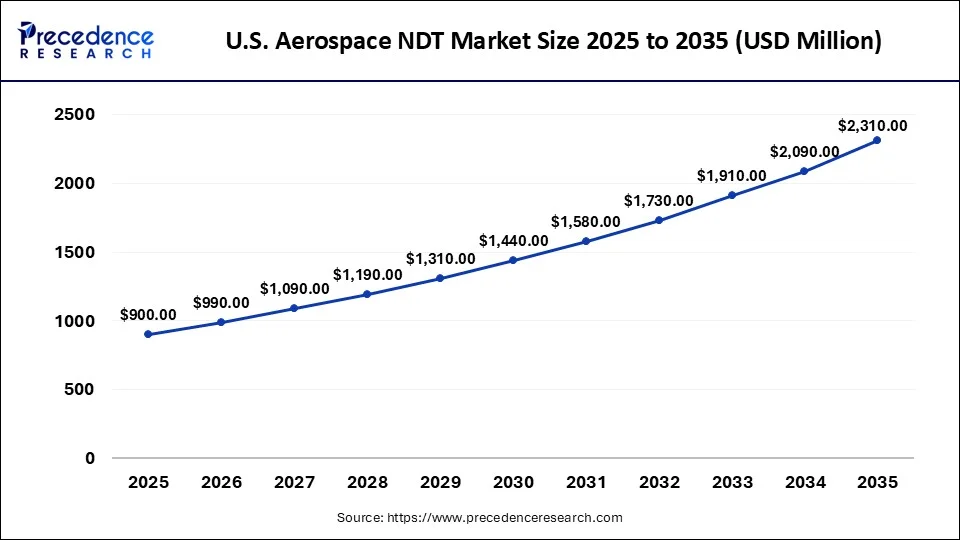
The U.S. Aerospace NDT market size was evaluated at USD 990 million in 2026 and is projected to reach around USD 2,310 million by 2035, growing at a CAGR of 9.88% from 2026 to 2035.
United States
The United States is at the forefront of the use of NDT in the aerospace sector, given a broad aircraft manufacturing footprint, sophisticated MRO facilities, long-standing defence projects and a continual drive to invest in digital inspection solutions in commercial and military aviation.
The Asia-Pacific Aerospace NDT Market Expected to Grow at a CAGR of 11.4% From 2026 to 2035
Asia-Pacific held the second-largest regional market share at 24% in 2026 and is estimated to grow at a CAGR of 11.4% from 2026 to 2035, supported by its aerospace industry through expanding aircraft manufacturing, rising airline fleets, and growing maintenance infrastructure.
China
China leads the regional market through expanding commercial aircraft manufacturing, growing aerospace supply chains, and increasing investments in advanced inspection technologies supporting domestic aviation programs.
India
Rapid expansion of aerospace manufacturing, new investments in MRO, and also growth of the government's support to develop its skills for aviation are expected to give the country its fastest growth.
Europe Held Significant Market Share of 28% in 2026
The Europe held a 28% market share in 2026 and is expected to grow at a CAGR of 9.7% from 2026 to 2035, driven by increasing aircraft production, sustainability initiatives, and advanced aerospace research investments.
Germany
Germany has a leading advantage in the region due to its world-class, integrated, and mature aerospace manufacturing system, composite aircraft parts manufacturing, precision engineering, and advanced industrial automation along aircraft supply chains.
United Kingdom
The UK is expected to achieve the highest growth, driven by both broadening aerospace research and the use of smart inspection practices and technologies that continue to grow within manufacturing plants.
Latin America Held Notable Market Share with 6% in 2026
The Latin America region is expected to grow at a notable CAGR of 8.9% between 2026 and 2035, due to its aerospace industry through expanding aircraft manufacturing, rising airline fleets, and growing maintenance infrastructure.
Brazil
Brazil tops the regional market with a well-developed aircraft manufacturing industry, aircraft production development for commercial applications, and continued increases in the maintenance function for both local and international operators.
Middle East & Africa Held a Considerable Market Share of 5% in 2026
The Middle East & Africa region is expected to grow at a strong CAGR of 9.2% between 2026 and 2035, fuelled by growing commercial aviation activity and regional aircraft support services.
United Arab Emirates
The UAE leads the regional market through its world-class aviation hubs, advanced aircraft maintenance facilities, and continuous investment in aerospace engineering and inspection capabilities.
Saudi Arabia
Saudi Arabia will witness the highest growth rate driven by growth in aviation infrastructure, aerospace localization, and the boost in aviation investments in maintenance and manufacturing capacities.
Aerospace NDT Market Supply Chain Analysis
- Raw Material Supply Chain
Examples of precision sensors include a range of ultrasonic transducers, imaging components and robotics, nature-inspired electronics, and specialist materials that are used to build aerospace NDT equipment.
Key Players: Evident Corporation, Baker Hughes, Teledyne Technologies, Varex Imaging, Olympus Scientific Solutions.
Equipment Manufacturing Landscape
Advanced aerospace NDT systems are manufactured by high concentration manufacturing bases, with qualified global supplier networks and by specialized manufacturers.
- Key Players: Waygate Technologies, Evident Corporation, Zetec Inc., Eddyfi Technologies, Sonatest.
Software Ecosystem
Digital imaging, analytics, automation, and inspection traceability are made possible by AI developers, cloud platform providers, and inspection software vendors.
- Key Players: Hexagon AB, Creaform, Waygate Technologies, NVIDIA, Microsoft.
- Supply Chain Risks
Aerospace NDT equipment supply chains face risks from semiconductor shortages, electronic-component sourcing constraints, logistics disruptions, and geopolitical instability
Key Players: Intel Corporation, Texas Instruments, TSMC, STMicroelectronics, Infineon Technologies.
Competitive Landscape
Market Structure
The field is heating up in terms of competition in the aerospace inspection segment, but it is not as balanced as it could be. Only a few global giants are dominant in the Testing, Inspection and Certification market. With specialists who have expertise in areas other than size competing on technology depth. DEKRA, TÜV SÜD and TÜV Rheinland are foundation-controlled companies but not listed on the stock exchange. This affects the extent to which companies can go the Apple route of taking over other companies aggressively. The combination of public giants and entrepreneurs who have gone public or public-private partnerships and foundations attempted to give rise to a niche yet consolidated player base.
Below them are specialist NDT (audit) equipment manufacturers which specialise in precision and not so much on breadth of equipment, such as Zetec, Sonatest and Nikon Metrology. Aerospace OEMs are emerging more as competitors than partners. The lines have been increasingly crossed between OEM, certifier and technology vendor, and determining who owns each specific capability. They are increasingly getting confused without careful examination of recent vendor moves. The more critical fact that the cards are increasingly being played.
Market Share Analysis
Comparing vendors by pure market share isn't reflective of how they really compete on a day-to-day basis. Competition instead becomes more about specialisation and speed of technology developments. In January 2025, SGS's portfolio was enhanced with Aster Global Environmental Solutions' greenhouse gas validation and forestry assurance services. In March 2025, TUV Rheinland expanded its presence in Spain and its agri-food certification activities with the acquisition of SYGMA Certification. The transactions are evidence of market leaders stacking their positions on a regular basis, rather than just trying to hold on to them.
Strategic Developments
It's been a high period in these months with regards to partnerships, technology releases, and wins with certifiers all over the industry. In April of 2026, GE Aerospace and Waygate Technologies announced a new partnership. They deliver automated inspection templates for engine maintenance based on the previous development of an AI-assisted template for borescope inspections. This was trained on thousands of labeled engine images. The expansion of the facilities has paralleled that of the rest of Singapore's investments. GE Aerospace has expanded into a new module repair shop at Seletar Aerospace Park. These overlapping contracts, launches, and certifications indicate the industry taking steps on several fronts at the same time.
Competitive Benchmark Matrix
There is a wide spectrum in the way vendors approach their strategies. GE Aerospace is in the lead on both the volume of engine data in the process of incorporating AI into its defense platform. Pierre Kleiber and Indhuja Bhagwat lead on geographic presence and R&D breadth. Spending dollars on dozens of acquisitions and service lines and not just one piece of technology. It's a matter of footprints, and TÜV Rheinland and DEKRA do it with more of a focus on credibility of certification than do any of the proprietary automation tools.
Company Profiles
Gecko Robotics
Since starting operations in Pittsburgh in 2013 out of a college dorm room project. Gecko Robotics has expanded to become a significant player in the AI-powered infrastructure inspection space. It has private equity backers Cox Enterprises, Founders Fund, and Y Combinator and was a unicorn by 2025. Gecko's cloud-based software solution that transforms raw scans into 3D thickness maps and machine-learning identified risk zones instead of traditional inspection reports.
Hexagon AB
Centred on four business areas, including manufacturing intelligence, infrastructure & geospatial, and autonomous solutions. Hexagon claims to be the global leader in precision measurement, positioning, and autonomous solutions. It is a public firm that has been working on a portfolio restructuring program to spinoff Octave business as the Octave Holding Company (LN). Hexagon's inspection technologies range from hardware to predictive software. The company unveiled an AI-based predictive condition monitoring platform for coordinate measuring machines (CMs).
Aerospace NDT Market Companies
- Applus Services SA
- Baker Hughes Company
- Intertek Group plc
- Mistras Group Inc.
- SGS SA
Future Market Outlook (2026-2035)
Short-Term Outlook (2026-2028)
Growth in inspection workload appears to be reflecting gains in aircraft production, more than just on paper forecasts. In October 2025, Boeing raised its 737 MAX production rate to 42 aircraft per month from limited production of 38 throughout the year. This was imposed by the FAA. Those planes need NDT during manufacture, and every one of them will be added to the in-service fleet. That MRO providers have to perform inspections on from time to time. This ramp is happening concurrently with a change in regulation, which will in turn change the way inspections are conducted.
Medium-Term Outlook (2028-2032)
The next big change is to be expected during the shift to predictive maintenance. From the act of an inspection to an operating input. In March 2026, Hexagon's own APOLLO platform will be introduced. Warning decay in metrology equipment up to 90 days prior to the deterioration event, by the early 2030s. Aerospace manufacturers will want the same function in their own metrology tools used to probe their production lines. The industry will naturally shift to this fully autonomous, self-correcting inspection ecosystem. Arriving in the decade to come as the digital twins and commercial space infrastructure become a reality.
Long-Term Outlook (2032-2035)
By the early 2030s, fully autonomous inspection ecosystems should be consistently used on fleets with all other technologies maturing. The transition is already a uniquely new revenue stream for aerospace inspection technology. One that is based on microgravity-enabled robotics, not crawlers, and not drones, on the ground. The 2032-2035 timeline promises to reinvent the term inspection, and put space beyond the runway.
Strategic Recommendations
Recommendations for Equipment Manufacturers
The road to success in material handling in the coming years is increasingly paved with automation and AI. For equipment manufacturers, the expectation of integration should be expected as standard feature. Not a do-you-price extra-cost option, as customers redo comparing companies based on automation and AI levels. Those manufacturers that do not come with a comparable predictive layer face being outperformed by competing companies. Those that can sell their hardware with periodic software revenues.
Recommendations for Inspection Service Providers
Digital transformation can not be limited to pilot projects anymore. It is set to be the default status for all contracts to operate with. Those who continue to rely on paper-based or silo reporting will find themselves losing out on contracts with industry competitors. Those that are data platform-based, centralized, and equipped with predictive analytics. The need for workforce development must be matched in urgency, as there is no cyclical shortage; it is structural. To meet that shortage, service providers must invest directly in the training pipelines, not just clamor for the same lack of certified technicians.
Recommendations for Aerospace OEMs and MRO Companies
Plans for regulatory compliance should begin today. Well before any of the rules are published. Because the new rules for drone inspection will change MRO scheduling. The FAA's Part 108 rule for beyond-visual-line-of-sight drone operations is likely to be finalized in March 2026. Early adopters of compliance building out frameworks are more likely to ramp up automated inspections. Than others who might be waiting for the rule to be finalized in its entirety. On the other hand, other regional OEM-MRO partnerships should be studied closely as they plan their own lifecycle strategies heading toward the following decade of investment decisions.
Recommendations for Investors
New regional opportunities are not to be missed, especially when infrastructure is being constructed, particularly for inspectors. The latest move towards localization of India's defense MRO market with the upcoming opening of the site in Bengaluru, India. Tata Advanced Systems is installing the fab and should not be ignored as a new demand center in the country, but a genuine one. The most promising individual market is perhaps the aforementioned AI-powered inspection platforms. Hexagon will pay up specifically for NDT businesses it can layer on top of its current AI and metrology software processes. While continuing investors will see the same process as other equipment manufacturers try to plug the same software hole over the next decade.
Complete Market Segmentation
By Technique
- Ultrasonic Testing (UT)
- Conventional UT
- Phased Array Ultrasonic Testing (PAUT)
- Time-of-Flight Diffraction (TOFD)
- Radiographic Testing (RT)
- Digital Radiography (DR)
- Computed Radiography (CR)
- X-ray Computed Tomography (CT)
- Eddy Current Testing (ECT)
- Visual Testing (VT)
- Direct Visual Inspection
- Remote Visual Inspection (RVI)
- Magnetic Particle Testing (MPT)
- Liquid Penetrant Testing (LPT)
- Thermography Testing
- Shearography
- Acoustic Emission Testing
By Component
- Equipment
- Portable Equipment
- Automated Inspection Systems
- Robotic Inspection Systems
- Software
- Inspection Software
- AI-Based Defect Detection
- Digital Twin & Analytics
- Services
- Inspection Services
- Calibration Services
- Maintenance Services
- Training & Certification
- Consumables
By Aircraft Type
- Commercial Aircraft
- Narrow-body
- Wide-body
- Regional Aircraft
- Military Aircraft
- Fighter Aircraft
- Transport Aircraft
- Helicopters
- Business Jets
- General Aviation
- Spacecraft & Launch Vehicles
- Unmanned Aerial Vehicles (UAVs)
By Application
- Airframe & Structures
- Engine Components
- Landing Gear
- Avionics & Electronics
- Composite Materials Inspection
- Turbine Blades
- Weld Inspection
- Maintenance, Repair & Overhaul (MRO)
By Inspection Method
- Manual Inspection
- Semi-Automated Inspection
- Fully Automated Inspection
By End User
- Aircraft OEMs
- Maintenance, Repair & Overhaul (MRO) Providers
- Defense Organizations
- Space Agencies
- Component Manufacturers
By Region
- North America
- Latin America
- Europe
- Asia-Pacific
- Middle East and Africa
For inquiries regarding discounts, bulk purchases, or customization requests, please contact us at sales@precedenceresearch.com
Frequently Asked Questions





Ask For Sample
No cookie-cutter, only authentic analysis – take the 1st step to become a Precedence Research client
 Get a Sample




 sales@precedenceresearch.com
 Schedule a Meeting
