



AI-Powered Embryo Selection Market Size, Companies, Share, Patient Volume, Treatment Adoption Rates, Pricing Analysis, Regulatory Landscape, Competitive Positioning, and Demand Forecast
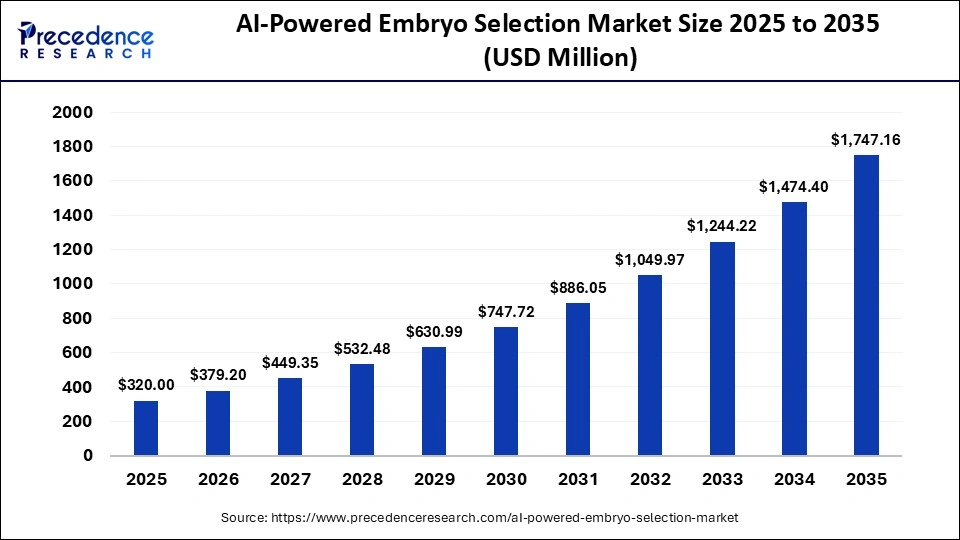
Rohan Patil, a Healthcare Industry Expert, highlights that the ai-powered embryo selection market has reached USD 379.20 million in 2026 and is on track to reach USD 1,747.16 million by 2035, advancing at a CAGR of 18.50%. Key ai-powered embryo selection market companies shaping the market include Vitrolife AB, CooperSurgical Inc., Genea Biomedx, Fairtility Ltd., Alife Health Inc., while major growth segments span By Component, By Technology, By Application, By End-Use.
Source: https://www.precedenceresearch.com/ai-powered-embryo-selection-market
 Get a Sample
 Table Of Content


What is the AI-Powered Embryo Selection Market Size in 2026?
The global AI-powered embryo selection market size accounted for USD 320.00 million in 2025 and is predicted to increase from USD 379.20 million in 2026 to approximately USD 1,747.16 million by 2035, expanding at a CAGR of 18.50% from 2026 to 2035. The market is driven by ongoing advancements in machine learning, increasing success rates in IVF treatments, and the rising demand for personalized fertility solutions.
Key Takeaways
- North America led the AI-powered embryo selection market in 2025 with a 40% share.
- The Asia Pacific is observed to grow at the highest CAGR of 21% between 2026 and 2035.
- By component, the software segment led the market with 65% share in 2025.
- By component, the services segment is observed to grow at a CAGR of about 17% in the upcoming period.
- By technology, the deep learning segment dominated the global market in 2025 with a 45% and is expected to grow at the fastest CAGR over the forecast period.
- By application, the in vitro fertilization segment led the global market in 2025 with a 50% share.
- By application, the embryo viability assessment segment is expected to expand at the fastest CAGR of 20% in the coming years.
- By end-use, the fertility clinics segment led the global market in 2025 with 60% share and is expected to grow at the fastest CAGR of 18.8% in the coming years.
AI-Powered Embryo Selection Market Overview
Artificial intelligence and machine learning technologies are transforming the approach to infertility treatment. AI-driven embryo selection enables embryologists to identify the most viable embryos for IVF by providing more precise and objective evaluations of embryo viability. By analyzing extensive datasets of embryo images and developmental patterns, AI systems can detect subtle characteristics and have the potential to improve prediction accuracy compared to conventional techniques. This advancement contributes to higher IVF success rates while reducing the emotional and financial burden on patients.
Tools such as iDAScore, ERICA, and Life Whisperer are among the most widely used. These AI solutions deliver comprehensive image-based analyses of each embryo and examine their features to generate an AI score, helping embryologists select the highest-quality embryos for the IVF process.
AI-Powered Embryo Selection Market Trends
- Growing Integration of AI-enabled Telehealth in Fertility Care: The integration of AI-powered embryo selection with a telehealth platform is enabling remote consultation, data sharing, and improved decision-making, enhancing accessibility and efficiency in IVF treatments.
- Emergence of Patient-Centered Digital Platforms: Patient-centered digital platforms are emerging, allowing clinics to analyze embryo data, track treatment progress, and enhance decision-making, improving overall efficiency in fertility treatment.
- Growing Strategic Partnership in Fertility Tech: Partnership between AI developers, fertility clinics, and IVF technology providers is advancing intelligent embryo acceleration data-driven fertility solutions
Market Scope
| Report Coverage | Details |
| Market Size in 2025 | USD 320.00 Million |
| Market Size in 2026 | USD 379.20 Million |
| Market Size by 2035 | USD 1,747.16 Million |
| Market Growth Rate from 2026 to 2035 | CAGR of 18.50% |
| Dominating Region | North America |
| Fastest Growing Region | Asia Pacific |
| Base Year | 2025 |
| Forecast Period | 2026 to 2035 |
| Segments Covered | Component, Technology, Application, End Use, and Region |
| Regions Covered | North America, Europe, Asia-Pacific, Latin America, and Middle East & Africa |
Market Dynamics
Drivers
Increasing Adoption of AI-Driven IVF tools
The increasing adoption of AI-driven IVF tools is driving the AI-powered embryo selection market by enhancing the accuracy and efficiency of embryo assessment during in vitro fertilization. AI algorithms analyze a wide range of data, including genetic, morphological, and clinical factors, to predict the best embryos for implantation, improving success rates and reducing time and cost for fertility treatments. As IVF clinics and fertility centers seek to optimize outcomes and offer more personalized care, AI-driven tools are becoming integral to the embryo selection process.
Restraints
Ethical Concerns and Limited Data Transparency
Ethical concerns surrounding the use of AI in embryo selection are restraining the growth of the AI-powered embryo selection market. Additionally, limited data transparency and concerns about the reliability of AI models, particularly when it comes to sensitive reproductive health data, are creating hesitancy among patients and healthcare providers. These challenges hinder the wider adoption and integration of AI in fertility treatments.
Opportunity
Demand for Personalized Fertility Treatment
A major opportunity in the AI-powered embryo selection market lies in the potential for personalized fertility treatments that significantly improve success rates in IVF procedures. As AI algorithms continue to evolve, the ability to analyze large datasets, such as genetic, morphological, and clinical factors, can offer highly tailored embryo selection, reducing risks and increasing efficiency. Furthermore, expanding access to AI-powered tools in emerging markets, where IVF adoption is growing, presents a significant growth opportunity for the industry.
Segment Insights
Component Insights
AI-Powered Embryo Selection Market Share, By Component, 2025-2035 (%)
| Component | 2025 | 2035 | CAGR (%) |
| Software | 65.00% | 67.00% | 19.0% |
| Services | 35.00% | 33.00% | 17.0% |
The Software Segment Dominated the Market in 2025
The software segment led the AI-powered embryo selection market in 2025, accounting for approximately 65% share, and is projected to grow at the fastest CAGR of around 19% during the forecast period. This growth is primarily attributed to the pivotal role of AI-driven software in embryo grading, time-lapse image analysis, and predictive modelling, which significantly enhance IVF success rates and minimize manual subjectivity. Software-driven tools effectively analyze time-lapse imaging data to identify embryos with the highest developmental potential. These assessments not only reduce subjectivity but also standardize clinical decision-making and optimize pregnancy outcomes, thereby facilitating broader market adoption.
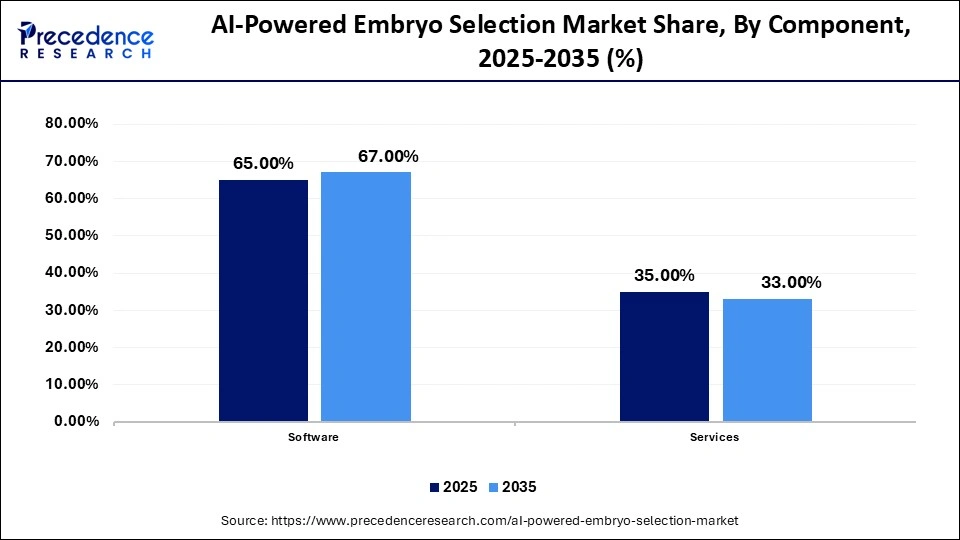
The services segment accounted for 35% share of the market in 2025 and is expected to grow at a CAGR of nearly 17% in the coming years. The growth of the segment is propelled by the rising demand for AI integration, system training, data management, and continuous technical support among fertility clinics implementing digital solutions. These services enhance implantation and pregnancy rates, tailor care for individual patients, and may decrease the number of IVF cycles needed to achieve a successful outcome.
Technology Insights
AI-Powered Embryo Selection Market Share, By Technology, 2025-2035 (%)
| Technology | 2025 | 2035 | CAGR (%) |
| Machine Learning | 30.00% | 28.00% | 16.5% |
| Deep Learning | 45.00% | 48.00% | 20.5% |
| Computer Vision | 25.00% | 24.00% | 17.5% |
The Deep Learning Segment Held a 45% Share of the Market in 2025
The deep learning segment dominated the AI-powered embryo selection market with about 45% share in 2025 and is anticipated to sustain its leading position in the coming years. This growth is attributed to its exceptional performance in image recognition, which facilitates the development of automated and highly accurate embryo grading systems. Deep learning algorithms provide innovative insights by directly analyzing raw time-lapse sequences without preconceived notions regarding the importance of the data that embryologists typically prioritize, thereby promoting market adoption.
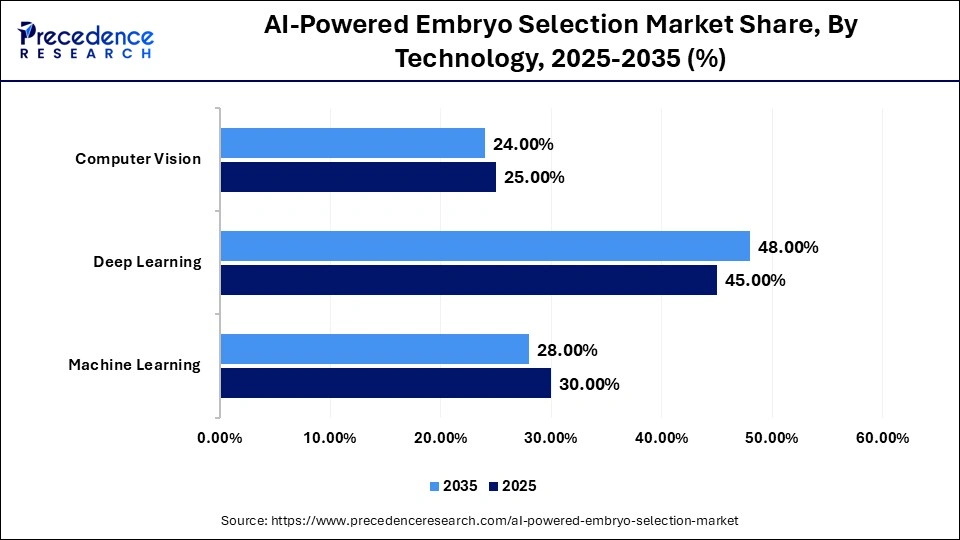
The machine learning segment held about 30.00% share of the market in 2025 and is expected to grow at a CAGR of 16.5% in the upcoming period. This is mainly due to its extensive application in predictive analytics. This enables clinicians to evaluate embryo quality by analyzing historical and clinical data patterns. Machine learning (ML) algorithms present significant advantages over traditional methods of embryo selection, providing new opportunities to prioritize embryos for transfer more effectively, thereby reducing the time to pregnancy.
The computer vision segment held a 25.00% share of the market in 2025 and is expected to grow at a CAGR of 17.5% over the projection period. This growth is attributed to its capability to facilitate real-time embryo monitoring and image processing, which enhances decision-making accuracy during in vitro fertilization (IVF) procedures. Additionally, computer vision improves the efficiency of critical tasks and offers advanced algorithms that act as benchmarks, thereby reducing subjectivity in the decision-making process.
Application Insights
The In Vitro Fertilization (IVF) Segment Dominated the Market in 2025
The in vitro fertilization (IVF) segment led the AI-powered embryo selection market in 2025 with approximately 50% share, reflecting its role as the primary application of AI-powered embryo selection. AI enhances embryo selection accuracy, increases implantation success rates, and reduces the number of cycles required. Advances in AI also enable the analysis of vast datasets to predict optimal stimulation protocols, potentially improving oocyte quality and fertilization rates, which further supports market growth.
AI-Powered Embryo Selection Market Share, By Application, 2025-2035 (%)
| Application | 2025 | 2035 | CAGR (%) |
| In Vitro Fertilization (IVF) | 50.00% | 48.00% | 18.0% |
| Genetic Screening | 20.00% | 22.00% | 19.5% |
| Embryo Viability Assessment | 20.00% | 22.00% | 20.0% |
| Others | 10.00% | 8.00% | 15.0% |
The embryo viability assessment segment accounted for about 20% market share in 2025 and is expected to grow at the fastest CAGR of 20% during the studied period. The growth of the segment is driven by the increasing adoption of AI-based viability scoring, which minimizes human bias and improves the prediction of successful pregnancies. The technology processes digital video data captured in real time from embryos shortly before transfer or storage (such as cryopreservation), supporting its expanding use and market growth.
The genetic screening segment held a 20% share of the market in 2025 and is projected to grow at a CAGR of 19.5%, driven by the integration of AI with genetic testing, which improves the detection of chromosomal abnormalities and supports better embryo selection outcomes. AI helps interpret detected variants to identify those that may affect gene function and are more likely to be disease-causing. This provides a more comprehensive view of potential health impacts and further supports market expansion.
End-Use Insights
The Fertility Clinics Segment Led the Market With a 60% Share in 2025
The fertility clinics segment dominated the AI-powered embryo selection market in 2025 with a 60.00% share and is projected to grow at the fastest CAGR of 18.8% in the upcoming period. This dominance is driven by high IVF volumes and the rapid adoption of AI tools to improve clinical outcomes and operational efficiency. These solutions enable clinics to analyze vast amounts of data, identify patterns, and support embryologists and clinicians in making more informed decisions.
AI-Powered Embryo Selection Market Share, By End-Use, 2025-2035 (%)
| End-Use | 2025 | 2035 | CAGR (%) |
| Fertility Clinics | 60.00% | 62.00% | 18.8% |
| Hospitals | 25.00% | 23.00% | 17.0% |
| Research Institutes | 15.00% | 15.00% | 16.5% |
The hospital segment held a 25% market share in 2025 and is projected to grow at a CAGR of 17.0%. This is primarily due to the increasing integration of AI into reproductive medicine departments to enhance treatment precision and patient outcomes. The transition toward a single, interoperable digital infrastructure that connects hospitals using passive sensors and ambient intelligence also drives segmental growth.
The research institutes segment held nearly 15% share of the market in 2025 and is expected to expand at a CAGR of 16.5% over the forecast period, driven by developing and validating AI models that support innovation in reproductive technologies. AI enhances the effectiveness of fertility treatments, helping address ethical and legal considerations, and opening new avenues for research and clinical practice. In addition, AI is significantly improving drug discovery and development processes by streamlining workflows, reducing time and costs, and further promoting market growth.
Regional Insights
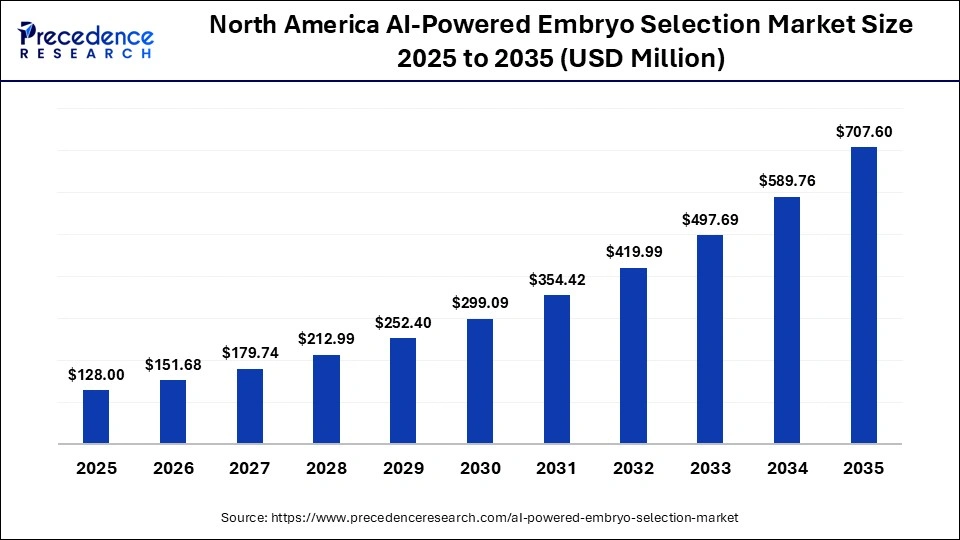
North America AI-Powered Embryo Selection Market Size and Growth 2026 to 2035
The North America AI-powered embryo selection market size is estimated at USD 128.00 million in 2025 and is projected to reach approximately USD 707.60 million by 2035, with a 18.65% CAGR from 2026 to 2035.
North America Led the AI-Powered Embryo Selection Market in 2025
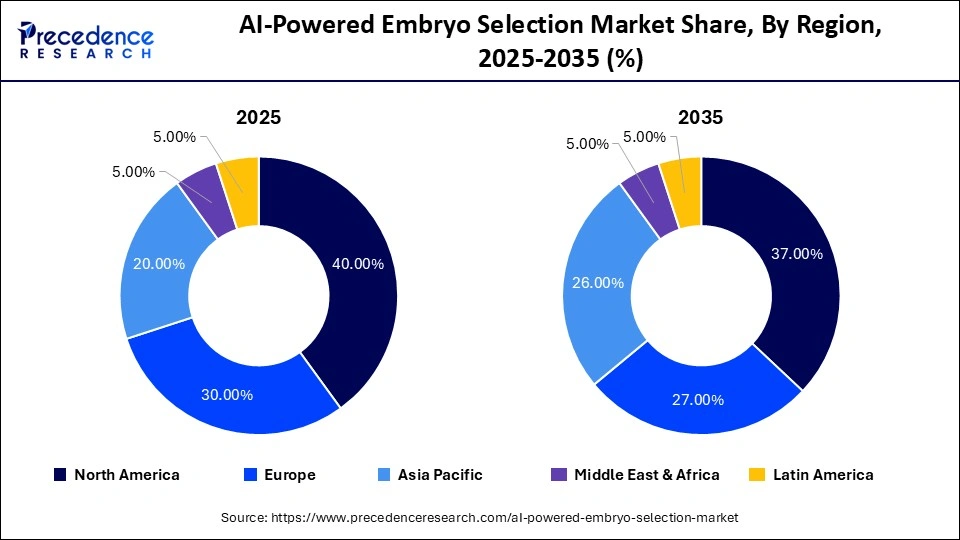
North America dominated the AI-powered embryo selection market in 2025 with around 40.0% share, supported by advanced IVF infrastructure, high adoption of AI-based healthcare solutions, and a strong presence of key technology providers. There is a high level of specialized AI software solutions to manage the complexities of IVF processes in clinics and fertility centers. Robust technical environment and highly developed healthcare infrastructure are key factors fostering innovation in assisted reproductive technologies.
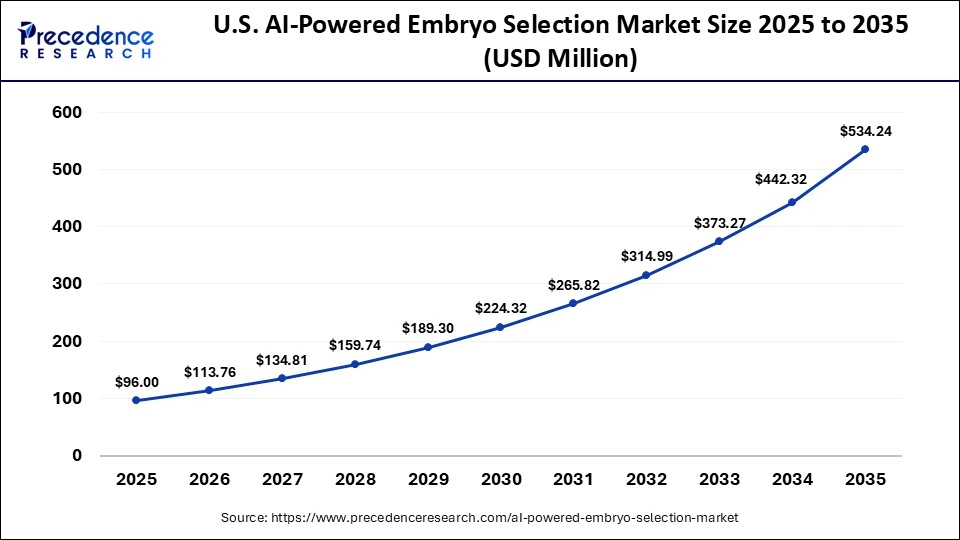
U.S. AI-Powered Embryo Selection Market Size and Growth 2026 to 2035
The U.S. AI-powered embryo selection market size is calculated at USD 96.00 million in 2025 and is expected to reach nearly USD 534.24 million in 2035, accelerating at a strong CAGR of 18.73% between 2026 and 2035.
U.S. Market Analysis
The U.S. leads the North American market, supported by a robust digital health infrastructure, substantial investments in AI technologies, and the growing prevalence of IVF procedures. Rising demand for personalized and remote fertility care, along with the increased use of AI tools integrated into proprietary electronic health record (EHR) systems, is enhancing patient care and reducing clinicians' administrative burden.
Europe: The Second-Largest Market
Europe captured around 30% share of the global market in 2025 and is expected to grow at a CAGR of 17.8% over the forecast period. This is because of rising infertility rates, supportive regulations, and strong demand for assisted reproductive technologies. Growing investment in digital health, stringent medical device standards, robust insurance coverage, advanced lab infrastructure, and high awareness levels continue to support the adoption of AI-powered embryo selection and steady IVF demand.
Germany Market Analysis
Germany recorded steady growth within Europe, driven by its advanced healthcare infrastructure, emphasis on clinical precision, and increasing number of infertility cases. Continuous development of cutting-edge reproductive technologies, rising awareness of treatment options, and high IVF success rates also drive the market growth in Germany.
Asia Pacific: The Fastest-Growing Region
Asia Pacific held a 20% share of the market in 2025 and is expected to grow at the fastest CAGR of 21.0% in the coming years. This is primarily due to rising infertility rates, the rapid expansion of IVF clinics, and the accelerating adoption of AI technologies in reproductive medicine. The region also benefits from broader healthcare digitization and government initiatives that support digital infrastructure for AI-based embryo selection.
China Market Analysis
China leads the Asia Pacific AI-powered embryo selection market, supported by a strong technology ecosystem and growing awareness and acceptance of fertility services, which together create attractive investment opportunities. The country is home to leading market companies such as Basecare Medical, Jinxin Fertility, and BGI Genomics, which are key contributors to regional market growth.
AI-Powered Embryo Selection Market Companies
- Vitrolife AB
- CooperSurgical Inc.
- Genea Biomedx
- Fairtility Ltd.
- Alife Health Inc.
- Overture Life
- AIVF (Artificial Intelligence IVF)
- iGenomix (Vitrolife Group)
- Merck KGaA
- Fujifilm Irvine Scientific
- Hamilton Thorne Ltd.
- Nikon Corporation
- ZEISS Group
- Esco Medical
- LabIVF Asia
Recent Developments
- In August 2025, Nova IVF Fertility, a leading IVF center chain, announced a major enhancement to its fertility treatment services by integrating artificial intelligence (AI) into its IVF laboratories to improve precision and transparency in embryo selection.(Source: https://www.ocacademy.in)
- In October 2025, Life Health's AI-powered embryo selection tool, Embryo Predict, received CE Mark certification under the European Medical Device Regulation (MDR).(Source: https://www.medicaldevice-network.com)
Segments Covered in the Report
By Component
- Software
- Services
By Technology
- Machine Learning
- Deep Learning
- Computer Vision
By Application
- In Vitro Fertilization (IVF)
- Genetic Screening
- Embryo Viability Assessment
- Others
By End-Use
- Fertility Clinics
- Hospitals
- Research Institutes
By Region
- North America
- Latin America
- Europe
- Asia-pacific
- Middle and East Africa
For inquiries regarding discounts, bulk purchases, or customization requests, please contact us at sales@precedenceresearch.com
Frequently Asked Questions





Ask For Sample
No cookie-cutter, only authentic analysis – take the 1st step to become a Precedence Research client
 Get a Sample




 sales@precedenceresearch.com
 Schedule a Meeting
