



Asia Pacific Electric Vehicle (EV) Charging Station Market Size, Companies, Share, Vehicle Production Volume, Sales Performance, Export & Import Analysis, Technology Adoption, Competitive Positioning, and Demand Trends
Laxmi Narayan is an automotive and electric mobility infrastructure market research analyst covering the Asia Pacific electric vehicle (EV) charging station market. He monitors charging infrastructure installations, government electrification policies, charging technology, investment initiatives, and public/private partnerships throughout the region. Closely follows the actions taken by states and local governments. His research provides comprehensive market intelligence, competitive benchmarking, and strategic insights to support infrastructure developers, charging network operators, automotive manufacturers, utilities, and institutional investors in their business decision-making processes.
Source: https://www.precedenceresearch.com/asia-pacific-electric-vehicle-charging-station-market
 Get a Sample
 Table Of Content


Asia Pacific Electric Vehicle (EV) Charging Station Market Size and Forecast 2026 to 2035
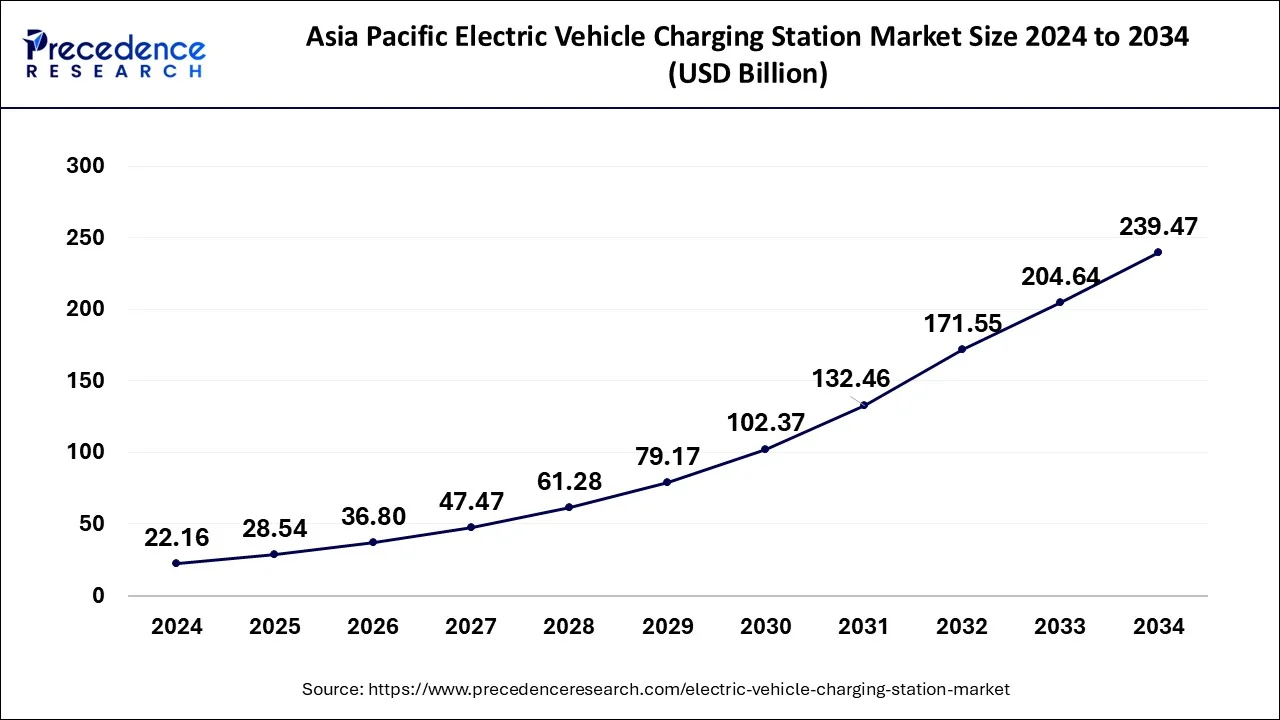
Laxmi Narayan has over 5 years of experience in the field of electric mobility infrastructure, EV charging technology, and transportation electrification research. With extensive market research her company has done, he is convinced that the Asia Pacific electric vehicle (EV) charging station market offers ample potential for a healthy future. Owing to the continuous expansion of charging infrastructure by governments to foster EVs in the region. The market was estimated at USD 36.8 billion in 2026 and is expected to reach USD 273 billion by the end of the forecast period from 2026 to 2035, coming in at a CAGR of 25.34%. He also emphasizes the significant investments being made in large-scale public infrastructure. The increase in adoption of EVs and the supportive policy environments, and the ongoing expansion of high-power charging infrastructure are the main contributors to this market's growth.
Key Takeaways
- By level of charging, the level 2 segment led the market with a 56% share in 2025.
- By charging station type, the AC charging segment captured a major revenue share of 61% in 2025.
- By power output, the 11kW-50kW segment captured the largest commercial vehicle braking system market share of 46% in 2025.
- By vehicle type, the passenger cars segment captured the largest market share of 48% in 2025.
- By installation type, the fixed segment captured the largest market share of 58% in 2025.
Market Value Projected to Approach USD 273 Billion by 2035
As per our research, at the rate this market is going, it will reach a total of about USD 273 billion in 2035 from USD 36.8 billion in 2026, almost ten times its size in just ten years. Few regions have seen as many years with the same level of investment in infrastructure in categories other than highway and aerospace. In some of these markets, capital investment in charging equipment could exceed capital investment in the vehicles themselves over the next ten years. Near tenfold growth by 2035 makes this as much a capex story as an EV adoption story.
Key Insight: A long-term CAGR of over a quarter, over 10 years, is driven by structural factors, namely the government's EV mandate, the high density of cities, and the growth of EV manufacturing on a scale pioneered by China, as opposed to an immediate stimulus effect.
Source: Precedence Research Database
DC Fast Charging (Level 3) Set to Overtake Level 2 as the Dominant Tier by 2035
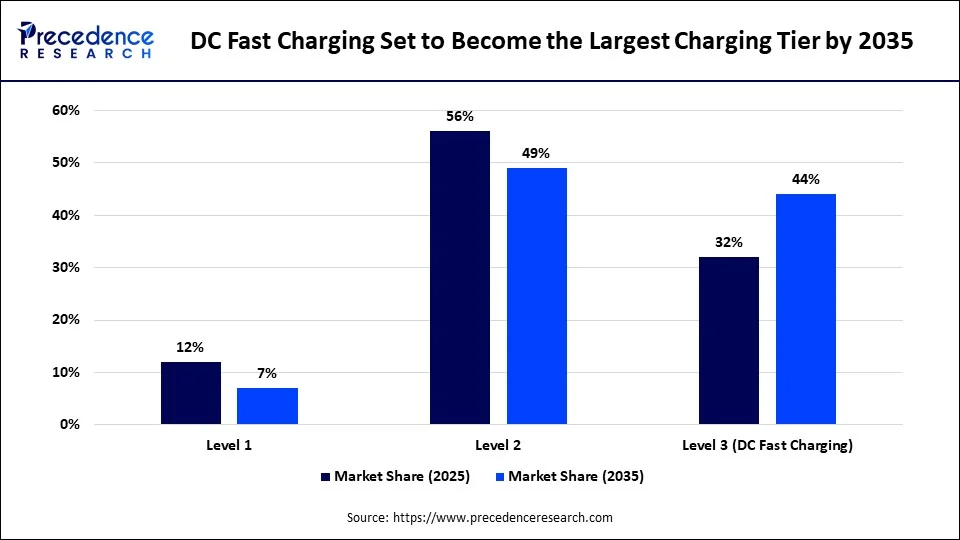
According to Aman, standard level 2 charging is still the workhorse of the Asia Pacific electric vehicle (EV) charging station market, which held a market share of 56% in 2025, owing to an upright compromise between installation price tag and usability. The direction of travel is crystal clear, however, as fast, level 3 charging gains momentum at a clearly accelerated rate, expected to hold 44% of total market share in 2035, with the aid of supplementary highways and urban fast charging hubs. A big part of that difference should be overcome by the end of this decade on the faster tier.
Key Insight: Growth at Level 3 DC fast charging is almost 60 per cent faster than at Level 1, reflecting regional government policies to focus on fast charging corridors along the highway and urban landscape as well as slow charging at home.
Source: Precedence Research Database
Fastest-Growing Sub-Segments Span Wireless Charging, Ultra-Fast Power, and Fleet Use Cases
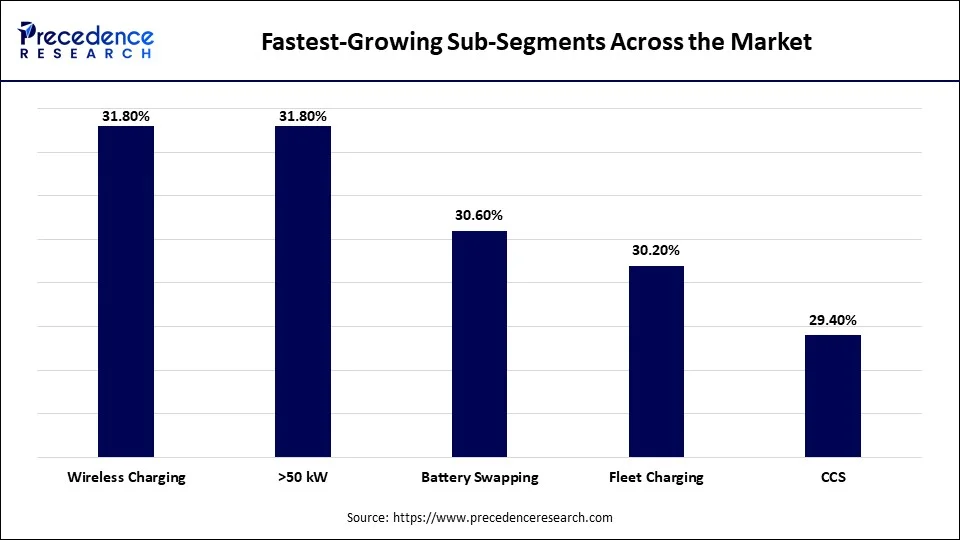
As per my research, the fastest-growing sub-segments under each show the direction in which investments are gaining momentum in the Asia Pacific EV charging station market. The demand for faster, automated, and high power charging is expected to boost wireless charging and the >50 kW charging stations segment with a compound annual growth rate of 31.8% and 31.8%, respectively. Battery swapping will take over with a CAGR of 30.6%. As it helps minimize charging downtime for commercial vehicles, fleet charging will grow at 30.2% CAGR with fleet electrification on the rise. CCS connectors are expected to witness the growth of adoption of DC fast charging, and higher compatibility with modern EV models, with a CAGR of 29.4%.
Key Insight: The market is moving towards high-power, automated, and commercial charging solutions, thereby witnessing the greatest growth.
Source: Precedence Research Database
Statistical Images - Country-Level Infrastructure Analysis
China's Charging Pile Stock Has Grown Nearly 300x Since 2015
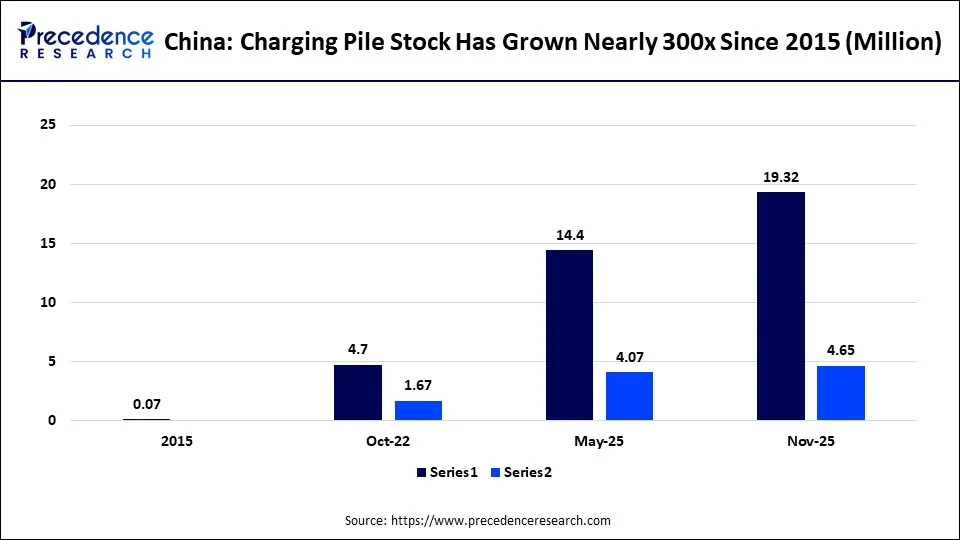
My research shows that there were only 66,000 charging piles installed in China as early as 2015, but by the end of October 2022. The number of charging piles had reached 4.7 million. By the end of November 2025, the country's total number of piles reached June 1st figure 19.32 million, of which 4.63 million were public and 14.7 million were private, an increase of 52% from the previous year. Furthermore, in just the first 11 months of 2025, China has increased the charging capacity of its vehicles by more than the total amount in the world a few years ago. Its growth rate is almost 300 times per decade, making it stand out on the scale in terms of growth in the Asia Pacific electric vehicle (EV) charging station market.
Key Insight: China has installed a greater number of charging piles in the first 11 months of 2025 than the entire world did in the previous few years combined (roughly 6.6 million net).
Source: China National Energy Administration (NEA), as reported by english.www.gov.cn (Dec 2025); CarNewsChina (Aug 2025); EVCIPA data via ScienceDirect (2025)
India's Public Charging Stations Have Grown Sixfold Since 2023
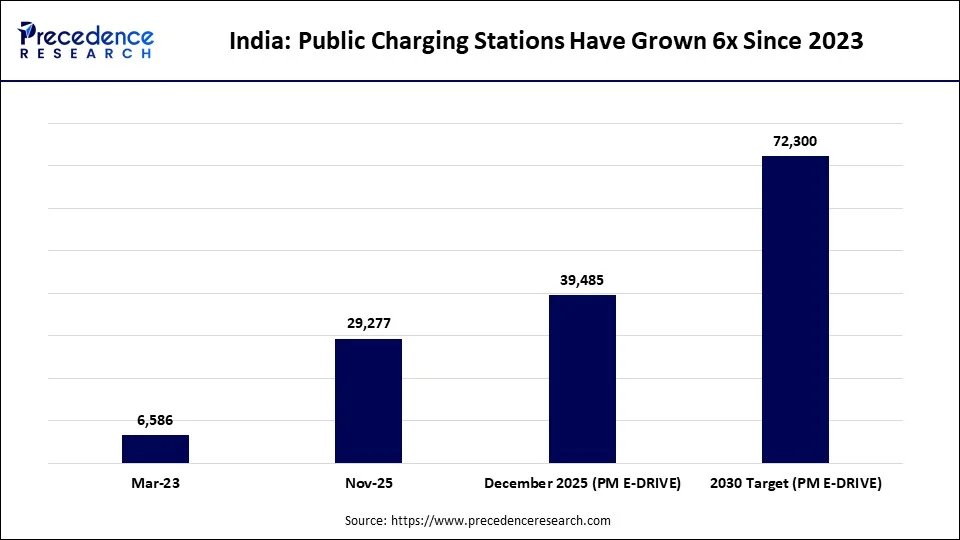
As a market research analyst, I interpret this dataset as evidence. In March 2023, the public charging network in India had 6,586 stations, with 8,414 of them being fast chargers. But by November 2025, it had risen to 29,277 stations, and in March 2024 to 31,569 stations. Further, by December 2025, the progress update on PM e-drive showed it had jumped to 39,485 stations, with 8,414 of them fast chargers. The government programme aims for 72,300 stations, almost double the current number of stations installed in a dedicated program. Roughly sixfold growth in under three years still leaves the steepest phase of India's build-out ahead rather than behind.
Key Insight: India's public charging base has almost tripled in less than three years, but the public charging base that India's government is aiming for with its own PM E-DRIVE program is nearly double the current number, suggesting that the biggest part of the build-out is yet to come.
Source: Government of India, Lok Sabha written replies (Feb 2026, PIB); MarkLines (Dec 2025); PM E-DRIVE official portal (pmedrive.heavyindustries.gov.in).
Japan Targets a Tenfold Increase in Charging Points by 2030
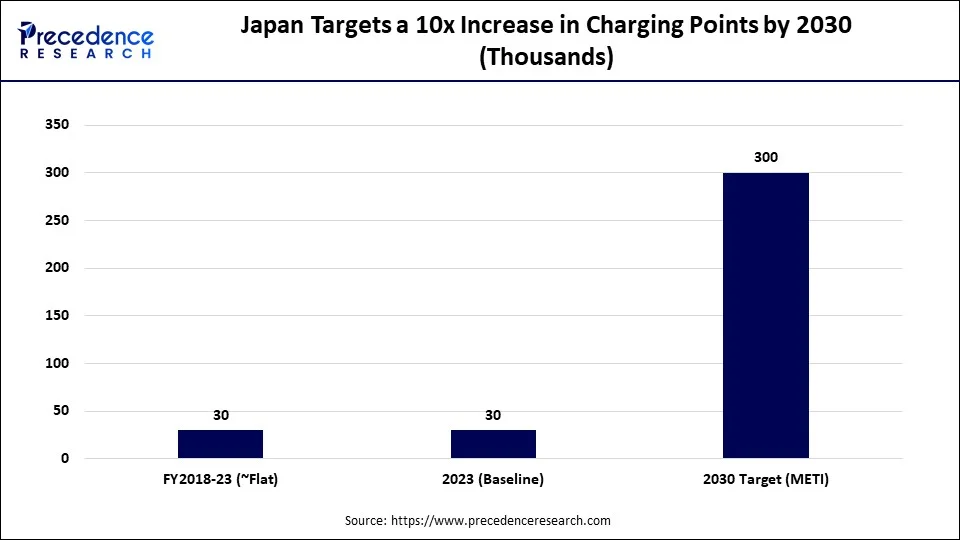
Aman interpreted that the number of public charging points in Japan remained nearly unchanged at around 300,000 units. The halt in development prompted the Japanese Ministry of Economy, Trade and Industry to scale back and shoot for 150,000 public locations. The figure was doubled two years ago to reach 300,000 by 2030. The flat overall five-year period followed by the second set of doubled government targets is almost like saying that infrastructure, and not vehicle technology, has been the actual problem.
Key Insight: Japan's charging stock languished around 30,000 units for half a decade, but doubling the target indicates a policy decision that infrastructure has been a limiting factor, rather than vehicle technology, on EV uptake in Japan.
Source: Japan Ministry of Economy, Trade and Industry (METI), as reported by MLex (Oct 2023) and Power Systems Research (2024).
South Korea Is on Track for 500,000 Public Chargers by 2025
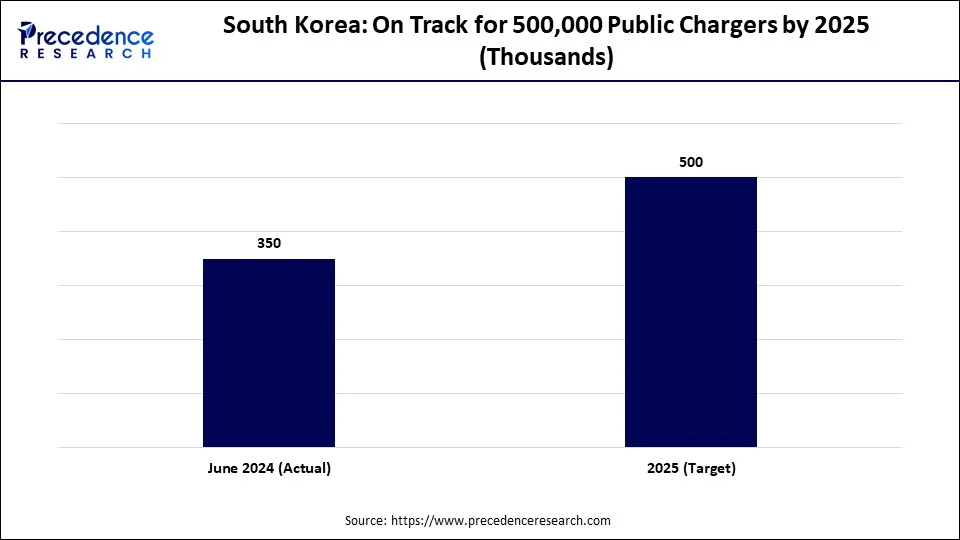
According to our research, South Korea had already reached 350,000 public chargers by June 2024. Working out to 6.82 chargers per thousand people, one of the highest per capita ratios anywhere globally. The government's target of 500,000 chargers for 2025 implied a growth rate projected at 39% annually. Hitting that 500,000 charger target would make South Korea the region's density leader on a per-vehicle basis, not just on raw installation counts in the Asia Pacific electric vehicle (EV) charging station market.
Key Insight: South Korea already has more chargers per person than most G7 countries, and if it achieves 500,000 chargers per person, it will be the highest density G7 country based on chargers per vehicle, not just absolute numbers.
Source: AA Weekly/FOURIN (Oct 2024); TrendForce (Nov 2024) public charging pile forecast.
Australia's Fast-Charging Network More Than Tripled in Three Years
Australia: Fast-Charging Sites More Than Tripled, 2022-2025
| Time Period | Fast-Charging Sites (Nationwide) |
| 2022 | 356 |
| H1 2025 | 1,272 |
According to the research data, I interpreted that Australia's charging infrastructure growth accelerated, increasing both the number of charging stations from 356 in 2022 to 1,272 plus over 3,436 plugs by the first half of 2025. This was predominantly from the federal Driving the Nation fund as well as a number of state level funding programs. During the same period, the on road EV fleet has quadrupled to over 300,000 in the country by March 2025 from 38,750 in January 2022. Even though the jump in the EV fleet is 7.7 times. The fast charger fleet is still increasing its share at a rate of roughly 3.6 times. Its supply and demand balancing is not as negative as can be said about most markets in this section.
Key Insight: The near future gap is closing faster than the headline EV adoption rates suggest, as fast charging site growth has now surpassed Australia's fast EV fleet growth (increased by ~3.6x since 2022).
Source: Electric Vehicle Council via evinfrastructurenews.com (Oct 2025); energy.gov.au (ARENA); HoustonKemp/Energy Consumers Australia report (Jul 2025).
Southeast Asian Governments Target 5-17x Current Charging Capacity
Southeast Asia: Governments Target 5-17x Current Charging Capacity
| Country | Current Public Charging Points (2024/25, Thousand) | Government Target (Thousand) | Target Year |
| Singapore | 3.6 | 60.0 | 2030 |
| Thailand | 3.7 | 12.0 | 2030 |
| Indonesia | 5.0 | 30.0 | 2030 |
| Malaysia | 1.5 | 10.0 | 2025 |
According to our research, there are currently about 3600 charging points available in Singapore, with a target of 60,000 by 2030. As of March 2025, there was 11622 connectors across 3720 stations in Thailand. On the other hand, the goal is to reach 12000 stations by March 2025. Indonesia has fewer than 5,000 stations, and its goal is 30,000 stations by 2030 (as of December 2025). Thus, Malaysia is at about 1,500 stations, and has set a target of 10,000 stations for 2025.
Singapore's target figures the highest in-group growth in terms of percentage change, while Indonesia has the widest absolute jump in deployment. All governments in this collective are on the fast track to a goal they are seeking that is defined many multiples higher than they are positioned in relation to their current efforts. This shows that Southeast Asia is in the early build phase of this cycle of Asia Pacific electric vehicle (EV) charging station market.
Key Insight: Indonesia has the highest absolute gap in deployment (6x target-to-deploy ratio on a larger base) and Singapore the highest relative deployment target (~17x current ratio), indicative of the land-constrained, high-density urban planning approach in Singapore.
Source: IEA Global EV Outlook 2025 (Southeast Asia targets); Anari Energy Thailand market analysis (2025); CFA Institute, "Shifting gears" (Apr 2026); Malay Mail (Jan 2024)
Statistical Images - Independently Researched TOC Topics
China Alone Accounts for Roughly 65% of the World's Public EV Chargers
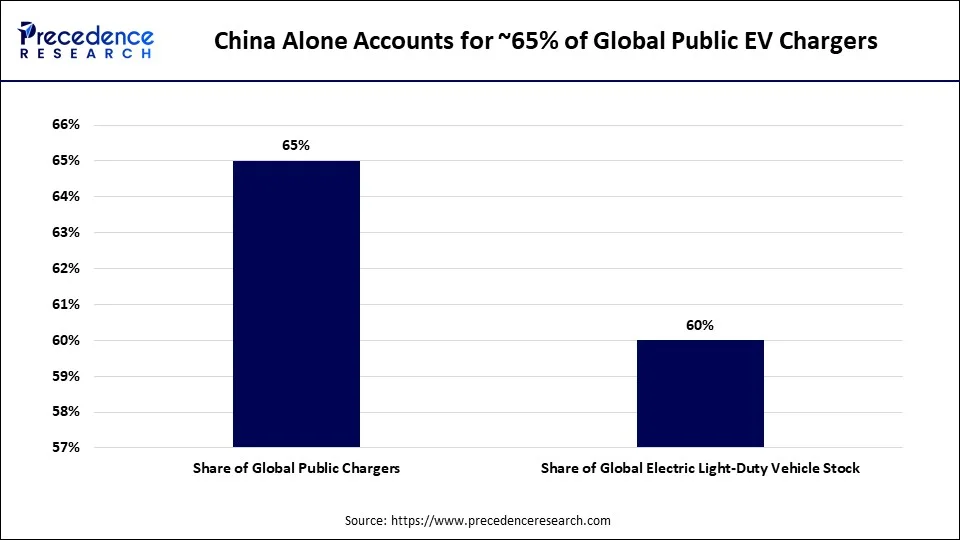
I interpreted that, globally, approximately 60% of the electric light-duty vehicle stock was in China, whereas about 65% of all public EV chargers were in China as of year-end 2024. The charger share is ahead of the vehicle share by about five points, reflecting China's catching up in comparison to the other region. The charging infrastructure and the number of vehicles are growing in parallel in China, as indicated by China's Charger to Vehicle ratio (WCC).
Key Insight: China's charging lead is slightly ahead of its EV fleet lead (65% vs. 60%), meaning China is slightly overbuilding infrastructure when compared to the vehicle base, as compared to other Asia Pacific markets, which have yet to establish a buffer in this regard.
Source: IEA, Global EV Outlook 2025, "Electric vehicle charging" chapter (iea.org).
China's Charger to Vehicle Ratio Is Improving as Both Scale in Parallel
| Period | Metric | Reported Ratio |
| End-2023 | NEVs per public charging pile | 7.5 : 1 |
| Aug-25 | Charging piles per 5 vehicles (all piles) | 02:05 |
As a market research analyst, I interpret that there were 20.41 million public charging piles and about 7.5 new energy vehicles. By the end of 2023, China had approximately 7.5 new energy vehicles for every public charging pile. In a more general ratio, by August 2025, China's National Energy Administration reported 2 charging piles per 5 vehicles of all types. This was echoed in an open statement that same month by the director of the National Energy Administration of China. Both these figures are trended differently; one includes only public piles, and one includes all pile types, but they are headed in the same direction. The growth of vehicles is keeping pace with, or slightly outpacing, infrastructure on both metrics.
Key Insight: The two ratios are not directly comparable (public only vs all piles), but they both indicate a materially better relationship between chargers and vehicles consistent with NEA director Wang Hongzhi's comments in August 2025 that infrastructure build-out is matching NEV sales growth.
Source: ScienceDirect/EVCIPA data (Dec 2025); english.www.gov.cn / National Energy Administration statement (Aug 2025, via CarNewsChina).
Battery Swapping Infrastructure: NIO's Early Lead Meets CATL's Rapid Scale-Up
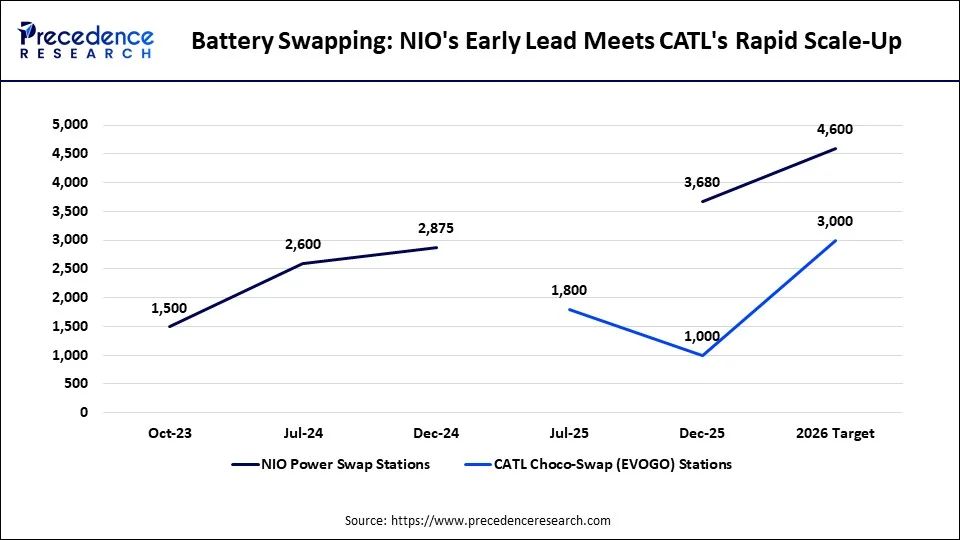
Aman's interpretation shows that NIO's power swap network grew from roughly 1,500 stations in October 2023 to 2,609 by July 2024, 2,868 by December 2024, and 3,676 by the end of 2025, with a target of more than 4,600 by the end of 2026. Even though it was practically nonexistent at the start of 2025, by the end of that year CATL's rival Choco-Swap network. It operates under its e-commerce weight, including caes and evogo, claimed to have reached 1,020 stations and, by the middle of 2026, passed 1,800.
This was set to exceed 3,000 by the end of that same year. CATL constructed up to a year more swap stations than NIO did over the course of three years. Strategic capital partnership is now becoming each other's objective, then amounts to a winner-take-all standard fight in the Asia Pacific electric vehicle (EV) charging station market. As the two companies have invested large capital amounts in the breakthrough company Nio Power, a clear indication that the two are converging on a strategic alliance rather than the standard fight.
Key Insight: In nearly two years, CATL was able to install more battery swap stations than NIO during its initial three years of operation. While competing with each other, the two companies have entered into what amounts to a strategic capital partnership (CATL is investing up to RMB 2.5 billion/USD 346 million in NIO Power). Showing that it is likely that the technology will converge in the future, and not be a standard war with one company winning and the other losing.
Source: CnEVPost (Oct 2025); electrive.com (Jul 2025); electric-vehicles.com (May 2026, Jul 2026); NIO official newsroom (Mar 2025); The Motley Fool (May 2026).
India's Charger to EV Ratio Trails the Global Benchmark by More Than 10x
| Category | Charger-to-EV Ratio |
| India (Current Ratio) | 1:235 |
| Global Benchmark (Low End) | 1:6 |
| Global Benchmark (High End) | 1:20 |
Based on the research findings and my interpretation, India's ratio is one public charger to 235 registered vehicles. This is considerably lower than the average ratio of one public charger per six to twenty registered vehicles in other countries worldwide. India needs nearly 13,200 times as many public charging stations today to come close to the 30% plug-in car adoption target by 2030, according to one policy research estimate. The fall in income is the sharpest in the region, on an India platform of this scale and against the six-to-twenty benchmarks.
Key Insight: India's EV market is the steepest infrastructure catch-up in the region, with the policy research estimate of 1.32 million PCSs by 2030 compared with only 9,500 stations today.
Source: mmcm.in EV charging infrastructure analysis (May 2026), citing ORF (Observer Research Foundation) projections and government registration data.
Government Charging Infrastructure Targets Vary Widely Across the Region
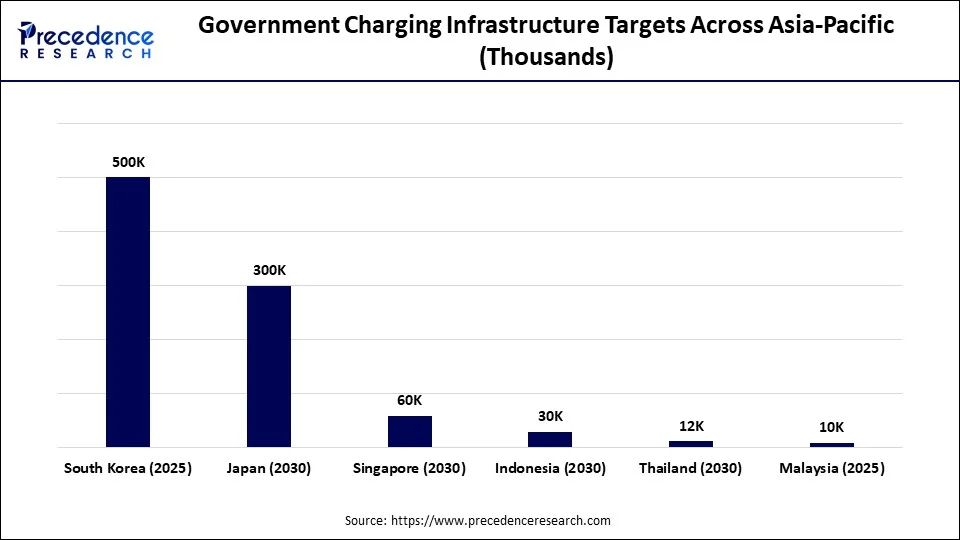
The companies that are covered in government charging infrastructure targets are targeting Asia Pacific markets, with some markets being more ambitious in their plans for EV adoption due to their larger sizes and varied mobility needs. The investments in nationwide charging networks continue, with South Korea planned to reach 500,000 public charging points by 2025 and Japan 300,000 by 2030.
Emerging markets in Asia Pacific electric vehicle (EV) charging station sector are on a fast growth curve too. Singapore aims for 60,000 chargers by the end of the decade, Indonesia 30,000, and Thailand 12,000. The national targets collectively reflect the fact that developed and developing economies are placing a high priority on charging infrastructure. This spurs the adoption of electric vehicles and incentivizes private sector investment.
Key Insight: Governments are rushing to increase the roll-out of charging infrastructure, with well-established markets such as the Asia Pacific region seeing both new and existing economies grow public charging networks to promote EV uptake.
Source: IEA Global EV Outlook 2025; METI (Japan); TrendForce (South Korea); UNESCAP/Krungsri Research ASEAN EV policy compilation (Dec 2024); Malay Mail (Malaysia, Jan 2024).
EV Sales Momentum Outside China Is Accelerating Charging Demand
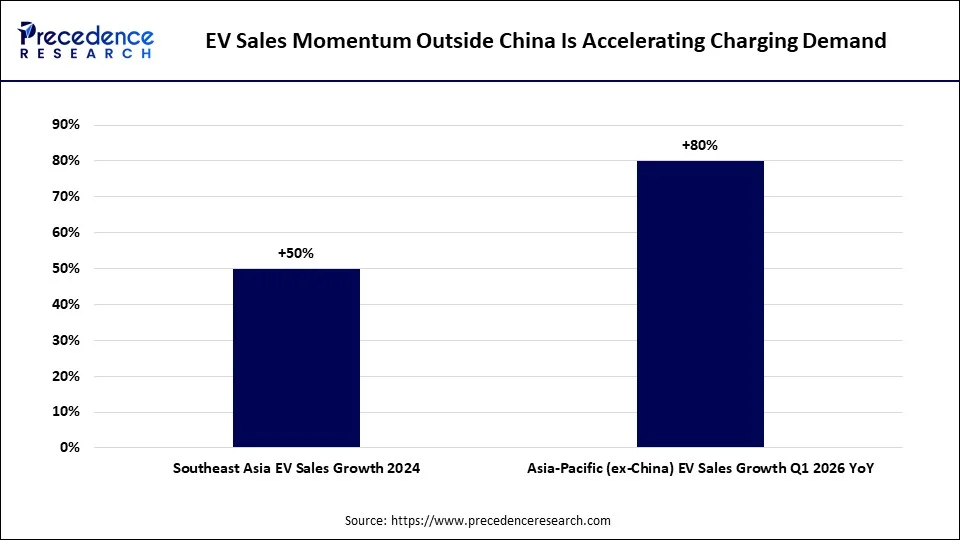
Aman interpreted that in 2024, sales of EVs in Southeast Asia grew by approximately 50% compared to the previous year. The region's share of EV vehicle sales rose to around 9%, with Thailand and Vietnam particularly outpacing the rest of the region. Sales of electric vehicles (EVs) are picking up in Asia Pacific, excluding China, as well, with increases of approximately 80% year on year in the first quarter of 2026. This is further expected to surpass sales in China in the near future. An 80% rise year over year suggests the next round of charging investment will not only be China-based.
Key Insight: The sales growth of non-China Asia Pacific EVs (80% YoY in Q1 2026) is even outpacing the growth rate of China, indicating that markets outside China will drive the next wave of charging infrastructure investment across Asia Pacific.
Source: IEA, Global EV Outlook 2025 (Southeast Asia); IEA, Global EV Outlook 2026 (Q1 2026 regional growth), via Virta and Axis Intelligence coverage (2026).
Important Segment Categories
Level of Charging: Level 2 Charging Leads Today, but Level 3 (DC Fast) Is Closing the Gap
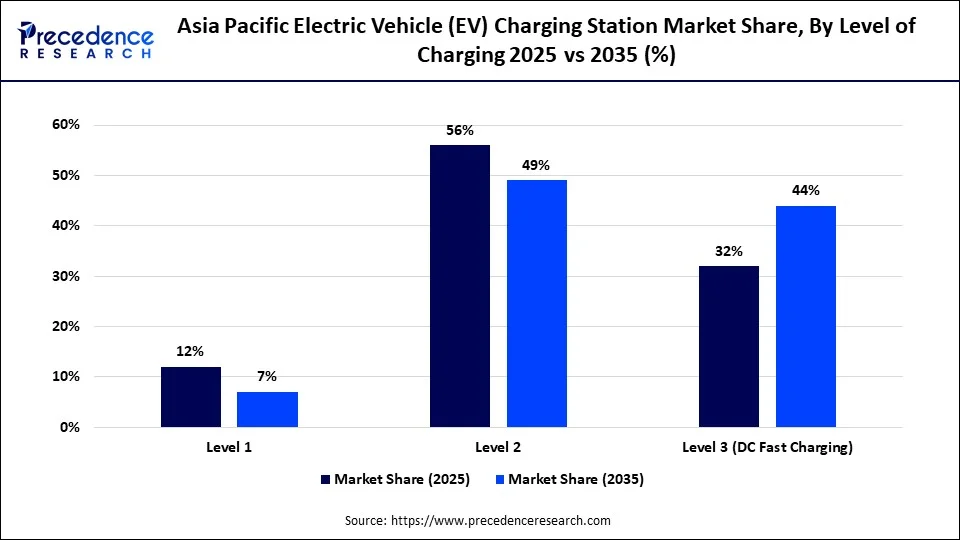
Aditi interpreted that, by reviewing this data, the level of charging segment analysis indicated that the adoption of Level 2 charging has secured its potential in the Asia Pacific electric vehicle (EV) market, expected to rise from 56.0% of market share in 2025, due to the boosting by mix of both commercial and residential use. The share is forecast to become slightly smaller at 49.0% by 2035, but is expected to continue to grow at a 23.8% CAGR.
Executing on fast charging at highway corridors and urban locations, Level 3 or DC fast charging is expected to account for 32.0% of the gasoline share in 2025 and will reach 44.0% by 2035. The gap is reduced enough in Level 3 that a crossover beyond 2035 appears to be only a matter of time in Level 2, with a 29.8% CAGR on Level 3.
Key Insight: Level 2 held the largest 2025 share (56.0%), while Level 3 (DC Fast Charging) grows fastest at a 29.8% CAGR through 2035 with a growing landscape of fast charging at highway corridors and urban locations.
Source: Precedence Research Database
Charging Station Type: AC Charging Still Dominates, but DC Charging Is Rapidly Gaining Share
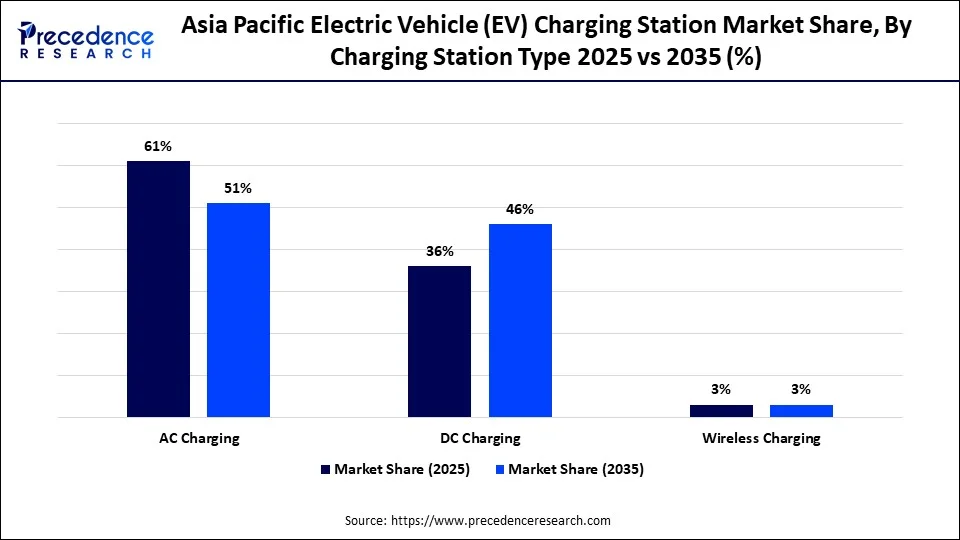
AC charging held the largest position in this category in 2025 at 61.0% share, driven by its strong residential and workplace foundation. DC charging segment is closing in on the ground fast, increasing its share from 36.0% to 46.0% at a robust rate of 29.6% year-on-year. Facilitated by government efforts to expand DC charging infrastructure rapidly.
Key Insight: AC Charging held the largest 2025 share (61.0%), while Wireless Charging grows fastest at a 31.8% CAGR through 2035, owing to the growing government efforts in introducing DC charging infrastructure.
Source: Precedence Research Database
Power Output: >50kW Ultra-Fast Charging Set to Become the Largest Power Tier by 2035
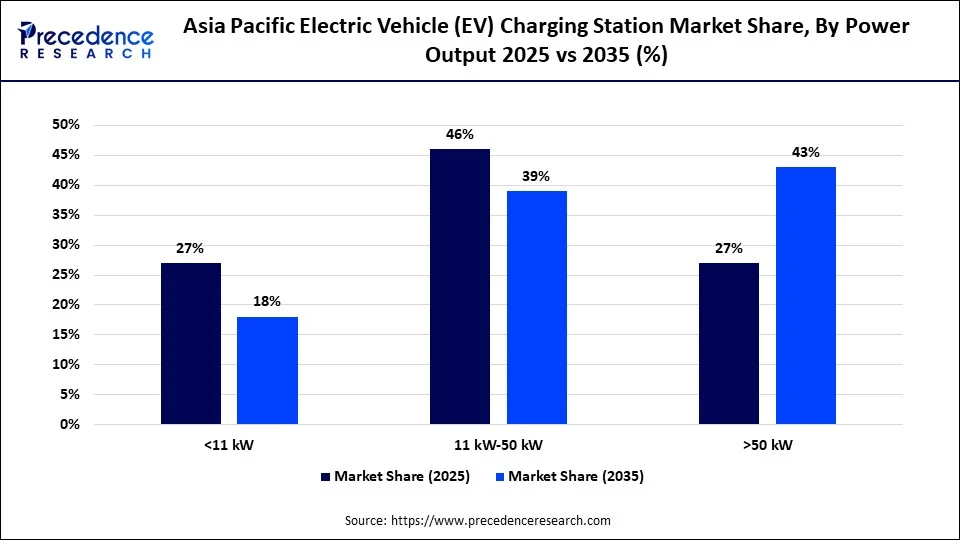
The 11 kW to 50 kW segment band held the largest market share of this category in 2025 at 46.0%, which accounted for the majority of workplace or destination charging use cases. This will further increase over the next ten years at 23.7% CAGR annually, but will have contracted to 39.0% by 2035. The above-50 kW ultra-fast tier is expected to be the segment that will overtake the past leader in the Asia Pacific electric vehicle (EV) charging station market. This will increase fastest over the next year with 31.8% CAGR, as ultra-fast networks spread throughout the region.
Key Insight: 11 kW-50 kW held the largest 2025 share (46.0%), while >50 kW grows fastest at a 31.8% CAGR through 2035, with growth of ultra-fast charging networks across the world.
Source: Precedence Research Database
Vehicle Type: Passenger Cars Anchor Demand, While BEVs Post the Fastest Vehicle-Type Growth
Asia Pacific Electric Vehicle (EV) Charging Station Market Share, By Vehicle Type 2025 vs 2035 (%)
| Vehicle Type | 2025 | 2035 |
| Passenger Cars | 48% | 46% |
| BEV | 21% | 27% |
| PHEV | 10% | 8% |
| Heavy Commercial | 7% | 8% |
| Light Commercial | 6% | 5% |
| Two-Wheelers & Scooters | 8% | 6% |
The Asia Pacific EV charging station market was dominated by passenger car charging stations at 48.0% in 2025 and is expected to slightly decline to 46.0% by 2035 due to the growing number of commercially driven EVs. Battery Electric Vehicles (BEVs) are expected to achieve the highest growth at 29.5% CAGR, as the number of ZEVs is expected to rise. Government incentives are also favoring BEVs. There is a lot of availability of models in the region, and public charging infrastructure is being rapidly installed.
Key Insight: The major demand driver was still the passenger car segment, and battery electric vehicles (BEVs) saw the greatest growth, reflecting increased EV adoption in the Asia-Pacific region.
Source: Precedence Research Database
Installation Type: Fixed Infrastructure Dominates, but Commercial Installations Grow Fastest
Asia Pacific Electric Vehicle (EV) Charging Station Market Share, By Installation Type 2025 vs 2035 (%)
| Installation Type | 2025 | 2035 |
| Fixed | 58% | 55% |
| Portable | 6% | 5% |
| Residential | 20% | 19% |
| Commercial | 16% | 21% |
Fixed charging points accounted for the largest market share of 58.0% in the Asia Pacific EV charging station market in 2025, due to their widespread deployment in residential, workplace, and public areas. On the other hand, commercial installations are expected to witness the highest growth with a CAGR of 28.8%, and the share is projected to surge from 16.0% in 2025 to 21.0% by 2035, backed by increased investments in fleets, retail, highways, and destination charging infrastructure.
Key Insight: Fixed charging infrastructure was the largest, whereas commercial installations were the fastest-growing, as companies ramped up investments in public and fleet charging infrastructure in 2025.
Source: Precedence Research Database
Connector Type: CCS Extends Its Lead as the Region's Dominant Fast-Charging Standard
Asia Pacific Electric Vehicle (EV) Charging Station Market Share, By Connector Type 2025 vs 2035 (%)
| Connector Type | 2025 | 2035 |
| Normal Charging | 11% | 7% |
| Type 2 | 24% | 21% |
| CCS | 28% | 35% |
| CHAdeMO | 12% | 6% |
| Tesla SC | 6% | 8% |
| GB/T | 17% | 21% |
The combined charging system (CCS) led the Asia Pacific electric vehicle (EV) charging station market with a share of 28.0% in 2025 and is expected to grow at the highest rate of 29.4% CAGR and hold a share of 35.0% by 2035. Expansion is due to the rise in adoption by global car makers, broader deployment of high-power DC fast chargers, and the increasing need for standardised, interoperable charging infrastructure in Asia Pacific.
Key Insight: While the market for DC fast charging is growing and offering more and more choices for global EV compatibility, CCS was the dominant connector standard in 2025.
Source: Precedence Research Database
Application: Public Charging Expands Its Majority Share Through 2035
Asia Pacific Electric Vehicle (EV) Charging Station Market Share, By Application 2025 vs 2035 (%)
| Application | 2025 | 2035 |
| Private | 41% | 36% |
| Public | 59% | 64% |
Public charging accounted for the majority of the Asia Pacific EV charging station market, with a 59.0% share in 2025, and is expected to grow at the highest CAGR of 27.4%, reaching 64.0% by 2035. It is enabled by a growing network of charging infrastructure supported by government and the public sector, public investment in charging infrastructure, and the availability of fast charging infrastructure. As public infrastructure continues to grow at a faster pace, private charging will fall to 36.0% of the market by 2035, but still register a relatively moderate 22.4% CAGR in the years ahead.
Key Insight: Public charging continued to be the predominant and fastest-growing charging mode, as a result of growing public charging demand and government-backed infrastructure investments.
Source: Precedence Research Database
Mounting Type: Pedestal-Mounted Systems Overtake Wall Mounts as Public Charging Scales
Asia Pacific Electric Vehicle (EV) Charging Station Market Share, By Mounting Type 2025 vs 2035 (%)
| Mounting Type | 2025 | 2035 |
| Wall Mount | 43% | 37% |
| Pedestal Mount | 54% | 60% |
I found that pedestal-mounted charging stations dominated the market with a 54.0% market share in 2025, and the anticipated growth in CAGR is 27.3%, the highest of all the charging stations. They are being deployed in public charging stations, highways, commercial centers, and fleet charging stations, and their growth is fuelled by these. Wall-mounted chargers, however, accounted for 43.0% of the market in 2025 and will decrease to 37.0% by 2035, with the growth rate of public charging infrastructure putting a cap on its growth with 22.5% CAGR.
Key Insight: Pedestal mounted charging stations held the largest market share and are predicted to see the largest growth, owing to the increase in public charging stations in Asia Pacific.
Source: Precedence Research Database
Charging Service: Conventional Charging Still Dominates, but Battery Swapping Grows Fastest
Asia Pacific Electric Vehicle (EV) Charging Station Market Share, By Charging Service 2025 vs 2035 (%)
| Charging Service | 2025 | 2035 |
| EV Charging Service | 91% | 88% |
| Battery Swapping Service | 9% | 12% |
In 2025, the vast majority of the charging service segment, with a 91.0% share, was from conventional EV charging services, and this share will slowly decline to 88.0% by 2035 while increasing by 24.9% on a CAGR. Smaller, but growing at a 30.6% CAGR, the smaller service model of battery swapping held a market share of 9.0% to 12.0% between 2025 and 2035, spurred mainly by commercial fleet and two-wheeled battery swapping.
Key Insight: In 2025, EV Charging Services were the largest in the market, whereas Battery Swapping Services will grow most rapidly until 2035, as the demand for fast charging grows in all commercial and shared mobility vehicles on the market.
Source: Precedence Research Database
End User: Commercial Public Charging Stations Are the Largest End-User Segment
Asia Pacific Electric Vehicle (EV) Charging Station Market Share, By End User 2025 vs 2035 (%)
| End User | 2025 | 2035 |
| Commercial EV Charging | 15% | 14% |
| Commercial Public EV Charging | 29% | 31% |
| On-Road Charging | 13% | 16% |
| Parking Spaces | 12% | 11% |
| Destination Chargers | 8% | 8% |
| Commercial Private EV Charging | 9% | 8% |
| Fleet Charging | 8% | 9% |
| Captive Charging | 3% | 2% |
| Residential EV Charging | 3% | 1% |
Continuous government, utility and charging network operator investment in commercial public EV charging stations is driving growth in this segment. This is expected to secure the largest market share of 29.0% in 2025 and 31.0% in 2035 with a CAGR of 27.9%. Meanwhile, fleet charging is forecast to grow the fastest, with its market share projected to rise from 8.0% in 2025 to 9.0% by 2035, with fast electrification of logistics, public transport and corporate vehicle fleets playing a significant part.
Key Insight: Commercial public EV charging stations were the top segment in 2025, and the fleet charging segment is projected to register the highest growth, as commercial vehicle electrification is accelerated in the Asia-Pacific region.
Source: Precedence Research Database
Recent Developments
| Date | Development |
| October 2023 | Singapore's charge+ announced that it has raised an undisclosed-sized funding round led by Trive for an ambitious charging corridor project that runs between Singapore and Vietnam for 5,000 kilometres, as well as a separate contract with Singapore's Land Transport Authority for 4,000 charging points across HDB carparks. |
| March 2025 | In a strange twist of events, the two biggest battery swap competitors in China entered into a strategic capital and technology partnership in March 2025, in a bid to build close partnerships on the NIO Power Swap network. |
| September 2025 | Charge+ came back to the funding market with a follow-on round that was led by tnb aura and Trive Venture Capital, to continue the expansion in Southeast Asia. |
| October 2025 | CATL's CES division has set an ambitious goal to expand the battery swap network aggressively to over a hundred Chinese cities by the end of 2026, shifting the deadline a few months later. |
| November 2025 | The Chinese National Energy Administration released new data indicating that the nation had nearly doubled its total number of charging piles over the prior year, with roughly half of those facilities located in public spots, the other half in private ones. |
| December 2025 | The Chinese National Energy Administration released new data indicating that the nation had nearly doubled its total number of charging piles over the prior year, with roughly half of those facilities located in public spots, the other half in private ones. |
| May 2026 | India has ministry of Heavy Industries announced the approval of 4,874 more EV chargers under the PM eDrive program and the introduction of a new platform, Unified Bharat eCharge, which will enable drivers to find and pay at any operator's charging stations. |
Asia Pacific Electric Vehicle (EV) Charging Station Market Companies
| Company | Headquarters | Core Business | What They Are Doing | Source |
| Teld (Wanbang Digital) | China | Public EV charging pile operation and network management | As of July 2025, the number of current public charging piles in China is about 807,000, which is the highest number of any public charging pile operator in the country. | CarNewsChina (Aug 2025). |
| Star Charge | China | Public EV charging pile operation and hardware manufacturing | Charge is China's 2nd biggest public charging pile operator, which also has an in-house pile manufacturing business, and during the period operated about 703,000 pillars. | CarNewsChina (Aug 2025). |
| Nio Power | China | Battery-swap station network and EV manufacturing | Operates a battery swap station network, partnering with Nio Inc with a strategic capital and tech transaction agreed in early 2025, to join with its own rapidly growing swap network. | electrive.com; eletric-vehicles.com (2025-2026); NIO newsroom (Mar 2025). |
| CATL (CAES / Evogo) | China (Ningde, Fujian) | Battery manufacturing and Choco-Swap (EVOGO) battery-swap network | World's largest EV battery maker, and runs the choco-swap network as its own, under the evogo brand, launching a series of standardized swappable battery packs in December 2024, since when building a network of stations has been done in an aggressive manner, accelerated by 2025 and 2026. | CnEVPost (Oct 2025); Electronic Design; The Motley Fool (May 2026). |
| Charge+ | Singapore | Integrated EV charging solutions (hardware, software, operations) for Southeast Asia | Founded in Singapore, charge+ positions itself as Singapore's largest integrated EV charging operator, accomplished by hardware, software, and operations across over 130 condominium partnerships and over 1000 charging stations. | TechNode Global; Dealroom; S&P Global AutoTechInsight (2023-2025). |
| Kazam | India | EV charging network and charge-point operation | Founded by Kazam's management team with funds from Vertex Ventures Southeast Asia and India, Avaana Capital and Alteria Capital, it is an India-based charging network and charge point operator. | S&P Global AutoTechInsight (2025). |
| Tata Power | India (Mumbai) | EV charging infrastructure deployment and utility-backed charge point operation | One of the major public private partnerships involved in rollouts of the EV infrastructure at the state level, Tata Power is headquartered in Mumbai, and as part of an overall investment plan valued at about fifteen hundred crore rupees by the Karnataka state government, Tata Power has invested in the Bengaluru-Mysuru highway corridor. | IndiaDataMap state-wise EV charging analysis (Nov 2025). |
| V-Green | Vietnam | EV charging network deployment for VinFast vehicles across Southeast Asia | V-Green, which is the spinoff of Vietnam's VinGroup and Vinfast, is rolling out the charging infrastructure in the Southeast Asian region, among which the project with Prime Group is one of the biggest announced charging deployments in the region, and Vinfast has an existing presence in the Philippines. | CFA Institute, "Shifting gears" (Apr 2026). |
| Spark eV | Thailand | Charge point operation, including e-motorcycle charging networks | Founded in 2024 in Thailand with backing from Hong Kong's Gaw Capital, cornerstone technologies, and the Hong Kong Investment Corporation, Spark eV (charged by sponsor entity Spark Capital) became the first charge point operator (CPO) to launch an e-motorcycle network in Bangkok in 2025 with its charging partner Mile Green. | CFA Institute, "Shifting gears" (Apr 2026). |
| Evolt Technology | Thailand | Ultra-fast charging installation, including underground urban car parks | Thailand-based Volt manufacturing plants are also specializing in ultra-fast installations like underground urban car park offices and are supported by clean energy investor Banpu Next, whilst working on Bangkok installations in conjunction with Zeekr Group and China-based charger manufacturer Autel Energy. | CFA Institute, "Shifting gears" (Apr 2026). |
Expert Insights
The Asia Pacific electric vehicle (EV) charging station market is maturing from the initial infrastructure roll-out to a massive smart charging network. Supported by electrification and digitalization in the coming years. I think there are going to be great opportunities for those companies that can integrate smart energy management, grid integration, software platforms, and high-power charging technology into the whole package. To me, government policy support, growth of fast charging stations, and the increasing of commercial fleet electrification will define market leadership in the next decade. I also expect the public fast-charging network and fleet charging infrastructure to grow faster than residential charging. Thus, when EV adoption continues to ramp up, demand for reliable and high-utilization charging grows.
Our Experts
Laxmi Narayan led the primary market research, developed the methodology, and analyzed segmentation, regional trends, competition, and forecasts, forming the report's analytical foundation.
Aman was responsible for collecting and validating regulatory filings, company financial data, commodity pricing, and other independently sourced quantitative datasets, strengthening the evidence base behind the market estimations.
Aditi reviewed the complete research document, performed quality checks, validated findings, refined content, corrected inconsistencies, and finalized the report, ensuring accuracy and clarity.
Segments Covered in the Report
By Level of Charging
- Level 1
- Level 2
- Level 3 (DC Fast Charging)
By Charging Station Type
- AC Charging
- DC Charging
- Wireless Charging
By Power Output
- <11 kW
- 11 kW–50 kW
- >50 kW
By Vehicle Type
- Passenger Cars
- Battery Electric Vehicles (BEV)
- Plug-in Hybrid Vehicles (PHEV)
- Heavy Commercial Vehicles
- Light Commercial Vehicles
- Two-Wheelers & Scooters
By Installation Type
- Fixed
- Portable
- Residential
- Commercial
By Connector Type
- Normal Charging
- Type 2
- CCS
- CHAdeMO
- Tesla Supercharger
- GB/T
- Other Connectors/Regional Standards
By Application
- Private
- Public
By Mounting Type
- Wall Mount
- Pedestal Mount
- Ceiling Mount
- By Charging Service
- EV Charging Service
- Battery Swapping Service
By End User
- Commercial EV Charging Stations
- Commercial Public EV Charging Stations
- On-Road Charging
- Parking Spaces
- Destination Chargers
- Commercial Private EV Charging Stations
- Fleet Charging
- Captive Charging
- Residential EV Charging Stations
By Country / Sub-region
- China
- Japan
- India
- South Korea
- Australia
- Southeast Asia - Singapore, Thailand, Indonesia, Malaysia, Vietnam, Philippines, Rest of Southeast Asia
- Rest of Asia-Pacific
For inquiries regarding discounts, bulk purchases, or customization requests, please contact us at sales@precedenceresearch.com
Frequently Asked Questions





Ask For Sample
No cookie-cutter, only authentic analysis – take the 1st step to become a Precedence Research client
 Get a Sample




 sales@precedenceresearch.com
 Schedule a Meeting
