



Automotive Brake Friction Product Market Size, Companies, Share, Vehicle Production Volume, Sales Performance, Export & Import Analysis, Technology Adoption, Competitive Positioning, and Demand Trends
Automotive Brake Friction Product Market (By Product Type: Brake Pads, Brake Linings, Brake Shoes; By Material: Metallic, Ceramic, Composites/Others; By Vehicle Type: Passenger Vehicles, Commercial Vehicles; By Channel: OEM, Aftermarket) - Global Industry Analysis, Size, Trends, Leading Companies, Regional Outlook, and Forecast 2026 to 2035
Source: https://www.precedenceresearch.com/automotive-brake-friction-product-market
 Get a Sample
 Table Of Content


What is the Automotive Brake Friction Product Market Size in 2026?
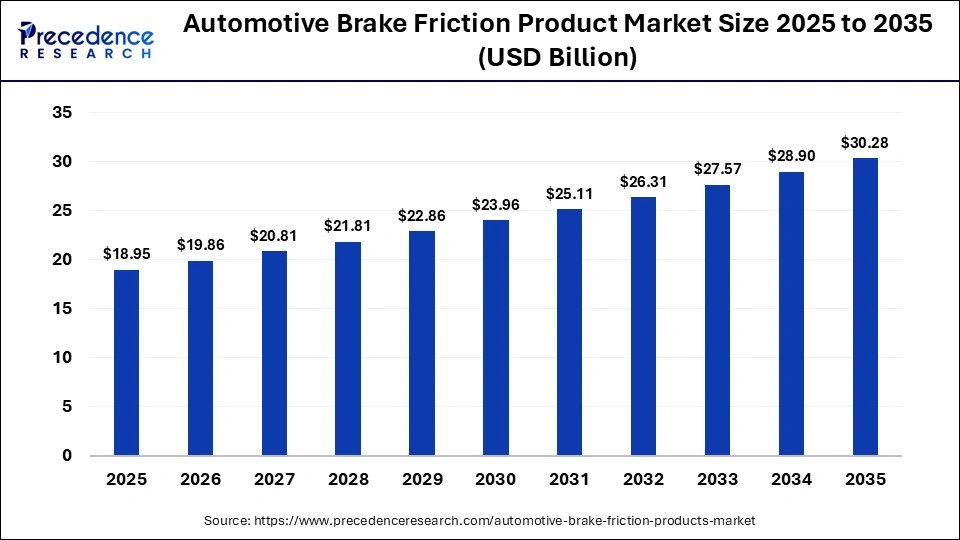
The global automotive brake friction product market size was calculated at USD 18.95 billion in 2025 and is predicted to increase from USD 19.86 billion in 2026 to approximately USD 30.28 billion by 2035, expanding at a CAGR of 4.80% from 2026 to 2035. The market is experiencing robust growth, driven by the increasing production of vehicles, stringent regulatory policies, and aftermarket replacement demand.
Key Takeaways
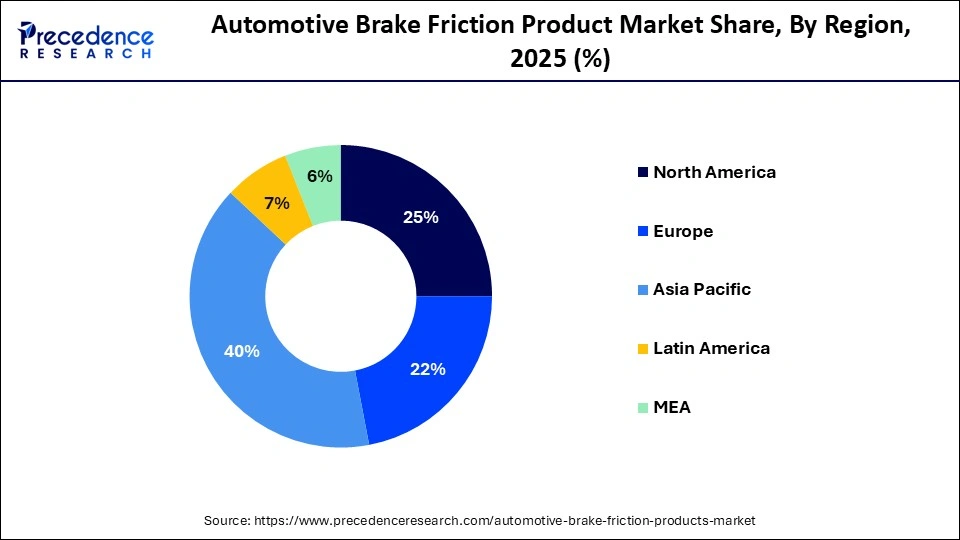
- Asia-Pacific dominated the global automotive brake friction product market with a share of approximately 40% in 2025 and is expected to grow at the fastest CAGR of 5.0% in the market during the forecast period.
- By product type, the brake pads segment held a dominant position in the market with a share of approximately 55% in 2025 and is expected to grow at the fastest CAGR of 3.7% in the market during the forecast period.
- By material, the metallic segment accounted for a considerable revenue share of approximately 43% in the market in 2025.
- By material, the ceramic segment is expected to grow with the highest CAGR of 3.8% in the market during the studied years.
- By vehicle type, the passenger vehicles segment led the global market with a share of approximately 60% in 2025
- By vehicle type, the commercial vehicles segment is expected to expand rapidly in the market with a CAGR of 4.0% in the coming years.
- By channel, the OEM segment held the largest revenue share of approximately 60% in the market in 2025.
- By channel, the aftermarket segment is expected to gain the highest share of the market with a CAGR of 4.2% between 2026 and 2035.
Automotive Brake Friction Product: Ensuring Driving Safety and Performance
The automotive brake friction product market is growing rapidly because the number of vehicles manufactured is on the rise, and more importance is being placed on road safety. Market growth is driven by demand for high-performance braking systems across passenger cars, commercial vehicles, and electric vehicles (EVs). It is currently increasing durability and heat resistance and reducing noise through technological improvements to the material composition. Moreover, stringent environmental and safety laws are transforming the innovation of products in international markets.
How is AI Revolutionizing Automotive Brake Friction Products?
Artificial intelligence (AI) technologies are revolutionizing how brake systems are designed through predictive modelling and material simulation. AI tools help develop new friction formulas based on particular needs. AI-based analytics are used to optimize the structure of friction materials to enable better wear resistance and temperature stability. Smart braking systems fitted with sensors allow real-time performance monitoring and proactive maintenance. Moreover, AI is an automated manufacturing assistant, making processes more precise. It also minimizes human errors and maximizes the productivity of the entire production process.
Automotive Brake Friction Product Market Trends
- EV-Specific Friction Materials: The growing demand for electric cars is creating incentives for low-noise, corrosion-resistant friction in the generative braking systems.
- Rise of Ceramic Brake Pads: Ceramic brakes are becoming popular because of the low dust, low noise, and long life, unlike conventional materials.
- Minimizing Weight: Manufacturers are working on lightweight braking parts to make vehicles more fuel-efficient and improve their range.
- Tough Environmental Policies: Stringent regulations are formulated to promote copper-free and low-emission brake materials to limit the pollution of the environment and particulate pollution.
- Technological Advancements: Advanced technologies are leveraged to develop innovative brake friction products with enhanced braking stability, wear resistance, and noise control, delivering dependable solutions.
Market Scope
| Report Coverage | Details |
| Market Size in 2025 | USD 18.95 Billion |
| Market Size in 2026 | USD 19.86 Billion |
| Market Size by 2035 | USD 30.28 Billion |
| Market Growth Rate from 2026 to 2035 | CAGR of 4.80% |
| Dominating Region | Asia Pacific |
| Base Year | 2025 |
| Forecast Period | 2026 to 2035 |
| Segments Covered | Product Type, Material, Vehicle Type, Channel, and region |
| Regions Covered | North America, Europe, Asia-Pacific, Latin America, and Middle East & Africa |
Segmental Insights
Product Type Insights
Which Product Type Segment Dominated the Automotive Brake Friction Product Market?
The brake pads segment dominated the market with a share of approximately 55% in 2025 and is expected to show the fastest growth with a CAGR of 3.7% over the forecast period, since they are commonly used in passenger vehicles and light commercial vehicles. The high rate of replacement is an important factor to ensure demand sustainability in OEM and aftermarket channels. Advanced technology leads to an increase in friction stability, noise mitigation, and performance standards. The segmental growth is also attributed to the increasing number of vehicles manufactured globally and the rising use of more sophisticated braking mechanisms.
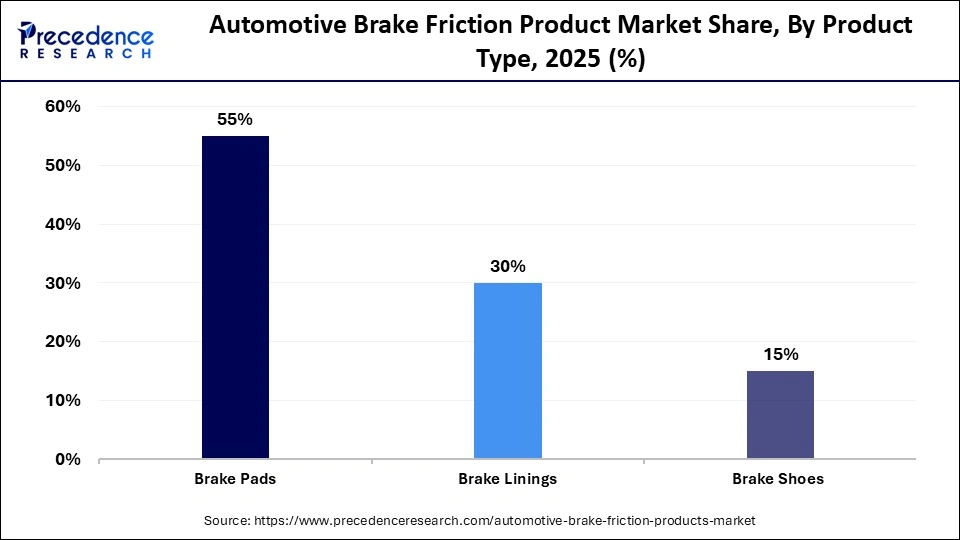
The brake linings segment is expected to witness significant growth in the market over the forecast period, driven by the demand for brake linings, especially in heavy and commercial cars. Brake linings are fundamental parts of drum brakes that are adopted in trucks and buses. The rising demand for sustainable lining materials is driven by the growth of the logistics and transportation industries. Product reliability is being improved in terms of heat resistance and wear life. Increasing infrastructure advancement also boosts the growth of commercial vehicles.
Material Insights
What Made the Metallic Segment Dominate in the Automotive Brake Friction Product Market?
The metallic segment held the largest market share of approximately 43% in 2025, due to its ability to withstand and dissipate heat. Metallic friction products are widely applicable in high-performance and heavy-duty type cars where the stress of braking is critical. Their popularity is also supported by cost-effectiveness over ceramic equivalents. Semi-metallic formulations are performance-cost balanced. Good compatibility with traditional braking systems maintains leadership in the market.
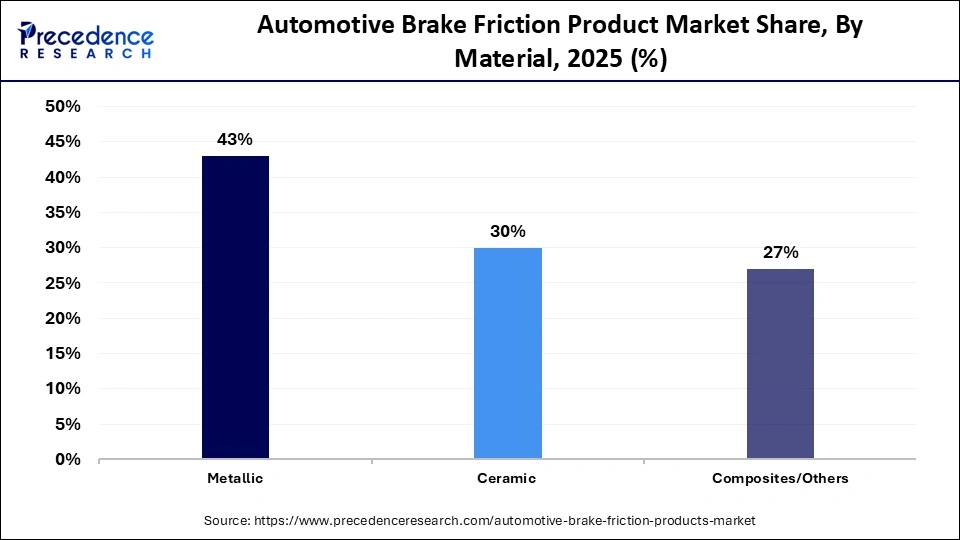
The ceramic segment is expected to gain the highest market share with a CAGR of 3.8% between 2026 and 2035, because of the lesser brake dust, lesser noise levels, and longer life span. These materials offer more slickness of braking and enhanced thermal stability. Growing consumer willingness to use superior vehicles potentiates the use of ceramic brake pads. Growth is further encouraged by environmental regulations that encourage the use of low-emission materials. An increase in the production of EVs also supports the use of ceramic materials.
Vehicle Type Insights
How the Passenger Vehicles Segment Led the Automotive Brake Friction Product Market?
The passenger vehicles segment led the market with a share of approximately 60% in 2025 because of the high volume of production in the world. The demand is supported by the growing urbanization and the growth in personal vehicle ownership. The increasing interest in safety functions improves the usage of sophisticated braking systems. Routine replacement and maintenance augment aftermarket sales. Further growth is fostered by the increase in EV passenger car production.
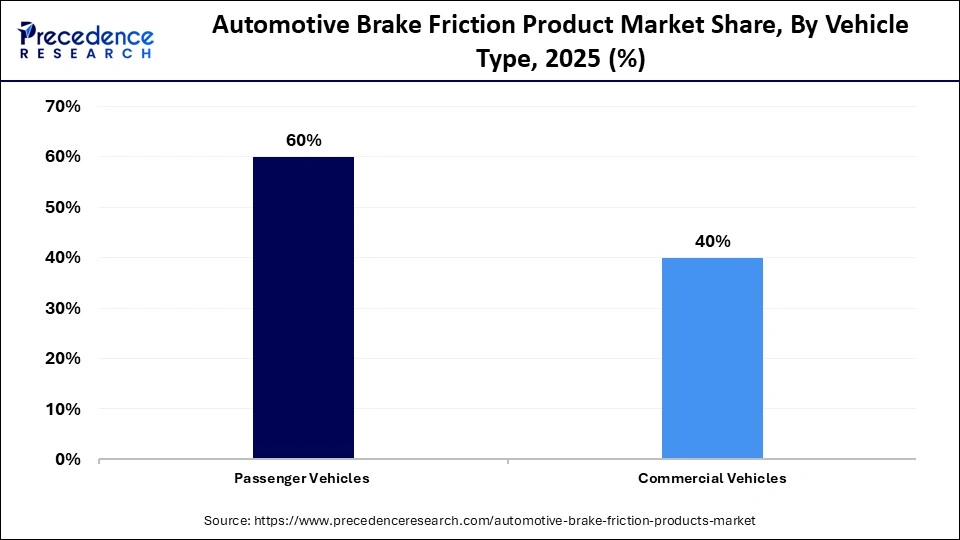
The commercial vehicles segment is expected to grow at the fastest CAGR of 4.0% in the market between 2026 and 2035, driven by the development of the logistics and e-commerce industries. There are demands for durable braking systems in increased freight transportation activities. Strict safety measures on heavy vehicles also increase the demand for friction material further. Segment expansion is facilitated by infrastructure development and construction. The programs for modernizing fleets also lead to stable development.
Channel Insights
Which Channel Segment Dominated the Automotive Brake Friction Product Market?
The OEM segment contributed the biggest market share of approximately 60% in 2025 because there are good relationships between brake companies and automotive firms. Huge manufacturing contracts provide stable income. OEMs require exclusive friction solutions that are platform-specific. Strict quality principles strengthen the relationships with suppliers. The proliferation of world vehicle production contributes to the dominance of channels.
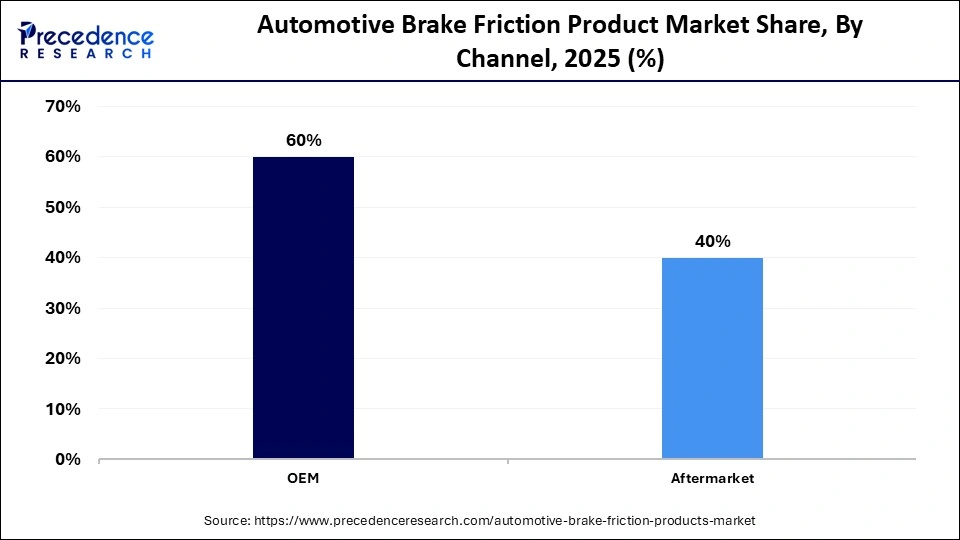
The aftermath is expected to grow with the highest CAGR of 4.2% in the market during the studied years, driven at a high rate by the rising vehicle fleets and frequent replacements. Consumers prefer economical and performance-enhancing alternatives. E-commerce is increasing the availability of products. There are independent workshops and service centers that generate high demand. The increment in the awareness of preventive maintenance contributes to the long-term growth of the aftermarket.
Regional Insights
Asia Pacific Automotive Brake Friction Product Market Size and Growth 2026 to 2035
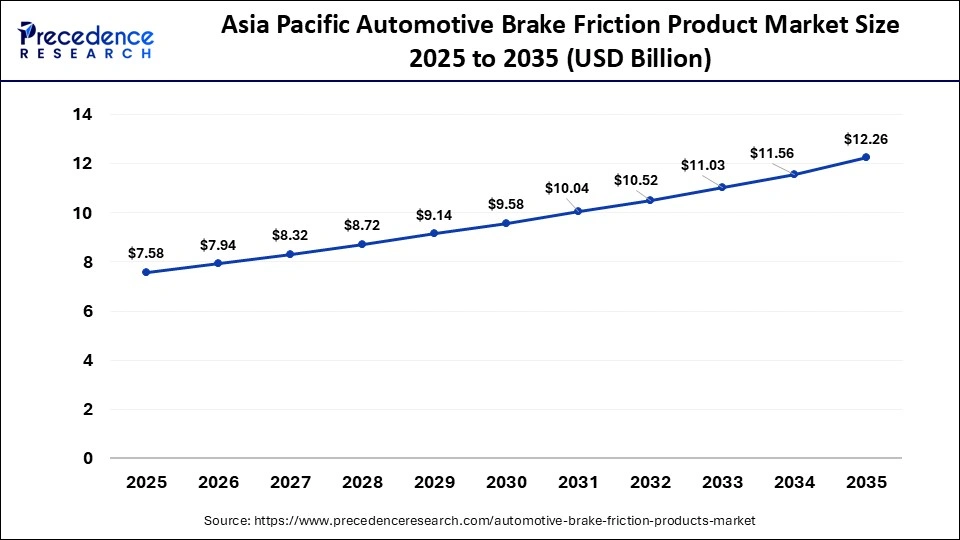
The Asia Pacific automotive brake friction product market size is expected to be worth USD 12.26 billion by 2035, increasing from USD 7.58 billion by 2025, growing at a CAGR of 4.93% from 2026 to 2035.
Why Asia-Pacific Dominated the Automotive Brake Friction Product Market?
Asia-Pacific held a major revenue share of approximately 40% in the market in 2025 and is expected to host the fastest-growing market with a CAGR of 5.0% in the coming years, owing to the increasing use of EVs and braking systems. High regulatory standards of vehicle safety and environmental compliance promote a high level of demand for friction materials. The increase in the consumption of SUVs and light trucks increases the consumption of brake pads. Automation and technological innovation increase the efficiency of manufacturing. The increasing aftermarket demand also stimulates the growth of the region. Competitiveness is enhanced with strategic investment in automotive R&D.
Country-Level Analysis
At the country level, China leads the market because it is the largest automotive manufacturing country globally and experiences robust growth in the EV sector. India has shown robust growth with the increasing sales of passenger vehicles and the development of infrastructure. Japan has a steady demand with developed automobile technologies and a high presence of OEMs. South Korea is a contributor to its well-established automotive export industry. Southeast Asian nations are new markets that enjoy the fruits of manufacturing growth. In general, the diversification at the country level supports the domination of the Asia Pacific.
Why is North America the Notable Region in the Automotive Brake Friction Product Market?
North America is expected to grow at a considerable CAGR in the upcoming period, due to the increasing production of automobiles and the presence of key players. Government organizations launch initiatives and regulations to promote innovations in the automotive sector. The growing adoption of EVs, an aging vehicle fleet, and the increasing use of advanced technologies. Countries like the U.S. and Canada are at the forefront of positioning themselves as global leaders in EV manufacturing and export, fueling the need for brake friction products.
Country-Level Analysis
On the country level, the U.S. leads the market in North America with a great number of vehicles and robust aftermarket sales. Canada is also a consistent supplier of growing automotive production and logistics. Mexico is already becoming a major center for assembling vehicles and manufacturing components. The market is also increasing EV investments in the region. Good OEM deals boost the stability of the supply chain. In general, North America shows a high level of growth, which is innovative and speedy.
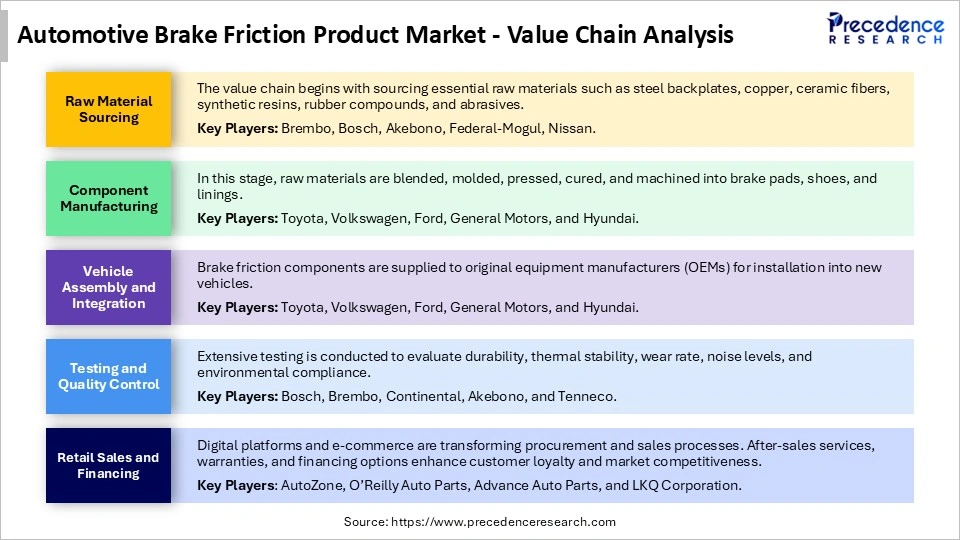
Automotive Brake Friction Product Market Value Chain Analysis
Automotive Brake Friction Product Market Companies
- ABS Friction
- Aisin Seiki
- Akebono Brake Industries
- Bendix Spicer
- Brembo
- Continental AG
- Delphi
- FederalMogul
- FTE Automotive
- ITT Inc.
- Japan Brake Industrial
- Macas Automotive
- Masu Brakes Pvt Ltd
- Nisshinbo Holdings
- Robert Bosch
Recent Developments
- In February 2026, DRiV announced the extension of its Ferodo Premier copper-free brake pad line of commercial vehicles with new advanced formulations that do not use copper but deliver the same performance as the OE. A high-performance red coating increases friction during the initial application of braking, which leads to improved bedding-in, durability, and braking safety of fleets, as well as minimizes environmental contamination.(source: https://www.tenneco.com)
- In November 2025, Momentum USA introduced a new line of EPS Friction brake pads designed especially to fit the European market, and sold by New World Friction only. The range also offers extended coverage of passenger cars in various European makes and models, which enhances the aftermarket.(source: https://www.aftermarketmatters.com)
- In September 2025, Friction One established a new plant in Juarez, Mexico, to increase manufacturing and local supply of North American friction products through a new brake pad and disc production. The company assured that the complex will operate with a focus on automation and advanced quality systems, improving the speed, consistency, and production throughput.(source: https://www.aftermarketinternational.com)
Segments Covered in the Report
By Product Type
- Brake Pads
- Brake Linings
- Brake Shoes
By Material
- Metallic
- Ceramic
- Composites/Others
By Vehicle Type
- Passenger Vehicles
- Commercial Vehicles
By Channel
- OEM
- Aftermarket
By Region
- North America
- Europe
- Asia-Pacific
- Latin America
- Middle East & Africa
For inquiries regarding discounts, bulk purchases, or customization requests, please contact us at sales@precedenceresearch.com
Frequently Asked Questions





Ask For Sample
No cookie-cutter, only authentic analysis – take the 1st step to become a Precedence Research client
 Get a Sample




 sales@precedenceresearch.com
 Schedule a Meeting
