



Automotive Powertrain Market Size, Key Companies, Company Market Share, Vehicle Production Volume, Sales Performance, Export & Import Analysis, Technology Adoption, Competitive Positioning, and Demand Trends
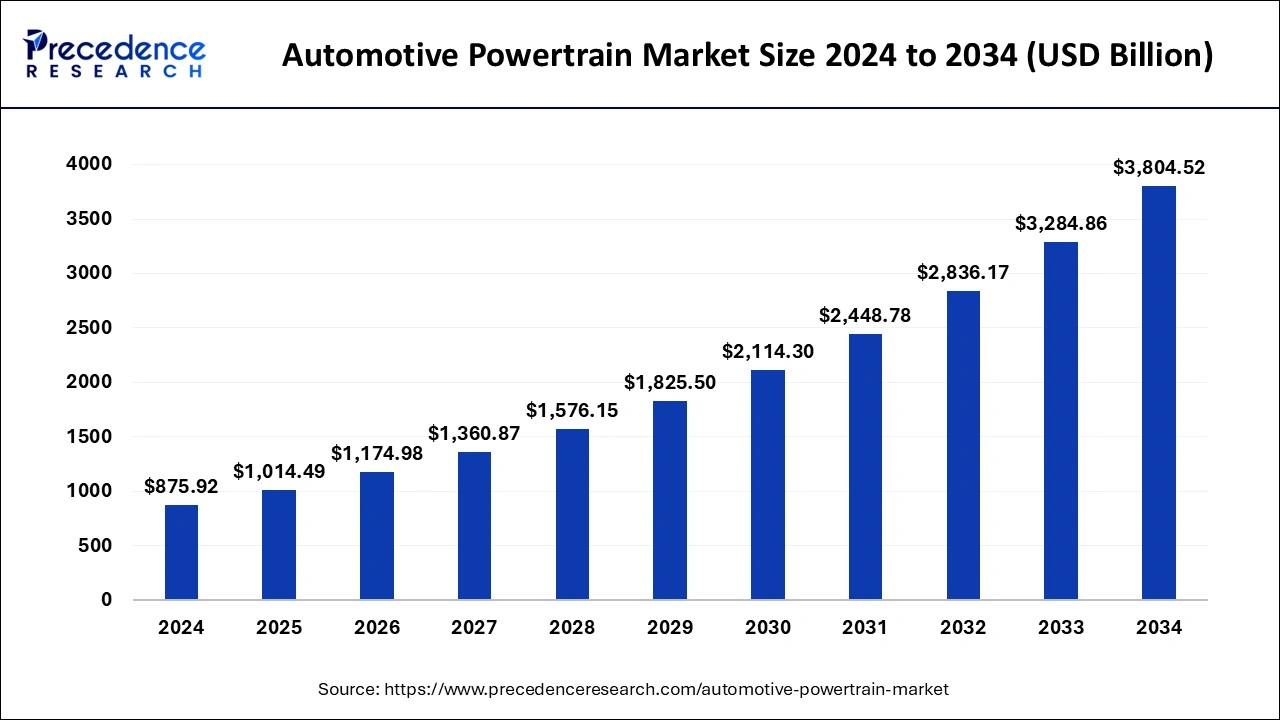
The global automotive powertrain market is projected to grow from USD 1,174.98 billion in 2026 to USD 4,276.87 billion by 2035, registering a CAGR of 15.47%. Growth is driven by rising electric vehicle adoption, increasing vehicle production, supportive government policies for clean mobility, and advancements in AI-powered powertrain optimization and electrification technologies. Asia Pacific dominates the market due to strong automotive manufacturing and EV demand, while Europe is expected to witness the fastest growth, supported by stringent emission regulations and sustainability initiatives.
Source: https://www.precedenceresearch.com/automotive-powertrain-market
 Get a Sample
 Table Of Content


What is the Automotive Powertrain Market Size?
The global automotive powertrain market size is calculated at USD 1,014.49 billion in 2025 and is predicted to increase from USD 1,174.98 billion in 2026 to approximately USD 4,276.87 billion by 2035, expanding at a CAGR of 15.47% from 2026 to 2035. The automotive powertrain market is driven by rising demand for fuel-efficient and electrified vehicles.
Key Takeaways
- By Region, Asia Pacific accounted for the largest revenue share of the automotive powertrain market in 2025.
- By Region, Europe is expected to grow at the fastest CAGR in the market during the forecast period.
- By position, the all-wheel drive segment led the global market with a share in 2025.
- By position, the front-wheel drive segment is expected to expand rapidly in the market with a CAGR in the coming years.
- By engine type, the gasoline segment registered its dominance over the global market with a share in 2025.
- By engine type, the diesel segment is expected to witness the fastest growth in the market with a CAGR over the forecast period.
- By vehicle type, the passenger car segment dominated the global market, accounting for 77% in 2025.
- By vehicle type, the light commercial vehicle segment is expected to gain the highest market share with a CAGR of 17.04% between 2026 and 2035.
Market Overview
Powertrain is one of the important components for an automobile that produces power to drive the vehicle by transferring it to the wheels. Some of the main components of powertrain include transmission, engine, driveshaft, and differentials. The performance as well as efficiency of a vehicle depends on powertrain properties.
Impact of AI on the Automotive Powertrain Market
Artificial intelligence (AI) and machine learning (ML) have found immense potential in the automotive sector to improve vehicle performance, driver safety, and passenger experience. AI and ML can be used to select appropriate powertrains for vehicles by identifying the perfect combination for motor size, winding configuration, and inverter topology. AI can optimize every component of the powertrain for maximum efficiency and performance. Additionally, AI and ML can play a vital role in designing and developing powertrains based on vehicle requirements. AI can streamline the entire development process, improving efficiency and reducing overall costs. AI algorithms can also be used for powertrain control, adapting to the dynamic environment.
Automotive Powertrain Market Growth Factors
- Favorable Government Policies: Government regulations support the development of automotive powertrains, boosting market growth.
- Technological Advancements: The advent of advanced technologies drives the latest innovations in automotive powertrains.
- Growing Demand for Sustainability: The growing demand for environmental sustainability increases the demand for environmentally friendly vehicles, augmenting the market.
- Increasing Vehicle Production: The surge in vehicle production particularly across developing nations is anticipated to further propel the automotive powertrain market during the forthcoming years.
- Rising Pollution: The rising rate of global pollution leads to initiatives to reduce carbon dioxide and greenhouse gas emissions, potentiating the use of automotive powertrains.
- Increasing Sales of EVs: The increasing sales of electric vehicles (EVs) globally also contributes to the market growth.
Market Scope
| Report Coverage | Details |
| Market Size in 2025 | USD 1,014.49 Billion |
| Market Size in 2026 | USD 1,174.98 Billion |
| Market Size by 2035 | USD 4,276.87 Billion |
| Growth Rate from 2026 and 2035 | CAGR of 15.47% |
| Base Year | 2025 |
| Forecast Period | 2026 to 2035 |
| Segments Covered | Position, Engine, Vehicle |
| Regional Scope | North America, APAC, Europe, Latin America, MEAN, Rest of the World |
Market Dynamics
Driver
Increasing Vehicle Production
The increasing number of vehicle production is a major driver of the automotive powertrain market. According to theEuropean Automobile Manufacturers' Association, approximately 76 million units of cars were produced globally in 2023. The rising demand for vehicles increases the use of powertrains. Powertrains are used in all types of vehicles including internal combustion engines (ICE), hybrid vehicles, and electric vehicles. The rapid advancements in vehicle features have driven the demand for vehicles, impacting their sales. More than 72 million cars were sold globally in 2023.
Restraint
Reliability of Powertrain Components
The major challenge of the automotive powertrain market is the reliability of powertrain components on the road. Components like the battery, motor, and power electronics are vulnerable to environmental stresses such as temperature variation and mechanical shocks.
Opportunity
Growing Investments
The future of the automotive powertrain is promising, driven by the increasing investments in automotive R&D. Major automotive giants are increasing their investments in automotive R&D to promote the development of advanced motor vehicle components. The amalgamation of automobile R&D investments and technological advancements drive the latest innovations in powertrains with an aim to improve vehicle performance. The changing consumer demands and the surge in market competition lead to increased investments in R&D. This enables key players to stand out in the market and strengthen their position as leaders.
Segments Insights
Position Insights
Which All-Wheel Drive Segment Dominated the Automotive Powertrain Market?
The all-wheel drive segment held a dominant position in the market in 2025 due to its ability to provide better traction, stability, and driving performance on a variety of terrains. Demand for SUVs, crossover vehicles, and upscale passenger vehicles increased. The use of AWD systems has grown in popularity among customers, thus emphasizing the safety and handling benefits it provides. The car industry continued to advance with several carmakers working on more advanced systems that encourage efficiency in an auto.
The front-wheel drive segment is expected to witness strong growth during the forecast period due to its efficient fuel economy and cost of production. Being so compact has minimised the vehicle weight and maximised interior cabin space. The segment is seeing growth as the demand for transportation and mobility solutions, due toue to the affordability factor, as well as to achieve better fuel economy, is increasing.
The rear-wheel drive segment is projected to grow at a notable pace due to its weight distribution and performance properties. Applying it to luxury automobiles, sporty cars, and cargo trucks is a common choice for this type. The load weight is above the limits of the system; the system provides better towing performance and handling properties. The market is growing due to the demand for high-end and performance vehicles.
Engine Type Insights
Why Did the Gasoline Segment Dominate the Automotive Powertrain Market?
The gasoline segment dominated the market in 2025 as a result of its high dominance in the passenger vehicle and well-established gasoline fueling infrastructure. Gasoline engines are less expensive to purchase and have more favorable characteristics in handling than many other choices. As a result of the advanced developments in fuel injection and turbocharging technology, the efficiency and CO2 performance of engines have improved.
The diesel segment is expected to grow significantly during the forecast period, as commercial vehicles and long-distance transport demand for fuel usage will remain high. In heavy-duty applications, diesel engines have more desirable qualities such as higher torque output, better fuel economy, etc. Logistics, construction, and freight companies still use diesels. Regulations can be met by advances in emission abatement technologies.
Vehicle Type Insights
How the Passenger Car Segment Dominated the Automotive Powertrain Market?
The passenger car segment dominated the market in 2025 due to the high production and sales volume of cars. Robust demand was explained by urbanisation and the improved income of consumers. Changing the target of cars but also on COâ‚‚ emissions, car manufacturers' system technologies for an ecological and electrified benchmark are continuously growing in their car product banks. The continued increase in sales of SUVs and crossover models also contributed to the segment's growth.
The light commercial vehicle segment is expected to grow steadily during the forecast period due to continued ecommerce/last mile logistics expansion globally. Companies are making investments in efficient transport solutions to increase logistics operations. The growing fleet turnaround activities are bolstering the demand for advanced powertrain systems. Hybrid and electric light commercial vehicles are new products to comply with emission regulations.
The heavy commercial vehicle segment is projected to grow at a healthy pace. The need for high performance and durability in the powertrain systems is considered for long-haul trucks, with construction applications also continuing to provide demand. With demand for higher fuel efficiency and lower operating costs, fleet operators are turning to new engine technology. Government policy to promote reduced emissions for vehicles is driving technology innovation.
Regional Insights
What is the Asia Pacific Automotive Powertrain Market Size?
The Asia Pacific automotive powertrain market size was evaluated at USD 628.98 billion in 2025 and is predicted to be worth around USD 2,666.88 billion by 2035, rising at a CAGR of 15.54% from 2026 to 2035.
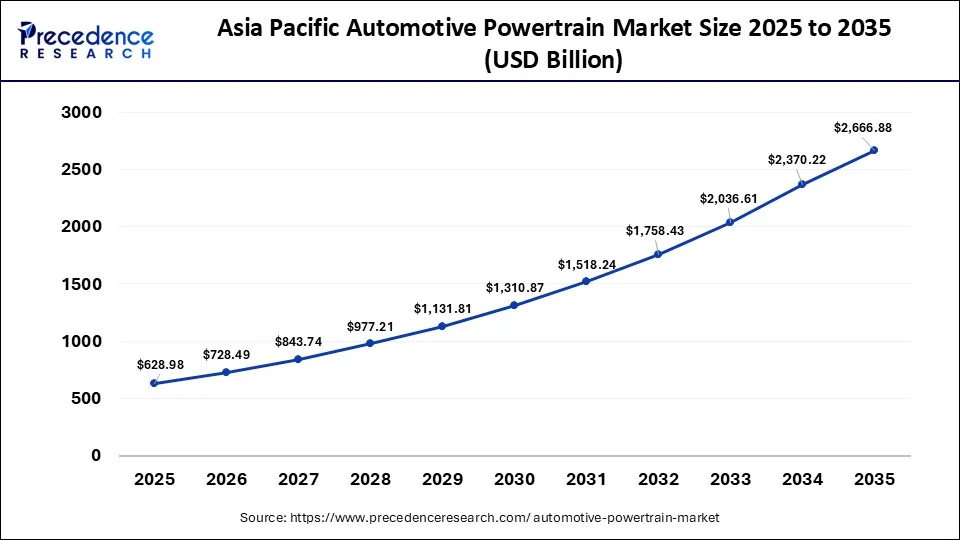
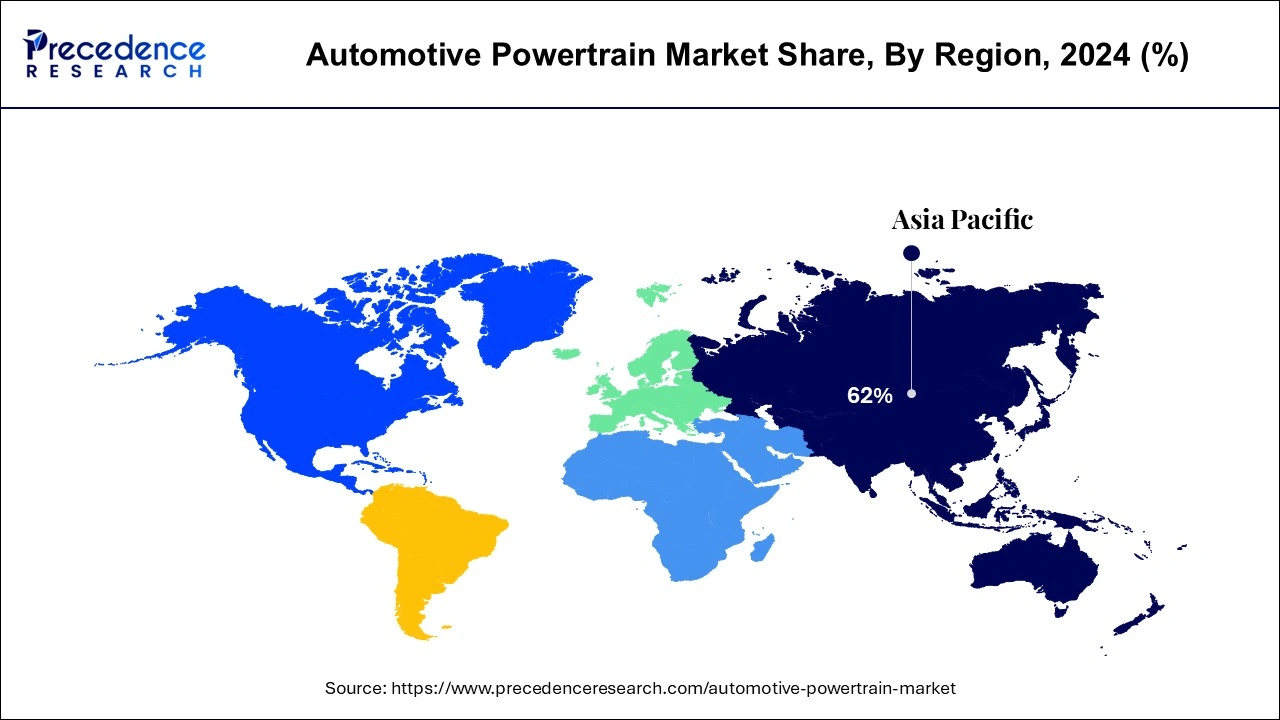
By geography, the global automotive powertrain market is studied for North America, Europe, Asia Pacific, Latin America, and Middle East & Africa. The Asia Pacific is the major revenue contributor for the year 2024 and anticipated to maintain the same trend over the analysis period. This is mainly attributed to the increasing sale of vehicles along with surge in demand for automated transmission in Asian countries that include India and China. Besides this, rising purchasing power of consumers in the developing nations is likely o augment the demand for state-of-the-art vehicles that in turn propels the demand for upgraded powertrains in the vehicles. Furthermore, Chinese government has introduced several energy saving programs for the automotive industry such as new energy vehicle development program that has significantly transformed the automotive industry in the Asia Pacific region.
China Market Trends
China's automotive powertrain market is anticipated to grow significantly due to its huge automotive manufacturing production base and fast development of EV production capacity. Government incentives to entice new vehicle powertrain investment. In-house manufacturing of electric motors, batteries, and hybrid systems continues to grow for manufacturers. Market growth is encouraged by rising demand from consumers for energy-saving vehicles. Better growth prospects are expected to be maintained by strong government policies and investments in industry.
Europe is projected to expand at the highest CAGR in the automotive powertrain market during the forecast period. Europe produces the largest number of vehicles globally. The increasing vehicle production promotes the demand for automotive powertrains. The rising sales of electric vehicles in the region also contribute to the market. Approximately 3.2 million electric cars were registered in 2023, an increase of 20% from 2022. Favorable government policies on environmental sustainability augment the market in Europe. The European Union recently launched the European Green Deal and the 8th Environment Action Programme (8EAP), setting out specific objectives and conditions to drive sustainability.
Germany Market Trends
Germany market is anticipated to grow significantly, driven by some of the best automotive manufacturers and cutting-edge engineering expertise. Businesses are investing in electric powertrains, hybrid powertrains, and hydrogen-based products. Widespread EU emission regulations are fostering innovation for new vehicle technologies that will use less fuel. Increased investments in automotive research, production, and manufacturing of batteries are strengthening competitiveness in the market. Market growth is being bolstered by the country's robust export-oriented automotive market.
Shift Toward Electrified Powertrains Driving Market Growth in North America
North America shows a significant growth during the forecast period. It is primarily driven by the rising need for advanced, efficient, and scalable solutions across multiple industries. The rising number of digital transformation initiatives, combined with the expanding adoption of these initiatives among enterprises of all sizes, continues to create strong development prospects.
U.S. Market Trends
U.S. market is anticipated to grow significantly, with continued research and development on next-generation propulsion systems. The firms in the automotive sector are spending heavily on powertrain systems and advanced transmission technologies that are becoming e-enabled. Technological innovation is gathering pace thanks to tough regulation on fuel economy and emissions. The domestic automotive industry is being boosted by the increase in investment in manufacturing facilities for batteries, as well as EV manufacturing.
Emission Regulations Accelerating Powertrain Innovation in Latin America
Latin America shows a notable growth during the forecast period. It is driven by the demand to reduce harmful tailpipe pollutants, like nitrogen oxides, and the transition toward electric vehicles and, thus, crucially, cleaner, more efficient hybrid options. Urban areas are undergoing an increasing need for cleaner transportation, leading to a growth in charging stations and user interest in eco-friendly vehicles.
Brazil Market Trends
Brazil's automotive powertrain market is anticipated to grow significantly, as vehicle demand and production grow, as well as the rising demand for flex-fuel and hybrid vehicles. Government programs to improve the cleanliness of transportation technologies are making technology investments by industry more attractive. Adoption of advanced powertrains has been gaining speed as consumers seek more fuel-efficient cars. Ongoing investments by global automotive OEMs could help drive growth in the market over the coming years.
Growth of the Middle East and Africa in the Automotive Powertrain Market
The Middle East and Africa region is expected to witness significant growth in the market due to an increase in vehicle electrification and automotive manufacturing projects in the region. Governments encourage sustainable transport and industrial diversification to build up the automotive sector. Strong growth of commercial vehicles is driving progress in the gradual shift towards electric powertrain deployment in logistics and infrastructure. Automakers from abroad are growing roots in the region, via strategic investments and local assembly brands.
Saudi Arabia Market Trends
Saudi Arabian market is anticipated to grow significantly. Rising investments in the automotive sector via vehicle production, battery manufacturing, and industrial infrastructure are helping to bolster the automotive ecosystem in the country. The increasing popularization of electric and hybrid vehicles is giving rise to the demand for advanced powertrain technologies. Advanced strategic partnerships with international auto manufacturers are driving rapid technology transfer and indigenous manufacturing.
Government Policies and Regulatory Initiatives Supporting the Automotive Powertrain Market
- In March 2026, the Government of India announced a friendly policy towards EVs, extending the PM E-DRIVE Scheme with an outlay of ₹10,900 crore. Promote e-mobility adoption and develop a local capacity for the major parts and high-end automotive powertrain technologies. (Source: https://www.drishtiias.com)
- In January 2025, the U.S. Department of Energy (DOE) pledged to extend programs to promote advanced vehicle and battery production and next-generation powertrain technologies under the Bipartisan Infrastructure Law and the Inflation Reduction Act of 2025. It aims to improve the fuel efficiency of vehicles and build “local” car production. (Source: https://www.hklaw.com)
- In October 2024, the EU updated the COâ‚‚ emission standard requirements, including hybrids and electric vehicles, which will further necessitate the auto segment to push its strategy and gain pace in developing hybrid and electric technologies. The rule helps to reach the transition to low-emission transport and introduces innovations in the development of advanced car powertrains. (Source: https://theicct.org)
Value Chain Analysis for the Automotive Powertrain Market
- Raw Material Sourcing: It is a highly complex, strategic process that acts as the base of vehicle production, involving the extraction, processing, and delivery of materials such as steel, aluminum, copper, rare earth elements, and plastics.
Key Players: Robert Bosch GmbH, Denso Corporation, Magna International, BorgWarner Inc. - Component Manufacturing:
It is a specialized, high-precision, multi-tiered process that transforms raw materials into the essential mechanical and electrical parts that drive a vehicle.
Key Players: BorgWarner Inc., ZF Friedrichshafen AG, Robert Bosch GmbH - Vehicle Assembly and Integration:
It includes the precise combination of engine or motor, transmission, and drivetrain components into the vehicle chassis.
Key Players: Magna International Inc., ZF Friedrichshafen AG, Robert Bosch GmbH
Competitive Landscape
Automotive powertrain includes global automakers and automotive component providers that work on designing and developing efficient automotive powertrain technologies such as internal combustion, hybrid, and electric powertrains. Key market participants include major players such as Aisin Seiki Co., Ltd., Ford Motor Company, BorgWarner Inc., JTEKT Corporation, and Volkswagen AG, with a strong market presence across the globe. They compete with these companies in product innovation, electrification plans, strategic partnerships, and investments in the latest propulsion technologies.
The manufacturers ensure competitiveness by focusing on electric powertrains, hybrid power systems, reducing drivetrain weight, and AI-assisted systems for driving. Enterprises are investing in manufacturing capacity expansion and collaborating with the battery and semiconductor companies in this transition towards vehicle electrification. The stringent emission standards, rapidly rising raw material costs, and the rapidly expanding trend of electric mobility are major obstacles.
Automotive Powertrain Market Companies
- General Motors Company: General Motors Company provides a diverse powertrain portfolio for the automotive market, which is transitioning from conventional internal combustion engines toward a heavily invested, all-electric future driven by its proprietary Ultium technology.
- Hyundai Motor Company: Hyundai Motor Company provides a comprehensive, multi-path portfolio in the automotive powertrain market, thus, ranging from high-efficiency internal combustion engines to more advanced electrification technologies, with a strong aim on hybrid and battery-electric (BEV) systems.
- GKN PLC: GKN Automotive is a global contributor in drive systems, providing a comprehensive, powertrain-agnostic portfolio programmed for traditional internal combustion engines, hybrids, and electric vehicles.
Other Major Key Players
- Aisin Seiki Co. Ltd.
- Ford Motor Company
- Borgwarner Inc.
- Jtekt Corporation
- Volkswagen AG
- Toyota Motor Corporation
- ZF Friedrichshafen AG
Latest Announcement by Industry Leaders
- Keerthi Prakash, Managing Director, Renault Nissan Automotive India Pvt. Ltd., commented that the company produced a total of 4.5 million units of powertrains. The company has also exported powertrain units and components worldwide. He also said that the company aims to boost the infrastructure to produce engines and gearboxes for their new models, with an investment of $600 million.
Recent Developments
- In January 2026, KGM Motors UK announced the launch of its new-generation dual-tech hybrid powertrain vehicles in the Torres Hybrid and Actyon Hybrid model range. The new series-parallel hybrid design combines the dynamics of electric drive with longer range, increased durability, and towing.(Source: https://www.hyundai.com)
- In April 2025, Hyundai Motor Group started production of the new hybrid power system, which comprises the 2.5-litre turbocharged engine and the enhanced electrification system for the 2025 Palisade SUV. It increases fuel economy and handling/gas mileage and improves engine performance.(Source: https://www.automotivepowertraintechnologyinternational.com)
- In January 2025, Skoda launched its new Enyaq and Enyaq Coupe SUVs with Enyaq 60 powertrains. The new powertrain offers more power and a larger battery for the SUV.
- In April 2024, Ramkrishna Forgings Ltd. announced that it had received approval to supply powertrain components to the U.S.'s largest electric passenger vehicle producer. The collaboration is a result of the ongoing commitment to innovate and its capabilities to meet the demands for the EV industry.
Segments Covered in the Report
By Position
- All-wheel Drive (AWD)
- Rear-wheel Drive (RWD)
- Front-wheel Drive (FWD)
By Engine Type
- Diesel
- Gasoline
- Others
By Vehicle Type
- Passenger Car
- Light Commercial Vehicle (LCV)
- Heavy Commercial Vehicle (HCV)
By Regional Outlook
- North America
- US
- Rest of North America
- Europe
- UK
- Germany
- France
- Rest of Europe
- Asia Pacific
- China
- Japan
- India
- Rest of Asia Pacific
- Latin America
- Brazil
- Rest of Latin America
- Middle East & Africa (MEA)
- GCC
- North Africa
- South Africa
- Rest of the Middle East & Africa
For inquiries regarding discounts, bulk purchases, or customization requests, please contact us at sales@precedenceresearch.com
Frequently Asked Questions





Ask For Sample
No cookie-cutter, only authentic analysis – take the 1st step to become a Precedence Research client
 Get a Sample




 sales@precedenceresearch.com
 Schedule a Meeting
