



Bacteriological Testing Market Trends, Companies, Revenue / Sales Performance, Food Production, Processing Capacity, Sales Volume, Distribution Performance, Competitive Landscape, and Industry Outlook
Bacteriological Testing Market (By Bacterium: Salmonella, Coliform, Listeria, Legionella, Campylobacter, Other Bacteria; By Technology: Traditional, Rapid; By End-Use Industry: Food and Beverage, Water, Pharmaceutical, Cosmetics and Personal Care; By Component: Instruments, Test Kits, Reagents and Consumables) - Global Industry Analysis, Size, Trends, Leading Companies, Regional Outlook, and Forecast 2026 to 2035
Source: https://www.precedenceresearch.com/bacteriological-testing-market
 Get a Sample
 Table Of Content


What is the Bacteriological Testing Market Size in 2026?
The global bacteriological testing market size accounted for USD 26.03 billion in 2025 and is predicted to increase from USD 28.02 billion in 2026 to approximately USD 54.35 billion by 2035, expanding at a CAGR of 7.64% from 2026 to 2035. In industries like food and beverage, water treatment, pharmaceuticals, and clinical diagnostics, bacteriological testing has emerged as a vital safety measure. As global health concerns, food safety regulations, and antimicrobial resistance have grown, so has their strategic relevance.
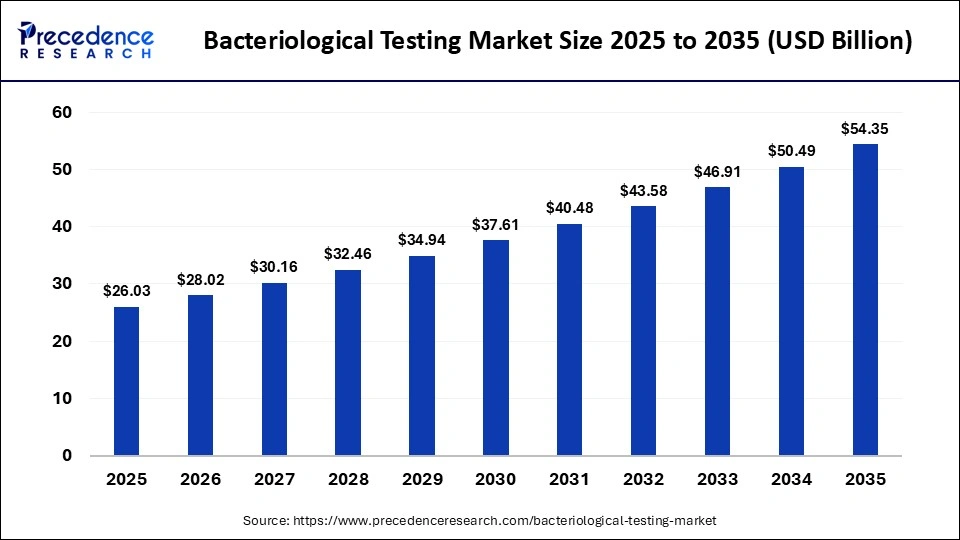
Key Takeaways
- Europe dominated the global bacteriological testing market in 2025.
- Asia-Pacific is expected to witness the fastest growth during the predicted timeframe.
- By bacteria, the Salmonella segment held a dominant position in the market with a share in 2025.
- By bacteria, the coliform segment is expected to grow rapidly in the forecast period of 2026 to 2035.
- By technology, the rapid segment led the global market in 2025.
- By technology, the traditional segment is expected to grow at the highest CAGR in the forecast period.
- By end-use industry, the pharmaceutical segment registered its dominance over the global market in 2025.
- By end-use industry, the food and beverage segment is expected to grow at the fastest CAGR in the upcoming period.
- By component, the test kits segment held the largest revenue share in the market in 2025.
- By component, the reagents and consumables segment is expected to grow rapidly over the forecast period.
What is the Bacteriological Testing Market?
Bacteriological testing is a cornerstone activity that allows us to distinguish and analyze the presence of bacteria in a wide variety of media, food, water, pharmaceuticals, and other clinical samples. The driving force for this market is increasing health concerns pertaining to bacterial infections and foodborne illnesses, and strict regulatory requirements from governments and health organizations. Bacteriological testing products are generally divided into categories, such as culture media, reagents, kits, and equipment, which are gaining traction among many end users of the industry.
Some common applications of bacteriological testing include clinical diagnostics, environmental assessments, and safety testing in the food and beverage and pharmaceutical sectors. Bacterial infections are what we might call all conditions or diseases caused by the multiplication of harmful bacteria or their toxins. Infections of this character may be acquired through contact with or exposure to contaminated environments, contact with infected individuals or animals, or ingestion of food or other contaminated items.
Impact of AI in the Bacteriological Testing Market
Artificial intelligence (AI) is a promising tool to improve the effectiveness, accuracy, and scalability of bacteriological testing. It can automate data processing, increase diagnostic accuracy, and expedite end-to-end results. ML and DL models can be used to analyze large volumes of complex data to identify bacteria and their susceptibility profiles more quickly and with greater accuracy. In addition, AI-enhanced diagnostic tools enhance bacterial detection by means of cost-effective smartphone-based image processing systems, cloud-based diagnostic systems, and automatic interpretation, all contributing to a lot of improvement for bacterial identification.
AI also offers pattern recognition in the form of technologies that can learn from large volumes of historical microbial images and datasets. This leads not only to quicker pathogen identification but also to a clearer separation of true positives versus background disturbances. AI has been applied to plate counting, mass spectrometry, microscopy detection (including holographic microscopy), and high-tech techniques such as Raman spectroscopy and surface-enhanced Raman scattering (SERS).
Bacteriological Testing Market Trends
- New Quality Assurance Standards for Pharmaceuticals: Microbial health and safety requirements for raw materials, intermediates, and finished goods are crucial to our pharmaceutical and healthcare industries. The purity of medicines, vaccines, and other healthcare supplies is checked via bacteriological testing. The pharmaceutical industry is upgrading its internal bacteriological capabilities and outsourcing activities that follow GMP and apply risk-based microbial monitoring techniques in light of the stringent regulatory regimes observed worldwide.
- Automation in the Bacteriological Testing Laboratory: Under all new technologies, AI-driven image detection, robotic pipetting, and equipment to automate culturing will be incorporated into the products developed by all labs. Previous practices, including manual plating, viewing the number of colonies in a field, etc., are being steadily replaced by robotic sampling processes and automated incubation. Automation will bring with it an obvious improvement in laboratory uniformity, both in terms of standardization and scalability preparedness for audits. If the technology used in association with other disciplines is also used, the automated lab environment could provide continuous examination and even more accurate assessment.
- Data Solutions Powered by AI: AI integrated with cloud-enabled informatics systems is beginning to upend the reading and use of findings. Now, some systems are already using AI to assess complex sample matrices to identify positive results, which can quickly identify and reduce the time taken to see raw data manually. Image recognition is now being used to identify colonies, and predictive analytics helps predict contamination risks.
- Rapid Development in Molecular Diagnostics: Molecular diagnostics approaches, including PCR, qPCR, and DNA sequencing assays, have shown great progress. Enhanced sensitivity and specificity with these approaches promote early detection of pathogenic species. The quick and reduced detection time, coupled with the possibility of simultaneous detection of multiple pathogens have fueled more acceptance and investment in molecular methods of diagnosis.
Market Scope
| Report Coverage | Details |
| Market Size in 2025 | USD 26.03 Billion |
| Market Size in 2026 | USD 28.02 Billion |
| Market Size by 2035 | USD 54.35 Billion |
| Market Growth Rate from 2026 to 2035 | CAGR of 7.64% |
| Dominating Region | Europe |
| Fastest Growing Region | Asia Pacific |
| Base Year | 2025 |
| Forecast Period | 2026 to 2035 |
| Segments Covered | Bacterium, Technology, End-Use Industry, Component, and Region |
| Regions Covered | North America, Europe, Asia-Pacific, Latin America, and Middle East & Africa |
Segmental Insights
Bacterium Insights
Which Bacterium Segment Dominated the Bacteriological Testing Market?
The Salmonella segment held the largest revenue share of the market in 2025, due to growing numbers of foodborne illnesses and the regulatory need to test in the poultry and meat industries. Rapid PCR and immunoassay kits for early detection have led to the implementation of Salmonella testing as an essential component of food safety management systems. Salmonella is the most common genus of typhoid-causing bacteria. The rising prevalence of typhoid through contaminated food and water, especially in developing countries, promotes the need for Salmonella testing.
The coliform segment is expected to show the fastest growth over the forecast period, as it becomes widely used in the beverage sector for the protection of public health. Monitoring of coliform concentration is mandatory for municipal water authorities and bottled water producers. In contrast to evaluating each pathogen independently, coliform detection is more economical in measuring contamination possibilities. The increasing efforts towards rural water quality and environmental monitoring have created a pressing need in developing areas and strengthened public health monitoring.
Technology Insights
Why Did the Rapid Segment Dominate the Bacteriological Testing Market?
The rapid segment contributed the biggest revenue share of the market in 2025, due to its ability to make decisions on production lines. Manufacturers have no stomach for delays of several days during incubation. Hence, these new systems reduce detection times to mere hours and consequently reduce inventory holding costs dramatically. Advancements in diagnostic techniques and growing research activities have led to the development of rapid testing tools for different bacteria.
The traditional segment is expected to gain the highest share of the market between 2026 and 2035. Traditional culture procedures are gaining momentum as they continue to represent regulatory gold standards in other industries. Most pharmacopeia and food safety regulations still require culture confirmation. These methods entail longer process turnaround times, but have proven reliability and cost-effectiveness. These traditional approaches are largely in use at smaller laboratories and emerging areas for routine bacteriological examinations.
End-Use Industry Insights
How the Pharmaceutical Segment Dominated the Bacteriological Testing Market?
The pharmaceutical segment accounted for the highest market share in 2025, due to stringent Good Manufacturing Practice (GMP) sterility requirements. Injectable and biologic drugs are produced at such low levels of microbial contamination that it can no longer even be verified. Continuous requests for high-precision bacteriological solutions come due to such activities as environmental monitoring, raw material evaluation, and final product sterility analysis.
The food and beverage segment is expected to witness the fastest growth in the market over the forecast period, due to the increasing consumer awareness of food safety and quality. The rising incidences of foodborne illness and regulatory hurdles have driven food manufacturers to adopt microbiological testing as one of the important measures to confirm the purity of their products against potentially hazardous species.
Outbreak risks may impact brand loyalty and export opportunities. Infectious disease risk identification is now a routine part of Hazard Analysis Critical Control Point (HACCP) plans and preventive controls. Furthermore, the increasing consumption of processed foods also continues to lead to an increase in the frequency of these tests.
Component Insights
Which Component Segment Led the Bacteriological Testing Market
The test kits segment led the market in 2025, due to increased convenience and portability for more on-site applications, with the trend of ready-to-use kits. Streamlined workflows help reduce food processors' and water utilities' reliance on centralized laboratories. These kits are well-suited for rapid and molecular platforms, so screening on-site can be carried out before confirmatory testing occurs, pushing testing closer to the production sites instead of relying solely on central laboratories.
The reagents and consumables segment is expected to expand rapidly in the market in the coming years. This segment is a major foundation for the bacteriological testing industry; every cycle of bacteriological testing will depend on these materials. Reagents and consumables, on the other hand, produce demand consistently relative to test volumes compared to instruments that may have variable demand. Such items must flow steadily with the laboratory throughput. Common examples of reagents and consumables include culture media, buffers, enrichment broths, filtration membranes, pipette tips, and microplates.
Regional Insights
Why Europe Dominated the Bacteriological Testing Market?
Europe held a major revenue share of the market in 2025. This remarkable dominance is mainly because of the region's strict food safety legislation, enforcement of food hygiene standards, and its sophisticated infrastructure for assessing food quality. Germany, France, and the U.K., leading countries with developed food processing industries, benefit from a network of certified laboratories. Bacteriological testing is particularly reliant on the European Food Safety Authority (EFSA)'s mandate to ensure microbial safety assessments along food supply chains. Moreover, the demand for superior food products that are pathogen-free, along with rising levels of foodborne illnesses, is also pushing the region to expand testing standards.
Germany Market Trends
The German market is growing as it is one of the most technologically advanced countries in Europe and has the perfect laboratory infrastructure. Its laboratories operate in a regulatory environment where strict regulation is followed closely, and strict enforcement makes its production continuously demanding for testing services. From meat processing cells in Bavaria to water monitoring labs based near ports in Hamburg, early investments in fast and reliable testing techniques are being made by German factories. Such a dynamic setting facilitates innovation, rigorous quality control, and better adoption of advanced microbial diagnostic technologies.
How is Asia-Pacific Growing in the Bacteriological Testing Market?
Asia-Pacific is expected to witness the fastest growth during the predicted timeframe. Rapid urbanization processes are prompting a lot of growth in this area, and the food industry is advancing too, along with consumers developing greater awareness regarding food safety. Governments' efforts to modernize food safety procedures, combined with the growth of retail food chains and e-commerce systems, are increasing demand for testing services. Investments in laboratory infrastructure upgrades, in addition to the high prevalence of foodborne disease and intensified control of the outbreaks, are consolidating the quality of testing on bacteriological tests in the Asia-Pacific.
China Market Trends
The rapid surge in bacteriological testing in China is mainly due to its population, the burgeoning food and pharmaceutical industry, and more stringent health and safety regulations. Its market has developed at an unprecedented rate compared to other areas, and there are more testing laboratories globally to consider high quality standard in place. Increasing microbial surveillance efforts are evident among both provincial water regimes and commercial food exporters, indicating an increased commitment to automation and rapid detection methods.
Bacteriological Testing Market Companies
- SGS SA
- ALS Limited
- Vimta Labs
- Bureau Veritas
- Intertek Group plc
- Charm Sciences, Inc.
- Eurofins Scientific
- Thermo Fisher Scientific Inc.
- IDEXX Laboratories, Inc.
- Hardy Diagnostics
- Merck KGaA
- BioMérieux SA
- HiMedia Laboratories
- 3M Food Safety
- Neogen Corporation
- Agilent Technologies, Inc.
- Romer Labs Division Holding GmbH
- Microbac Laboratories, Inc.
- Merieux NutriSciences Corporation
- QIAGEN N.V.
- R-Biopharm AG
- FOSS
- DuPont Nutrition & Biosciences
Recent Developments
- In September 2025, Cagayan de Oro (PH) health authorities announced that 16 of 19 drinking water samples contained coliform and fecal coliform bacteria, and bacteriological testing and sanitation actions were expanded throughout the city's distribution systems. Officials reported an unusual cluster of positive results that prompted emergency flushing, increased laboratory monitoring, and community advisories to boil water, a reminder of lapses in routine microbial monitoring.(Source: https://www.gmanetwork.com)
- In April 2025, researchers from Amsterdam UMC developed a new diagnostic test that can diagnose bacterial meningitis quickly and accurately. Their research showed that elevated CRP in cerebrospinal fluid is an indicator of bacterial meningitis. The device could measure the amount of CRP in cerebrospinal fluid from blood samples. (Source: https://www.news-medical.net)
Segments Covered in the Report
By Bacterium
- Salmonella
- Coliform
- Listeria
- Legionella
- Campylobacter
- Other Bacteria
By Technology
- Traditional
- Rapid
By End-Use Industry
- Food and Beverage
- Water
- Pharmaceutical
- Cosmetics and Personal Care
By Component
- Instruments
- Test Kits
- Reagents and Consumables
By Region
- North America
- Europe
- Asia-Pacific
- Latin America
- Middle East & Africa
For inquiries regarding discounts, bulk purchases, or customization requests, please contact us at sales@precedenceresearch.com
Frequently Asked Questions





Ask For Sample
No cookie-cutter, only authentic analysis – take the 1st step to become a Precedence Research client
 Get a Sample




 sales@precedenceresearch.com
 Schedule a Meeting
