



Beverage Crates Market Size, Companies, Share, Sales Volume, Consumer Demand, Pricing Trends, Distribution Performance, Competitive Positioning, and Growth Forecast
Beverage Crates Market (By Material Type: High-Density Polyethylene (HDPE), Polypropylene (PP), Recycled Plastics, Others; By Product Type: Collapsible Crates, Compartmentalized Crates, Nestable Crates & Stackable; By Application: Alcoholic Beverages , Non-Alcoholic Beverages , Dairy & Milk Distribution, Institutional & Retail Supply Chains) - Global Industry Analysis, Size, Trends, Leading Companies, Regional Outlook, and Forecast 2026 to 2035
Source: https://www.precedenceresearch.com/beverage-crates-market
 Get a Sample
 Table Of Content


What is the Beverage Crates Market Size in 2026?
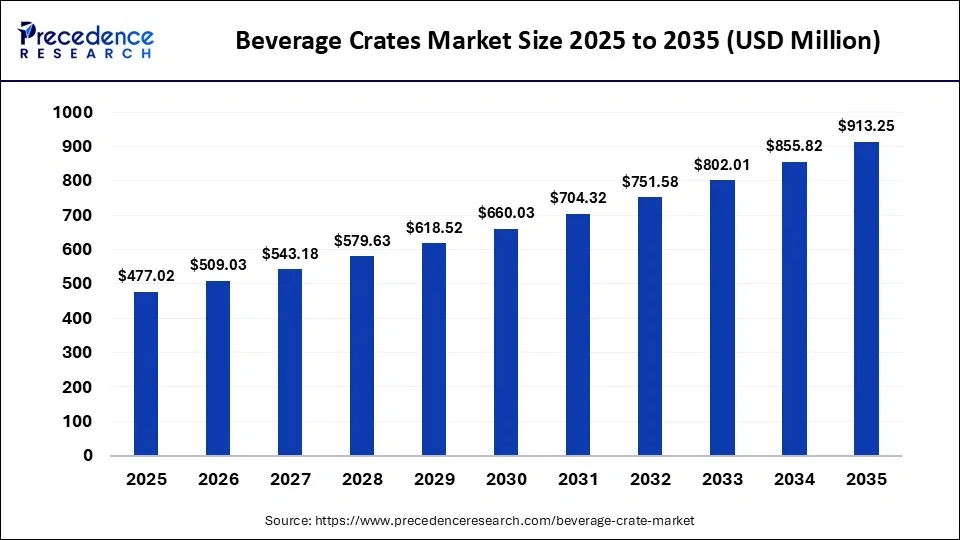
The global beverage crates market size was calculated at USD 477.02 million in 2025 and is predicted to increase from USD 509.03 million in 2026 to approximately USD 913.25 million by 2035, expanding at a CAGR of 6.71% from 2026 to 2035. The market is experiencing robust growth, driven by the need to have a safe, reusable, and durable packaging solution in the beverage business. The growing demand for environmental sustainability and highly durable container for beverage transport drives the market.
Key Takeaways
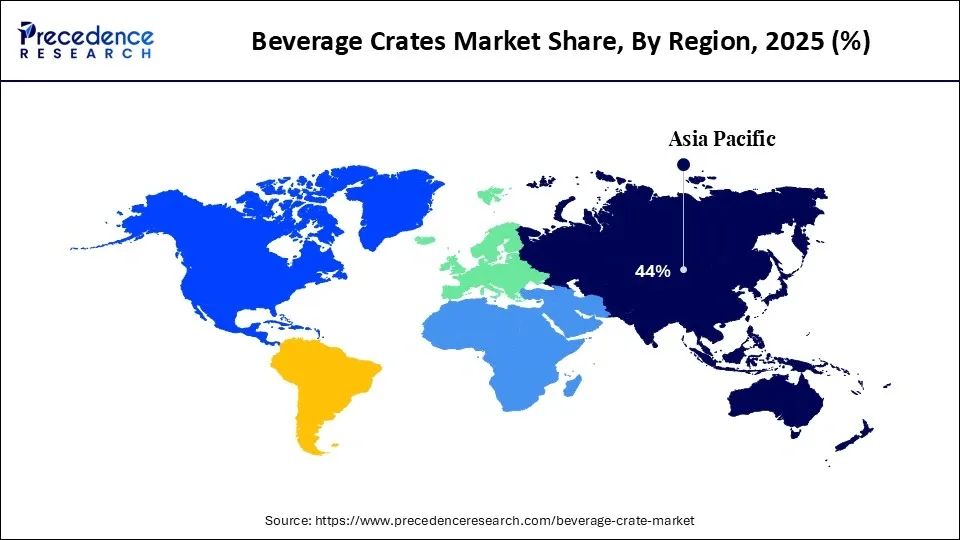
- Asia Pacific dominated the global beverage crates market with the largest market share of 44% in 2025.
- North America is expected to host the fastest-growing market in the coming years.
- By material type, the high-density polyethylene (HDPE) segment held a dominant position in the market in 2025.
- By material type, the polypropylene segment is expected to grow at the fastest CAGR in the market between 2026 and 2035.
- By product type, the nestable and stackable segment led the global market in 2025.
- By product type, the collapsible segment is expected to grow with the highest CAGR in the market during the studied years.
- By application, the non-alcoholic drinks segment registered its dominance over the global market in 2025.
What are Beverage Crates?
The beverage crates market deals with the production and distribution of the crates, which are utilized in storing and transportation of beverages such as bottled water, soft drinks, dairy products, beer and other alcoholic beverages. Strong materials used to make the crates, such as high-density polyethylene (HDPE) and polypropylene. The beverage companies widely use crates to make logistics more efficient and reduce product damage. The market is growing because of the growth in the consumption of beverages, the increasing number of retail stores and the growing demand for sustainable and recyclable packaging solutions.
Impact of AI in the Beverage Crates Market
The beverage crates market is being transformed by Artificial Intelligence which offers more visibility and efficiency in the supply chain. The demand forecasting using AI technology allows beverage manufacturers to take informed decisions regarding the manufacturing of crates, inventory as well as distribution of the products according to the actual consumption trends.
Sophisticated tracking of crates with the help of RFID and IoT technologies enables the manufacturers of beverages to monitor the position and utilization of cases in real-time. Predictive maintenance systems that work on AI can be used to activate faulty or inefficient crates in advance before they break down. AI-sorting and stacking systems can be applied in automated warehouses to optimize the space and minimize the work of manual handling. AI is therefore allowing beverage producers to minimize the cost of logistics, minimize waste of products, and maximize supply chain output.
Moreover, the implementation of analytics solutions based on the AI technology is helping manufacturers to analyze the performance of the crate life cycle and optimise the utilisation of assets to be used in different distribution cycles. Machine learning algorithms will be able to interpret the patterns of use and give the recommendation of the best routes and location where the crates are stored.
Trends Influencing the Beverage Crates Market
- Rising Demand for Sustainable Packaging Solutions: The beverage industry is experiencing a growing demand for sustainable and recyclable beverage crates made from materials such as recycled HDPE and polypropylene. This is because sustainable packaging solutions have become a need to reduce plastic waste and embrace the principles of the circular economy, aligning with stringent regulatory policies.
- Adoption of Smart Tracking Solutions: The adoption of RFID and IoT-based beverage crates is increasing at a rapid pace in the logistics sector. This is because smart tracking solutions enable real-time tracking of beverage crates. Advanced crate tracking solutions also enable companies to optimize distribution efficiency.
- Rising Demand for Collapsible and Stackable Crates: Collapsible and stackable crate designs are increasingly being adopted due to their storage advantages. These crates increase the efficiency of loading vehicles and help reduce the storage space of warehouses. The demand for such crates is rising among beverage companies as they help reduce logistics costs.
Market Scope
| Report Coverage | Details |
| Market Size in 2025 | USD 477.02 Billion |
| Market Size in 2026 | USD 509.03 Billion |
| Market Size by 2035 | USD 913.25 Billion |
| Market Growth Rate from 2026 to 2035 | CAGR of 6.71% |
| Dominating Region | Asia Pacific |
| Fastest Growing Region | North America |
| Base Year | 2025 |
| Forecast Period | 2026 to 2035 |
| Segments Covered | Material Type, Product Type, Application, and region |
| Regions Covered | North America, Europe, Asia-Pacific, Latin America, and Middle East & Africa |
Segmental Insights
Material Type Insights
The high-density polyethylene (HDPE) segment dominated the beverage crates market in 2025 due to its exceptional durability, chemical resistance, and lightweight nature. HDPE crates are highly resistant to impact, moisture, and temperature variations, making them ideal for repeated use in beverage distribution and storage. Their robust structure ensures safe transportation of glass bottles and other fragile packaging, minimizing breakage during handling and transit. Additionally, HDPE crates are easy to clean and maintain, which aligns with hygiene requirements in the food and beverage industry. The combination of long service life and cost-effectiveness has made HDPE the preferred material among manufacturers and distributors, solidifying its dominant position in the market.
The polypropylene (PP) segment is witnessing the fastest growth due to its growing adoption in lightweight and recyclable beverage crates. PP offers advantages such as lower production costs, flexibility in design, and resistance to chemical and environmental stressors. Its ability to withstand repetitive stacking and rough handling makes it increasingly attractive for large-scale beverage supply chains, particularly in emerging markets. Additionally, rising environmental concerns and demand for recyclable materials are driving manufacturers to innovate PP-based crates that are sustainable without compromising durability. The combination of cost-efficiency, sustainability, and performance is fueling rapid adoption, positioning PP as the fastest-growing material segment in the forecast period.
The recycled plastics segment is gaining attention as beverage companies focus on sustainable packaging solutions. Crates made from recycled plastics help reduce environmental impact while maintaining performance standards, including durability and moisture resistance. The growing emphasis on circular economy initiatives and corporate sustainability commitments is boosting demand for recycled plastic crates, particularly in regions with strict environmental regulations. While adoption is not yet as widespread as HDPE or PP, recycled plastic crates are gradually emerging as a viable alternative for eco-conscious distributors and beverage companies.
Product Type Insights
Nestable and stackable crates dominated the market in 2025 due to their versatility and operational efficiency. Stackable crates allow multiple units to be securely placed on top of one another during storage and transport, maximizing warehouse space utilization. Nestable designs enable empty crates to be nested within each other, reducing space requirements during returns or storage. This dual functionality of storage and transportation efficiency, combined with their durability and cost-effectiveness, makes nestable and stackable crates the most widely adopted product type in the market.
Collapsible crates are emerging as the fastest-growing product type due to their space-saving design, which significantly reduces transportation and storage costs. Their foldable structure allows empty crates to occupy minimal space during return logistics, improving operational efficiency and cost-effectiveness for beverage distributors. Increasing adoption in urban logistics, retail chains, and export markets, where space and transportation optimization are critical, is accelerating growth. Moreover, collapsible crates are designed for durability and repeated use, making them a sustainable option aligned with industry trends toward reducing packaging waste.
Application Insights
The non-alcoholic beverages segment dominated the market, driven by the high global consumption of soft drinks, juices, bottled water, and energy drinks. Beverage crates for non-alcoholic drinks are essential for handling high-volume shipments efficiently while ensuring product safety. Nestable, stackable, and HDPE crates are widely adopted in this segment to meet large-scale logistics demands. The sheer volume and consistency of demand in this category have contributed to its dominant position in the beverage crates market.
The dairy and milk distribution segment is emerging as the fastest-growing application due to the increasing demand for fresh dairy products and expansion of organized retail in emerging economies. Crates designed for dairy products are engineered to maintain hygiene, prevent spillage, and withstand frequent handling. Rising consumption of packaged milk, yogurt, and other dairy items, along with improvements in cold-chain logistics, is driving the adoption of specialized crates, propelling growth in this segment.
Crates used in institutional and retail supply chains support efficient inventory management, transportation, and storage of various beverages. They are increasingly employed in supermarkets, convenience stores, hotels, and foodservice operations for both alcoholic and non-alcoholic products. The integration of standardized crate solutions in large-scale supply chains enhances operational efficiency, reduces breakage, and ensures product traceability. Although this segment grows steadily, its expansion is linked closely to the growth of beverage consumption and retail modernization in different regions.
Regional Insights
Asia Pacific Beverage Crates Market Size and Growth 2026 to 2035
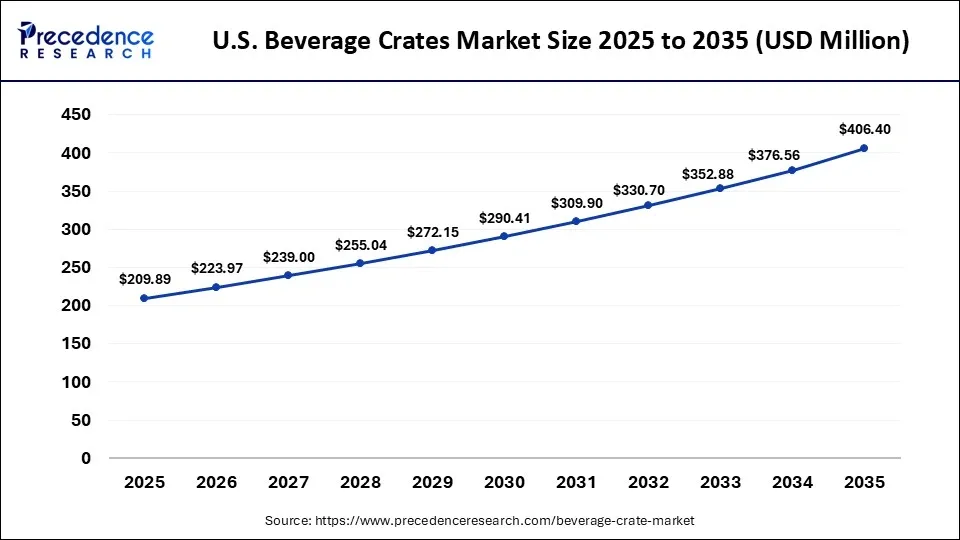
The Asia Pacific beverage crates market size is expected to be worth USD 406.40 billion by 2035, increasing from USD 209.89 billion by 2025, growing at a CAGR of 6.83% from 2026 to 2035.
Why is Asia Pacific Expanding at a Significant CAGR in the Market?
Asia Pacific recorded the largest share of 44% in 2025 beverage crates market due to the rate at which the population is growing in terms of urbanization, population and consumption of packaged beverages such as bottled water, soft drinks and dairy products. The growth of the retail industry and the production of beverages in places like India and China is stimulating the influence of the high demand of the strong and reusable crate systems. Moreover, the growing presence of e-commerce services of beverages delivery is driving the need towards efficient solutions of transit packaging.
How Does North America Dominate the Beverage Crates Market?
Beverage crates market in North America is on a rapid boom because consumption of alcoholic and non-alcoholic drinks is high. The logistics system in North America is highly sophisticated and the channels of distribution are automated. This has seen more usage of stacking and collapsing beverage crates. Smart tracking systems are also being adopted in the beverage industry including RFID-enabled beverage crates in order to minimize the losses incurred during transit. Reusable beverage crates have also been adopted in North America because of the growing need to use green packaging materials.
Europe is seen to grow at a notable rate due to the stringent environmental regulations that advocate on the reusability and recycling of packaging system. European beverage industry is looking at the use of the returnable crates to counter the plastic waste and also increase efficiency in logistics. The market is also being driven by the existing beverage production industry and warehouse automated systems in Europe. The growing trend toward recycled materials in the manufacturing of beverage crates is a positive development in relation to the growing popularity of the circular economy practices.
Beverage Crates Market Companies
- Schoeller Allibert
- DS Smith Plc
- ORBIS Corporation
- Myers Industries
- Craemer Group
- Tosca
- CABKA Group
- Georg Utz Holding AG
Beverage Crates Market Value Chain Analysis
- Raw Material Sourcing
The process of value chain begins with the purchase of raw materials including High-Density Polyethylene (HDPE), Polypropylene (PP), and plastics that are recycled. Manufacturers are also moving to the use of green and recycled materials in a bid to ensure sustainability and reduce the use of virgin plastic in the production of crates.
- Manufacturing and Design
This involves injection moulding, designing, and testing of beverage crates. Manufacturers are also in the process of developing the robust, lightweight and stackable crates that would offer safety of the products in the storage and transportation, and the automated handling system in the modern warehouses.
- Distribution and End-Use
The completed crates are shipped to beverage businesses, logistic businesses, and retail distributors to store and transport the crates in bulk. Reusable crate is usually implemented to achieve an efficient transportation of beverages in bottle and cans through the supply chain and, therefore, reduce the packaging waste and logistical costs.
Recent Developments
- In April 2025, Tetra Pak partnered with Schoeller Allibert to introduce a new transport crate made from polyAl, a recycled material derived from used beverage cartons. This initiative was unveiled at the Plastics Recycling Show in Amsterdam and is designed to replace conventional crates with a more sustainable and durable solution that incorporates up to 50% recycled beverage carton material.
- In December 2025, Italian retailer Iperal transformed its fresh supply chain by launching a partnership with Tosca to deploy automation ready reusable plastic crates for fresh products. These reusable crates support sustainability and logistical efficiency in automated operations, eliminating reliance on single use packaging and enhancing handling across suppliers and stores.
Segments Covered in the Report
By Material Type
- High-Density Polyethylene (HDPE)
- Polypropylene (PP)
- Recycled Plastics
- Others
By Product Type
- Collapsible Crates
- Compartmentalized Crates
- Nestable Crates & Stackable
By Application
- Alcoholic Beverages
- Non-Alcoholic Beverages
- Dairy & Milk Distribution
- Institutional & Retail Supply Chains
By Region
- North America
- Latin America
- Europe
- Asia-pacific
- Middle and East Africa
For inquiries regarding discounts, bulk purchases, or customization requests, please contact us at sales@precedenceresearch.com
Frequently Asked Questions
Tags





Ask For Sample
No cookie-cutter, only authentic analysis – take the 1st step to become a Precedence Research client
 Get a Sample




 sales@precedenceresearch.com
 Schedule a Meeting
