



Blockchain Distributed Ledger Market Trends, Companies, Revenue / Sales Performance, Subscriber Growth, Pricing Strategies, Cloud Adoption, Infrastructure Expansion, Competitive Landscape, and Industry Outlook
Blockchain Distributed Ledger Market (By Application: Smart Contracts, Cryptocurrency, Supply Chain Management, Compliance Management, Trade Finance; By Ledger Type: Permissioned (Private Blockchain), Permissionless (Public Blockchain), Hybrid; By Deployment: Cloud, On Premise) - Global Industry Analysis, Size, Trends, Leading Companies, Regional Outlook, and Forecast 2026 to 2035
Source: https://www.precedenceresearch.com/blockchain-distributed-ledger-market
 Get a Sample
 Table Of Content


What is the Blockchain Distributed Ledger Market Size in 2026?
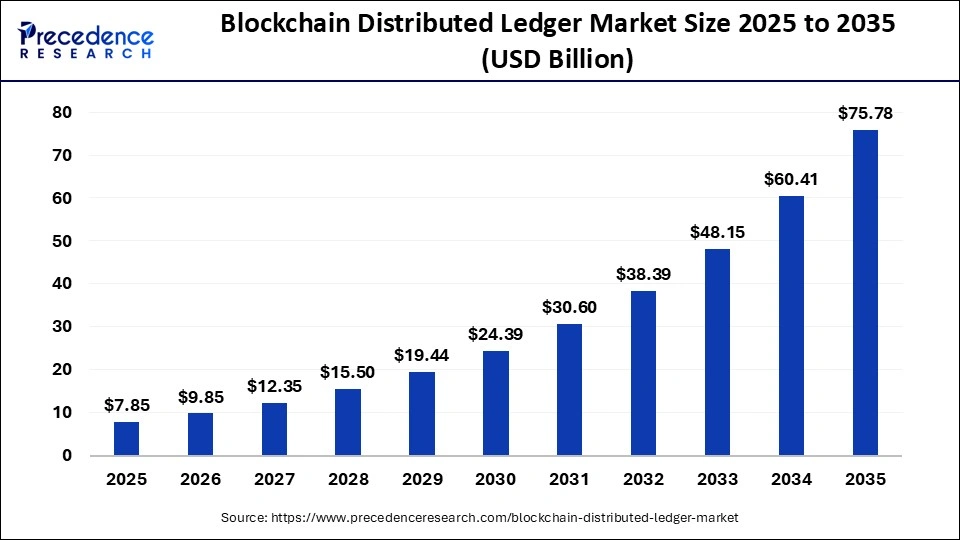
The global blockchain distributed ledger market size accounted for USD 7.85 billion in 2025 and is predicted to increase from USD 9.85 billion in 2026 to approximately USD 75.78 billion by 2035, expanding at a CAGR of 25.45% from 2026 to 2035. Various contributors lead to the rising market trend, such as the rising uptake by businesses, enhanced consciousness in various industries, minimal risk of fraud, and economical and low-cost technology applicability.
Key Takeaways
- North America dominated the blockchain distribution ledger market in 2025.
- Asia-Pacific is expected to grow rapidly in the blockchain distributed ledger market in the forecast period of 2026 to 2035.
- By application, cryptocurrency held the dominance in the blockchain distributed ledger market in 2025.
- By application, the supply chain management segment is expected to grow rapidly over the forecast period of 2026 to 2035.
- By ledger type, the permissioned segment in the blockchain distributed ledger market is dominating market share in 2025.
- By ledger type, the permissionless segment in the blockchain distributed ledger market is expected to grow at a higher pace in the forecast period.
- By deployment, the cloud has dominated the market in 2025 and is expected to grow at a higher pace over the forecast period.
What is the Blockchain Distributed Ledger Market?
DLT (Distributed Ledger Technology) takes advantage of an encoded and distributed database that logs transactions. One such ledger can be widely distributed on many computers, nodes, institutions, or countries, and is accessible to many users around the world. A blockchain is a digital ledger of the transaction that is transferred through the networked computers (nodes). There is no server - no centralized node: Each node logs, shares, and synchronizes the transactions in synchrony separately.
Blockchain is a technology that implements digital signatures and encryption, decentralized networks, and other protection mechanisms and security mechanisms to ensure information security for applications. This is a peculiar kind of DLT, in which exchanges are backed up by a permanent cryptographic hash, which is why people often use the word blockchain with distributed ledgers. Although blockchains utilize consensus-based protocols (e.g., proof of work, proof of stake), DLT can accommodate a wider range of mechanisms. Moreover, DLTs have applications across industries because they can handle various problems in these fields. Blockchain has long been linked to the financial sector as a tool for recording payment systems.
Impact of AI in the Blockchain Distributed Ledger Market
The union of blockchain and artificial intelligence will surely bring to fruition an era of invention in which distributed ledgers come to life via machine automation, secure functioning, and intelligent capability. Traditional centralized infrastructures, however, are open to information security threats and data tampering that would jeopardize information privacy, security, integrity, and trust in digital interactions. AI-infused cyberattacks, including malware, phishing campaigns, and social engineering, are also being advanced and can leverage vulnerabilities in systems and network architecture for sensitive data access. AI-powered security solutions utilize machine learning algorithms to mine and explore huge data sets, discover irregularities, and discover cyber threats instantly while actively reacting to them in a live environment. It helps to make cybersecurity measures more effective and flexible, hence much more resilient and adaptable. It serves as a strong solution to cybersecurity issues from many domains that can protect digital assets from dynamic cyber threats and risks. In the process, organizations gain the greatest benefit of using decentralized ledger technology, with intelligent security analytics as the third dimension of their framework to help strengthen the integrity, transparency, and strength of their cybersecurity systems, thereby making it possible for them to create a digital world with confidence.
Key Government Regulations for the Blockchain Distributed Ledger Market
|
Regulations |
Focus Areas |
Descriptions |
|
EU MiCA |
Operational Licensing and Stablecoins |
Fully implemented EU-wide framework requiring licenses for crypto asset service providers and strict reserve rules for stablecoin issuers. |
|
AML/KYC and Travel Rule Compliance |
Illicit Activity Prevention |
Mandatory Customer Due Diligence, transaction monitoring, and VASP registration with financial authorities. |
|
FATF Crypto-Asset Reporting Standards |
Taxation and Data Transparency |
Global standards requiring automated, mandatory reporting of crypto holdings to tax authorities to end tax opacity. |
Market Trends of the Blockchain Distributed Ledger Market
- Interoperability Fuels the Next Wave of DeFi Expansion: The next part of Fintech is in Interoperability and is a significant step forward towards DeFi. As a result of this developing trend, the use of blockchain inter-connectivity technologies has been gaining momentum in distributed ledger systems. In this context, the development of the bridge and protocols in a distributed architecture serves to help facilitate the easy transportation of assets and data across many distributed systems. Decentralized run, self-governing organizations stand to benefit from governance by allowing users to take an active part.
- Institutional-Grade Tokenization Enters the Mainstream : The application of real-world asset tokenization goes from theory to practical application. Financial instruments, including bonds, funds, and carbon credits, are increasingly integrated into distributed ledger systems, providing fractional ownership, instant settlement, and automatic compliance. The emergence of blockchain tokenization platforms will accelerate the speed of the capital markets by facilitating the clearing cycles and liquidity.
- Scaling Blockchain for Supply Chain Security and Transparency: From pharmaceuticals to food exports, distributed ledger technology is creating this infrastructure for traceability through all the network elements. Real-time access to complete information can ensure transparency and reduce data sharing risk and conflict in the blockchain network. And they are written in a block linked cryptographically to its predecessor, creating a chain of blocks of records. This decentralized structure greatly diminishes efforts by malicious actors to shape or adapt data, which, in turn, protects information integrity.
Market Scope
| Report Coverage | Details |
| Market Size in 2025 | USD 7.85 Billion |
| Market Size in 2026 | USD 9.85 Billion |
| Market Size by 2035 | USD 75.78 Billion |
| Market Growth Rate from 2026 to 2035 | CAGR of 25.45% |
| Dominating Region | North America |
| Fastest Growing Region | Asia Pacific |
| Base Year | 2025 |
| Forecast Period | 2026 to 2035 |
| Segments Covered | Application, Ledger Type, Deployment, and Region |
| Regions Covered | North America, Europe, Asia-Pacific, Latin America, and Middle East & Africa |
Segment Insights
Application Insights
Cryptocurrency
Cryptocurrency segment held the dominance in the blockchain distributed ledger market in 2025. One of the biggest drivers of growth in this industry is the growing use of digital currency in transactions, investments, and remittances. Demand is likely to increase dramatically as individuals and organizations both begin to perceive cryptocurrencies as an asset class to be seized. Digital currencies, including stablecoins and central bank digital currencies, are reaching out and are contributing to transactional usage as well, beyond traditional monetary speculation. Consequently, the crypto assets are now more embedded within institutional portfolios, and payment solutions have the potential to process crypto settlements, and distributed ledger technology emerges as another framework for finance.
Supply Chain Management
The supply chain management segment is expected to grow rapidly over the forecast period of 2026 to 2035. The expansion hinges mostly on the increasing call for traceability as a regulatory necessity and competitive factor. It is this transparency, traceability, and security nature of blockchain that makes it rather strong and makes possible its tremendous potential in supply chain processes optimization. It facilitates traceability of products movement in real time, verification of product authenticity, and compliance with regulations. Thus, the use of blockchain technology has led to the recording of each transaction on a decentralized ledger, where the odds of fraud and errors are minimized, and the functionality and responsiveness are maximized.
Ledger Type Insights
Permissioned (Private Blockchain)
The permissioned segment in the blockchain distributed ledger market dominated with a market in 2025. This kind of private blockchain creates restrictions for a small number of participants, which is advantageous in industries that depend heavily on the need to have a very tight, organized way to control information. That is such an efficient approach for data transfers for financial institutions and healthcare organizations. It combines decentralization with crucial operational oversight, making it suitable for regulated industries that would be ready to use blockchain in a non-public manner.
Permissionless (Public Blockchain)
The permissionless segment in the blockchain distributed ledger market is expected to grow at a higher pace in the forecast period. Open blockchains facilitate decentralized participation and accessibility is leading the market growth. These blockchains are used extensively in cryptocurrency platforms and decentralized applications.
Deployment Insights
Cloud
The cloud has dominated the market with a market in 2025 and is expected to grow at a higher pace over the forecast period. Cloud-based platforms have a huge impact on that trend due to the fact that organizations have the advantage of being able to deploy nodes quickly and operate networks, and even integrate blockchain services without a cost on the hardware front. Businesses should select flexibility rather than the pain of physical infrastructure. Moreover, cloud models also facilitate faster upgrades, remote access, and integration with AI analytical tools, and in return offer better results and many benefits for users as well. These abilities will be of importance for SMEs and startups emerging from blockchain.
On Premise
On-premise installations still matter for enterprises with highly sensitive data. This is also part of the drive towards control and personalization. Mainstream financial institutions and governmental organizations have incorporated blockchain nodes in their IT architecture to satisfy strict compliance requirements. While uptake rates are slower compared with cloud solutions, on-premise blockchain infrastructures provide significantly greater data sovereignty and improved cybersecurity guarantees.
Regional Insights
North America Blockchain Distribution Ledger Market Size and Growth 2026 to 2035
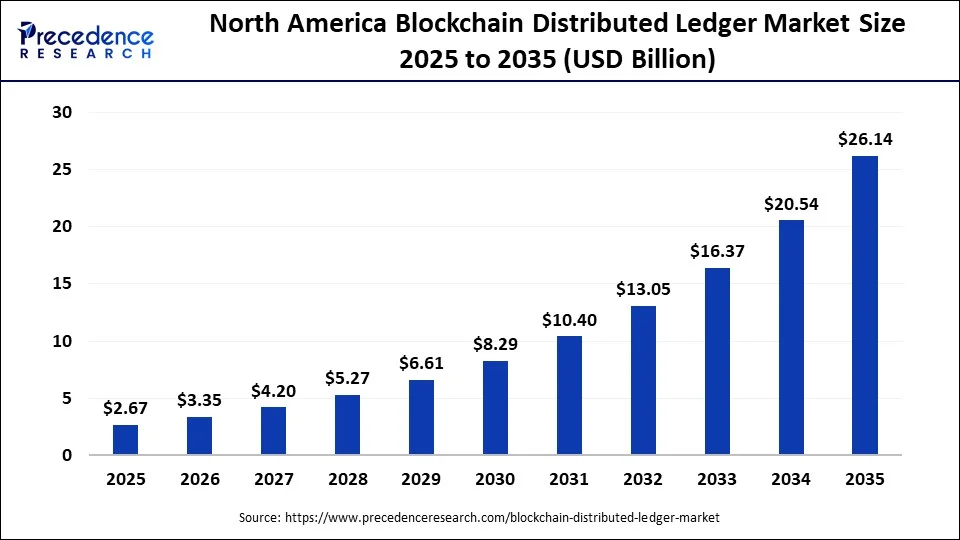
The North America blockchain distribution ledger market size is estimated at USD 2.67 billion in 2025 and is projected to reach approximately USD 26.14 billion by 2035, with a 25.63% CAGR from 2026 to 2035.
Why Does North America Dominate the Blockchain Distributed Ledger Market?
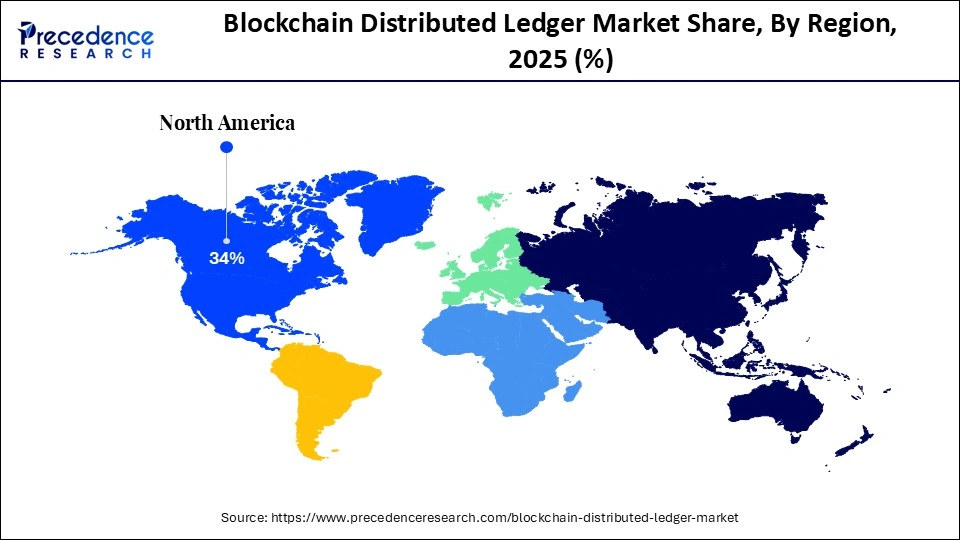
North America dominated the blockchain distribution ledger market with a market share of 34% in 2025. There are large investments in the start-ups doing blockchain-related work that make a difference among other activities that underpin growth and development in the region, also its good institutional rules, and demand for safe, transparent transactions in a variety of industries. North America is particularly committed to blockchain technology in terms of how deeply it has penetrated local fintech, cross-border payments, and projects of decentralized identity building. Venture capital investment, heavy concentration of developer talent, and enterprise-level product development trials have made North America the first-tier location for blockchain protocols as well as an enterprise-ready solution platform.
U.S. Blockchain Distribution Ledger Market Size and Growth 2026 to 2035
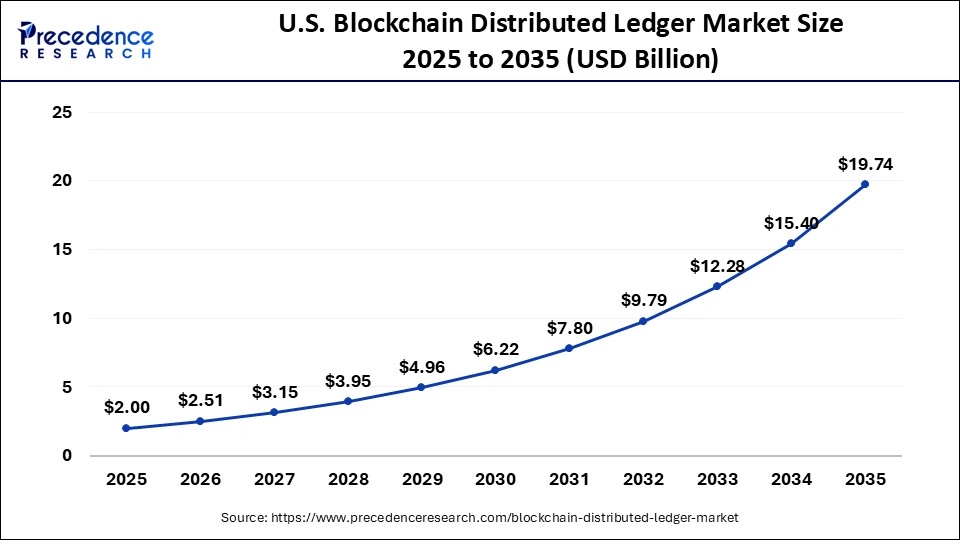
The U.S. blockchain distribution ledger market size is calculated at USD 2.00 billion in 2025 and is expected to reach nearly USD 19.74 billion in 2035, accelerating at a strong CAGR of 25.73% between 2026 and 2035.
U.S. Distribution Ledger Market analysis
The United States grows rapidly with capital market development in its key geographies and early involvement in the blockchain technology by institutional players, America could see that growth quick track. And particularly decentralized finance (DeFi). Clarity in regulations is increasingly taking hold, driving experimentation even further. In practice, American firms are shoring up their uses tokenized assets, smart contract architectures, for example, rather than theoretical projects. Wall Street firms are collaborating with distributed ledger technology providers to drive innovations in settlement processes. Instead of speculation, that makes the U.S. one of the hotbeds of blockchain research and enterprise implementations.
Asia-Pacific Market analysis
The Asia-Pacific is expected to grow rapidly in the blockchain distributed ledger market in the forecast period of 2026 to 2035. This growth is motivated by escalating tech investments, a strong startup ecosystem, and government moves toward digital transformation. Applications of blockchain across this region are diverse, from providing the traceability of supplies at the manufacturing level to digital identities for use in governmental and other applications. As the mobile penetration rates explode and the networks of young developers grow, so does the living ecosystem. Blockchain is the cornerstone of fully digitalized innovation, not the outgrowth of niche experimentation across other areas of innovation; this is what it has led to.
China
Because the national strategy directly incorporates distributed ledgers into systems for digital currency and governance, China's advanced use of blockchain technology accelerates even more. Investments for innovation technology are always directed at these areas. China is incorporating blockchain into infrastructure projects, from pilot projects for sovereign digital currencies to consortia focused on smart logistics. Public crypto markets here fundamentally vary from those in Western nations, but enterprises and government entities are using the ledger systems for supply chain management, finance, and identity verification at a pace of one of the fastest rates across the globe.
How will Europe be considered Notable Growth in the Blockchain Distributed Ledger Market?
Europe is experiencing notable growth in the global market, primarily driven by proactive regulation, substantial institutional adoption, and strong public sector support for infrastructure projects, particularly in Germany and the UK. The implementation of the Markets in Crypto-Assets regulation provides a harmonized, secure, and compliant legal environment across EU member states. This regulatory clarity fosters trust and attracts institutional investors with financial assets, making transactions faster, cheaper, and more secure.
Germany Market Trends
Germany established itself as a leading regulated Distributed Ledger Technology hub, creating a token economy that combines robust industrial expertise with advanced financial practices. BaFin is paving the way by enforcing EU regulations like MiCAR and DAC8 tax reporting, ensuring secure, enterprise-grade blockchain applications and automated supply chains with decentralized technologies.
How will Latin America Emerge in the Blockchain Distributed Ledger Market?
Latin America is expected to grow significantly in the coming years, driven by high inflation, the need for efficient cross-border payments, and increasing regulatory maturity. In countries facing high inflation and currency depreciation, such as Argentina and Venezuela, residents and businesses are turning to stablecoins as a secure, dollar-denominated store of value. With a large unbanked population, blockchain-based financial services (DeFi) provide access to capital and secure payments that traditional banking systems cannot offer.
Brazil Market Trends
Brazil is establishing itself as a key Regional RWA Tokenization Hub, moving towards institutional-grade adoption through B3's upcoming tokenization platform, the widespread use of the Meli Dolar stablecoin, and new stringent regulations from the Central Bank for VASPs. This shift is further solidified by advanced government analytics to monitor blockchain transactions and a strong regulatory framework for virtual asset providers.
How will the Middle East and Africa Grow in the Blockchain Distributed Ledger Market?
The Middle East and Africa are experiencing significant growth in the global market, primarily due to strong government initiatives, the need for financial inclusion, and rapid digitization across various sectors. Governments in the UAE and Saudi Arabia are actively adopting blockchain technology to enhance the efficiency of public services and aim to become global hubs for the Web. Blockchain is being extensively used to increase transparency in agriculture, oil, and mineral supply chains, combating fraud in sectors like logistics, with higher adoption in banking, finance, and healthcare.
Saudi Arabia Market Trends
Saudi Arabia is quickly evolving into a global blockchain powerhouse. The Kingdom is aggressively implementing decentralized technology, engaging in CBDC trials until 2026, developing the NEOM digital identity ecosystem, and establishing a new Tokenization Center of Excellence in Al Khobar, thus solidifying its commitment to a diversified digital economy.
Blockchain Distributed Ledger Market Companies
- Accenture PLC
- Amazon Web Services Inc
- Chain Inc.
- Microsoft Azure
- Auxesis Services & Technologies Ltd.
- Digital Asset Holdings LLC
- Huawei Technologies Co. Ltd.
- Intel Corporation
- International Business Machines Corporation
- Distributed Ledger, Inc.
- iXLedger
- NTT DATA Corporation (The Nippon Telegraph and Telephone Corporation)
- Visa Inc.
Recent Developments
- In September 2025, SWIFT (BE) revealed plans to implement a blockchain-based shared ledger across the global payments infrastructure that will enable 24/7 real-time global transactions with over 30 financial institutions. The ledger will also record, validate, and sequence transactions using smart contracts, linking old systems for interoperability together with tokenized value rails. (Source: https://www.swift.com)
- In February 2026, the UK government chose HSBC Orion (UK) as the platform for its Digital Gilt Instrument (DIGIT) pilot initiative, a cutting-edge sovereign bond tokenization system built on distributed ledger technology. This pilot applies a blockchain-based approach to the issuance, settlement, and lifecycle processing of government debt, and focuses on developing the infrastructure of the capital market and boosting transparency. (Source: https://www.domain-b.com)
- In October 2025, the Blockchain Distributed Ledger Market is gaining relevance in emerging economies-notably up to 2033-due to demand for decentralized data security, lower operational costs, and other real-world applications in payments, supply chain management, and smart contracts-research from Report Ocean via Taiwan News. AI, IoT, and DeFi were among the other major adoption accelerators.(Source: https://www.taiwannews.com.tw)
Segments Covered in the Report
By Application
- Smart Contracts
- Cryptocurrency
- Supply Chain Management
- Compliance Management
- Trade Finance
By Ledger Type
- Permissioned (Private Blockchain)
- Permissionless (Public Blockchain)
- Hybrid
By Deployment
- Cloud
- On Premise
By Region
- North America
- Europe
- Asia-Pacific
- Latin America
- Middle East & Africa
For inquiries regarding discounts, bulk purchases, or customization requests, please contact us at sales@precedenceresearch.com
Frequently Asked Questions





Ask For Sample
No cookie-cutter, only authentic analysis – take the 1st step to become a Precedence Research client
 Get a Sample




 sales@precedenceresearch.com
 Schedule a Meeting
