



Border Security Technologies Market Trends, Companies, Contract Wins / Project Pipeline, Defense Contracts, Procurement Volume, Government Spending, Production Capacity, Competitive Positioning, and Growth Outlook
Border Security Technologies Market (By Technology Type: Surveillance Systems, Biometric Identification Systems, Detection & Sensor Technologies, Communication & Command Systems, Cybersecurity for Border Infrastructure; By Surveillance Platform: Ground-Based Surveillance, Aerial Surveillance, Satellite-Based Surveillance, Mobile Surveillance Units; By Detection Technology: Radar Systems, Seismic Sensors, Motion & Acoustic Sensors, Chemical & Biological Detection; By Biometric Technology: Fingerprint Recognition, Facial Recognition, Iris Recognition, Voice Recognition; By Application: Immigration & Border Control, Counter-Terrorism, Search & Rescue Operations; By End-User: Government Border Security, Defense & Military Forces, Law Enforcement Agencies, Customs & Immigration Authorities, Coast Guards) - Global Industry Analysis, Size, Trends, Leading Companies, Regional Outlook, and Forecast 2026 to 2035
Source: https://www.precedenceresearch.com/border-security-technologies-market
 Get a Sample
 Table Of Content


What is the Border Security Technologies Market Size?
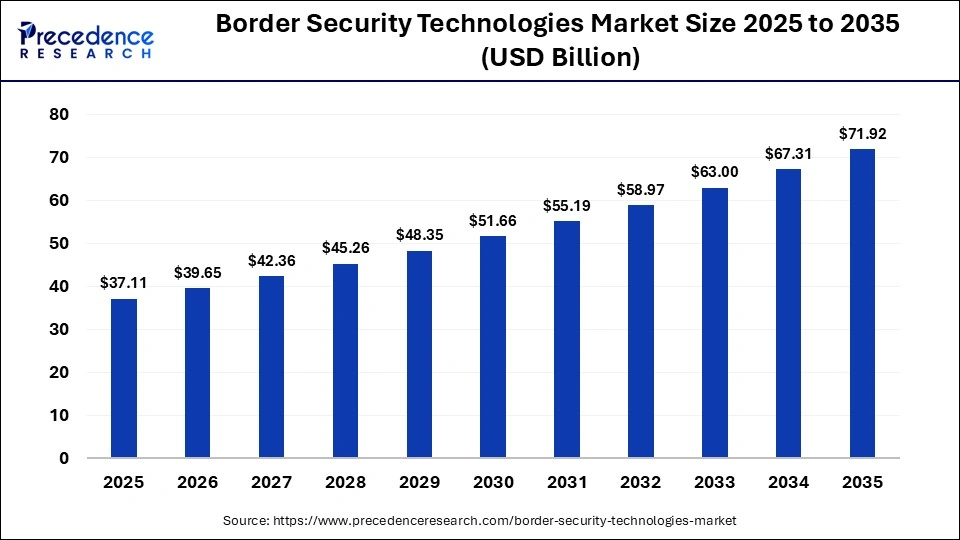
The global border security technologies market size is predicted to increase from USD 39.65 billion in 2026 to approximately USD 71.92 billion by 2035, expanding at a CAGR of 6.84% from 2026 to 2035. The global border security technologies market is witnessing substantial growth due to AI, advanced sensors like cameras, drones, radars, and edge computing, demanding powerful, efficient processors for real-time threats like unauthorized crossings, smuggling, and terrorism. These systems use specialized chips for video analytics, biometric identification, and predictive patrolling, pushing innovation in autonomous surveillance and data fusion for comprehensive security.
Market Highlights
- North America led the global market with the largest market share of 39% in 2026.
- Asia Pacific is expected to witness the fastest CAGR from 2026 to 2035.
- By technology type, the surveillance systems segment held a major market share in 2026.
- By technology type, the AI & data analytics platforms segment is expected to grow at the fastest CAGR in the border security technologies market from 2026 to 2035.
- By surveillance platform, the ground-based surveillance segment led the market in 2026.
- By surveillance platform, the aerial surveillance (UAVs) segment is expected to witness the fastest CAGR from 2026 to 2035.
- By detection technology, the radar systems segment held a major market share in 2026.
- By detection technology, the infrared & thermal imaging segment is expected to grow with the highest CAGR from 2026 to 2035.
- By biometric technology, the facial recognition segment held a major market share in 2026.
- By biometric technology, the iris recognition segment is expected to expand rapidly from 2026 to 2035.
- By application, the immigration & border control segment led with the largest border security technologies market share in 2026.
- By application, the counter-terrorism segment is expected to gain the fastest CAGR from 2026 to 2035.
- By end-user, the government border security agencies segment dominated the market in 2026.
- By end-user, the coast guards segment is expected to show the fastest growth over from 2026 to 2035.
What are Border Security Technologies?
The global border security technologies market includes advanced systems, platforms, equipment, and digital solutions deployed to monitor, detect, prevent, and respond to cross-border threats and illegal activities. These technologies are used across land borders, coastal regions, airports, seaports, and remote frontier areas to enhance national security, immigration control, customs enforcement, and counter-terrorism operations. The market integrates surveillance, biometric identification, communication systems, command & control platforms, AI-based analytics, unmanned systems, and cyber-physical security solutions.
How does AI transform the Border Security Technologies Market?
Artificial intelligence (AI) is transforming the global market by providing real-time, autonomous threat detection, predictive analytics for high-risk movements, and efficient data analysis from diverse sources, creating smarter, faster defenses. Additionally, AI analyzes live video, thermal, and sensor data to detect anomalies, identify unauthorized crossings, and distinguish threats from authorized personnel, reducing false alarms. By processing vast datasets, AI predicts migration flows and potential security risks, enabling proactive deployment for comprehensive situational awareness and faster decision-making, creating intelligent defense networks.
Border Security Technologies Market Overview
- Industry Growth Overview: The market is poised for strong growth from 2026 to 2035. This growth is primarily driven by escalating geopolitical tensions, increasing cross-border illegal activities such as human trafficking and smuggling, and significant government investments in modern surveillance and integrated border management solutions.
- Integration of AI and Autonomous Systems: This major trend creates smarter, data-driven, and proactive security frameworks. This shift is moving the industry from traditional, manpower-intensive monitoring toward an intelligent, automated, and interconnected defense ecosystem, improving situational awareness across land, sea, and air domains.
- Global Expansion: The global market is expanding rapidly, with North America and Asia-Pacific leading in investments and adoption. The Asia-Pacific region, in particular, is the fastest-growing market due to rising defense budgets and territorial disputes, while Europe, Latin America, and the Middle East and Africa are also emerging markets.
- Major Investors: Governments and major defense and aerospace corporations focus on large-scale government contracts and R&D. Many corporations include Lockheed Martin, Northrop Grumman, BAE Systems, Thales Group, Elbit Systems, and General Dynamics to maintain a competitive edge.
- Startup Ecosystem: Many defense contractors dominate, and a vibrant startup ecosystem is focusing on niche, disruptive innovations. Companies like Dedrone specialize in counter-drone technologies, securing significant funding to address evolving aerial threats to enhance existing infrastructure.
Segmental Insights
Technology Type Insights
Which Technology Type Segment Dominated the Border Security Technologies Market?
The surveillance systems segment dominated the market in 2026, mainly because of the integration of advanced technologies like AI, ML, and unmanned systems, which offer real-time situational awareness and enhanced threat detection across large and difficult terrains. These systems enhance detection accuracy, enable predictive analysis, and decrease the need for constant human oversight. Surveillance tools, such as high-performance radars, thermal imaging, and cameras, can identify unauthorized crossings and suspicious activities that traditional methods might miss, thereby boosting security.
The AI & data analytics platforms segment is expected to grow the fastest, primarily because these technologies shift monitoring from traditional, human-heavy methods to a more efficient, proactive, and data-driven security approach. They address the increasing complexity and volume of modern border threats by incorporating data from various sensors into a unified real-time picture, enabling quick detection of anomalies and threats. These systems also automate labor-intensive tasks, reducing manual effort and accelerating processing at legal entry points.
Surveillance Platform Insights
How the Ground-Based Surveillance Segment Led the Border Security Technologies Market?
The ground-based surveillance segment led the market in 2026 because land borders require extensive deployments of sensors, smart fences, AI-powered towers, and radar to prevent illegal crossings, smuggling, and infiltration. Since many nations have large land borders, ground surveillance is the main defense against illegal immigration and cross-border crime. Countries with porous borders, such as India, China, and the U.S., invest heavily in ground systems like radars and smart walls to bolster physical security, providing better situational awareness and faster responses.
The aerial surveillance (UAVs) segment is expected to experience the fastest growth. This is mainly because unmanned systems offer many operational and cost benefits over traditional manned platforms. They are also more affordable to purchase, operate, and maintain compared to helicopters or fixed-wing aircraft, making advanced aerial surveillance accessible to a wide range of countries and agencies. The rapid integration of cutting-edge technologies allows UAVs to autonomously detect threats, analyze data, and send alerts, significantly speeding up decision-making and accuracy.
Detection Technology Insights
Which Detection Technology Segment Dominated the Border Security Technologies Market?
The radar systems segment held a major revenue share of the market in 2026 due to its unmatched long-range, all-weather, 24/7 surveillance capabilities. Unlike cameras, radar functions effectively in darkness, fog, rain, or smoke, providing reliable detection regardless of conditions. They enable early threat detection and wide-area monitoring, making them essential for border security. Modern systems such as phased-array and synthetic aperture radar provide high-resolution imaging and target differentiation, allowing quick responses to incursions and trafficking.
The infrared & thermal imaging segment is experiencing the fastest market growth due to its ability to see in complete darkness and adverse weather conditions. High demand for 24/7 surveillance, AI integration for automated threat detection, and decreasing costs all contribute to this growth. Advanced thermal systems, including cooled detectors for longer-range identification, enhance situational awareness and improve overall effectiveness.
Biometric Technology Insights
Why Did the Facial Recognition Segment Dominate the Border Security Technologies Market?
The facial recognition segment held the largest market share in 2026, mainly due to its unmatched speed, accuracy, and efficiency in identity verification at e-gates and checkpoints. Leveraging AI and ML for threat detection enables seamless passenger flow. They integrate with e-passports, strengthening national security and handling high-volume travel compared to traditional methods despite ongoing privacy issues. This technology meets the demand for contactless solutions, especially after the pandemic, improving the passenger experience.
The iris recognition segment is expected to witness the fastest growth because of its unmatched uniqueness and stability. It is inherently contactless and integrates seamlessly with large-scale government ID programs and travel initiatives, driven by terrorism threats and digital identity needs. Since iris patterns are highly unique and remain stable over a lifetime, they are highly reliable for identity verification, reducing false positives and improving overall system dependability.
Application Insights
Which Application Segment Dominated the Border Security Technologies Market?
The immigration & border control segment held a dominant market share in 2026, fueled by increasing global migration, terrorism fears, and smuggling activities. This has led to significant government investments in biometric technologies such as facial recognition, fingerprints, and AI-powered surveillance like drones and cameras, along with automated e-gates for efficient identity checks at land, sea, and air ports. Airports, in particular, are the primary end users, leveraging real-time threat detection, predictive analytics, and automated data analysis to enable proactive security.
The counter-terrorism segment is expected to have the fastest growth. This is mainly because evolving threats demand advanced solutions, driving the adoption of AI, biometrics, sensors, and drones for proactive detection, faster identification, and integrated surveillance, moving beyond traditional barriers. AI-powered analytics, facial recognition, and automated systems detect anomalies, track movements, and speed up processing, crucial for counter-terrorism, and push nations to invest heavily in technology for comprehensive threat mitigation.
End-User Insights
How the Government Border Security Agencies Segment Dominated the Market?
The government border security agencies segment dominated the border security agencies market in 2026. This is mainly due to the higher demand for integrated, advanced solutions like radar, surveillance systems, drones (UAVs), and biometrics, focusing on comprehensive land, aerial, and maritime monitoring to combat illegal trafficking, terrorism, and migration. Governments seek holistic systems combining surveillance like radar, thermal detection, command & control, and communication for end-to-end monitoring.
The coast guards segment is expected to experience the fastest growth during the forecast period. This is mainly due to escalating maritime threats, increased maritime trade, and geopolitical tensions, driving demand for advanced technologies for enhanced situational awareness, quicker response in search and rescue, and comprehensive offshore security, especially with growing investments in modernization and unmanned systems. Drones and satellite tech improve speed and efficiency in SAR operations, for surveillance and reconnaissance.
Regional Insights
How Big is the North America Border Security Technologies Market Size?
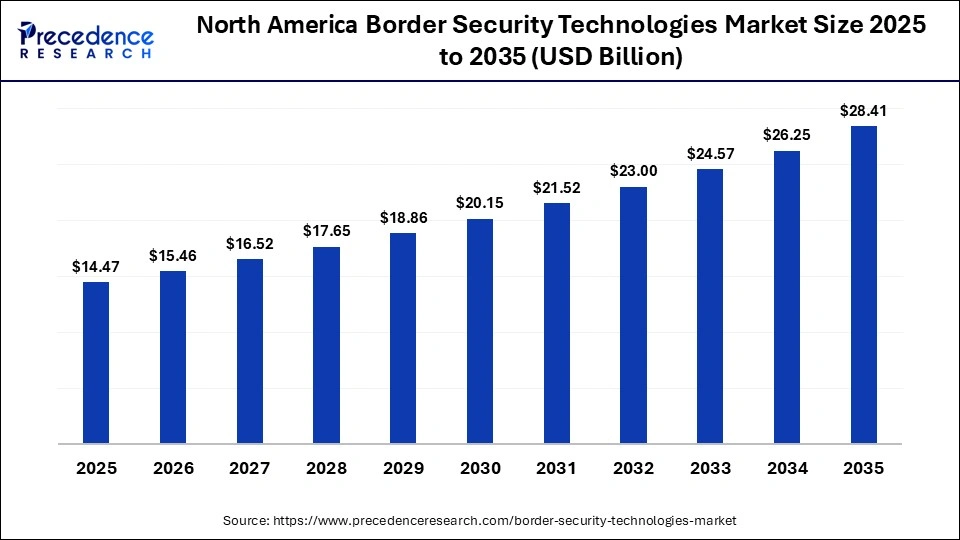
The North America border security technologies market size is estimated at USD 15.46 billion in 2026 and is projected to reach approximately USD 28.41 billion by 2035, with a 6.98% CAGR from 2026 to 2035.
How North America Dominated the Border Security Technologies Market?
North America dominated the global market in 2026, due to significant government investments, extensive border protection needs, strong local technological innovation, and ongoing security challenges, such as illegal immigration and human trafficking. This dominance is further supported by a demand for advanced solutions, including AI surveillance, radar systems, and UAVs. The region is home to major defense contractors like Lockheed Martin and Northrop Grumman. Governments prioritize integrated systems, smart borders, and AI-driven threat detection to enhance situational awareness and standardize technology adoption.
What is the Size of the U.S. Border Security Technologies Market?
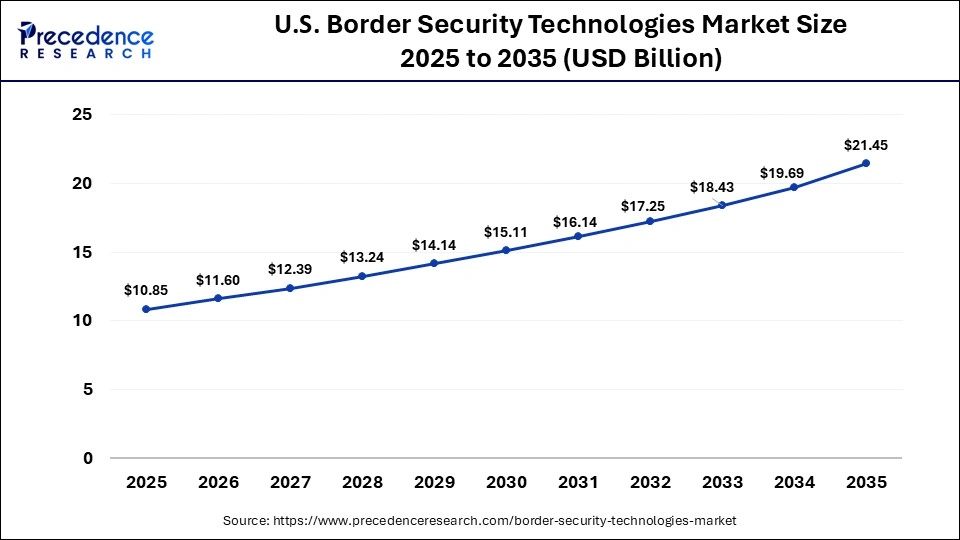
The U.S. border security technologies market size is calculated at USD 11.60 billion in 2026 and is expected to reach nearly USD 21.45 billion in 2035, accelerating at a strong CAGR of 7.05% between 2026 and 2035.
The U.S. Border Security Technologies Market Trends
The U.S. is the dominant player in the global market, largely due to high defense spending, a substantial defense industry, and significant border management requirements. The Science & Technology Directorate (S&T), a U.S. government body, invests in border security research and development for technologies and provides solutions to prevent illicit movement.
Will Asia Pacific Grow in the Border Security Technologies Market?
Asia-Pacific is expected to host the fastest-growing market in the coming years. This growth is driven by increasing geopolitical tensions, substantial government defense spending, and rapid technological advancements such as AI and unmanned systems. Countries like China, India, Japan, and South Korea are allocating significant portions of their budgets to modernize their defense and homeland security infrastructure. The region faces numerous territorial disputes, including those in the South China Sea and along the India-Pakistan and India-China borders, aimed at protecting national sovereignty and mitigating cross-border threats.
India Border Security Technologies Market Trends
India is also a rapidly growing market, driven by significant national security challenges such as cross-border terrorism and smuggling along its extensive and varied borders. India is heavily investing in smart fencing, integrated surveillance systems, drones, and AI-powered analytics for real-time threat detection, alongside satellite surveillance to achieve situational awareness in challenging terrains, focusing on developing cost-effective and tailored solutions that meet specific operational requirements.
How is Latin America Growing in the Border Security Technologies Market?
Latin America is expected to grow at a notable CAGR in the foreseeable future. The transformation of soldiers is receiving importance in the region to manage readiness among the military forces. To update the soldiers, the acquisition of high-level electronics for high-level border security is at a high rise. The official acceptance of body-worn cameras is developing quickly among the Brazilian defense forces, and a greater acceptance of body-worn electronics and cameras is pushing the urge for a high-level camera system. Such factors are driving the development of the border security industry in this region.
Brazil Market Trends
Brazil's Integrated Border Monitoring System is an innovative and step-by-step defense program tracked by the Brazilian Army. They are crafted to develop operational control and border security present across Brazil's huge land borders. SISFRON is one of the biggest and most passionate border surveillance initiatives. SISFRON is one of Brazil's Defense visionary projects made to assist the country's National Defense Strategy (END).
Which Factors Drive the Border Security Technologies Market in Europe?
Europe is expected to grow at a considerable CAGR in the upcoming period. The European Union has officially accepted current surveillance technology, which includes drone monitoring and facial recognition technology (FRT) to develop huge security. Such technologies develop basic rights challenges, but they can also classify travelers smoothly and check unauthorized crossings. This technology of facial recognition systems and unaligned aerial drones has transformed from unchecked crossings.
Germany Market Trends
The country's step-by-step position inside the Schengen Area and its respective role are tracking external EU borders, which are present in the urge for standard surveillance systems. Germany's funding concentrates on multi-layered security designs, which include sensor networks, radar, and cyber tracking for illegal shifting and multinational threats. Regulatory assistance from EU border policies and developed investments for the security modernization facilitates development.
Border Security Technologies Market Value Chain Analysis
Who are the Major Players in the Global Border Security Technologies Market?
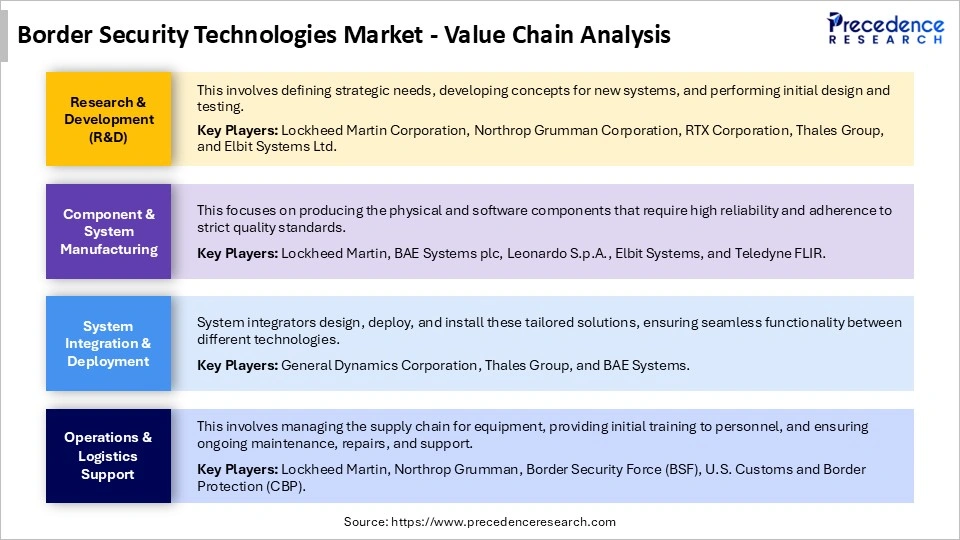
The major players in the border security technologies market include Lockheed Martin, Northrop Grumman, BAE Systems, General Dynamics, Thales Group, RTX Corporation, Elbit Systems, L3Harris Technologies, Airbus, Leonardo S.p.A., Teledyne FLIR, Saab AB, and Indra Sistemas.
Recent Developments in the Border Security Technologies Market
- In September 2025, Elbit Systems Ltd. unveiled Frontier, a state-of-the-art wide-area persistent surveillance system designed to enhance border defense. The system autonomously detects and assesses threats using advanced AI, improving intelligence gathering across land, air, and maritime domains.
(Source: https://raksha-anirveda.com)
Border Security Technologies Market Segments
By Technology Type
- Surveillance Systems
- Biometric Identification Systems
- Detection & Sensor Technologies
- Communication & Command Systems
- AI & Data Analytics Platforms
- Cybersecurity for Border Infrastructure
By Surveillance Platform
- Ground-Based Surveillance
- Aerial Surveillance (Drones, UAVs)
- Satellite-Based Surveillance
- Mobile Surveillance Units
By Detection Technology
- Radar Systems
- Infrared & Thermal Imaging
- Seismic Sensors
- Motion & Acoustic Sensors
- Chemical & Biological Detection
By Biometric Technology
- Fingerprint Recognition
- Facial Recognition
- Iris Recognition
- Voice Recognition
By Application
- Immigration & Border Control
- Smuggling & Trafficking Prevention
- Counter-Terrorism
- Customs & Trade Security
- Search & Rescue Operations
By End-User
- Government Border Security Agencies
- Defense & Military Forces
- Law Enforcement Agencies
- Customs & Immigration Authorities
- Coast Guards
By Region
- North America
- Europe
- Asia-Pacific
- Latin America
- Middle East & Africa
For inquiries regarding discounts, bulk purchases, or customization requests, please contact us at sales@precedenceresearch.com
Frequently Asked Questions





Ask For Sample
No cookie-cutter, only authentic analysis – take the 1st step to become a Precedence Research client
 Get a Sample




 sales@precedenceresearch.com
 Schedule a Meeting
