



Air Cargo Security Screening Systems Market Trends, Companies, Contract Wins / Project Pipeline, Defense Contracts, Procurement Volume, Government Spending, Production Capacity, Competitive Positioning, and Growth Outlook
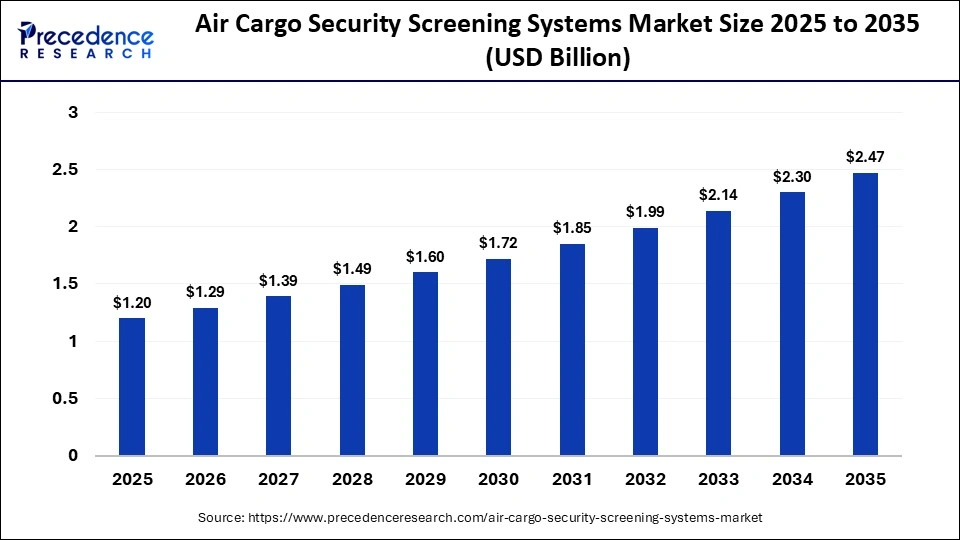
Gautam Mahajan, an Aerospace and Defence Industry Expert, identifies strong market momentum in the air cargo security screening systems market, which reached USD 1.29 billion in 2026 and is projected to attain USD 2.47 billion by 2035 at a CAGR of 7.50%. Major air cargo security screening systems market companies, including L3 Technologies, Smiths Detection, Rapiscan System, Bosch Security Systems, Nuctech Company Limited, CEIA S.p.A compete across critical segments such as By Product Type, By Technology, By Application, By End-Use.
Source: https://www.precedenceresearch.com/air-cargo-security-screening-systems-market
 Get a Sample
 Table Of Content


What is the Air Cargo Security Screening Systems Market Size in 2026?
The global air cargo security screening systems market size accounted for USD 1.20 billion in 2025 and is predicted to increase from USD 1.29 billion in 2026 to approximately USD 2.47 billion by 2035, expanding at a CAGR of 7.50% from 2026 to 2035. The air cargo security screening systems market is driven by rising air cargo volumes, concerns over cargo security, and the adoption of advanced screening technologies.
Key Takeaways
- Asia Pacific dominated the air cargo security screening systems market with a share of 35% in 2025.
- North America held the second-largest market share in 2025 and is expected to grow at a significant rate during the forecast period.
- By product type, the X-ray screening systems segment held a dominant position in the market with a share of 50% in 2025.
- By product type, the explosive detection systems segment is the second-largest shareholder and is expected to grow at a significant rate between 2026 and 2035.
- By technology, the air cargo screening systems segment accounted for a major share of 45% in 2025.
- By technology, the automated screening systems segment is the second-largest shareholder and is expected to grow at the fastest rate between 2026 and 2035.
- By application, the airlines segment led the global market with a share of 39.50% in 2025.
- By application, the freight forwarders segment is the second-largest shareholder and is expected to grow at a significant rate between 2026 and 2035.
- By end use, the airports segment led the global market in 2025.
- By end use, the cargo terminals segment is anticipated to witness the fastest growth during the forecasted years.
Market Overview
The air cargo security screening systems are high-end technologies used at airports to inspect and analyze cargo shipments for potential threats. These systems play a critical role in aviation security by detecting explosives, weapons, and hazardous materials that could endanger flight operations. Utilizing technologies such as X-ray imaging, computed tomography (CT), and AI-based threat detection, they help ensure the safe and efficient movement of goods across global air transport networks.
The air cargo security screening systems market is experiencing significant growth, driven by the rapid increase in global air passenger and cargo traffic, which demands robust and efficient security measures. Additionally, rising security concerns and the implementation of stringent aviation regulations across various countries are further accelerating the adoption of these systems.
How is AI Integration Impacting the Air Cargo Security Screening Systems Market?
Artificial intelligence is significantly revolutionizing the air cargo security screening systems market by greatly improving the detection systems, efficiency in the operations, and decision-making. AI-based algorithms allow automated detection of threats based on the analysis of complex imaging data of X-ray and CT scanners with great precision, and allow the detection of explosives, weapons, and dangerous materials. Also, the implementation of AI helps supplement real-time data analytics that enable security staff to evaluate risks faster and focus on inspections more efficiently. It is also capable of making a proactive maintenance forecast for screening equipment to reduce downtimes and provide uniform performance.
Air Cargo Security Screening Systems Market Trends
- The growing use of AI and machine learning in screening is increasing the accuracy of threat detection, allowing automated identification of suspicious cargo, decreasing human error, and significantly increasing the efficiency of operations at airports and cargo handling facilities around the world.
- Increasing investments in the modernization of airport infrastructure, particularly in emerging economies, are boosting the need for next-generation cargo screening systems that would support international security requirements and manage the growing volumes of air freight effectively and safely.
- The integration of automation and intelligent logistics systems with cargo screening technologies is streamlining operations. This integration reduces processing times, enables real-time monitoring, and provides data-driven insights for improved decision-making and risk management.
- Increasing emphasis on cost-effective and scalable security solutions is encouraging manufacturers to develop compact, energy-efficient, and easily deployable screening systems. These solutions can be adapted to airports of varying sizes and cargo capacities, ensuring broader accessibility and flexibility.
Market Scope
| Report Coverage | Details |
| Market Size in 2025 | USD 1.20 Billion |
| Market Size in 2026 | USD 1.29 Billion |
| Market Size by 2035 | USD 2.47 Billion |
| Market Growth Rate from 2026 to 2035 | CAGR of 7.50% |
| Dominating Region | Asia Pacific |
| Fastest Growing Region | North America |
| Base Year | 2025 |
| Forecast Period | 2026 to 2035 |
| Segments Covered | Product Type, Technology, Application, End-Use, and Region |
| Regions Covered | North America, Europe, Asia-Pacific, Latin America, and Middle East & Africa |
Market Dynamics
Drivers
Expansion of the Aviation and E-commerce Sectors
The rapid expansion of the aviation industry worldwide, alongside the enormous growth of e-commerce, is a significant factor driving the air cargo security screening systems market. Growth of air traffic has resulted in the growth of cargo volume as airlines and logistics organizations increase their services to handle international trade requirements. Simultaneously, the increase in online purchases has also increased air freight dramatically as consumers are demanding shorter delivery schedules of goods across borders. This necessitates the need to have effective, high-speed, and reliable cargo screening solutions to guarantee safety without suppressing supply chains.
Restraint
High Maintenance Cost and Evolving Security Threats
The high cost of maintaining security systems and the need for continuous upgrades are major factors that create barriers and limit the growth of the air cargo security screening systems market. The threats to air cargo are constantly changing, and security systems need to be changed regularly in order to identify new forms of explosives, weapons, and dangerous substances. This presents financial strain to the airport operators and the logistics companies because the advanced technologies usually come with high installation, training, and maintenance expenses. The ongoing need for innovation and system upgrades may limit adoption, especially in cost-sensitive areas.
Opportunity
Rising Demand for Advanced and Cost-Effective Screening Technologies
There is increasing demand for sophisticated and low-cost screening technologies as a result of growing security concerns, which is expected to create immense opportunities in the air cargo security screening systems market. New technologies like AI-assisted threat detection, automated screening devices, and small and energy-efficient devices are allowing more efficient and quicker inspections of cargo and lowering the operational expenses. They are becoming attractive to airports and logistics providers since such technologies can decrease human errors, increase the detection rate, and enhance efficiency. Also, the need to comply with international safety standards is stimulating the use of next-generation systems.
Segment Insights
Product Type Insights
Air Cargo Security Screening Systems Market Share, By Product Type, 2025-2035 (%)
| Product Type | 2025 | 2035 | CAGR(%) |
| X-ray Screening Systems | 50.00% | 47.00% | 6.50% |
| Explosive Detection Systems | 25.00% | 28.00% | 8.00% |
| Computed Tomography (CT) Systems | 15.00% | 18.00% | 10.00% |
| Other Screening Systems | 10.00% | 7.00% | 4.50% |
The X-ray Screening Systems Segment Held a 50% Share of the Market in 2025
The X-ray screening systems segment held a dominant position in the air cargo security screening systems market with a share of 50% in 2025, owing to their immense popularity, low cost, high efficiency, and reliability. These systems are widely deployed at airports and logistics centers because they have the capability to handle high-throughput cargo by scanning fast and detecting efficiently. The X-ray systems, which are both 2D and 3D, are easy to install into existing infrastructure. The segment's dominance is also reinforced by ongoing advances in X-ray screening systems, which have improved image quality and accuracy.
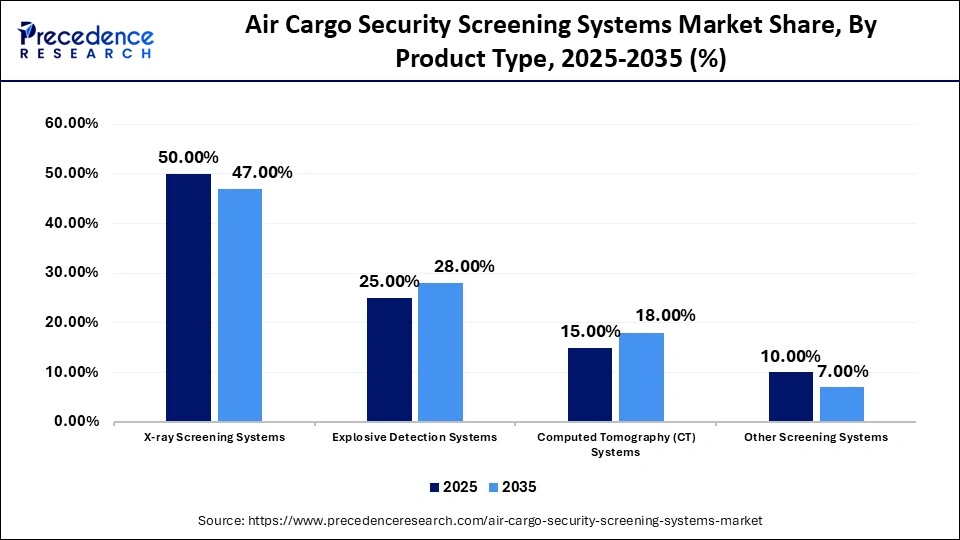
The explosive detection systems segment held a 25% share of the market in 2025 and is expected to grow at a significant rate in the coming years. This is because of the rising global security issues and increasingly stringent regulatory requirements. The rising threat of explosives and hazardous materials in air cargo has led to the adoption of more advanced detection technologies, including explosive trace detection (ETD) and liquid detection systems. These systems offer high sensitivity and precision, enabling the identification of even trace amounts of dangerous substances, thereby ensuring enhanced safety and security across air cargo operations.
The computed tomography (CT) systems segment held a 15% share of the market in 2025 and is expected to grow at the fastest rate during the projection period, owing to the high degree of imaging as well as enhanced threat detection capabilities. The ability to generate high-resolution 3D images allows for more accurate identification of complex and concealed threats within cargo shipments. Both single-view and multi-view CT systems are gaining traction as they improve screening accuracy and significantly reduce false alarm rates. These systems not only support stringent security standards but also enhance operational efficiency across air cargo screening processes.
Technology Insights
Air Cargo Security Screening Systems Market Share, By Technology, 2025-2035 (%)
| Technology | 2025 | 2035 | CAGR(%) |
| Air Cargo Screening Systems (ACS) | 45.00% | 43.00% | 6.80% |
| Automated Screening Systems (ASS) | 35.00% | 37.00% | 9.20% |
| Manual Screening Systems | 20.00% | 20.00% | 3.50% |
The Air Cargo Screening Systems Segment Dominated the Market in 2025
The air cargo screening systems segment dominated the air cargo security screening systems market with a major share of 45% in 2025 as a result of the growing security needs at airports, along with the growing cargo volumes. The rising demand for comprehensive screening across international supply chains has led to the widespread adoption of ACS solutions in airports and logistics hubs worldwide. These systems support both manual and automated screening processes, offering operational flexibility to accommodate varying security and throughput requirements.
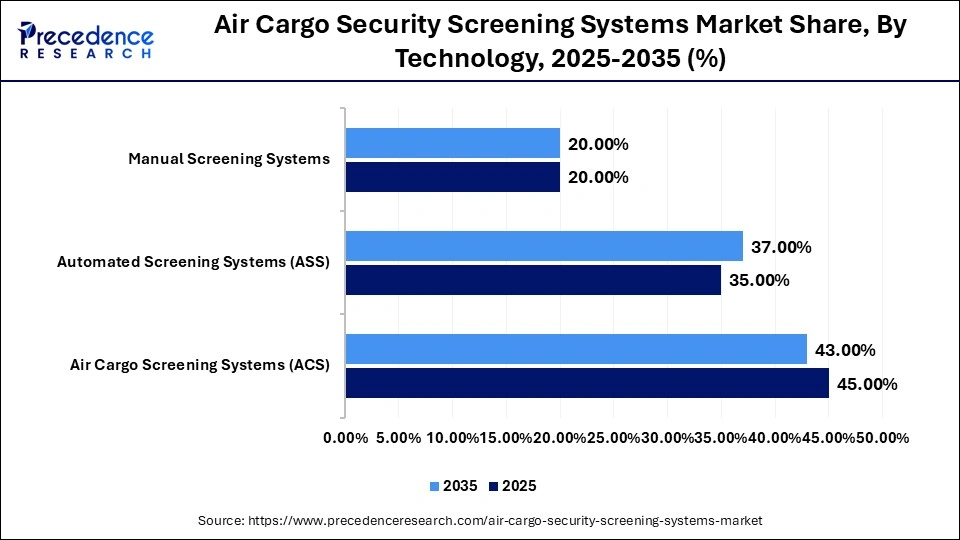
The automated screening systems segment was the second-largest shareholder, holding a 35% share of the market in 2025, and is expected to grow at the fastest rate over the forecast period. This growth is driven by the increasing demand for faster and more efficient cargo screening solutions. Rising air freight volumes and the need to reduce processing times are prompting airports and logistics hubs to adopt advanced automated systems, including inline and stand-alone screening solutions. These systems minimize human intervention, enhance detection accuracy, improve throughput, and maintain high levels of security.
The manual screening systems segment held a 20.00% share of the market in 2025 due to their cost-effectiveness and ease of use. These systems are widely used in smaller airports and regional cargo centers, where lower initial investment requirements and simpler implementation processes make them a practical choice. Traditional and hybrid manual screening solutions continue to provide essential, baseline security capabilities in environments where advanced technologies may not be feasible.
Application Insights
Air Cargo Security Screening Systems Market Share, By Application, 2025-2035 (%)
| Application | 2025 | 2035 | CAGR(%) |
| Airlines | 39.50% | 37.50% | 7.20% |
| Freight Forwarders | 25.00% | 26.00% | 8.00% |
| Ground Handling | 15.00% | 18.00% | 9.50% |
| Logistics Providers | 10.00% | 12.00% | 10.50% |
| Other Applications | 10.50% | 6.50% | 4.00% |
Why Did Airlines Lead the Air Cargo Security Screening Systems Market?
The airlines segment led the market by holding a share of 39.50% in 2025 as a result of the rapid expansion of international airlines and cargo transit businesses. As the volume of passenger traffic and international trade has increased, airlines are under increasing pressure to ensure both the safety and security of cargo while maintaining operational efficiency. The adoption of advanced screening technologies, such as X-ray systems, computed tomography (CT), and explosive detection systems, enables airlines to effectively identify potential threats, minimize delays, and enhance overall confidence in both passenger and cargo operations.
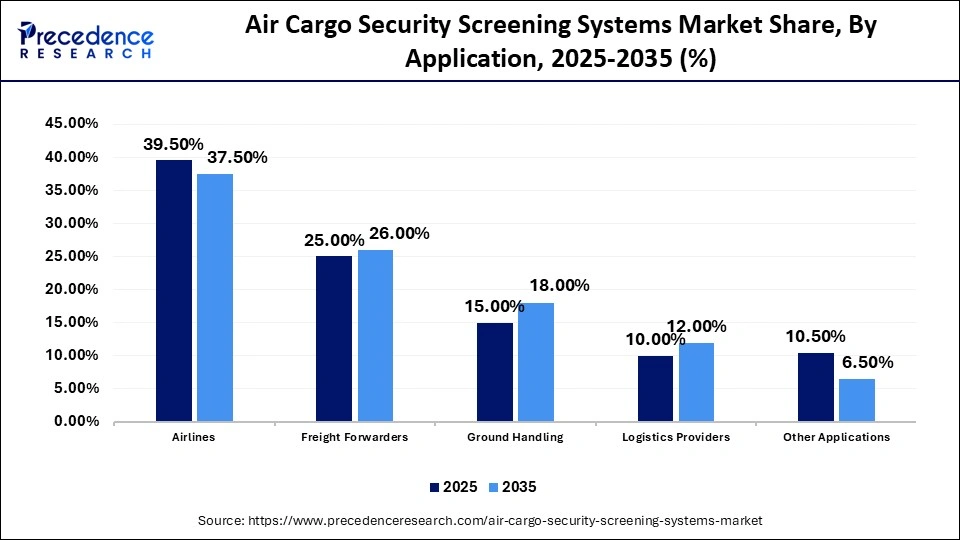
The freight forwarders segment held a 25% share of the market in 2025 due to increased investments in advanced cargo screening systems to comply with stringent international security regulations and ensure safe cross-border shipments. Additionally, the rapid growth in global trade and e-commerce has led freight forwarders to adopt automated and trace detection technologies to handle high shipment volumes efficiently.
The ground handling segment held a 15% share of the market in 2025, as more cargo terminal operators and airport cargo handlers implement automated and sophisticated screening systems. Ground handling operations are moving toward inline and standalone screening technology to enhance the accuracy of detection and efficiency in operations. Also, the increasing air freight volumes demand quicker, more trustworthy screening solutions at the airports to avoid delays and make sure that the global security standards are met.
The logistics providers segment held a 10% share of the market in 2025, driven by the increasing adoption of advanced air cargo screening solutions amid the rapid growth of e-commerce. Rising shipment volumes and growing customer expectations for faster deliveries are key factors contributing to segmental growth. As a result, logistics providers are investing in automated and AI-enabled screening systems to ensure secure, efficient, and timely cargo handling.
End-Use Insights
The Airports Segment Led the Air Cargo Security Screening Systems Market?
The airports segment led the market with the largest revenue share in 2025 because of the necessity of efficient and secure operations in airways. As the airport operations keep getting complicated, international and regional airports are moving toward the use of advanced controllers to streamline passenger traffic, control vital systems, and offer operational safety. Airports handle millions of passengers and massive air cargo every year, boosting the need for advanced automation and monitoring systems to meet stringent regulatory and operational requirements.
The cargo terminals segment is anticipated to witness the fastest growth during the forecast period due to the increasing global trade and e-commerce growth. Freight and express cargo terminals are implementing advanced control systems to enhance operational efficiency, optimize cargo handling, and improve system reliability. These solutions support real-time tracking, automated cargo movement, and effective management of complex logistics networks.
The customs and border protection segment is expected to grow at a significant CAGR over the forecast period due to the rising security and regulatory demands at borders. With the high level of scrutiny that is being set up on goods, passengers, and cargo, there is increasing use of automated solutions to ensure security and streamline operations. Automated control solutions help agencies monitor goods, passengers, and cargo efficiently, ensuring compliance with international trade laws and facilitating smooth workflows while managing high volumes of cross-border shipments.
Region Insights
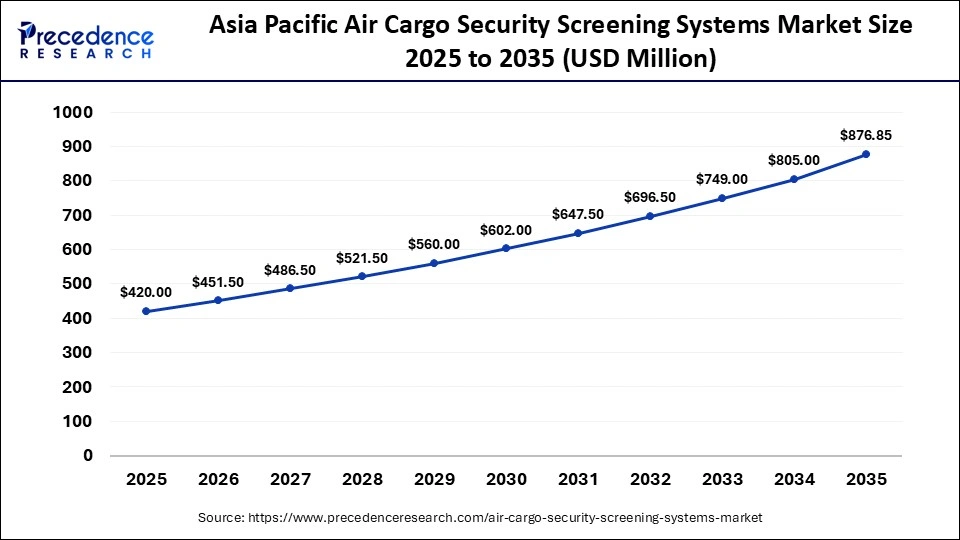
Asia Pacific Air Cargo Security Screening Systems Market Size and Growth 2026 to 2035
The Asia Pacific air cargo security screening systems market size is expected to be worth USD 876.85 million by 2035, increasing from USD 420.00 million by 2025, growing at a CAGR of 7.64% from 2026 to 2035.
Why Did Asia Pacific Lead the Air Cargo Security Screening Systems Market?
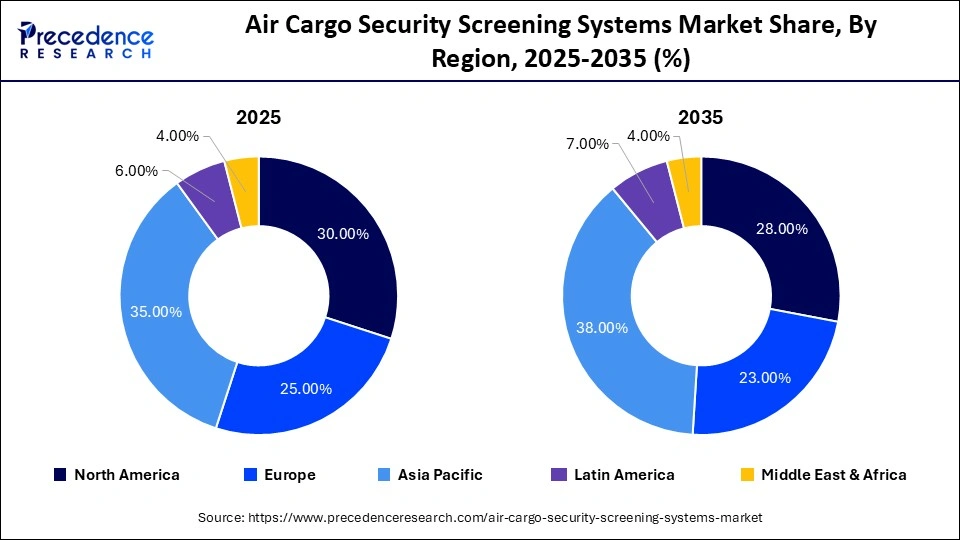
Asia Pacific dominated the air cargo security screening systems market by holding a 35% share in 2025 and is expected to continue its leadership over the forecast period. This is because of the rapid expansion of air cargo operations and the increasing need for regulatory compliance in developing economies. Rising trade activities, booming e-commerce, and growing passenger and freight volumes are prompting significant upgrades to airport security infrastructures. Governments and aviation authorities are investing heavily in advanced screening technologies to enhance operational efficiency while maintaining stringent security standards. The proliferation of low-cost carriers and regional cargo centers further supports the adoption of automated and scalable screening systems.
China Market Analysis
China is a rapidly growing market for air cargo security screening systems, driven by the expansion of air cargo networks, surging e-commerce, and evolving regulatory requirements. Major airports such as Beijing Capital, Shanghai Pudong, and Guangzhou Baiyun are upgrading their screening processes with advanced technologies, including X-ray systems, computed tomography (CT), and AI-enabled threat detection software, to manage high cargo throughput effectively. Security enhancements are closely monitored and regulated by the Civil Aviation Administration of China to ensure the safety of both passenger and cargo operations.
North America: The Second-Largest Market
North America was the second-largest shareholder of the market in 2025, holding a 30% share, owing to the region's highly developed aviation security policies, well-established infrastructure, and the presence of major international airports. Strict regulatory frameworks enforced by governments and security agencies, such as the Transportation Security Administration (TSA) in the U.S., require airports to deploy advanced cargo screening systems to ensure the safety of passengers and shipments. High passenger and freight volumes in the region have also driven demand for high-throughput, automated, and AI-powered screening solutions.
U.S. Market Analysis
The U.S. is the major contributor to the North American air cargo security screening systems market, supported by its sophisticated aviation infrastructure, stringent regulations, and large cargo volumes. Airports are mandated by the TSA to implement advanced screening technologies, including X-ray systems, computed tomography (CT), and explosive detection equipment, to maintain safety standards. Major international hubs, such as Atlanta, Los Angeles, and Chicago, process significant cargo volumes, further fueling the adoption of automated, high-throughput, and AI-enhanced screening systems.
How is the Opportunistic Rise of Europe in the Air Cargo Security Screening Systems Market?
Europe held a 25% share of the air cargo security screening systems market in 2025 and is expected to grow at a significant rate, driven by stringent aviation security regulations and the presence of major air cargo hubs across the region. European airports are required to deploy advanced screening technologies, including X-ray, computed tomography (CT), and explosive detection systems, to comply with mandates set by the European Union Aviation Safety Agency (EASA) and national authorities. Major cargo airports in Germany, France, and the Netherlands handle substantial volumes of freight, creating demand for efficient, automated, and reliable screening solutions.
Germany Market Analysis
The market in Germany is expanding, driven by its leading security regulations and prominent international airports. High-traffic airports such as Frankfurt, Munich, and Leipzig/Halle drive demand for advanced screening systems, including X-ray, CT, and automated explosive detection technologies. Serving both passenger and cargo operations, these airports require sophisticated solutions to meet EASA standards and international security requirements.
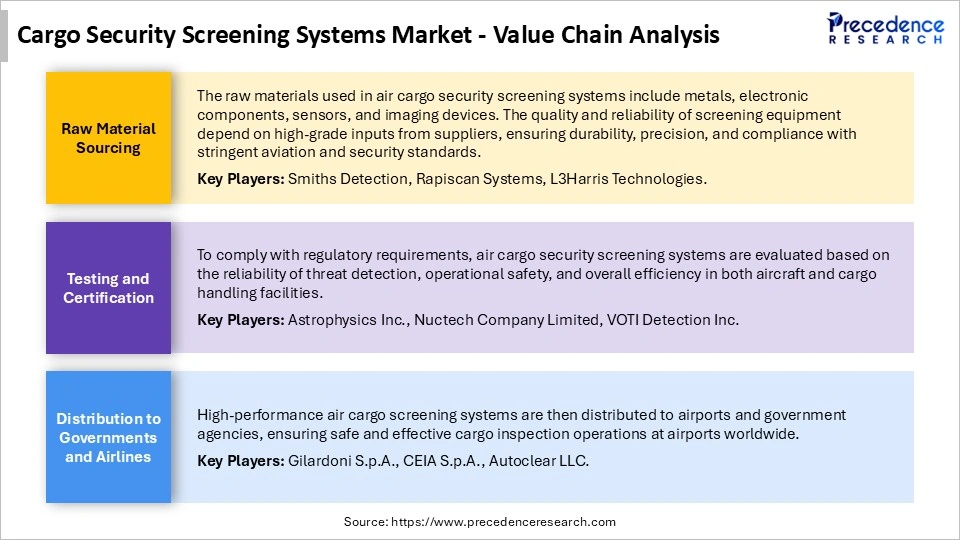
Cargo Security Screening Systems Market Value Chain Analysis
Air Cargo Security Screening Systems Market Companies
- L3 Technologies
- Smiths Detection
- Rapiscan System
- Bosch Security Systems
- Nuctech Company Limited
- CEIA S.p.A.
- Klaus Union
- Vanderlande
- Securitas AB
- Analogic Corporation
- American Science and Engineering
- Gilardoni S.p.A.
- Astrophysics Inc.
- Lödige Industries
- Aviapro
Recent Developments
- In February 2026, London Heathrow Airport (LHR) installed the next-generation CT-based screening technology in every passenger terminal, and thus, the airport became even more convenient and effective in operations. The upgrade allows passengers to pack liquids and electronics in their hand luggage when clearing through security check-ins.(Source: https://www.internationalairportreview.com)
- In December 2025, Dnata and Dubai Police introduced a new centralized screening control room in the cargo section at the Dubai International Airport (DXB), which is a customer of Dubai Police, a development that will be significant in terms of digitalizing the air cargo operations. The system consists of real-time automation together with improved security surveillance to realize high efficiency and surveillance.(Source: https://cargotrends.in)
- In October 2024, CHAMP Cargosystems launched a new sanctions interface service in Cargospot, which contained the workflow outcome of airline and handler third-party screening. This innovation will reduce the manual operations, but also better comply with the fluctuating international air cargo regulations.(Source: https://www.champ.aero)
Segments Covered in the Report
By Product Type
- X-ray Screening Systems
- 2D X-ray Systems
- 3D X-ray Systems
- Explosive Detection Systems
- Trace Detection Systems
- Explosive Detection Liquid
- Computed Tomography (CT) Systems
- Single-view CT Systems
- Multi-view CT Systems
- Other Screening Systems
- Passive Millimeter Wave Imaging Systems
- Automated Explosive Detection Systems
By Technology
- Air Cargo Screening Systems (ACS)
- Manual Screening
- Automated Screening
- Automated Screening Systems (ASS)
- Inline Systems
- Stand-alone Systems
- Manual Screening Systems
- Traditional Methods
- Hybrid Manual Systems
By Application
- Airlines
- Passenger Air Cargo
- Freight Air Cargo
- Freight Forwarders
- Logistics Companies
- Express Delivery Providers
- Ground Handling
- Cargo Terminal Operators
- Airport Cargo Handlers
- Logistics Providers
- Third-party Logistics
- Warehousing
- Other Applications
- Customs and Border Protection
- Military Applications
By End-Use
- Airports
- International Airports
- Regional Airports
- Cargo Terminals
- Freight Cargo Terminals
- Express Cargo Terminals
- Customs and Border Protection
- Others
By Region
- North America
- Latin America
- Europe
- Asia-pacific
- Middle and East Africa
For inquiries regarding discounts, bulk purchases, or customization requests, please contact us at sales@precedenceresearch.com
Frequently Asked Questions





Ask For Sample
No cookie-cutter, only authentic analysis – take the 1st step to become a Precedence Research client
 Get a Sample




 sales@precedenceresearch.com
 Schedule a Meeting
