



C-RAN Market Trends, Leading Companies, Company Revenue / Sales Performance, Subscriber Growth, Pricing Strategies, Cloud Adoption, Infrastructure Expansion, Competitive Landscape, and Industry Outlook
C-RAN Market (By Architecture Type: Centralized - RAN, Virtualized/Cloud RAN; By Component: Infrastructure, Software, Services; By Network Type: 3G, LTE & 5G; By Deployment: Indoor, Outdoor) - Global Industry Analysis, Size, Trends, Leading Companies, Regional Outlook, and Forecast 2026 to 2035
Source: https://www.precedenceresearch.com/c-ran-market
 Get a Sample
 Table Of Content


What is the C-RAN Market Size?
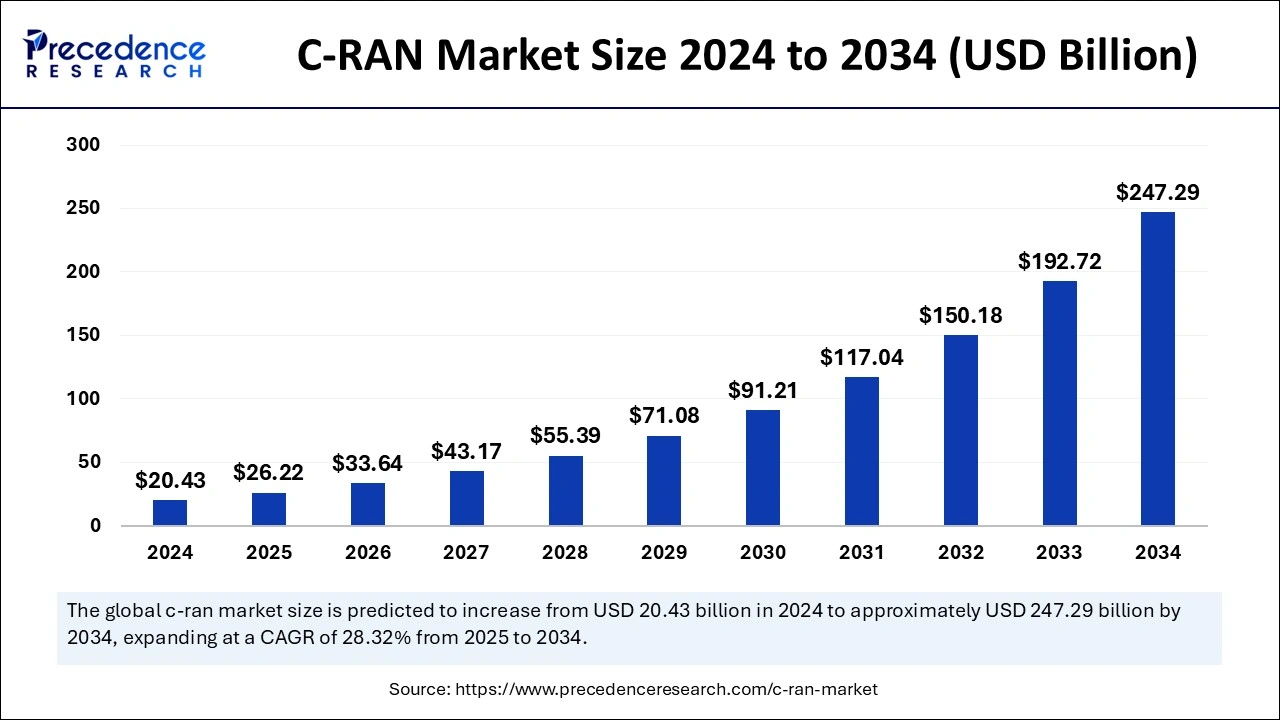
The global C-RAN market size is valued at USD 26.22 billion in 2025 and is predicted to increase from USD 33.64 billion in 2026 to approximately USD 293.84 billion by 2035, expanding at a CAGR of 27.34% from 2026 to 2035.The demand for C-RAN is increasing due to the growth in networks like 5G, which boosts efficiency and allows users to work more efficiently. The rising demand for low-latency and high signal quality is influencing the market growth.
C-RAN Market Key Takeaways
- Asia Pacific dominated the global C-RAN market with the highest share of 33% in 2025.
- India is growing at a double-digit CAGR of 34.3% over the forecast period.
- North America is anticipated to grow at the highest CAGR of 27.6% during the forecast period.
- By architect type, the centralized segment has held a major market share of 61% in 2025.
- By architect type, the virtualized/cloud-based segment is projected to grow at the double digit CAGR 30.02% during the forecast period.
- By network type, the LTE and 5G segment secured the highest market share in 2025.
- By network type, the 3G segment is expected to witness considerable growth during the forecast period.
- By component, the infrastructure segment registered the highest market share in 2025.
- By component, the services segment is anticipated to grow at the highest CAGR during the forecast period.
- By deployment model, the outdoor segment contributed the highest share in 2025.
- By deployment model, the indoor segment is anticipated to register the highest CAGR during the forecast period.
Market Overview
Centralized/Cloud Radio Access Network (C-RAN) is a modern cloud-computing-based architecture that vitally enhances and scales performance. The C-RAN market is growing rapidly due to the rising need to manage high data traffic in cities through centralization. The main components of the architecture are remote radio units, baseband processing units, and a fronthaul network, which play a major role in handling radio frequency transmission, performing signal processing, and maintaining the bandwidth within the network. The importance of C-RAN is increasing due to various benefits. It reduces the need for capital expenditure, uses the resources virtually, and also enhances the overall performance.
How is Artificial Intelligence (AI) Transforming Global Networks?
The emergence of technologies like artificial intelligence and machine learning (ML) is playing a transformative role in the networking industry. These technologies are significantly optimizing network resources by using real-time traffic patterns. AI-based tools are also gaining significant attention due to their capabilities in predictive analytics that enhance the network demand. AI also enhances automation through self-optimizing networks that can reduce the requirement for human intervention, making it profitable in the long run. Additionally, AI's role in managing real-time tasks is anticipated to play a vital role during complex situations like data traffic during peak times.
- In October 2024, SoftBank and Ericsson enhanced their AI-RAN collaboration to develop techno-economic analyses, prototypes, and lab demos for optimizing RAN and AI convergence at the edge.
C-RAN Market Growth Factors
- The rapid increase in mobile data is the major factor that drives the need for enhanced network solutions, which boosts the demand in the C-RAN market.
- The adoption of centralized resources plays a significant role in reducing the overall costs of operations.
- The rising technological adoption is leading to rapid transformation in digital infrastructure that helps enhance the user experience.
- The demand for high-quality video streaming on social media platforms like Instagram, Facebook, YouTube, etc, is playing a vital role in boosting smooth network solutions.
Market Scope
| Report Coverage | Details |
| Market Size by 2026 | USD 33.64 Billion |
| Market Size in 2025 | USD 26.22 Billion |
| Market Size in 2035 | USD 293.84 Billion |
| Market Growth Rate from 2026 to 2035 | CAGR of 27.34% |
| Dominating Region | Asia Pacific |
| Fastest Growing Region | India |
| Base Year | 2025 |
| Forecast Period | 2026 to 2035 |
| Segments Covered | Architect Type, Network Type, Component, Deployment, and Regions. |
| Regions Covered | North America, Europe, Asia-Pacific, Latin America, and Middle East & Africa |
Market Dynamics
Drivers
Rising demand for 5G networks
The rapid digitalization in the developed regions has been playing a significant role in increasing the demand for 5G networks that fulfill the demand for a high-speed connection. The adoption of 5G is also leading towards automation in the automotive sector, where connectivity becomes crucial in autonomous vehicles. The overall demand for 5G in the corporate sector also becomes a crucial factor, as the companies are witnessing significant business opportunities for C-RAN.
- The data by Ericsson states that 90% of Americans live in areas covered by 5G low-band, and 210–300 million Americans are covered by 5G mid-band.
Growth of cloud computing
The demand for cloud computing is significantly increasing due to its cost-effectiveness, which helps companies manage their expenses. This adoption eliminates the need for physical infrastructure and also provides the operation of network infrastructure with scalability. The C-RAN market is witnessing significant demand due to the growing virtualization of basebands that are replacing the hardware components and adapting software-driven systems. Small companies are also getting significant opportunities to help them adjust their operational costs. The C-RAN systems are anticipated to increase due to the growth across various industries.
Restraint
Higher initial investments
The rapid digitalization in urban areas has significantly helped the growth of centralized networks. The deployment of these technologies uses advanced technologies, which are higher in cost and cannot be affordable in underdeveloped regions. The C-RAN market could face certain challenges due to the higher cost of hardware equipment that requires higher investments. Additionally, the transformation also raises the requirement for a skilled workforce, which can be a restraining factor as it adds to operational costs.
Opportunities
Rising demand in IoT and smart devices
The growth in technology has been playing a transformative role in network enhancement, fulfilling the requirements of connected devices. The C-RAN market is growing due to the rise of IoT networks, which are almost billions of dollars in value and include home appliances, sensors in various industries, etc. The architecture of C-RAN helps manage the resources of these smart devices. The rise of smart devices in various sectors like healthcare, automotive, and others has led to a demand for low latency, which has led to the growing demand for C-RAN.
Government focus towards digital transformation.
The rising technological advancements around the world are playing a transformative role in the adoption of digitization. Governments are heavily investing in 5G adoption to meet the requirements in developing economies that provide efficient services around different industries. The C-RAN market is growing rapidly due to the smart city initiatives that increase the need for enhanced connectivity. For instance, the Indian government approved a budget of INR 24 billion for the smart city projects to be executed in the year 2024-25. The growing initiatives are opening many business opportunities through public-private partnerships.
Segment Insights
Architect Type Insights
The centralized segment marked its dominance by registering the highest revenue share in 2025. The architecture includes the placement of BBUs at a central location, whereas the RRUs are distributed across various locations. The dominance of the segment is attributed to the well-established technology that manages the resources efficiently and provides services at lower costs. The C-RAN market is growing due to the rising network operations that have developed the need for simplified network management, especially during high data traffic.
The virtualized/cloud-based segment is expected to grow at the highest CAGR during the forecast period of 2025 to 2034. The segment includes the replacement of hardware components with software-based solutions that can offer efficient services without the requirement for additional on-premise infrastructure. The C-RAN market grows efficiently due to the rising demand for flexible services that can be handled based on the traffic demand. The rising regulatory support from the governments is playing a vital role in the adoption of cloud solutions.
Network Type Insights
The LTE and 5G segment marked their dominance by contributing to the highest revenue share in 2025. The growth of the segment is attributed to the reliability of LTE, which has managed to provide high-speed connectivity over the past few years. The C-RAN market is experiencing significant demand due to the rising adoption of 5G networks in urban areas. The rise of global data traffic is one of the major factors that are driving significant investments in the adoption of centralized networks. Additionally, there is an increasing focus on infrastructure improvement.
The 3G segment is anticipated to grow notably during the forecast period of 2025 to 2034. The use of 3G remains prominent in the regions where 4G and 5G aren't deployed, i.e., in underdeveloped regions. The low economy of these areas makes 3G a cost-effective solution for companies and individuals. The majority of the rural population resides in developing countries that are adopting these services to mark improvement in these regions.
Component Insights
The infrastructure segment stood dominant as it contributed to the highest revenue share in 2025. The infrastructure heavily relies on C-RAN systems due to the distribution of the networks. The C-RAN market is growing rapidly due to the increasing number of investments in the 5G network, which can fulfill the market demand. The demand also leads towards a rising focus on advanced hardware that is effective in performing in complex situations.
The services segment is anticipated to grow at the highest CAGR during the forecast period of 2025 to 2034. The segment deals with various aspects like designing, installation, and execution. The growth of personalized networks plays an important role in the implementation of these services due to the need for various preferences. The rising technologies are becoming crucial for managing services in the C-RAN market. Additionally, companies anticipate boosting these services for maintenance purposes.
Deployment Insights
The outdoor segment stood dominant as it generated the highest revenue share in 2025. The segment includes RRUs in outdoor locations like rooftops, towers, and many more that help provide a wider location. The C-RAN market is growing rapidly due to the rising need for enhanced networks in urban areas for various purposes like home appliances, industrial needs, and others. The demand for these architectures increases due to the rising need for connectivity in various weather conditions, which attracts significant investments.
The indoor segment is anticipated to grow at the highest CAGR during the forecast period of 2025 to 2034. The growth of the segment is attributed to the growing number of corporate offices, shopping malls, hospitals, etc. The demand for the C-RAN market increases due to the increasing number of users who need high-speed connectivity in these settings. Additionally, the rise of Augmented Reality and Virtual Reality is anticipated to raise the network standards in the upcoming years. The growth of the companies is leading to increasing initiatives toward security, which leads to the deployment of private networks to manage their operations.
Regional Insights
Asia Pacific C-RAN Market Size and Growth 2026 to 2035
The Asia Pacific C-RAN market size is exhibited at USD 11.10 billion in 2026 and is projected to be worth around USD 98.61 billion by 2035, growing at a CAGR of 27.55% from 2026 to 2035.
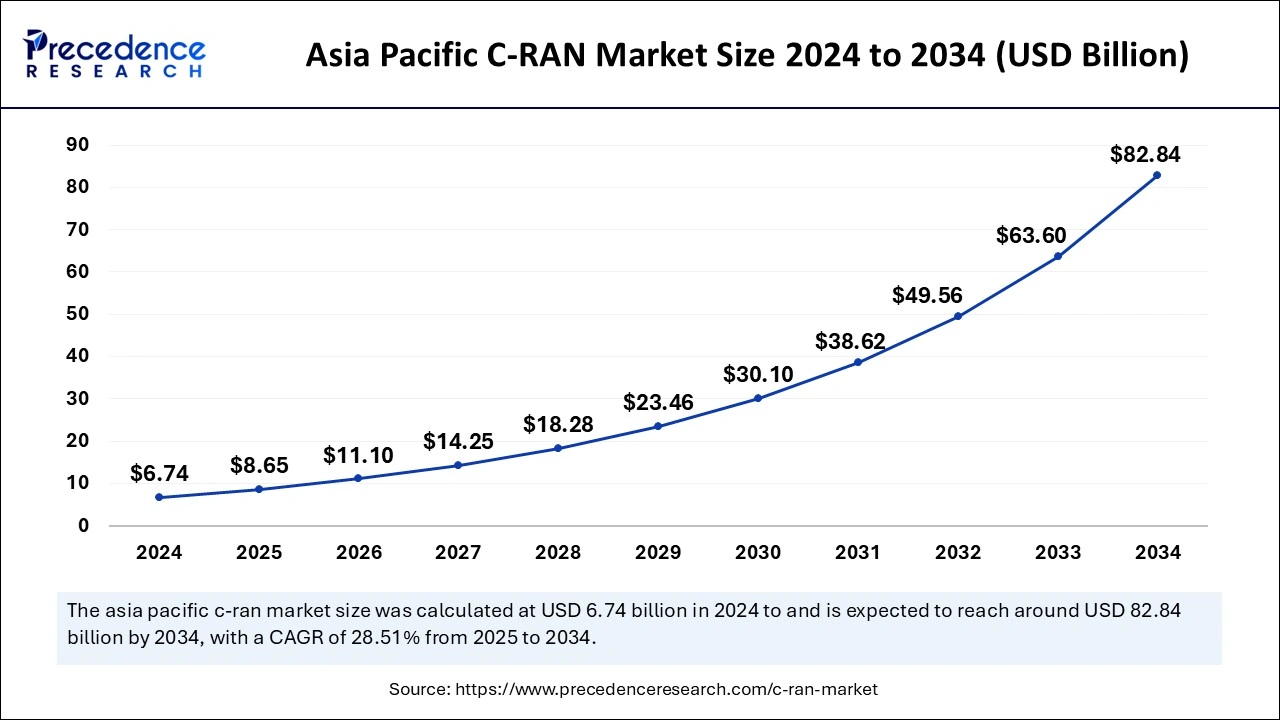
Asia Pacific dominated the C-RAN market by capturing the largest share in 2025. This is mainly due to the increased number of mobile users in countries like China, India, and Japan. With the increased proliferation of 5G networks, the need for advanced network infrastructure such as C-RAN has increased. The region also witnessed significant advancements in 5G infrastructure, bolstering the regional market growth.
India led the market in Asia Pacific and is expected to sustain its dominance in the coming years due to the growing emphasis on digitalization. With the growing industrialization, there is a heightened acceptance of cloud and Internet of Things (IoT) solutions, which significantly boosts market growth.
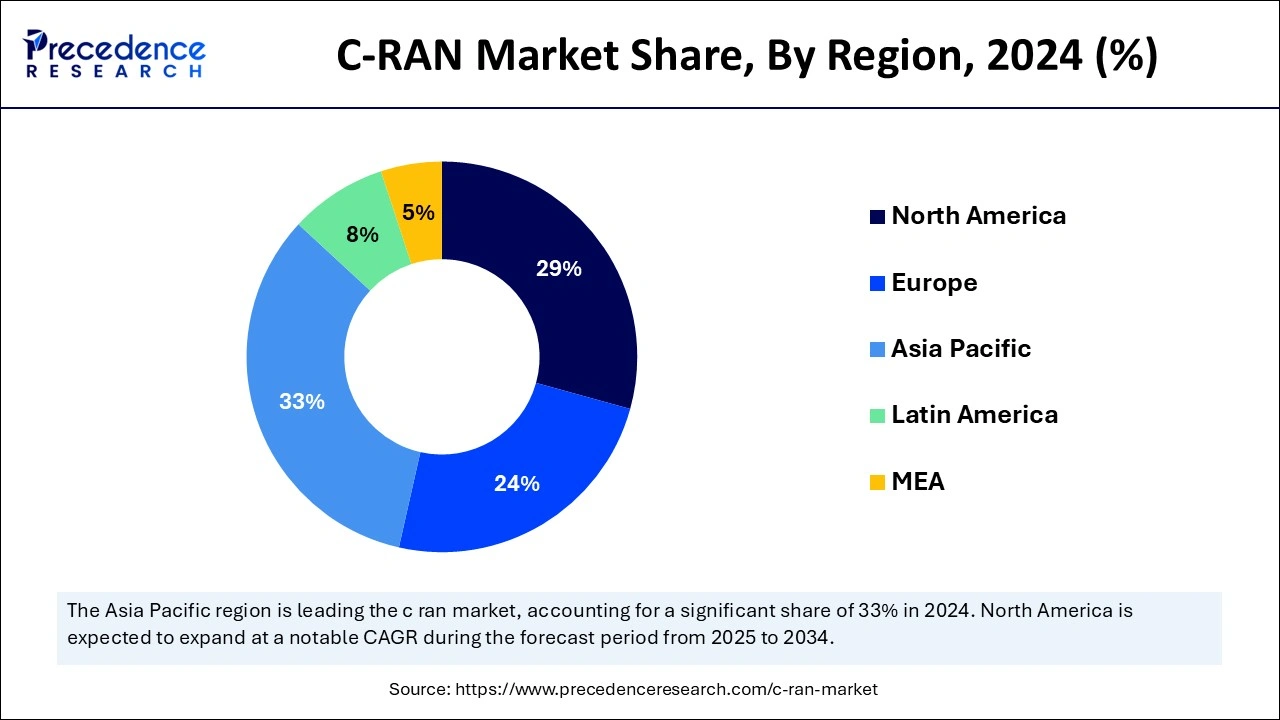
The market in North America is projected to expand at the highest CAGR throughout the forecast period. The regional market growth is attributed to the presence of advanced technologies in countries like the United States and Canada. The region boasts many leading telecom companies. This leads to heavy investments in deploying 5G infrastructures. Additionally, the telecommunication industry in the region is focusing on improving network performance by reducing operational costs and boosting the demand for C-RAN.
U.S. Market Trends
The U.S. is leading the charge in the North American market, fueled by the closing of the network and the move towards cloud-based telecommunications networks. The U.S. is witnessing major investments in virtualizing RAN infrastructure and in adopting Open RAN across various operators. Moreover, the U.S.-based semiconductor and cloud companies are playing a crucial role in contributing to the evolution of C-RAN architecture.
Why are the Advancements in the C-RAN Market in Europe?
Europe is set to witness significant growth in the market over the forecast period. This growth is driven by rapid 5G spectrum rollout, energy-efficiency mandates, and an expanding focus on open and interoperable RAN frameworks. Operators in the region are prioritizing centralized architecture to reduce operational costs and improve network utilization. The region also benefits from strong regulatory support, encouraging adoption across countries like Germany, France, and the UK.
Germany C-RAN Market Trends: Germany's robust digital infrastructure, high smartphone penetration, and progressive 5G deployment initiatives make it a key player for innovative RAN solutions. Open RAN adoption and multi-vendor ecosystems are also gaining traction in Germany, reflecting industry efforts to boost interoperability and reduce reliance on single suppliers.
What are the Key Trends in the C-RAN Market in Latin America?
Latin America is set to experience substantial growth in the market in the upcoming years. This growth is due to progressive 5G trials, expanding fiber availability, and a growing operator interest in network cost optimization. Countries such as Brazil, Mexico, and Chile are leading players as they are modernizing legacy RAN infrastructure. The region is also seeing continued investments in the market, thus accelerating adoption.
Brazil C-RAN Market Trends: Factors such as the emergence of 5G and the increasing demand for low-latency and high-speed networks, improved quality of service, and governments and regulatory bodies increasingly supporting infrastructure are some of the major factors propelling the country's market landscape. There is also growing interest in virtualized, cloud-native RAN and Open RAN approaches as operators seek cost-efficient, scalable solutions and vendor diversity.
How is the Middle East and Africa Region Growing in the C-RAN Market?
The Middle East and Africa are expected to maintain a steady growth trajectory over the forecasted years. This growth is driven by selective 5G rollouts and increasing investments being made in telecom infrastructure. Countries like the UAE, Saudi Arabia, and Qatar are leading players in the region. Fiber expansion and cloud integration programs are also gaining traction, improving deployment feasibility across urban centers.
Saudi Arabia C-RAN Market Trends: Saudi Arabia's C-RAN market is driven by the increasing demand for high-speed, reliable mobile connectivity. Other market drivers include rapid urbanization and digital transformation initiatives. The regional government's push towards smart city projects and 5G deployment further pushes the market forward.
Competitive Landscape
The C-RAN market remains moderately consolidated among established telecom infrastructure and semiconductor companies. Samsung Networks also enhanced RAN virtualization through new operator deals in the region, as detailed on its website. Other recent operator partnerships in North America also drove virtualized RAN deployments, according to Samsung Networks. Traditional companies prudently hold their market advantages, such as patents, operator networks, and worldwide deployment possibilities.
Various partnerships and acquisitions, along with telecom advancements powered by AI, are still influencing global competitive positioning. Rakuten Symphony has grown its deployments of open RAN to the cloud by entering into contracts with telecom operators around the world. The maturation of strategic partnerships between operators and hyperscale cloud operators keeps advancing the adoption and growth of the virtualized RAN.
C-RAN Market Companies
- HRMavenir Systems, Inc
- NEC Corporation
- Samsung Electronics Co., Ltd.
- ASOCS Ltd.
- Cisco Systems, Inc.
- Telefonaktiebolaget LM Ericsson
- Fujitsu Limited
- Huawei Technologies Co., Ltd.
- Intel Corporation
- Altiostar Networks
Announcement by Global leaders
- In September 2024, NVIDIA CEO Jensen Huang stated, “We've fused signal processing and AI,” emphasizing its role in advancing C-RAN technology and optimizing telecom networks.
Recent Developments
- In May 2026, Ericsson and Vodafone Three completed a pioneering network upgrade by integrating Ericsson's 'Multi-Operator Core Network' (MOCN) technology with the latter's 'Multi-Operator Radio Access Network' (MORAN) across over 10,000 UK sites. This advancement allows up to 28.6 million customers to connect automatically to the best available coverage on either network. Following the Vodafone and Three merger, millions of subscribers are now enjoying faster speeds and improved reliability for 4G and 5G services. (Source: https://www.ericsson.com)
- In May 2026, the OCUDU Ecosystem Foundation, hosted by the Linux Foundation to promote open and secure Open Source RAN implementations, expanded its community by adding five new General Members and 16 new Associate Members. These diverse members, including tech providers, research institutions, and academic organizations, contribute to the development of carrier-grade, cloud-native RAN infrastructure. (Source: https://www.linuxfoundation.org)
Segments Covered in the Report
By Architecture Type
- Centralized - RAN
- Virtualized/Cloud RAN
By Component
- Infrastructure
- Remote Radio Units
- Baseband Units
- Fronthaul
- Software
- Services
- Consulting
- Design and Architecture Type
- Maintenance and Support
- Others
By Network Type
- 3G
- LTE & 5G
By Deployment
- Indoor
- Outdoor
By Geography
- North America
- Asia Pacific
- Europe
- Latin America
- Middle East and Africa
For inquiries regarding discounts, bulk purchases, or customization requests, please contact us at sales@precedenceresearch.com
Frequently Asked Questions
Tags





Ask For Sample
No cookie-cutter, only authentic analysis – take the 1st step to become a Precedence Research client
 Get a Sample




 sales@precedenceresearch.com
 Schedule a Meeting
