



Capillary Electrophoresis Market Size, Key Companies, Company Market Share, Patient Volume, Treatment Adoption Rates, Pricing Analysis, Regulatory Landscape, Competitive Positioning, and Demand Forecast
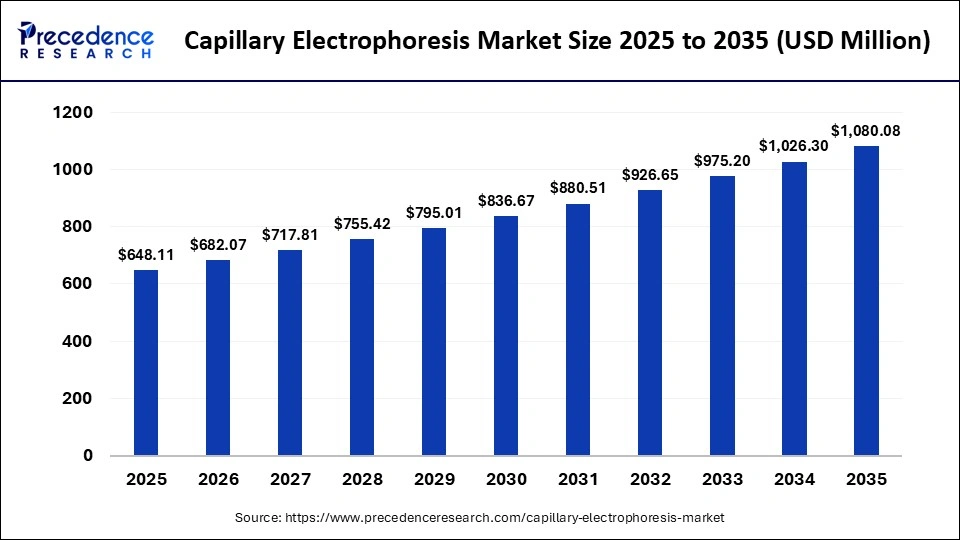
Deepa Pandey, a Healthcare Industry Expert, highlights that the capillary electrophoresis market has reached USD 682.07 million in 2026 and is on track to reach USD 1,080.08 million by 2035, advancing at a CAGR of 5.24%. Key capillary electrophoresis market companies shaping the market include Agilent Technologies, SCIEX while major growth segments span product type, technique, end-user, application, region.
Source: https://www.precedenceresearch.com/capillary-electrophoresis-market
 Get a Sample
 Table Of Content


What is the Capillary Electrophoresis Market Size?
The global capillary electrophoresis market size accounted for USD 648.11 million in 2025 and is predicted to increase from USD 682.07 million in 2026 to approximately USD 1,080.08 million by 2035, expanding at a CAGR of 5.24% from 2026 to 2035. The market growth is attributed to increasing demand for high-resolution, rapid, and reproducible analytical techniques in pharmaceutical, biotechnology, and clinical research applications.
Market Highlights
- North America dominated the market with the highest market share of 46.8% in 2025.
- The Asia Pacific is expected to grow at a notable CAGR 7% between 2026 and 2035.
- By product type, the capillary electrophoresis systems segment contributed the biggest market share of 58.8% in 2025.
- By product type, the reagents & consumables segment growing at a solid CAGR of 6.2% between 2026 and 2035.
- By technique, the capillary zone electrophoresis (CZE) segment captured the highest market share of 42.5% in 2025.
- By technique, the capillary isoelectric focusing (CIEF) segment is set to grow at a 6.1% CAGR between 2026 and 2035.
- By end-user, the pharmaceutical & biotechnology companies segment registered dominance by capturing 35.5% of the market share in 2025.
- By end-user, the clinical laboratories segment is poised to grow at a 5.9% of CAGR from 2025 to 2034.
- By application, the drug development and QC segment held a dominant market share of 38.9% in 2025.
- By application, the clinical diagnostics segment is growing at a CAGR of 5.8% between 2026 and 2035.
Market Overview
The capillary electrophoresis market is experiencing strong growth due to the rising demand for high-resolution separation and analysis in drug development and quality control. CE is an electrokinetic separation technique that separates charged analytes through fused-silica capillaries under an electric field. This method separates analytes based on their charge-to-size ratio, requires very small sample volumes, reduces waste, and produces reproducible, sharp peaks.
CE is gaining popularity as pharmaceutical and biotechnology companies work to characterize complex biologics, detect impurities, analyze glycosylation, and identify charge variants. These activities are crucial for regulatory compliance and safety. Advancements in coupling CE with mass spectrometry (CE-MS) have expanded the range of analysis. CE is also being used more widely in clinical labs and research centers for purposes beyond drug development. Furthermore, the increasing demand for biologics and advanced diagnostics worldwide, along with CE's flexibility, is likely to drive further growth and adoption of the CE market.
Impact of Artificial Intelligence on the Capillary Electrophoresis Market
Artificial intelligence (AI) is transforming the capillary electrophoresis market by boosting innovation, increasing analysis efficiency, and enhancing the value of CE systems in pharmaceutical and industrial laboratories. Labs use AI-driven data analysis engines to examine electropherograms more accurately. Developers embed AI into devices to improve method development, predict separation outcomes, and automate complex parameter adjustments. Furthermore, with the growing adoption of AI, more high-value applications are emerging in the development of therapeutics, diagnostics, environmental testing, and food safety analysis.
Capillary Electrophoresis Market Growth Factors
- Rising Biopharmaceutical R&D Activities: Growing development of biologics and biosimilars is driving demand for high-resolution CE techniques.
- Expanding Clinical Diagnostic Applications: Increasing adoption of CE for protein profiling, genetic testing, and biomarker analysis is boosting market growth.
- Growing Adoption of Automated CE Systems: Automation in sample handling and analysis is propelling efficiency and throughput in laboratories.
- Advancements in CE–MS Integration: Improved coupling of capillary electrophoresis with mass spectrometry is fuelling enhanced molecular characterization capabilities.
- Increasing Regulatory Compliance Requirements: Stricter guidelines for drug quality control and biopharmaceutical characterization are driving CE adoption.
Capillary Electrophoresis Market Outlook
- Market Growth Overview: The capillary electrophoresis market is experiencing growth due to its high-resolution capabilities, ability to analyze complex molecular structures, and widespread use in pharmaceuticals, biotechnology, and diagnostics. Increased demand for personalized medicine, advancements in proteomics, and growing investments in laboratory automation are also driving the market.
- Global Expansion: The market is expanding globally as demand rises for accurate, fast, and cost-effective analytical techniques, with significant growth opportunities in emerging regions like Asia-Pacific and Latin America, driven by improving healthcare infrastructure and increasing biotechnology research. These regions offer untapped markets where the adoption of CE technologies in clinical diagnostics and drug development is expected to grow substantially.
- Major Investors: Key investors in the market include major biotechnology firms like Thermo Fisher Scientific and Agilent Technologies, along with academic research institutions and government agencies. These players contribute by advancing CE technologies, improving product innovation, and providing extensive support for the integration of CE into both clinical and research environments.
Market Scope
| Report Coverage | Details |
| Market Size in 2025 | USD 648.11 Million |
| Market Size in 2026 | USD 682.07 Million |
| Market Size by 2035 | USD 1,080.08 Million |
| Market Growth Rate from 2026 to 2035 | CAGR of 5.24% |
| Dominating Region | North America |
| Fastest Growing Region | Asia Pacific |
| Base Year | 2025 |
| Forecast Period | 2026 to 2035 |
| Segments Covered | Product Type, Technique, End-User, Application, and Region |
| Regions Covered | North America, Europe, Asia-Pacific, Latin America, and Middle East & Africa |
Capillary Electrophoresis Market Segment Insights
[[segment_insights]]
Capillary Electrophoresis Market Regional Insights
[[regional_insights]]
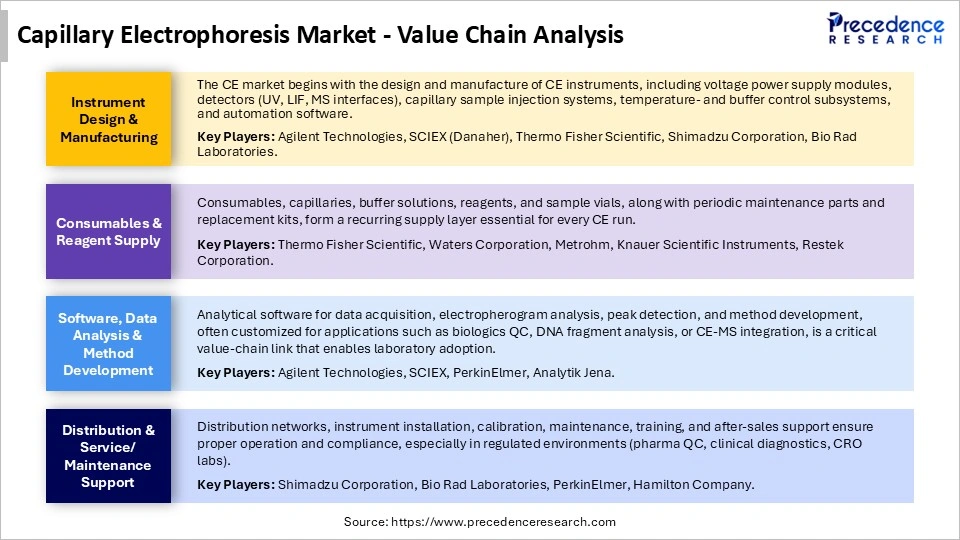
Capillary Electrophoresis Market Value Chain
Top Companies in the Capillary Electrophoresis Market & Their Offerings
- Agilent Technologies (U.S.): Agilent is a leading provider of high-performance analytical instruments, including capillary electrophoresis systems, consumables, and software solutions for life sciences, pharmaceuticals, and biotechnology applications.
- SCIEX (U.S.): SCIEX specializes in CE-MS and CE-UV systems, offering advanced separation and detection technologies for proteomics, metabolomics, and biopharmaceutical analysis.
- Thermo Fisher Scientific (U.S.): Thermo Fisher provides a comprehensive portfolio of CE instruments, reagents, and lab automation solutions for analytical and clinical laboratories worldwide.
- PerkinElmer (U.S.): PerkinElmer delivers capillary electrophoresis platforms and integrated analytical solutions, emphasizing biopharma QC, diagnostics, and research applications.
- Shimadzu Corporation (Japan): Shimadzu offers a wide range of CE systems, focusing on high-precision separation, sensitive detection, and automation for life science and industrial labs.
- Bio-Rad Laboratories (U.S.): Bio-Rad provides CE instruments and accessories, specializing in protein and nucleic acid analysis for clinical, research, and biopharma laboratories.
- Metrohm (Switzerland): Metrohm delivers compact and modular CE systems, emphasizing reproducibility, ease of use, and integration with advanced detection methods.
- Knauer Scientific Instruments (Germany): Knauer manufactures CE instruments and microfluidic systems for precise separation and analytical workflows in research and quality control labs.
- Hitachi High-Tech (Japan): Hitachi High-Tech provides innovative CE systems with enhanced automation and detection capabilities for pharmaceutical, clinical, and research applications.
Recent Developments
- In March 2025, Thermo Fisher Scientific launched the IVDR-compliant SeqStudio Flex Dx Genetic Analyzer. The CE system supports both clinical laboratories and research applications, enabling Sanger sequencing and fragment analysis. It is designed to improve efficiency and provide flexible run schedules. The platform ensures compliance with regulatory mandates while enhancing laboratory workflow.(Source: https://www.technologynetworks.com)
- In January 2024, Agilent Technologies introduced the automated ProteoAnalyzer CE system for protein analysis. The system offers rapid, high-resolution separation of complex protein mixtures, meeting the needs of pharma, biotech, food analysis, and academic research. Growing interest in monoclonal antibodies and protein therapeutics is driving their adoption. The platform simplifies analytical workflows and increases throughput for protein characterization.(Source: https://www.investor.agilent.com)
- In July 2024, Sysmex and Hitachi High-Tech announced a collaboration to develop CE-based genetic testing systems. They aim to create efficient, low-cost platforms for broader clinical use. The partnership focuses on optimized genetic testing for individual diseases. This initiative follows joint research and a feasibility study conducted since 2023.(Source: https://www.hitachi.com)
Capillary Electrophoresis Market Segments Covered in the Report
[[segment_covered]]
For inquiries regarding discounts, bulk purchases, or customization requests, please contact us at sales@precedenceresearch.com
Frequently Asked Questions





Ask For Sample
No cookie-cutter, only authentic analysis – take the 1st step to become a Precedence Research client
 Get a Sample
.webp)



 sales@precedenceresearch.com
 Schedule a Meeting
