



Cast Acrylic Sheets Market Trends, Leading Companies, Company Revenue / Sales Performance, Plant Utilization, Production Volume, Pricing Dynamics, Supply Chain Performance, Competitive Landscape, and Industry Growth
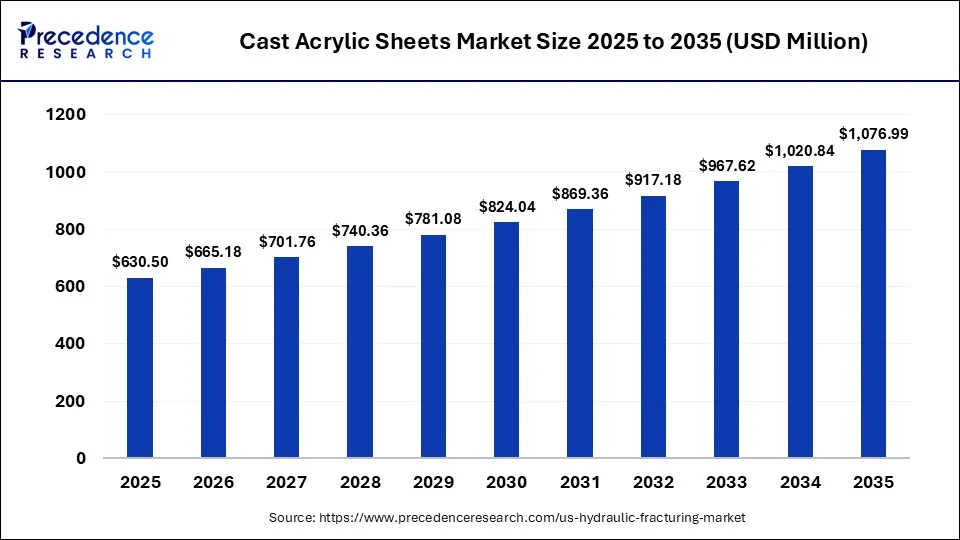
The cast acrylic sheets market reached USD 665.18 million in 2026. Growth is mainly driven by the growing adoption of cast acrylic sheets across the automotive, construction, and interior design industries. Market trends were analyzed by our Senior Research Analyst, Vidyesh Swar, to curate this report. His report benefits multiple stakeholders across the entire value chain, including manufacturers, distributors, fabricators, and signage and display companies.
Source: https://www.precedenceresearch.com/cast-acrylic-sheets-market
 Get a Sample
 Table Of Content


Cast Acrylic Sheets Market Size, Share, Trends and Growth Forecast 2035
The global cast acrylic sheets market is forecasted to expand from USD 665.18 million in 2026 to USD 1,076.99 million by 2035, growing at a CAGR of 5.5% from 2026 to 2035.
Key Takeaways
- By product, the clear cast acrylic segment held the largest market share of 37.4% in 2025.
- By manufacturing process, the cell cast segment dominated the market in 2025.
- By application, the signage and display segment contributed the biggest market share of 35.6% in 2025.
- In 2026, PMMA prices in several key markets were in the USD 2,000-2,250/ton range, and MMA prices were well below top-cycle peaks.
- In 2025, China produced about 1.82 million tonnes of MMA, up 19.4% compared with the same period last year.
- The value chain of cast acrylic sheets spans polymer formulation, casting, finishing and masking, cutting, distribution, and fabrication.
- During July 2024 to June 2025, China, the U.S., and India were the top three exporters of cast acrylic sheets, while the U.S., India, and Singapore were major importers.
- Integrated chemical producers have upstream MMA/PMMA production capacity, while large sheet manufacturers have broad distribution and multi-process capabilities.
How is the Cast Acrylic Sheets Market Evolving?
The incremental opportunity through 2035 is therefore approximately, with Asia-Pacific expected to provide the largest absolute addition to demand. Volume growth is supported by construction, retail infrastructure, signage, lighting and transportation, while revenue growth is enhanced by impact-modified, UV-resistant, light-diffusing, recycled-content, hard-coated and application-specific grades.
Coverage Highlights
- Volume and value conversion
- Incremental USD opportunity
- Regional growth contribution
- Segment-level CAGR
- Base, upside, and downside scenarios
- Country-level market sizing
Segmentation Analysis
Which Product and Manufacturing Process Segment Dominated the Market in 2025?
Clear cast acrylic held approximately 37.4% of the cast acrylic sheets market in 2025, while 5.1 to 10 mm sheets accounted for 41.1% of market share in 2025.
The specialty grades segment is experiencing higher demand than standard grades and is expected to grow at a CAGR of approximately 7.3% by 2035. Sheets above 20 mm, including block formats, are also in high demand because of the rising need from aquariums, architectural installations, high-end displays, and specialized industrial fabrication.
By manufacturing process, the market is categorized into cell cast and continuous cast. Cell cast is typically the most popular for its higher customized thicknesses, optical properties, and difficult fabrication. Continuous cast gives higher throughput, dimensional stability, and consistency for larger quantities.
By application, signage and display remains the largest pool at approximately 35.6%, while architecture/interior design is emerging as a higher-growth segment.
Coverage Highlights
- Cell cast vs continuous cast
- Clear, colored, translucent and specialty sheets
- ≤5 mm, 5.1-10 mm, 10.1-20 mm and >20 mm
- Standard vs specialty grades
- Signage/display
- Architecture/interiors
- Sanitary ware
- Automotive/transportation
- Lighting, marine, and industrial applications
What are the Growth Factors and Challenges of the Cast Acrylic Sheets Market?
The major growth factor of the market is the higher need to replace glass and other rigid transparent materials with cast acrylic materials. The lower weight, easier fabrication, and design flexibility of cast acrylic sheets create economic value. Acrylic is lighter than glass due to its lower density of approximately 1.19 g/cm³ and visible light transmission of around 92% in clear grades. It also retains higher optical performance than glass.
A major market restraint is the cost of Methyl methacrylate Monomer (MMA)), a key feedstock used in PMMA production. Asian MMA prices reduced to around 21% during 2025, reflecting relatively comfortable supply and cautious downstream demand. This creates opportunities for sheet producers to rebuild margins when feedstock costs fall, but also increases competitive pressure as lower input costs can be passed through to buyers.
Coverage Highlights
- Glass substitution
- Lightweighting
- Construction and retail expansion
- LED/signage growth
- MMA cost exposure
- Competitive substitution from polycarbonate
- Standardization versus customization
- Specialty-grade premiumization
What is the Pricing Analysis of the Cast Acrylic Sheets Market?
Pricing can be best assessed through USD/kg, USD/m², thickness-adjusted ASP, and regional delivered price rather than only revenue per sheet. In 2026, PMMA prices in several key markets were in the USD 2,000-2,250/ton range, and MMA prices were well below top-cycle peaks, providing a healthier raw-material environment than that seen during previous supply tightening.
A representative 8 × 4 ft, 2 mm cast acrylic sheet pricing in India was around INR 80/sq ft. This demonstrates the marked difference between a commodity regional price vs. high-end branded or engineered grade. Pricing for real-world products is subject to thickness, optical quality, color, masking, finish, qty, and shipping.
Since the buyer is paying for performance, premium grades command significant value premiums. UV resistance, impact modification, hard coating, diffusion, color consistency, food-contact suitability, and custom dimensions can add real value to ASP.
Coverage Highlights
- USD/kg and USD/m² benchmarks
- Thickness-adjusted pricing
- Regional ASP
- Clear vs specialty premium
- MMA/PMMA feedstock impact
- Manufacturing and conversion cost
- Freight and distributor margins
- Price-pass-through analysis
How is the Demand-Supply Balance Shaping Market Opportunities for Cast Acrylic Sheet Producers?
Asia-Pacific is emerging as the structural supply center for acrylic sheets, supported by rapid expansion across the upstream MMA/PMMA ecosystem. In 2025, China produced about 1.82 million tonnes of MMA, up by 19.4% compared with the same period last year. The sharp rise suggests an increasing amount of feedstock available to make downstream acrylic. Sheet-market competitiveness factors include polymer availability, local casting ability, a range of sheet thicknesses, quality specialty-color capability, and distributor stocks. Thus, North American and European buyers depend on indigenous production even when Asian material is more affordable.
What are the Highest-Value Margin Pools Emerging Across the Cast Acrylic Sheets Value Chain?
The value chain of cast acrylic sheets spans polymer formulation, casting, finishing and masking, cutting, distribution, and fabrication. Standard clear sheets are more exposed to price-based competition, while specialty formulations, custom dimensions, optical grades, hard-coated products, and application-engineered sheets require additional processing and technical qualification. These segments influence buying decisions that prioritize performance, durability, customization and application, rather than material cost only.
Downstream conversion economics can be as important to profitability as upstream raw-material costs. Actual process margins beyond polymer costs are a function of casting throughput, scrap rate, energy use, finishing and masking costs, inventory carry costs, logistics, distributor/fabricator economics. Producers with the special ability to convert off-the-shelf polymer inputs into differentiated sheet products with superior process economics will be at an advantage to defend margins in the face of current qualification hurdles and switching barriers that challenge direct price comparability.
A potential shift in competitive advantage from simple polymer availability toward conversion efficiency, product specialization, and application-level technical support is observed. Therefore, related manufacturers and downstream companies focus on processing technology, specialty grades, maximize yield and energy, pursue greater degrees of specialization, and build a better relationship with distributors and fabricators.
The report includes MMA and PMMA economics, casting conversion costs, yield and scrap, energy, mask and finishing economics, distributor and fabricator margins, logistics, and inventory needs throughout the value chain.
How Does Cross-Border Trade Create Regional Price Arbitrage and Localization Opportunities?
China, the U.S., and India were the top three exporters of cast acrylic sheets from July 2024 to June 2025.
China accounted for 107,465 shipments, while the U.S. and India accounted for 42,181 and 35,316 shipments, respectively.
The U.S., India, and Singapore were the major importers of cast acrylic sheets.
The data above indicate that Asia-Pacific remains a major production base and a significant export platform. At the same time, North America and Europe still offer attractive alternatives for imported specialized grades and short-lead-time products.
The report comprises a comprehensive assessment of HS-code trade flows, export/import values, quantity shipped, trade balance, tariffs, regional price gaps, and leading trade routes, outlining where local supply can replace imports.
What are the Emerging Technological Innovations of Cast Acrylic Sheets?
Key players make constant efforts to develop customized cast acrylic sheets useful for various applications. This enables them to reinforce their market position and diversify their product mix. Customers are more likely to purchase acrylic sheets that offer additional features, such as impact modification, UV/IR filters, light diffusion, anti-reflection properties, scratch resistance, and antimicrobial qualities.
Additionally, rigorous sustainability policies motivate makers to recycle cast acrylic sheets, which lessens the impact on the environment and generates less waste. Recycling is particularly important because PMMA can be chemically depolymerized to MMA. Mechanical recycling is also commercially relevant; recycled-content acrylic sheet products are being developed using recovered acrylic manufacturing waste.
How are Regulatory Requirements Impacting the Cast Acrylic Sheets Market?
Regulatory and sustainability policies are being formed that consider material traceability, waste reduction, recycling, VOC exposure during fabrication, product safety, and environmental declarations. PMMA can be processed back into MMA; thus, it creates the potential to retain material value rather than treating it as material waste. This way of working supports the circularity of ecosystems and environmental sustainability.
Recycling policy allows manufacturers to concentrate on 'proven' circularity, traceability, and low-carbon content, which build the confidence of buyers and influence their decision to purchase. Suppliers that provide recycled feedstocks backed up by documentation and stable sheet quality can set themselves apart from the rest based on value, not just cost and performance.
Demand for certified low-carbon and circular acrylic sheets continues to rise. These are premium products, allowing producers to optimize waste-recovery systems, ensure traceability of material flows, enhance environmental documentation, and develop products that satisfy technical requirements and sustainability standards.
The report also provides a comprehensive overview of requirements, recycling/circularity solutions, material traceability, waste-management procedures, VOC aspects, product-safety demands, environmental declarations, and sustainability focused product differentiation.
Why are Fabricators Critical Decision Makers for Cast Acrylic Sheets?
The customer structure of the market is usually fragmented. Large original equipment manufacturers (OEMs) and architectural buyers follow specifications. Distributors, sign manufacturers, display fabricators, sanitary-ware manufacturers, and specialist processors determine the actual sheet brand and grade.
Optical quality, thickness tolerance, color consistency, UV stability, fabrication behavior, and technical support are major aspects that influence purchasing of acrylic sheets. Switching costs are moderate for standard clear sheets but materially higher for qualified specialty grades.
How are Producers Competing Across Different Value Pools in the Cast Acrylic Sheets Market?
The market is characterized by a three-tier competitive structure. Integrated chemical producers have upstream MMA/PMMA production capacity, while large sheet manufacturers have broad distribution and multi-process capabilities. The main competitive strengths of different company types are as follows
- Regional sheet specialists: Customization, fast supply, and niche applications.
- Integrated players: Feedstock security and specialty R&D.
- Downstream specialists: Product breadth, shorter lead times, customized dimensions, and application-specific support.
The competitive landscape depends on how the player contributes to various segments of cast acrylic sheets. Major integrated groups, like Mitsubishi Chemical Group and Rohm, dominate the market because they have higher value chain ownership of upstream materials and bespoke product development. Other companies like Plaskolite stand out in the market due to their manufacturing breadth and geographic reach. Plaskolite strengthened its position in North America through a recent acquisition of a Mexican cell-cast facility.
Low-cost production of cast acrylic sheets is not very beneficial for producers. They need to focus on specialty formulations and technically differentiated grades. Local specialists must design customized offerings with fast delivery, regional inventory, and application engineering. This will open up different competitive paths. Competition will probably continue to be more intense where standard products are easily interchangeable, though technically qualified and customized applications can provide differentiation.
The complete report offers more competitive benchmarking of upstream integration, access to MMA/PMMA, casting techniques, manufacturing abilities, range of products, geographic presence, distribution network, customization ability, portfolio of specialty grades, and application support.
Selected Companies in the Cast Acrylic Sheets Value Chain
| Company | Headquarters | Market Position | Core Strength | Major Applications |
| Mitsubishi Chemical Group | Japan | Global leader | Integrated PMMA/acrylic portfolio | Architecture, displays, automotive |
| Röhm | Germany | Global leader | PLEXIGLAS, PMMA technology | Architecture, lighting, industrial |
| Plaskolite | U.S. | North American leader | Multi-process sheet portfolio | Displays, construction, bath |
| 3A Composites | Switzerland | European leader | Cast/extruded acrylic brands | Display, architecture, transport |
| Trinseo | U.S. | Integrated materials player | Acrylic materials | Specialty applications |
| Arkema / Altuglas | France | Global specialist | Specialty acrylic materials | Optical, industrial |
| Kuraray | Japan | Specialty leader | PARAGLAS cast sheet | Architecture, display, industrial |
| Sumitomo Chemical | Japan | Integrated producer | MMA/PMMA ecosystem | Optical, electronics |
| CHIMEI | Taiwan | Asian scale player | PMMA materials | Displays, electronics |
| LOTTE Chemical | South Korea | Asian producer | PMMA production | Automotive, electronics |
| Asahi Kasei | Japan | Specialty materials player | High-performance PMMA | Automotive, optics |
| Palram | Israel | Sheet specialist | Thermoplastic sheet | Construction, glazing |
| Spartech | U.S. | Specialty sheet producer | Cell-cast acrylic | Aerospace, medical, mobility |
| Aristech Surfaces | U.S. | Specialty producer | Cast acrylic/surface materials | Sanitary, interiors |
| ASTARI | Indonesia | Asian cast-sheet specialist | Cast acrylic exports | Signage, architecture |
| Madreperla | Italy | European specialist | Acrylic sheet | Displays, interiors |
| Gevacril | Italy | Regional specialist | Acrylic sheet | Displays, industrial |
| Pyrasied Xtreme Acrylic | Netherlands | Specialty specialist | Premium/custom acrylic | Design, architecture |
| Asia Poly Industrial | Malaysia | Regional producer | Acrylic sheet | Signage, fabrication |
| Ray Chung Acrylic Enterprise | Taiwan | Asian specialist | Acrylic sheets | Displays, industrial |
| Shanghai Acrylic (Cast) Chemical | China | Chinese specialist | Cast acrylic | Industrial, signage |
| Limacryl | Spain | European specialist | Cast acrylic | Architecture, displays |
What is the Strategic Positioning of Different Companies in the Cast Acrylic Sheets Market?
The competitive field separates into:
- Market Leaders: Mitsubishi Chemical Group, Röhm, Plaskolite
- Scale/Portfolio Leaders: 3A Composites, Trinseo, Kuraray
- Technology/Specialty Leaders: Arkema/Altuglas, Sumitomo Chemical, Asahi Kasei
- Regional Leaders: ASTARI, Asia Poly Industrial, Shanghai Acrylic
- Application Specialists: Spartech, Aristech Surfaces, Pyrasied Xtreme Acrylic
- Growth Challengers: Madreperla, Gevacril, Ray Chung and other regional producers
What is the Market Share and Competitive Ranking of the Cast Acrylic Sheets Market?
Premium and specialty applications are expected to constitute about 40% to 50% of market value for world-class players. Regional players collectively comprise an important portion of those for standard and tailor-made sheets.
Instead of providing each and every supplier with artificial accuracy, the complete analysis ranks the Top 5, Top 10, and the rest of the market, adding sheet-specific revenue exposure, capacity, geography, and product relevance.
Coverage Highlights
- Estimated 2025 company shares
- Top 5/Top 10 ranking
- Share concentration
- Share gain/loss
- Regional market shares
- Specialty-grade leadership
What Does the Product Portfolio Benchmarking of Cast Acrylic Sheets Indicate?
Companies that provide all-inclusive clear, colored, textured, UV-resistant, impact-modified, and recycled grades, and experts concentrating on a more limited range of premium applications, split portfolio leadership.
3A Composites offers multiple cast and extruded acrylic brands, including recycled-content products.
The full benchmark compares over 72 product families where disclosed, thickness, color, surface treatment, certifications, recycled content, and application coverage across leading participants.
How is Manufacturing Localization Reshaping Regional Markets?
Asia-Pacific held a major market share in 2025 due to the presence of extensive manufacturing capacities. China plays a significant role in Asia-Pacific across the MMA/PMMA and sheet-production ecosystem. Europe holds a strong position in the market, specializing in premium-grade and specialization-intensive products. North America's market growth is attributed to localized manufacturing and distribution capabilities. Rather than one global price level, this geographic structure results in differentiated competitive positions, with producers competing on costs of production and closeness to customers.
Regional competitiveness is based on delivery time, tariff exposure, local present stock, and technical support. Low-cost manufacturing is not guaranteed to be a commercial success, if importing products results in increased lead times, trade-related costs, or restrictions in customization. This becomes even more critical for buyers that rely on replenishment cycles, specialized specifications, or application-specific technical support.
Many developing nations are focusing on regional manufacturing, and replace imports of processed products with localized production, and thus preserve flexibility, which is the golden rule of supply chain management. Producers could preserve their competitiveness on the regional level by securing the regions' stock of cast acrylic sheets near demand centers and building their localized converting/finishing capabilities. Producers of centralized supply who depend on cross-border supply must differentiate by size, product economics, and specialty grades.
The report assesses geographic benchmarking of manufacturing capacity, production footprint, the regional availability of supply, level of local content, import dependence, logistics, tariffs, inventory positioning, local customization, and technical-support network.
What is the Manufacturing and Capacity Benchmarking of the Cast Acrylic Sheets Market?
Manufacturers can cater to a wider customer base and reduce substitution risk by supplying cell cast, continuous cast, and extruded acrylic from a coordinated network of distributors. For instance, Plaskolite's acquisition of a Mexican facility of 11 acres expanded its cell-cast manufacturing capacity.
The report contains facilities, production technologies, announced capacity additions, geographic footprint, utilization, and vertical integration.
Where is M&A Creating the Greatest Strategic Advantage in the Cast Acrylic Sheets Market?
Recent strategic activity indicates that the focus is on capability acquisition and scale expansion. Capacity, geographic expansion, and portfolio completion are major strategic considerations for leading market players. Highly complementary manufacturing capabilities may be a stronger strategic asset than additional capacity that duplicates existing operations than incremental capacity that replicates an existing production footprint.
The most prominent and desirable acquisition should be made to address capability and market-access gaps, including specialty casting assets, recycled material technologies, regional distribution networks, and businesses with qualified customer relationships. All of this has the potential to accelerate market entry, enhance product features, and deepen customer retention without requiring an entirely new organic build-up.
The future of M&A activities is likely to be evaluated increasingly on technology fit, geographic reach, customer qualification, process diversification, and sustainability capabilities. This gives buyers the chance to help fill specific portfolio gaps and also build up the strategic value of niche regional producers. Companies with unique casting capabilities, recycling operations, and existing customer bases have an upper hand in the market.
The report offers more insights into M&A activity, the reason for an acquisition, assets capability, manufacturing technologies, geographical footprint, specialty-product portfolio, distribution channel, the customer relationship, and the technologies of circular material.
What Does the White-Space Analysis of Cast Acrylic Sheets Indicate?
The largest white spaces are expected across:
- Recycled-content cast acrylic, supported by circularity requirements.
- Architectural and interior-grade products, where design differentiation supports premium pricing.
- LED/light-diffusing sheets, benefiting from illumination and signage demand.
- High-thickness blocks, where technical barriers reduce commodity competition.
- Localized production in high-import regions, particularly for custom sizes.
- Medical, sanitary, and industrial grades, where qualification requirements increase switching costs.
- Digital fabrication-ready sheets, optimized for laser cutting, CNC, and automated processing.
Where Does Competitive Power Lie Across the Cast Acrylic Sheets Industry Structure?
| Entry Barriers | Level | Reason |
| Supplier Power | Medium to High | MMA and PMMA economics materially influence sheet costs. |
| Buyer Power | Medium to High | Standard sheet buyers can switch suppliers, while qualified specialty applications are stickier. |
| Threat of New Entrants | Medium | Basic sheet production is accessible, but consistent optical quality, casting know-how, certifications and distribution require investment. |
| Threat of Substitutes | Medium to High | Glass, polycarbonate and other transparent engineering materials compete in selected applications. |
| Competitive Rivalry | High | Price competition is intense in standard grades, while differentiation is stronger in specialty applications. |
What is the PESTLE Analysis of the Cast Acrylic Sheets Market?
- Political: tariffs, localization, and industrial policy.
- Economic: construction cycles, MMA prices, interest rates and freight.
- Social: preference for lightweight, visually flexible materials.
- Technological: advanced casting, coatings, recycling and optical grades.
- Legal: product safety, chemical compliance and application certifications.
- Environmental: recycled content, carbon footprint and circular PMMA.
Which Factors Will Define the Next Phase of the Cast Acrylic Sheets Market?
The cast acrylic sheets market is redefining a new growth trajectory with the widespread use of acrylic sheets across construction, transportation, and specialty displays. The next few years will hinge on volume growth and producers' ability to grow the value pool by accessing higher-value applications and managing upstream and cyclical risks.
The future is also driven by specialty value pools rather than standard transparent sheet volumes. Functional surfaces, recycled-material products, thick blocks, application-qualified grades, and customized formats provide more scope for differentiation than commoditized products. This shift is expected to make technical qualification, customization capabilities, and circular-material offerings important to margin protection.
The most significant implication is the emergence of a two-speed geographic growth model. The most promising opportunities will be focused on those producers that can leverage regional supply capabilities with differentiated products and circularity credentials rather than volumes only.
The main body of this report presents scenario-based analysis through to 2035, with projections for base-, upside-, and downside-case market paths, demand drivers, substitution threats, application-level growth opportunities, regional forecasts, and shifting value pools. It further evaluates the implications of MMA supply conditions, construction activity, transportation demand, specialty applications, regionalization and circularity to identify the most attractive growth and investment opportunities across the cast acrylic sheets market.
Key Strategic Questions Addressed
- What is the global cast acrylic sheets market size in 2025, and how large can it become by 2030 and 2035?
- What cast-sheet technology and product formats generate the largest revenue and margin contributions?
- Why does clear acrylic outperform specialty grades that are experiencing a faster growth rate?
- Which thickness categories provide the strongest value opportunity?
- How much of market growth comes from signage, architecture, sanitary ware, transportation and lighting?
- How sensitive are sheet ASPs and margins to MMA and PMMA prices?
- Where are the largest supply-demand imbalances and import-substitution opportunities?
- How concentrated is global cast acrylic sheet manufacturing?
- Who are the market leaders in scale, technology, capacity, and geographic reach?
- How do integrated producers compare with regional sheet specialists?
- Which competitors have the broadest specialty and recycled-content portfolios?
- In which markets are factories expanding or buying goods?
- Which products have the most pricing power and switching costs?
- Which regions represent the most attractive white-space opportunities?
- Which technologies, applications, and competitive strategies are most likely to reshape the cast acrylic sheets market through 2035?
Cast Acrylic Sheets Market Segments
By Type
- Clear Cast Acrylic Sheets
- Colored Cast Acrylic Sheets
- Translucent/Frosted Cast Acrylic Sheets
- Textured Cast Acrylic Sheets
- Mirrored Cast Acrylic Sheets
- Specialty/Functional Cast Acrylic Sheets
By Thickness
- Up to 2 mm
- 2 to 5 mm
- 5 to 10 mm
- 10 to 20 mm
- Above 20 mm
By Surface Finish
- Smooth/Glossy
- Matte
- Textured
- Hard-Coated
- Anti-Glare
- Other Specialty Finishes
By Product Format
- Standard Sheets
- Custom-Cut Sheets
- Thick Blocks
- Rods/Specialty Shapes
By Application
- Signage & Display
- Architecture & Construction
- Automotive & Transportation
- Lighting & Illumination
- Retail & Point-of-Purchase
- Furniture & Interior Design
- Industrial & Machinery
- Marine
- Sanitaryware
- Other Applications
By End User
- Construction & Building Materials
- Automotive & Transportation
- Retail & Commercial
- Advertising & Signage
- Industrial Manufacturing
- Furniture & Interior
- Electrical & Electronics
- Healthcare
- Marine
- Others
By Distribution Channel
- Direct Sales
- Distributors & Dealers
- Specialty Plastic Suppliers
- Online/E-commerce
By Region
- North America
- U.S.
- Canada
- Mexico
- Europe
- Germany
- UK
- France
- Italy
- Spain
- Rest of Europe
- Asia-Pacific
- China
- Japan
- India
- South Korea
- Southeast Asia
- Australia & New Zealand
- Rest of Asia-Pacific
- Latin America
- Middle East & Africa
For inquiries regarding discounts, bulk purchases, or customization requests, please contact us at sales@precedenceresearch.com
Frequently Asked Questions





Ask For Sample
No cookie-cutter, only authentic analysis – take the 1st step to become a Precedence Research client
 Get a Sample




 sales@precedenceresearch.com
 Schedule a Meeting
